
北京市海淀区2017届高三上学期期末考试英语试题 Word版含答案
海淀区高三年级第一学期期末练习英语2017.01本试卷共12页,共150分。
考试时间120分钟。
注意事项:1.考生务必将答案答在答题卡上,在试卷上作答无效。
2.答题前考生务必将答题卡上的姓名、准考证号用黑色字迹的签字笔填写。
3.答题卡上选择题必须用2B铅笔作答,将选中项涂满涂黑,黑度以盖住框内字母为准,修改时用橡皮擦除干净。
非选择题必须用黑色字迹的签字笔按照题号顺序在各题目的答题区域内作答,未在对应的答题区域内作答或超出答题区域作答的均不得分。
第一部分:听力理解(共三节,30分)第一节(共5小题;每小题1.5分,共7.5分)听下面5段对话。
每段对话后有一道小题,从每题所给的A、B、C 三个选项中选出最佳选项。
听完每段对话后,你将有10秒钟的时间来回答有关小题和阅读下一小题。
每段对话你将听一遍。
1. Which of the following does the woman suggest?A. B. C.2. What kind of novels does the woman like most?A. Fantasies.B. Science fiction.C. Detective stories.3. When do high schools usually start?A. At 8:30AM.B. At 8:15AM.C. At 7:30AM.4. What does the man invite the woman to do?A. Plan a wedding.B. Watch a new movie.C. Go to a concert.5. Where does the conversation most probably take place?A. At a gas station.B. At a car wash.C. At a repair shop.第二节(共10小题;每小题1.5分,共15分)听下面4段对话或独白。
每段对话或独白后有几道小题,从每题所给的A、B、C三个选项中选出最佳选项。
听每段对话或独白前,你将有5秒钟的时间阅读每小题。
听完后,每小题将给出5秒钟的作答时间。
每段对话或独白你将听两遍。
听第6段材料,回答第6至7题。
6. What’s the man’s favorite food?A. Fruit salad.B. Apple pie.C. Chocolate shake.7. Why doesn’t the man want to eat?A. He doesn’t like the woman’s cooking.B. He has already had something.C. He is not feeling very well.听第7段材料,回答第8至9题。
8. Why is the woman raising money?A. To help street dogs.B. To help homeless people.C. To help “Children’s Home”.9. How will they collect more money?A. By washing cars.B. By selling cookies.C. By having a yard sale.听第8段材料,回答第10至12题。
10. What can we know about the man?A. He often catches a cold.B. He doesn’t like the weather.C. He refuses to do anything.11. What is so special about the traditional Chinese medicine?A. It contains chemicals.B. It can cure many colds.C. It has few side-effects.12. What will the man probably do next?A. Buy some medicine.B. See a traditional doctor.C. Check his diary.听第9段材料,回答第13至15题。
13. Who is the speaker talking to?A. Animal keepers.B. Tourists.C. Tour guides.14. Which of the following behaviors is allowed in the park?A. Feeding some gentle animals like monkeys.B. Getting out of the vehicles for a short break.C. Taking photos with the permission of the guide.15. What will happen to those who break rules with no serious consequences?A. They will be thrown into prison.B. They will get fined up to $ 5,000.C. They will be asked to leave the park.第三节(共5小题;每小题1.5分,共7.5分)听下面一段对话,完成第16至20五道小题,每小题仅填写一个词。
听对话前,你将有20秒钟的时间阅读试题,听完后, 你将有60秒钟的作答时间。
这段对话你将听两遍。
第二部分:知识运用(共两节,45分)第一节单项填空(共15小题;每小题1分,共15分)从每题所给的A、B、C、D四个选项中,选出可以填入空白处的最佳选项,并在答题卡上将该项涂黑。
21. Things don’t always go as planned, ______ I still stay positive.A. orB. asC. butD. for22. —What a drive! I’m tired out.—No wonder! You have been driving for such a long time ______ taking a break.A. byB. withoutC. throughD. in23. The 24 solar terms(二十四节气) a great effect on Chinese people’slives for thousands of years.A. have hadB. hadC. haveD. had had24. ______ as a volunteer teacher in Tibet for a year, Linda has become more experienced.A. To workB. WorkingC. Having workedD. Worked25. Yesterday I went back to my primary school, ______ my teachers and Irecalled our good old days.A. whichB. thatC. whenD. where26. Li Hua’s parents hold different opinions on whether they should have ______ child.A. anotherB. otherC. othersD. the other27. Social media, like WeChat, ______ the way of communication nowadays.A. are changingB. changeC. changedD. were changing28. In big cities, young people often go to cafés with friends.A. relaxedB. relaxC. to relaxD. relaxing29. I usually sleep with the window open ______ it is really cold.A. ifB. unlessC. now thatD. in case30. Beijing’s new international airport ______ into use in 2019, according to the spokesperson.A. was putB. will putC. has putD. will be put31. I had to catch my flight. That was ______ I left Tom’s party so early yesterday.A. whatB. howC. whyD. when32. Jenny was practicing her speech in the hall when she heard her name ______.A. callingB. calledC. to callD. having called33. If you want to be on the school football team, you ______ train harder.A. canB. wouldC. mightD. must34. A long road tests a horse’s strength and a long-term task ______ a man’s heart.A. provesB. will proveC. is provingD. has proved35. If there were no cellphones, life ______ quite different because wedepend too much on them.A. will beB. would beC. isD. were第二节完形填空(共20小题;每小题1.5分,共30分)阅读下面短文,掌握其大意,从每题所给的A、B、C、D四个选项中,选出最佳选项,并在答题卡上将该项涂黑。
I was the fool at school, regarded as a special needs student. I was termed as such. Obviously, because I was not interested in school and did not care for my __36__.Over time, I started to believe in my stupidity. I __37__ the fact that I was in special needs classes and poured it out as anger and depression. But one activity __38__ this view of myself: chess.I started to play chess with my father after school simply because I wanted to __39__ him at something. My father was a __40__ man, fond of physics, writing, religion, …, almost every __41__. He was called a walking dictionary. So, winning in chess against my father would be a __42__ that I had intellectual power. On the small chessboard, I had a chance to __43__ my so-called inability.Game after game, I wanted to beat my father even more. I started tostudy chess books and play against a chess computer to __44__ my skills. One weekend, I finally checkmated(将杀) my father on a ferry ride, which made me feel __45__ .Two years later, I became the second board on my school chess team, with our top board being the best high school player in the state. But before the tournament season, our top player __46__ to come. There came my chance to play as top board against the best players in other states.I was determined to show who I had become: a(n) __47__ person able to win with calculation, logic and will. My most __48__ game came in the final round. Our team was facing a high school which only excellent students attended. It was __49__ a match between a special needs student and a smart soul. My opponent(对手) was playing well and kept __50__ while I kept defending to keep my king safe. He spent long trying to break down my defenses, but could not find the final push. I __51__ with more defensive moves, trying to make it as difficult for him as possible. With little__52__ left, he started to make rapid moves. __53__ he could make the final decision, he ran out of time. Honestly, as his clock flag fell, I jumped up out of my seat and kissed the floor out of excitement. Of course it was not the most sportsmen-like __54__, but I could not control my emotions.While holding my winner’s cup, I knew I was not __55__. The inferiority complex(自卑感) had melted away, and I realized that underneath our thoughts, each person is a genius.36. A. habits B. grades C. plans D. benefits37. A. noticed B. explained C. accepted D. ignored38. A. changed B. supported C. questioned D. showed39. A. please B. comfort C. beat D. disturb40. A. smart B. strict C. quiet D. strong41. A. method B. topic C. event D. field42. A. dream B. lesson C. theory D. sign43. A. prove B. expose C. overcome D. promote44. A. teach B. sharpen C. choose D. invent45. A. overjoyed B. disappointed C. puzzled D. interested46. A. promised B. managed C. happened D. failed47. A. brave B. lucky C. active D. intelligent48. A. terrible B. memorable C. dangerous D. popular49. A. normally B. possibly C. actually D. partly50. A. attacking B. smiling C. pausing D. escaping51. A. returned B. quit C. won D. exchanged52. A. patience B. time C. energy D. wisdom53. A. Once B. Until C. Before D. Unless54. A. spirit B. thought C. comment D. behavior55. A. proud B. stupid C. bright D. lazy第三部分:阅读理解(共两节,40分)第一节(共15小题;每小题2分,共30分)阅读下列短文,从每题所给的A、B、C、D四个选项中,选出最佳选项,并在答题卡上将该项涂黑。
北京市海淀区2017届高三第一学期期中考试英语试题(有答案)[精品]
![北京市海淀区2017届高三第一学期期中考试英语试题(有答案)[精品]](https://360docs-1393072327.cos.ap-beijing.myqcloud.com/ca36ae98f705cc175427094b.webp)
海淀区高三年级第一学期期中练习英语本试卷共12页,共150分。
考试时间120分钟。
注意事项:1.考生务必将答案答在答题卡上,在试卷上作答无效。
2.答题前考生务必将答题卡上的姓名、准考证号用黑色字迹的签字笔填写。
3.答题卡上选择题必须用2B铅笔作答,将选中项涂满涂黑,黑度以盖住框内字母为准,修改时用橡皮擦除干净。
非选择题必须用黑色字迹的签字笔按照题号顺序在各题目的答题区域内作答,未在对应的答题区域内作答或超出答题区域作答的均不得分。
第一部分:听力理解(共三节,30分)第一节(共5小题;每小题1.5分,共7.5分)听下面5段对话。
每段对话后有一道小题,从每题所给的A、B、C三个选项中选出最佳选项。
听完每段对话后,你将有10秒钟的时间回答有关小题和阅读下一小题。
每段对话你将听一遍。
1. What has the woman got for her mother?A. B. . C.2. When does the concert start?A. At 630PM.B. At 650PM.C. At 730PM.3. What does the woman thin of the scarf?A. It’s epensive.B. It’s a bargain.C. It’s poorly made.4. Why does the woman mae the call?A. To mae an appointment.B. To mae an invitation.C. To mae a suggestion.5. What are the speaers mainly taling about?A. Places in the brochure.B. Hunting in Alasa.C. Plans for vacation.第二节(共10小题;每小题1.5分,共15分)听下面4段对话或独白。
每段对话或独白后有几道小题,从每题所给的A、B、C三个选项中选出最佳选项。
北京市海淀区2017届高三上期末考试英语

海淀区高三年级第一学期期末练习英语参考答案及评分标准2017.01第一部分:听力理解(共三节,30分)第一节(共5小题;每小题 1.5分,共7.5分)1. B2. A3. A4. C5. C第二节(共10小题;每小题 1.5分,共15分)6. B7. B8. C9. A 10. A 11. C 12. B 13. B 14. C 15. C第三节(共5小题;每小题 1.5分,共7.5分)★每小题超过一个词不计分;★拼写错误不计分;★16题首字母不大写不计分;★20题没有复数s不计分。
16. Tuesday 17. 19/nineteen/Nineteen 18. waste 19. broken 20. metres/meters第二部分:知识运用(共两节,45分)第一节单项填空(共15小题;每小题1分,共15分)21. C 22. B 23. A 24. C 25. D 26. A 27. A 28. C 29. B 30. D 31.C 32. B 33. D 34. A 35. B第二节完形填空(共20小题;每小题 1.5分,共30分)36. B 37. C 38. A 39. C 40. A 41. D 42. D 43. C 44. B 45. A 46. D 47. D 48. B 49. C 50. A 51. A 52. B 53. C 54. D 55. B第三部分:阅读理解(共两节,40分)第一节(共15小题;每小题2分,共30分)56. C 57. B 58. B 59. C 60. A 61.A 62. D 63. A 64. B 65. A66. C 67. D 68. B 69. D 70. C第二节(共5小题;每小题2分,共10分)71. G 72. C 73. B 74. A 75. F第四部分:书面表达(共两节,35分)第一节(15分)一、评分原则:1.本题总分15分,按4个档次给分。
20171北京市海淀区高三上学期期末考试英语含答案及解析
北京市海淀区高三第一学期期末测试2017.1 第二部分:知识运用(共两节,45分)第一节单项填空(共15小题;每小题1分,共15分)21. Things don’t always go as planned, ______ I still stay positive.A. orB. asC. butD. for22. —What a drive! I’m tired out.—No wonder! You have been driving for such a long time ______ taking a break.A. byB. withoutC. throughD. in23. The 24 solar terms(二十四节气) a great effect on Chinese people’s lives for thousandsof years.A. have hadB. hadC. haveD. had had24. ______ as a volunteer teacher in Tibet for a year, Linda has become more experienced.A. To workB. WorkingC. Having workedD. Worked25. Yesterday I went back to my primary school, ______ my teachers and I recalled our good olddays.A. whichB. thatC. whenD. where26. Li Hua’s parents hold different opinions on whether they should have ______ child.A. anotherB. otherC. othersD. the other27. Social media, like WeChat, ______ the way of communication nowadays.A. are changingB. changeC. changedD. were changing28. In big cities, young people often go to cafés with friends.A. relaxedB. relaxC. to relaxD. relaxing29. I usually sleep with the window open ______ it is really cold.A. ifB. unlessC. now thatD. in case30. Beijing’s new international airport ______ into use in 2019, according to the spokesperson.A. was putB. will putC. has putD. will be put31. I had to catch my flight. That was ______ I left Tom’s party so early yesterday.A. whatB. howC. whyD. when32. Jenny was practicing her speech in the hall when she heard her name ______.A. callingB. calledC. to callD. having called33. If you want to be on the school football team, you ______ train harder.A. canB. wouldC. mightD. must34. A long road tests a horse’s strength and a long-term task ______ a man’s heart.A. provesB. will proveC. is provingD. has proved35. If there were no cellphones, life ______ quite different because we depend too much on them.A. will beB. would beC. isD. were第二节完形填空(共20小题;每小题1.5分,共30分)I was the fool at school, regarded as a special needs student. I was termed as such. Obviously, because I was not interested in school and did not care for my __36__.Over time, I started to believe in my stupidity. I __37__ the fact that I was in special needs classes and poured it out as anger and depression. But one activity __38__ this view of myself: chess.I started to play chess with my father after school simply because I wanted to __39__ him at something. My father was a __40__ man, fond of physics, writing, religion, …, almost every __41__. He was called a walking dictionary. So, winning in chess against my father would be a __42__ that I had intellectual power. On the small chessboard, I had a chance to __43__ my so-called inability.Game after game, I wanted to beat my father even more. I started to study chess books and play against a chess computer to __44__ my skills. One weekend, I finally checkmated(将杀) my father on a ferry ride, which made me feel __45__ .Two years later, I became the second board on my school chess team, with our top board being the best high school player in the state. But before the tournament season, our top player __46__ to come. There came my chance to play as top board against the best players in other states.I was determined to show who I had become: a(n) __47__ person able to win with calculation, logic and will. My most __48__ game came in the final round. Our team was facing a high school which only excellent students attended. It was __49__ a match between a special needs student and a smart soul. My opponent(对手) was playing well and kept __50__ while I kept defending to keep my king safe. He spent long trying to break down my defenses, but could not find the final push. I __51__ with more defensive moves, trying to make it as difficult for him as possible. With little__52__ left, he started to make rapid moves. __53__ he could make the final decision, he ran out of time. Honestly, as his clock flag fell, I jumped up out of my seat and kissed the floor out of excitement. Of course it was not the most sportsmen-like __54__, but I could not control my emotions.While holding my winner’s cup, I knew I was not __55__. The inferiority complex(自卑感) had melted away, and I realized that underneath our thoughts, each person is a genius.36. A. habits B. grades C. plans D. benefits37. A. noticed B. explained C. accepted D. ignored38. A. changed B. supported C. questioned D. showed39. A. please B. comfort C. beat D. disturb40. A. smart B. strict C. quiet D. strong41. A. method B. topic C. event D. field42. A. dream B. lesson C. theory D. sign43. A. prove B. expose C. overcome D. promote44. A. teach B. sharpen C. choose D. invent45. A. overjoyed B. disappointed C. puzzled D. interested46. A. promised B. managed C. happened D. failed47. A. brave B. lucky C. active D. intelligent48. A. terrible B. memorable C. dangerous D. popular49. A. normally B. possibly C. actually D. partly50. A. attacking B. smiling C. pausing D. escaping51. A. returned B. quit C. won D. exchanged52. A. patience B. time C. energy D. wisdom53. A. Once B. Until C. Before D. Unless54. A. spirit B. thought C. comment D. behavior55. A. proud B. stupid C. bright D. lazy第三部分:阅读理解(共两节,40分)第一节(共15小题;每小题2分,共30分)AMy doorbell rings. On the step, I find the elderly Chinese lady, small and slight, holding the hand of a little boy. In her other hand, she holds a paper carrier bag.I know this lady. It is not her first visit. She is the boy’s grandmother, and her daugh ter bought the house next door last October.Her daughter, Nicole, speaks fluent English. But she is now in Shanghai, and her parents are here with the little boy. Nicole has obviously told her mother that I am having heart surgery soon, so her mother has decided I need more nutrients. (56题)I know what is inside the bag—a thermos with hot soup and a stainless-steel container with rice, vegetables and either chicken, meat or shrimp, sometimes with a kind of pancake. This has become an almost-daily practice.(57题) Communication between us is somewhat affected by the fact that she doesn’t speak English and all I can say in Chinese is hello. Once, she brought an iPad as well as the food. She pointed to the screen, which displayed a message from her daughter telling me that her mother wanted to know if the food was all right and whether it was too salty. I am not used to iPads, so she indicated I should go with her to her house. Then, she handed the iPad to her husband and almost immediately I found myself looking at Nicole in Shanghai and discussing her mother’s cooking and salt intake. Instantly, tears welled in my eyes.“Your mother just can’t be bringing me meals like this all the time,” I insisted. “I can hardly do dishes in return.”“Oh, no, Lucy.” Nicole said. “Mum doesn’t like western food. Don’t worry about it; she has to cook for the three of them anyway, and she wants to do it.”The doorbell keeps ringing and there is the familiar brown paper carrier bag, handed smilingly to me.I am now working on some more Chinese words—it’s the least I can do after such a display of kindness.“Thank you” is, of course, the first one. Somehow, it seems inadequate. (58题)56. The elderly Chinese lady visits Lucy regularly because______.A. Lucy pays her to deliver foodB. Lucy likes cooking Chinese foodC. she cares about Lucy’s state of healthD. she wants to make friends with Lucy57. Nicole’s mum took an iPad to Lucy’s home for_________.A. displayingB. communicatingC. cookingD. chatting58. In this passage Lucy mainly expresses her ______.A. preference for the Chinese foodB. gratitude to the Chinese familyC. love of the advanced technologyD. affection for the Chinese languageBChinese Emoji (表情符号) Circles Globe (62题)“Funny”, a made-in-China emoji, seems to have recently moved beyond China. Now, it is more than an emoji, but a cultural expansion.●Reaching Global MarketsA series of “funny” emoji-based bolsters (抱枕) have attracted the attention of Japanese customers. Even if one bolster is more than three times as expensive as in China, it doesn’t kill their desires to buy it. One Japanese customer Miki said, “They are just so cute and I bought three bolsters at one time for my family. And every time I see them, my mood just brightens suddenly.” (59题)A Japanese netizen Kiro Kara said, “I think the emoji implies very complicated meanings. My dad will send it when he doesn’t agree with someone but he has to say someth ing and behave politely.”●Addition to Domestic Social MediaCompared with Japanese impressions of the “funny” emoji, Chinese netizens prefer to use the emoji to tease one another on social media.One commonly seen online comment is, “We strongly suggest st opping the usage of the emoji. Because every time other people send me the emoji, I feel very uncomfortable and consider myself as a fool.”Regarded as the most popular emoji, the “funny” emoji has received much attention since its release in 2013. In fact, the “funny” emoji is the updated version of its original one; “funny” has a smiley mouth, two eyebrows and a naughty look. All these characteristics present users a sense of satire (讽刺). (60题)●In Everyday Use AbroadIt’s not the first time the Chi nese emoji takes the world stage. Earlier this year, one emoji from the Chinese basketball celebrity Yao Ming has been spread through the Middle East region. In a city in southern Egypt, Yao’s smiling emoji has appeared frequently in local traffic signs to remind people the road ahead is one-way. Many locals do not know Yao Ming but are familiar with his emoji and nickname “Chinese Funny Face”.As a new online language, emojis have become a necessary part of people’s daily life, helping people express their views in a more vivid and precise way. (61题) Also, it can help foreigners learn about Chinese culture. But how to properly use “the fifth innovation in China” without hurtingothers and turn them into commercial advantages still needanswers.59. Why do the bolsters attract Miki’s attention?A. They are inexpensive.B. They helpreach an agreement.C. They help brighten the mood.D. They are helpful to express desire.60. According to the passage, which of the following is the lates t “funny” emoji?A. B. C. D.61. Emojis are so popular worldwide mainly because people use them to ______.A. express their views more vividlyB. present their sense of satire directlyC. imply very complicated meanings properlyD. tease one another on social media purposely62. The main purpose of the text is to ______.A. promote the emoji worldwideB. teach us how to use the emojiC. explain the meaning the emojiD. show us the popularity of the emojiCEvery year billions of pounds are spent on hair loss treatment. If we succeed in curing hair loss with 3D printed hair follicles(毛囊), it will be a huge revolution.L’Oreal, the cosmetics firm is partnering with a French bio-printing company called Poietis, which has developed a form of laser(激光) printing for cell-based objects. Poietis’ technique begins with the creation of a digital map that determines where living cells and other tissue components should be placed to create the desired biological structure. This involves how the cells are expected to grow over time. The file based on the digital map is then turned into instructions for the printing equipment, so that it can lay down tiny droplets made out of the cell-based "bio ink" one layer at a time. The printing process involves bouncing a pulsing laser off a mirror and through a lens, so that when it hits a ribbon(色带) containing the bio ink, a droplet of the matter falls into place. About 10,000 of these micro-droplets are created every second. (63题)It typically takes about 10 minutes to print a piece of skin 1cm wide by 0.5mm thick. However, since hair follicles are complex and consist of 15 different cells in a structure, they may take longer.Poietis is not the only company working on bio-printing, but most others use another way, which involves pushing a bio-ink through a nozzle(喷嘴), rather than lasers to build their tissue.Poietis suggests its technique puts less stress on the biological matter, meaning there is less risk of causing it damage. (64题)Alopecia UK—a charity that provides support and advice about hair loss—has mixed feelings about the development. “It is encouraging to know that (66题)companies such as L’Oreal are investing in technology that may help those with hair loss in the future,” s aid spokeswoman Amy Johnson.(66题) “However, we would suggest it’s still very early to be getting excited about what this potentially could mean for those with medical hair loss. At this point it is unclear as to whether this technology could benefit those with all types of hair loss.” (65题)“Also, if this new technology does lead to a treatment option, given the high costs of existing hair transplant procedures, how many people will be able to realistically afford any new technological advances that may become available? (65题) As with any other research and development into processes that may be able to help those with hair loss, we watch with great interest.”63. What does Paragraph 2 mainly tell us?A. How the printing process is carried out.B. Where the living cells should be placed.C. How long the cells are expected to grow.D. What the printing equipment is made up of.64. What does the underlined word “it” in Paragraph 4 refer to?A. hair follicleB. biological matterC. nozzleD. bio-ink65. The passage implies that the new technology may ______.A. meet some practical challengesB. help people with hair loss at presentC. offer solutions to all problems of hair lossD. cost a large sum of money to transplant hair66. What is Amy Joh nson’s attitude towards the new technology?A. Disapproving.B. Optimistic.C. Cautious.D. Negative.DThere is no doubt eCommerce is growing, and it will continue to grow. However, physical stores would not die as a result of the rise of eCommerce, at least not in the near future. The idea that eCommerce is taking over physical stores has already misguided many people. Physical stores are far from vanishing, and there are some solid reasons for it. (69题)The projections for online spending is optimistic with $150 billion expected to be spent in the coming three years, yet we are also expecting (67题) $300 billion in spending at physical stores in the same duration. Do you still think that physical-store shopping is too small to sustain the eCommerce blow?Even though consumers are staying away from physical stores that follow older concepts, yet we are seeing the rise of fresh concept stores all around the US. We are seeing innovative and attractive success stories of physical stores, ranging from clothes stores to restaurants to health spas. It would be easy to assume that this trend will continue.Indeed, many shopping malls are dying, yet there are still those shopping centers that areperforming well. You can see this for yourself by visiting shopping malls near you. What I want to emphasize here is that not all shopping centers are made equal, just like not all eCommerce retailers are made equal. Both shopping malls and eCommerce sites can lose business if they fail to maintain productivity through improvements and innovations. (68题) When you visit shopping centers that are serious about their business, you would see their shops and parking lots packed.On the other hand, even e-tailers like Amazon have experimented with pop-up shopping concepts. It is important to bear in mind that consumers prefer face-to-face interactions instead of online interactions during shopping, meaning that physical stores are going to stay there.Still, eCommerce retailers are seeing all of their excitement disappear as they settle the sales tax problem associated with e-tailing. As of now, five states of America have already imposed sales tax on purchases through eCommerce sites, and e-tailers in those states have already witnessed 6 to 12 percent decrease in sales.This reinforces the fact that physical stores are here to stay, and if you are still undervaluing their growth, you are omitting a huge chunk of the retail representation. (69题)67. The underlined word "projections" in Paragraph 2 probably means____.A. intentionsB. assessmentsC. performancesD. predictions68. What can we infer from the passage?A. E-tailers are more creative businesses.B. Fresh concepts help build good business.C. Fewer consumers will visit physical stores.D. Physical stores can’t stand the blow of eCommerce.69. What is the best title for this passage?A. Is Offline Spending Greater Than Online Spending?B. Online Stores V.S. Physical Stores—What’s the Difference?C. Will Physical Stores replace eCommerce in the Near Future?D. Does eCommerce Success Mean Physical Stores Will Disappear?70. Which of the following shows the development of the passage?第二节(共5小题;每小题2分,共10分)根据短文内容,从短文后的七个选项中选出能填入空白处的最佳选项。
2017北京市海淀区高三英语一模试卷及答案
1 / 19 海淀区高三年级第二学期期中练习英语 2017.04第一部分:听力理解(共三节,30分)第一节(共5小题;每小题1.5分,共7.5分)听下面5段对话。
每段对话后有一道小题,从每题所给的A 、B 、C 三个选项中选出最佳选项。
听完每段对话后,你将有10秒钟的时间来回答有关小题和阅读下一小题。
每段对话你将听一遍。
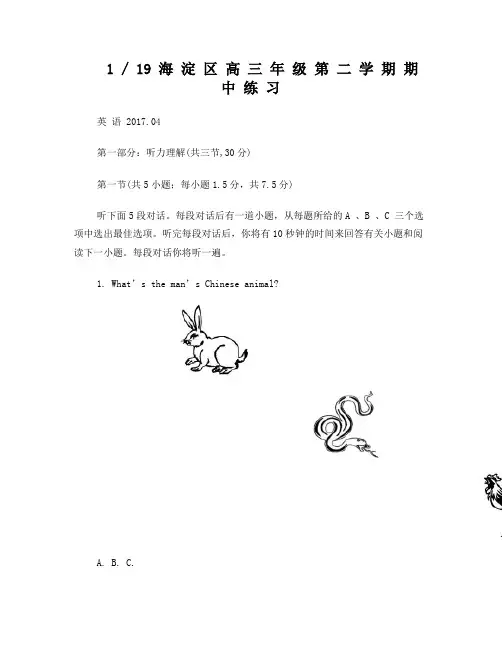
1. What’s the man’s Chinese animal?A. B. C.2. How does the woman want the beef?A. Rare.B. Medium.C. Well-done.3. What time does the meeting start?A. At 9:30am.B. At 10:00am.C. At 10:15am.4. How does the woman feel about the news?A. Excited.B. Terrified.C. Disappointed.5. Where does the conversation probably take place?A. At a store.B. At a bank.C. In a police station. 第二节(共10小题;每小题1.5分,共15分)听下面4段对话或独白。
每段对话或独白后有几道小题,从每题所给的A 、B 、C 三个选项中选出最佳选项。
听每段对话或独白前,你将有5秒钟的时间阅读每小题。
听完后,每小题将给出5秒钟的作答时间。
每段对话或独白你将听两遍。
听第6段材料,回答第6至7题。
6. What class did the man like best?A. Science.B. Biology.C. Public speaking.7. What is the woman probably doing?A. Asking for information.B. Offering help.C. Giving advice.听第7段材料,回答第8至9题。
高三试题—2017-2018学年北京海淀区高三上学期期末英语试卷
A. had been held up
B. were holding up
C. have been held up
D. would hold up
8. Chongyang Festival,
is also known as the Double Ninth Festival, falls on the ninth day of the ninth month
But I soon found that my
15
had only begun: I was lost! I could not tell which was east or west,
but 16 about here and there, crying and calling, though I knew that no one could 17 me. All at once
of the Chinese lunar calendar.
A. when
B. which
C. that
D. who
9. ---Has the interviewee arrived?
---No. He may have got lost. It
easy to find this place.
A. isn't
bushes and 8 rapid streams. The woods grew thicker and darker, and the ground more wet. Suddenly I
met in my way a 9 porcupine(豪猪), who made himself still larger when he saw me. Fearing that he
北京市海淀区2017届高三年级一模考试英语试题

2017届海淀区高三年级第二学期第一次模拟考试英语2017.04本试卷共12页,共150分。
考试时间120分钟。
第一部分:听力理解(共三节,30分)第一节(共5小题;每小题1.5分,共7.5分)听下面5段对话。
每段对话后有一道小题,从每题所给的A、B、C三个选项中选出最佳选项。
听完每段对话后,你将有10秒钟的时间来回答有关小题和阅读下一小题。
每段对话你将听一遍。
1. What’s the man’s Chinese animal?A. B. C.2. How does the woman want the beef?A. Rare.B. Medium.C. Well-done.3. What time does the meeting start?A. At 9:30am.B. At 10:00am.C. At 10:15am.4. How does the woman feel about the news?A. Excited.B. Terrified.C. Disappointed.5. Where does the conversation probably take place?A. At a store.B. At a bank.C. In a police station.第二节(共10小题;每小题1.5分,共15分)听下面4段对话或独白。
每段对话或独白后有几道小题,从每题所给的A、B、C三个选项中选出最佳选项。
听每段对话或独白前,你将有5秒钟的时间阅读每小题。
听完后,每小题将给出5秒钟的作答时间。
每段对话或独白你将听两遍。
听第6段材料,回答第6至7题。
6. What class did the man like best?A. Science.B. Biology.C. Public speaking.7. What is the woman probably doing?A. Asking for information.B. Offering help.C. Giving advice.听第7段材料,回答第8至9题。
2017北京市海淀区高三英语一模试卷及答案(精品资料).doc
【最新整理,下载后即可编辑】海淀区高三年级第二学期期中练习英语2017.04第一部分:听力理解(共三节,30分)第一节(共5小题;每小题1.5分,共7.5分)听下面5段对话。
每段对话后有一道小题,从每题所给的A、B、C三个选项中选出最佳选项。
听完每段对话后,你将有10秒钟的时间来回答有关小题和阅读下一小题。
每段对话你将听一遍。
1. What’s the man’s Chinese animal?A. B. C.2. How does the woman want the beef?A. Rare.B. Medium.C. Well-done.3. What time does the meeting start?A. At 9:30am.B. At 10:00am.C. At 10:15am.4. How does the woman feel about the news?A. Excited.B. Terrified.C. Disappointed.5. Where does the conversation probably take place?A. At a store.B. At a bank.C. In a police station.第二节(共10小题;每小题1.5分,共15分)听下面4段对话或独白。
每段对话或独白后有几道小题,从每题所给的A、B、C三个选项中选出最佳选项。
听每段对话或独白前,你将有5秒钟的时间阅读每小题。
听完后,每小题将给出5秒钟的作答时间。
每段对话或独白你将听两遍。
听第6段材料,回答第6至7题。
6. What class did the man like best?A. Science.B. Biology.C. Public speaking.7. What is the woman probably doing?A. Asking for information.B. Offering help.C. Giving advice.听第7段材料,回答第8至9题。
北京市海淀区2017届高三英语上学期期中试题
北京市海淀区2017届高三英语上学期期中试题本试卷共12页,共150分。
考试时间120分钟。
注意事项:1.考生务必将答案答在答题卡上,在试卷上作答无效。
2.答题前考生务必将答题卡上的姓名、准考证号用黑色字迹的签字笔填写。
3.答题卡上选择题必须用2B铅笔作答,将选中项涂满涂黑,黑度以盖住框内字母为准,修改时用橡皮擦除干净。
非选择题必须用黑色字迹的签字笔按照题号顺序在各题目的答题区域内作答,未在对应的答题区域内作答或超出答题区域作答的均不得分。
第一部分:听力理解(共三节,30分)第一节(共5小题;每小题1.5分,共7.5分)听下面5段对话。
每段对话后有一道小题,从每题所给的A、B、C三个选项中选出最佳选项。
听完每段对话后,你将有10秒钟的时间来回答有关小题和阅读下一小题。
每段对话你将听一遍。
1. What has the woman got for her mother?A. B. . C.2. When does the concert start?A. At 6:30PM.B. At 6:50PM.C. At 7:30PM.3. What does the woman think of the scarf?A. It’s expensive.B. It’s a bargain.C. It’s poorly made.4. Why does the woman make the call?A. To make an appointment.B. To make an invitation.C. To make a suggestion.5. What are the speakers mainly talking about?A. Places in the brochure.B. Hunting in Alaska.C. Plans for vacation.第二节(共10小题;每小题1.5分,共15分)听下面4段对话或独白。
北京市海淀区2017年高三上学期期末英语试题
2016-2017北京西城区高三英语期末试卷第二部分:知识运用第一节:单项填空(共15小题;每小题1分,共15分)21. _____ a tough challenge tough, the Chinese women’s volleyball team won an Olympic title in Rio.A. FaceB. FacedC. FacingD. To face22. The ancient Silk Road _____ China and Europe has become an ideal place for studying and traveling.A. amongB. alongC. acrossD. between23. The teacher decided to give the task to _____ had a strong sense of responsibility.A. whoeverB. whicheverC. whateverD. whenever24. Bob checked the equipment thoroughly, only _____ the power was not set.A. findB. foundC. findingD. to find25. ---Wow, I didn’t know you play golf so well.---I _____ for the last 6 months.A. playB. playedC. am playingD. have been playing26. Shelly _____ shy as a child, but now she is very outgoing.A. isB. wasC. has beenD. had been27. Participants at the conference was thankful for the information that _____ for them.A. providedB. is providedC. will be providedD. had been provided28. John stepped on the stage without hesitation _____ he had been preparing for this moment all his life.A. even ifB. as ifC. as soon asD. as long as29. Honesty _____ an important role in a child’s ability to succeed in school and later life.A. playedB. playsC. has playedD. had played30. The great things about music is _____ it can bring people of different cultural backgrounds together.A. whichB. whatC. thatD. whether31. If you _____ to his speech attentively, you should have known that his achievement was not all from good luck.A. listenedB. would listenC. had listenD. would have listened32. ---I am learning the piano. How can I learn it well?--- _____ the traditional first before trying the modern.A. MasterB. MasteringC. MasteredD. To master33. You _____ give me a lift. I want to walk home for exercise.A. needn’tB. couldn’tC. can’tD. mustn’t34. Many universities share teaching resources online, creating a learning space _____ benefits life-long learners.A. howB. whatC. whichD. where35. _____ by the heavy rain, we had to take shelter under a big tree.A. DriveB. DrivenC. DrivingD. To drive第二节:完形填空(共20小题;每小题 1.5分,共30分)It was the third period of the day and time for the physical education class. Once outside, students broke into an easy jogLook! What happened to the __36__? It looks … angry.” The toward the field until, all of a sudden, Marcu s cried out, “students turned to see what he was pointing at all at once: Someone painted angry faces on the walls of the stadium!During lunch, all of the students were whispering with __37__ about the graffiti (涂鸦). Possible explanations spreadlike wildfire __38__ the school.Later in the afternoon, when Brian cleaned the blackboard, Marcus suddenly __39__ the paint on his hands. He __40__that it was Brian who painted the graffiti, so after school, Marcus followed Brian to his locker and __41__ on what he wasdoing. When Brian opened his locker, Marcus saw small cans of paint in there! He decided to __42__ it to Mr. Johnson.ked __43__ about the graffiti, The next morning, Bria n was called to the principal’s office. The moment Mr. Johnson ast join thetears started flowing down Brian’s cheeks. Filled with shame, he explained that he liked to paint, but he couldn__44__ club because he had to go right home after school to baby-sit his little brother. “I don’t know why I painted thosehe sobbed.faces, and now I’ve __45__ the stadium!”Mr. Johnson was quite angry at first, but he began __46__ as he realized how miserable Brian was. “Brian, paintinggraffiti on school walls is a very __47__ matter. We have to call your mother and of course you will have to clean and __48__the walls.” Mr. Johnson paused. “__49__I must say, those paintings are quite good. Did you have any __50__ with them?”Brian looked up and said, “No, I did them myself. Drawing and painting are only things I can do well.”he said, “some teachers Mr. Johnson looked at Brian and thought for a moment before making a __51__. “Well,” suggested that we hire a local __52__ to paint our school mascot (吉祥物) on the stadium wall. How would you feel about participating in that?”__53__ to believe what he just heard.“Really?” Brian hesitated,“Yes, but this project will be hard work, and you’ll be expected to complete the job on time. We can consider it part ofyour __54__,” Mr. Johnson said, trying to hide his__55__ as he picked up the phone.36. A. field B. classroom C. office D. stadium37. A. curiosity B. excitement C. fear D. relief38. A. to B. around C. from D. beyond39. A. wiped B. examined C. spotted D. scanned40. A. remembered B. suspected C. witnessed D. hoped41. A. spied B. reflected C. commented D. hit42. A. make B. report C. describe D. retell43. A. hesitantly B. patiently C. directly D. sympathetically44. A. art B. math C. sports D. music45. A. changed B. decorated C. cleaned D. ruined46. A. worry B. soften C. relax D. panic47. A. strange B. urgent C. serious D. unusual48. A. repaint B. hide C. build D. repair49. A. And B. So C. Or D. But50. A. connection B. difficulty C. experience D. help51. A. promise B. choice C. decision D. judgment52. A. reporter B. artist C. designer D. scientist53. A. unable B. unwilling C. unlikely D. unhappy54. A. responsibility B. talent C. devotion D. punishment55. A. regret B. anger C. smile D. pride第三部分:阅读理解(共50分)第一节:阅读下列短文,根据短文内容,从短文后各题所给的A、B、C、D四个选项中,选择最佳选项,并在答题卡上将该选项涂黑。
2017年北京市海淀区高三英语一模试题与答案
海淀区高三年级第二学期期中练习英语2017.04本试卷共12页,共150分。
考试时间120分钟。
注意事项:1.考生务必将答案答在答题卡上,在试卷上作答无效。
2.答题前考生务必将答题卡上的姓名、准考证号用黑色字迹的签字笔填写。
3.答题卡上选择题必须用2B铅笔作答,将选中项涂满涂黑,黑度以盖住框内字母为准,修改时用橡皮擦除干净。
非选择题必须用黑色字迹的签字笔按照题号顺序在各题目的答题区域内作答,未在对应的答题区域内作答或超出答题区域作答的均不得分。
第一部分:听力理解(共三节,30分)第一节(共5小题;每小题1.5分,共7.5分)听下面5段对话。
每段对话后有一道小题,从每题所给的A、B、C三个选项中选出最佳选项。
听完每段对话后,你将有10秒钟的时间来回答有关小题和阅读下一小题。
每段对话你将听一遍。
1. What’s the man’s Chinese animal?A. B. C.2. How does the woman want the beef?A. Rare.B. Medium.C. Well-done.3. What time does the meeting start?A. At 9:30am.B. At 10:00am.C. At 10:15am.4. How does the woman feel about the news?A. Excited.B. Terrified.C. Disappointed.5. Where does the conversation probably take place?A. At a store.B. At a bank.C. In a police station.第二节(共10小题;每小题1.5分,共15分)听下面4段对话或独白。
每段对话或独白后有几道小题,从每题所给的A、B、C三个选项中选出最佳选项。
听每段对话或独白前,你将有5秒钟的时间阅读每小题。