
富马酸替诺福韦二吡呋酯片(CXHS1400189)申报上市注册申请技术审评报告
CXHS1400189国家食品药品监督管理总局药品审评中心2017年1月一、基本信息 (4)1.申请人信息 (4)2.原料药及制剂基本情况 (4)3.审评程序及审评与审核人员信息 (5)4.审评经过 (5)5.其他 (6)二、核查与检验等情况 (6)1.研制现场核查情况 (6)2.样品检验情况 (6)3.申请人获得申报剂型的GMP证书情况 (6)三、综合审评意见 (6)1.适应症/功能主治 (6)2.药理毒理评价 (7)3.原料和/或制剂评价 (8)4.支持上市申请的关键性临床数据及评价 (8)5.评价过程中发现的主要问题及处理 (10)四、三合一审评情况 (10)1.生产现场检查情况 (10)2.抽样检验情况 (11)3.遗留问题的解决情况 (11)4.技术审评的总体评价 (12)五、技术审评意见 (13)1.技术结论 (13)2.上市后要求 (14)3.上市后风险控制 (14)4.提请注册司关注的相关问题 (14)批准日期:2016年12月12日批准文号:国药准字H20163436富马酸替诺福韦二吡呋酯片(CXHS1400189)申请上市技术审评报告一、基本信息1.申请人信息2.原料药及制剂基本情况3.审评程序及审评与审核人员信息(略)4.审评经过总局受理日期:2014年6月19日药审中心承办日期:2014年8月5日召开会议情况:5.其他无二、核查与检验等情况1.研制现场核查情况四川省局出具了本品的《药品注册申请审查意见表》和《药品注册研制现场核查报告》,核查单位为成都倍特药业有限公司、四川省人民医院药物临床试验机构与四川大学华西药学院,综合评定结论为通过。
2.样品检验情况四川省食品药品检验所按富马酸替诺福韦二吡呋酯片中报告标准检验三批样品,结果符合规定。
3.申请人获得申报剂型的GMP证书情况固体制剂车间已通过GMP认证并于2014年9月16日取得了GMP证书。
生产地址:成都市双流西南航空港经济开发区空港四路1166号。
三、综合审评意见1.适应症/功能主治艾滋病特点及临床治疗现状:艾滋病作为一种慢性传染病,目前尚无法治愈,也无有效的疫苗。
自1981 年报告首例艾滋病以来,目前全球已有200 多个国家报道了本病。
艾滋病已经成为我国乃至全球的重大公共卫生问题。
现在,全世界感染艾滋病病毒的人数已经增加到3300多万,其中只有大约660万人能享受到药物治疗。
截至2011年底,估计我国存活艾滋病感染者和病人78万。
高效抗反转录病毒疗法(HAART)是目前治疗艾滋病(AIDS)的最有效措施。
目前治疗艾滋病的药物已发展到6大类近30种,为有效指导临床治疗,各国包括世界卫生组织制定了临床指南,推荐了治疗方案的选择。
我国新版《国家免费艾滋病抗病毒药物治疗手册(2012年版)》推荐的抗病毒治疗一线方案为替诺福韦或齐多夫定+拉米夫定+依非韦伦或奈韦拉平。
富马酸替诺福韦二吡呋酯是一种单磷酸腺苷的类似物,在体内发生酯基水解转化为替诺福韦,随后经细胞酶磷酸化为替诺福韦二磷酸盐,通过与天然底物去氧腺苷5’-三磷酸盐竞争,抑制HIV-1逆转录酶和HBV逆转录酶的活性,并与病毒DNA融合,终止DNA链延伸。
富马酸替诺福韦二吡呋酯原研制剂为片剂(Viread 薄膜包衣片),于2001年10月26日首先获得美国FDA的快速批准,与其他抗逆转录病毒药物联用治疗HIV-1感染;2006年3月8日又获传统批准。
2002年2月5日,EMA对该品授予“特殊情况下上市许可”,与其他抗逆转录病毒药物联用治疗年龄超过18岁成人的HIV-1感染;2005年7月8日变更为标准的“完全”许可。
目前在全球已经获得150多个国家/地区的批准。
2008年4月和8月,EMA和美国FDA分别批准该品用于治疗成人慢性乙型肝炎;目前在全球已经获得100多个国家/地区的批准。
Gilead Science公司拥有富马酸替诺福韦二吡呋酯在世界各国的专利权。
2006年在中国获得专利(ZL200410046290.X),包括化合物、合成方法和用途,2018年到期。
2008年6月18日,我国批准片剂进口,与其他抗逆转录病毒药物联用治疗成人HIV-1感染。
2013年10月9日,批准用于成人及12岁以上儿童乙型肝炎治疗的适应症。
2012年11月,原研原料药获准进口。
2.药理毒理评价药理毒理方面通过。
说明书药理毒理部分参考已批上市同品种。
3.原料和/或制剂评价(略)4.支持上市申请的关键性临床数据及评价本品为富马酸替诺福韦二吡呋酯片,规格为300mg(以富马酸替诺福韦二吡呋酯计),申报适应症为抗HIV-1和治疗慢性乙型肝炎。
CFDA临床试验批件号为2013L01799,注册分类为化药3类。
递交了一份完成的人体生物等效性试验报告及其相关资料。
原研美国吉利德公司的富马酸替诺福韦二吡呋酯片(商品名韦瑞德)已于2008年6月在中国上市,批准的适应证是抗HIV-1感染,2013年10月,韦瑞德治疗慢性乙肝的适应症在中国也获得批准。
因此对于本研究中采用与原研产品的生物等效性研究作为生产注册研究予以认可。
本品的人体生物等效性研究由四川省人民医院药物临床试验机构完成,生物样本分析由四川大学华西药学院临床药学研究中心完成,研究时间为2013年9月-2014年4月,提供了相关证明性文件。
研究入选48名男性健康受试者,分别参加单剂量空腹、单剂量餐后生物等效性研究(计划每组24名,空腹BE组因个人原因退出3例,实际完成21例),均采用开放、随机、交叉、双周期给药方案。
每周期服药剂量为300mg(空腹BE组禁食12h后空腹给药;餐后BE组在给药前30min进食高脂餐),与说明书推荐单次用药剂量一致。
服药后72h内采集静脉血15个点,基本涵盖吸收、分布与消除相,两次服药间清洗1周。
整个研究过程的实施和管理遵照GCP要求进行。
报告提供了受试者入选排除标准、筛选期与复查体检结果、试验管理情况、试验流程、高脂餐食谱。
基本符合要求。
本研究中未观察到不良事件,试验过程中无不良主诉,试验结束复查没有观察到有临床意义的异常改变。
采用HPLC-MS/MS法测定血浆中的替诺福韦的浓度,提供了生物样品分析方法学验证资料,包括线性、专属性、精密度、准确度、稳定性、基质效应等方法学考核指标。
血浆中替诺福韦的标准曲线范围为7.440ng/ml~744.0ng/ml,定量下限为7.440ng/ml,提取回收率稳定可重现。
日间和日内变异(RSD)均小于15%。
低、高两浓度血浆样品中替诺福韦和内标的绝对基质效应分别为为90.10%、104.63%、88.92%。
基本符合要求。
进行血浆样品分析测定时,共分成了8个分析批,每个分析批均建立了新的随行标准曲线并测定低、中、高三个浓度的QC样品,质控样本测试结果在规定范围内,受试者血浆样品浓度测定结果有效。
提供了方法学确证和100%受试者样品测试的色谱图复印件(包括质控样品色谱图复印件)。
空腹等效性试验结果:21名健康受试者空腹条件下服用本品与参比制剂后体内替诺福韦的C max、AUC0-72和AUC0-∞经对数转换后,受试制剂与参比制剂的C max、AUC0-72和AUC0-∞几何均数比值的90%臵信区间分别为98.49%~123.05%、93.87%~107.99%、93.65%~108.38%,均在规定范围内。
T max经非参数检验,不同制剂间无显著性差异(p > 0.05)。
餐后等效性试验结果:24名健康受试者高脂餐后服用本品与参比制剂后体内替诺福韦的C max、AUC0-72和AUC0-∞经对数转换后,受试制剂与参比制剂的C max、AUC0-72和AUC0-∞几何均数比值的90%臵信区间分别为99.01%~115.01%、97.99%~111.95%、101.97%~112.00%,均在规定范围内。
T max经非参数检验,不同制剂间无显著性差异(p > 0.05)。
据以上结果,在空腹与餐后两种状态下,受试制剂(成都倍特药业有限公司生产的富马酸替诺福韦二吡呋酯片)与参比制剂(美国 Gilead Science公司授权南非PHARMACARE LIMITED trading as ASPEN PHARMACARE公司生产的富马酸替诺福韦二吡呋酯片)在健康中国人体内具有生物等效性。
本品说明书参考进口原研产品修订。
适应症为抗HIV-1治疗。
5.评价过程中发现的主要问题及处理审评过程中对本品的管理进行了讨论。
富马酸替诺福韦二吡呋酯制剂国内已有多家企业申请抗HIV-1感染适应症的6类报产申请,或者按照3类申报治疗慢性乙型肝炎的生产注册,以及原料药按照3类报产。
同时进口原研产品的治疗慢性乙肝适应症也已获批。
鉴于此,根据2010年1月14日药品注册司与审评中心沟通会会议纪要,本品为“6追3”产品,因此建议将本品按注册分类6类批准生产,适应症为抗HIV-1感染和治疗慢性乙型肝炎。
2015年12月2日,本件由管理岗位退回,要求“请部门结合中心报送总局的文件,以及中心主任工作会的要求,再酌”。
经查,中心于2014年9月11日向总局药化注册司提交了“关于富马酸替诺福韦二吡呋酯有关问题的请示”,涉及该品种两个适应症(HIV-1和HBV)问题,一直未获得答复。
在2015年5月召开的第22次中心主任工作会议上专门对此进行了讨论。
会议指出,中心不宜暂停品种审评,而是要按现有规定对相关品种进行审评处理;对于申请抗HIV-1感染适应症的品种按特殊审批程序加快审评,但只针对抗HIV-1感染适应症。
鉴于本品按照抗HIV-1感染适应症纳入特殊审评审批程序,建议本品批准适应症仅限于抗HIV-1感染。
相关管理问题请后续管理部门关注。
四、三合一审评情况1.生产现场检查情况本品2016年1月6日结束技术审评,2016年1月11日签发《药品生产现场检查告知书》,申请人于2016年2月25日向国家局审核查验中心提交注册生产现场检查申请,国家局审核查验中心于2016年7月18日组织对本品进行了药品注册生产现场检查(注:本品按《药品注册管理办法》化药注册分类3申报临床试验,在注册过程中因原研进口可按6类进行技术要求,但仍应按照新药注册程序申报生产,故由国家局审核查验中心进行批准前药品注册生产现场检查)。
生产设备与工艺验证时所用设备一致,生产能力与本品批量生产相匹配;设施符合该品种的生产要求。
申报批量6万片,工艺验证批、生产现场检查批的批量与申报批量一致;原辅料和直接接触药品的包装材料来源合法,并与《告知书》。
变更产地后按照工艺规程进行了4个批次生产,生产批记录、现场检查情况与《告知书》所附生产工艺信息表的生产工艺及关键参数一致,生产设备规格/ 型号、制造商相符。
综合评定结论为:经现场检查本品的生产设施设备、质量控制条件、批量生产过程及相关文件、原始记录等,未发现真实性、一致性问题;产品实际生产工艺与注册申报工艺一致,生产过程和质量管理基本符合药品GMP要求。
丙酚替诺福韦用于范科尼综合征恩替卡韦治疗失败的慢性乙型肝炎患者挽救治疗个案报道并文献复习
【摘要】 慢性乙型肝炎治疗的关键是抗病毒治疗。
临床上长期使用阿德福韦酯或富马酸替诺福韦二吡呋酯抗病毒治疗的慢性乙型肝炎患者可发生范科尼综合征等罕见不良反应,临床上多采用恩替卡韦作为挽救治疗方案。
但对于恩替卡韦治疗失败的范科尼综合征患者,后续抗病毒治疗的证据尚不多见。
现报道1例恩替卡韦治疗失败的范科尼综合征患者,采用丙酚替诺福韦治疗有效,并对相关文献进行复习,为此类患者的治疗提供依据。
【关键词】 慢性乙型肝炎;丙酚替诺福韦;恩替卡韦;范科尼综合征;病毒学突破Tenofovir alafenamide as the rescue therapy for chronic hepatitis B patient with Fanconi syndrome and entecavir treatment failure: a case report and literature reviewWang Qian 1, Chang Chunyan 2, Yang Song 2 (1. Department of Pharmacy, the 960th Hospital of PLA Joint Service Support Force, Jinan 250031, China; 2. Center of Hepatology, Beijing Ditan Hospital, Capital Medical University, Beijing 100015, China) Correspondingauthor:YangSong,E-mail:*******************【Abstract 】 Antiviral therapy is the key for management of chronic hepatitis B. Fanconi syndrome is a rare side effect in chronic hepatitis B patients who take long-term therapy of adefovir dipivoxil or tenofovir disoproxil fumarate. Usually entecavir is chosen as rescue therapy for these patients. There is little evidence for rescue therapy for chronic hepatitis B patients who comorbid with Fanconi syndrome and experienced entecavir treatment failure. We reported a case of Fanconi syndrome patient who underwent entecavir treatment failure and was rescued successfully with tenofovir alafenamide. Also, we reviewed related literatures. Our case might provide evidence for management of chronic hepatitis B patients who experienced entecavir treatment failure and comorbid with Fanconi syndrome.【Key words 】 Chronic hepatitis B; Tenofovir alafenamide; Entecavir; Fanconi syndrome; Virologic breakthrough丙酚替诺福韦用于范科尼综合征恩替卡韦治疗失败的慢性乙型肝炎患者挽救治疗:个案报道并文献复习王倩1,常春艳2,杨松2(1.中国人民解放军联勤保障部队第960医院 药学部,济南 250031;2.首都医科大学附属北京地坛医院 肝病中心,北京 100015)基金项目:传染病防治国家科技重大专项(2017ZX10202202;2018ZX10715-005);吴阶平医学基金会临床科研专项(No.LDWJPMF-105-201701)通信作者:杨松 E-mail :*******************慢性乙型肝炎(chronic hepatitis B ,CHB )治疗的关键是抗病毒治疗。
富马酸丙酚替诺福韦片生物等效性研究技术指导原则

2022年11月一、概述 (1)二、人体生物等效性研究设计 (1)(一)研究类型 (1)(二)受试人群 (1)(三)给药剂量 (1)(四)给药方法 (2)(五)血样采集 (2)(六)检测物质 (2)(七)生物等效性评价 (2)三、人体生物等效性研究豁免 (2)四、参考文献 (2)一、概述富马酸丙酚替诺福韦片(Tenofovir Alafenamide Fumarate Tablets)用于治疗成人和青少年(年龄12岁及以上,体重至少为35kg)慢性乙型肝炎。
主要成份为富马酸丙酚替诺福韦,是替诺福韦的亚磷酰胺前体药物。
富马酸丙酚替诺福韦片生物等效性研究应符合本指导原则,还应参照《以药动学参数为终点评价指标的化学药物仿制药人体生物等效性研究技术指导原则》、《高变异药物生物等效性研究技术指导原则》、《生物等效性研究的统计学指导原则》等相关指导原则要求。
二、人体生物等效性研究设计(一)研究类型可采用两制剂、两周期、两序列交叉设计,也可采用部分重复或完全重复交叉设计,开展单次给药的空腹及餐后人体生物等效性研究。
(二)受试人群健康受试者。
(三)给药剂量建议采用申报的最高规格单片服用。
(四)给药方法口服给药。
(五)血样采集合理设计样品采集时间,使其包含吸收、分布及消除相。
(六)检测物质血浆中的丙酚替诺福韦及其代谢产物替诺福韦。
(七)生物等效性评价建议以丙酚替诺福韦的C max、AUC0-t和AUC0-∞作为生物等效性评价的指标。
替诺福韦的C max、AUC0-t和AUC0-∞用于进一步支持临床疗效的可比性,也可采用AUC0-72h来代替AUC0-t和AUC0-∞评价制剂间替诺福韦吸收程度的差异。
应在研究方案和统计分析计划中提前制定生物等效性分析方法。
若采用两交叉试验设计,生物等效性接受标准为受试制剂与参比制剂的C max、AUC0-t和AUC0-∞的几何均值比的90%置信区间在80.00%~125.00%范围内。
富马酸替诺福韦二吡呋酯片

对感染HBV但中断富马酸替诺福韦二吡呋酯治疗的患者必须严密监测,包括临床及实验室随访在停止治疗后 还要持续至少几个月的时间。如果条件适当,可以准许患者重新开始抗乙肝病毒治疗。
新出现的或更严重的肾功能损害
替诺福韦主要通过肾脏清除。使用富马酸替诺福韦二吡呋酯时,曾有其引起肾功能损害的报告,包括出现急 性肾衰和Fanconi综合征(肾小管损伤伴严重低磷酸血症)的病例(参见 “不良反应-上市后经验”)。
富马酸替诺福韦二吡呋酯片
介绍
01 警示语
03 性状 05 规格
目录
02 成份 04 适应症 06 用法用量
07 不良反应
09 注意事项 011 儿童用药
目录
08 禁忌
010
孕妇及哺乳期妇女用 药
012 老年用药
013 药物相互作用
目录
014 药物过量
015 临床试验
016 药理毒理
017 药代动力学
富马酸替诺福韦二吡呋酯在12岁以下或体重低于35kg的慢性乙肝儿童患者中的安全性和有效性尚未确定。
老年用药
老年用药
富马酸替诺福韦二吡呋酯的临床试验没有入选足够数量的年满65岁或以上的受试者,无法判定他们的应答是 否与较年轻的受试者的应答不同。一般而言,老年患者选择剂量应当谨慎,切记他们肝、肾、心功能下降,并发 疾病或正在使用其他药物治疗的几率增加。
性状
性状
本品为白色杏仁状薄膜衣片,一面上刻有“GILEAD”,下刻有“4331”,除去包衣后显白色。
适应症
适应症
HIV-1感染 富马酸替诺福韦二吡呋酯适用于与其他抗逆转录病毒药物联用,治疗成人HIV-1感染。 使用富马酸替诺福韦二吡呋酯开始治疗HIV-1感染时,应考虑以下几点: 富马酸替诺福韦二吡呋酯不应与含有替诺福韦的固定剂量复方制剂联用,包括: ·依非韦伦/恩曲他滨/富马酸替诺福韦二吡呋酯 ·利匹韦林/恩曲他滨/富马酸替诺福韦二吡呋酯 ·艾维雷韦/克比司特/恩曲他滨/富马酸替诺福韦二吡呋酯 ·恩曲他滨替诺福韦 慢性乙型肝炎 富马酸替诺福韦二吡呋酯适用于治疗慢性乙肝成人和≥12岁的儿童患者。 在开始使用富马酸替诺福韦二吡呋酯治疗HBV感染时,应考虑到以下要点:
国产替诺福韦说明书
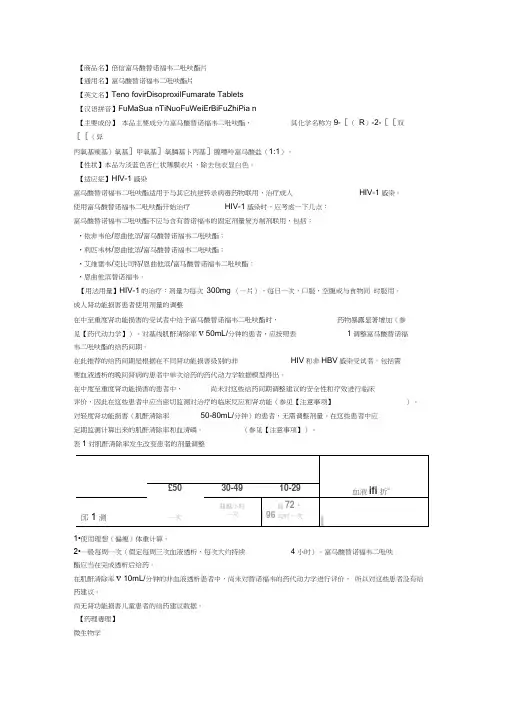
【商品名】倍信富马酸替诺福韦二吡呋酯片【通用名】富马酸替诺福韦二吡呋酯片【英文名】Teno fovirDisoproxilFumarate Tablets【汉语拼音】FuMaSua nTiNuoFuWeiErBiFuZhiPia n【主要成份】本品主要成分为富马酸替诺福韦二吡呋酯,其化学名称为9-[(R)-2-[[双[[(异丙氧基羰基)氧基]甲氧基]氧膦基卜丙基]腺嘌呤富马酸盐(1:1)。
【性状】本品为淡蓝色杏仁状薄膜衣片,除去包衣显白色。
【适应症】HIV-1感染富马酸替诺福韦二吡呋酯适用于与其它抗逆转录病毒药物联用,治疗成人HIV-1感染。
使用富马酸替诺福韦二吡呋酯开始治疗HIV-1感染时,应考虑一下几点:富马酸替诺福韦二吡呋酯不应与含有替诺福韦的固定剂量复方制剂联用,包括:•依非韦伦/恩曲他滨/富马酸替诺福韦二吡呋酯;•利匹韦林/恩曲他滨/富马酸替诺福韦二吡呋酯;•艾维雷韦/克比司特/恩曲他滨/富马酸替诺福韦二吡呋酯;•恩曲他滨替诺福韦。
【用法用量】HIV-1的治疗:剂量为每次300mg (—片),每日一次,口服,空腹或与食物同时服用。
成人肾功能损害患者使用剂量的调整在中至重度肾功能损害的受试者中给予富马酸替诺福韦二吡呋酯时,药物暴露显著增加(参见【药代动力学】)。
对基线肌酐清除率v 50mL/分钟的患者,应按照表1调整富马酸替诺福韦二吡呋酯的给药间期。
在此推荐的给药间期是根据在不同肾功能损害级别的非HIV和非HBV感染受试者,包括需要血液透析的晚间肾病的患者中单次给药的药代动力学数据模型得出。
在中度至重度肾功能损害的患者中,尚未对这些给药间期调整建议的安全性和疗效进行临床评价,因此在这些患者中应当密切监测对治疗的临床反应和肾功能(参见【注意事项】)。
对轻度肾功能损害(肌酐清除率50-80mL/分钟)的患者,无需调整剂量。
在这些患者中应定期监测计算出来的肌酐清除率和血清磷。
(参见【注意事项】)。
国产替诺福韦说明书

【商品名】倍信富马酸替诺福韦二吡呋酯片【通用名】富马酸替诺福韦二吡呋酯片【英文名】Tenofovir Disoproxil Fumarate Tablets【汉语拼音】FuMaSuanTiNuoFuWeiErBiFuZhiPian【主要成份】本品主要成分为富马酸替诺福韦二吡呋酯,其化学名称为9-[(R)-2-[[双[[(异丙氧基羰基)氧基]甲氧基]氧膦基]-丙基]腺嘌呤富马酸盐(1:1)。
【性状】本品为淡蓝色杏仁状薄膜衣片,除去包衣显白色。
【适应症】HIV-1感染富马酸替诺福韦二吡呋酯适用于与其它抗逆转录病毒药物联用,治疗成人HIV-1感染。
使用富马酸替诺福韦二吡呋酯开始治疗HIV-1感染时,应考虑一下几点:富马酸替诺福韦二吡呋酯不应与含有替诺福韦的固定剂量复方制剂联用,包括:·依非韦伦/恩曲他滨/富马酸替诺福韦二吡呋酯;·利匹韦林/恩曲他滨/富马酸替诺福韦二吡呋酯;·艾维雷韦/克比司特/恩曲他滨/富马酸替诺福韦二吡呋酯;·恩曲他滨替诺福韦。
【用法用量】HIV-1的治疗:剂量为每次300mg(一片),每日一次,口服,空腹或与食物同时服用。
成人肾功能损害患者使用剂量的调整在中至重度肾功能损害的受试者中给予富马酸替诺福韦二吡呋酯时,药物暴露显著增加(参见【药代动力学】)。
对基线肌酐清除率<50mL/分钟的患者,应按照表1调整富马酸替诺福韦二吡呋酯的给药间期。
在此推荐的给药间期是根据在不同肾功能损害级别的非HIV和非HBV感染受试者,包括需要血液透析的晚间肾病的患者中单次给药的药代动力学数据模型得出。
在中度至重度肾功能损害的患者中,尚未对这些给药间期调整建议的安全性和疗效进行临床评价,因此在这些患者中应当密切监测对治疗的临床反应和肾功能(参见【注意事项】)。
对轻度肾功能损害(肌酐清除率50-80mL/分钟)的患者,无需调整剂量。
在这些患者中应定期监测计算出来的肌酐清除率和血清磷。
拟纳入优先审评程序药品注册申请的品种名录(第1-14批)aicomer

氢溴酸伏硫西汀片
169
氢溴酸伏硫西汀片
170
奥达特罗吸入喷雾剂
171
沙库巴曲缬沙坦钠片
172
沙库巴曲缬沙坦钠片
173
沙库巴曲缬沙坦钠片
174
德谷胰岛素注射液
JXHL1600144 JXHL1600143 CXHL1600220 CXHL1600221 CXHL1600219 CXSL1600085 CXSL1600084 JXSL1600063 JXHL1600137 CYHS1400517 CYHS1300851 JXHS1600073 JXHS1600074 JXHS1600075 JXHS1600076 JXHS1600072 JXHS1600083 JXHS1600084 JXHS1600085 JXSS1500010
7
ASC16片 Ravidasvir Tablet
CXHL1500710
8
伏拉瑞韦及胶囊
CXHL1501084 CXHL1501085
9
KW-136及胶囊
10
西美瑞韦胶囊 simeprevir capsules
11
阿舒瑞韦软胶囊AsunaprevirSoft Capsules
盐酸达拉他韦片 12 DaclatasvirDihydrochlorideTabl
帕瑞昔布钠
CN97193747.8)将2017年4
月到期
WO9738986(中国同族
2
注射用帕瑞昔布钠
CN97193747.8)将2017年4
月到期
WO9738986(中国同族
注射用帕瑞昔布钠
CN97193747.8)将2017年4
月到期
醋酸卡泊芬净的化合物专利
WHO-富马酸替诺福韦Tenofovir disoproxil fumarate质量标准
Monographs: Pharmaceutical substances: Tenofoviri disoproxili fumaras - Tenofovir disoproxil fumarateC19H30N5O10P,C4H4O4Relative molecular mass. 635.5Chemical name. 1,1'-bis(1-methylethyl)1,1'-[({[(1R)-2-(6-amino-9H-purin-9-yl)-1-methylethoxy]methyl}phosphonoyldioxy)dimet hyl] dicarbonate (ester) hydrogen (2E)-but-2-enedioate (salt); CAS Reg.No. 202138-50-9.Description. White to almost-white, crystalline powder.Solubility. Slightly soluble in water, soluble in methanol, very slightly soluble in dichloromethane.Category. Antiretroviral (Nucleotide Reverse Transcriptase Inhibitor).Storage. Tenofovir disoproxil fumarate should be kept in a tightly closed container, protected from light, and stored at a temperature between 2 and 8°C.Additional information. Tenofovir disoproxil fumarate may exhibit polymorphism.RequirementsDefinition. Tenofovir disoproxil fumarate contains not less than 98.5 percent and not more than 101.0 percent of tenofovir disoproxil fumarate (C19H30N5O10P,C4H4O4), calculated with reference to the anhydrous substance.Manufacture. The production method is validated to ensure that the substance, if tested, would comply with:- a limit of not more than 5 ppm for the mutagenic impurity9-(prop-1-enyl)-9H-purin-6-amine (impurity K), which may be a synthesis related substance, using a suitable method, and- a limit of not more than 1.0% for the tenofovir disoproxil (S)-enantiomer (impurity G), using a suitable chiral chromatographic method.Identity tests• Either tests A, B and C or test D may be applied.A. Carry out test A.1 or, where UV detection is not available, test A.2.A.1 Carry out the test as described under 1.14.1 Thin-layer chromatography, using silica gel R6 as the coating substance and a mixture of 67 volumes of dichloromethane R, 20 volumes of acetonitrile R, 10 volumes of methanol R and 3 volumes of ammonia (~260 g/l) TS as the mobile phase. Apply separately to the plate 5 μl of each of 2 solutions in methanol containing (A) 10 mg of the test substance per ml and (B) 10 mg of tenofovir disoproxil fumarate RS per ml. After removing the plate from the chromatographic chamber, allow it to dry exhaustively in air or in a current of air. Examine the chromatogram in ultraviolet light (254 nm).The principal spot obtained with solution A corresponds in position, appearance, and intensity with that obtained with solution B.A.2 Carry out the test as described under 1.14.1 Thin-layer chromatography, using the conditions described above under test A.1 but using silica gel R5 as the coating substance. Stain the plate with iodine vapour and examine the chromatogram in daylight.The principal spot obtained with solution A corresponds in position, appearance, and intensity with that obtained with solution B.B. Carry out test B.1 or, where UV detection is not available, test B.2.B.1 Carry out the test as described under 1.14.1 Thin-layer chromatography, using silica gel R6 as the coating substance and a mixture of 50 volumes of heptane R, 30 volumes of glacial acetic acid R and 20 volumes of dichloromethane R as the mobile phase. Apply separately to the plate 5 μl of each of the following 2 solutions in ethanol R. For solution (A) use 10 mg of the test substance per ml and for solution (B) use 2 mg of fumaric acid R per ml. Develop the plate in an unsaturated tank over a path of 10 cm. After removing the plate from the chromatographic chamber, allow it to dry exhaustively in air or in a current of air. Examine the chromatogram in ultraviolet light (254 nm).One of the principal spots obtained with solution A corresponds in position, appearance, and intensity with that obtained with solution B.B.2 Carry out the test as described under 1.14.1 Thin-layer chromatography, using the conditions described above under test B.1 but using silica gel R5 as the coating substance. Spray lightly with a 16 g/l solution of potassium permanganate R and examine the chromatogram in daylight.The principal spot obtained with solution A corresponds in position, appearance, and intensity with that obtained with solution B.C. The absorption spectrum (1.6) of a 25 µg/ml solution, when observed between 220 nmand 320 nm, exhibits a maximum at about 261 nm; the specific absorbance () is 230 to 250.D. Carry out the examination as described under 1.7 Spectrophotometry in the infrared region. The infrared absorption spectrum is concordant with the spectrum obtained from tenofovir disoproxil fumarate RS or with the reference spectrum of tenofovir disoproxil fumarate. If the spectra thus obtained are not concordant, repeat the test using the residues obtained by separately dissolving the test substance and tenofovir disoproxil fumarate RS in a small amount of methanol R and evaporating to dryness. The infrared absorption spectrum is concordant with the spectrum obtained from tenofovir disoproxil fumarate RS.Specific optical rotation (1.4). Use a 10.0 mg/ml solution in hydrochloric acid (0.1 mol/l)VSand calculate with reference to the anhydrous substance; = -20° to -26°.Water. Determine as described under 2.8 Determination of water by the Karl Fischer method, Method A. Use about 1.0 g of the substance; the water content is not more than 10 mg/g.Heavy metals. Use 1.0 g in 30 ml of methanol R for the preparation of the test solution as described under 2.2.3 Limit test for heavy metals, Procedure 2; determine the heavy metals content accordi ng to Method A; not more than 20 μg/g.Sulfated ash (2.3). Not more than 1.0 mg/g.Related substances. Carry out the test as described under 1.14.4 High-performance liquid chromatography, using a stainless steel column (25 cm x 4.6 mm) packed withbase-deactivated particles of silica gel the surface of which has been modified with chemically bonded oct adecylsilyl groups (5 μm).The mobile phases for the gradient elution consist of a mixture of Mobile phase A and Mobile phase B, using the following conditions:Mobile phase A: 2 volumes of acetonitrile R, 20 volumes of phosphate buffer pH 6.0 and 78 volumes of water R.Mobile phase B: 65 volumes of acetonitrile R, 20 volumes of phosphate buffer pH 6.0 and 15 volumes of water R.Prepare the phosphate buffer pH 6.0 by dissolving 3.50 g of potassium dihydrogen phosphate R and 1.70 g of tetrabutyl ammonium hydrogen sulfate R in 800 ml of water R, adjust the pH to 6.0 by adding sodium hydroxide (1 mol/l) VS and dilute to 1000 ml with water R.After preparation, keep the solutions at about 6°C, or use an injector with cooling.Prepare the following solutions using water R as diluent. For solution (1) use 1.0 mg of the test substance per ml. For solution (2) dilute a suitable volume of solution (1) to obtain a concentration of 5 µg of tenofovir disoproxil fumarate per ml. For solution (3) use 0.2 mg of fumaric acid R per ml.For the system suitability test: prepare solution (4) by heating solution (1) carefully in a boiling water-bath for 20 minutes.Operate with a flow rate of 1.0 ml per minute. As a detector use an ultraviolet spectrophotometer set at a wavelength of 260 nm.Maintain the column temperature at 30 °C.Inject 20 μl of solution (4). The test is not valid unless the resolution between the principal peak (retention time about 40 minutes) and the peak due to the tenofovir monoester (with a relative retention of about 0.5) is not less than 25.Inject alternat ively 20 μl each of solutions (1) and (2) and (3). In the chromatogram obtained with solution (1), the following peak is eluted at the following relative retention, with reference to tenofovir (retention time about 40 minutes): fumarate about 0.15.In the chromatogram obtained with solution (1), the area of any peak due to the tenofovir monosoproxil (impurity A) is not greater than twice the area of the principal peak obtained with solution (2) (1.0%); the area of any other impurity peak is not greater than the area of the principal peak obtained with solution (2) (0.5%) and the areas of not more than two such peaks are greater than 0.4 times the area of the principal peak obtained with solution (2) (0.2%). The sum of the areas of all peaks, other than the principal peak, is not greater than 5 times the area of the principal peak obtained with solution (2) (2.5%). Disregard any peak corresponding to the peak obtained in the chromatogram with solution (3) and any peak with an area less than 0.1 times the area of the principal peak in the chromatogram obtained with solution (2) (0.05%).AssayDissolve 0.40 g, accurately weighed, in 30 ml of glacial acetic acid R1 and titrate with perchloric acid (0.1 mol/l) VS, determine the end point potentiometrically as described under 2.6 Non-aqueous titration Method A. Each ml of perchloric acid (0.1 mol/l) VS is equivalent to 63.55 mg of tenofovir disoproxil fumarate (C19H30N5O10P,C4H4O4).ImpuritiesA. (1-methylethyl)(8R)-9-(6-amino-9H-purin-9-yl)-5-hydroxy-8-methyl-5-oxo-2,4,7-trioxa-5-λ5-phosphanon anoate (tenofovir monosoproxil),B. (1-methylethyl)(5RS,8R)-9-(6-amino-9H-purin-9-yl)-5-methoxy-8-methyl-5-oxo-2,4,7-trioxa-5-λ5-phosph anonanoate,B. methyl (1-methylethyl)(5RS)-5-{[(1R)-2-(6-amino-9H-purin-9-yl)-1-methylethoxy]methyl}-5-oxo-2,4,6,8-tetrao xa-5-λ5-phosphanonanedioate,D. (1-methylethyl)(5RS,8R)-9-(6-amino-9H-purin-9-yl)-8-methyl-5-(1-methylethoxy)-5-oxo-2,4,7-trioxa-5-λ5-phosphanonanoate,E. (1-methylethyl)(8R)-5-hydroxy-8-methyl-9-(6-{[(1-methylethoxy)carbonyl]amino}-9H-purin-9-yl)-5-oxo-2,4,7-trioxa-5-λ5-phosphanonanoate,F. bis(1-methylethyl)9,9'-[methylenebis(imino-9H-purine-6,9-diyl)]bis[(8R)-5-hydroxy-8-methyl-5-oxo-2,4,7-tri oxa-5-λ5-phosphanonanoate] (tenofovir monosoproxil dimer),G. bis(1-methylethyl)5-{[(1S)-2-(6-amino-9H-purin-9-yl)-1-methylethoxy]methyl}-5-oxo-2,4,6,8-tetraoxa-5-λ5 -phosphanonanedioate (tenofovir disoproxil (S)-enantiomer) [see under Manufacture],H. 1-methylethyl propyl(5RS)-5-{[(1R)-2-(6-amino-9H-purin-9-yl)-1-methylethoxy]methyl}-5-oxo-2,4,6,8-tetrao xa-5-λ5-phosphanonanedioate,I. bis(1-methylethyl)5-{[(1R)-2-(6-{[({9-[(2R)-5-hydroxy-2,11-dimethyl-5,9-dioxo-3,6,8,10-tetraoxa-5-λ5-pho sphadodecyl]-9H-purin-6-yl}amino)methyl]amino}-9H-purin-9-yl)-1-methylethoxy]methyl }-5-oxo-2,4,6,8-tetraoxa-5-λ5-phosphanonanedioate (tenofovir di- and monosoproxil heterodimer),J. tetrakis(1-methylethyl)5,5'-(methylenebis{imino-9H-purine-6,9-diyl[(2R)-propane-1,2-diyl]oxymethylene})bis[5-oxo-2,4,6,8-tetraoxa-5-λ5-phosphanonanedioate] (tenofovir disoproxil dimer),K. 9-(prop-1-enyl)-9H-purin-6-amine, [see under Manufacture],L. (1-methylethyl)(5RS)-5-{[(1R)-2-(6-amino-9H-purin-9-yl)-1-methylethoxy]methyl}-10-methyl-5,9-dioxo-2,4,6,8-tetraoxa-10-aza-5-λ5-phosphaundecanoate,M. ethyl 1-methylethyl(5RS)-5-{[(1R)-2-(6-amino-9H-purin-9-yl)-1-methylethoxy]methyl}-5-oxo-2,4,6,8-tetrao xa-5-λ5-phosphanonanedioate.。
富马酸替诺福韦二吡呋酯片处方开发研究
D U Y i we i L I Mi I I
1 . C h i n a P h a r ma c e u t i c a l U n i v e r s i t y , Na n j i n g 2 1 0 0 0 9 , C h i n a ; 2 . C h e n Xi n P h a r ma c e u t i c a l L i mi t e d L i a b i l i t y C o mp a n y ,
艺为 : 富马酸替诺福韦二吡呋酯 3 0 0 m g ; 乳糖 6 0 m g ; 微晶纤维素 1 6 5 m g ; 预胶化淀粉 1 0 0 ag r ; 交联羧 甲基 纤维素钠 3 5 m g ; 硬脂酸镁 5 m g ; 欧巴代薄膜包衣预混剂 2程不苛刻 , 适合放大生产 , 稳定性研究结果与市售品性质相似, 体外溶出行为相近 , 处方设计合理 。 【 关键词 】 富马酸替诺福韦二吡呋酯片 ; 稳定性 ; 处方工艺; 参 比制剂 “ V I R E A D ’
【 中图分 类 号 】 Q3 2 6 [ 文献 标 识 码 】 B [ 文章 编 号 】 2 0 9 5 — 0 6 1 6( 2 0 1 4) 1 7 — 2 3 — 0 3
Res e a r c h a nd de v e l o pm e nt pr e s c r i p t i 0n o f t e no f o v i r d i s o pr o xi l
i l l u mi n a t i o n ,s c r e e n i n g a r e a s o n a b l e p r e s c r i p t i o n p r o c e s s . Re s ul t s P r e s c r i p t i o n p r o c e s s wa s u l t i ma t e l y d e t e r mi n e d
LC-HRMS
[基金项目]广东省广州市知识产权工作专项资金(ZL201710649577.9)。
▲通讯作者LC-HRMS/MS研究富马酸替诺福韦二吡呋酯片中聚合物肖 颖1 王健松1▲ 袁 晓2 林顺权2 叶心睿31.广州白云山医药集团股份有限公司白云山制药总厂,广东广州 510515;2.广州牌牌生物科技有限公司,广东广州 510530;3.广州白云山明兴制药有限公司,广东广州 510250[摘要] 目的 研究富马酸替诺福韦二吡呋酯片中潜在的聚合物杂质。
方法 采用液质联用方法,选用大气压化学离子化源(APCI 离子源)和电喷雾离子化源(ESI 离子源)对富含杂质的样品(包括破坏实验后的样品)进行聚合物研究,发现其潜在的聚合物并推测其结构。
结果 富马酸替诺福韦二吡呋酯片破坏样品中检出二聚体、三聚体杂质。
结论 富马酸替诺福韦二吡呋酯片中存在潜在可检出的聚合物杂质:二聚体和三聚体杂质,其中二聚体的三个杂质为已知杂质,分别为杂质H、W、S。
[关键词] 富马酸替诺福韦二吡呋酯;二聚体;三聚体;液质联用[中图分类号] R969 [文献标识码] A [文章编号] 2095-0616(2024)07-0068-05DOI:10.20116/j.issn2095-0616.2024.07.16LC-HRMS/MS study on polymers in tenofovir disoproxil fumarate tabletsXIAO Ying 1 WANG Jiansong 1 YUAN Xiao 2 LIN Shunquan 2 YE Xinrui31. Guangzhou Baiyunshan Pharmaceutical Holdings Co., Ltd. Baiyunshan Pharmaceutical General Factory, Guangdong, Guangzhou 510515, China;2. Guangzhou PI PI Biotech Inc., Guangdong, Guangzhou 510530, China; 3 Guangzhou Baiyunshan Mingxing Pharmaceutical Co., Ltd., Guangdong, Guangzhou 510250, China[Abstract] Objective To study the potential polymer impurities in tenofovir disoproxil fumarate tablets. Methods The samples rich in impurities (including the samples after the destructive experiment) were studied by liquid chromatography-mass spectrometry (LC-MS) with atmospheric pressure chemical ionization source (APCI ion source) and electrospray ionization source (ESI ion source), with their potential polymers found and their structures speculated. Results Dimer and trimer impurities were detected in the sample after the destructive experiment of tenofovir disoproxil fumarate tablets. Conclusion There are potential detectable polymer impurities in tenofovir disoproxil fumarate tablets: dimer and trimer impurities, among which the three impurities in the dimer are known impurities, namely H, W, and S.[Key words] Tenofovir disoproxil fumarate; Dimer; Trimer; Liquid chromatography-mass spectrometry富马酸替诺福韦二吡呋酯为美国Gilead Sciences Inc.公司1988年开发,2001年在美国首次上市,适应证为艾滋病病毒(human immunodificiency virus,HIV)感染,2008年增加乙型肝炎病毒(hepatitis B virus,HBV)感染适应证。
2024年富马酸替诺福韦酯市场环境分析
2024年富马酸替诺福韦酯市场环境分析1. 简介富马酸替诺福韦酯(Favipiravir)是一种新型的抗病毒药物,广泛用于治疗流感等病毒感染。
在当前全球爆发的新冠疫情中,富马酸替诺福韦酯被用作治疗COVID-19的药物之一。
本文将对富马酸替诺福韦酯市场环境进行分析,探讨其发展前景。
2. 市场规模及增长趋势根据市场研究报告,富马酸替诺福韦酯市场规模呈逐年增长的趋势。
随着COVID-19疫情的爆发,全球对抗病毒药物的需求急剧增加。
富马酸替诺福韦酯作为一种有效的抗病毒药物,市场需求持续增长。
预计未来几年内,其市场规模将进一步扩大。
3. 市场竞争分析富马酸替诺福韦酯市场竞争激烈,存在多家制药公司参与生产和销售。
目前,国内外一些知名制药公司已获得富马酸替诺福韦酯的生产许可。
此外,一些新兴的制药公司也加入到该市场中。
市场竞争主要体现在产品质量、价格、品牌知名度等方面。
为了在激烈的市场竞争中占据优势地位,制药公司不断加强研发力度,提高产品质量,降低成本。
4. 市场需求驱动因素富马酸替诺福韦酯市场需求主要受以下因素驱动:•突发公共卫生事件的频发:新冠疫情等突发公共卫生事件的爆发导致抗病毒药物的需求急剧增加。
•感染病毒的多样性:富马酸替诺福韦酯可用于治疗多种病毒感染,包括流感、RSV等,因此对该药物的需求相对稳定。
•人口老龄化趋势:随着全球人口老龄化趋势的加剧,对疾病治疗药物的需求也随之增加,从而带动富马酸替诺福韦酯市场的增长。
5. 市场发展前景富马酸替诺福韦酯作为一种广谱抗病毒药物,具有良好的市场前景。
随着全球疫情的不断发展,抗病毒药物的需求将持续增加,从而推动富马酸替诺福韦酯市场的发展。
此外,随着技术的进步和生产效率的提高,富马酸替诺福韦酯的成本也有望降低,进一步促进其市场发展。
结论2024年富马酸替诺福韦酯市场环境分析表明,该市场具有较大的发展潜力。
然而,市场竞争激烈,制药公司需不断提高产品质量和降低成本,以保持竞争优势。