
七年级英语上册Unit3公开课教案
七年级英语上册Unit3公开课教案
第一篇:七年级英语上册Unit 3公开课教案
七年级英语上册Unit 3公开课教案
一、Teaching Aims
1.words: kid, glad, seat, mother, father, doctor, parent, office
worker, driver, farmer, cook, nurse , work, on, farm, hospital,
drive.`
2.phrases: in an office, in a hospital, on a farm, in a school
3.sentences: what does he/ she do? He/she is a/an…
Where does he/she work? He/she works…
二、Teaching Important and Difficult points:
1.Get the students to make dialogues using “what does
he/she do?
Where does he/ she work?
2.How to make dialogues, using them
三、Teaching Procedures
Step 1.Revision
1.sing a song →The More we Get together
2.Review words and phrases of section A and B using
e the picture in section A, 3a to review the following
sentences:
what do you do? I am a/an….What does he/ she do? He/She
is a/ an….Step 2.Presentation
1.Ask and answer between the teacher and the students
Leading the dialogue:
①A: What do you do?
B: I am a student.A: Where do you study?
B: I study in a school.②A: What does he/ she do?
B: He/she is a/an… A: Where does he/ she work?
B: He/ she works…
e the pictures on the blackboard to ask the Ss to practice
the dialogue.Step 3.Practise.1.Pair-work: Ask Ss to Make similar
dialogues(Ask father, mother, sister, brother…)
2.Work in groups to practice the dialogue.Step 4
consolidation
1.Make a survey
2.Summary the expression about jobs and work places.Step
5.Exercise
1.Discuss in pairs and finish 2.Then check the answer.2.Listen
to 3.Let Ss finish it alone, and check the answer.Step 6.Project:
1.play a game.Step 7.Home work.1.Go over section B
2.Do same-step exercise.3.Pre-view section C
第二篇:英语七年级上册Unit3 SectionA说课稿
新目标英语七年级上册Unit3 SectionA说课稿
谢燕娥 尊敬的各位评委老师:
你们好!今天我说课的题目是新目标英语七年级上册第三单元Unit3 This is my sister.中的SectionA部分,整个说课我将分成六个大部分进行讲述:即 教材分析、学情分析、教法、学法、教学过程 及
板书设计。
第一板块:教材分析
(一)、说教材
《新目标英语》教材的语言教育理念是:知识用于行动,强调“语言应用”,培养“创新实践能力”,发展“学习策略”。它采用任务型语言教学模式。教材中每单元都设计一个或几个与该单元话题有关的任务,让学生在完成任务的过程中,使用英语获取信息,用英语进行交流,培养运用英语解决实际问题的能力。本课是新目标英语七年级上册第三单元第一课时,教材以This is my sister.为中心话题,围绕着谈论有关家庭成员的用语,并学会询问别人的情况,介绍自己的家庭,谈论自己的情感。并在此任务中认识到名词复数的概念及其运用。
(二)、教学目标
1.知识目标:a)学习单词:
mother.father.brother.sister.these.are.those 等b)学习并掌握句型:Is this your sister?No, it isn’t./ Yes, it is.This is my friend.These
are my friends.That is my brother.Those are my brothers.2.能力目标:通过Introduce people和Identify people使学生学会介绍他人和
识别他人,掌握基本This is/ That is...These are/ Those are…
等句型,培养学生实际交际的能力。
3.情感目标:通过介绍家人和朋友,对学生进行亲情教育,使他们学会感恩。
(三)、教学重难点
1.重点;学习重点单词,句型和语法点: This is my friend.These
are my
friends.That is my brother.Those are my brothers.2.难点:名词复数形式及其正确的运用
第二板块:学情分析
七年级的学生正处于青春期发育期,他们有较高的求知欲和表现欲,希望自己的表现能得到同学和老师的认可。且该阶段学生已具备初步的语言表达能力和较强的记忆力与模拟能力。对他们所熟悉的话题学生的爱好会更浓,而本单元的话题正符合这一特点,所以我就设计任务型的课堂活动,让学生人人参与,增强他们学习的积极性和学习的自信心。
第三板块:说教法
新教材重视以人为本,强调素质教育。在教学中,要注意发挥学生的主体作用,把空间留给学生。抓住初中生活泼好动,表现欲强的心理特点,课堂上我设计了大量听、说、读、写的训练,启发学生动脑思考,鼓励学生大胆开口,畅所欲言,尽可能运用英语表达实际意义,从而最大限度地调动学生的积极性和主动性。教学中,我主要采用任务型教学法,情景结合教学法,分层法和通过学习五步教学法,精讲巧练,由浅入深,由易到难,由已知到未知,循序渐近地深化教学内容。展开以教师为主导,以学生为主体的师生双边活动。
第四板块:学法指导
1.引导学生用小组合作学生的方式来完成任务型教学所设计的各项活动。全班分为7个小组,每组6-7人,各组英语水平相当,并引入竞争机制。培养学生的实际能力,发展学生的合作能力。
2.采取的教学手段是多媒体辅助教学,充分利用农村中小学现代远程教育资源,自制课件,用生动的课件调动学生的感官,进行听说读写的训练。培养学生的观察力和想象力,发展学生的思维能力。
第五板块:教学过程
Step 1.Leading-in 创设情景,导入新课
出示一些实物,如钢笔、钥匙、尺子等,用下面句型引导学生与同伴之
间进行交谈。复习前面学过的句型,为新授作好铺垫。
S1: Is this your pen?-----Yes, it is.S2:Is that her ruler?-----No, it isn’t.It’s my ruler.Step 2.Presentation 新课讲解,呈现教学内容
我先出示一张照片,通过创设情景,师生对话,引出新知识:
e.g.:T:What is this ?------Ss: It’s a photo.T:Is this your photo?-------Ss: No, it isn’t.-------
T:It’s not your photo.It’s my photo.And this is my sister.从而引出本课时重点句型: This is my sister.并在此基础上讲解“this
is…”是用来向对方介绍他人的。同时运用这句型“This is…”进行教学新单词:mother , father , sister , brother , grandfather 等所有家庭成员。让学生先对本课所要讲的内容有个初步的感知,激发学生进一步学习的动机。Step 3.Practicing反复操练,巩固运用
为了调动学生的积极性,主动深化短时记忆中的信息,并逐步向长时 记忆迈进、发展。我将利用多媒体生动活泼呈现多张家庭成员图片。让学生将单词与图中人物匹配,认识家庭成员。并学会使用This /
That is my …和 These are / Those are … 介绍家人和朋友,巩固知识、操练知识。在此同时,要注意与讲解名词的复数形式 以及 让学生能够正确的运用。
Step 4.Listening and doing口语操练,加深印象
学生通过前面的学习,已经对新的知识形成了初步的新知识结构,但
在名词复数结构上还存在着模糊点,这时通过一系列的综合练习可以巩固、发展及完善学生的知识结构。
a)通过播放1b录音,学生听,模仿说,完成任务,巩固语言材料,培养
学生听说能力。
b)让学生准备几分钟,运用本课所学的句型“This / That is …”和“These /
Those are …”对1a 中戴夫家庭成员进行介绍。进一步巩固本课的重难点。
c)对学生进行分组,分别完成2c对话之后。让学生用自己的照片,编出自
己的对话,到前面进行对话表演。转换角色,练习对话。
Step 5.Consolidating课堂练习,巩固知识
在学生已在大脑中构建新的认知结构基础上,提供适当的课堂练习,不仅能让学生在实践中自我学习、自我改进、达到自我完善;而且能够充分地让学生体会到“知识的获得并不只是单方面的‘输入’过程,更重要的是知识的‘输出’” 也就是说能够根据外部实际情况对新知识准确地提取并加以运用。
因此我会出示一些与本课语言点相关的选择题和情景对话,要求学生当场完成。课堂练习的目的在于检查学生掌握知识的情况以便教师发现学生缺漏,及时补充。同时也有助于进一步巩固,加强对本课内容的理解和运用。Step 6.Homework课外作业
外研版七年级上册module1unit3教案

Module 1 unit3
一、Analysis of the text
In this text students will learn how to introduce their
friends and family members to others and make relative
greetings
二、Analysis of the students
Our students came from different schools, so some of them
might not learn English before. We have learnt Unit 1 and Unit 2
before this class. Students have some knowledge about the
basic English, such as letters, some new words and some simple
sentences.
三、Teaching Aims
Knowledge aims
Students can learn how to introduce their friends and their
family members to others.
Skill aims
Students can understand other’s introduction of
someone. Be able to write the introduction of their friends.
Affection aims
Students can introduce their friends to others and
realize the differences between Chinese and English.
七年级英语上册Module2MyfamilyUnit2Thesearemyparents 【公开课教案】新版外研版_166

Unit 2 These are my parents
第二课时(Activity 4-Activity 6)
Step 1:Review
1.Read the passage in Activity 3 and answer the questions.
(1)How many students are there in the passage?
(2)Who are they?
2.Ask students to read again and tick T or F.
(1)These are Betty's parents.They are actors.( )
(2)This is Tony's mother,she is an English teacher.( )
(3)This is Daming's father.He works at a hotel.( )
(4)This is Lingling's father.He works at the bus station.( )
(5)Daming's mother and Lingling's mother are at the same hospital.( )
3.Check the answers.
Keys:(1)F (2)T (3)F (4)T (5)T
Step 2:Have a dictation
Get the students to write the words and phrases in Unit 2,check them if they have grasped the usages
of the points.
Step 3:Practice
1.Have a reading competition.Let two students read the passage in Activity 3 and see who reads better.
七年级英语上册Unit3测试题_3
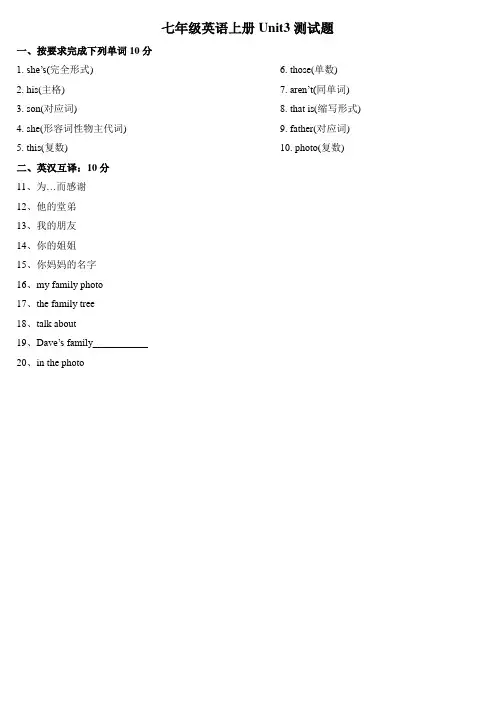
七年级英语上册Unit3测试题
一、按要求完成下列单词10分
1. she’s(完全形式)_________
2. his(主格)__________
3. son(对应词)__________
4. she(形容词性物主代词)__________
5. this(复数)__________ 6. those(单数)__________
7. aren’t(同单词)__________
8. that is(缩写形式)__________
9. father(对应词)__________
10. photo(复数)__________
二、英汉互译:10分
11、为…而感谢_____________
12、他的堂弟_____________
13、我的朋友_____________
14、你的姐姐_____________
15、你妈妈的名字_____________
16、my family photo___________
17、the family tree_____________
18、talk about_____________
19、Dave’s family_____________
20、in the photo_____________
三、根据句意及首字母提示补全单词。10分
21. This is my s________ kate.
22. That is his good f________ Silly.
23. What’s this in E_________?
24. A________ these your sisters?
25. My mother’s sister is my a_______?
26. My father’s brother is my u________?
27. T______ are his books.
28. I’m my father’s d________.
七年级英语上册Unit3测试题
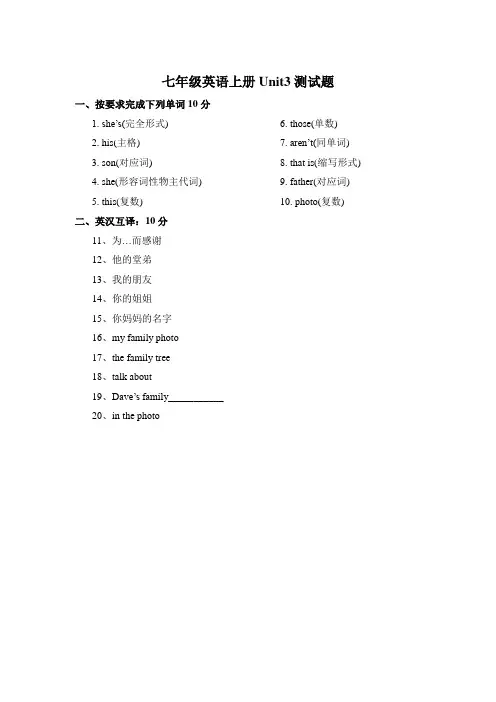
七年级英语上册Unit3测试题
一、按要求完成下列单词10分
1. she’s(完全形式)_________
2. his(主格)__________
3. son(对应词)__________
4. she(形容词性物主代词)__________
5. this(复数)__________ 6. those(单数)__________
7. aren’t(同单词)__________
8. that is(缩写形式)__________
9. father(对应词)__________
10. photo(复数)__________
二、英汉互译:10分
11、为…而感谢_____________
12、他的堂弟_____________
13、我的朋友_____________
14、你的姐姐_____________
15、你妈妈的名字_____________
16、my family photo___________
17、the family tree_____________
18、talk about_____________
19、Dave’s family_____________
20、in the photo_____________
三、根据句意及首字母提示补全单词。10分
21. This is my s________ kate.
22. That is his good f________ Silly.
23. What’s this in E_________?
24. A________ these your sisters?
25. My mother’s sister is my a_______?
26. My father’s brother is my u________?
27. T______ are his books.
28. I’m my father’s d________.
英语七年级上册Unit3教案人教版3
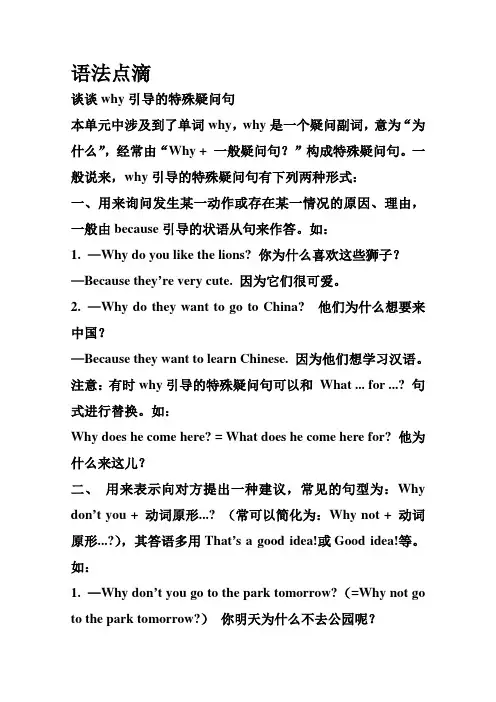
语法点滴
谈谈why引导的特殊疑问句
本单元中涉及到了单词why,why是一个疑问副词,意为“为什么”,经常由“Why + 一般疑问句?”构成特殊疑问句。一般说来,why引导的特殊疑问句有下列两种形式:
一、用来询问发生某一动作或存在某一情况的原因、理由,一般由because引导的状语从句来作答。如:
1. —Why do you like the lions? 你为什么喜欢这些狮子?
—Because they’re very cute. 因为它们很可爱。
2. —Why do they want to go to China? 他们为什么想要来中国?
—Because they want to learn Chinese. 因为他们想学习汉语。
注意:有时why引导的特殊疑问句可以和 What ... for ...? 句式进行替换。如:
Why does he come here? = What does he come here for? 他为什么来这儿?
二、 用来表示向对方提出一种建议,常见的句型为:Why
don’t you + 动词原形...? (常可以简化为:Why not + 动词原形...?),其答语多用That’s a good idea!或Good idea!等。如:
1. —Why don’t you go to the park tomorrow?(=Why not go
to the park tomorrow?) 你明天为什么不去公园呢? —Good idea! 好主意!
2. —Why don’t you buy a cake for your mother?(=Why not
buy a cake for your mother?) 你为什么不给你妈妈买块儿蛋糕呢?
—That’s a good idea! 好主意!
初中英语科普版七年级上册Unit1《Topic3 How old are you SectionA》优质课教案公开课教师面试试讲教案

初中英语科普版七年级上册Unit1《Topic 3 How old are you?
SectionA》优质课教案省级比赛获奖教案公开课教师面试试讲教案
【名师授课教案】
1教学目标
Ⅱ. Teaching aims
⒈ Knowledge aims
能够根据已学语音及发音规则,正确朗读并运用下列词汇: twelve, year, old, class, grade, in, eleven, fourteen, fifteen, sixteen 等;
能够熟练读写数字:11~20;
能够用谈论年龄、年级和班级等个人信息的基本表达形式交流: How old are you? I’m …What class/grade are you in? I’m in Class/ Grade ...
⒉ Skill aims
能听懂有关询问年龄、年级和班级等个人信息的句型和对话,并能做出正确反应;
能在课堂活动中交流年龄、年级和班级等个人基本信息;
能正确地朗读对话,并能注意语音语调;
能正确书写和使用基数词11~20;
能模仿课文,编写询问年龄、班级和年级的对话。
⒊ Emotional aims
培养学生学习英语的信心,鼓励学生积极大胆开口说英语,敢于模仿。
2学情分析
初中学生的抽象思维能力比较低,形象思维能力强,但注意力容易分散。我们可以拟以歌曲、游戏等形式展示,并配以丰富的课件设计,从而增强学生的兴趣和注意力。学生对英语普遍感兴趣,但有很大的不稳定性,好奇心强,求知欲旺盛,已不满足教师对课文的简单重复。
3重点难点
Ⅲ. The key points and difficult points
⒈ Key points
正确运用表示谈论年龄、年级和班级等个人信息的表达方法进行交流;
正确书写和掌握基数词11~20。
⒉ Difficult points
最新科普(仁爱)版英语七年级上册Unit1 Topic3 SectionA【公开课教案】
最新科普(仁爱)版英语七年级上册Unit1 Topic3 SectionA【公开课教案】
Unit1 Topic3 SectionA
一、教材分析
This lesson is the first period of Topic 3. The main activities are
1a and 2a. The students will review 1-10 and learn numbers
11-20. They will learn how to inquire about someone’s age,
class and grade and to make the right response in this lesson.
二、教学目标
1. Knowledge aims
1) Be able to read and write the following words: twelve, year,
old, class, grade, in, eleven, fourteen, fifteen, sixteen, seventeen,
eighteen, nineteen and twenty.
2) Be able to write and use the numbers: 11~20.
3) Be able to talk about personal information about one’s age,
class and grade.
4) Learn and master the sentences “How old are you? I’m…,
What class are you in? I’m in Class/Grade …”.
2. Skill aims
1) Learn to inquire about someone’s age, class and grade and to
初中英语科普版七年级上册Unit2《Topic1 I have a small nose. SectionB》优质课教案公开课教师试讲教案
初中英语科普版七年级上册Unit2《Topic1 I have a small
nose. SectionB》优质课教案省级比赛获奖教案公开课教师面试试讲教案
【名师授课教案】
1教学目标
1. 能够听懂、会说、能读、会写考点单词与句型:
actor, Chinese, does, arm, hand, leg, foot, short;
She/He/It has…
Does he/she have…?
2. 能够听懂并正确朗读对话,注意语音语调,并顺利进行角色扮演;
3. 能够运用所学句型进行人物描写的短文写作;
4. 能够在游戏中和同伴积极合作,互相帮助互相学习,共同完成任务。
2学情分析
本班23%的学生基础好,57%的学生基础较为扎实,而20%的学生成绩在及格线以下,因此设计不同的课堂活动,从而试图让每个层次的同学对本节课的交际用语都有深刻的印象。
3重点难点
正确使用表示描述和询问人物外貌特征的表达方法:She/He/It has… Does he/she have…?
正确使用实义动词:have /has;
正确使用助动词do/does:Do you have…?
Does he have …?
难点:正确使用使役动词have /has;
助动词does的应用;
能够掌握由形容词性物主代词转化为have/has引导的同义句;
4教学过程
4.1第一学时
Warming-up (3分)
通过师生间的亲切问候及值日报告,让学生集中注意力,为本课学习做准备。
1. 日常问候;
2. Duty report.
3. 猜班级同学的谜语,应用SectionA所学的have/has句型培养学生善于观察周围人或物的能力。
Unit 3 第5课时 公开课教学设计【人教版英语八年级上册】
Unit 3
I’m more outgoing than my sister.
Self Check教学设计
一、教学目标
1. 复习本单元所学习的形容词和副词比较级的变化规则。
2. 复习如何对两者进行比较。能够综合运用所学的知识来对两个事物或人物进行对比。
3. 总结本单元所学习的基本句型短语以及单词,并可以灵活运用。
4. 能够运用所学的句型提问别人的各种身心特征以及能够谈论自己的各种身心特征,并进行比较。
5. 能对人物的外表进行描绘,个性进行比较,可以正确表达自己的想法,使学生在交流中学会尊重和理解他人,学会交换不同看法,了解他人的喜好,增进友谊。
二、教学重点及难点
重点:正确使用形容词、副词的比较级对事物进行比较。
难点;
1. 能根据提示信息,对两个人物或事物进行对比。
2. 复习运用形容词或副词的比较级形式。
三、教学准备
教师:教学课件;多媒体设备
学生:课前预习
四、教学过程
Step 1 Warming-up
Ask students to look at the following pictures, and review the comparative forms.
【设计意图】根据本单元所学的知识进行灵活运用,培养学生自由表达的能力。
Step 2 Presentation
Review the grammar this unit.
➢ 比较级的规则变化与不规则变化
➢ 比较级的常用句型结构
Step 3 Practice
Work on Self Check 1 1. Put the words in the correct columns in the chart. Make sure they know they should put some
adjectives in the first column. In the second column, they should put some “verbs + adverbs”
初中英语人教版七年级下册三单元 阅读教案
Unit3 How do you get to school?
授课人:龙琴 时间:2017年3月14日
班级:初2016级3班 课型:阅读课
一、教学内容分析
本节课选材为人教版Go for it,七年级下册Unit3 How do you get to school?的Section B 部分的阅读文章,介绍了一个偏远山区孩子上学的故事。文章贯穿了不同交通方式的表达,阅读后能激起珍惜自己的学习条件和自己的生活。
二、学情分析
本课的教授对象是初2016级3班:
1.大部分学生有较强的语言组织和表达能力,愿意参加课堂活动。
2.上阅读课喜欢记笔记,课堂安静。
三、教学目标分析
1. 知识与技能:
(1)重点词汇及短语:cross,bridge,boat,afraid,leave,villager;come
true, between...and…
(2)重难句子: One 11-year-old boy, Liangliang , crosses the river every
school day. But for the students in one small village in China ,it is
difficult.
2.过程与方法:
主要采用task-based method ,communicative approach ,头脑风暴,小组讨论和团队合作来打开学生思维,训练学生的思维发散能力,锻炼学生的思考问题能力,提高学生的合作能力。 大活动从文章出发,以采访的形式让学生回忆课文,思考问题和表达观点。
3.情感态度价值观: 学会珍惜自己的生活和学习,鼓励学生努力奋斗。
四、教学重难点
1. 如何使用阅读策略快速且准确的找出关键信息,利用关键信息定位解题。