
人教版英语八年级下册unit1-unit9知识点总结
人教版英语八年级下册unit1-unit9知识点总结
Unit 1 what’s the matter?
一、 theme(了解):
1) Talk about health and first aid 健康与急救
2)Give advice 提建议 二、 知识点
P1
1、What’s the matter with(关于) sb\sth?某人或某物怎么了?(询问健康问题或困难,麻烦等)
询问问题的其他常用句型:
What’s the trouble\problem with sb?
What’s wrong with sb? What’s up? (口语)
What happened to sb? 某人发生了什么事?
Is there anything wrong with sb?
2、健康问题的表达:
1)have\has +a\an+疾病have a cold\fever\cough (感冒,发烧,咳嗽)
2)have\has+a\an+身体–ache have a stomachache\toothache\headache(胃疼,牙疼,头疼)
3)have\has+a\an sore+身体部位have a sore back\throat (背疼,嗓子疼)
4)身体部分+hurt head and neck hurt 头和脖子疼(P2)
5)sb +hurt+身体部位\oneself hurt yourself 伤到你自己(P4)hurt his back伤到他的背(p5)
6)cut oneself\身体部位cut myself切到自己(P2)
7)have a heart problem心脏病have problems breathing 呼吸困难
8)get hit 被打 get sunburned被晒伤
3、1)foot-feet on foot 步行 tooth-teeth
2) She talked too much yesterday and didn’t drink enough water.
(1) too much, much too和too many: too much 太多,可以修饰动词和不可数名词;much too 太,修饰形
容词,much too cold太冷;too many 太多,修饰可数名词复数。
(2)enough adv. adj. 足够的(地),充分的(地),enough修饰名词,可前可后,water enough=enough
water足够的水;修饰形容词需后置,big enough足够大
P2
4、1)lie down and rest 躺下来休息
考点lie 趟,lie-lay-lain-lying
考点:休息 rest=take\have a rest=take breaks(a break)
2) hot tea with honey 加蜂蜜的热茶with介词带有,具有(反without)
3)see a dentist 看牙医 4)get an X-ray
考点5)take one’s temperature 量体温
5.1)What should I do?
考点:should 情态动词,应该,应当,用于询问,提出建议,或表达职责和义务。
As a student, you should study hard. (职责,义务)
You should lie down and rest. (提建议)
2)sound like 听起来像 3)on the weekend 在周末 all weekend 整个周末
6、You need to take breaks away from the computer.你需要离开电脑休息。
考点1)need 实意动词,需要 need+n\ving(被动)\to do sth (需要做某事)
I need your help.
The trees need watering. (to be watered)树需要浇水了
情态动词,need+do sth
考点2)break cn 休息,间歇 take a break=take breaks v 折断,打破
7、I sat in the same way for too long without moving .我以同样的姿势一动不动地做了太久。
1)in the same way 同样的方式 2)for too long 太久 3)without 没有+n\ving
8、Ifyour head and neck still hurt tomorrow, then go to a doctor.
考点1)if引导的条件状语从句,用一般现在时表示将来。
考点2)hurt vi 疼痛
3)go to a doctor去看医生=go to see a doctor
P3
3a 9、1)go along沿着
考点2)see sb doing sth 看到某人正在干某事(强调动作正在进行),
See sb do sth 看到某人做某事(强调动作过程或经常发生)
类似用法的感官动词:hear\watch\notice sb doing\do sth
3)next to紧挨着,旁边 4)shout for help 呼救
10、The bus driver, 24-year-old Wang Ping, stopped the bus without thinking twice.公交车司机,
24岁的王平,没有多想便停下了车。
考点1)24-year-old,复合形容词,数词-名词(单数)-形容词,只作定语,表语用24 years old
考点2)without thinking twice 没有再想,毫不犹豫反think twice
11、He got off and asked the woman whathappened?他下车问那位妇女发生了什么事?
考点1)get off从、、、下来 get off the bus\plane\horse\ship (较大的交通工具),反 get on
get out of the car\taxi下车反 get into 上车
考点2)happen vi 发生,没有被动语态,
(1) sth happened+地点、时间某地或某时发生了某事
(2) sth happened to sb 某人发生了某事(不好的事)
(3) sb happened to do sth 某人恰巧干某事I happened to meet him.
12、He expected most or all the passengers to get off and wait for the next bus.他希望大部分或
全部乘客下去等下一辆公交车。
考点1)expect sb to do sth期望某人做某事expect to do sth 期望做某事expect that从句
2)wait for sb\sth 等待某人、某物 wait for sb to do sth等待某人做某事 wait to do sth 等待做某
事
13、To his surprise, they all agreed to go with him.令他惊讶的是,他们都同意和他一起去。
考点1)surprise n 惊讶to one’s surprise让某人惊讶的是in surprise 惊讶地 v 使惊奇
考点2)agree to do sth同意做某事agree with sb 同意某人的观点 agree on sth 就某事达成一致
We agreed on the price. 我们就价格达成了一致。
14、Thanks to Mr. Wang and the passengers, the man was saved by the doctors in time.多亏王先生
和乘客们,医生及时挽救了老人。
考点1)Thanks to+n.\pron. 多亏,=with the help of thanks for 因、、、而感谢
考点2)was saved 被动语态 was\were+动词的过去分词(被动语态的一般过去时)
考点3)in time 及时 on time 准时
15、1)help others帮助 2)think about 考虑3)hit-hit-hit4)right away立刻,马上=at once
考点5)get into trouble陷入困境,惹麻烦be in trouble困境中 have trouble doing sth做某事有困
难 P4
16、1)反身代词:
单数:myself, yourself ,himself, herself, itself
复数:ourselves, yourselves, themselves
反身代词的用法:
(1) 作主语同位语I made dinner myself. 我自己做的晚饭。
(2)作动词的宾语:hurt, cut, enjoy, help, hurt, teach, dress, look after等
Did you hurt yourself playing soccer? (现在分词短语作时间状语)
2)fall down 摔倒 P5
17、1)Someone felt sick.有人生病了。
考点:sick adj. 生病的,有病的,可以做表语和定语,be sick\ill 生病sick kids 生病的孩子
2)tell sb (not) to do sth
P6
18、考点1)have problems\trouble\difficulty doing sth做某事有困难(反have no problem doing sth)
2)be interested in+n\doing sth 对、、、感兴趣
19、As a mountain climber, Aron is used to taking risks .作为登山者,阿伦习惯于冒险。
考点1)be used to doing sth习惯做某事used to do sth 过去常常做某事
I used to stay up late, but I’m used to going to bed early.我过去常常熬夜,但是现在习惯早睡了。
考点2)risk cn.危险,风险take a risk=take risks
3)one of+cn复数、、、之一
4)because of +n\pron\doing(短语) 因为、、、、 because+句子
20、He found himself in a very dangerous situation.发现自己处在非常危险的境地。
考点1)find+sb\sth(宾语)+adj.\介词短语\现在分词(宾补)
考点2)in a very dangerous situation处于非常危险的境况
人教版八年级英语下册Unit8重难点知识总结
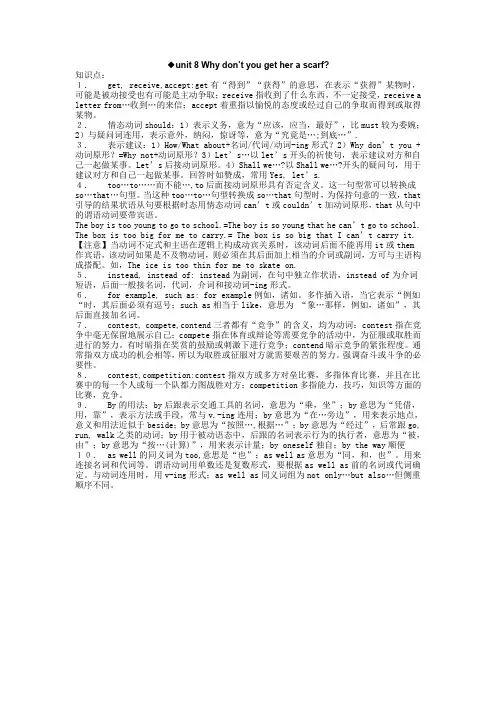
◆unit 8 Why don’t you get her a scarf?
知识点:
1. get, receive,accept:get有“得到”“获得”的意思,在表示“获得”某物时,可能是被动接受也有可能是主动争取;receive指收到了什么东西,不一定接受,receive a
letter from„收到„的来信;accept着重指以愉悦的态度或经过自己的争取而得到或取得某物。
2. 情态动词should:1)表示义务,意为“应该,应当,最好”,比must较为委婉;2)与疑问词连用,表示意外,纳闷,惊讶等,意为“究竟是„;到底„”.
3. 表示建议:1)How/What about+名词/代词/动词-ing形式?2)Why don’t you +动词原形?=Why not+动词原形?3)Let’s„以let’s开头的祈使句,表示建议对方和自己一起做某事。Let’s后接动词原形。4)Shall we„?以Shall we„?开头的疑问句,用于建议对方和自己一起做某事。回答时如赞成,常用Yes, let’s.
4. too„to„„而不能„,to后面接动词原形具有否定含义。这一句型常可以转换成so„that„句型。当这种too„to„句型转换成so„that句型时,为保持句意的一致,that引导的结果状语从句要根据时态用情态动词can’t或couldn’t加动词原形,that从句中的谓语动词要带宾语。
The boy is too young to go to school.=The boy is so young that he can’t go to school.
The box is too big for me to carry.= The box is so big that I can’t carry it.
【注意】当动词不定式和主语在逻辑上构成动宾关系时,该动词后面不能再用it或them作宾语,该动词如果是不及物动词,则必须在其后面加上相当的介词或副词,方可与主语构成搭配。如,The ice is too thin for me to skate on.
人教版八年级英语下册Unit9重难点知识总结

◆unit 9 Have you ever been to an amusement park?
知识点:
1. 现在完成时表示发生或已经完成的某一动作对现在造成的影响或结果。通常表示短暂动作或位置转移的动词(非延续性动词,不能与表示一段时间的状语连用;也可以表示过去开始,一直延续到现在的动作或状态。也就上说,现在完成时虽与过去有关,但实际上强调的是对现在的影响或结果,句中谓语动词通常是延续性动词,且常与表示一段时间状语连用(these days,all this year, recently,for+时间段,since+时间点)
2. 通常与现在完成时连用的几个副词:already,recently,just,
ever,never,before,yet等。表示不确定时间的时间词连用。Already,just多用于肯定句;yet,ever,never多用于疑问句或否定句。
3. 现在完成时的结构:主语+have/has+动词过去分词
4. have been to, have gone to:have been to“到过某地”说话时此人很可能不在那里,已经回来,侧重指经历;have gone to“已经去了某地”,说话时此人在那里,或可能在路上,反正不在说话现场。
5. neither开头的倒装句:在英语中“Neither+助动词/情态动词/+主语”这个倒装结构是一种否定形式,表示“两者都不”。如,I can’t work out the problem. Neither can
Li Ming.
6. be from, come from:两者都为“从„来,出自„”;表示“出身于„”,应用come
from
【注意】问别人的出身或叙述自己的出身时,时态一定要用一般现在时,如果时态为一般过去时,则表示“从„地方来”。
7.Population的用法:1)population是个集合名词,意思为“人口,人数”,常用来指人口的总称。被看作一个整体时,一般不加-s,在句中作主语时,谓语动词多用单数形式。如,The population of China is about1,300,000,000.
人教版初中英语八年级英语下册unit9导学案
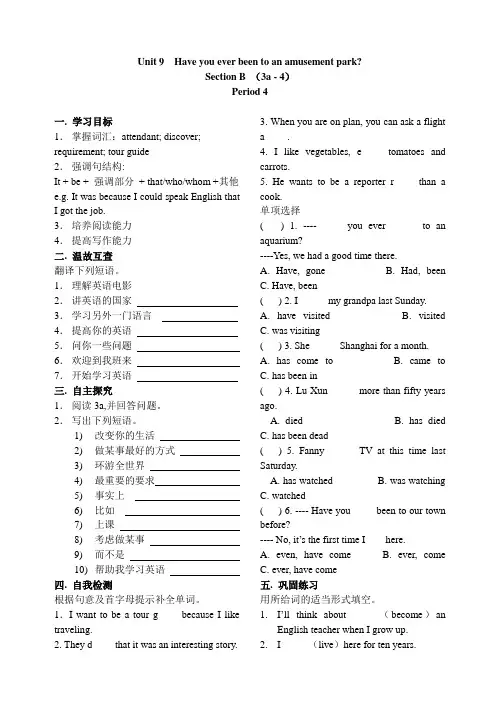
Unit 9 Have you ever been to an amusement park?
Section B (3a - 4)
Period 4
一. 学习目标
1. 掌握词汇:attendant; discover;
requirement; tour guide
2. 强调句结构:
It + be + 强调部分 + that/who/whom +其他
e.g. It was because I could speak English that
I got the job.
3. 培养阅读能力
4. 提高写作能力
二. 温故互查
翻译下列短语。
1. 理解英语电影 ____________________
2. 讲英语的国家
3. 学习另外一门语言
4. 提高你的英语
5. 问你一些问题
6. 欢迎到我班来
7. 开始学习英语
三. 自主探究
1. 阅读3a,并回答问题。
2. 写出下列短语。
1) 改变你的生活
2) 做某事最好的方式
3) 环游全世界
4) 最重要的要求
5) 事实上
6) 比如
7) 上课
8) 考虑做某事
9) 而不是
10) 帮助我学习英语
Unit1语法知识点梳理人教版英语八年级下册

人教版八年级英语下册语法知识点
Unit1. What’s the matter?
▶短语归纳1. have a cold 感冒
2. have a stomachache 胃痛
3. have a headache 头痛
4. have a sore throat 喉咙痛
5. have a fever 发烧
6. have a cough 咳嗽
7. have a heart problem 有心脏病
8.hurt oneself伤到自己
9.cut oneself割伤自己
10.fall down 摔倒;跌倒
11.get hit/sunburned 被击中/晒伤
12. lie down 躺下
13. take breaks/take a break 休息
14. go to a/the doctor 看医生
15.see a dentist 看牙医
16. get an Xray 拍个X光片
17. take one's temperature 量体温
18. put some medicine on...在…上敷些药
19.take sb. to the hospital带某人去医院
20. take risks/take arisk冒险 21.lose one’s life 失去生命
22.run out(of)用尽;耗尽
23.cut off 切除
24.away from 远离
25. make a decision /make decisions
做决定
26.sound like 听起来好像
27.get out of离开;从………出来
28. get off 下车
29. get to 到达
30.get into 陷人;参与
31.wait for 等待
32.think twice 慎重考虑,再三考虑
33.think about 考虑
34. go mountain climbing 去爬山
期末Units1-10单元知识点总结 人教版八年级英语下册

Unit 1 What’s the matter?
一、词形变化
1. stomach 名词 胃;腹部——stomachache 名词 胃痛
2. lie 躺 lie—lay—lain lying; 说谎 lie—lied—lied
3. hurt 动词 (使)疼痛;受伤 hurt—hurt—hurt
4. hit 动词 击;打 hit—hit—hit
5. 反身代词(oneself):myself 我自己—ourselves 我们自己
himself 他自己—herself 她自己—themselves 他们自己
yourself 你自己—yourselves 你们自己
enjoy oneself 玩得开心 hurt oneself 伤害自己 by oneself 独自
6. climb 动词 登;爬——climber 名词 登山者
7. knife 名词 小刀——复数:knives
8. mean 动词 意思是;打算 mean—meant—meant
9. important 形容词 重要的—importance 名词 重要性
10. decide 动词 决定——decision 名词
11. die 动词 死——death 名词 死亡——dead形容词 死亡的
die—died—died dying
二、短语归纳 1. lie down 躺下 to one’s (my/his/her...) surprise 令某人惊讶的是
2. take one’s (my/your/his/her..) temperature 量体温
3. take a break = take breaks 休息 take a risk = take risks冒险
4. run out 物做主语:The money ran out. 钱用光了。
人教版新目标英语八年级上册各单元知识点复习unit1-unit10

1 Unit 1 Where did you go on vacation?
一、重点短语:
1.go on vacation 2.quite a few 3.stay at home 4. take photos
5.most of the time 6.go shopping 7.in the countryside 8.keep a diary
9.have a good time = have fun = enjoy oneself
10.arrive in/at = get to = reach 11.feel like 12.in the past 13.because of
14.find out 15.of course 16. visit museums 17. go to summer camp
18. go to the beach 19. anywhere interesting 20. go out with sb 21. seem to be
22. decide to do sth 23. enough money 24. the top of the mountain
25.something special 26.so...that 27.study for tests 28.wait for
二、重点句型:
1. ---Where did you go on vacation? ---I went to New York City.
2. ---Did you buy anything special? ---Yes, I bought something for my father.
3. ---How was the food? ---Everything tasted really good!
人教版英语八年级下册Unit1知识要点
Unit 1
A
1.advice n. 建议,忠告,劝告
(1)advice是不可数名词,表示“一条建议”“两条建议”“一些建议”可用:
a piece of advice;two piece of advice;some advice
(2)advice作名词时的常用搭配:
①ask sb. for advice征询某人的建议
②give sb. some advice= give some advice to sb.给某人提出一些建议
③give advice on sth.在某方面给出建议
④take (follow) one’s advice接受某人的建议
e.g. He often gives us some advice.=He often gives some advice to us.
他经常给我们一些建议。
★例题:Your ________________ is very helpful. I guess I’ll take it.
A. secret B. advice C. promise D. purpose
答案:B 秘密;建议;承诺;目标。由下句“我想我会采纳。”可知“你的建议很有用”。
2.What’s the matter?怎么了?
(1)该句用来询问对方所遇到的麻烦,或医生及护士询问病人身体情况,常与with连用,后跟sb./sth.,意为“某人或某物怎么了?”
e.g.——What’s the matter (with you)? (你)怎么了?
——I lost my pen./I have a cold. 我把我的钢笔弄丢了。/我感冒了。
(2)“(你)怎么了?”各种常见表达:
What’s the matter (with you)?
=What’s the trouble (with you)?
=What’s the problem(with you)?
人教版八年级英语下册unit1单元知识总结
Unit one What’s the matter?
Key words and expressions.
㈠key words见图
㈡句型
1 what’s the matter?
what’s the matter with you?
what’s wrong with you?
2 should 情态动词
what should she do?
should I take my temperature?
主语+should/shouldn’t+动原
3 do you think it comes from a newspaper or
a book?
4 I think I sat in the same way for too long
without moving.
without 用法
5 she said that the man had a heart problem
and should go to the hospital.
宾语从句 6 it’s sad that many people don’t want to help
others because they don’t want any trouble.
㈢ 交际用语
1 what’s the matter?
I have a stomachache.
you shouldn’t eat so much next time.
2 what’s the matter with Ben?
he hurt himself. he has a sore back.
he should lie down and rest.
3 do you have a fever?
yes, I do./ no, I don’t./ I don’t know
4 what should she do?
--she should take her temperature.
(精校版)人教版八年级英语下册各知识点归纳总结
(直打版)人教版八年级英语下册各知识点归纳总结(word版可编辑修改)
(直打版)人教版八年级英语下册各知识点归纳总结(word版可编辑修改)
编辑整理:
尊敬的读者朋友们:
这里是精品文档编辑中心,本文档内容是由我和我的同事精心编辑整理后发布的,发布之前我们对
文中内容进行仔细校对,但是难免会有疏漏的地方,但是任然希望((直打版)人教版八年级英语下
册各知识点归纳总结(word版可编辑修改))的内容能够给您的工作和学习带来便利。同时也真诚
的希望收到您的建议和反馈,这将是我们进步的源泉,前进的动力。
本文可编辑可修改,如果觉得对您有帮助请收藏以便随时查阅,最后祝您生活愉快 业绩进步,以
下为(直打版)人教版八年级英语下册各知识点归纳总结(word版可编辑修改)的全部内容。
(直打版)人教版八年级英语下册各知识点归纳总结(word版可编辑修改)
人教版八年级英语下册各知识点归纳总结
Unti1 what’s the matter?
短语归纳1.too much 太多 2.lie down 躺下
3.get an X-ray 做个X光检查 4。take one 's temperature 量体温
5.put some medicine on .。。。.。在。.。。上敷药 6.have a fever 发烧7.take breaks /take a break 休息 8。without thinking twice 没多想9.get off 下车 10。take sb to the hospital 送某人去医院 11。wait for等待 12。to one’s surprise 使..。.。.。惊讶的13.thanks to多亏于;由于 14.in time及时 15.think about 考虑 16。have a heart problem患有心脏病
17.get into the trouble 遇到麻烦 18.do the right thing做正确的事情事情19。fall down 摔倒 20.put 。。.。。. on sth把。。.放在某物上 21.get hit/sunburned 摔伤/烧伤 22。be interested in 对。。。.。感兴趣
人教版八年级英语下册Unit9重难点知识总结 2
◆unit 9 Have you ever been to an amusement park?
知识点:
1. 现在完成时表示发生或已经完成的某一动作对现在造成的影响或结果。通常表示短暂动作或位置转移的动词(非延续性动词,不能与表示一段时间的状语连用;也可以表示过去开始,一直延续到现在的动作或状态。也就上说,现在完成时虽与过去有关,但实际上强调的是对现在的影响或结果,句中谓语动词通常是延续性动词,且常与表示一段时间状语连用(these days,all this year, recently,for+时间段,since+时间点)
2. 通常与现在完成时连用的几个副词:already,recently,just,
ever,never,before,yet等。表示不确定时间的时间词连用。Already,just多用于肯定句;yet,ever,never多用于疑问句或否定句。
3. 现在完成时的结构:主语+have/has+动词过去分词
4. have been to, have gone to:have been to“到过某地”说话时此人很可能不在那里,已经回来,侧重指经历;have gone to“已经去了某地”,说话时此人在那里,或可能在路上,反正不在说话现场。
5. neither开头的倒装句:在英语中“Neither+助动词/情态动词/+主语”这个倒装结构是一种否定形式,表示“两者都不”。如,I can’t work out the problem. Neither can
Li Ming.
6. be from, come from:两者都为“从„来,出自„”;表示“出身于„”,应用come
from
【注意】问别人的出身或叙述自己的出身时,时态一定要用一般现在时,如果时态为一般过去时,则表示“从„地方来”。
7.Population的用法:1)population是个集合名词,意思为“人口,人数”,常用来指人口的总称。被看作一个整体时,一般不加-s,在句中作主语时,谓语动词多用单数形式。如,The population of China is about1,300,000,000.