
牛津英语上海版2B教案
牛津英语上海版2B教案
教案点拨载体《牛津英语上海版2B》是针对中学生的英语学习教材,本教案重点针对Unit 1-6进行教学设计,总字数不足1200字。
一、教材分析
1.教材内容:
Unit 1: Sports Day
Unit 2: The Zoo
Unit 3: The Weather
Unit 4: At the Department Store
Unit 5: On the Farm
Unit 6: At the Pet Show
2.学生年级:中学二年级
3.学习目标:
掌握与体育活动、动物、天气、购物、农场、宠物展有关的词汇和表达方式。
通过听、说、读、写等综合训练,提高学生的听说能力、语言应用能力和跨文化交际能力。
二、教学设计
Unit 1: Sports Day 1. Warm-up Activity: Have a class discussion about favorite
sports, ask students to share their opinions and reasons.
2. Vocabulary: Introduce new vocabulary related to sports,
such as running, jumping, swimming, etc. Use flashcards and real
objects to help students understand and memorize the words.
3. Listening: Play a recording of a sports event, ask
students to listen and answer questions about the participants
and their performance. Have a class discussion about the sports
event.
4. Speaking: Organize a mini sports day in the classroom.
Divide the class into groups and assign different sports to each
group. Students will take turns performing their chosen sports
and describing their actions in English.
6. Writing: Ask students to write a paragraph about their
favorite sports and why they like it. Provide sentence starters
and vocabulary to support their writing.
Unit 2: The Zoo
1. Warm-up Activity: Show students pictures of different
animals, ask them to identify the animals and describe their
characteristics.
2. Vocabulary: Introduce new vocabulary related to animals,
such as lion, elephant, giraffe, etc. Use flashcards and real
pictures to help students understand and remember the words. 3. Listening: Play a recording about a visit to the zoo, ask
students to listen and answer questions about the animals seen
at the zoo. Discuss the experience as a class.
4. Speaking: Organize a group presentation about different
animals. Each group will research and present information about
an assigned animal, including its physical characteristics,
habitat, and behavior.
6. Writing: Ask students to write a paragraph about their
favorite animal and describe its appearance and characteristics.
Provide sentence starters and vocabulary to support their
writing.
Unit 3: The Weather
1. Warm-up Activity: Review previous knowledge about
different types of weather. Ask students to share their favorite
weather and reasons.
2. Vocabulary: Introduce new vocabulary related to weather,
such as sunny, rainy, windy, etc. Use flashcards and pictures to
help students understand and remember the words.
3. Listening: Play a weather report recording, ask students
to listen and identify the weather conditions mentioned. Discuss
the weather conditions and their impact on activities.
4. Speaking: Organize a weather forecast presentation. Each
group will research and present a weather forecast for a chosen city, including the current weather conditions and predictions
for the next few days.
6. Writing: Ask students to write a short weather report for
a chosen city. Provide sentence starters and vocabulary to
support their writing.
Unit 4: At the Department Store
2. Vocabulary: Introduce new vocabulary related to
department store items, such as clothes, shoes, bags, etc. Use
flashcards and real objects to help students understand and
remember the words.
3. Listening: Play a conversation between a customer and a
shop assistant in a department store, ask students to listen and
answer questions about the customer's needs and the shop
assistant's suggestions. Discuss the conversation as a class.
4. Speaking: Organize a role play activity where students
act as customers and shop assistants. They will take turns
practicing conversations in a department store setting, focusing
on making inquiries and providing suggestions.
6. Writing: Ask students to write a short letter to a friend,
describing a shopping experience in a department store. Provide
sentence starters and vocabulary to support their writing.
Unit 5: On the Farm 1. Warm-up Activity: Show pictures of different farm animals,
ask students to identify the animals and describe their
appearances and behaviors.
2. Vocabulary: Introduce new vocabulary related to farm
animals, such as cow, sheep, chicken, etc. Use flashcards,
videos, and real objects to help students understand and
remember the words.
3. Listening: Play an audio recording about life on a farm,
ask students to listen and answer questions about the daily
activities and responsibilities of farmers. Discuss the
recording as a class.
4. Speaking: Organize a class discussion about farming and
its importance. Ask students to share their thoughts on why
farming is important and the challenges faced by farmers.
沪教版牛津英语2B-Unit1-Farm-Animals教案-牛津版
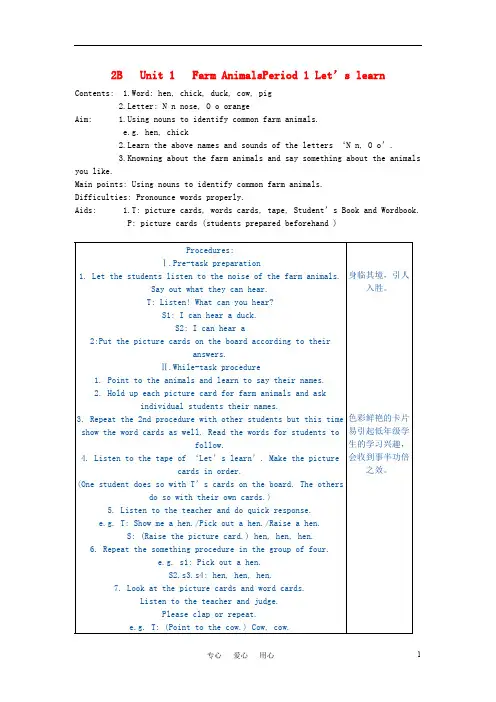
专心 爱心 用心12B Unit 1 Farm AnimalsPeriod 1 Let’s learnContents: 1.Word: hen, chick, duck, cow, pig 2.Letter: N n nose, O o orangeAim: ing nouns to identify common farm animals. e.g. hen, chick 2.Learn the above names and sounds of the letters ‘N n, O o’. 3.Knowning about the farm animals and say something about the animals you like.Main points: Using nouns to identify common farm animals.Difficulties: Pronounce words properly.Aids: 1.T: picture cards, words cards, tape, Student’s Book and Wordbook. P: picture cards (students prepared beforehand ) Procedures: Ⅰ.Pre-task preparation1. Let the students listen to the noise of the farm animals.Say out what they can hear.T: Listen! What can you hear?S1: I can hear a duck.S2: I can hear a2:Put the picture cards on the board according to their answers.Ⅱ.While-task procedure1. Point to the animals and learn to say their names.2. Hold up each picture card for farm animals and ask individual students their names.3. Repeat the 2nd procedure with other students but this time show the word cards as well. Read the words for students to follow.4. Listen to the tape of ‘Let’s learn’. Make the picture cards in order.(One student does so with T’s cards on the board. The others do so with their own cards.)5. Listen to the teacher and do quick response.e.g. T: Show me a hen./Pick out a hen./Raise a hen. S: (Raise the picture card.) hen, hen, hen.6. Repeat the something procedure in the group of four.e.g. s1: Pick out a hen. S2.s3.s4: hen, hen, hen.7. Look at the picture cards and word cards.Listen to the teacher and judge.Please clap or repeat.e.g. T: (Point to the cow.) Cow, cow. 身临其境,引人入胜。 色彩鲜艳的卡片易引起低年级学生的学习兴趣,会收到事半功倍之效。
牛津上海版二年级上英语教案unit8

49 课 题 Unit 8 Clothes
教
学
目
标 知识目标:1. 能够听懂会说单词:tie.belt.socks.shirt.dress.coat.
2. 学生能用Put on your coat. Take off your shoes. I need….交流,表达自己的需要。
3. 学会字母Mm及其在单词中的发音。
4. 能够听懂指令:put on, put off.
5. 能够听懂故事。
6. 学会有节奏地念歌谣。
能力目标1. 学会用所学句型表达需要。
. 2.能运用put on, put off等指令和别人进行情境表演
3. 学生能根据天气情况、不同场合选择服装。
4.根据周围环境会问答:I need….
情感目标:1.培养孩子的正确审美情趣。
2.会用学到的句子表达自己喜欢穿的服装。
3.体会合作学习的乐趣。
4. 培养学生独立人格。
重 点
难 点 1. 能够听懂会说单词:tie.belt.socks.shirt.dress.coat.
2. 学生能用Put on your coat. Take off your shoes. I need….交流,表达自己的需要。
3. 学生能根据天气情况、不同场合选择服装。
4..根据周围环境会问答:I need….
教学准备 课件 教学方法 游戏教学法 情景教学法
课时安排 4课时
第 一 课 时
教学
目标 知识目标:Using nouns to identify clothing items, e.g. belt.
能力目标:Describe or talk about their clothes.
Difficult and key points: Picture
二年级下册英语教案-ThingsIlikedoing|牛津上海版
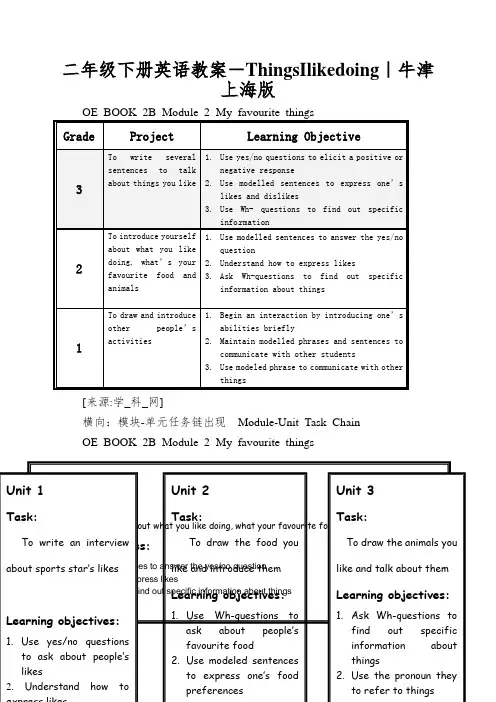
二年级下册英语教案-ThingsIlikedoing|牛津上海版
OE BOOK 2B Module 2 My favourite things
Grade Project Learning Objective
3 To write several
sentences to talk
about things you like
1. Use yes/no questions to elicit a positive or
negative response
2. Use modelled sentences to express one’s
likes and dislikes
3. Use Wh- questions to find out specific
information
2 To introduce yourself
about what you like
doing, what’s your
favourite food and
animals
1. Use modelled sentences to answer the yes/no
question
2. Understand how to express likes
3. Ask Wh-questions to find out specific
information about things
1 To
draw and introduce
other people’s
activities 1. Begin an interaction by introducing one’s
abilities briefly
2. Maintain modelled phrases and sentences to
communicate with other students
3. Use modeled phrase to communicate with other
上海牛津英语2b:unit5washwithwater教学设计
上海牛津英语2B:Unit5 Wash with water教学设计
教学目标:
一.知识与技能
let’s learn: ---water,dirty,wash,soap
let’s talk:--- I wash ----with----.
1.学生能够正确拼读单词 water, wash, dirty, soap.
2.学生能掌握句型I wash ---with----.
二.过程与方法
通过媒体给学生直观印象并运用有节奏感的chant操练所学的内容,同时由丰富多彩的课堂活动及讨论合作过程,逐步渗透研究性学习的方法,让学生自主学习。
三.情感态度价值观 1.让学生了解水是生命之源,我们的生活离不开水,万物生长离不开水,激发学生去探究水的用途,珍惜生命的价值——两纲教育。
2.让学生了解水是非常宝贵的,要珍惜水资源,节约用水——环境教育。
教材分析及教学设计:
本单元的学习主题是水,在与其他单元的关联上不是有很强的联系,不能用惯用的以旧带新的方法来开展教学内容,因此在授课内容的安排上,鉴于它是围绕 水展开教学的,我就通过水来引出学习内容,因此我的第一课时并不是依照课文的进度安排,我是设想通过词汇的教学来展开对句式的学习,从而涉及水的用处和重要性,而本课的词汇方面都是一些有关日常生活用品的,都与水有着联系,所以在引入上可以做到很自然。此外,我觉得语言学习的目的是能够在实际的生活中加以运用并培养学生对生命的热爱及增强环保意识。为此,我本节课把教学目标定位在提高学生的语言运用能力及情感培养上,围绕这个目标,我设计了一系列的活动,现主要通过以下几个方面谈谈自己本节课的教学设计。
我的教学安排是七个新词汇我先选取4个(dirty、water、wash、soap)教并结合一个句型(I wash … with …),因为考虑到学生的接受能力,把七个单词放在一起掌握有些难度,并且toothbrush、toothpaste和towel前两个单词与我课时的安排上不能做到很好的关联而towel这词的读音有些难,本课中已经涉及到两个较难准确朗读的词wash和with,所以我将这三个单词不列入第一课时的教学。
二年级英语下册 2B Unit7 Hot summer1教案 沪教牛津版
2B Unit7 Hot summer
【单元分析(UNIT ANALYSIS)】
一、教材地位(UNIT POSITION)
1、 从本单元的中心“夏天”为主线来看,教材内容是着重围绕夏天的天气,以及海滩边常见的景物主题展开;语言的使用环境是在海滩边进行交际.。
2、 词汇方面是学习一些与夏天有关的词汇summer ,sun ,cloud ,hot, beach, shell, sand的口头表达。
3、句型方面第一次接触祈使句Let’s…,
4、在一年级时学习了致谢,本单元将学习致歉“I’m sorry.”It’s OK.”
二、学习目标(LEARNING OBJECTIVES)
1、 夏天烈日炎炎,,来到海边尽情享受美妙的时光。通过去海滩边游玩,
学生感受夏天的气息,培养学生热爱自然的美好情感。
2、能够看图用正确的语音语调表述summer ,sun ,cloud ,hot,beach,shell,sand等。
3、在情景中能听懂并正确表达Let’s…,
4、在玩玩做做的活动中,要求学生看图片后能运用“ is ”正确描述.。.
5、在正确的场合使用“I’m sorry.”,It’s OK.”
6、通过朗读儿歌,了解大自然,激发学生热爱生活的情感。
三、教学资源(TEACHING RESOURCES)
1、现代技术支撑(I.T. support)
录音机
电脑
实物投影机
2、视听材料辅助(Audio-visual aids)
图片
实物
3、学习材料(Materials)
学生用书
配套练习册
补充材料
教学参考书
四、课时划分(PERIOD DIVISION)
本单元建议分六课时完成。 PERIOD TITLE CONTENTS
1st period Let’s act
Let’s
learn summer beach shell
Let’s….
上海版牛津英语2B教案
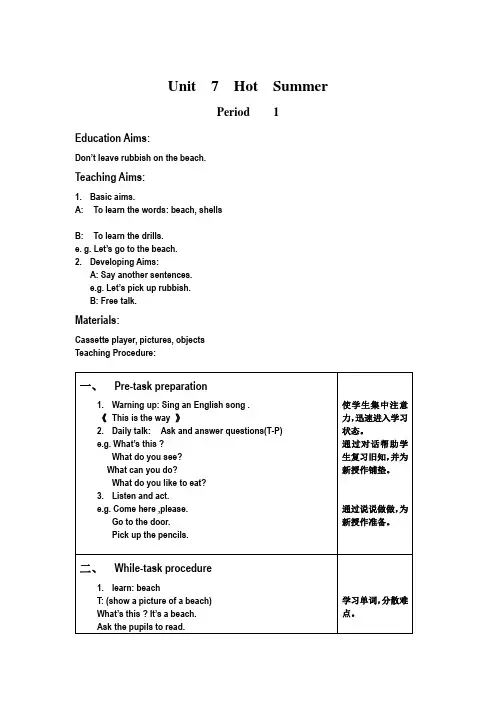
Unit 7 Hot Summer
Period 1
Education Aims:
Don’t leave rubbish on the beach.
Teaching Aims:
1. Basic aims.
A: To learn the words: beach, shells
B: To learn the drills.
e. g. Let’s go to the beach.
2. Developing Aims:
A: Say another sentences.
e.g. Let’s pick up rubbish.
B: Free talk.
Materials:
Cassette player, pictures, objects
Teaching Procedure:
一、 Pre-task preparation
1. Warning up: Sing an English song .
《 This is the way 》
2. Daily talk: Ask and answer questions(T-P)
e.g. What’s this ?
What do you see?
What can you do?
What do you like to eat?
3. Listen and act.
e.g. Come here ,please.
Go to the door.
Pick up the pencils.
使学生集中注意力,迅速进入学习状态。
通过对话帮助学生复习旧知,并为新授作铺垫。
通过说说做做,为新授作准备。
二、 While-task procedure
1. learn: beach
T: (show a picture of a beach)
What’s this ? It’s a beach.
二年级英语下册 2B Unit3 My room(1-3)教案 沪教牛津版
Unit3 My room
第一课时(1ST PERIOD)
一、主要新授内容(New contents)
Let’s learn –window, door, bed, room, bedroom, sitting-room
Let’s talk—This is my room.
Letters: Rr, Ss
二、学习目标(Objectives)
1、通过同学们对房间物品的认识,培养学生整理自己的房间,爱清洁的良好习惯。
2、通过房间的摆设和布置,让学生动动手,动动口,学会用正确的语音语调表述window, door, bed,
room。
3、学会认读单词window, door, bed, room, rubber, sweet, 培养学生最基本的阅读能力。
4、在情景中基本能并学会用This is my ________.来描述观察到的物品,培养学生能将房间正确布置的能力。
5、在练习新单词时适当拓展词汇bedroom, sitting-room, clean,有助于学生更好地理解和运用所学知识。
三、教学建议
1、任务前期准备阶段(Pre-task preparation section)
Activity 1 ( Song )
1、教学辅助(Aids)
录音机
磁带
2、活动过程(Process)
Steps Contents Methods Purpose
1. Song If you’re happy 播放歌曲的音带,让学生轻松愉快地唱歌。 运用学生熟悉的歌曲将学生引入英语学习氛围,激发学生的兴趣。
Activity 2 (Ask and answer )
1、教学辅助(Aids)
电脑
屏幕
2、活动过程(Process)
Steps Contents Methods Purpose
1. What is this ? 在电脑屏幕上不断出现单词图片的不断替换,可以训练Questions and
上海牛津英语2BM1U1教案
Oxford English 2BM1 Using my five senses
U1 What can you see?
Period 1
Contents:
Words: purple,pink, white, black, orange, brown
Sentence structure: ---What colour are they?
---They are…
Language Focus:
Listening: 1) Identifying the key words by listening to the pronunciation
2) Understanding the Wh-questions
3) Understanding the use of the modal verb can
Speaking: 1) Pronouncing the key words, phrases and sentences correctly
2) Using Wh-questions to find out specific information
3) Using Wh-questions to find out the colours of objects
4) Using adjectives to identify colours
Difficult Points:
Using Wh-questions to find out the colours of objects
Key point: To master the new words.
Materials: multi-media, a recorder
Procedure Contents Methods Purpose
Pre-task
preparation:
上海版新牛津英语2BM2U2教案
111Teaching plan
Period 1
Title Look and learn Look and say
Aims Language aims:
ing nouns to indicate the food items.e.g. salad,carrot,fish,chicken,banana
ing Wh-questions to ask about one‟s food preferences.e.g. What do you like
eating?
ing modelled sentences to answer the questions .e.g. I like eating….
Ability aims:
1.Through the teacher's guidance, let the students pronounce the key
words, phrases and sentences correctly.
ing modelled sentences to ask about one‟s likes.
Emotional aims:
Help the students build their self- confidence in English learning
Developing aims:
1.Let the students talk about their favourite food.
2.Tell them how to keep health and the importance of balanced diet.
Main points Using modelled sentences to ask about one‟s food preferences and provide a
response to factual questions. e.g. What do you like eating? I like eating…
上海版牛津英语 2B的全部教案
最大最全最精的教育资源网
需要更完整的资源请到 新世纪教育网 学校租用教师免费下载 Unit1 Farm animals
The First Period Language focus: Using imperatives to give simple instructions e.g. Draw the cow on the paper. Language skills: Listening and speaking Materials: Book, cassette, plain sheets of paper, toy animals, workbook Pre-task preparation 1. Show a picture of a cow. Ask‘ What animal is this?’ 2. Draw an outline of a cow on the blackboard. Ask the students what you are doing? Ask them what you are drawing on the blackboard. 3. Ask Can you draw a cow? Give the students a few pieces of paper each. Say Today we’ll learn to draw some animals. While-task procedure 1. Teach the students to draw a cow on the paper. Make sure they understand the meaning of drawing a cow on the paper. 2. Show toy animals and say‘ Draw the…on the paper.’ e.g. bird. 3. Tell a story like this: One day, a boy went out to play. When he came to the river, he saw a duck swimming. How beautiful! He picked up a stick and began to draw the duck on the ground. 4. Ask What did the boy draw? Where did he draw the duck? 5. Say‘ Draw the duck on the group.’ The students repeat and point to the correct picture. 6. Play the cassette tape. Let the students listen to the instructions. Ask the students to repeat and mime the actions. 7. Invite individual students to act out the scene. Post-task activity 1. Divide students into pairs. Have one students give the instruction and the other mime the action. Then let them change roles. 2. Invite pairs of students to act out the dialogue to the class. Students vote for the best pairs. 3. Ask some students to draw a pig on the blackboard. The rest of the students choose which drawing they like best. Consolidation Workbook page 2: Listen and draw. P2 最大最全最精的教育资源网