
【初中英语】动词基本形式专题复习(2)
必备英语【初中英语】动词基本形式专题复习一、动词基本形式1.When was _______ umbrella_______?A. / ; inventedB. a ; discoveredC. an ; discoveredD. the ; invented【答案】 D【解析】【分析】句意:雨伞是什么时候发明的?discover发现,invent发明,雨伞应是被发明的,而非被发现的,而且在这里,雨伞应是特指,所以要用定冠词the。
故选D。
【点评】本题考查词义辨析及特指用定冠词the。
是要求考生掌握的基本知识点。
2.Mei Ping eats a lot every day. She has ___________ five pounds these days.A. put upB. turned onC. put onD. washed away【答案】 C【解析】【分析】句意:梅萍每天吃很多。
她这些天已经增长了五英镑。
put on weight:增长体重,put up: 搭起,turn on:打开,wash away: 冲走,根据语境,故选C。
【点评】考查动词短语。
熟记这四个短语的意思。
3.—Whom would you for the job?—Tom, I think. He's always careful and serious.A. suggestB. remindC. rememberD. explain【答案】 A【解析】【分析】句意:—你会提议谁做这份工作? —汤姆,我认为。
他既细心又严肃。
suggest意为“提议,建议”;remind意为“提醒”;remember意为“记得”;explain意为“解释”。
根据答语,故答案为A。
【点评】考查动词辨析。
4.Kite is so interesting that we all like it.A. flyB. to flyC. to flyingD. flying【答案】 D【解析】【分析】句意:放风筝是如此有趣,我们都很喜欢。
根据is可知此空为动名词短语做主语。
故选D。
【点评】考查动词不同形式的辨析。
5.— So many problems! I'm too tired.— You should try ________ them by yourself.A. get overB. to get offC. getting overD. getting off【答案】 C【解析】【分析】句意:“那么多问题,我太累了。
”“你应该试着自己解决他们。
”get over克服;解决;get off下车。
try to do sth尽力做某事;try doing sth.试着做某事。
结合句意可知选C。
【点评】考查非谓语动词。
6.The girl has a boyfriend Bill.A. callB. calledC. is calledD. is calling【答案】 B【解析】【分析】句意:那个女孩有个名叫比尔的男朋友。
此题考查过去分词做定语。
called名叫......的。
故选B。
【点评】考查动词的不同形式。
7.My sister used to _____ thin and short, but now she is tall.A. beB. wasC. hasD. have【答案】 A【解析】【分析】根据thin and short又瘦又矮,可知此处填动词be。
used to do sth.过去常常做某事。
故选A。
【点评】考查动词原形。
8.—Look! Smiths are playing basketball—Let's them.A. The; join inB. The; joinC. A; join inD. A; join【答案】 B【解析】【分析】句意:——看!史密斯一家正在打篮球。
——让我们加入他们的行列吧。
冠词作为一种虚词,只能和名词一起使用。
英语中的冠词分为不定冠词和定冠词。
不定冠词有两个,a和an,a用在辅音音素开头的单词前面,an用于以元音音素开头的单词前。
不定冠词用在单数可数名词前面,表示这个人或事物是泛指的不确定的一个,相当于中文的“一个”。
定冠词和名词连用,表示某个或某些特定的人或东西。
Let sb do sth让某人做某事。
姓氏的复数形式前面上定冠词,表示该姓夫妇或该姓一家人。
join指加入某组织并成为其中一员,join in一般指参加活动:不过不是很大型的。
所以选B。
9.—It's going to rain. Remember to __________ your umbrella with you when you go to school, dear.—All right, Mum. Bye!A. takeB. buyC. put【答案】 A【解析】【分析】句意:——要下雨了,去上学的时候记得带一把伞哦。
——好的,妈妈。
再见。
take 带,buy 买,put 放,take sth. with sb.意为“某人随身带某物”,符合题意,故选A。
【点评】本题考查固定短语 take sth with sb 的用法。
10.—I think the girl under the tree must be Alice.—No,it be her.She is in the gym now.A. can'tB. mustn'tC. mayD. may not【答案】 A【解析】【分析】句意:——我认为树下的那个女孩一定是爱丽斯。
——不,不可能是她。
她现在在体育馆。
A. 不可能,B. 表示禁止,C. 可能,D. 可能不,由最后一句“她现在在体育馆”可知,设空句句意为“不,那不可能是她”,故用can't。
故选A。
【点评】本题考查情态动词。
熟记情态动词的用法,并能在语境中熟练运用。
11.Before stamps, people didn't for the letters they sent, but for the letters they received.A. payB. costC. spendD. lake【答案】 A【解析】【分析】句意是:在邮票出现之前,人们寄信不花钱,但是收到信时付费。
pay for是固定搭配,意为“付款”,故选A。
【点评】本题考查表示“花费、付款”等几个动词的辨析。
12.I don't know if he______ to my party, but I'll ask him about it when he ______ to school soon.A. comes; will comeB. will come; will comeC. comes; comesD. will come; comes 【答案】 D【解析】【分析】句意:我不知道他来不来我的派对,但是我会在他回学校的时候问一下。
第一个空,他还没有来,所以用一般将来时,所以用will come。
第二空,when引导的时间状语从句,从句用一般现在时,主语是he,谓语动词用单三式comes,故选D。
【点评】考查一般将来时及时间状语从句,注意平时识记,理解句意。
13.Tina is so shy that she is afraid of _______ in front of a group.A. to speakB. speakC. speakingD. spoke【答案】 C【解析】【分析】句意:Tina如此害羞以至于她害怕在人群面前讲话。
be afraid of doing sth害怕做某事,故选C。
【点评】考查动名词作宾语。
14.Lin Feng has to make a living by himself because his parents have _________ for years.A. dieB. deadC. diedD. been dead【答案】D【解析】【分析】句意:林峰不得不靠自己生活因为他的父母已经死了许多年了。
和一段时间连用, 动词用延续性的或者是对应的延续性状态, die对应的延续性状态使be dead, 故答案为:D。
【点评】die是瞬间性动词,不能与for的时间词连用,可以转化成be+形容词表示延续性动词。
15.—The T-shirt looks nice on you! How much does it __________?—I just __________ten dollars for it.A. take; affordedB. cost; paidC. cost; spentD. spent; took【答案】B【解析】【分析】句意:——你穿这件t恤很好看!这要花多少钱?——我刚花了十美元。
当物做主语时,花费用cost;人做主语时,花费用spend...on 和pay...for;it 做主语时,用it takes some time to do sth.根据句意和句子结构,故答案为B。
【点评】考查动词辨析。
注意掌握动词的词义区别和用法。
16.—Come home before dinner time, Peter!—I ______, Mom.A. promiseB. guessC. wishD. admire【答案】A【解析】【分析】句意:——彼得,晚饭时间之前回家!——妈妈,我保证。
promise许诺,保证;guess猜测;wish希望; admire羡慕;根据Come home before dinner time,Peter!可知妈妈要求彼得晚饭前回来,所以这里彼得要答应她,故应是保证回来,故选A。
【点评】此题考查动词辨析,注意意义相近的动词词义辨析,根据语境选择合适的动词。
17.—You aren't supposed to smoke in public.It's bad for our health.—Sorry,I will ______ my cigarette right now.A. give upB. put downC. put outD. give away【答案】C【解析】【分析】句意:——你不应该在公众场所吸烟。
这对我们的健康不好。
——对不起,我会马上戒掉香烟。
give up放弃,戒掉;put down放下;put out扑灭;give away捐赠。
根据It's bad for our health.可知吸烟有害健康,因此应戒掉,故选C。
【点评】此题考查动词短语辨析,熟记短语词义,根据语境选择合适的短语。
动词五种基本形式(初中英语专题复习)2
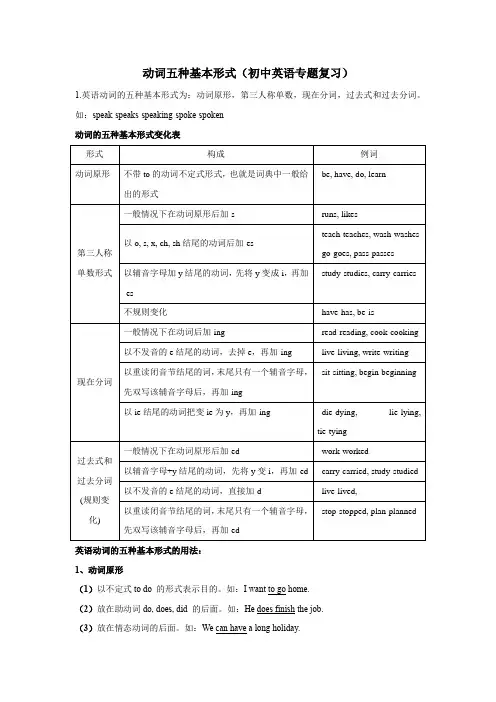
动词五种基本形式(初中英语专题复习)1.英语动词的五种基本形式为:动词原形,第三人称单数,现在分词,过去式和过去分词。
如:speak-speaks-speaking-spoke-spoken动词的五种基本形式变化表英语动词的五种基本形式的用法:1、动词原形(1)以不定式to do 的形式表示目的。
如:I want to go home.(2)放在助动词do, does, did 的后面。
如:He does finish the job.(3)放在情态动词的后面。
如:We can have a long holiday.(4)用于一般现在时(除第三人称单数外)。
如:I like playing the piano.2、第三人称单数形式:用于主语为第三人称单数的一般现在时。
如:Tom often goes to school by bus.3、现在分词:用于进行时态,包括现在进行时,过去进行时等。
如:The students are reading the books now. // When the storm was coming, I was sleeping.4、过去式:用于一般过去时态,表示过去某一时刻或某一段时间内所发生的动作或情况。
通常一般过去式带有表示动作时间状语的词,词组或从句。
如yesterday, the day before last, last week, two days ago 等,上下文清楚时可以不带时间状语。
如:I was late yesterday. // They went to see a film two days ago. // The man smoked a lot in the past.5、过去分词:用于被动语态和完成时。
如:A new bridge will be built next year. // He has told me the sports meet might be put off.。
初中英语语法知识—动词的解析(2)

一、选择题1.Their eyes __________blue, but ours_________black.A.are; are B.is; are C.are; is . D.are; is2.Here _______a nice photo of my family.A.am B.be C.is D.are3.Kay looked _________ at the guests who said that the food she cooked tasted _________. A.happily; wonderfully B.happily; wonderfulC.happy; wonderful D.happy; wonderfully4.Jim a basketball?A.Does; have B.Does; has C.Is; have5.—Listen! I can hear someone __________ for help.—Is there __________?A.calling; anything wrong B.call; anything wrongC.calling; wrong anything D.call; wrong anything6.The library ______ from 8 a.m. to 3 p.m. on weekdays. But it______ at 5 p.m. on Saturdays and Sundays.A.is open; closes B.opens; closed C.is opened; closes D.is opening; is closed 7.I tried to make the baby ________by singing, and that worked well at last.A.stop crying B.to stop crying C.stop to cry D.to stop to cry 8.Lily and Lucy _______ their mother. They have big eyes and yellow hair.A.like both B.both are like C.both like D.are both like 9.Amy and her best friend often________books together.A.read B.reads C.look D.looks 10.Speak louder, ________ you can’t make yourself________.A.and; hear B.or; hear C.and; heard D.or; heard11.—I am feeling ill. What should I do?— eating junk food and breakfast every day.A.Stop; having B.Stop; have C.To stop; have. D.To stop; to have 12.Colours can change our moods and make us happy or sad .A.feel B.to feelC.felt D.feeling13.Tom and Jim __________ in Class 3.A.is B.be C.am D.are14.— Tom in the library?—Yes,and his friends Eric and Dale in the library,too.A.Is;are B.Is;is C.Are;is15.—What __________ he do? —He __________ an actor.A.is, is B.does, does C.does, is D.is, does16.The baby is crying. Her brother tries her best to make her ______A.to laugh B.laugh C.laughing D.laughed 17.The water ______ cool when I jumped into the pool for morning exercise.A.was felt B.is felt C.felt D.feels18.--Lucy______her mother and her mother______very young.A.looks like; looks like B.looks like; looksC.looks; looks like D.looks; looks19.As we all know, the Anti-Japanese War ________ in 1937, and ________ for eight years. A.was broken out; lasted B.broke into;lastedC.broke out; was lasted D.broke out;lasted20.I often play volleyball after class. But my cousin Lily _________.A.does B.doesn’t C.do D.don’t21.The air _______ fresh after the rain. And the sky is blue.A.feels B.tastes C.smells D.sounds22.________your brother________ a baseball?A.Do; have B.Does; has C.Does; have D.Do; has 23.—Do you have an art festival at school?—Yes, ________.A.we have B.we can C.we do24.2019 has come. I hope everyone can make his dream ________.A.came true B.come true C.comes true D.coming true 25.Karen and Helen _______ my brother's friends. I know _______.A.is; her B.are; them C.are; her D.is; them【参考答案】***试卷处理标记,请不要删除一、选择题1.A解析:A【解析】【分析】【详解】句意:他们的眼睛是蓝色的,但是我们的眼睛是黑色的。
初中英语动词及动词短语考点
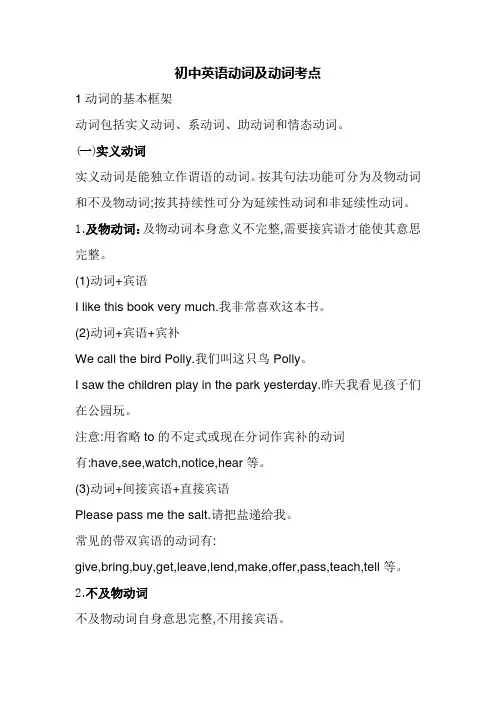
初中英语动词及动词考点1动词的基本框架动词包括实义动词、系动词、助动词和情态动词。
(一)实义动词实义动词是能独立作谓语的动词。
按其句法功能可分为及物动词和不及物动词;按其持续性可分为延续性动词和非延续性动词。
1.及物动词:及物动词本身意义不完整,需要接宾语才能使其意思完整。
(1)动词+宾语I like this book very much.我非常喜欢这本书。
(2)动词+宾语+宾补We call the bird Polly.我们叫这只鸟Polly。
I saw the children play in the park yesterday.昨天我看见孩子们在公园玩。
注意:用省略to的不定式或现在分词作宾补的动词有:have,see,watch,notice,hear等。
(3)动词+间接宾语+直接宾语Please pass me the salt.请把盐递给我。
常见的带双宾语的动词有:give,bring,buy,get,leave,lend,make,offer,pass,teach,tell等。
2.不及物动词不及物动词自身意思完整,不用接宾语。
Horses run fast.马跑得快。
(1)有些动词既可作及物动词又可作不及物动词。
We study English.我们学习英语。
(及物动词)We study hard.我们努力学习。
(不及物动词)(2)有些不及物动词与一些别的词搭配在一起构成动词短语,它的作用相当于一个及物动词。
①动词+介词Listen to the teacher carefully.仔细听老师讲。
此类动词短语后面的宾语无论是名词还是代词,都只能放在介词后面,不能放在动词和介词之间。
②动词+副词+介词Let’s go on with our work!让我们继续我们的工作吧!He gets along well with his classmates.他与他的同学们相处得很好。
动词常见考点

动词常见考点一、动词的基本形式动词是表示动作、行为或状态的词类,它在句子中起着重要的作用。
在英语中,动词有不同的形式,包括基本形式、过去式和过去分词等。
动词的基本形式通常是指动词的原形,是不受人称和数的影响的。
例如,不管是第一人称单数还是第三人称复数,动词“go”的基本形式都是“go”。
二、动词的时态时态是动词的一种形式,用来表示动作或状态发生的时间。
英语中常见的时态包括:一般现在时、一般过去时、一般将来时、现在进行时、过去进行时、将来进行时、现在完成时、过去完成时等。
不同的时态有不同的构成方法,需要根据具体的句子语境来正确使用。
三、动词的语态语态表示事物所处的状态或者受事物所作用的方式。
英语中常见的语态包括:主动语态和被动语态。
在主动语态中,动作的执行者是主语;而在被动语态中,主语是动作的承受者。
使用不同的语态可以使句子更加灵活,但我们需要根据句子的需要来正确选择语态。
四、动词的短语动词短语动词是由一个或多个词组成的固定搭配,其意义不同于单个动词的意义。
短语动词通常由一个动词和一个介词、副词或形容词组成。
例如,"look up"、"give in"、"put off"等。
短语动词在英语中非常常见,学好短语动词的用法对于我们的英语学习非常重要。
五、动词的非谓语形式英语的非谓语动词包括动词不定式、动名词和分词。
这些非谓语动词的形式可以在句子中作主语、宾语、表语或状语等。
非谓语动词的形式灵活多样,我们需要根据句子的需要灵活运用。
六、动词的词义变化动词在不同的语境中可能会产生词义上的变化,从而表达出不同的含义。
这种词义变化可以是通过加前缀、后缀、变换词性等方式实现的。
了解和掌握动词的词义变化对于我们准确理解和使用词汇非常重要。
七、动词的搭配和固定搭配动词在句子中通常会与其他词组成固定的搭配,这些固定搭配具有一定的语言规律,需要我们进行积累和记忆。
上海中考英语复习专题2动词(包含初中英语八种时态)专题
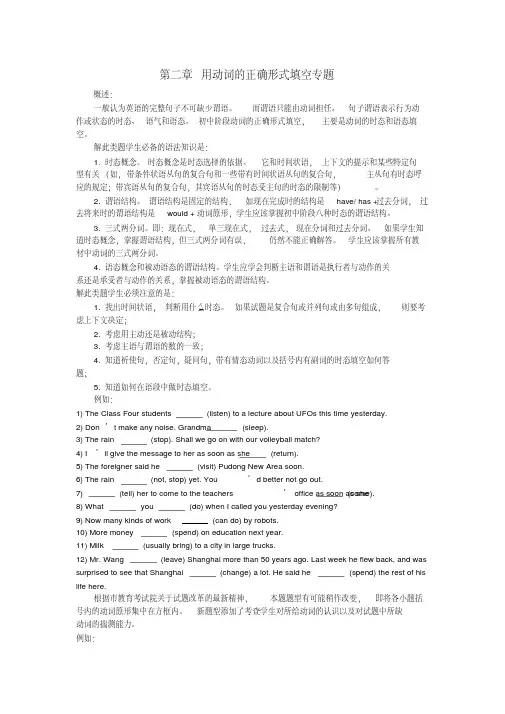
/did/
pass embarrass process dress miss cross discuss relax wash fish publish finish wish push brush reach watch fetch /iz/
/t/
die tie
/z/
/d/ agree /z/
/s/
/t/ compare declare prepare store trouble smile
+d 请 举高 表扬 是惊讶 关 假设
/t/ please raise praise surprise close suppose
双写 +ing 尾辅音 双写 +ed
表 2 不规则动词表
花费 切割 打击 让 放 安置 吐唾液 预报 伤害 读 传播
deal fail mail call fill kill pull fool whirl seem climb clean open happen fasten listen explain rain train join pardon turn return
重复 表演 收集 改正 保护 举起 等候 访问 种植 想要 发明 画画 指点 数数 开始 报道 使兴趣 坚持 邮递 调节 喊叫 +s
伸出 介意 听上去 受伤 奖励 记录
+s +ing +ed
通过 使窘迫 处理 穿衣 错过 横过 讨论 放松 洗 捕鱼 出版 完成 希望 推 刷 到达 观看 去取 +s +ing +ed
死 扎,系
+s dy+ying +d 同意 +s +ing +ed 希望 打字 喜欢 吸烟
初中英语语法知识—动词的专项训练解析含答案(2)
一、选择题1.—Would you like to try some pizza?—Yes, please. It lovely and nice.A.sounds, sees B.looks, smells C.hears, turns D.sounds, watches 2.Colours can change our moods and make us happy or sad .A.feel B.to feelC.felt D.feeling3.The strawberries delicious. You can have a try.A.eat B.drink C.taste D.sound 4.Parents always hope their children a happy and healthy life.A.to live B.can live C.living D.should live 5.Coffee is ready. How nice it ______! Would you like some?A.looks B.smells C.sounds D.feels6.I don’t have a baseball, but AlanA.do B.does C.have D.has7.What kind of music ________ he ________?A.does; listen B.does; listen to C.is; listen D.is; listen to 8.My mother with me ________ at my grandma’s home ________that snowy night. A.were, at B.was, at C.was, on9.Lucy and I ________ good friends.A.am B.is C.are10.—Why ______ you so busy these days?—Because they arrived ______ London ______ the morning of July1.A.are; in , in B.are; in , on C.do; on , in D.do; at , on 11.I think the music is great , and it is worth________A.to listen B.to listen to C.listening D.listening to 12.—Do you like watching cooking programs on TV?—No, I don’t , but my twin brother . He's very fond of cooking.A.does B.do C.is D.are 13.What a beautiful song! It ___________so sweet.A.feels B.sounds C.tastes D.smells 14.— Tom in the library?—Yes,and his friends Eric and Dale in the library,too.A.Is;are B.Is;is C.Are;is15.—________ you Mary? —Yes, I ________.A.Are; is B.Is; am C.Are; am D.Am; is16.—Do you know whom they will have ________the parts of car together?—Sorry,I have no idea.A.fix B.fixed C.to fix D.fixing17.I don't have a Ping-Pong ball, _______ my brother _______.A.but; do B.and; does C.and;do D.but; does18.Li Ming's father __________want __________the new coat.A.doesn't; buy B.don't; to buy C.don't; buy D.doesn't; to buy 19.Our teachers always make us ________ a lot of homework.A.to do B.do C.does D.doing20.— How ________ your trip to Australia?—Great. I’ll go there again next year.A.was B.is C.are D.were21.— How sweet the flowers _____ in spring!— Yes, many tourists come to enjoy them every day.A.taste B.smell C.feel22.The air _______ fresh after the rain. And the sky is blue.A.feels B.tastes C.smells D.sounds23.I like this dress very much. It soft and smooth.A.feels B.touches C.is felt D.is touched 24.2019 has come. I hope everyone can make his dream ________.A.came true B.come true C.comes true D.coming true 25.—William, your hat _______ nice.—Thanks.A.buys B.looks C.finds【参考答案】***试卷处理标记,请不要删除一、选择题1.B解析:B【解析】【分析】【详解】句意:——你想尝尝披萨吗?——好的,请。
最新初中英语语法知识—动词时态的知识点总复习含答案解析(2)
一、选择题1.Don’t turn on the TV. Grandma ________.A.sleeps B.is sleeping C.sleep D.are sleeping 2.—Mom, can you teach me how to pronounce the words?—Wait a minute. I ________.A.am cooking B.cookC.cooked D.will cook3.— Look at my new watch.—Well, it’s so cool! When and where________you buy it?A.Do B.will C.did D.Are4.It ________ heavily when I left the movie theater.A.rains B.was raining C.is raining D.will rain 5.It’s 4:00 p.m. The students _____ in the pool.A.swim B.swam C.swims D.are swimming6.—I called you at three yesterday afternoon, but you weren’t in.—I ________ a meeting at that time.A.had B.was having C.have had D.would have 7.—How much is the ticket (票) to Central Park?—One ticket $40, and you can $80 for two persons.A.costs; pay B.cost; spend C.pay; spend D.spends; pay 8.My mother when I got home yesterday.A.will cook B.cooks C.has cooked D.was cooking9.--Look! Someone the classroom.--Well,it wasn't me. I didn't do it.A.is cleaning B.was cleaning C.has cleaned D.will clean 10.If Tina _____ at home tomorrow, I _____ her.A.is staying, will visit B.stays, will visit C.will stay, visit 11.He _______ to school by bike, but now he _____ to school on foot.A.used to going, gets used to goingB.used to go, gets used to goC.used to go, gets used to going12.—Rose, can you give me a hand?—Just a minute. I ______ the followers.A.am watering B.have wateredC.watered D.water13.Look at Amy. She ________ for the school bus.A.wait B.is waiting C.waits D.waiting 14.— Have you ever been anywhere for a trip?— A trip? I ________ away from my hometown even once.A.went B.have gone C.have been D.have never been 15.The water ______ cool when I jumped into the pool for morning exercise.A.was felt B.is felt C.felt D.feels 16.While I_______ a detective story, someone_______ at the door.A.read, was knockingB.read, knockedC.was reading, knockedD.was reading, was knocking17.--What age did you leave home ?--I left home at 18. I ___your city for five yearsA.have gone to B.have been to C.have been in D.have come to 18.The film Operation Red Sea_____a lot of praise since its first show months ago. A.wins B.win C.will win D.has won 19.It’s 8 o’clock. The students _________ an English class.A.have B.having C.is having D.are having 20.—Did you hear the strange noise next door around 9 o’clock last night?— No, I ________my favourite film in my bedroom.A.watch B.watched C.am watching D.was watching 21.Don’t talk! The baby ________.A.sleeps B.is sleep C.sleeping D.is sleeping 22.— What do you use MP3 for?— I ________ it ________ to music.A.use; listen B.are listening; listeningC.use; to listen D.is listening; to listening23.My father was reading ________ I was sleeping.A.while B.when C.before D.after 24.Look! All my classmates ___________ on the playground.A.are running B.ran C.were running D.run25.—I can’t find Peter. Where is he?— He ______ tea in the living room.A.drinks B.drinking C.is drinking D.drink【参考答案】***试卷处理标记,请不要删除一、选择题1.B【解析】【分析】【详解】句意:别开电视,奶奶正在睡觉。
所有的动词知识点总结
所有的动词知识点总结动词是语言中最基本的词类之一,它不仅是句子的核心,也是句子传递信息的重要组成部分。
在英语中,动词的形式和用法非常丰富多样,而且动词在句子中扮演着各种不同的角色。
因此,对动词的掌握是学习英语的关键之一。
本文将对动词的形式、时态、语态、情态动词等知识点进行总结和梳理,希望对读者有所帮助。
一、动词的形式动词的形式包括基本形式、过去式和过去分词。
在英语中,大部分动词的过去式和过去分词形式是相同的,但也有一些不规则动词的过去式和过去分词形式需要单独记忆。
动词的形式受人称、数和时态的影响,不同的形式在句子中扮演着不同的角色。
1. 基本形式动词的基本形式是指不加任何词缀的动词形式,通常是动词的原形。
例如:go,eat,sleep等。
2. 过去式动词的过去式用来表示过去的动作或状态,通常在动词原形后面加-ed或-d构成。
例如:go→went,eat→ate,sleep→slept等。
3. 过去分词动词的过去分词用来表示完成的动作或状态,通常在动词原形后面加-ed或-d构成。
例如:go→gone,eat→eaten,sleep→slept等。
二、时态时态是动词的一种形式,用来表示动作或状态发生的时间。
在英语中,时态分为一般时、进行时、完成时和将来时。
不同的时态在句子中扮演着不同的角色,通过不同的时态可以清晰地表达句子的含义。
1. 一般时一般时用来表示习惯性的动作、真理、客观事实等。
一般时分为一般现在时、一般过去时和一般将来时。
(1)一般现在时一般现在时表示经常性、习惯性的动作或状态,也用来表示客观事实、真理等。
例如:Igo to school every day.(我每天都去学校。
)The sun rises in the east.(太阳从东方升起。
)(2)一般过去时一般过去时表示过去的动作或状态,常常和表示具体时间的副词连用。
例如:I visited Beijing last summer.(我去年夏天参观了北京。
中考英语语法复习动词分类
九年级 动词Verb在英语中,动词变化形式最多,考题最灵活,所占分值也最大,约占整个卷面的15%左右。
近年来中考的考查重点主要集中在系动词,助动词,动词短语及易混词辨析上。
关于动词的题型也很多变,如完形填空和语法填空、短文填空等。
表示动作或状态的词是动词。
一、动词的基本形式(了解即可) 1、动词原形定义:动词最基本的形式,没有任何变化。
运用:①放在情态动词之后;②放在助动词do, does, did, will, shall 等之后;③放在使役动词 let, make, have 之后作宾语补足语; ④放在to 后面构成动词不定式; ⑤放在祈使句句首; ⑥一般现在时非三单时; 2、动词三单变化规则:①一般情况下只在动词后面加s;②以s, x, sh, ch 结尾的动词,后加es;③以辅音字母加y 结尾的动词,改y 为i ,加es; ④不规则变化:havehas, beis/are/am, gogoes...运用:在一般现在时中,当句子主语是第三人称单数时,谓语动词要用第三人称单数形式。
3、动词过去式变化规则:①一般情况下只在动词后面加ed;②以不发音的e 结尾的,加d;③以辅音字母加y 结尾的动词,改y 为i ,加ed;④以“一个元音字母和一个辅音字母”结尾的重读闭音节动词,先双写末尾一个字母,再加ed;动词原形过去分词⑤不规则变化:havehad, bewas/were, gowent...运用:在一般过去时中,动词原形要改为过去式4、现在分词变化规则:①一般情况下只在动词后面加ing②以不发音的e结尾的,先去掉e,再加ing;③以“一个元音字母和一个辅音字母”结尾的重读闭音节动词,先双写末尾一个字母,再加ing;④以ie结尾的名词,一般将ie改为y,再加ing. 如lie, tie, die运用:现在分词与be动词构成进行时态,现在进行时或过去进行时。
5、过去分词变化规则:过去分词规则变化与过去式相同,动词不规则变化需查不规则变化动词表。
中考英语专项复习专题【动词时代】(附例题以及答案)
中考英语专项复习专题【动词时代】(附例题以及答案)本章节内容1.动词的基本形式2. 时态的基本框架3.时态判定4.名词在句子中运用1动词的五种基本形式动词主要用来表示动作、状态和性质,而动作和状态的发生有具体的时间和表现方式,这就是英语中动词的时态。
英语中动词的时态由动词的不同形式来表示。
英语动词的五种基本形式为:动词原形、第三人称单数、现在分词、过去式和过去分词。
如:work—works—working—worked—worked。
1.动词的五种基本形式变化表2时态的基本框架常见六种时态的构成及用法(1)一般现在时用法:①现在经常性的状态或动作;②客观事实和真理。
构成:①be+表语;②实义动词作谓语标志词:often, sometimes, usually, always, never,twice a month, every day/week/month/year(every系列)例句:He usually gets to school early.他通常很早到校。
The moon moves around the earth.月亮绕着地球转。
练一练1.认识从实践开始Knowledge practice.2.如果明天下雨,我们就不去公园了。
If it tomorrow,we to the park.【答案】1. begins with.2.rains,won’t go(2)一般过去时用法:表示过去的动作或状态。
构成:①was/were+表语;②实义动词作谓语标志词:a moment ago,just now,ago, yesterday, last night/week/month(last系列)例句:We went to Yunnan last Monday.上周一我们去了云南。
1.She (not visit)her aunt last weekend.2.My friend,Lucy, (study)for the math test and (practice)English last night. 【答案】1.didn’t visit 2.studied practiced(3)一般将来时用法:表示将来的动作或状态。