
沪教牛津版六年级英语上册教案 Module4 Unit2.
沪教牛津版六年级英语上册教案
Unit2Holidays
一、单元分析(Unit Analysis)
(一)单元地位(Unit Position)
1.在Unit1中学习并巩固了以be going to引导的一般将来时,本单元继续学习以will引导的一般将来时。
在本册书中首次出现。
对于基础薄弱的学生,没有必要去仔细讲解两者的区别。
建议随着今后will用法的多次出现,再加以小结。
2.本单元出现了大量包含will的特殊疑问句。
因此,教师有必要帮助学生操练。
3.本单元围绕“假日”这个主题,从讨论假日安排→讨论天气→全家出游。
因此教师在教学时应紧紧抓住这条主线,在情景中教学。
下一单元主题为“节日”,有了本单元的基础,教师可以在下一单元结束时,将两单元串起来,设置一个活动。
(将在下个Unit中详细说明。
)
(二)单元目标(Unit Target)
1.学会使用一般将来时态“will”来描述将来发生的事情。
2.学会使用How,Where,What,When,How long等特殊疑问词针对将来的事件发表问题。
3.了解形容词比较级的简单用法(用于比较不同地区之间的气候差异)。
4.其他需要解决的问题:
1)掌握一些介词的用法或搭配,如by aeroplane,(stay)with relatives,(stay)on the boat,(stay)at a hotel等。
2)掌握描述天气的基本方式,能看懂简单的天气预报。
3)初步了解enough做形容词和副词的基本用法和区别。
(三)单元重点(Unit Focus)
1.关键词:cold,cool,warm,cold,dry,wet,sun→sunny,wind→windy,snow→snowy,rain→rainy,cloud→cloudy(通过词类的变化,让学生总结n.+y→a.的规则),coat,T-shirt,shorts,scarves,gloves,sandals,socks,clothes,brochure,a river/boat trip,a4-star hotel,enough,wear,fish(v.),China Eastern。
2.功能
1)询问信息(Asking for information)
●Where will we go?
What will we do there?
What will we see there?
How long will we stay there?
2)描述(Describing things)
●Guilin will be cold.
Xi’an will be very cold and snowy.
3)比较(Comparison)
●Xi’an will be colder than…
●Hainan Island will be warmer than…
3.语法点
本课主要解决的语法知识为使用will表示的一般将来时态。
尤其是要注重操
练其特殊疑问句的形式。
还要特别注重强调在使用will+行为动词和will+be+
形容词时的用法。
二、教学设计(Teaching Designs)
教学内容教学实施建议教学资源参考
1.P65和P66上单词的集中扫除这两页的内容是一脉相承的。
所以建议在教学的过程中集中教授两页的单词。
以免学生由于生词而影响到操练的效果。
这一教学环节可放在第1课时的一开始。
2.Look and read(Page65)在这一部分中,课本提供了两幅在一般的holiday brochure 中经常出现的两个页面。
这是一个锻炼学生自我寻求信息的好机会。
因此,不能仅仅教授单词的媒体,而是教师应当通过一系列的问题或其他手段来帮助学生获取其中因此提供的信息。
3.课本65页内容的综合运用教授完本页全部内容后,可布置给学生一个任务。
即为自
己做一个Holiday plan。
1.学生以5人为1小组。
他们可以讨论春节的时候愿意去
作为本课的作
业,教师可要求
学生根据所学
哪些地方。
每组只能选择1个地方,然后决定所做的事情,所能见到的东西。
然后准备一个与Read and answer内容相近的“角色扮演”。
2.为学生提供一些必要的短语或词组,如:
1)go shopping in department stores
2)visit the zoo
3)go to the amusement parks
4)visit the museums
5)…
3.鼓励学生能在“角色扮演”之前先将脚本写下。
1.各小组轮流在教室前表演。
教师在每组表演结束后提出
一些问题来检验其他学生是否已经明白表演者所表达的内容。
的内容,已经自己以前所去过的地方(国内或国外),制作1份形如Look and read的导游手册插页。
在后续课程中需要使用到。
4.课本66页内容的巩固与拓展本页中操练了含will的一般将来时态的特殊疑问句。
但课文中涉及的特殊疑问词有所局限。
教师可以有的放矢地拓宽特殊疑问句的操练。
此外,教师还可以要求学生在原文的基础上,简要介绍行程的安排。
5.有关天气的词汇教学有关天气的词汇在本课中应当是需要给予重视的。
学生大部分都已经学过,因此,我们可以以老带新。
进行词汇的教学。
6.Look,read and answer true/ false(Page67)由于课文的内容比较简单,教师可以设置一个收听天气预
报的情景,让学生带着任务去收听这段课文的录音。
学生
需要完成下面的这张表格:
Place Weather
Guilin cold
Xi’an very cold
Hainan warm&sunny
Guangzhou cool&wet
1.《活页资料》
84页。
(Answers are applied in the table in italics.)听完后,在进行朗读的教学。
7.Look and read(Page68)本文出现在最后一个课时中,家人已从讨论旅游过渡到了
在旅游。
因此,情景创设也应该是在旅游过程当中。
课文中出现了enough clothes/money的用法,前一课时中也
出现了warm/cool enough的用法。
因此,在教授课文后,
需要有个简单的小结(不宜扩展,点到为止)。
《活页资料》86
页。
提供可供整个单元使用的课件一份。
六年级上册英语教案Module 4 Unit 2 Our favourite festival is the Spring Festival. 外研社

Now point ot the pictures but don't say the name of the festival. Encourage the students to tell yopu.
我国古代的读书人,从上学之日起,就日诵不辍,一般在几年内就能识记几千个汉字,熟记几百篇文章,写出的诗文也是字斟句酌,琅琅上口,成为满腹经纶的文人。为什么在现代化教学的今天,我们念了十几年书的高中毕业生甚至大学生,竟提起作文就头疼,写不出像样的文章呢?吕叔湘先生早在1978年就尖锐地提出:“中小学语文教学效果差,中学语文毕业生语文水平低,……十几年上课总时数是9160课时,语文是2749课时,恰好是30%,十年的时间,二千七百多课时,用来学本国语文,却是大多数不过关,岂非咄咄怪事!”寻根究底,其主要原因就是腹中无物。特别是写议论文,初中水平以上的学生都知道议论文的“三要素”是论点、论据、论证,也通晓议论文的基本结构:提出问题――分析问题――解决问题,但真正动起笔来就犯难了。知道“是这样”,就是讲不出“为什么”。根本原因还是无“米”下“锅”。于是便翻开作文集锦之类的书大段抄起来,抄人家的名言警句,抄人家的事例,不参考作文书就很难写出像样的文章。所以,词汇贫乏、内容空洞、千篇一律便成了中学生作文的通病。要解决这个问题,不能单在布局谋篇等写作技方面下功夫,必须认识到“死记硬背”的重要性,让学生积累足够的“米”。
板书设计:
Module 4 Unit 2
Our favorite festivalis the Spring Festival.
牛津上海版六年级上册U4教案
a useful book;注意另外两个特殊词: a one-leg table ; a European
②常见辅音字母不发音的单词有:an honest boy;an hour;an honor;
8.if=whether 是否
从下情况只用whether
.从句有or not 用whether...or not...
②后面里不定式to......whether to...
③放在介词后……介词+whether-.....
④宾语从句放句首,表强调:whether--.....
9.find out 查明(根据线索)
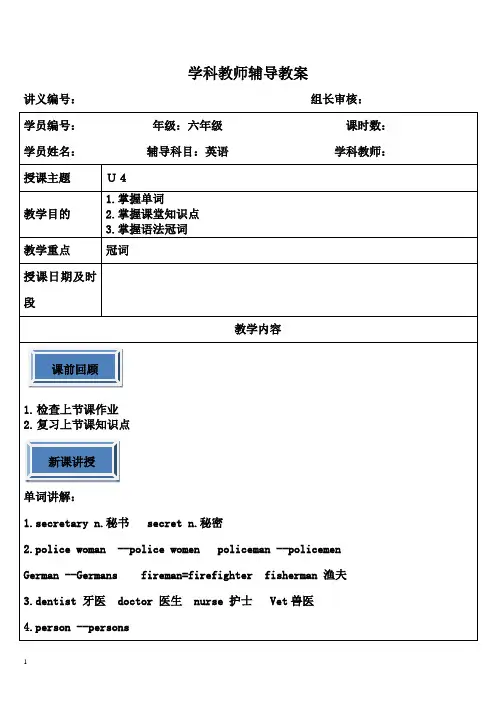
学科教师辅导教案
讲义编号: 组长审核:
学员编号: 年级:六年级 课时数:
学员姓名: 辅导科目:英语 学科教师:
授课主题
U4
教学目的
1.掌握单词
2.掌握课堂知识点
3.掌握语法冠词
教学重点
冠词
授课日期及时段
教学内容
1.检查上节课作业
2.复习上节课知识点
单词讲解:
1.secretary n.秘书 secret n.秘密
Cook v.做饭 n,厨师 cooker n厨具
because 因为十句子
because of 因为+短语/单词
I don’t go out because it is raining heavily.
I don’t go out because of the heavy rain.
let sb do = make sb do 让某人做……
Module2Unit4Ourneighbours(教案)牛津上海版(三起)英语六年级上册
Module2 Unit 4 Our neighbours(教案)牛津上海版(三起)英语六年级上册一、课程基本信息1.课程名称:Module2 Unit 4 Our neighbours2.教学年级和班级:六年级(1)班3.授课时间:2022年9月20日4.教学时数:1课时(45分钟)二、教学目标1. 学生能够听懂、会说、会读本课的生词和词组。
2. 学生能够掌握本课的语法结构。
3. 学生能够运用所学知识进行日常对话。
三、教学内容1. 生词和词组:neighbour, house, street, across, walk, tall, short, old, young, quiet, noisy, park, playground2. 语法结构:一般现在时四、教学步骤1. 导入(5分钟)教师通过提问的方式引导学生回忆上节课的内容,然后引出本节课的主题。
2. 词汇教学(15分钟)教师通过实物、图片等方式展示本课的生词和词组,让学生跟读并模仿。
3. 语法教学(15分钟)教师通过例句和练习的方式讲解一般现在时的用法,让学生进行模仿和练习。
4. 对话练习(10分钟)教师组织学生进行小组活动,用所学词汇和语法进行日常对话练习。
5. 总结和作业布置(5分钟)教师对本节课的内容进行总结,布置相关的作业,让学生进行巩固练习。
五、教学评价1. 学生能够正确发音本课的生词和词组。
2. 学生能够运用一般现在时进行日常对话。
3. 学生能够完成教师布置的作业。
二、核心素养目标三、教学难点与重点1. 教学重点本节课的核心内容是生词和词组的学习以及一般现在时的语法结构。
重点词汇包括:neighbour, house, street, across, walk, tall, short, old, young, quiet, noisy, park, playground。
重点语法是现在时的用法,包括主语、谓语动词的形式变化等。
六年级英语上册Unit4《Ourneighbours》(第2课时)教案牛津上海版(深圳用)

Our neighborsb.Ask and answer(1)Where did the rabbits and the owl live?(2)Why were the rabbits tired and angry?(3)Was the owl a good neighbour?Why or why not?(4)Where do many rabbits sleep today?d.根据课文,完成下题。
There_____(be)an owl and three rabbis in the forest.The owl______(live)in the tree.The rabbis______(居住)on the ground.The owl was very______(吵闹的).He ______(make)a lot of______(噪音).The rabbits was______(生气的).They_________________(有一个注意).They_____(dig)a hole ,then they can sleep well.e.Write about a neighbor.Tom is my neighbor.He is twenty years old.He is a worker. 学生根据课文内容完成本题学生根据课文内容完成本题学生根据课文内容来描述自己的邻居。
的掌握情况课文与语法相结合,达到课文与语法同步学习的目的。
课文与语法相结合,达到课文与语法同步学习的目的。
检测学生对自己的邻居的了解程度。
I often play ball games with him.I sometimes play football with him.Last Sunday,we played basketball together. Ⅳ.PronounceStep1(1)展示每个单词的读音,并附上录音。
牛津英语上海版六年级上册Module 2 Unit 4 What would you like to be 2课时英文教案

Module 2 Places and activitiesUnit 4 What would you like to be?一.知识与技能:掌握单词:secretary, businesswoman, businessman, bank, clerk, assistant, project, interview, finish, choir, information…理解词组:a bank clerk, a shop assistant, a factory worker, a lorry driver, put out fires, find out, an information board, talk about…应用句型:would like to… What jobs would you like to do?二. 过程与方法:感受:知道每个职业的英文说法,知道如何有礼貌地询问别人的职业,以及询问别人想要做什么职业。
三.情感态度,价值观:感悟:做自己喜欢的工作,并且要做好它,了解人们喜欢自己工作的原因,这样才能更好地完成自己的工作。
Period OneLanguage focus1Using nouns to identify people2Using 'would like to' to express intentions3Asking "Wh-" questions to find out the reason4 Using connectives to give reasonMaterials1Students’ Book 6B, page 43-442Workbook 6A, page 253Grammar Practice Book 6A, page 31-33Pre-task preparationRevision and introduction of the vocabulary of jobsA memory game-- Challenge your memoryStudents can look at the picture for only thirty seconds. In this period of time, try to memorize as many jobs as possible.While-task procedure1Read, think and say on page 44 of the SBa.Introduce and practice the pattern:I would like to be a/an ________ because I want to ________I wouldn't like to be a/an ________ because I don't want to ________.i) Look and the picture and the teacher gives a model first.ii) Look at four groups of pictures and try to practice the pattern in pairs.S1: I would like to be a/an ... because I want to ...S2: I wouldn't like to be a/an ... because I don't want to ...b.The dialogue on page 44 of the SBi) Listen to the recording of the dialogueii) Full-Class Repetition: repeat sentence by sentence after the recording.iii) Individual Repetition: Ss repeat the sentences one by one.iv) Individual S read the list aloud.2More oral practice:The following model dialogues are for Ss to read and act. Use the models as guides to make up their own conversations, using vocabulary of their choices.a) S1: Would you like to be a teacher?S2: Yes, I would.S1: Why would you like to be a teacher?S2: I'd like to be a teacher because I want to teach children.b) S1: Would you like to be a driver?S2: No, I wouldn't.S1: Why?S1: I wouldn't like to be a driver because I don't want to drive a lorry.Post-task activitiesA survey ---- Our ideal joba) Divide the whole class into four large groupsb) The whole group has a discussion to find out which has got the highest vote.c) A group leader will report the result to the class.Consolidation1Workbook page 25, 262Grammar book31-33Period TwoLanguage focus1 Asking 'wh--' questions to find out various kinds of information about a person2 Using connectives to give reasons3 Asking 'wh-' questions to indicate timeMaterials1Students’ Book 6B, page 45-462Grammar Practice Book 6B, page 34-363Some photos of famous peoplePre-task preparationA brainstormingTell students that they are going to interview some people and find out if they like their jobs. Let them try to tell the class which questions they are going to ask. While-task procedure1Look and read on page 45 of the SBa.Listen to the dialogue between Kitty and Samuel Han and complete the1. 422. doctor3. Yes.4. want to make sick people better5. 7:00 a.m.6.8:00 p.m.b) Full-Class Repetition: repeat sentence by sentenceafter the recording.c) Individual Repetition: Students repeat the sentences one by one.e) Do pair work to read the dialogue aloud.2More listening and speaking practice:a Listen to the dialogues between Kitty and Tony Chen, Ben and Amy Li. Fill inthe following two cards.(See the first two cards in Look and read on page 45 of the SB)b Divide the whole class into two groups, group A and group B. The students ingroup A will talk about card A, while the students in group B will talk about card B. Post-task activitiesA talk show. Ask the students to take out the photo. Work in pairs to prepare a talk show, in which the name of the job and the name of the person should not be mentioned. Consolidation1Grammar Practice Book 6B, page 34-362Interview an adult and fill in the card in Find out on page 45 of the SB.。
牛津上海版英语六年级上册Module2Unit4课时教学设计

4.口语表达:学生需要在小组讨论中表达自己的观点,但可能存在表达不流畅、词汇量不足等问题。
设想:设计口语交流任务,鼓励学生提前准备,并在课堂上提供词汇和句型的支持。
(二)教学设想
1.采用多元化教学手段:结合多媒体资源,如视频、歌曲、图片等,多角度呈现天气情况,增强学生的学习体验。
3.教学内容:
(1)词汇:介绍本节课的天气词汇,如“sunny”, “windy”, “cloudy”, “rainy”, “snowy”等,并通过例句展示词汇的用法。
(2)语法:讲解一般现在时态,引导学生用该时态描述日常活动和天气状况。
(三)学生小组讨论
1.教学活动:学生分成小组,讨论各自的天气喜好和经历。
3.分组合作法:鼓励学生进行小组合作,培养学生的团队意识和合作精神,提高学生的口语表达能力。
4.读写结合法:通过阅读与写作相结合的方式,提高学生的阅读理解能力,培养写作技巧,提升学生的综合语言运用能力。
(三)情感态度与价值观
在本章节的学习过程中,学生将培养以下情感态度与价值观:
1.学生能够关注天气变化,养成良好的生活习惯,注意防寒保暖、防晒防暑等。
针对牛津上海版英语六年级上册Module2 Unit4的教学内容,进行以下学情分析。六年级学生经过前期的英语学习,已具备一定的词汇量和语法基础,能够进行简单的日常交流。在此基础上,他们对天气话题有一定的认知,但词汇表达和句型运用可能仍较为有限。因此,在教学过程中,应注重以下方面:
1.关注学生个体差异:学生英语水平参差不齐,教师需针对不同层次的学生进行分层教学,提供适当的学习支持,使每位学生都能在原有基础上得到提高。
沪教牛津版小学英语六年级上册Module2《Unit 4 Our neighbours》教学课件PPT
Think and write
Write about a neighbour.
___________is my neighbour. He/ She is _____________(age). He/ She is a/an _____________(job). I often ______________________with him/her. I sometimes _______________with him/her. Last______________, we_______________.
Ms Guo: Did you see them this morning?
Peter: No, I didn’t, but I played with Mike and Nancy last weekend.
Ms Guo: Who are your neighbours, Alice? Alice: The Wus are my neighbours. They have a son. His name is Sam.
一天晚上,猫头鹰又制造噪音。兔子们很生气。“请停止 在晚上制造噪音,”兔子们说,“我们不能睡觉。”但是 猫头鹰不听。
4
One of the rabbits had an idea. “Let’s dig a hole and sleep in it. It’s very quiet underground.”
She sometimes plays chess with her father.
辨析:sometime, some time 与 some times
sometime some time
单词/短语 单词
意思 改天;来日;某个时间
新沪教牛津版六上Module 4教案
Module 4The natural world一、核心词汇1.名词:air 空气factory 工厂smoke 烟wood 木头;木材match 火柴Earth 地球part 地区;区域forest 森林land 陆地ocean 海洋rubbish 垃圾balloon气球glass玻璃制品;玻璃2.动词:plant 种植cool 使变凉miss 想念hurt 感到痛recycle 回收利用;再利用3.形容词:alive 活着的dirty 脏的fresh 清新的sick 生病的clean 干净的;洁净的own自己的4.其他:everywhere 处处;到处5.核心短语:keep…alive让……活着plant trees 植树have to不得不cut…down 把……砍倒look for 寻找so many这么多pickup捡起;拾起shopping bag 购物袋plastic bag 塑料袋二、了解词汇1.其他why 为什么2.一些短语look at 看一看be from 来自……cool the air 使空气变凉make a poster 制作一张海报live on the Earth 住在地球上in the tree 在树上三、核心句型1.It keeps them high in the sky.它让他们在高高的天空中。
解读: 此句型是表达使某人/某物保持一种状态的句型, 这个句型是一个一般现在时的陈述句, 主语是第三人称单数it, 所以谓语动词keep 要用其第三人称单数形式keeps。
keep是“维持, 保持”的意思, 后面接人称代词时要用其宾格形式。
举一反三: He would keep in touch with us wherever he was.他无论在什么地方,他总是与我们保持联系。
Will you keep us the seats? 你给我们保留些座位, 好吗?It keeps me sticking into my heart. 它使我的心不能忘却!2.We get wood from trees. 我们从树上获得木头。
新沪教牛津版六上Unit 4教案
Module 2 RelationshipsUnit 4 Our neighboursTeaching Aims(教学目标):1.能听、说、读、写本课的核心词汇:neighbour, son, daughter, noisy, dig2.能熟练掌握核心句型:Did you play with Sam last weekend?- Yes, I did.3.询问别人邻居的情况及邻里关系,体会邻里关系的重要性。
Teaching Importances and Difficulties (教学重难点):1.能在语境中正确运用本单元的核心词汇。
2.能用Do you…? 和Did you…? 询问别人和邻居的相处情况。
3.在句型Did you…?中动词用原型。
4.了解字母a, u, o及字母组合ar在单词中的发音规律,拼读简单的单词。
Teaching Tools(教学用具):录音机、自制课件、照片等Teaching Procedures(教学过程):StepⅠ. Warm up and revision(热身与复习)1. Greetings.2. Play a game: quick eyesStepⅡ. Presentation and practice (自主探究)1. 生词关T: Please write the meanings on your paperneighbour ______ son ______ daughter________writer________ weekend______ play chess_________The Greens__________ The Wus_________2. T:Show the pictures, learn the new words: neighbour / daughterSs:read these words after teacher.3. Work in groups to read the new words. Recite the new words, then recite in groups。
六年级上册英语教学设计-Module 4 Unit 2 Can you tell me about
六年级上册英语教学设计-Module 4 Unit 2 Can you tell meabout Christmas教学内容•学习关于圣诞节的词汇和表达方式•学习如何描述圣诞节的传统、食品和习惯•观看视频,了解关于圣诞节的文化知识教学目标•学生能够正确地使用关于圣诞节的词汇和表达方式•学生能够描述和比较圣诞节的传统、食品和习惯•学生能够在口语交流中运用所学知识表达自己的观点和看法•培养学生的跨文化交际能力和理解不同文化的意识教学重点•掌握关于圣诞节的词汇和表达方式•学习如何描述圣诞节的传统、食品和习惯教学难点•学生在口语交流中运用所学知识表达自己的观点和看法•培养学生的跨文化交际能力和理解不同文化的意识教学准备•教师课件PPT、视频课件•学生听力练习材料、课堂练习材料•课前调查问卷课本教学过程1.导入新课1.1 教师先通过图片、音频等手段给学生提供一些圣诞节的信息,让学生学习用英语表达“节日”和“探讨”等基本单词。
1.2 学生根据教师给出的信息和基础单词做口语练习,如:What’s your favorite holiday? Why? Can you tell me something about Christmas?2.学习新知识2.1 教师带领学生阅读课本Unit 2 Part A的内容,并注重表述方式、发音。
2.2 教师让学生围绕“绘制圣诞节卡片”这一话题展开口语练习,让他们通过对某些具体场景的描述,来表达圣诞节的特别之处。
3.视频观看3.1 教师选择一个关于圣诞节的视频,让学生了解更加深入的关于圣诞节的传统、食品和文化。
3.2 视频观看完后,让学生回答视频中提出的问题和对视频中看到的习惯表达自己的观点和看法。
4.游戏互动4.1 教师设计一个有趣的教学游戏,让学生在游戏中巩固所学的相关词汇知识和表达能力,比如:ABCD选出你最喜欢的圣诞节传统、食品等等。
5.作业布置5.1 教师布置相关作业,如:作文、文本短语配对和听力理解等。