
英语专业四级考试 语法词汇知识
2. that/those 的指代作用 1) 比较结构that of: His salary as a bus driver is much higher____. A. in comparison with a teacher’s B. than that of a teacher C. than a teacher D. than of a teacher’s 2) that 指代上文提到的内容 The following are all correct answers to “Who told the news to the teacher?” except___. A. Jim did this B. Jim did that C. Jim di分
虚拟语气: 虚拟语气: would rather+that从句+一般过去时; It is vital/ necessary/ important/ urgent/ imperative/ desirable/ advisable/ natural/ essential+that+动词原形; It is time/about time/high time+that+一般过 去时; proposal/suggestion+that+动词原形; lest+that+should+动词原形; if only+that+would+动词原形。
5. 表示时间、距离、金额、重量、面积、体积、 容积等度量的名词短语做主语时,谓语用单数。 Ten miles ____ in such a large city. A. are not a long distance B. is not a long distance C. is not long distance D. are not long distances 6. 与冠词的搭配 ___ London of Dicken’s time come to ___ in his books. A. The, / B. /,/ C. /, the D. The,the
3.前置修饰语的排列顺序 可以至于冠词前的形容词(all/both/such/half) --冠词, 指示形容词(this/that),所有格形容词(his/her),不定形 容词(a few/many/any/some)--基数词(one ) 序数词 (first)--- 性质,状态,质量(good useful)--大小,长 短,形状---年龄,新旧,温度--颜色---国籍,产地,区 域--材料--动名词,分词 Which of the following is incorrect? A. All his lectures were boring. B. Her few friends are all fond of dancing C. Half his money was gone. D. He invited many his friends to the party.
语法和词汇的复习思路:
1.全面掌握基本语法点,重点记住各个项目中 的“偏,特,难”点。 2.掌握常用习惯用法和词组。 3.注意在阅读中培养语感,因为在语篇层次上 培养的语感往往可以直接帮助答题。 4.研究以往考试试题,多加练习记住典型题例。
名词
1. 近义词与形近词辨析 (also in 完形填空) e.g. Teachers in this school were encouraged to use drama as a(n)___ of learning. A. design B. instrument C. agency D. tool 2. 固定搭配 (also in 完形填空) e.g. When he first started in university, he really felt at ____ with his major. A. shore B. bank C. ocean D. sea
5) 物质名词转化为个体名词时,不可数。 Cake is a kind of food。蛋糕是一种食物。 Bread and butter ____liked by Westerners. A. is B. are C. were D. be 6)合成名词的数:grown-ups,passers-by 7)名词修饰名词:women teachers, baby beds 4. 倍数+the+名词 The square itself is five hundred yards wide, five times ____ the size of St. peter’s in Rome. A. / B. that of C. which is D. of
2.习惯用法如:confess to/set about/be used to+doing; be supposed to/have/ make sb.+do等。 3.由同一动词构成的短语如:come,go,set, break,put等构成的短语。 4.单个的动词,抽象名词,形容词和副词多以 近义词、同义词的形式出现 5.介词短语在句中作状语如:in terms of; with the exception of;in vain等,另外还应注 意rather than,other than,such as,none/ nothing+but等词在考题中的出现。
独立主格结构多以逻辑主语+分词的形式出 情态动词多与完成时形式连用。 定语从句重点考查介词+关系代词(which)和 as作为关系代词。 动词时态常考完成时态,如现在完成时,现在 完成进行时,过去完成时,过去完成进行时, 将来完成时等。
词汇部分
掌握教学大纲中的基础阶段5000 6000 掌握教学大纲中的基础阶段5000—6000个认知词 5000 6000个认知词 并且能熟练运用其中3000 4000个单词及其 3000汇,并且能熟练运用其中3000-4000个单词及其 最基本的搭配。其考查重点为: 最基本的搭配。其考查重点为: 1.动词、名词与介词的搭配如: popular/patient+with; yield/solution/adapt/transfer/access+to; accuse/require+of; charge+for;under+discussion等等。
3.one的指代作用 one指代不确指的单数可数名词,复数为ones。 the one 指代确指的单数可数名词。如: A good writer is ___ who can express the commonplace in an uncommon way. A ) that B) one C) this D) which 4. 人称代词顺序2-3-1 ____ have known each other for ten years. A) I, you and he B) He, you and I. C) You, he and I D) You, he and me. 5. some 指某一个+单数名词:some Mr. Wang is
状语从句: 状语从句: 非if引导的条件状语从句,此类句子多用at times, provided,so long as,in case,once等来替代 if; 由even if/so,now that,for all等引导的让步 状语从句; just/hardly...when引导的时间状语从句; more than,as...as,not so much as,the same as,as much as等引导的比较状语从句。
3. 集体名词\物质名词的数:主谓一致 1)通常作复数的集体名词:police, people, cattle, militia, poultry等 Domestic cattle provide us with milk, beef and hid 2)通常作不可数名词的集体名词如: machinery It takes ___ to build a road A. a lot of machine B. a lot of machinery C. much machines D. much machineries 3)既可作单数也可作复数的集体名词如: audience, committee, class, crew, family, public, government等
I don't want to use Mary's ball pen because I don't like___. A) that ball pen of hers B) that her ball pen C) her that ball pen D) that ball pen of her England is justly proud of___ great poets, especially ___ in the 18th century. A) her,they B) his,them C) its,that D) its,those “Jack certainly has a low opinion of Susan.”It can not be any worse than ____ of him. A) hers B) she does C) her D) she
代词
1.与所指代的名词在性、数、格上一致 如:Each cigarette a person smokes does some harm, and eventually he may get a serious disease from ____ effect. Our association, which has consistently pressed for greater emplyment, will publish ___ proposals in the near future. A. their B. our C. his D. its other, another, the other, others,the ones
英语专四语法
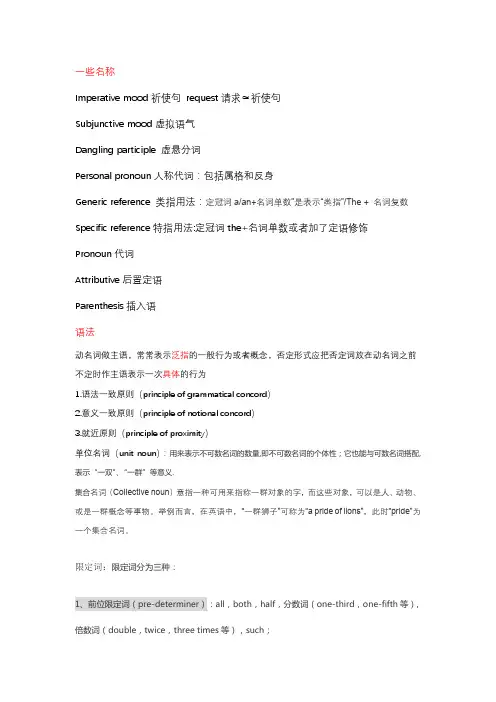
一些名称Imperative mood祈使句request请求≈祈使句Subjunctive mood虚拟语气Dangling participle 虚悬分词Personal pronoun人称代词:包括属格和反身Generic reference 类指用法:定冠词a/an+名词单数”是表示“类指”/The + 名词复数Specific reference特指用法:定冠词the+名词单数或者加了定语修饰Pronoun代词Attributive后置定语Parenthesis插入语语法动名词做主语,常常表示泛指的一般行为或者概念,否定形式应把否定词放在动名词之前不定时作主语表示一次具体的行为1.语法一致原则(principle of grammatical concord)2.意义一致原则(principle of notional concord)3.就近原则(principle of proximity)单位名词(unit noun):用来表示不可数名词的数量,即不可数名词的个体性;它也能与可数名词搭配,表示“一双”、“一群”等意义.集合名词(Collective noun)意指一种可用来指称一群对象的字,而这些对象,可以是人、动物、或是一群概念等事物。
举例而言,在英语中,“一群狮子”可称为“a pride of lions”,此时“pride”为一个集合名词。
限定词:限定词分为三种:1、前位限定词(pre-determiner):all,both,half,分数词(one-third,one-fifth等), 倍数词(double,twice,three times等),such;2、中位限定词(central-determiner):冠词(a,an,the),指示代词(this,that,these,those),不定代词(some,any,either),否定词(no,neither),全称限定词(every,each),所有格(my,your,John's);3、后位限定词(post-determiner):基数词(three,200),序数词(first,second,300th,last),数量词及短语(many,much,little,few,plenty of,a lot of,a large number of)等。
英语专四语法复习内容

英语专四语法复习内容想要通过英语专四考试,就必须掌握英语专四的语法。
那么英语专四的语法有哪些呢?下面由店铺为大家整理的英语专四语法内容,希望大家喜欢!英语专四语法内容一 There be 结构1. There be结构There were very few people left when we got there.There have been many such incidents.Nearby there had been a fight in full progress.也可以是情态动词 +beThere can be very little doubt about his guilt.There may always be instances about which we are uncertain. There ought to / should be some instructions on the lid.还可以是There +情态动词+ be 的完成时There may have been an accident.If the criminal had come this way, there would be / would have been footprints. There should / ought to have been someone on duty all the time.2. There + 半动词+ be,这里很少用完成体形式.There is certain to be trouble at the factory.There is sure / likely to be some rain tonight. There seems / appears to be no doubt about it.3. There be结构也可有被动式,这类there be结构有些可以与there be结构的一般形式相互转换。
专四必考语法

专四必考语法一、时态、语态1.表达将来时的形式:(1)在时间、条件、让步从句中,一般现在时代替将来时,但要注意区别从句的类型,如:I’ll tell him when you will ring again. (宾语从句) 比较:I’ll tell him when you ring again. (状语从句)(2)在make sure, make certain, see (to it) 后的that从句中,谓语动词用一般现在时代替将来时,如:See to it that you include i n the paper whatever questions they didn’t know the answer to last time.(include 不能用will include或其他形式)2.完成时是时态测试的重点,注意与完成时连用的句型和时间状语:(1)by/between/up to/till +过去时间、since、by the time/when +表示过去发生情况的从句,主句用过去完成时。
如:We had just had our breakfast when an old man came to the door.Between 1897 and 1919 at least 29 motion pictures in which artificial beings were portrayed had been produced.(表示1919年时已发生的情况)(2)by +将来时间、by the time/ when +谓语动词是一般现在时的从句,主句用将来完成时。
如:By the time you arrive in London, we will have stayed in Europe for two weeks.I hope her health will have improved greatly by the time we come back next year.(3)by now、since +过去时间、in/during/for/over/the past/last few(或具体数字)years/days/months,主句用现在完成时, 但在it is +具体时间since/before这一句型中,主句更多的时候不用完成时。
最新[英语考试]英语专业四级考试 语法词汇知识幻灯片课件
![最新[英语考试]英语专业四级考试 语法词汇知识幻灯片课件](https://360docs-1393072327.cos.ap-beijing.myqcloud.com/4b246e063186bceb18e8bbb7.webp)
D. are not long distances 6. 与冠词的搭配
___ London of Dicken’s time come to ___ in his books.
A. The, / B. /,/ C. /, the D. The,the
代词
The city council ___ meeting to discuss the point. A. is B. are C. was D. were ❖ 4) a committee,etc. of + 如果主语是由“a committee of /a panel of /a board of +复数名词”构成,随后的动词通常用
❖ 3.具体考查重点为以上项目中的特殊用法,不 常用的情况
❖ 2.习惯用法如:confess to/set about/be used to+doing; be supposed to/have/ make sb.+do
❖ 3.由同一动词构成的短语如:come,go,set, break,put
It takes ___ to build a road
A. a lot of machine B. a lot of machinery
C. much machines D. much machineries ❖ 3)既可作单数也可作复数的集体名词如: audience,
committee, class, crew, family, public, government
A. / B. that of C. which is D. of
❖ 5. 表示时间、距离、金额、重量、面积、体积、 容积等度量的名词短语做主语时,谓语用单数。 Ten miles ____ in such a large city.
高校英语专业四级考试·词汇语法详细解

高校英语专业四级考试·词汇语法详细解高校英语专业四级考试·词汇语法详细解形容词层迭修饰时的顺序几个属于不同层次的形容词作修饰语时,其词序一般按下列顺序排列:限定词→表示说话人评价的形容词→表示大小、形状、新旧的形容词→表示颜色的形容词→表示国别、来源、材料的形容词→表示用途或目的的形容词→名词中心词。
例如:the town’s charming old English churcha wellknown German medical schoolthe man’s first two interesting little red French oil paintings 近义词辨析bother, disturb, trouble, worry这组词均含有“不停地烦扰他人或搞得某人心神不宁”的意思。
botherdisturb常用于主动和被动两种形式中。
用于被动时,bother指常受到时有时无的小事的烦扰。
用于主动时,bother的意思比disturb强,带有故意打扰他人的意思。
If you return me the book, I will stop bothering you.你归还我的书后,我就不打扰你了。
disturb用于被动形式时,意思比bother强烈,有时甚至可指精神错乱。
用在主动形式时,意思最弱,指某人无意中打扰他人,这种打扰行为并非存心冲着他人去的。
The man was mentally disturbed.这个人精神错乱了。
trouble和worry主要用于被动,指被某事搞得心神不宁。
trouble比worry稍正式些,指麻烦别人一件事而影响他人舒适、方便、效率、健康或心境的平静等。
May I trouble you for the book?麻烦您把书递给我好吗?worry主要指因对某事的结果没有把握而焦虑不安,还可指某人沉浸在软弱无助的情绪或思虑中。
Worrying about your health can make you sick.经常担心你的健康,会使你生病的。
四级语法知识点大纲
四级语法知识点大纲第一节:名词1.定义:名词是表示人、事物、地点、概念等的词语。
2.分类:可数名词和不可数名词。
3.句中作用:名词在句子中可以作主语、宾语等成分,还可以通过所有格形式表示所属关系。
第二节:代词1.定义:代词是用来代替名词或名词词组的词语。
2.分类:人称代词、物主代词、指示代词、疑问代词、不定代词等。
3.句中作用:代词可以替代名词,使句子更加简洁明了。
第三节:动词1.定义:动词是表示动作、状态或变化的词语。
2.分类:及物动词和不及物动词。
3.句中作用:动词可以作谓语,表示主语的动作或状态,也可以作状语、宾语等成分。
第四节:形容词1.定义:形容词是用来描述名词或代词性质、特征、状态等的词语。
2.句中作用:形容词可以修饰名词或代词,使句子更具描述性和表达力。
第五节:副词1.定义:副词是用来修饰动词、形容词、副词、句子等的词语。
2.句中作用:副词可以表示时间、地点、程度、方式等,增加句子的信息量和表达的准确性。
第六节:介词1.定义:介词是用来表示名词或代词与其他词语之间的关系的词语。
2.句中作用:介词可以表示时间、地点、方式、原因等,丰富句子的含义和表达的层次。
第七节:连词1.定义:连词是用来连接单词、短语或句子的词语。
2.分类:并列连词、从属连词。
3.句中作用:连词可以让句子结构更加完整,使语言更加流畅。
第八节:数词1.定义:数词是表示数量或顺序的词语。
2.分类:基数词和序数词。
3.句中作用:数词可以表示数量、顺序或比较,使句子更具体、准确。
第九节:感叹词1.定义:感叹词是用来表示强烈的情感或感叹的词语。
2.句中作用:感叹词可以表达惊讶、赞叹、喜悦等情绪,增强句子的感情色彩。
通过以上九个知识点的学习,我们可以更好地理解和运用英语语法。
掌握这些知识点,对于学习和提高自己的英语水平具有重要的帮助。
希望大家能够认真学习,不断练习,进一步提升自己的英语能力。
专四词汇语法易错
专四词汇语法易错一、易混淆词汇。
1. affect (əˈfekt) - 动词。
- 意思:影响;(疾病)侵袭;使感动。
- 例句:The bad weather will affect our travel plans.(恶劣的天气将影响我们的旅行计划。
)- 易错点:容易和“effect (ɪˈfekt) - 名词/动词”混淆。
“effect”作名词时意思是“影响;效果”,如:The new law has had a positive effect on the environment.(新法律对环境有积极的影响。
)作动词时表示“使发生;实现”,例如:They hope to effect a change in the system.(他们希望在这个系统中实现变革。
)2. principal (ˈprɪnsəpl) - 形容词/名词。
- 形容词意思:主要的;最重要的。
名词意思:校长;本金。
- 例句:The principal reason for his absence is illness.(他缺席的主要原因是生病。
)The principal of the school is very strict.(这所学校的校长非常严格。
)- 易错点:与“principle (ˈprɪnsəpl) - 名词”混淆,“principle”的意思是“原则;原理”,如:We should stick to our principles.(我们应该坚持我们的原则。
)3. compose (kəmˈpəʊz) - 动词。
- 意思:组成;创作(音乐、文学作品等);使平静。
- 例句:Water is composed of hydrogen and oxygen.(水由氢和氧组成。
)He can compose beautiful music.(他能创作优美的音乐。
)- 易错点:容易和“comprise (kəmˈpraɪz) - 动词”弄混。
英语专四语法、词汇知识大全
英语专四语法、词汇知识大全英语专业四级语法、词汇知识1.语法考题的涉及面宽,近年考题曾经考到:几乎所有词类;三种动词的非谓语形式;各种从句及关系词的用法;动词时态、虚拟语气、情态动词的用法;独立主格,主谓一致,倒装,强调、并列结构等基本语法知识。
2.语法考试的重点突出,语法考试的重点为内容庞杂较难掌握的项目,这些项目还反复出现,如:虚拟语气,状语从句,定语从句,独立主格,情态动词。
3.具体考查重点为以上项目中的特殊用法,不常用的情况1)虚拟语气的考点为:would rather+that从句+一般过去时:It is vital/necessary/important /urgent/imperative/desirable/advisable/natural/essential+that+动词原形;It is time/about time/high time+that+一般过去时:proposal/suggestion+that+动词原形;lest +that+should+动词原形;if only+that+would+动词原形。
2)状语从句的考点为:非if引导的条件状语从句,此类句子多用at times,provided,so long as,in case,once等来替代if;由even if/so,now that,for all等引导的让步状语从句;just/hardly...when引导的时间状语从句;more than,as...as,not so much as,the same as,as much as等引导的比较状语从句。
3)独立主格结构多以逻辑主语+分词的形式出现。
4)情态动词多与完成时形式连用。
5)定语从句重点考查介词+关系代词(which)和as作为关系代词。
专业四级考试的词汇部分要求考生能灵活正确运用教学大纲语法结构表一至四级的全部内容,熟练掌握教学大纲词汇表中一至四级规定的5000—6000个认知词汇及其最基本的搭配。
专四词汇与语法
专四词汇与语法一、词汇部分。
1. abandon [əˈbændən](动词)- 词义:放弃;抛弃;放纵。
- 例句:Don't abandon yourself to despair.(不要自暴自弃。
)2. ability [əˈbɪləti](名词)- 词义:能力;才能。
- 例句:He has the ability to solve this difficult problem.(他有能力解决这个难题。
)3. abnormal [æbˈnɔːml](形容词)- 词义:反常的;不正常的。
- 例句:This abnormal weather has caused a lot of problems.(这种反常的天气造成了许多问题。
)二、语法部分。
1. 时态 - 一般现在时。
- 结构:主语 + 动词原形(第三人称单数形式为动词 + s/es)- 用法:- 表示经常或习惯性的动作或存在的状态。
例如:He often goes to school by bike.(他经常骑自行车上学。
)- 表示客观事实或普遍真理。
例如:The earth moves around the sun.(地球绕着太阳转。
)2. 名词的数 - 可数名词复数形式。
- 规则变化:- 一般情况加 -s,如book - books。
- 以s, x, ch, sh结尾的加 -es,如box - boxes。
- 以辅音字母 + y结尾的,变y为i加 -es,如city - cities。
- 不规则变化:- 如man - men,woman - women,child - children等。
3. 形容词和副词的比较级和最高级。
- 规则变化:- 单音节词和部分双音节词:- 一般情况加 -er(比较级)和 -est(最高级),如tall - taller - tallest。
- 以e结尾的加 -r和 -st,如nice - nicer - nicest。
专四语法常见考点
专四语法常见考点1。
限定词限定词是在名词词组中对名词中心词起特指、类指以及表示确定数量和非确定数量等限定作用的词类,主要包括冠词(a, an, the)、物主限定词(如my, her)、指示限定词(如this, those,such)、不定限定词(如all,both, no)、疑问限定词(如what, which,whose)、关系限定词(如whose)、名词属格(如Tom's, China’s)以及数词(如one,second)等。
2。
情态助动词❖主要情态助动词的用法(can/could,ma 1y/might, will/would,shall,should, must,need,dare)❖情态动词+have+过去分词3. 非谓语动词非谓语动词也叫非限定动词,指的是由动词变化而成,仍具有动词的性质与原义,但不能作动词使用的词。
非谓语动词和动词一样可以带有宾语、副词、补语等,主要有以下三大类:分词、不定式和动名词.非谓语动词可以充当多种成分,如主语、宾语、表语、定语、状语、宾语补足语等.4. 名词性从句名词性从句是指在句子中起名词作用的句子,功能相当于名词词组。
根据其在句中不同的语法功能,名词性从句可以分为主语从句、宾语从句、表语从句和同位语从句.5. 定语从句❖定语从句就是修饰名词或代词的从句,通常在被修饰词的后面,本质上相当于形容词的作用.被修饰的名词或代词叫做先行词。
❖定语从句分为限制性定语从句和非限制性定语从句。
限制性定语从句是先行词不可或缺的部分,去掉后主句意思往往不明确;非限制性定语从句是先行词的附加说明,去掉了也不会影响主句的意思,它与主句之间通常用逗号分开。
6。
状语从句如果一个从句用作状语,功能相当于副词并修饰动词、形容词或整个句子,那么该从句就是状语从句。
根据其作用,状语从句可分为时间、地点、条件、原因、让步、方式、比较、目的、结果等状语从句。
7。
时态与语态❖时态.英语主要的时态有12种,分别是:一般现在时,现在进行时,现在完成时,现在完成进行时;一般过去时,过去进行时,过去完成时,过去完成进行时;一般将来时,将来进行时,将来完成时,将来完成进行时。