
外研版八年级英语MODULE 5 CARTOONS UNIT 3 LANGUAGE IN USE导学案
外研版八年级英语下册导学案
Module 5 Cartoons
Unit 3 Language in use
一、学习目标
1.Knowledge objective:Get the students to be able to use the key vocabulary and new words they learn in this unit
2.Ability objective:To summarize and consolidate three kinds of tenses.
3.Moral objective:To be glad to listen to others’ opinions and enjoy the splendid cartoon culture in the world.
二、重点及难点:
1.To be able to tell the differences among the three kinds of tenses.
2.Through listening, speaking and writing, let students practise the present three tenses.
三、学习步骤:
Step 1 Revision and lead-in
Let Ss look at the pictures and answer the questions to review what they have learnt. Step 2 Language practice
To master the three tenses.
用适当的单词补全句子。
1. He ____ _____ popular for over eighty years.
2. Tintin _________ in China in the 1980s.
3. Snoopy ________ in his own private world.
Answer:has been, appeared, lives
Step 3 Complete the conversation with the correct form of the words in brackets
1. Read the dialogue carefully.
2. Use the correct form of the words in brackets to fill in the blanks.。
外研版八年级下册英语Module 5 Cartoons Unit3 Language in use

A. visited B. were visiting C. visit D. have visited
3. Don’t get off the bus until it___D____. (2020贵州毕节)
A. will stop B. stop C. stopped D. stops
4. I hear that it often ___A____ in Sichuan and there are usually floods, especially in summer. (2020湖北恩施)
结构 主语+was/ were+表语 主语+行为动词过去式…
标志词
two years ago, last week, last year, yesterday, the day before yesterday等
行为动词的过去式变化: 1. 一般在动词词尾直接加ed:
look → looked, listen → listened 2. 以“不发音的字母e”结尾的动词后加d:
9. The film My People, My Country, which amazed lots of
movie-goers, ____B___ to the top of the Chinese box
office last Monday. (2020湖南长沙)
A. jump
B. jumped
Module 5 Cartoons
Unit 3
Complete the sentences with the correct form of the given words.
1. He _h_a_s_b_e_e_n__ popular for over eighty years. (be) 2. Tintin _a_p_p_e_a_r_e_d_ in China in the 1980s. (appear) 3. Snoopy __li_v_e_s__ in his own private world. (live)
(新版)外研版八年级英语下册Module5CartoonstoriesUnit3Languageinuse
【拓展句】 1. Wonder Park is a fantastic cartoon film directed by Dylan Brown. 《奇迹公园》是由迪伦·布朗执导的一部精彩动画 片。 2. The film tells the story of a creative girl called Joni. 这部电影讲述了一个名叫乔尼的创意女孩的故事。
3. Tintin _a_p_p_e_a_r_e_d_ (appear) in China in the 1980s. 4. He _h_a_s_b_e_e_n_(be) popular for over eighty years. 5. Fans _h_a_v_e_b_o_u_g_h__t (buy) about 200 million copies of Tintin’s stories in more than fifty languages.
【连句成篇】 My favourite cartoon film is Finding Nemo. It’s a
great story about a fish called Nemo. At first, Nemo was just a kid as any kids. He thought he could do everything. When he tried to prove how brave he was, he swam alone far away. Later human caught him. The story tells us how Nemo’s father tried to save his son and
【知识详解·记】 一般现在时、一般过去时和现在完成时从用法、
外研版八年级英语下册Module 5 Cartoons M5 Unit 3 Language in use (2)
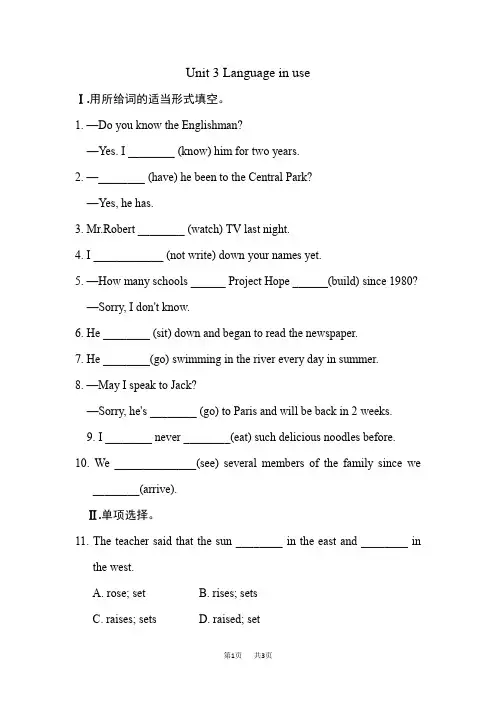
Unit 3 Language in useⅠ.用所给词的适当形式填空。
1. —Do you know the Englishman?—Yes. I ________ (know) him for two years.2. —________ (have) he been to the Central Park?—Yes, he has.3. Mr.Robert ________ (watch) TV last night.4. I ____________ (not write) down your names yet.5. —How many schools ______ Project Hope ______(build) since 1980?—Sorry, I don't know.6. He ________ (sit) down and began to read the newspaper.7. He ________(go) swimming in the river every day in summer.8. —May I speak to Jack?—Sorry, he's ________ (go) to Paris and will be back in 2 weeks.9. I ________ never ________(eat) such delicious noodles before.10. We ______________(see) several members of the family since we________(arrive).Ⅱ.单项选择。
11. The teacher said that the sun ________ in the east and ________ inthe west.A. rose; setB. rises; setsC. raises; setsD. raised; set12.—I ________ to the cinema yesterday.—It's a pity. You didn't invite me.A. goB. wentC. have gone13. —Mike, why are you watching TV again?—I ________ my homework.A. finishB. finishedC. have finishedD. had finished14. My grandmother ________ in Yangzhou. She was born there and hasnever lived anywhere else.A. livedB. livesC. was livingD. will live15. —Y unnan is very beautiful. I ________ there last year.—Yes, I ________ there twice.A. went; have goneB. went; have beenC. have gone; wentD. have been; went16. Don't worry. Bill will help you look after your dog when you________ away on business.A. areB. wereC. will beD. have been答案Ⅰ.1.have known 2.Has 3.watched 4.haven't wrote5. has; built6.sat7.goes8.gone9.have; eaten10. have seen; arrivedⅡ.11.B 12.B 13.C 14.B 15.B16. A点拨:when引导的时间状语从句,遵循主将从现的规则,故此处用一般现在时。
外研版英语八下Module5《Cartoons》(Unit3)说课稿

外研版英语八下Module 5《Cartoons》(Unit 3)说课稿一. 教材分析外研版英语八下Module 5《Cartoons》(Unit 3)是一篇关于卡通动画的阅读材料。
本节课的主要内容是让学生通过阅读一篇关于卡通动画的文章,了解卡通动画的发展历程、种类以及制作过程,提高学生的阅读理解能力。
文章中涉及到了许多与卡通动画相关的词汇和表达方式,同时也要求学生能够运用所学知识进行简单的口语表达和写作。
二. 学情分析根据对学生的了解,他们在学习这个模块之前已经掌握了一定量的词汇和基本的语法知识,同时也具备了一定的阅读理解能力。
但是,他们在学习过程中还存在一些问题,比如对某些词汇的理解不准确,阅读理解能力有待提高,以及口语表达和写作能力的不足。
因此,在教学过程中,我需要针对这些问题进行有针对性的教学。
三. 说教学目标根据教材和学情分析,我制定了以下教学目标:1.知识目标:让学生掌握文章中出现的关键词汇和表达方式,了解卡通动画的发展历程、种类以及制作过程。
2.能力目标:通过阅读理解,提高学生的阅读能力;通过口语表达和写作,提高学生的语言运用能力。
3.情感目标:激发学生对卡通动画的兴趣,培养他们的创新意识和审美情趣。
四. 说教学重难点1.教学重点:让学生掌握文章中出现的关键词汇和表达方式,了解卡通动画的发展历程、种类以及制作过程。
2.教学难点:对某些词汇的准确理解,阅读理解能力的提高,以及口语表达和写作能力的培养。
五. 说教学方法与手段为了达到教学目标,我采用了以下教学方法与手段:1.任务型教学法:通过设定各种任务,让学生在完成任务的过程中运用所学知识,提高他们的语言运用能力。
2.情境教学法:创设各种情境,让学生在真实的环境中学习,提高他们的学习兴趣和积极性。
3.合作学习法:学生进行小组讨论和合作,培养他们的团队精神和沟通能力。
4.多媒体教学手段:运用多媒体课件和视频素材,丰富教学内容,提高学生的学习兴趣。
最新初中英语外研版八年级下Module 5 Unit 3教案
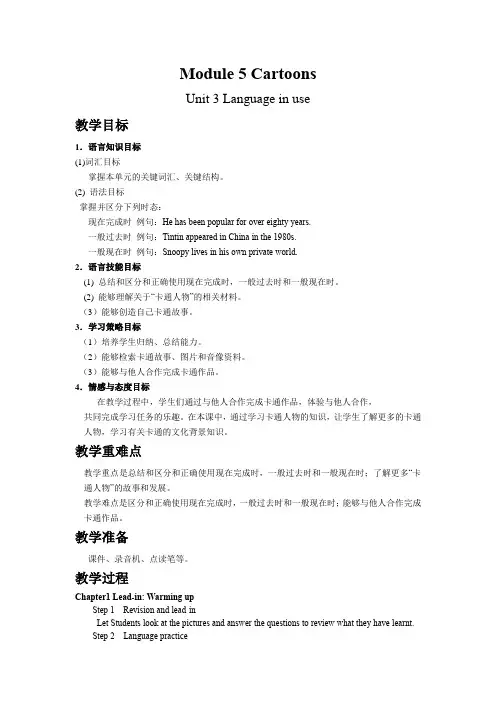
Module 5 CartoonsUnit 3 Language in use教学目标1.语言知识目标(1)词汇目标掌握本单元的关键词汇、关键结构。
(2) 语法目标掌握并区分下列时态:现在完成时例句:He has been popular for over eighty years.一般过去时例句:Tintin appeared in China in the 1980s.一般现在时例句:Snoopy lives in his own private world.2.语言技能目标(1) 总结和区分和正确使用现在完成时,一般过去时和一般现在时。
(2) 能够理解关于“卡通人物”的相关材料。
(3)能够创造自己卡通故事。
3.学习策略目标(1)培养学生归纳、总结能力。
(2)能够检索卡通故事、图片和音像资料。
(3)能够与他人合作完成卡通作品。
4.情感与态度目标在教学过程中,学生们通过与他人合作完成卡通作品,体验与他人合作,共同完成学习任务的乐趣。
在本课中,通过学习卡通人物的知识,让学生了解更多的卡通人物,学习有关卡通的文化背景知识。
教学重难点教学重点是总结和区分和正确使用现在完成时,一般过去时和一般现在时;了解更多“卡通人物”的故事和发展。
教学难点是区分和正确使用现在完成时,一般过去时和一般现在时;能够与他人合作完成卡通作品。
教学准备课件、录音机、点读笔等。
教学过程Chapter1 Lead-in: Warming upStep 1 Revision and lead-inLet Students look at the pictures and answer the questions to review what they have learnt.Step 2 Language practiceTo master the three tenses.用适当的单词补全句子。
1. He ____ _____ popular for over eighty years.2. Tintin _________ in China in the 1980s.3. Snoopy ________ in his own private world.Answer:has been, appeared, livesChapter 2 The students can learn by themselves, and ask some questions about the study.Step 3 Complete the conversation with the correct form of the words in brackets1. Read the dialogue carefully.2. Use the correct form of the words in brackets to fill in the blanks.Daming: Hi, Tony. What are you reading?Tony: The Adventures of Tintin. It’s fantastic. (1)_____ you __________(ever read) a Tintin book?Daming: No, I (2)_______________ (never read) a Tintin story. (3)_____ (be) they popular?Tony: Yes, they (4)__________(be) popular for more than eighty years. The first Tintin story (5)________(appear) in 1929.Daming: What does Tintin do?Tony: He (6)_______ (work) for a newspaper and he (7) ______ (have) lots of exciting experiences.Daming: And (8)_____ the stories ______(have) happy endings?Tony: Oh, yes, they always do.Daming: Sounds great! Do you mind if I borrow your book?Step 4 Complete the passage with the correct form of the words in bracketsRead the passage carefully. Use the correct form of the words in brackets to fill in the blanks.When I was young, I (1)_________ (not like) green vegetables. The only vegetable I (2) ____ (eat) was potatoes. I was quite small and not very strong, so I was not very good at sport.Then when I (3)_____________ (watch) television one day I saw the cartoon Popeye. When Popeye stands next to the bad man, Bluto, he(4)_______ (look) small and weak, and when they fight, he always (5)______ (lose). Then he eats some green vegetables. His arms(6)_______ (grow) thicker. He becomes stronger and he wins his fights. The next day I was going to play football at school, so I asked my mother for some green vegetables. I(7)________ (score) three times and we won the match! I (8)__________ (love) greenvegetables ever since.Step 5 Complete the passage with the words in the box1. Read the passage carefully.2. Use the correct form of the words in the box to fill in the blanks.Many people love cartoons because they are great fun.Parents and children (1)______ together as the Monkey King makes a terrible (2)_____ or Shrek, the (3)_____ green animal, sing a song. Cartoon heroes often live in a(n)(4)______ world of their (5)_____.Artists (6)_______ good cartoon heroes as well as bad people. The heroes always win, and their stories (7)______ us and help us feel safe.Chapter 3 The students can learn the main point with the help of the teacher, and solve the problems.Step 6 Work in pairs and decide on the best order for the pictures1.Look through the picture and discuss in pairs.2.Draw the correct answers from other group.Step 7 Now listen and checkNow listen and check which one is right.Step 8 ListeningListen to Part 5 and answer the questions.1. Why does Betty not think the cartoon is funny at first?2. Why does Tony think the cartoon is really clever?Step 9 Learning to learnLearn about how to listen to a word you don’t know.When you’re listening, do not stop paying attention when you hear a word you do not know. Keeping listening. The word might not be important, or the speaker may say something to explain its meaning.Step 10 ListeningListen to Part 6 and answer the questions.1) Where did the first cartoon appear?2) When did Walt Disney start to make films?3) Was Mickey Mouse Walt Disney’s most famous cartoon character?Step 11 Read the passage and complete the sentencesRead the passage in Part 6 and fill in the blanks.Step 12 Around the worldLearn about classical American cartoons.阅读本单元的Around the world部分,然后判断正(T)误(F)。
Module 5 Cartoons Unit 3 Language in use 教案4-优质公开课-外研八下精品

Unit 3 Language in use 教案【教学目标】Knowledge objective要求运用所给词汇描述对卡通的感受Moral objectiveTo be glad to listen to others’ opinions and enjoy the splendid cartoon culture in the world.【教学重点】要求学生自创、自编并自演动画故事【教学难点】consolidate the new words and expressionsarise discussion and guide students to ask questions and find answers on their own【教学方法】PWP method, task-based method and interactive approach【教学手段】A tape recorder, multimedia and some pictures【教学过程】Teaching Procedures:Step 1 Words, Phrases consolidation (Activity 8&9)In this procedure, students are provided some background knowledge to help them to finish the task in Activity 8. Meanwhile, their vocabulary is enlarged.The following is the material which shows the background knowledge of Mao Xiale:Cartoonist Mao Xiaole was born in the 1970s in northeast China. A happy-go-lucky guy with an off-beat sense of humor, he started drawing cartoons as a child. He became a professional cartoonist after short stints as a teacher, a government worker and a company employee. He has published 6 collections of comics.T: After reading the interview on Miao Xiaole, it’s easy for you to choose the correct words to complete the passage in Activity 8. Now please check the answers in groups.T: Are you ready? Let’s co me to Activity 9, please finish the short interview on the cartoonist called Jill. You can also use the material of Miao Xiaole to help you. Ask and answer in pairs.A sample dialogue:S1(Mike)Excuse me, can I have a word with you? I’ve been a fan of your work ever since I was a child. I’d like to show you some of my cartoons. They’re over there on the wall. Would you like to come and see them?S2 (Jill) Thank you. I’d like to see them. If you want to be a cartoonist, it’s very important to be able to draw, and your drawings are very good.Step 2 Around the worldLook at the pictures and let students read after the teacher.Ask the students to find out the sentences with attributive clause and then explain the phrases like this: two of the most famous American cartoons; be created a little more recently; appear in comic books; daily newspaper; in over 500 different newspaper; be made into; popularize sb. more widely; try to imitate sb.; the main thing; learn from sb.; do good things for people; in troubleLet students read it fluently and master the phrases.Step 3 Writing a cartoon story (Activity 10 and 11)Look at the questions in Activity 10 and form a group to discuss these questions.T: Carry on a co-operative job to finish the writing task in activity 11, Showing us your cartoon story by drawing pictures as well as writing a composition.A sample composition:One day, a wolf is so careless that he falls into a well. He can’t climb ou t of the well. He is very anxious. At that time, a goat walks to the well because he wants to drink some water. He asks the wolf how the water in the well is like. The wolf says it is sweet and clear. He asks the goat to come down into the well. The goat does so without thinking. After he finishes drinking the water. He talks over with the wolf about the way of getting out. The wolf is very tricky. He tells the goat that he gets out of the well by jumping from the goat’s back, then he pulls him out. The goats believes in the wolf and helps the wolf go out. But the wolf wants to leave alone and laughs at the goat’s foolishness.Step 4 HomeworkAsk the students to create their own cartoon character and compile their own cartoon story.Make a self-a ssessment of “I can say” ”I can ask” ”I know these words” on the workbook P147.。
初中英语外研版八年级下册《Module 5 Cartoon stories Unit 3 Langu
一样将来时表示在将来的某个时间打 算要做的事或对未来的猜测等。如: I’m going to see the XXXrise tomorrow. Robots will help us do lots of heavy jobs in the future. 常用be going to +动原或will+动原构成 Are you going to see the doctor? Will people live on the moon? I’m not going to wear jeans. He won’t come with us.
D:What does Tintin do?
T:He (6)__w_o_r_k_s_ (work) for a newspaper and he (7) ____h_a_s_ (have)
lots of exciting experiences.
D:And (8)__d_o____the storiehsav_e______(have) happy endings?
Grammar
一样现在时与一样将来时
一样现在时表示常常性动作、现 阶段状态或客观真谛等。如: I often have dinner at 6:30. She is a student now. The earth goes around the XXX. 谓语动词用动词原形或第三人称 单数 Do you have dinner at 6:30? Does he have dinner at 6:30? I don’t have dinner at 6:30. He doesn’t have dinner at 6:30.
Module 5 Cartoon stories
外研版八年级下册英语Module 5 Cartoons《Unit 3 Language in use》课件
• A: What cartoons do you like watching on TV? • B: I like watching... • A: When did you watch the cartoon ? • B: I watched it... • A:Have you ever wanted to be a man like the hero? • B:Yes, I have / No, I haven’t.
bad man, Bluto, he(4)_______ looks (look) small and weak, and when they fight, he always loses (lose). Then he eats some green (5)______ grow (grow) thicker. vegetables. His arms(6)_______ He becomes stronger and he wins his fights. The next day I was going to play football at school, so I asked my mother for some green scored (score) three times vegetables. I (7)________ have loved (love) and we won the match! I (8)__________ green vegetables ever since.
Simple present tense (一般现在时)
Action/Event
Past
Present
Say the tense of the sentences.
初中英语外研版八年级下册《Module 5 Cartoons Unit 3 Language in
难点
1、学会创作自己的英文故事剧本,掌握说明文的文段结构及时态的恰当使用。
2、培养观察归纳、听说读写的综合运用及创新能力。
教学过程
教学环节
教师活动
学生活动
设计意图
Step1:
Warming-up
课前互动
展示任务要求,要求学生跟读模块单词录音。参与记忆游戏,要求学生在3秒内快速说出所见词对应的中文词义及英文拼读。
3、播放视频“大力水手”,指导学生阅读完成Activity 2,提问式核对答案。
4、指导学生限时完成Activity 3的选词填空题,两人组核对答案。
5、展示Activity 4的图片,要求学生快速排序后进行口语表达,播放音频核对答案。两人组完成Activity 5中的问题。
6、展示Activity6的图表填空题,播放录音要求学生限时完成,检查答案。
巩固时态的综合运用。
巩固时态,提高阅读与写作能力。
提高合作能力
提高观察与口语表达能力
提高阅读能力。
拓展阅读知识面。
合作交流,提高口语表达与创新能力,交流学习。
Step3:
Practice
实战演练
课堂练习
完成练习。
巩固重难点。
Step4
Homework
课后巩固
布置作业
选用合适的插图,编写英文动画故事,与同学交流朗读。
4、限时完成Activity 3的选词填空题,两人组核对答案。
5、根据图片快速排序后进行口语表达,听音频核对答案。两人组完成Activity 5。
6、浏览图表填空题,听录音,限时完成,检查答案。
7、快速阅读Around the world.
外研版八年级英语下册Module 5 Cartoons《Unit 3 Language in use》教案
外研版八年级英语下册Module 5 Cartoons Unit 3 Language in use【教材简析】外研版八年级英语下册Module 5 Cartoons 是以卡通故事为话题,而卡通故事是少年儿童喜欢的话题,每个学生都有自己喜欢的卡通故事,所以本模块内容能够激发学生的学习兴趣和参与意识。
第一单元是Daming和Tony的对话,两人讨论做完作业后看什么动画片,从对话中可以看出两人的不同爱好。
但最终两从达成一致意见,看《猫和老鼠》。
第二单元介绍了几个很受欢迎的卡通形象,包括了美猴王、史莱克、尼莫、丁丁和史努比等。
这些卡通人物之所以为人们所喜爱的原因,并介绍艺术家创造这些卡通人物背后的故事。
这一模块的语法重点是对不同时态的综合运用,并分清各种时态所运用的地方。
本模块的Leaning to lean专栏中为学生提示了听力技巧,让学生在听听力时,有目的性的听。
Around the world部分介绍了美国比较经典的两个卡通故事。
本模块的任务是要求学生创作自己的卡通作品,分为策划、实施和展示三个步骤。
【教学目标】知识与技能目标:1.语言知识目标:(1)能够谈论卡通片和卡通人物;(2)能够综合运用一般过去时、一般现在时和现在完成时(3)能够根据情感态度的表达确定句子重音;(4)能够识别对话中提及的卡通故事和人物;(5)能够识别说话人对卡通故事及卡通人物的态度;(6)能够询问及回答有关卡通故事和卡通人物的信息;(7)能够读懂以卡通为主题的短文并提取相关信息;(8)能够描写自己喜欢的卡通人物和卡通故事;(9)能够展示卡通故事、介绍卡通作品和演示卡通故事;(10)能够正确运用各种时态。
2.学习策略:(1)能够检索卡通故事、相关图片及音像资料。
(2)能够与他人合作完成卡通作品。
3.文化意识:通过阅读卡通故事了解不同国家的文化。
4.情感态度:(1)能够就卡通故事或卡通人物进行交流,尊重他人的态度,倾听他人的不同意见.(2)能够与他人合作,创作自己的卡通故事.【教学重点】1、训练学生的听、说、读、写能力;2、引导学生有目的的听,培养学生有效的听力学习策略.3.通过任务型阅读教学引导,将复杂的文章简化,帮助学生理清文章的脉络。