
主谓一致(二)大学版
主谓一致一.以-s结尾的名词作主语的主谓一致问题1.以-s结尾的疾病名称和游戏名称⏹英语中有一些疾病名称是以-s结尾的,如arthritis(关节炎), bronchitis(支气管炎), rickets(软骨病), mumps(腮腺病), diabetes(糖尿病), phlebitis(静脉炎)等,这类名词通常作单数用,例:Mumps is a kind of infectious disease.⏹但也有一些疾病名称如measles(麻疹), rickets(佝偻病)既可作单数也可作复数用,例:Generally, measles occurs in children.Measles are sometimes caused by a tapeworm(绦虫).Rickets is /are caused by malnutrition(营养不良).●表示游戏名称的名词,如:darts(投镖游戏), marbles(打弹子游戏)等,通常作单数用。
●但也有个别表示游戏名称的名词,如:cards(打纸牌),作复数用。
●当darts, marbles等用于做这些游戏所用的镖或子弹等意义时,其复数形式仍作复数用,例:Three darts(三只镖)are thrown at each turn.Marbles(各种子弹)vary in kind and quality.2.以-ics结尾的学科名称◆某些以-ics结尾的学科名称,如physics(物理学), mathematics(数学),mechanics(机械学), optics(光学), acoustics(声学), politics(政治学), statistics(统计学), economics(经济学), linguistics(语言学), athletics (体育学), tactics(兵法)等,通常作单数用。
◆但若这类名词表示“学科”以外的其他意义,便可作复数用,例:My mathematics(运算能力)is /are rather shaky.Athletics(体育运动)have been greatly promoted at this college.The acoustics(音响效果)in the new concert hall are faultless.The tactics(策略)employed in this campaign were above reproach.(无可指责)The economics(经济意义)of the project are still being considered.3.以-s结尾的地理名称✧某些以-s结尾的地理名称,如果是国名,如the United States, the UnitedNations(联合国),the Netherlands(荷兰)等,尽管带有复数词尾,但系单一政治实体,故作单数用。
✧但若不是国名,而是群岛、山脉、海峡、瀑布等地理名称,通常作复数用,如:the West Indies(西印度群岛), the Bahamas(巴拿马群岛), the Himalayas(喜马拉雅山脉), the Straits Gibraltar(直布罗陀海峡), the Niagara Falls(尼亚加拉大瀑布)等。
4.其他以-s结尾的名词⏹英语中有一些由两个部分组成的物体名称通常是以-s结尾,如scissors(剪子),pincers(钳子),glasses, shorts, trousers, suspenders(吊带裤)等。
这类名词,如果不带“一把”、“一副”、“一条”等单位词而单独使用,通常作复数,例:The sugar-tongs are not in the sugar bowl.⏹如果带有单位词,则由单位词的单复数形式决定动词的单复数形式,例:One pairs of scissors isn’t enough.Two pairs of pliers, one large and one small, are missing from my tool box.●英语中还有一些以-s结尾的名词,如archives(档案), arms(武器),clothes, contents(内容,目录), eaves(屋檐), fireworks, goods(货物), minutes(记录), morals(道德,品行), remains(遗体), stairs (楼梯), suburbs(郊区), thanks(谢意), wages(工资)等,通常作复数。
●但也有少数这类名词作单复数均可:whereabouts(行踪),dramatics(舞台艺术)◆凡是以-ings结尾的名词,如clippings(剪下来的东西), diggings(掘出的东西), earnings(收入), filings(锉屑), lodgings(租住的房间), surroundings(环境), sweepings(扫拢的垃圾)等,通常作复数用。
◆但也有例外,如tidings(消息)既可作复数,也可作单数用,例:Good tidings have cheered them up.The tidings has come a little too late.✧还有一些以-s结尾的单复数同形的名词,如barracks(营房),headquarters(总部), means(方法,手段), series(系列), species(种类), works(工厂)等,随后动词的单复数形式取决于这些名词是用作单数还是用作复数,例:A barracks was stormed by the enemy.Two barracks in the suburbs have been surrounded.✧但也有少数这类名词用作单数和用作复数意义不同,如odds(单:小事,复:机会),例:What’s the odds?有什么要紧?The odds are against us.我们成功的机会很小。
二.以集体名词作主语的主谓一致问题1. 通常作复数的集体名词:police, people, cattle, militia(民兵),poultry(家禽),vermin(害虫)等。
2.通常作不可数名词的集体名词:foliage, machinery, equipment, furniture, merchandise(商品)等,随后动词用单数。
3.既可作单数也可作复数的集体名词:audience, committee, class(班级), crew(全体船员或机组人员), family, government, public(公众)等。
如将各该名词所表示的集体视为一个整体,则动词用单数。
如将侧重点放在组成集体的成员上,动词用复数。
4.a committee of等+复数名词如果主语是由“a committee of /a panel of /a (the) board of + 复数名词”构成,随后的动词通常用单数,例:A committee of five men and three women is to consider the matter.三.以并列结构作主语的主谓一致问题1.由and /both … and连接的并列主语由and /both … and连接的并列结构作主语,如果意义为复数,谓语动词用复数,例:The fishing and the hunting in Arizona were good that year.如果作主语的并列结构不是指两个或两个以上的人或物,而是表示单数意义,则动词用单数。
有一些带连词and的省略结构形似单数,而意义为复数,随后的动词用复数,例:Good and bad taste are inculcated by example.What I say and think are no business of yours.上述两例中,good and bad taste = good taste and bad taste;what I say and think = what I say and what I think当and连接的并列名词词组带有each, every,或者many a等限定词时,随后的动词通常用单数,例:Every boy and every girl in this room is entitled to a copy.Many a man and woman in this community finds himself or herself in need.也有一些由and连接的并列主语,其单复数意义不很明确,这就只能根据上下文判定。
2.由or /nor /either … or等连接的并列主语由or, nor, either … or, neither … nor, not only … but also连接的并列结构作主语,随后的动词形式通常按照“就近原则”处理。
3.主语+as much as等当主语后面跟有由as much as, rather than, more than, no less than等引导的从属结构时,随后的动词形式依主语本身的单复数而定,例:Some of the workers as much as the managers were responsible for the loss.His brother rather than his parents is to blame.4.主语+as well as等当主语后面跟有由as well as, in addition to, with, along with, together with, except等引导的词组时,其后的动词形式也取决于主语本身的形式(随前原则),例:The manager with some workers was working during the holidays.四.以表示数量概念的名词词组作主语的主谓一致问题1.以表示确定数量的名词词组作主语a)如果数量概念被看作一个整体,动词用单数;如果被看作组成该数量的一个个的个体,则动词用复数,例:Six months is too short a time, General Westmoreland warned.Five hours is needed to complete the outline.There were six silver dollars in each of the stockings.b)如果作主语的名词词组是由“分数(或百分数)+of-词组”构成,其动词形式依of-词组中名词类别而定,例:Over sixty percent of the city was destroyed in the war.Thirty-five percent of the doctors were women.c)两数相减或相除,动词用单数;两数相加或相乘,动词用单复数均可,例:Forty minus fifteen (40-15) leaves twenty-five.Forty divided by eight (40÷8) is five.Seven plus /and five (7+5) makes /make twelve.Five times eight (5×8) is /are forty.d)如果主语由“one of /one out of +复数名词”构成,在正式语体中,动词用单数;在非正式语体中,动词也可按“就近原则”用复数,例:One in ten students has failed the exam.One out of twenty was badly damaged.比较:One in ten students have failed the exam.One out of twenty were badly damaged.2.以表示非确定数量的名词词组作主语a)如果主语是all of …, some of …, none of …, half of …, most of …等表示非确定数量的名词词组,其后的动词形式依of-词组中的名词类别而定,例:Some of the money has been stolen.Some of the books were lost.b)如果主语是由“lots of, heaps of, loads of, scads of, plenty of +名词”构成,表示“许许多多”等概念时,随后动词的单复数形式也依of-词组中名词类别而定,例:Lots of food is going to waste.Lots of people are waiting outside.c)如果主语是由“a portion of, a series of, a pile of, a panel of +名词”构成,不管名词的类别为何,动词通常用单数,例:A series of accidents has been reported.d)如果主语是由“限定词+ kind /type /sort of +名词”构成,随后的动词形式按以下规则:①在a kind /sort /type of, this kind /sort /type of之后通常跟单数或不可数名词,动词用单数。
主谓一致知识点总结
主谓一致知识点总结主谓一致是英语语法中的一个重要知识点,指的是句子中的主语和谓语在人称和数上保持一致。
具体来说,如果主语是单数形式,则谓语动词也要用单数形式;如果主语是复数形式,则谓语动词也要用复数形式。
以下是主谓一致知识点的总结。
一、主语和谓语的一致性1.主语和谓语一致的基本原则是:单数主语与单数谓语相对应,复数主语与复数谓语相对应。
例如:- He reads books.(单数)- They read books.(复数)2. 如果主语是由含有“and”连接的两个或更多个成分构成的,谓语动词应该用复数形式。
例如:- Tom and Jerry are friends.3. 如果主语中有两个或更多个名词,用and连接,但其中有一个名词是表示无数概念的名词(具体名词或抽象名词),那么谓语应该用单数形式。
例如:- Bread and butter is my favorite breakfast.4. 如果主语是由连词“either…or”或“neither…nor”连接的两个名词构成的,谓语动词的单复数应与紧挨着的名词一致。
例如:5. 如果主语是由连词“not only…but also”连接的两个名词构成的,谓语动词的单复数应与紧挨着的名词一致。
例如:- Not only the teacher but also the students are going to the park.二、主谓一致的特殊情况1. 主语是以“everyone, everybody, someone, somebody, no one, nobody, anyone, anybody, each”等单词开头的不定代词时,谓语动词应该用单数形式。
例如:- Everyone knows the answer.2. 对于由and连接的两个主语,如果它们指的是同一个人或同一个物,谓语动词应该用单数形式。
例如:- Tom and Jerry is a famous cartoon.3. 对于固定短语“a number of + 名词”,谓语动词应该用复数形式。
大学英语语法汇总
大学英语语法汇总一、名词(一)以S结尾的名词做主语的主谓一致1、以s结尾的疾病和游戏arthritis,bronchitis,rickets,measles,mumps,diabetes,darts,marbles做主语时谓语动词应使用单数形式。
例:Arthritis causes pain in the joints.特殊情况:有一些疾病/游戏名词作谓语动词可单可复:measles,ricketsCards做主语动词用复数;darts,marbles指游戏使用的具体的镖和弹子意义时,谓语动词marbles可单可复,darts用复数形式。
例:Measles always cccur/occurs among kids.Nine darts are thrown at each turn.2、以s结尾的学科名称physics,mathematics,optics,acoustics,politics,athletics,tactics,linguist ics,etc做主语时谓语动词使用单数。
例:Mathematics is always a headache for girls.Politics always attracts boys.特殊情况:如果这些词并不是只带“学科”等意义,谓语动词便可做复数使用。
例如,mathematics运算能力,athletic体育运动,acoustics音响效果,tactics策略,economics经济学意义。
例:The acoustics in Bon Jovi’s Tulsa concert were beyond criticism last spring.3、以s结尾的地理名称The States,the united states,the Netherlands,the Philippines,the United Arab Emirates,the United Nation做主语时,谓语动词使用单数。
大学主谓一致教案
课时:2课时教学目标:1. 让学生掌握主谓一致的基本概念和原则。
2. 培养学生运用主谓一致规则的能力,提高语法水平。
3. 培养学生的逻辑思维能力和语言运用能力。
教学重点:1. 主谓一致的基本原则:语法一致、意义一致、就近一致。
2. 主谓一致的常见错误类型及修改方法。
教学难点:1. 主谓一致原则在实际句子中的应用。
2. 主谓一致的复杂情况及处理方法。
教学准备:1. 教师准备相关课件、练习题等教学材料。
2. 学生预习教材,了解主谓一致的基本概念和原则。
教学过程:第一课时一、导入1. 教师简要介绍主谓一致的概念和重要性。
2. 引导学生思考主谓不一致的常见情况,激发学生的学习兴趣。
二、新课讲解1. 主谓一致的基本原则:a. 语法一致:主语和谓语在单复数形式上要保持一致。
b. 意义一致:根据主语的实际意义确定谓语的单复数形式。
c. 就近一致:当主语由多个词构成时,谓语动词的形式取决于最靠近它的主语。
2. 主谓一致的应用:a. 集体名词作主语时,根据集体名词的实际意义确定谓语的单复数形式。
b. 名词作主语时,根据名词的复数形式确定谓语的单复数形式。
c. 不定代词、数词、量词等作主语时,根据其意义确定谓语的单复数形式。
三、课堂练习1. 教师出示练习题,学生独立完成。
2. 教师讲解练习题,分析错误原因,纠正学生错误。
四、总结1. 教师总结本节课所学内容,强调主谓一致的重要性。
2. 布置课后作业,巩固所学知识。
第二课时一、复习导入1. 教师提问上节课所学内容,检查学生对主谓一致原则的掌握情况。
2. 引导学生回忆主谓不一致的常见错误类型。
二、新课讲解1. 主谓不一致的常见错误类型及修改方法:a. 误用单复数:根据主语的实际意义确定谓语的单复数形式。
b. 误用主谓一致原则:根据主谓一致的基本原则进行修改。
c. 误用就近一致原则:根据就近一致原则进行修改。
2. 复杂情况及处理方法:a. 名词作主语时,根据名词的复数形式确定谓语的单复数形式。
大学英语语法 主谓一致
2.2 Problems of concord with nouns ending in–s
4. Other nouns ending in –s 2) Nouns usually taking plural endings: plural archives, arms, clothes, contents, eaves, fireworks, goods, minutes, morals, remains, stairs, suburbs, thanks, wages 3) Nouns ending in -ings: plural clippings, diggings, earnings, filings, lodgings, surroundings, sweepings
5. The police ____ are looking for the missing child.
6. His family ____ is a great one. 7. His family ____ are all music lovers. 8. Not every means ____ is useful. are useful. 9. Not all means ____ 10. It was late, but the audience was ____ increasing. 11. The audience ______ were all moved to tears.
next
3.1 Problems of concord with a coordinate subject
2. a kind / sort / type of , this kind / sort / type of之后 通常跟单数或不可数名词,动词用单数 This kind of man annoys me. 这样的结构中,通常不用复数名词,通常不说 this kind of roses, 如果要用复数,就得说: Roses of this kind are very sweet. 出现在these kinds of, many / several kinds of 之后 的名词,既可以是单数或不可数名词,也可以是 复数名词,动词都用复数。 在非正式语体中,还常见“these/ those kind of + 复数名词”的结构,其后动词用复数。
(完整版)主谓一致用法总结
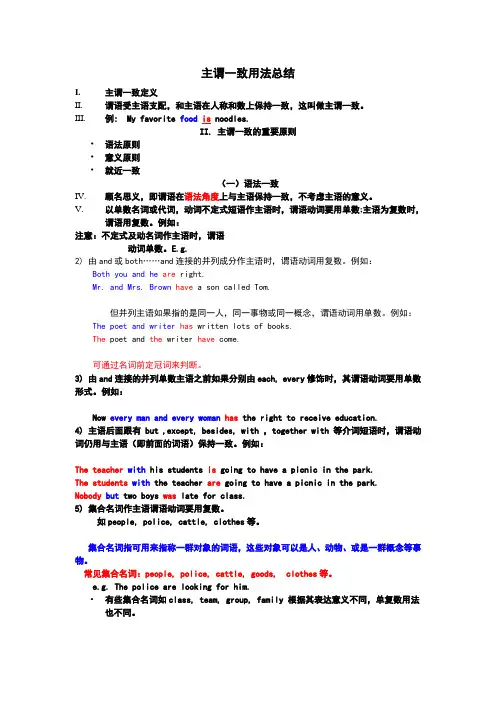
主谓一致用法总结I.主谓一致定义II.谓语受主语支配,和主语在人称和数上保持一致,这叫做主谓一致。
III.例: My favorite food is noodles.II. 主谓一致的重要原则•语法原则•意义原则•就近一致(一)语法一致IV.顾名思义,即谓语在语法角度上与主语保持一致,不考虑主语的意义。
V.以单数名词或代词,动词不定式短语作主语时,谓语动词要用单数;主语为复数时,谓语用复数。
例如:注意:不定式及动名词作主语时,谓语动词单数。
E.g.2) 由and或both……and连接的并列成分作主语时,谓语动词用复数。
例如:Both you and he are right.Mr. and Mrs. Brown have a son called Tom.但并列主语如果指的是同一人,同一事物或同一概念,谓语动词用单数。
例如:The poet and writer has written lots of books.The poet and the writer have come.可通过名词前定冠词来判断。
3) 由and连接的并列单数主语之前如果分别由each, every修饰时,其谓语动词要用单数形式。
例如:Now every man and every woman has the right to receive education.4) 主语后面跟有 but ,except, besides, with ,together with 等介词短语时,谓语动词仍用与主语(即前面的词语)保持一致。
例如:The teacher with his students is going to have a picnic in the park.The students with the teacher are going to have a picnic in the park.Nobody but two boys was late for class.5) 集合名词作主语谓语动词要用复数。
【推荐下载】新概念英语第二册语法讲解:主谓一致
[键入文字]
新概念英语第二册语法讲解:主谓一致
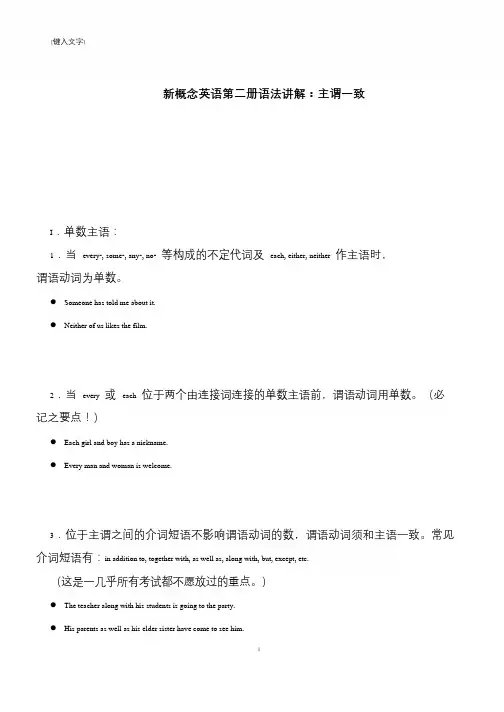
I.单数主语:
1.当every-, some-, any-, no- 等构成的不定代词及each, either, neither 作主语时,谓语动词为单数。
●Someone has told me about it.
●Neither of us likes the film.
2.当every 或each 位于两个由连接词连接的单数主语前,谓语动词用单数。
(必
记之要点!)
●Each girl and boy has a nickname.
●Every man and woman is welcome.
3.位于主谓之间的介词短语不影响谓语动词的数,谓语动词须和主语一致。
常见
介词短语有:in addition to, together with, as well as, along with, but, except, etc.
(这是一几乎所有考试都不愿放过的重点。
)
●The teacher along with his students is going to the party.
●His parents as well as his elder sister have come to see him.
1。
(完整版)英语语法主谓一致
1.主谓一致是指英语中谓语在人称、数及意义方面要与作主语的名词或代词一致。
2.主谓一致分为语法一致、意义一致、就近一致。
(1)语法一致原则:主语和谓语在语法形式上保持一致。
主语为单数,谓语用单数;主语为复数,谓语用复数。
I often help him and he often helps me.(2)意义一致原则:主语和谓语在意义上单复数一致。
主语为单数,谓语用单数;主语为复数,谓语用复数。
The police are searching the woods for the murderer.(3)就近一直原则:当主语有两个或两个以上时,谓语动词由靠近它的主语确定。
并列主语的谓语一致1.And(1)两个单数名词用and连接,表示不同概念时,谓语用发复数。
Tom and Jack are close friends.(2)两个单数名词用and连接,表示同一歌人、同一个物,同一个概念,或表示不可分割的整体时,谓语用单数。
The singer and dancer is to attend our evening party.(3)被every,each,many a,no等限定的单数名词由and连接时,谓语仍用单数,其中,后一个限定词可以省略。
every ……and ……every,each……and……each,no……and……no, many a……and……many a。
Each boy and (each) girl has an apple.(4)一个单数名词被几个用and连接的并列形容词修饰时,可以指一件事或几件事,这种名词作主语,要根据意义一致的原则决定单复数。
Simple and plain living is a fine quality.生活简朴一种优良品质。
Ancient and modern history are the subjects we are studying.(5)由and连接的两个what的从句作主语时,要根据意义一致的原则决定单复数What he says and does do not agree.(言行不一致)What he says and does does not concern me.2.由either or, neither nor, not but, not only but also,or, nor连接的并列主语,谓语动词常和邻近的主语一致。
主谓一致详解(含真题讲解)
主谓一致详解(附历年高考真题)主谓一致的关键在主语,主语的关键在名词。
一致,其中,最重要的是数的一致,即,主语的单/复数决定谓语的单/复数。
应该注意的是,主语的数是复数时加s,而谓语的数是单数时加s。
刚好相反。
(见右表)。
如,I bought three watches yesterday.(名词,复数时加-(e)s)。
He w atches TV every day.(动词,单数时加-(e)s)主谓一致的根本原则是意义一致原则。
①主谓一致,一般情况下采用意义一致原则。
什么是意义一致原则呢?无论主语是单数形式还是复数形式,若表示单数意义,则谓语用单数;若表示复数意义,则谓语用复数。
②主谓一致,个别情况下采用就近一致原则(可以看做权宜之计)。
什么是就近一致原则呢?在某些并列主语情况下,按照紧挨着谓语的那个主语来确定谓语的数。
一.使用主谓一致原则,首先得找到主语使用主谓一致原则,首先得找到主语。
谓语的左边紧挨着的词或短语,并非就是主语。
常见有三种情况妨碍我们找到主语:1. 排除定语或状语(如介词短语)的干扰,找到主语。
主语后常跟的定语或状语有:①表示增加的:with, along with, together with;as well as, as mu ch as;in addition to, accompanied by, besides, plus等。
②表示减去的:b ut(除去),except等。
③表示补充说明的:such as, like, including, rather tha n等。
如,●The man (together) with his children sits on the sofa watching TV.●The teacher as well as the students was excited.2.找到省略了的主语。
常见于“所有格或物主代词+(省略掉的名词)”。
大学英语语法主谓一致PPT45页
拉
60、生活的道路一旦选定,就要勇敢地 走到底 ,决不 回头。 ——左
大学英语语法主谓一致
26、机遇对于有准备的头脑有特别的 亲和力 。 27、自信是人格的核心。
28、目标的坚定是性格中最必要的力 量泉源 之一, 也是成 功的利 器之一 。没有 它,天 才也会 在矛盾 无定的 迷径中 ,徒劳 无功。- -查士 德斐尔 爵士。 29、困难就是机遇。--温斯顿.丘吉 尔。 30、我奋斗,所以我快乐。--格林斯 潘。
主谓一致知识点总结
主谓一致知识点总结主谓一致是句子结构中的一种语法规则,指的是主语和谓语在人称和数上保持一致。
主谓一致是表达清晰、符合语法规范的重要要求之一、正确的主谓一致可以使句子更加流畅和易于理解。
以下是关于主谓一致的一些重要知识点总结:1.人称一致:- 第一人称单数主语(I)与动词保持一致,例如:I am a student.(我是一名学生。
)- 第二人称单数主语(you)与动词保持一致,例如:You are my best friend.(你是我最好的朋友。
)- 第三人称单数主语(he/she/it)与动词保持一致,例如:He is a doctor.(他是一名医生。
)2.数一致:- 单数主语与单数动词保持一致,例如:The cat sleeps on the bed.(猫睡在床上。
)- 复数主语与复数动词保持一致,例如:The birds fly in the sky.(鸟儿在天空中飞翔。
)3.特殊情况:- 当主语由连词“or”或“nor”连接时,主谓一致取决于最接近的主语。
如果最接近的主语是单数,那么动词也使用单数形式;如果最接近的主语是复数,那么动词也使用复数形式。
例如:Neither John nor hisfriends want to go to the party.(既不是约翰,也不是他的朋友们想去参加派对。
)- 当主语由连词“either...or”或“neither...nor”连接两个名词时,动词的单复数形式与接近的名词保持一致。
例如:Either the students or the teacher is responsible for the mistake.(既有学生也有老师对这个错误负责。
)- 当主语由连词“and”连接时,如果主语为两个或两个以上的并列名词,动词使用复数形式。
例如:Tom and Jerry are good friends.(汤姆和杰瑞是好朋友。
)- 如果并列名词是一个整体,动词使用单数形式。