
Unit 1 FESTIVALS AROUND THE WORLD
Unit 1 FESTIV ALS AROUND THE WORLD设计主题阅读材料 Festivals and celebrations1.整体设计思路、指导依据说明教学设计理论依据:英语教学是一种动态教学或者活动教学,教学过程是交际活动的过程。
只有从组织教学活动入手,大量地进行语言实践,使英语课堂交际化,才能有效地培养学生的英语交际能力。
《高中英语课程标准》要求我们要改变以往过分强调英语单词和语法知识的简单传授的倾向,加强对学生实际语言能力的培养。
因此,本节课各个环节的教学设计都要突出体现以下几种新理念:1、任务型教学模式(task-based teaching method)2、以学生为主体,重视体验参与3、突出交际性,注重读写的实用性4、正视个体差异,多用积极的正面评价2.教学背景分析一、教材分析:本课是高中英语必修三第1单元,课题是Festivals and celebrations。
这是一节阅读课。
在本单元中处于中心地位。
内容介绍了世界各地不同主题的节日和庆祝活动。
我在本课的教学中将淡化语言点和语法知识的简单传授,采用任务型教学法和小组合作探究学习法,扩大课堂语料输入量和学生的语料输出量,主要锻炼学生的听说与阅读能力。
二、学生情况分析:高中生具有以下两个特点:1、他们已经初步具备了略读、跳读等阅读技巧以及确定主题句,预测材料内容等阅读微技能,形成了基本的阅读策略。
但是很多学生英语基础相对较弱,语言交际能力相对较差。
2、很多学生求知欲旺盛,思维活跃,好胜心强,但学习缺乏主动性,有畏难心理。
因此,教师要通过精心设计使他们感兴趣的活动,用活动教学的方法来调动学生的学习积极性,在师生互动,生生互动的过程中完成教学任务并达到目标。
3.教学目标分析1、认知目标(知识目标):⑴词汇和语言点⑵理解课文大意,用所学词汇复述课文,并用所学词汇与学生交流沟通2、智力目标(能力目标)在运用语言的过程中培养学生观察、分析、思维与自学能力,加强记忆力,提高英语综合运用能力,激发创造能力3、情感目标:利用多媒体手段营造情境,使学生在情境中调动思维活动与情感体验。
激发他们热爱生活的思想感情。
4.教学重点、难点分析一、教学重点:1、使学生对全文做整体理解2、使学生掌握本课的重点单词与词组:celebration starve origin religious in memory of feast belief dress up gain independence ga ther agriculture award admire lunar blossomhave fun with custom…3、找出各段的主题句并归纳本文内容,提高学生运用英语的能力二、教学难点:1、如何利用略读、跳读等阅读技巧和识别关键词、确定主题句、预测文章内容等阅读微技能来形成阅读策略2、如何帮助学生运用阅读策略来促进学习3、怎样以阅读课为依托,全面训练学生听、说、读、写等各方面的能力4、掌握本课的重点单词与词组,提高学生的实践能力5.教学过程设计(中文为主 + 所教学科目标语言)Step1. Warming up:1.Show the students some pictures about different celebrations in different festivals. And let them tal k about the pictures with each other.(设计目的和依据:本环节通过看图讨论来激发学生的学习兴趣,激活已有的背景知识,使学生能够运用已有的知识和经验思考本单元的中心话题。
能起到温故而知新的作用)2. Fill in the chart:As is known to us all, different countries have different festivals. Before you read the passage, ple ase work in groups and list at least three Chinese festivals that you know. Discuss when they take place, what they celebrate and what people do at that time.Festivals Time of year/date What it celebrates What people doMid-Autumn Festival autumn/fall the beauty of thefull moon, harvest,time with family and friends give and eatmoon cakes, watchthe full moon withfamily and friends3. Discussion:Which one is your favorite and why?_______________________________________________________________________________ _______________________________________________________________________________ 4. Predict what will be mentioned in the passage:_____________________________________________________________________________ (设计目的和依据:在读前先让学生讨论本节话题,预测文中要谈到的内容,能降低阅读难度,为后面的阅读环节和讨论环节做好铺垫。
)Step2. Listening and Fast reading一、ListeningListen to the tape and tick out the topics that the author covered in the passage:1. Spring Festivals2.Obon3. Qu Y uan4.Easter5.Thanksgiving Day6.Qi Qiao Festival7.Moth er’s Day二、Skim the reading passage and then fill in the following chart.Kinds of Festivals Names of Festivals CountriesFestivals of the DeadFestivals to Honor PeopleHarvest FestivalsSpring Festivals三、 Read the passage quickly and finish the True or False exercises below.1. All ancient festivals would celebrate the end of the cold weather, planting in spring and harvest i n autumn. ( )2. In Mexico, people celebrate the Day of the Dead in early November. ( )3. The Dragon Boat Festival is held to honor the famous ancient poet, Qu Yuan. ( )4. Both China and Japan have Mid-autumn festivals, when people admire the moon and enjoy mo on cakes. ( )5. Spring Festivals are the most important ones in the world. ( )(设计目的和依据:新课程理念要求学生对语篇整体学习,为此,这样不仅让学生快速把握文章结构要点,同时也锻炼了学生的听力)Step3. Careful reading一、Find out the main idea of each paragraphP1:_________________________________________________________________P2:_________________________________________________________________P3:_________________________________________________________________P4:_________________________________________________________________二、Read the passage carefully again and answer the following questions:1. What would the most ancient festivals celebrate?_______________________________________________________________________________ 2. Why did ancient people celebrate when they had food?_______________________________________________________________________________ 3. How is the festival Obon celebrated in Japan?_______________________________________________________________________________ 4. What is the origin of Halloween?_______________________________________________________________________________ 5. Whom does the Dragon Boat Festival in China honor?_______________________________________________________________________________ 6. What do the Harvest Festivals in China and Japan admire?_______________________________________________________________________________ 7. What are the most energetic and important festivals?_______________________________________________________________________________ 8. How do Chinese people celebrate the Spring Festival?_______________________________________________________________________________ 9. What does the Easter celebrate?_______________________________________________________________________________ 10. Why do people like to have festivals?_______________________________________________________________________________(设计目的和依据:通过小组活动共同努力,加深学生对文章深层内容的理解,锻炼学生的合作探究能力。
20版:(步步高) (全国) Unit 1 Festivals around the world
Book 3Unit 1Festivals around the worldⅠ.阅读理解话题:节假日活动难度星级:☆There are many unique festivals around the world.Here are some of them.Las Fallas,SpainLas Fallas is one of Spain’s strangest and craziest festivals.The focus of this festival is to create and destroy dolls.These dolls are lifelike and usually make fun of dishonest politicians and famous people in Spain.Many dolls are several feet tall.They remain complete until March 19th,after which men fill them with fireworks.All the streetlights are turned off and the dolls are set on fire on March 19th.Day of the Dead,MexicoDay of the Dead is traditionally celebrated on the 1st and 2nd of November in Mexico.This festival celebrates the lives of loved ones around you who have died.Celebrations can take a humorous tone as celebrants remember funny events about the dead.Toys are brought for the dead children and bottles of wine for adults.Mardi Gras,U.S.A.This day can occur anytime between February 3rd and March 9th,depending on when Easter is held that year.It is also called Fat Tuesday,reflecting the practice of eating richer and fatty foods.Other practices include wearing masks and parades,etc.Night of the Radishes,MexicoIt’s one of the most colorful and unique festivals of Mexico.It is celebrated on December 23rd.As crazy as it sounds,the festival lasts only a few hours due to the limited lifetime of vegetables as folk art.语篇解读本文主要介绍了世界上比较特殊的四个节日:西班牙的法雅节、墨西哥的亡灵节、美国的狂欢节和墨西哥的萝卜节,并对这四个节日的意义以及活动内容作了简要介绍。
人教版高中英语必修三Unit1Festivalsaroundtheworld
人教版必修三Unit 1 Festivals around the world智慧课堂中“节日”话题的词汇教学设计Lesson Plan●教材分析Teaching material analysis:本节词汇复习课紧扣人教版必修3,Unit1 “节日”话题——“Festivals around the world”,利用自选课外篇章An interesting festival学习和复习有关节日和民俗的词汇和表达,如origin, take place, reunion, religious,take place等。
引导学生发现英语词汇中的词缀,以此帮助了解不同的词性构成法,并有意识地应用该方法扩大词汇量。
利用本校引进的“慧学云”智能授课交互系统进行针对性的训练。
最后,鼓励学生利用所学词汇和表达,创设任务情景,请学生分享/创造重要/有趣的节日。
本课坚持“词不离句,句不离篇”的词汇学习原则,把词汇放到具体的语境中学习,并通过不同方式进行训练,让学生理解、记忆、复习与巩固与节日相关的词汇和表达。
同时,教会学生如何通过前缀和后缀进行词汇学习和拓展。
本课结合布鲁姆的认知目标分类,在教学中注重记忆、理解、应用、分析/评价、创造层层递进的教学环节,实现教学目标。
●学情分析Students analysis:高一(12)班是年级的重点班,同学对英语学习的热情较高,大部分同学在课堂上专注学习,但是课后未能有效运用所学的词汇和表达。
同时,他们对于单词的记忆方法不够科学,大部分限于拼读和生硬的记忆背诵。
此外,学生初步具有利用多媒体技术进行学习和动手实践的能力,具备一定的小组合作精神。
●教学目标Teaching aims:1. 语言知识和技能方面:1) 通过学习,学生能够对了解和掌握与“节日”话题相关的词汇和表达;2)学生能学以致用,应用所学词汇介绍中西方一些重要节日和民俗;3)学生能根据词缀构词法改善词汇学习和记忆单词的方法。
Unit 1《Festivals around the world》文字素材2(人教版必修3)

Unit 1 Festivals around the world圣诞的由来12月25日,是基督教徒纪念耶稣诞生的日子,称为圣诞节。
从12月24日于翌年1月6日为圣诞节节期。
节日期间,各国基督教徒都举行隆重的纪念仪式。
圣诞节本来是基督教徒的节日,由于人们格外重视,它便成为一个全民性的节日,是西方国家一年中最盛大的节日,可以和新年相提并论,类似我国过春节。
西方人以红、绿、白三色为圣诞色,圣诞节来临时家家户户都要用圣诞色来装饰。
红色的有圣诞花和圣诞蜡烛。
绿色的是圣诞树。
它是圣诞节的主要装饰品,用砍伐来的杉、柏一类呈塔形的常青树装饰而成。
上面悬挂着五颜六色的彩灯、礼物和纸花,还点燃着圣诞蜡烛。
红色与白色相映成趣的是圣诞老人,他是圣诞节活动中最受欢迎的人物。
西方儿童在圣诞夜临睡之前,要在壁炉前或枕头旁放上一只袜子,等候圣诞老人在他们入睡后把礼物放在袜子内。
在西方,扮演圣诞老人也是一种习俗。
圣诞的由来圣诞节的由来耶稣的生日究竞是哪一天,其实早无据可查。
为什么要把12月25日定为圣诞节呢?这是在5世纪中叶由教会规定的。
公元354年,在“菲洛卡连”日历中第一次写明12月25日是耶稣的生日,到5世纪西方普遍接受了这个日期为圣诞节。
圣诞树据称,圣诞树最早出现在古罗马12月中旬的农神节,德国传教士尼古斯在公元8世纪用纵树供奉圣婴。
随后,德国人把12月24日作为亚当和夏娃的节日,在家放上象征伊甸园的“乐园树”,上挂代表圣饼的小甜饼,象征赎罪;还点上蜡烛,象征基督。
到16世纪,宗教改革者马丁.路德,为求得一个满天星斗的圣诞之夜,设计出在家中布置一颗装着蜡烛的圣诞树。
不过,西方关于圣诞树的来历流行着另一种说法:有个善良的农民,在圣诞节那天,热情地招待了一名流浪的孩子,临别时,孩子折下一树枝插在地上树枝立即长成大树,孩子指着这树对农民说,每年今日,树上都长满礼物,以报答你们的盛情。
所以,今天人们所见的圣诞树上总是挂满了小礼物。
Unit 1 Festivals around the world
Book 3 Unit 1 Festivals around the worldⅠ.单项填空1.As the storm drew nearer, black clouds were________over the sky.A.smoothing B.disappearingC.gathering D.picking答案C[考查动词词义的辨析。
smooth使平整;使光滑;disappear消失;gather聚集;pick选择;挑选。
由语境可知C项正确。
句意:随着暴风雨的来临,乌云在天空聚集起来。
]2. We have bought so much food now that Suzie won’t be with us for dinner.A.may not B.needn’t C.can’t D.mustn’t答案B [may not不可以,needn’t不需要,can't不可能,mustn't绝不可能。
本句句意为:既然Suzie不和我们一起吃晚饭,所以我们就不需要买这么多食物。
] 3.Kathy________some French while she was away on a business trip in France.A.picked up B.took upC.made up D.turned up答案A[考查动词短语的辨析。
pick up拾起;捡起;无意中学会;take up开始从事;make up 弥补;编造;turn up 出现;调大音量。
句意:Kathy在去法国出差时学会了一些法语。
]4.It is________that he has been addicted to the drugs and has difficulty quitting it.A.obviously B.apparentlyC.possibly D.likely答案D[考查句型的搭配。
Unit-1--Festivals-around-the-world
Unit 1 Festivals around the worldI.教学内容分析本单元的中心话题是“节日”,主要讲述了不同地区不同种类的节日。
Warming Up部分设计了小组活动,通过图表填写让学生区分中国的传统节日与别国节日的异同,目的在于激活学生已有的节日背景知识,引出主题,为以后几堂课学习热身。
Pre-reading 通过几个问题,调动学生已有的知识和经验,激发学生想了解更多节日的好奇心,让他们主动参与到主题教学活动中,为下面学习阅读文章作铺垫。
Reading 部分先简要介绍了一下早期各种节日的起源以及存在的原因,然后又分别介绍了几种世界各地的节日,依次的顺序是亡灵节、纪念名人的节日、丰收节、春天的节日等。
Comprehending 由四个部分组成。
第一、三、四部分通过表格形式,第二部分通过让学生回答问题的方式,鼓励学生积极思考,加深对课文的理解。
Learning about Language 部分主要突出了本单元的语法项目——情态动词的用法。
这些情态动词主要有:can,could,may,might,will,would,shall,should,must,can’t 等的用法。
Using Language 部分中包括了听、说、读、写几个部分的内容。
学生可通过对Trinidad Carnival、情人节等一些节日的学习,分析问题,锻炼自己的思维能力。
阅读后的习题及讨论不仅帮助学生理解文章的主旨大意,更重要的是让学生寻找解决问题的方法。
Learning Tip 部分主要建议学生搜集各种资料,查询与世界各地节日有关的信息,了解各种节日的来源与内涵。
II.教学重点和难点1. 教学重点(1) 本单元的生词和短语;(2) 掌握一些情态动词的基本用法;(3) 了解有关节日和民俗,掌握有关词汇,如custom,religious等。
2. 教学难点(1) 增进学生对中国节日的理解,了解和感悟外国的节日;(2) 提高学生的社会文化素质,加强跨国文化素质;(3) 培养学生运用资源策略。
Unit 1 Festivals around the world
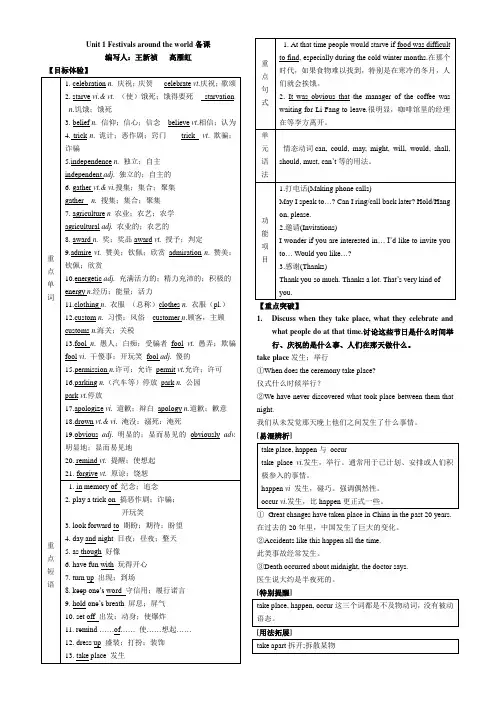
Unit 1 Festivals around the world备课编写人:王新祯高雁虹【目标体验】【重点突破】1.Discuss when they take place, what they celebrate andwhat people do at that time.讨论这些节日是什么时间举行、庆祝的是什么事、人们在那天做什么。
take place发生;举行①When does the ceremony take place?仪式什么时候举行?②We have never discovered what took place between them that night.我们从未发觉那天晚上他们之间发生了什么事情。
在过去的20年里,中国发生了巨大的变化。
②Accidents like this happen all the time.此类事故经常发生。
③Death occurred about midnight, the doctor says.医生说大约是半夜死的。
①Let’s take the radio apart and see what’s wrong with it.我们把收音机拆开看看有什么毛病。
②These books must not be taken away from the library.这些书不准带出图书馆。
③I take back what I said about you being selfish.我承认我不该说你自私。
④The army is threatening to take over if civil unrest continues. 军方声称如内乱不平息将实行军官。
[即景活用]They decided that the meeting should_______ on Monday.A. holdB. happenC. be taken placeD. take place [自我校对]D2. At that time people would starve if food was difficult to find, especially during the cold winter months.在那个时代,如果食物难以找到,特别是在寒冷的冬月,人们就会挨饿。
人教版高中英语必修3 unit1 Festivals around the world 课件
Mexico
Halloween
western countries
Dragon Boat Festival
China
Festivals to Honor People
Columbus Day
USA
Festival to Honor Gandhi
India
Harvest Festivals
Thanksgiving
Unit 1 Festivals around the world
Spring Festival Christmas
Unit 1 Festivals around the world
Tibetan New Year
Unit 1 Festivals around the world
Task 1
Scanning
Easter and some western
carnivals
countries
Cherry Blossom Japan Festival
Kinds of Festivals
Names of Festivals
Countries
Obon
Japan
Festivals of the Dead
Day of the Dead
A. 生病 B. 发疯
C. 受伤 D. 挨饿
2.Which one is used to honour someone?
A. Spring Festival
B. Thanksgiving
C. Dragon Boat Festival
D. Mid-autumn Day
3. Which of the following is not mentioned?
《高一英语课件:Unit1Festivalsaroundtheworld》
4 Historical Festivals
Reenacting or remembering historical events or periods.
Festivals aroundthe world
1
China: Spring Festival
Experience the awe-inspiring
Holi
Join the fun-filled festivities of colors, water balloons, and joyous dances during the Festival of Spring.
Raksha Bandhan
Experience the bond of love and protection between brothers and sisters through tying of rakhi.
2 ReligiousFestivals
Observing and honoring religious beliefs and significant events.
3 National Festivals
Commemorating national achievements, independence, or important historical moments.
Reasons for Celebrating Festivals
1 CulturalPreservation
Preserve and pass down cultural traditions, customs, and rituals to future generations.
2 Community Bonding
2022届高考英语一轮复习第1部分模块知识总复习必修3Unit1Festivalsaroundthe
7.play a trick on
8.keep one’s word 常 用 9.hold one’s breath 短 10.dress up 语 11.in memory of
12.day and night
__搞__恶__作__剧__;__诈__骗__ __守__信__用__;__履__行__诺__言___ __屏__息__;__屏__气______ __盛__装__;__打__扮__;__装__饰___ __纪__念____________ __日__夜____________
用however改写句子: 精
Usually, even if we are very busy,we will try to come home for 雕
the celebration. 玉
Usually,__h_o_w_e_v_e_r_b_u_s_y__w_e_a_r_e__, we will try to come home 琢
• 【多维训练】 • ◆语法填空 • ② I’m writing this letter to express my apology ______ you ______ not writing you back in time. • ③You should make ________ apology to her for ________ (arrive) late.
needed!(It+be obvious that…)
单元要点突破
• 1.admire vt. 赞美;钦佩;羡慕 • 【考点激活】 • ①He observed that Homer __________________ after two thousand years. • 他观察到,两千年后荷马仍然被人赞赏。
必修三Unit1 Festivals around the world
、
2 . 美: 美人 n . b e a u t y 3 . 祖先 : 祖宗 n . a n c e s t o r 4 . 集合 ; 聚集 ; 搜集 v t . &v i . &n . g a t h e r 5 . 起源 ; 由来 ; 起因 n . o r i g i n 6 . 习惯 ; 风俗 n . c u s t o m 7 . 诡计 ; 恶作 剧 n . 欺骗 ; 诈骗 v t .t r i c k 8 . 奖; 奖品 n .授予 ; 判定 v t . a w a r d 9 . 盛宴 , 宴会 , ( 宗 教 的) 节日n . f e a s t 1 0 . 诗人 凡 . p o e t 1 1 . 遍及 全世 界 的 . w o r l d w i d e l 2 . 基督 徒 n . 基督教的 耐 . C h i r s t i a n l 3 . 游行 : 阅兵 : 检 阅 . &V . p a r a d e 1 4 . p r e d i c t i o n/ / , . 预言: 预 报 1 5 . f a s h i o n n . 时尚; 样子 : 方 式 1 6 . p a r k i n g n . f 汽 车等 ) 停 放 1 7 . a p o l o g i z e v i . 道歉 ; 辩 白 1 8 . w e e p n . &v i . 哭: 哭 泣 1 9 . w i p e v t . 擦: 揩; 擦去
Fe s t i r a l S a r o u n d me wo r l d
◇ 广东 省博 罗县 华侨 中学 周春 萍
考 点 梳 理
重 点单 词 1 . 收获 : 收割 n . &v t . &v i . h a r v e s t