
译林版高中英语选必三Unit4 Reading I 教案(雅礼版)
Unit 4 Protecting our heritage sites
Welcome to the unit and Reading I
内容分析:
本单元的主题语境是“人与自然”“人与社会”,话题是“遗产保护”,涉及的语篇类型有视频、讲座文稿、博客文章、社论、杂志文章和海报等。本单元的教学旨在引导学生充分认识世界遗产的意义和价值,增强保护世界遗产的意识,自觉宣传世界遗产保护,践行遗产保护的理念,意识到保护世界遗产的重要性一有利于坚定文化自信、促进文明发展、推动文明交流互鉴,有利于夯实共建人类命运共同体的人文基础。
Welcome to the unit板块通过一段视频介绍三种不同类型的世界遗产,围绕世界遗产展开讨论,激发学生对本单元话题的学习兴趣; Reading板块是一篇关于世界遗产面临危险的讲座文稿,重点介绍世界遗产遭受威胁的原因及其影响。
本单元卷首的名人名言出自美国作家史蒂夫·贝里的文章《为什么保存历史很重要》(“ Why Preserving History Matters”),意为:“同心协力保护遗产对于我们的文化、教育、美学、精神和经济遗产而言,是至关重要的一环。”这句话意在说明保护遗产的重要性。
教学目标:
By the end of this section, students will be able to:
1. understand the quote highlighting the significance of heritage preservation;
2. learn about three categories of heritage sites;
3. talk about the heritage site that impresses them most;
4. share their knowledge about heritage sites;
5. develop an interest in exploring more about heritage sites.
教学重难点:
1. Explain the dangers our heritage sites face and analyze the reasons;
2. Identify the structure of the lecture transcript;
3. Connect two paragraphs using a transitional sentence;
4. Realize the importance of taking action to protect world heritage.
教学过程:
Step 1 Lead-in
Lead in: Watch a video and answer the question “How many World Heritage Sites are
there in China?”
Read the Quote: A concerted effort to preserve our heritage is a vital link to our
cultural, educational, aesthetic, inspirational, and economic legacies.
—Steve Berry
【设计意图:紧扣主题,用视频资料和学生熟悉的名人名言来激活学生已有的知识和经验,引入主题。】
Step 2 Welcome to the unit
Watch a video and fill in the blanks.
The Great Pyramid of Giza belongs to the cultural heritage sites. This tall man-made
structure shows us the advanced ancient architecture.
Yellowstone National Park is one of the natural heritage sites. It is known for its
diverse wildlife and geothermal features.
Mount Huangshan, one of the mixed sites, is famous for its breathtaking mountain
scenery.
【设计意图:通过看视频和填空激活学生已有的关于世界遗产的知识,通过询问学生一些问题激发学生对于主题的兴趣。】
Step 3 While-reading
1. What is the structure of the passage?
Para(s) 1: Introduction
Para(s) 2-6: Reasons and Consequences
Para(s) 7: Ending
2. Read the transcript and complete the chart below.
【设计意图:通过一边听一边阅读快速熟悉文章大意,培养学生快速阅读的能力。】
3. Read Para.1 and answer the question.
4. Read Para.2 and fill in the blanks.
5. Read Para. 3-5 and answer the questions.
How do wars threaten heritage sites?
Wars can cause damage to ancient clay sculptures and buildings.
What activity is causing damage to the temples of Angkor?
Thousands of tourists climbing up the narrow stone steps every day.
Why is the Historic Center of Vienna on the List of World Heritage in Danger?
Due to high-rise construction projects in central Vienna.
6. Read Para.6-7 and make your choice.
Which is one of the benefits of the reef? C
A. Decreasing people’s job opportunities.
B. Providing home to people.
C. Improving the development of tourism.
D. Extending the coastline.
What is the purpose of the last paragraph? D
A. To analyze some specific issues at present.
B. To emphasize the importance of heritage sites.
C. To call on people to pay a visit to heritage sites.
D. To call on people to take action to protect the heritage sites.
What is the speaker’s attitude to heritage sites remained? B
A. Positive. B. Worried.
C. Indifferent. D. Doubtful.
Step 5 Post reading
What’s the purpose of the lecture given by the UNESCO official?
To educate people about the dangers that heritage sites face.
To emphasize that these heritage sites should be treated with respect because they are
our legacy.
To raise awareness that everyone should shoulder the responsibility of protecting and
preserving them by taking immediate action and participating in any way one can.
Step 6 Homework
Finish B1 on P47.
Surf the Internet and learn more about heritage in danger.
教学反思
译林版高中英语选必二Unit4 Reading I 教案(雅礼版)
Unit 4 Living with technology
Welcome to the unit & Reading (I)
内容分析:
本单元为学生提供了丰富的语言学习材料,引导学生围绕“科技发展”这一话题开展相互关联的语言活动,在训练语言技能的同时,提高学习能力,发展思维品质。 Welcome to the unit板块通过一段视频介绍了科技发展使得科幻作品中的幻想变为现实的几个例子,以此导入单元话题,激发学生对本单元的学习兴趣;
Reading板块的语篇是一篇关于人工智能的科普文章,重点说明了人工智能的定义、发展、应用以及人们对其发展后果的担忧,引导学生正确认识人工智能的两面性。
教学目标:
By the end of this section, students will be able to
1. know what descriptions in science fiction have turned into reality;
2. share their ideas about whether anything people can imagine can be made real;
3. imagine future technology and explain how it will change people’s lives.
教学重难点:
1. Analyze the benefits and potential threats of the development of AI;
2. Know about the applications of facial recognition technology and questions related
to it.
教学过程:
Step 1 Lead-in
1. Lead in: The advance of technology is based on making it fit in so that you don’t
译林版高中英语选必三Unit4 Project 教案
1 《英语》(选择性必修·第三册)
Unit 4 Protecting our heritage sites
Project
I. Learning objectives
By the end of the lesson, students will be able to:
1. research a chosen heritage site;
2. learn the core vocabulary: elsewhere, entry, ban;
3. make a poster about a UNESCO heritage site through cooperation and exploration;
4. evaluate and comment on each other’s work.
II. Key competence focus
1. Make a poster about a UNESCO heritage site through cooperation and exploration.
2. Improve their writing-poster skills.
III. Predicted area of difficulty
1. Do research into a heritage site.
2. Design a poster about a UNESCO heritage site through cooperation and exploration.
IV. Teaching procedures
Step 1 Revising the core vocabulary of extended reading
T asks Ss to fill in the blanks with the proper forms of the (given) words.
译林版高中英语必修三Uint4 Grammar and usage (I) 教案(雅礼版)
Unit 4 Scientists who changed the world
Grammar & Usage (I)
Verb-ed forms as attributives, adverbials and object complements
内容分析:
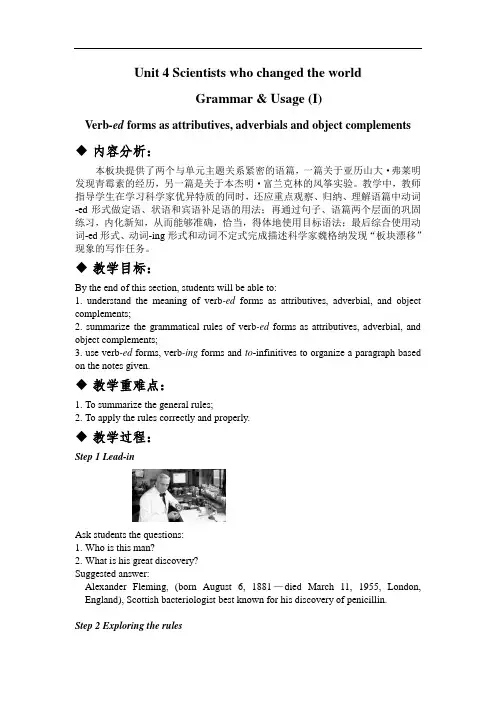
本板块提供了两个与单元主题关系紧密的语篇,一篇关于亚历山大·弗莱明发现青霉素的经历,另一篇是关于本杰明·富兰克林的风筝实验。教学中,教师指导学生在学习科学家优异特质的同时,还应重点观察、归纳、理解语篇中动词-ed形式做定语、状语和宾语补足语的用法;再通过句子、语篇两个层面的巩固练习,内化新知,从而能够准确,恰当,得体地使用目标语法;最后综合使用动词-ed形式、动词-ing形式和动词不定式完成描述科学家魏格纳发现“板块漂移”现象的写作任务。
教学目标:
By the end of this section, students will be able to:
1. understand the meaning of verb-ed forms as attributives, adverbial, and object
complements;
2. summarize the grammatical rules of verb-ed forms as attributives, adverbial, and
object complements;
3. use verb-ed forms, verb-ing forms and to-infinitives to organize a paragraph based
on the notes given.
教学重难点:
1. To summarize the general rules;
2. To apply the rules correctly and properly.
译林版高中英语选必三Unit4 Reading I 教案(雅礼版)

Unit 4 Protecting our heritage sites
Welcome to the unit and Reading I
内容分析:
本单元的主题语境是“人与自然”“人与社会”,话题是“遗产保护”,涉及的语篇类型有视频、讲座文稿、博客文章、社论、杂志文章和海报等。本单元的教学旨在引导学生充分认识世界遗产的意义和价值,增强保护世界遗产的意识,自觉宣传世界遗产保护,践行遗产保护的理念,意识到保护世界遗产的重要性一有利于坚定文化自信、促进文明发展、推动文明交流互鉴,有利于夯实共建人类命运共同体的人文基础。
Welcome to the unit板块通过一段视频介绍三种不同类型的世界遗产,围绕世界遗产展开讨论,激发学生对本单元话题的学习兴趣; Reading板块是一篇关于世界遗产面临危险的讲座文稿,重点介绍世界遗产遭受威胁的原因及其影响。
本单元卷首的名人名言出自美国作家史蒂夫·贝里的文章《为什么保存历史很重要》(“ Why Preserving History Matters”),意为:“同心协力保护遗产对于我们的文化、教育、美学、精神和经济遗产而言,是至关重要的一环。”这句话意在说明保护遗产的重要性。
教学目标:
By the end of this section, students will be able to:
1. understand the quote highlighting the significance of heritage preservation;
2. learn about three categories of heritage sites;
3. talk about the heritage site that impresses them most;
4. share their knowledge about heritage sites;
译林版高中英语选必三Unit4 Reading II 教案(雅礼版)
Unit 4 Protecting our heritage sites
Reading (II)
内容分析:
【What】本板块的语篇围绕“世界遗产”这一主题,以讲座文稿的形式具体介绍了世界遗产面临的危险,分析了危险形成的原因及其影响,并呼吁全人类共同行动起来保护世界遗产。
【Why】本文通过介绍世界遗产的危险处境及其成因,引导学生充分认识世界遗产保护的重要性和紧迫性,意识到人人都有保护世界遗产的责任,人人都可以参与到世界遗产的保护中来,遗产保护造福当代,福泽后世。
【How】本文的语篇类型为讲座文稿。文章可以分成四个部分,第一段用两个一般疑问句引出话题,点明世界遗产面临危险这一现实问题;第二至第五段分析世界接产处境危险的成因,第六段指出这些危险不仅影响世界遗产本身,而且对人们具有极大的影响;第七段指出遗产保护迫在眉睫。文章通过大量的举例增强文本的直观性和形象性,如埃及金字塔的风化、柬埔寨吴哥窟的损坏、奥地利维也纳历史中心的濒危、大堡礁珊瑚的死亡等。文章中转承句的使用使行文更加流畅自然。
教学目标:
By the end of this section, students will be able to:
1. explain the danger our heritage sites face and analyse the reason;
2. identify the structure of the lecture transcript;
3. connect two paragraphs using a transitional sentence;
4. share their knowledge about heritage sites;
5. realize the importance of taking action to protect world heritage.
译林版高中英语选必三Unit4 reading I 教案
1 《英语》(选择性必修·第三册)
Unit 4 Protecting our heritage sites
Welcome to the unit & Reading (I)
I. Learning objectives
By the end of the lesson, students will be able to:
1. grasp the topic and the general idea of the lecture transcript;
2. understand some important details of the lecture transcript;
3. form their own opinions based on the lecture transcript.
II. Key competence focus
1. Use the given information to express oneself.
2. Get a deep understanding of the lecture transcript.
III. Predicted area of difficulty
Free discussion about more examples of heritage sites facing dangers.
IV. Teaching procedures
Step 1 Welcome to the unit
1. T greets the class.
T: Class begins, boys and girls! Good morning/afternoon!
T: Open your book at page 43. Let’s have a look at the picture on this page. What do you see on it?
译林版高中英语必修二Uint4 Reading (I)教案(雅礼版)
1 Unit 4 Exploring literature
Welcome to the unit & Reading (I)
内容分析:
本单元的主题语境是“人与社会”,话题是“文学作品”,涉及的语篇类型有:议论文、推荐信、小说(节选)、海报。本单元的教学,旨在帮助学生认识阅读文学作品的意义,体验文学作品的魅力。
整个单元的八个板块分别涉及“文学作品”的多个层面。Welcome to the unit板块以两个节选自名著的段落来激发学生对于文学的探究欲。Reading板块引导学生探究优秀文学作品的特征,思考阅读文学作品的好处。本板块的任务是“名著选段赏析”,教材选取了查尔斯·狄更斯的《大卫·科波菲尔》和桑德拉·希斯内罗丝的《芒果街上的小屋》的两个语段。这两段文字都反映了对生活充满热情的积极人生态度,诠释了面对逆境时应有的心态,与学生生活密切相关。通过对这两段文字的赏析,可以激发学生进一步探究本单元话题的兴趣,为单元学习做好热身。
本单元卷首语的引言出自埃兹拉·庞德,意为:“伟大的文学只不过是在最大程度上承载意义的语言。” 埃兹拉·庞德是美国著名的诗人和文学评论家。这句话说明文学语言承载着丰富的内涵,阅读文学作品时我们要认真揣摩和体会。
教学目标:
By the end of this section, students will be able to:
1. know about the structure, the figure of speech and writing skills used in the text;
2. express their opinions on what qualities a great work of literature should have;
3. talk about their favourite work of literature by the three qualities.
译林版高中英语必修三Uint4 Integrated skills 教案(雅礼版)
Unit 4 Scientists who changed the world
Integrated skills: Making a plan for the school Science Festival
内容分析:
本板块围绕单元主题,展开一系列听、说、读、写的语言技能学习活动。教学活动首先引导学生从听力文本中获取科技节的相关信息,以及为科技节设计活动方案需要包括的内容要点;再让学生通过阅读一篇有关校园科技节的新闻报道,直观感受科技节的方方面面;接下来通过和同伴的讨论确定自己方案中的信息点;最终完成为校园科技节设计方案这一半开放的写作活动,形成个性化产出。
教学目标:
By the end of this section, students will be able to:
1. know what to include in making a plan for a school Science Festival;
2. analyse a news report on a school Science Festival using the newly learnt
knowledge;
3. discuss what topics they would like to include in their own plans;
4. use the key information and suggested structure to write a plan.
教学重难点:
1. To learn what to include and how to analyse a school festival;
2. To use keywords when planning a festival.
教学过程:
Step 1 Lead-in
Q1: What does the badge stand for?
译林版高中英语必修三Uint3 Reading (I) 教案(雅礼版)
Unit 3 The world online
Welcome to the unit & Reading (I)
内容分析:
本单元的主题语境是“人与社会”,话题是“互联网与网络时代”。Welcome
to the uni板块以互联网发展史上的三个创举来帮助学生了解互联网在人类交际中所起到的作用,激发学生对于互联网其他功能的探究欲;Reading板块以“网络是无疆世界”为话题,引导学生辩证看待互联网的利弊,培养学生的批判性思维能力,使他们能够正确使用互联网。
本单元卷首的名人名言出自蒂姆·伯纳斯-李,意为:“我希望我们能用互联网跨越障碍,联结文化。” 蒂姆·伯纳斯-李是英国计算机科学家,万维网的发明者。这句话提现了他对互联网的美好愿景。
教学目标:
By the end of the lesson, students will be able to:
1. know some important milestones in the development of the Internet;
2. think critically and express their opinions on some advantages of the Internet;
3. think about what proper online behaviour is.
教学重难点:
Understand the structure and keep a proper attitude towards the Internet.
教学过程:
Step 1 Lead-in
1. The history of the Internet started in the 1960s. Let’s take a short look at a brief
introduction of the timeline.
译林版高中英语选必四Unit2 Reading I 教案(雅礼版)
Unit 2 Understanding each other
Welcome to the unit & Reading I
内容分析:
本单元的话题是“相互理解”,教学活动通过观看一段视频,就两位高中生日常交流中的问题,激活学生的背景知识,引导学生分析产生问题的原因,并展开讨论与自我反思,为本单元后续板块的学习做好准备。
教学目标:
By the end of the lesson, the students will be able to:
1. interpret the quote about listening and speaking;
2. analyse communication problems and explore possible solutions;
3. summarize the keys to effective communication;
4. apply the skills of effective communication in daily life.
教学重难点:
1. Analyze and solve the communication problems.
2. Summarize the keys to effective communication.
教学过程:
Step 1 Lead-in
1. Have students answer the question and lead to the topic: communication.
In your opinion, what is the best way to understand each other?
2. Ask more questions about communication:
Q1: Why communication is so significant?