
人教版英语九年级全册第七单元Section B (1a-1e)
1 人教版英语九年级全册第七单元Section B (1a-1e)导学案
Unit 7 Teenagers should be allowed to choose their own clothes. Section B (1a-1e)
预习目标:
1. 通过听力训练,围绕Peter的故事,用所学知识谈论校规。
2. 通过预习,在谈论校规的基础上举一反三,学会谈论班规、家规、图书馆的相关规定等。
3. 通过预习,掌握一些重要短语和知识点。
预习导学:
一、复习前面学过的被动语态的基本结构:be+动词的过去分词
1. 一般现在时:am/is/are+ 动词过去分词
2. 一般过去时:was/were+ 动词过去分词
3. 含有情态动词的被动语态:情态动词(should \ can \must\ may) + be + 动词的过去分词
例如:1.The big meal is made by Tom’s mother every day.
2.The beautiful dress was bought for Alice by her mother yesterday.
3.The school rule should be made by the teachers.
二、复习上一节课学习的一些短语。
1.应该被允许___________________________ 2.不够严谨_______________________
3.同意某人______________________ 4.鼓励某人做某事__________________
5.太...以至于不能...._________________ 6.某人自己做决定______________________
7.做兼职工作______________________ 8.向...学习_______________________
9.闪光_____________ 10.远离...___________________ 11.搬出去__________________
12.照顾__________________________ 13.应付自己的生活_____________________
14.继续做某事_______________________ 15.英汉字典_________________________
参考答案:
1.should be allowed 2.not serious enough 3.agree with sb. 4.encourage sb. to do sth.
5.too...to... 6.make one’s own decision 7.have part-time jobs 8.learn from...
e a flash 10.keep away from... 11.move out 12.take care of \ look after
13.manage one’s own lives 14.continue to do sth. 15.English-Chinese dictionary
三、把下列句子改为被动语态。
1.The farmers grow apples on the farm every year.
_____________________________________________________________________________
2.Bob used a knife , some pieces of paper and wood to make a boat last Sunday.
_____________________________________________________________________________
3.Teachers should allow children to exercise more.
_____________________________________________________________________________
参考答案:
1. Apples are grown on the farm (by farmers).
2. A knife , some pieces of paper and wood were used to make a boat last Sunday (by Bob).
3. Children should be allowed to exercise more (by teachers).
预习导学:
Let’s talk about school rules:
At school , we have to ..... \ we can ... \ we can’t ... \ we are allowed to ... \ we aren’t allowed to ...
I think we should be allowed to ...
1a Read the questions. How often do you do these things ? Write A for always , U for usually , S
for sometimes and N for never. Then talk with a partner about other things you do. 2 Do you ever ...
1.get to class late? —
2.study with friends? —
3.finish a test early? —
4.worry about failing a test? —
5. …
1b Talk about your answers in 1a.
Make sentences like this :
1.I sometimes get to school late. 2.I always study with friends.
3.I never finish a test early. 4.I hardly ever worry about failing a test.
______________________________________________________________________________________________________________________________________________________________
1c Listen and circle the things in 1a that Peter talks about.
参考答案:
1.get to class late? 4.worry about failing a test?
1d Listen again. Match these sentence parts.
1.Peter is going to... ______ a. take the test.
2.He isn't allowed to... ______ b. pass the test .
3.Peter wasn't allowed to... ______ c. fail a math test.
4.He could... ______ d. take the test later.
5.He should be allowed to... ______ e. get to class late .
参考答案:
1——c 2——e 3——a 4——b 5.——d
关于听力材料的展开活动:
Retell the story of Peter:
Peter had a talk with his father about the math test .He told his father that he was going to
fail the test because he 1._______________ and he had to 2.________________. So his teacher
didn’t allow him to 3._____________________. Peter thought it was not 4.________, and he
should be 5.________________________.His father said he could 6.__________________after
school. So Peter said maybe if he explained 7._________________.
参考答案:
1.missed the bus 2.walk to school 3.take the test 4.fair 5.allowed to take the
test later 6.talk to the teacher 7.what happened
Discuss : Should Peter be allowed to take the test later ?Why or why not ?
运用句型:I think Peter should be allowed ...because...
I don’t think Peter should be allowed …because…
1e Read the statements. Then discuss them with your group.
Peter should be allowed to take the test later.
Students need strict rules.
Parents should not be too strict with teenagers.
发表观点的一些句子:
I think … I’m afraid… In my opinion,… I hope…
I agree. I disagree. I don’t think so.
Unit 3 Section B1 1a-1e 课时训练 人教版九年级英语全册

Unit 3 Section B1 1a1e
Ⅰ.根据句意及汉语提示完成句子
1.All the ________(职员) in the bank work hard at their work.
2.You can find a library at the ________(角落) of Market and Main Streets.
3.It's very ________(方便的) to get information on the Internet.
4.Few people are in the classroom, so it's ________(不拥挤的).
Ⅱ.用所给单词的适当形式填空
5.Now computers are ________(expensive). Most people can afford them.
6.The trip to the Space World was so ________(interest).
7.Can you tell me if there is a good place ________(relax)?
8.He was attracted by the girl's ________(fascinate) beauty.
Ⅲ.用方框中所给短语的适当形式填空
start with be excited go along go past walk up to
9.Jack ________________ to receive a letter from his pen pal in America last night.
10.________________ the road, and you will find many flowers on both sides.
11.The poor boy ________________ a staff person to get a piece of bread just now.
人教九年级英语全册Unit 11 Section B (1a-1e)练习题

Unit 11 Sad movies make me cry Section B (1a-1e)
Ⅰ.完成句子 根据汉语意思完成英语句子,每个空格填一个单词
1.即使他一个人生活在农村,他也从来不感到孤单。
He never feels lonely he lives in the countryside alone.
2.[2019·高新区二模改编] 我每天散步半个小时。
It me half an hour a walk every day.
3.他虽然找到了一份好工作,但仍然闷闷不乐。
Although he found a good job, he still .
4.他开心地带着一个漂亮的盒子回到了家。
He happily with a beautiful box.
5.他们正在街上寻找彼得的宠物狗。
They are Peter′s pet dog in the street.
Ⅱ.选择填空
( )6. —Lin Jia, you have a loving grandma, right?
—Yes, she always her time with me whenever I need her.
A.spends es C.takes D.pays
( )7.They are making some delicious bread , and it makes
them .
A.happy; happy
B.happy; happily
C.happily; happy
D.happily; happily
( )8. —Andy practiced hardest among us and he won first prize in the
九年级英语全一册同步训练Unit 7 Section B(1a-1e)(含答案)
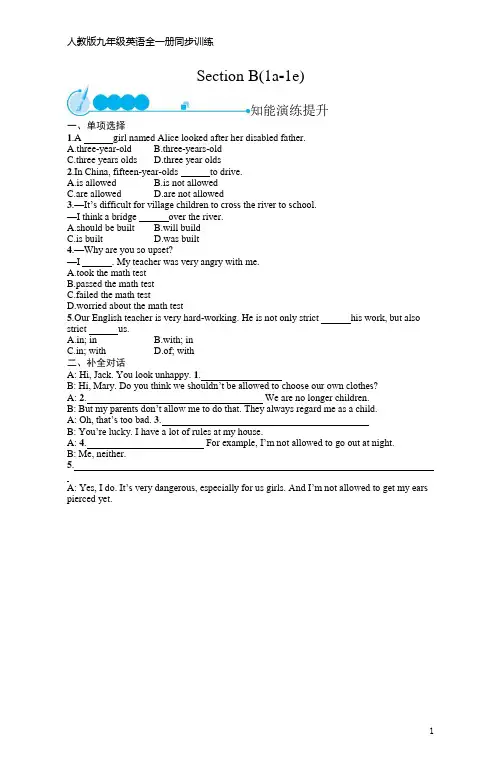
人教版九年级英语全一册同步训练
1
Section B(1a-1e)
知能演练提升
一、单项选择
1.A girl named Alice looked after her disabled father.
A.three-year-old B.three-years-old
C.three years olds D.three year olds
2.In China, fifteen-year-olds to drive.
A.is allowed B.is not allowed
C.are allowed D.are not allowed
3.—It’s difficult for village children to cross the river to school.
—I think a bridge over the river.
A.should be built B.will build
C.is built D.was built
4.—Why are you so upset?
—I . My teacher was very angry with me.
A.took the math test
B.passed the math test
C.failed the math test
D.worried about the math test
5.Our English teacher is very hard-working. He is not only strict his work, but also
strict us.
A.in; in B.with; in
C.in; with D.of; with
二、补全对话
A: Hi, Jack. You look unhappy. 1.
人教版九年级第七单元 Section B 1a—1e教案
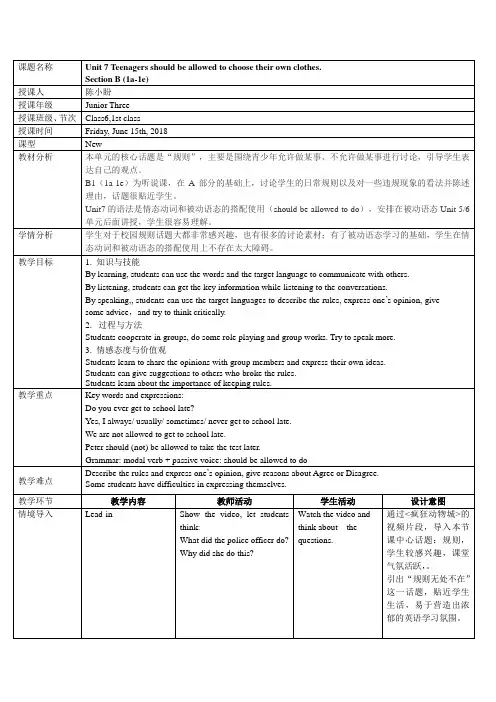
课题名称 Unit 7 Teenagers should be allowed to choose their own clothes.
Section B (1a-1e)
授课人 陈小盼
授课年级 Junior Three
授课班级、节次 Class6,1st class
授课时间 Friday, June 15th, 2018
课型 New
教材分析 本单元的核心话题是“规则”,主要是围绕青少年允许做某事、不允许做某事进行讨论,引导学生表达自己的观点。
B1(1a-1e)为听说课,在A部分的基础上,讨论学生的日常规则以及对一些违规现象的看法并陈述理由,话题很贴近学生。
Unit7的语法是情态动词和被动语态的搭配使用(should be allowed to do),安排在被动语态Unit 5/6单元后面讲授,学生很容易理解。
学情分析 学生对于校园规则话题大都非常感兴趣,也有很多的讨论素材;有了被动语态学习的基础,学生在情态动词和被动语态的搭配使用上不存在太大障碍。
教学目标 1. 知识与技能
By learning, students can use the words and the target language to communicate with others.
By listening, students can get the key information while listening to the conversations.
By speaking,, students can use the target languages to describe the rules, express one’s opinion, give
some advice,and try to think critically.
2. 过程与方法
Students cooperate in groups, do some role playing and group works. Try to speak more.
人教版英语九年级全一册教案:Unit1 SectionB(1a-1e)

第 1 页 Unit1 SectionB(1a-1e) 教案
【教材版本与册数】新目标人教版九年级全一册
【单元名称】Unit 1 How can we become good learners?
【课时】Section B 1a-1e(第4课时)
【课型】Listening and Speaking(听说课)
【本课时教学设计】 教材版本:新目标 册数:第5册 年级:九年级
单元:Unit 1 课型(课时):Section B 1a-1e 听说课
教材分析 【本单元话题】
本部分在Section A谈论英语学习的基础上,在话题上从英语的学习困难及解决方案,拓展到优秀学习者的学习习惯;在语言上巩固了Section A所学语言结构,丰富了与学习相关的话题词汇;在技能上将听说能力综合,突出阅读训练,由读促写;在策略上,引导学生关注优秀学生的学习方式,借鉴并用于自身;在情感上,鼓励学生直面学习困难,积极探索解决方案,不断改进自己的学习方法、提高学习效率。
【本单元重点掌握目标】
用“by + 动词-ing形式”结构来表达方式方法。
【教材内容拆分分析】
活动1a-1e是围绕英语学习的听说任务链活动。1a-1b让学生思考自己英语学习有哪些困难,并写出来。1a列举的学习困难也为后面1c-1d的听力谈论的相关话题进行了预热。1e需要结合所听内容,用对话形式复现听力信息。 第 2 页 【综合技能】
通过本单元的学习使学生学会谈论自己和别人的学习方式,巩固所学语言结构,丰富了与学习相关的话题词汇,引导学生关注优秀学生的学习方式,借鉴并用于自身。
教学目标 语言知识目标:
1.熟练掌握下列词汇: pronounce increase speed partner
2掌握所涉重点句子
3.完成课本各听力题目。
情感态度价值观目标:
人教版英语九年级全一册教案:Unit7 SectionB(1a-1e)
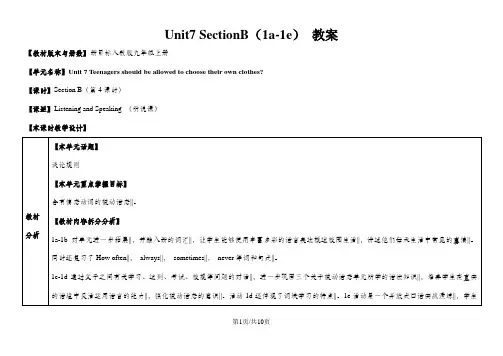
第1页/共10页 Unit7 SectionB(1a-1e) 教案
【教材版本与册数】新目标人教版九年级上册
【单元名称】Unit 7 Teenagers should be allowed to choose their own clothes?
【课时】Section B(第4课时)
【课型】Listening and Speaking (听说课)
【本课时教学设计】
教材分析 【本单元话题】
谈论规则
【本单元重点掌握目标】
含有情态动词的被动语态||。
【教材内容拆分分析】
1a-1b对单元进一步拓展||,并融入新的词汇||,让学生能够使用丰富多彩的语言表达概述校园生活||,讲述他们每天生活中常见的事情||。同时还复习了How often||, always||, sometimes||, never等词和句式||。
1c-1d通过父子之间有关学习、迟到、考试、校规等问题的对话||,进一步巩固三个关于被动语态单元所学的语法知识||,培养学生在真实的语境中灵活运用语言的能力||,强化被动语态的意识||。活动1d还体现了词块学习的特点||。1e活动是一个开放式口语实战演练||,学生第2页/共10页 就三个话题展开讨论||,表达同意或不同意||,并陈述自己的理由||。
【通过本单元的学习学生需掌握哪些综合技能】
通过本单元的学习使学生学会谈论各种规则||,熟练含有情态动词的被动语态||。
教学目标 语言知识目标:
1.熟练使用以下词汇、短语和句型:
短语:fail a test||, take the test||, pass the test||, take the test later||,
句型:Do you ever…?
He should be allowed to take the test later.
2.含有情态动词的被动语态||。
3.学会合作探究学习||,学习解决难题
人教版九年级英语第七单元教案
Unit 7 Teenagers should be allowed to choose their own clothes.
The First Period Section A 1a–2c
Teaching aims(教学目标)
口、笔头掌握句型
1. A: I don’t think sixteen-year-olds should be allowed to drive.
B: I agree. They aren’t serious enough at that age.
2. A: Do you think teenagers should be allowed to choose their own clothes?
B: Yes, I do. / No, I don’t. 3. Sixteen-year-olds should be allowed to get their ears pierced.
4. He should stop wearing that silly earring.
5. Students must not be allowed to have part-time jobs.
熟练掌握词汇:smoke, license, safety. 了解下列词汇: pierce, earring
技能目标:能用should/should not be allowed to do谈论应该被允许和不应该被允许做的事情。
情感态度:勇于发表自己的观点和意见,表达同意或不同意。
Difficulties(难点):be (not) allowed to do
Teaching steps(教学步骤) 1. Warm-up and revision(课堂热身)
Show pictures of “Where are dads going?”
Kid: Can I drive my friends to the mall?
人教版九年级英语第七单元教案 2
Unit 7 Teenagers should be allowed to
choose their own clothes.
教学目标:
1语言目标:理解并正确运用本单元的重点词汇
2 技能目标:熟练运用 “should (not) be allowed to do”谈论应该被允许和不应该被允许做某事;
熟练运用 “be (not) allowed to do”谈论被允许和不被允许做某事;
熟练运用 “I agree / disagree.”或“ I don’t agree.”表达自己的观点。
3 情感目标:通过了解和反思自己的言行举止是否符合中学生日常行为准则、规范自己的言行,养成自觉遵守规则的良好习惯和优良品德;
正确看待“家规”“班规”“校规”等,并能认真遵守;
明白父母、教师的合理建议对自己成长的重要性
4文化意识目标:
了解中外审美观的差异,形成自己的审美观,展示个性;
了解中西方关于青少年的不同文明准则。
教学重点:
重点语法:被动语态
重点词汇:smoke, pierce, license, safety, earring, cry, field, hug, lift, awful, teen, regret, poem,
bedroom , community, chance, manage, society, unit, educate, professional, enter, support
talk about, keep away from, make one’s own decision, get in the way of
重点句型:
I don’t think sixteen-year-olds should be allowed to drive.
I agree./ I disagree. I think sixteen is too young.
人教版 九年级 英语 unit 7 section A-1
Unit 7 Section A-1
Class Type Listening, reading and speaking
Objectives 1. To find out the sentences that are agreed or disagreed by
reading the statements.
2. To learn to express the sentences by listening.
3. To practice talking about the things teenagers should
(not) be allowed to do.
Key
structure 1. I go to the shopping center with John? He just got his
driver’s license.
— No way. I don’t think sixteen-year-olds should be
allowed to drive. I’m worried about your safety.
— I agree. They aren’t serious enough.
2. Do you think teenagers should …
— Yes, I … / No, I …
4. That’s too bad / …
Difficulties How to talk about the things teenagers should and should
not do by reading and listening.
Vocabulary License, safety, smoke, part-time, flash
be allowed to, no way
Period 1
Procedure
Lead-in Free talk.
人教版英语九年级全册Unit2sectionB(1a1e)说课稿
人教版英语九年级全册Unit2sectionB(1a1e)说课稿
一、教材分析
(一)内容概述
本节课内容为人教版英语九年级全册Unit2 Section B (1a-1e)。本单元的主题是“主题公园之旅”,旨在通过介绍不同主题公园的特色和活动,帮助学生掌握描述公园、娱乐活动及表达个人喜好的语言技能。本节课在整个课程体系中的位置是承前启后的关键环节,它位于Unit2的Section B部分,是单元学习的核心内容。
主要知识点包括:
1. 词汇:公园相关的词汇,如amusement park, theme park, exciting, enjoyable等。
2. 语法:一般现在时态和一般过去时态的运用,以及there be句型的运用。
3. 听力:培养学生听力理解能力,能听懂关于主题公园的对话和描述。
4. 口语:训练学生运用所学词汇和语法,描述主题公园的特色和活动。
(二)教学目标
1. 知识与技能:
(1)学生能够掌握本节课所学的词汇和语法知识,能够正确运用一般现在时态和一般过去时态描述主题公园;
(2)学生能够听懂关于主题公园的对话和描述,提高听力理解能力;
(3)学生能够运用所学知识,进行关于主题公园的口语交流。
2. 过程与方法:
(1)通过图片、音频等教学资源,引导学生主动参与课堂,激发学生的学习兴趣;
(2)采用任务型教学法,让学生在实际语境中运用所学知识;
(3)通过小组合作,培养学生的团队协作能力和沟通能力。
3. 情感态度与价值观:
(1)培养学生热爱生活、热爱旅游的情感;
(2)提高学生对英语学习的兴趣和自信心;
(3)培养学生的跨文化意识,了解不同国家的主题公园特色。
(三)教学重难点
1. 教学重点:
(1)掌握本节课所学的词汇和语法知识;
(2)听懂关于主题公园的对话和描述;
(3)运用所学知识进行关于主题公园的口语交流。
2. 教学难点:
(1)一般现在时态和一般过去时态的运用;