
人教版初中英语总复习第一轮教案
Unit 4一、知识点1、①give sb sth=give sth to sb类似的词还有:pass、lend、show、write、send等②buy sb sth=buy sth for sb类似的词还有:make、draw、cook等2、hundred 、thousand、mi11ion与数字连用不能用复数。
hundreds of、thousands of、mi11ions of中必须用复数。
3、look for寻找find找到、发现find out指经过观察、探索、调查等弄清楚、弄明白。
discover 指发现那些客观存在而不为人所知的实情。
如科学上的重大发现。
4、bring 带来take 带走fetch 去并拿来5、talk to/with sb 同××说话。
tell 告诉, 分辨,辨别。
speak to sb 同××说话,做及物动词,后跟语言。
say 后跟名词、代词及宾语从句做宾语,着重强调说话内容。
6、What if ……如果……将会怎么样?(引导条件状语从句、疑问句)eg What if she doesn't come? 她要是不来怎么办?What if your parent don't agree? 如果你的父母不同意怎么办?What if you should fall sick? 如果你生病了怎么办?7、before 引导一个句子,为连词。
后跟短语或名词等,则为介词。
8、food 表示食品种类,一种食物时,为可数名词eg fried foods 油炸食品break foods 早餐食品frozen foods 冷冻食品9、复数名词可表示一类食品(如dogs)a/an+单数可数名词可表示一类(如a dog)10、confident(adj.) confidence(n.)11、What does/do ×× look like? 问相貌。
What's ×× like? 问"品质性格"。
12、give a speech 做演讲have a speech听演讲give a report 做报告have a report 听报告13、permission (n.) 允许,许可permit (v.) 允许14、plenty of 充足的,相当多的。
修饰可数或不可数名词,只能用于肯定句。
否定、疑问句中用enough.15、not……in the slightest=not……at all 根本不16、company ①公司②一群人,一伙人③陪伴17、get along (with)=get on (with)①进行,进展eg The business is getting along very well. 生意进展的很顺利。
How are you getting along with your English study? 你的英语学习进展的怎么样了?②相处eg Do you get along with your boss?= Do you and your boss get along? 你跟老板合得来吗?I'm getting along very well with my classmates. 我和同学们相处得很好。
18、would rather … than … (= would … rather than)宁愿,而不愿。
前后连接两个动词原形,否定形式为:would rather not do sth①would rather … than … = prefer … to …但prefer … to … 若连接两个动词,动词应为v-ing 形式。
eg He would rather jog than play football.=He prefers jogging to playing football.②would rather 常单独使用,表示"宁愿做…"eg He would rather watch TV at home.③rather than = instead of 而不是连接两个并列成分,前后对称。
eg I'd prefer to go to in summer rather than in winter.I decided to write rather than telephone.I like going out with you rather than with him.She enjoys listening rather than speaking.19、today、here、there、downstairs、upstairs、above、below做宾语修饰名词,放在名词之后eg the weather today今天的天气people here这里的人们the man downstairs楼下的那个男的the passage below 下面的这段话20、a little = a bit 修饰形容词、副词a little = a bit of 修饰不可数名词21、There is an English speech contest next month用一般现在时表示将来,表示计划或安排好的动作,或者日历、时刻表的规定内容。
22、the rest 其余的,可指代可数或不可数名词。
The other(s) 只能指代可数名词23、come up with 提出或提出(答案、方法)等。
类似于think of.eg How would you come up with this idea? 你怎样想出这个注意的?My brother is a person who often comes up with good idea.我弟弟是个常常能想出好点子的人24、offer 提供offer sb sth 给××……offer to sb sth 主动提出干……二、短语1、give it to charity 把它捐给慈善机构2、medical research 医学研究3、What if …… 如果…怎么样?4、get nervous 紧张5、take a big exam 参加大考6、help with 有助于7、in public 在公共场合8、hardly ever 几乎不9、the whole school 全校10、without permission 为经许可11、be(make) friends with 与…交朋友12、ask one's permission 请求××的允许13、introduce…to… 把…介绍给…14、invite…to do… 邀请…干…15、social situations 社会环境16、not… in the slightest 根本不,一点也不17、right away 立刻,马上18、all day 全天19、be friendly to 对…友好20、at lunch time 在午饭时间21、a bit shy 有点害羞22、English speech contest 英语演讲比赛23、represent the class 代表班级24、come top 名列第一(前茅)25、let … down 使…失望26、come up with 提出、想出27、be sure of + n./pron. 28、the rest of the students 其余的学生be sure to do 相信…29、have a lot of experience (in) doing sth be sure +that 从句在做某事方面有经验30、deal with 对付,处理31、come out 出版32、give advice on… 在…方面提出意见、建议33、by accident 偶然地,无意之中34、hurry to do sth 匆匆忙忙干…35、an internet friend 网友三、句子1、He doesn't know if he should bring a present. 他不知道是否该带礼物。
2、You shouldn't worry about what other people say.你不应该考虑别人说什么。
3、What will you do if you had a million dollars? 如果你有一百万美元,你会干什么?4、If I were you, I 'd take a small present.如果我是你,我会带一个小礼物。
5、I'm too tired to do well.我太累了,没考好。
6、Dogs can be a lot of trouble.狗会带来很多麻烦。
7、What are you like? 你是什么样的人?8、I'd invite him/her to have dinner at my house.我会邀请他(她)到我家吃饭。
9、You enjoy the company of other people.你喜欢别人的陪伴。
10、I feel nervous talking in front of many people.我在众人面前讲话时感到紧张。
11、She always comes top in the school exams.她在学校的考试中总是名列前茅。
12、She doesn't want to let her friends down.她不愿让朋友失望。
13、If I were you, I'll get out of here.如果我是你,我会离开这里。
虚拟语气一、词的语气指我们平常说的说话人说话的口气。
(在英语中,语气除了指语调以外,最主要的是通过动词发生变化而表示不同语气)英语中的语气分为三类:陈述语气(用于陈述句、疑问句、感叹句)祈使语气(用于祈使句)虚拟语气(用于条件状语从句、宾语从句等)二、虚拟语气如果所说的不是事实,而是一种假设、愿望、建议或是一种实现不了的空想,就用虚拟语气。
三、虚拟语气在非真实条件状语从句中的用法1、真实条件状语从句与非真实条件状语从句eg If he doesn't hurry up, he will miss the bus.( 真实条件状语)If he was free, he asked me to tell stories.(真实条件状语)If I were you, I would go at once.(非真实条件状语从句)If there was no air, people would die.(非真实条件状语从句)2、虚拟语气在非真实条件状语从句中的用法及动词形式①表示与现在事实相反的情况(条件)从句谓语动词形式主句谓语动词形式谓语动词用过去式(be用were) should/would/could/might+动词原形eg:If I were you, I'd take an umbrella.如果我是你,我会带把伞。
初中英语中考复习 中考英语(人教新课标)一轮复习教案:九年级全册Unit 11-14

第30课时课题:9年级(U11-14)一、目标:1. 能运用“使役动词make ”带“去to 不定式”和形容词作“宾语补足语”的基本用法;2. 能理解“过去完成时态”的基本用法;3. 识记下列重点单词和短语:(U11)drive, examine, weight, courage, agreement, drive sb. mad, the more …the more, be friends/f riendly with sb., neither...nor …, to start/begin with, be hard on sb./be strict with sb.; (U12) backpack, ring, worker, above, alive, airport, till/until, west, market, fool, lady, officer, by the time …, give sb. a lift, in line with, show up, by the end of, sell out; (U13)bottom, coal, ugly, advantage, cost, gate, bottle, president, be harmful to, at the top of, turn off, pay for, take action, throw away, bring back; (U14) survey, row, keyboard, double, shall, ours, senior, text, manager, gentleman, congratulate, thirsty, look back at, go by, first of all, be thankful to sb., ah ead of, along with, set out二、重点:1. “动词不定式一般式to + v .”作“宾语补足语”时带不带“to ”的用法;2. 理解“过去完成时态”表示 “过去的过去”的用法:三、知识梳理:1. 词汇:(1)职业名称: 演员 主席/女主席 厨师 导演 医生 司机 农夫 actor chairman/-womancook director doctor driver farmer 领导 主人/师傅 经理 军官 物主乘客先锋 leader master manager officer owner passenger pioneer 邮递员警察/女警察总统/校长 囚犯 学生 科学家 秘书 postman policeman/-woman president prisoner pupil scientist secretary士兵 陌生人 学生 老师 侍者 工人soldierstrangerstudentteacherwaiterworker地址 机场 区域 军队 澡堂卧室建筑物addressairportareaarmybathroom bedroom building中考一轮 复习教学参考资料2. 句型与语法:(1)使役动词make的两个用法:五、巩固练习:(一)词汇练习(略)1.英汉互译下列单词:(1)职业名称:士兵老师侍者工人stranger student(2)最常用表“处所”的名词:卧室address airport area army bathroom building 首都电影院教室ceiling coast college company国家农场concert corner countryside floor gym 医院湖泊陆地图书馆heaven kitchen lab(oratory)会议博物馆办公室公园market nature palace运动场餐馆河流房间学校place pond剧院村庄世界动物园supermarket toilet university(3)表示“感觉、感情”方面的形容词:生气的兴奋的angry crazy excited glad happy interested 紧张的有病mad nice patient surprisedexamine(v.)→_____________(n.) comfortable(adj.) →_____(反义形容词) weight(n.) →_____________(v.) agree(v.) →____________________(v.) expect(v.) →____________(adj.) →_______________(反义形容词)work(n. & v.) →__________(n.) discovery(n.) →_________________(v.) alive(adj.) →________(v.) →______(-ly形式adj.) →______(-ing形式adj.) believable(adj.) →_________(v.) disappear(v.) →____________(反义词) wooden(adj.) →___________(n.) advantage(n.) →____________(反义词)scientific(adj.) →__________(n.) congratulate(v.) →______________(n.)thank(n.) →_____________(adj.) ahead(adv.) →_________________(n.)(二)语法练习1. 语法填空:(1) A: What ______(make) you angry?B: When people throw rubbish on the streets, it makes me ______(anger).C: Me, too. It takes me ______(want) to tell them clean up the streets.(2) I was made ______(cry) by sad movies.(3) _____ the time Mary ____(get) up, Tim had already gone into the bathroom.(4) ____ dinner time, I had already remembered all the news words of the class.(5) A: The river was so dirty. Even the river bottom _____(be) full of rubbish.B: But it ____(use) to be clean!A: Yes, but people _______(throw) litter(垃圾) into the river.B: So I think everyone in the town should _____(help) (to) clean up the river.(6) I ____(be) about to go to school ____ I found that I had left my homework in my bedroom.(7) As I ___________ (talk) with my classmates, I saw our math coming into the classroom.2. 将下列句子译成汉语:(1) When he put the noodles into a bowl, he realized that he had forgotten to add the green beans. __________________________________________________(2) Before she got a chance to say goodbye, he had got into the building.________________________________________________________3. 用英语回答下列问题:(1) What do you remember about Grade 7?________________________________________________________(2) What happened in Grade 8 that was special?________________________________________________________(3) What did you use to do that you don’t do now?________________________________________________________(4) How have you changed since you started junior high school?________________________________________________________(5) How do you think things will be different in senior high school?________________________________________________________(6) What are your plans for next year?________________________________________________________(7) What are you looking forward to?________________________________________________________(三)综合练习1. 听下面的独白,从每小题中所给的A、B、C三个选项中选出符合对话内容的最佳选项。
初中英语中考复习 中考英语(人教新课标)一轮复习教案:七年级下册Unit 9--10
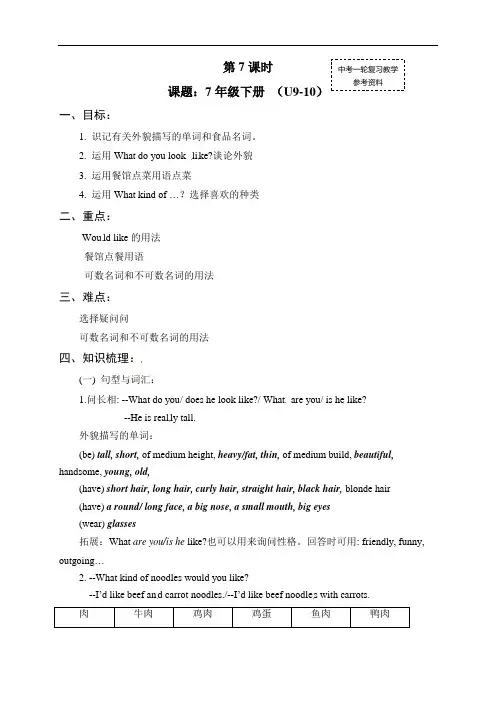
第7课时课题:7年级下册 (U9-10)一、目标:1. 识记有关外貌描写的单词和食品名词。
2. 运用What do you look li ke?谈论外貌3. 运用餐馆点菜用语点菜4. 运用What kind of …?选择喜欢的种类二、重点: Wou ld like 的用法餐馆点餐用语可数名词和不可数名词的用法三、难点:选择疑问问可数名词和不可数名词的用法四、知识梳理:(一) 句型与词汇:1.问长相: --What do you/ does he look like?/ What are you/ is he like? --He is real ly tall. 外貌描写的单词:(be) tall, short, of medium height, heavy/fat, thin, of medium build, beautiful, handsome, young, old,(have) short hair, long hair, curly hair, straight hair, black hair, blonde hair (have) a round/ long face, a big nose, a small mouth, big eyes (wear) glasses拓展:What are you/is he like?也可以用来询问性格。
回答时可用: friendly, funny, outgoing …2. --What kind of noodles would you like?--I’d like beef an d carrot noodles./--I’d like beef noodles with carrots. 肉牛肉鸡肉鸡蛋鱼肉鸭肉中考一轮复习教学参考资料meat beef chicken egg fish duck猪肉羊肉火腿蔬菜卷心菜土豆pork mutton ham vegetable cabbage potato胡萝卜西红柿洋葱面条饺子面包carrot tomato onion noodles dumpling bread蛋糕汉堡米饭汤薄煎饼粥,稀饭cake hamburger rice soup pancake porridge3.--What size would you like?--I’d like a large/ medium/ small bowl, please.4. --Would you like a large bowl?--Yes, please.(肯定回答)--No, thank you.(否定回答)5. See you later then. 回头见。
中考英语总复习第一轮教案-人教新目标版
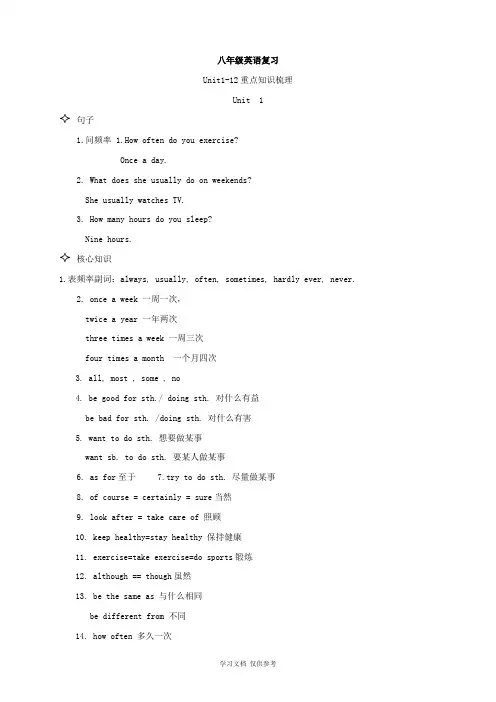
八年级英语复习Unit1-12重点知识梳理Unit 1✧句子1.问频率 1.How often do you exercise?Once a day.2. What does she usually do on weekends?She usually watches TV.3. How many hours do you sleep?Nine hours.✧核心知识1.表频率副词:always, usually, often, sometimes, hardly ever, never.2. once a week 一周一次,twice a year 一年两次three times a week 一周三次four times a month 一个月四次3. all, most , some , no4. be good for sth./ doing sth. 对什么有益be bad for sth. /doing sth. 对什么有害5. want to do sth. 想要做某事want sb. to do sth. 要某人做某事6. as for至于7.try to do sth. 尽量做某事8. of course = certainly = sure当然9. look after = take care of 照顾10. keep healthy=stay healthy 保持健康11. exercise=take exercise=do sports锻炼12. although == though虽然13. be the same as 与什么相同be different from 不同14. how often 多久一次15. most of the students=most students16. get good grades取得好成绩17. some advice 中的advice是不可数名词18. keep/be in good health保持健康19.shop=go shopping=do some shopping购物20. surf the internet 上网21. a lot of == lots of 许多22. health n., healthy adj. ,healthily adv. , unhealthy adj.23. different adj. difference n. 可数✧熟读P1 1b , P 2 2a G.F, P3 3 , P5 3a 3bUnit 2✧句子1. 看病用语①What’s the matter(with sb.)? 怎么了?= What’s th e trouble (with sb.)?= What’s wrong (with sb.)?= Is there anything wrong (with sb.)?②I’m not feeling well. 我觉得不太舒服= I’m feeling ill/sick. =I feel terrible/bad.= I don’t feel well③I have a stomachache 我胃痛= I have got a stomachache= There is something wrong with my stomach= My stomach hurts= I have (got) a pain in my stomach④ When did it start? 什么时候开始的?⑤ You should drink more water. 表建议You shouldn’t eat more.2. That’s a good idea 好主意That’s too bad 太糟糕了3. I have no idea = I don’t know 我不知道4. I’m sorry to hear that.听到此事我很难过✧核心知识1.身体各部位名称P7 1a2. 情态动词should 与shouldn’t 表建议3. have a cold / stomachache / toothache /fever/ sore throat4. see a dentist / doctor5. soon 一会儿6. feel 觉得,get 变, stay 保持, keep 保持,sound 听起来是系动词常和形容词连用如:feel happy , get tired, stay / keep healthy7. lie down 躺下 8. for example 例如9. too much 太多+不可数名词,too many 太多+可数名词,much too 太+形容词10. stressed out压抑筋疲力尽11. it’s +形容词+ to do sth. 做某事怎么样12. a few 一些修饰可数名词a little 一些修饰不可数名词few 少许修饰可数名词表否认little 少许修饰不可数名词表否认13. at the moment = now 此刻常和现在进行时连用14. neck and neck 并驾齐驱,齐头并进15. I think so 我认为如此16. tooth n . 复数形式teeth✧熟读 P7 1a , P8 , P9 3a ,P10 1a 形 1b 建议 , P11 4 , P12 2Unit 3✧句子1. What are you doing for vacation?I’m visiting my grandmother.2. When are you doing?I’m going on Monday.3.That sounds nice / interesting.4. 问多长时间 How long are you staying?For four days.5.Can I ask you some questions?✧核心知识1. 现在进行时表一般将来时常用的动词有:is / am / are goingis / am / are leavingis / am / are coming2. take walks == go for a walk散步3. some 一些, any 一些4. sing v.—singer n.5. take a vacation=take vacations=go on vacation6. think about考虑7. something different8. plan to do sth.计划做某事 9. spend time10. finish doing 完成做某事 11. a lot 许多12. need to do sth.需要做某事13. go camping 去野营 go shopping 去买东西go swimming 去游泳 go boating去划船go skating 去溜冰 go walking去散步go climbing 去登山 go fishing 去钓鱼go hiking 去徒步远足 go dancing去跳舞go sightseeing 去观光14. do some shopping 买东西do some washing 洗衣服do some cooking 做饭do some reading 读书do some speaking训练口语15.. how about=what about ……怎么样?16. go back , come back , get back 回来17. tour n.—tourist n.✧写作 P17 3a 假期计划✧熟读P14 GF , P15 3a , P16 1a , P 17 3aUnit 4✧句子1. How do you get to school? I ride my bike.2. How does he get to school?He takes the train.3. 问多长时间How long does it take?It takes about 10 minutes.4. 问路程How far is it ?How far is it from home to school? It is about 10 kilometers.5. Don’t worry.✧核心知识1.by bike, by bus, by subway, by taxi,by boat, by car, by train(乘坐……车,放在句尾)2. take the taxi / train / bus/ subway / car3. ride a bike 骑自行车4. walk to+地点走到…5. have a quick breakfast6. how long 多长时间 how far 多远Unit 5✧句子1. Can you come to my party?=Would you like to come to my party?问星期What is today? It is Monday?What day is it today? It is Monday.✧核心知识1.情态动词can 与can’t2. I’d love to 我非常乐意3. I’m sorry 对不起4. write soon 尽快回信5. would like sth. 想要某物would like (love )to do sth.想要做某事愿意做某事6. have a piano lesson 上一堂钢琴课7. keep quiet! 请保持安静,keep+形容词表示“保持某种状态”8. the day after tomorrow 后天the day before yesterday 前天9. invite v.—invitation n. 邀请✧写作P29 3a 关于拒绝邀请的回信✧熟读 P25 1a 1c , P26 2b 2c G.F ,P27 4 , P29 3a 3b 4Unit 6 ➢句子1. Tina is taller than Paul.2. Tom is more athletic than Sam➢核心知识1. 形容词副词的比较级、最高级2. as …as 与…一样,not as /so…as 与…不一样3. look the same我们看起来一样4. both :be+both , both+实义动词5. a little, much , even, far 可修饰比较级6. be good at sth./ doing sth. 擅长于…7. make sb. do 使某人做某事8. be important for sb. 对某人来说很重要9. in some ways在某些地方10. more than== over 超过➢熟读 P32 G.F, P33 3a , P35 3a➢写作 P33 3a 描写人物Unit7➢句子How do you make a banana milk shake?问数量1.How many bananas do we need ? We need 5.2.How much yogurt do we need? One cup.➢核心知识1. 量词 a cup of , a bottle of , a piece of ,a bowl of , a pair of , a box of ,a slice of , a teaspoon of2. 连词 first , next , then , finally3. turn on 打开, turn off 关上,turn down 关小4. cut up切碎5. mix up 混合6. add …to …把…加到…上➢熟读P41 1b , P42 2c G.F. , P 43 3a , P45 3a➢写作写一篇制作食物的步骤Unit8➢句子1. Did you go to the zoo? Yes, I did. No, I didn’t.2. Were there any sharks?Yes, there were. No, there weren’t.3. What else did you do ?你还做了些什么?➢核心知识一般过去时1. hang out 闲荡2. have a good time3. late adj. / adv. 迟4. take a class 上课5. luck n. lucky adj. luckily adv.6. see you soon 盼望很快见到你Unit9 ➢句子1.When was he born ? He was born in 18952. How long did he hiccup? For 5days.3. When did he start hiccupping?He started hiccupping in 1922.➢核心知识一般过去时1. be born 出生2. start doing ==start to do 开始做某事begin doing== begin to do3. too…to 太…而不能做某事4. violinist小提琴家 , violin 小提琴pianist 钢琴家,piano 钢琴5. well—known adj. 著名的6. at the age of …在…岁7. take part in 参加某种活动、比赛、项目join 参加某个组织成为其中一员8. because of+名词因为9. 70—year adj. 70年的10. usual adj. 寻常的unusual adj. 不寻常的➢写作P55 3a 和P57 3a 描写人物➢熟读 P53 1b, P54 2c G.F,P55 3a , P56 2b 2c , P57 3aUnit 10 ➢句子1. What are you going to do when you grow up?I’m going to be an actor.2. How are you going to do that?I’m going to take acting lesson.➢核心知识1. be going to 是一般将来时①表将要发生的动作或存在的状态②常和将来的时间连用如:next day/week/ month / year …in the future , in 20 years , tomorrow,the day after tomorrow 等2. grow up长大3. at the same time 同时4. read v.—reader n.读者5. somewhere interesting 有趣的地方6. save money 存钱7. maybe 也许8. get good grades 取得好成绩9. keep fit ==keep healthy10. 时间状语从句由when , after , before ,as soon as , not…until , while , since 等词引导注:当主句是一般将来时,从句用一般现在时I will be a teacher when I grow up.➢写作P61 3a 如何实现自己的梦想➢熟读 P59 1b 1c , P60 GF. , P 61 3a 3b,P62 1a 1b , P63 3aUnit 11➢句子表请求句子以及答复1. Could you please sweep the floor?Yes, sure. Sorry, I can’t. I have to go out.2. Could I please go to the movies?Yes, you can. No, you can’t . I have to go out. ➢核心知识1.could you please…你能…吗?/请你干….好吗?2. need to do sth.3. hate doing / to do sth.讨厌做某事4. do the dishes 洗餐具5. sweep the floor清扫地板6. stay out late晚归7. make one’s bed铺床8. fold one’s clothes叠衣服9. take out the trash倒垃圾10. invite sb. to do./ somewhere邀请某人做某事/到某地11. take care of ==look after 照顾12. forget to do 忘记去做某事13. help n. 不可数help v.14. have a test 休息15. borrow sth. from sb.向某人借某物(借入)16. agree 同意disagree 不同意➢写作P69 3a 请求帮助的信➢熟读P65 1a 1b , P66 2c G.F. ,P67 3a 4 , P68 1a , P69 3aUnit 12➢句子1. What is the best clothing store ? Jason’s. ➢核心知识1. 形容词、副词的比较级和最高级2. love v. 喜爱 lovely adj.美好的,令人愉快的3. south n—southern adj.north n.—northern adj.east n.—eastern adj.west n. —western adj.4. close to 靠近接近5. music n. musician n. musical adj.6. lead v. 指挥,指导leader n.主唱人指挥者➢写作P76 2 介绍一个旅游景点➢熟读 P71 1b , P72 2c G.F, P73 3a ,P75 3a , P76 2八年级英语〔下〕复习Unit1-10重点知识梳理◆unit 1 Will people have robots?目标语言:Make predictions重点句型:People won’t use money. Everything will be free.知识点:1.形容词,副词的比较等级考查热点透视:a)表示A与B在程度上相同时,“as+形容词或副词的原级+as”结构。
(完整)初三英语第一轮复习教案1

(完整)初三英语第一轮复习教案1初三英语第一轮复教案1目标本教案的目标是帮助学生进行初三英语第一轮复,在复过程中巩固基础知识,提高听说读写能力。
教学步骤1. 复语法知识:复语法知识:复习语法知识:- 复基本句型:主语+谓语+宾语- 复时态:一般现在时、一般过去时、一般将来时- 复被动语态- 复直接引语和间接引语的转换2. 复词汇:复词汇:复习词汇:- 复常用动词、名词、形容词和副词,并进行词义辨析- 复常用短语和惯用语,并进行运用练3. 听力训练:听力训练:听力训练:- 听录音,进行听力理解练- 听写句子和短文,提高听写准确性4. 口语训练:口语训练:口语训练:- 进行口语练,包括对话模拟和情景演练- 练口头表达,培养流利的口语能力5. 阅读训练:阅读训练:阅读训练:- 阅读短文,回答相关问题,提高阅读理解能力- 阅读文章,进行速读和细读,培养阅读技巧6. 写作练:写作练:写作练习:- 练写作句子、段落和作文,提高写作表达能力- 通过写作练巩固语法和词汇知识教学评估本节课的评估主要侧重于学生对所学知识的掌握情况和实际运用能力。
可以采用以下方式进行评估:1. 选择题测试学生对语法知识的理解和运用能力。
2. 口语表达练,测试学生的口语流利度和准确性。
3. 阅读理解练,考察学生对文章的理解和推理能力。
4. 书面作文,测试学生的写作能力和语法词汇的运用情况。
教学资源- 音频材料- 阅读材料- 词汇表- 语法练题- 写作题目教学延伸在课堂教学结束后,学生可以进行以下延伸练,巩固所学内容:1. 自主复:学生可以自主复本节课所学的语法知识和词汇,并进行练题的巩固。
2. 合作研究:学生可以与同学一起进行口语对话和作文练,互相纠正,提高语言表达能力。
3. 阅读拓展:学生可以选择其他英语阅读材料进行阅读练,扩大阅读广度和深度。
4. 写作拓展:学生可以进行更多写作练,如写信、写日记等,提高写作技巧和表达能力。
备战中考人教版英语第一轮教案
备战中考人教版英语第一轮教案--、教材分析:1、教学内容:本单元是一( 下) Unit- 。
主要围绕"这一主题展开各种教学活动,并以这一主题引出xx等语言功能。
本单元旨在创造一个轻松,愉快的学习,交流环境,通过听,说,读,写来培养学生综合运用这些知识的能力。
并让学生能在"做中学" (learningbydoing) ,通过有限的课堂实践活动,拓展以往的经历,能准确地用英语来表达。
2、教材的地位和作用:年级一单元讲述的是一的用法,这是初中非常重要的时态之一。
学生们能够用现在一来表达自己的经历,来体会别人的感受是很重要的。
这个单元-定要体会现在一的真正含义和用法。
要避免混淆几个重点词组的使用。
我们更要使学生不仅理解枯燥的语法,还要让学生们会用新学的语法知识来表达思想。
3、教材的处理:根据《英语课程标准》(实验稿) 关于总目标的具体描述,结合本单元这部分的教学内容及基于对教材的分析,我对本单元的内容进行如下处理,目的是突出重点,使课堂节奏紧凑,衔贯。
本单元分为四课时,第一课时是SectionA,第二课时是SectionB,第三课时是SelfCheck,第四课时是一,最后- 部分是做练习,以学生的自测为主,然后予以校对。
二、学情分析:我们教学的对象是初二学生(好,中,筹生都有),他们学习英语既感到好奇又担忧,希望能得到他人的肯定。
因此我在教学活动中尽量让他们参与到活动中来,有更多的机会来说英语,减少他们的恐惧感,通过学生间的合作学习,降低他们的学习难度,使他们体验到成功的喜悦。
同时在阅读和书面表达中加以落实,提高他们综合运用语言的能力,使各层次的学生都有所收获。
三、教学目标:根据以上我对本单元教材内容的分析和新课标的指导,我确定以下几个为本单元的教学目标:语言知识,语言技能,学习策略,情感态度和文化意识五个方面。
1、语言知识:本单元要求学生掌握以下词汇一语言功能:学习和增加阅读技巧和阅读策略。
人教版初一英语复习课教案——Units1—8总复习
人教版初一英语复习课教案——Units1—8总复习As the school year comes to a close, it's time to review all the language skills we've learned in Units 1-8 of our People's Education Press English textbook. This review will help ensure that we have a complete understanding of the language, grammar, and vocabulary we've covered over the past several months. As we prepare to move ahead, it's important to look back so that we do not miss any important information or skills.Unit 1In Unit 1, we learned the basics of introductions, including greetings, names, ages, and nationalities. We also learned how to ask and answer simple questions about ourselves and others. To review this unit, practice introducing yourself to someone else in the class, or ask someone else their name, age, and nationality. You can also review the vocabulary and practice asking and answering simple questions.Unit 2In Unit 2, we expanded our knowledge of personal information to include family, jobs, and hobbies. We learned how to describe people and things using adjectives, and we practiced talking about our likes and dislikes. To reviewthis unit, write a short paragraph about yourself, include information about your family, job or school, and hobbies. Use adjectives to describe your physical appearance and personality.Unit 3In Unit 3, we learned how to talk about our daily routines, including getting up, having breakfast, and going to school or work. We also learned how to tell time and use prepositions to describe locations. To review this unit,write a daily schedule for yourself or a family member, including what time you wake up, go to bed, and what you do during the day. Use prepositions to describe where you go during the day.Unit 4In Unit 4, we expanded our vocabulary to include foods, restaurants, and ordering at restaurants. We also learned howto give directions and use imperatives to give commands. To review this unit, practice giving directions to a location on a map. Also, practice ordering a meal at a restaurant, including drinks, appetizers, main courses, and desserts.Unit 5In Unit 5, we learned how to talk about our likes and dislikes in terms of sports and leisure activities. We also learned how to ask and answer questions about the weather and use comparative adjectives. To review this unit, practice talking about a sport or leisure activity you enjoy. Also, practice asking and answering questions about the weather and using comparative adjectives to describe different things.Unit 6In Unit 6, we expanded our vocabulary and grammar knowledge to include jobs, places of employment, and future plans. We also learned how to use the simple future tense and modals to talk about possibility and necessity. To reviewthis unit, practice talking about your future plans,including what job you would like to have and where you seeyourself living in the future. Use modals to talk about possibility and necessity.Unit 7In Unit 7, we learned how to describe places and transportation options. We also learned how to use the present continuous tense to talk about actions happening now and schedule events in the future. To review this unit, describe your hometown or a place you have visited. Include information about the buildings, people, and transportation options. Use the present continuous tense to talk about actions happening now and future events.Unit 8In Unit 8, we learned about people and events in history, including famous people and significant events. We also learned how to ask and answer questions using the past tense. To review this unit, research and describe a famous person from history or a significant event. Use the past tense to talk about the person or event.Overall, these reviews of each unit from our People's Education Press English textbook will help us to ensure that we have a comprehensive understanding of the language, grammar, and vocabulary that we've learned this school year. Practicing the above activities regularly will help us become more fluent and confident in our language abilities, which will be helpful as we continue to learn and grow in our English education.。
人教版英语中考总复习第一轮教案
⼈教版英语中考总复习第⼀轮教案九年级英语第⼀轮复习教案审核:九年级全体英语教师新⽬标七年级英语(上)期末复习⼿册Unit1-12重点知识梳理Unit 1句⼦:1.初次见⾯⽤语课P2. 2CWhat’s your name? My name is …/ I’m…Nice to meet you !2.问电话号码:What’s your phone number?What’s his/her phone number?It’s 3272310.词汇:1.family name, first name, last name语法:1. 形容词性物主代词的⽤法2. ⼈称代词主格的⽤法3. 基数词:1⾄10的读法和写法Unit 2句⼦1.Is this / that your pencil?2. What’s this in English?It’s a pen/ ruler/ book….How do you spell pen/ ruler/book? P-E-N.核⼼知识1. 认识26个字母,辅⾳字母,元⾳字母2. 认识⼀般疑问句的句式写作:课P11.3a Found and LostUnit 3句⼦:1.介绍别⼈或某物This is …That is …These are …Those are …词汇:课P131a写作:1.学习英语信的格式2.课P17 以信的形式介绍相⽚中⼈物Unit 4句⼦询问地⽅Where is / are …?It’s …/ They are …核⼼知识1. 词汇课P24 12. take 与bring 的区别3. there be 的⽤法4. on the wall5. 介词:on , in , under , behind ,next to , between…and…6. 认识特殊疑问句的句式熟读:P23.3a , P24. 3 , Grammar Focus Unit 5句⼦1. Do you have …?Yes, I do. No, I don’t.2. Does he / she have …?Yes, he / she does. No, he / she doesn’t.3. Let’s …4. That sounds good / interesting. That’s a good idea.5. Welcome to …核⼼知识⼀、there be 与have 的区别课本:P25 1a , P26 G.F. ,P27 3b,P28 1a , P30 1与3Unit 6句⼦询问所喜欢的东西1. Do you like….?Yes, I do. No, I don’t.2. Does he like …? Yes, he does. No, he does.核⼼知识1.⼀般现在时2. 可数名词与不可数名词3. lots of4. go on picnic5. health, healthy, healthily6. P36 1熟读课本:P31 1a , P32 G. F. , P35 3a, P36 1Unit 7 ?句⼦问价格1. How much is this T-shirt? It’s 10 dollars.2. How much are they? They are 100 dollars.问颜⾊1. What color do you want ? What color is it? 购物⽤语:P393a1. Can I help you? What can I do for you?2. Yes, please.3. I’ll take it .4. Thank you.5. You’re welcome.6. Have a look.核⼼知识两位数的基数词读法与写法P40熟读课本P37 1c,P38 G. F.,P 39 3a ,P40 1b,P41 3a ,P42 1与3Unit 8句⼦1. When is your birthday?2. My birthday is January fifteenth.3. What year were you born?4. I was born in 1999.5. When were you born?6. I was born in January first,1999.核⼼知识1.基数词和序数词基变序⼝决基变序有规律,词尾加上-th ;⼀⼆三特殊记,单词结尾t d d ;⼋减t , 九减e , f 要把ve替;ty 把y 改为i , 记住前还有e ;若遇到⼏⼗⼏,只把个位变序。
中考英语第一轮复习教案七篇
中考英语第一轮复习教案七篇中考英语第一轮复习教案七篇中考英语第一轮复习教案怎么写?英语,自从电子计算机普及以来,使不少与这范畴相关的词语进入大众的生活;另外,与电信科技相关的新词,有不少都是透过词缀的组合来构成新词。
下面是小编为大家带来的中考英语第一轮复习教案七篇,希望大家能够喜欢!中考英语第一轮复习教案(精选篇1)一、教学内容:Unit4 How do you get to school二、教学目标:1、知识目标:单词:subway take the subway train ride a bike walk 等。
2、语言目标:how引导的特殊问句;肯定句与否定句。
听:能听懂谈话出行的方式。
说:能表达自己想到达目的的出行方式。
读:能正确朗读本单元的对话和句型。
写:能写本单元的单词和句型。
3、学习策略:注意通过语言语调的表达来推测词义,也可借手势动作和表情来完成。
(主动参与学习,善于和他人合作交流)。
4、情感目标:学会在交流活动中尊重和理解别人,学会交换不同的看法,了解他人的生活习惯,增进情谊。
5、德育目标:在歌曲和游戏中习他人积极、乐观、努力进取的团队合作精神。
6、多元智能:人际交往逻辑表达个性呈现7、文化意识:了解英、美国家中小学生上学的方式,培养世界意识。
了解中西文化的差异。
三、教学重点、难点:1. how /how far /howlong 引导的特殊疑问句.2. 乘坐交通工具的表示方法.3. It takes /willtake/took sb. some time to do sth.四、课前准备:cards and atape-recorder .五、教学运用:情景交际法、游戏法等。
六、教学手段:多媒体演示、flash动画、ppt演示、歌曲游戏及肢体语言的应用。
七、教学过程:Step 1.Warming up.Greatthe class as usual.Talkabout the weather .T:How’s the weather todayT:How was the weatherlike yesterday ……pointstudent A say“ Hello! Listen to me ok .I willsing a song to you .But youmust …”.(用手指作安静动作)Listening to a song歌曲欣赏,创造轻松愉快的学习气氛, 激发学生的好奇心,为学习新课打下伏笔。
部编人教版中考英语一轮复习 教案 七上 Unit 1-4
教学难点
一般现在时,主语+谓语+宾语
教学方法
讲、练结合
教学准备
七上课本、练习题
教学过程
教学程序
教学内容
教学构思
一、课堂导入
通过强化成就感,及时总结得失,顺利完成从小学到初中的转变,争取完全上轨道。来询问学生或让学生之间互相询问,复习本节课所需句型。
call sbat+电话号码,以......号码给某人打电话。
Thanks for…“因……而感谢!” Thanks for后面跟名词或者动名词。
【应用】
1. --- Linda, thanks ________ your brother's birthday gift. I'll call him to say "thank you".
【应用】1. ---________ my hat, Mum?--- It is on your head.
A. WhereB. HowC. WhatD. When
2. --- _______ are these? --- They are letters from the US.
A. WhereB. WhyC. WhatD. When
A. ofB. forC. toD. at
3. ---Thanks for ________ me to play basketball. ---You're welcome.
A. teachB. teachingC. teachesD. taught
【答案】1. C 2. D 3. B知识点7:介词短语
初中英语总复习第一轮教案
Unit 4一、知识点1、①give sb sth=give sth to sb类似的词还有:pass、lend、show、write、send等②buy sb sth=buy sth for sb类似的词还有:make、draw、cook等2、hundred 、thousand、mi11ion与数字连用不能用复数。
hundreds of、thousands of、mi11ions of中必须用复数。
3、look for寻找find找到、发现find out指经过观察、探索、调查等弄清楚、弄明白。
discover 指发现那些客观存在而不为人所知的实情。
如科学上的重大发现。
4、bring 带来take 带走fetch 去并拿来5、talk to/with sb 同××说话。
tell 告诉, 分辨,辨别。
speak to sb 同××说话,做及物动词,后跟语言。
say 后跟名词、代词及宾语从句做宾语,着重强调说话内容。
6、What if ……如果……将会怎么样?(引导条件状语从句、疑问句)eg What if she doesn't come? 她要是不来怎么办?What if your parent don't agree? 如果你的父母不同意怎么办?What if you should fall sick? 如果你生病了怎么办?7、before 引导一个句子,为连词。
后跟短语或名词等,则为介词。
8、food 表示食品种类,一种食物时,为可数名词eg fried foods 油炸食品break foods 早餐食品frozen foods 冷冻食品9、复数名词可表示一类食品(如dogs)a/an+单数可数名词可表示一类(如a dog)10、confident(adj.) confidence(n.)11、What does/do ×× look like? 问相貌。