
2012英语四级改错习题和答案精选
2012英语四级改错习题和答案精选
这篇关于2012英语四级改错练习题及答案精选,是笔者特地为大家整理的,希望对大家有所帮助!
Americans this year will swallow 15000 tons of aspirin, one of safest and most effective drugs
1.__________ invented by man. The most popular medicines in the
2.__________ world today, it is an effective pain reliever. Its bad effects are relatively mild, and it is cheap. For millions of people suffered from arthrities,
3.__________ it is the only thing that works. Aspirin, in short, is truly the 20th-century wonder drug. It is also the second largest suicide drug and is the leading cause of poisoning among children. it has side effects that, if
4.__________ relatively mild, are largely unrecognized between users.
5.__________ Although aspirin was first sold by Germam company in 1899, it has been around much longer than that. Hippocrates, in ancient Greece, understood the medical
value of the leaves and tree bark which today is known to 6.__________ contain salicylates, the chemical in aspirin. during the 19th century, there was a great number of experimentation 7.__________
in Europe with this chemical, and it led in the introduction 8.__________ of aspirin. By 1915, aspirin tablets were available in the United States.
A small quantity of aspirin(two five-grain tablets) relieves pain and inflammation. It also reduces down 9.__________ fever by interfering with some of the body’s reactions.Specifically, aspirin seems to slow down the formation of the acids involved in pain and the complex chemical reactions that cause fever. The chemistry of these acids is not fully understood, and the slowing effect of aspirin
10.__________ is well known.。
2012.12大学英语四级改错习题

2012.12大学英语四级改错习题这篇关于2012.12大学英语四级改错练习题,是笔者特地为大家整理的,希望对大家有所帮助!Aphrodite loved Adonis more than she did to heaven, for 1.________He was a brisk, lovely young hunter. She residenceat Olympus and took to the woods, where she dressedherself up like a huntress and kept the youth companion all day 2.________long. With him she roved through bushy grounds and groves andover hills and dales, cheering hounds and pursuing game of aharmless sort. They had a great time together. However, shewarned him many times to chase wild beasts like lions and 3.________wolves, but the young man just laughed at the idea.One day, after warning him thus, she left to Olympus in 4.________her chariot. Quite by chance Adonis’ hounds found a boar, that 5.________roused Adonis to enthusiasm. He hit the beast with a dart, and 6.________the boar, turning on him ,buried its white tusk deep into histender side and trampled him to death.When Aphrodite came back to find her lover cold in death,she burst into a passion of tears. Unable to wrest him back fromthe low world, she sprinkled nectar on Adonis’ blood and 7.________turned it into anemone, a delicate purple flower.Aphrodite was, therefore, still inconsolable. In grief and 8.________despair she flew to Zeus and implored him to restore Adonis toher. Though she had Zeus’ sympathy, Hades was by no meansprepared to comply with her request. After the much dispute a 9.________compromise was worked out under which Adonis was to spendhalf the year above ground with Aphrodite, but the rest six 10.________months in the Elysian Fields. Therefore, in spring time Adoniscame back to the loving embrace of Aphrodite, came he had to return most reluctantly to Hades.答案1. to → /2. companion → company3. times ∧ to → not4. to → for5. that → which6. and → but7. low → lower8. therefore → however9. the → /10. rest → remaining。
2012年12月英语四级真题及答案
2012年12月英语四级真题及答案For this part, you are allowed 30 minutes to write a short essay entitled Education PaysYou should write at least 120 words but no more than 180 words. Part II Reading Comprehension (Skimming and Scanning) Why Integrity Matters What is Integrity? "Integrity" is defined as "adherence to moral and ethical principles; honesty." The key to integrity is consistency--not only setting high personal standards for oneself (honesty, responsibility, respect for others, fairness) but also living up to those standards each day. One who has integrity is bound by and follows moral and ethical standards even when making life's hard choices, choices which may be clouded by stress, pressure to succeed, or temptation. What happens if we lie, cheat, steal, or violate other ethical standards? We feel disappointed in ourselves and ashamed. But a lapse of integrity also affects our relationships with others. Trust is essential in any important relationship, whether personal or professional. Who can trust someone who is dishonest or unfair? Thus, integrity must be one of our most important goals. Risky Business We are each responsible for our own decisions, even if the decision-making process has been undermined by stress or peer pressure. The real test of character is whether we can learn from our mistake, by understanding why we acted as we did, and then exploring ways to avoid similar problems in the future. Making ethical decisions is a critical part of avoiding future problems. We must learn to recognize risks, because if we can't see the risks we're taking, we can't make responsible choices. To identify risks, we need to know the rules and be aware of the facts. For example, one who doesn't know the rules about plagiarism may accidentally use words or ideas without giving proper credit, or one who fails to keep careful research notes may unintentionally fail to quote and cite sources as required. But the fact that such a violation is "unintentional" does not excuse the misconduct. Ignorance is not a defense. "But Everybody Does It" Most people who get in trouble do know the rules and facts, but manage to fool themselves about the risks they’re taking by using excuses: "Everyone else does it," "I'm not hurting anyone," or "I really need this grade." Excuses can get very elaborate: "I know I'm looking at another's exam, even though I'm supposed to keep my eyes on my own paper, but that's not cheating because I'm just checking my answers, not copying." We must be honest about our actions, and avoid excuses. If we fool ourselves into believing we're not doing anything wrong, we can't see the real choice we're making--and that leads to bad decisions. To avoid fooling yourself, watch out for excuses and try this test: Ask how you would feel if your actions were public, and anyone could be watching over yourshoulder. Would you feel proud or ashamed of your actions? If you'd rather hide your actions, that's a good indication that you're taking a risk and rationalizing it to yourself. Evaluating Risks To decide whether a risk is worth taking, you must examine the consequences, in the future as well as right now, negative as well as positive, and to others as well as to yourself. Those who take risks they later regret usually focus on immediate benefits ("what's in it for me"), and simply haven't considered what might go wrong. The consequences of getting caught are serious, and may include a "0" on a test or assignment; an "F" in the class; Suspension or Dismissal from school; transcript notation; and a tarnished reputation. In fact, when you break a rule or law, you lose control over your life, and give others the power to impose punishment: you have no control over what that punishment might be. This is an extremely precarious and vulnerable position. There may be some matters of life and death, or highest principle, which might justify such a risk, but there aren't many things that fall in this category. Getting Away With It--Or Not Those who don't get caught pay an even higher price. A cheater doesn't learn from the test, depriving him/herself of an education. Cheating undermines confidence and independence: the cheater is a fraud, and knows that without dishonesty, he/she would have failed. Cheating destroys self-esteem and integrity, leaving the cheater ashamed, guilty, and afraid of getting caught. Worst of all, a cheater who doesn't get caught the first time usually cheats again, not only because he/she is farther behind, but also because it seems "easier." This slippery slope of eroding ethics and bigger risks leads only to disaster. Eventually, the cheater gets caught, and the later he/she gets caught, the worse the consequences. Students have been dismissed from school because they didn't get this simple message: Honesty is the ONLY policy that works. Cheating Hurts Others, Too Cheaters often feel invisible, as if their actions "don't count" and don't really hurt anyone. But individual choices have a profound cumulative effect. Cheating can spread like a disease, and a cheater can encourage others just by being seen from across the room. Recent statistics suggest 30% or more of college students cheat. If a class is graded on a curve, cheating hurts others' grades. Even if there is no curve, cheating "poisons" the classroom, and others may feel pressured to join in. ("If I don't cheat, I can't compete with those who do.") Cheating also has a destructive impact on teachers. The real reward of good teaching is seeing students learn, but a cheater says, "I'm not interested in what you're trying to teach; all I care about is stealing a grade, regardless of the effect on others." The end result is a blatant and destructive attack on the quality of your education. Finally, cheating can hurt the reputation of the University, and harm those who worked hard for their degree. Why Integrity Matters If cheating becomes the norm, then we are in big trouble. We must rely on thehonesty and good faith of others every day. If not, we couldn't put money in the bank, buy food, clothing, or medicine from others, drive across a bridge, get on a plane, go to the dentist--the list is endless. There are many examples of the vast harm that is caused when individuals forget or ignore the effect their dishonesty can have. The savings and loan scandal, the stock market and junk bond swindles, and, of course, Watergate, have undermined the faith of many Americans in the integrity of political and economic leaders and society as a whole. Such incidents take a tremendous toll on our nation's economy and our individual well-being. For example, but for the savings and loan debacle, there might be funds available to reduce the national debt and pay for education. In sum, we all have a common stake in our school, our community, and our society. Our actions do matter. It is essential that we act with integrity in order to build the kind of world in which we want to live. 1. A person of integrity not only sets high moral and ethical standards but also _______. A) sticks to them in their daily life B) makes them known to others C) understands their true values D)sees that others also follow them 2. What role does integrity play in personal and professional relationships? A) It helps to create team spirit B) It facilitates communication C) It is the basis of mutual trust D) It inspires mutual respect 3. why must we learn to identify the risks we are going to take? A. To ensure we make responsible choices. B. To avoid being overwhelmed by stress. C. so that we don’t break any rules. D. so that we don’t run into trouble. 4. Violation of a rule is misconduct even if _______? A. it has caused no harm. B. it is claimed to be unintentional. C. it has gone unnoticed. D. it is committed with good intentions. 5. What should one do if he doesn’t wish to fool himself? A. Avoid making excuses. B. Listen to other people’s advice. C. Make his intensions public. D. Have others watch over his shoulder. 6. Those who take risks they regret later on _______. A. will often become more cautious B. are usually very aggressive C. value immediate benefits most. D. may lose everything in the end 7. According to the author, a cheater who doesn’t get caught right away will _______. A) pay more dearly B) become more confident C) be widely admired D) feel somewhat lucky 8. Cheaters at exam don’t care about their education, all they care about is how to _______ 9. Integrity matters in that all social activities rely on people’s _______ 10. Many Americans lost faith in the integrity of their political leaders asa result of _______. Part III Listening Comprehension Section A Directions: In this section, you will hear 8 short conversations and 2 long conversations. At the end of each conversation, one or more questions will be asked about what was said. Both the conversation and the questions will be spoken only once. After each question there will be a pause. During the pause, you must read the four choices marked A), B), C) and D), and decide which is the best answer. Then mark the corresponding letter on Answer Sheet 2 with a single line through the centre. 11. W: I just heard about a really beautiful park in the east end of the town. There are a lot of roses in bloom. M: Why don’t we walk over there and see for ourselves? Q: What will the speakers probably do? 12. M: My presentation is scheduled for 9:30 tomorrow morning at the lecture hall.I hope to see you there. W: Oh, sorry. I was about to tell you that I have an appointment with my dentist at 9:00 o’clock tomorrow. Q: What do we learn about the woman? 13. W: How long have you been running this company? M: Twenty years if you can believe that. I brought it from a small operation to what it is today. Q: What do we learn about the man? 14. M: Have you read the news on the campus net? Susan has won the scholarship for next year. W: I knew she would from the very beginning. Such a brilliant and diligent girl! She certainly deserves it. Q: What does the woman mean? 15. W: Taking a bus to Miami, it’s cheaper than going by train. M: That’s true. But I’d rather pay a little more for the added comfort andconvenience. Q: What does the man mean? 16. M: I think it’s time we got rid of all this old furniture. W: You’re right. We need to promote our image besides it’s not a real antique. Q: What do the speakers mean? 17. M: That was some storm yesterday. How was I afraid I couldn’t make it home. W: Yeah, most of the roads to my house were flooded. I didn’t get home from the lab until midnight. Q: What do we learn from the conversation? 18. W: My boys are always complaining that they’re bored. M: Why don’t you get them into some team sports? My son and daughter play soccer every Saturday. And they both look forward to it all week. Q: What does the man mean? Questions 19 to 21 are based on the conversation you have just heard. W: I don’t know what to do. I can’t seem to get anyone in the hospital to listen to my complaints and this outdated equipment is dangerous. Just look at it. M: Hmm, uh, are you trying to say that it presents a health hazard? W: Yes, I am. The head technician in the lab tried to persuade the hospital administration to replace it, but they are trying to cut costs. M: You are pregnant, aren’t you? W: Yes, I am. I made an effort to get my supervisor to transfer me to another department, but he urged me not to complain too loudly. Because the administration is more likely to replace me than an X-ray equipment, I’m afraid to refuse to work. But I’m more afraid to expose my unborn child to the radiation. M: I see what you mean. Well, as your union representative, I have to warn you that it would take quite a while to force management to replace the old machines and attempt to get you transferred may or may not be successful. W: Oh, what am I supposed to do then? M: Workers have the legal right to refuse certain unsafe work assignments under two federal laws, the Occupation or Safety and Health Act and the National Labor Relations Act. But the requirements of either of the Acts may be difficult to meet. W: Do you think I have a good case? M: If you do lose your job, the union will fight to get it back for you along with back pay, your lost income. But you have to be prepared for a long wait, maybe after two years. Q19. What does the woman complain about? Q20. What has the woman asked her supervisor to do? Q21. What does the man say about the two federal laws? Q22. What will the union do if the woman loses her job Questions 22 to 25 are based on the conversation you have just heard. W: Mr. Green, is it fair to say that negotiation is an art? M: Well, I think it’s both an art and science. You can prepare for a negotiation quite scientifically, but the execution of the negotiation has quite a lot to do with one’s artistic quality. The scientific part of a negotiation is in determining your strategy. What do you want out of it? What can you give? Then of course there are tactics. How do you go about it? Do you take an opening position in a negotiation which differs from the eventual goal you are heading for? And then of course there are the behavioral aspects. W: What do you mean by the behavioral aspects? M: Well, that’s I think where the art comes in. In your behavior, you can either be an actor. You can pretend that you don’t like things which you are actually quite pleased about. Or you can pretend to like things which you are quite happy to do without. Or you can be the honest type negotiator who’s known to his partners in negotiation and always plays everything straight. But the artistic part of negotiation I think has to do with responding immediately to cues one gets in the process of negotiation. These can be verbal cues or even body language. This is where the artistic quality comes in. W: So really, you see two types of negotiator then, the actor or the honest one. M: That’ right. And both can work. I would say the honest negotiator can be quite effective in some circumstances. In other circumstances you need an actor. Q23. When is a scientific approach best embodied in a negotiation according to the man? Q24. In what way is a negotiator like an actor according to the man? Q25. What does the man say about the two types of negotiator? Section B Directions: In this section, you will hear 3 short passages. At the end of each passage, you will hear some questions. Both the passage and the questions will be spoken only once. After you hear a question, you must choose the best answer from the four choices marked A), B), C) and D). Then mark the corresponding letter on Answer Sheet 2 with a single line through the center. Passage 1 Questions 26 to 28 are based on the passage you have just heard. Since I started working part-time at a grocery store, I have learned that a customer is more than someone who buys something. To me, a customer is a person whose memory fails entirely once he or she starts to push a shopping cart. One of the first things customers forget is how to count. There is no other way to explain how so many people get in their express line, which is clearly marked 15 items or less, with 20, 25 or even a cart load of items. Customers also forget why they came to the store in the first place. Just as I finish ringing up an order, a customer will say, “Oops, I forgot to pick up a fresh loaf of bread. I hope you don’t mind waiting while I go get it.” Five minutes later, he is back with the bread, a bottle of milk, and three rolls of paper towels. Strange as it seems, customers also seem to forget that they have to pay for their groceries. Instead of writing a check or looking for a credit card while I am ringing up the groceries, my customers will wait until I announce the total. Then, in surprise, she says, “Oh no, what did I do with mycheck book?” After 5 minutes of digging through her purse, she borrows my pen because she’s forgotten hers. But I have to be tolerant of customers because they pay my salary, and that’s something I can’t afford to forget. Q26. What does the speaker say about customers’ entering the grocery store? Q27. Which customers are supposed to be in the express line? Q28. What does the speaker say some customers do when they arrive at the check-out counter? Q29. What does the speaker say about his job at the end of the talk? Passage 2 Questions 29 to 31 are based on the passage you have just heard. The speech delivery style of Europeans and Asians tends to be very formal. Speakers of these cultures often read oral presentations from carefully written manuscripts. On the other hand, American speakers are generally more informal relative to speakers in other cultures. American audiences prefer natural, spontaneous delivery that conveys a lively sense of communication. They don’t relate well to speakers who read from a manuscript. If you use an outline of your ideas instead of a prepared text, your speech will not only sound more natural, but you will also be able to establish better relationship with your listeners and keep their attention. The language and style you use when making an oral presentation should not be the same as the language and style you use when writing. Well-written information, that is meant to be read, does not work as well when it is heard. It is, therefore, important for you to adapt written texts or outlines for presentations. Good speakers are much more informal when speaking than when writing. They also use their own words and develop their own speaking styles. Whenever possible, they use short words. Listeners appreciate it when speakers use simple, everyday words in a presentation. One advantage is that it’s much easier for speakers to pronounce short words correctly. Another is that long and sophisticated vocabulary choices make listening more difficult. Question 30 to 32 30. What does the speaker say American audiences prefer? 31. What should one pay attention to when making an oral presentation? 32. What does the speaker focus on in the talk? Passage 3 Questions 32 to 35 are based on the passage you have just heard. Let children learn to judge their own work. A child learning to talk does not learn by being corrected all the time. If corrected too much, he will stop talking. He compares a thousand times a day the difference between language as he uses it and language as those around him use it. Bit by bit, he makes the necessary changes to make his language like other people’s. In the same way, kids learning to do all the other things they learn without adult teachers, to walk, run, climb, ride a bike, play games, compare their own performance with what more skilled people do, and slowly make the needed changes. But in school we never give a child a chance to detect his mistakes. We do it all for him. We act as if we thought he would never notice a mistake unless it was pointed out to him. Soon he becomes dependent on the expert.We should let him do it himself. Let him figure out, with the help of other children if he wants it, what this word says, what is the answer to that problem, whether this is a good way of saying or doing this or that. If right answers need to be given, as in mathematics or science, give him the answer book. Let him correct his own papers. Why should we teachers waste time on such tedious work? Our job should be to help children when they tell us that they can’t find a way to get the right answer. Question 33 to 35 33. How does a child learn to do something according to the speaker? 34. What belief do teachers commonly hold according to the speaker? 35. What does the speaker imply about the current way of teaching? Section C Directions: In this section, you will hear a passage three times. When the passage is read for the first time, you should listen carefully for its general idea. When the passage is read for the second time, you are required to fill in the blanks numbered from 36 to43 with the exact words you have just heard. For blanks numbered from 44 to 46 you are required to fill in the missing information. For these blanks, you can either use the exact words you have just heard or write down the main points in your own words. Finally, when the passage is read for the third time, you should check what you have written. (听力原文)Time is, for the average American, of utmost importance. To the foreign visitor, Americans seem to be more concerned with getting things accomplished on time (according to a predetermined schedule) than they are with developing deep interpersonal relations. Schedules, for the American, are meant to be planned and then followed in the smallest detail. It may seem to you that most Americans are completely controlled by the little machines they wear on their wrists, cutting their discussions off abruptly to make it to their next appointment on time. Americans’ language is filled with references to time, giving a clear indication of how much it is valued. Time is something to be “on,” to be “kept,” “filled,” “saved,” “wasted,” “gained,” “planned,” “given,” “made the most of,” even “killed.” The international visitor soon learns that it is considered very rude to be late -- even by 10 minutes -- for an appointment in America. Time is so valued in America, because by considering time to be important one can clearly achieve more than if one “wastes” time and doesn’t keep busy. This philosophy has proven its worth. It has enabled Americans to be extremely productive, and productivity itself is highly valued in America. Many American proverbs stress the value of guarding time, using it wisely, and setting and working toward specific goals. Americans believe in spending their time and energy today so that the fruits of their labor may be enjoyed at a later time. Part IV Reading Comprehension (Reading in Depth) Section A Directions: In this section, there is a passage with ten blanks. You are required to select one word for each blank from a list of choices given in a word bank following the passage. Read the passage through carefully before making your choices. Each choice in the bank is identified by a letter. Please mark the corresponding letterfor each item on Answer Sheet 2 with a single line through the centre. You may not use any of the words in the bank more than once. Questions 47 to 56 is based on the following passage. So many people use the cell phone so frequantly every day,But ___47__little is certain adout he health effects of its use.Macufacturers___48___that cell phones meet government standards for safe radio- frequency radiation omission,but enough studies are beginning to document a possible ___49___in rare brain tumour(肿瘤):bendaches and behavioral disorders in children to cause coneem.So far,the avidence isn't___50___on whether the use of cell phones __51__to any uncased risk of cancer.In a new trial,researchers asked 47 yolunteers to ___52__in a project to measure glucose(葡萄糖)consurnption in the brain by scanning the brain to see how cells use energy.For both 50- minute scans,the volunteers had a cell phone __53__to each ear.During be first scan,the devices were turned off,but for the second scan,the phone on the right ear as___54____on and received a recorded- message call,although the yolume was muted(消毒) so the dise wouldn't bias the results.The results of the second scan abowed that the__55__of the brain rarest to the device had higher rales of glucose consumption than the rest of the brain.The study ows that cell phones can change brain activity,and __56__a whole new avenue for scientific quiry,tuough it doesn't say anything about whether cell-phone radiation can cause cancer. 注意:此部分试题请在答题卡2上作答。
2012年12月英语四级真题及答案解析

2012年12月英语四级真题答案解析Part I Writing标准版:The above bar chart clearly shows us education pays in 2010. We see that one with higher education background earns more money weekly than those with lower ones. For instance, the college students with no degree get paid$712 per week whereas those with a Bachelor’s degree can earn $1038.Several reasons, in my opinion, can be identified to account for this phenomenon. To begin with, compared with those with comparatively lower education degree, people who have received higher education possess considerably wider knowledge, more remarkable learning and research ability, greater innovation and most of all, resourceful social network, all of which are essential to a high-income work. Also, the higher one’s education degree is, the bigger platform he will have to show his ability. For example, his college, university, or research institute will organize various job fairs for them to communicate face to face with employers.This phenomenon tells us that education is a worthy investment. Therefore, substantial education investment should be strengthened while we, as college students, should study harder to build our country and strive for a better life for ourselves.高分版:Education PaysJudging from the table, we can see that people’s income increases along with their education levels. Above all,the average college graduates earn much more than the typical high-school graduates.The fact revealed by these data is obvious: a degree does bring distinctive financial benefits to its holders. But is it true that a degree alone can ensure a bright future? I don’t think so because, on the one hand, the financial value of high education depends heavily on what skills graduates can gain from it instead of the degree itself. After all, an employer only pays for your ability and performance, not for your certificate. On the other hand, the most valuable bless high education brings to graduates is the ability to learn quickly and efficiently. People received more education tend to keep lifelong learning habits after their graduation, which would help them gain more opportunities in their career path.In conclusion, what accounts for education pays is not the degree alone, but the graduate’s ability and leaning habit.作文B:标准版:Education PaysThe above bar chart clearly shows us education pays in 2010. We see that unemployment rate of those with higher education background is much lower than those with lower education degree. For instance, the unemployment rate of college students with no degree is as high as 14.9% while that of those with doctoral degree is only 1.9%.The followingreason, in my opinion, is the most important one to account for this phenomenon. Compared with those with comparatively lower education degree, people who have received higher education possess considerably wider knowledge, more remarkable learning and research ability, greater innovation and most of all, resourceful social network, all of which make them more qualified and competent for their task. Thus, they are less likely to lose their jobs.This phenomenon tells us that education is a worthy investment. Therefore, education investment should be strengthened while we, as college students, should study harder to avoid unemployment.高分版:Education PaysAs is shown in the table, the unemployment rate decreases steadily as the education level increases. The fact revealed by the statistics is obvious: graduates with a degree are less likely to be unemployed.What has brought about this effect? I believe there are three main reasons. To begin with, the education level is still the top factor that employers would take into account when selecting job candidates. It is believed that people with a college degree tend to be more intelligent and qualified. In addition, as a result of good learning habit formed during college, job hunters with high education background are also more efficient in acquiring and processing job hunting information. Finally, college education equips graduates with specialized skills, leading to greater attachment to the company they are employed and higher possibility to be reemployed even if they leave their previous company.In conclusion, it is the qualifications, learning habit and specialized skills that high education equip a graduate that make one distinctive in labor market.【标准版点评】这次四级作文出了图表题,可能让大家有些意外,但是四六级考察图表作文已经并不是第一次,早在2002年的时候就已经出现过,是图表+提纲的形式,图表反应的是大学生使用计算机的情况。
2012年12月大学英语四级考试真题及答案
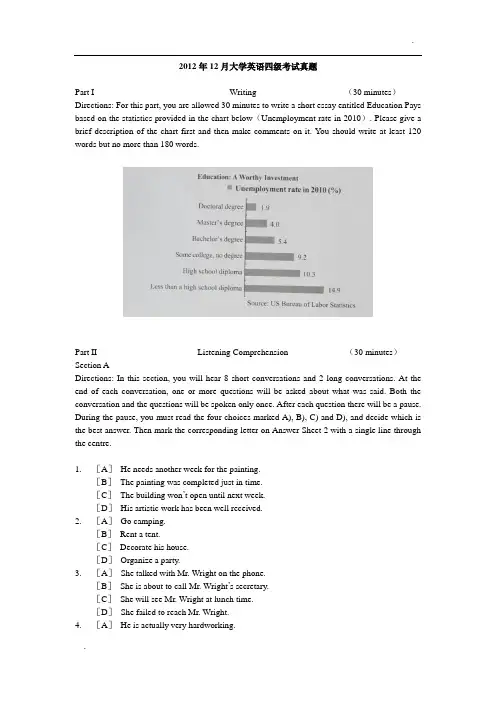
2012年12月大学英语四级考试真题Part I Writing (30 minutes)Directions: For this part, you are allowed 30 minutes to write a short essay entitled Education Pays based on the statistics provided in the chart below(Unemployment rate in 2010). Please give a brief description of the chart first and then make comments on it. You should write at least 120 words but no more than 180 words.Part II Listening Comprehension (30 minutes)Section ADirections: In this section, you will hear 8 short conversations and 2 long conversations. At the end of each conversation, one or more questions will be asked about what was said. Both the conversation and the questions will be spoken only once. After each question there will be a pause. During the pause, you must read the four choices marked A), B), C) and D), and decide which is the best answer. Then mark the corresponding letter on Answer Sheet 2 with a single line through the centre.1. [A]He needs another week for the painting.[B]The painting was completed just in time.[C]The building won’t open until next week.[D]His artistic work has been well received.2. [A]Go camping.[B]Rent a tent.[C]Decorate his house.[D]Organize a party.3. [A]She talked with Mr. Wright on the phone.[B]She is about to call Mr. Wright’s secretary.[C]She will see Mr. Wright at lunch time.[D]She failed to reach Mr. Wright.4. [A]He is actually very hardworking.[B]He has difficulty finishing his project.[C]He needs to spend more time in the lab.[D]He seldom tells the truth about himself.5. [A]Rules restricting smoking. [C]Smokers’ health problems.[B]Ways to quit smoking. [D]Hazards of passive smoking.6. [A]He is out of town all morning. [C]He has been writing a report.[B]He is tied up in family matters. [D]He has got meetings to attend.7. [A]He is not easy-going. [C]He is not at home this weekend.[B]He is the speakers’ boss. [D]He seldom invites people to his home.8. [A]Take a break.[B]Refuel his car.[C]Ask the way.[D]Have a cup of coffee.Questions 9 to 11 are based on the conversation you have just heard.9. [A]They are as good as historical films. [C]They have greatly improved.[B]They give youngsters a thrill. [D]They are better than comics on film. 10. [A]The effects were very good. [C]The plot was too complicated.[B]The acting was just so-so. [D]The characters were lifelike.11. [A]They triumphed ultimately over evil in the battle.[B]They played the same role in War of the Worlds.[C]They are popular figures among young people.[D]They are two leading characters in the film.Questions 12 to 15 are based on the conversation you have just heard.12. [A]It is scheduled on Thursday night. [C]It takes place once a week.[B]It is supposed to last nine weeks. [D]It usually starts at six.13. [A]To make good use of her spare time in the evening.[B]To meet the requirements of her in-service training.[C]To improve her driving skills as quickly as possible.[D]To get some basic knowledge about car maintenance.14. [A]Participate in group discussions. [C]Listen to the teacher’s explanation.[B]Take turns to make presentations. [D]Answer the teacher’s questions.15. [A]Most of them are female. [C]They plan to buy a new car.[B]Some have a part-time job. [D]A few of them are old chaps.Section BDirections: In this section, you will hear 3 short passages. At the end of each passage, you will hear some questions. Both the passage and the questions will be spoken only once. After you hear a question, you must choose the best answer from the four choices marked A), B), C) and D). Then mark the corresponding letter on Answer Sheet 2 with a single line through the centre.Passage OneQuestions 16 to 19 are based on the passage you have just heard.16. [A]She is not good at making friends. [C]She enjoys company.[B]She is not well off. [D]She likes to go to concerts alone.17. [A]Their similar social status. [C]Their common interest.[B]Their interdependence. [D]Their identical character.18. [A]Invite Pat to a live concert. [C]Help take care of Pat’s kids.[B]Buy some gifts for Pat’s kids. [D]Pay for Pat’s season tickets.19. [A]It can develop between people with a big difference in income.[B]It can be maintained among people of different age groups.[C]It cannot last long without similar family background.[D]It cannot be sustained when friends move far apart.Passage TwoQuestions 20 to 22 are based on the passage you have just heard.20. [A]Priority of students’ academic achievements.[B]Equal education opportunities to all children.[C]Social equality between teachers and students.[D]Respect for students’ individuality.21. [A]Efficient.[B]Complicated.[C]Lengthy.[D]Democratic.22. [A]To help them acquire hands-on experience.[B]To try to cut down its operational expenses.[C]To provide part-time jobs for needy students.[D]To enable them to learn to take responsibility.Passage ThreeQuestions 23 to 25 are based on the passage you have just heard.23. [A]The best way to work through a finger maze.[B]Individuals doing better in front of an audience.[C]Researchers having contributed greatly to psychology.[D]Improvements on the classification of human behavior.24. [A]When you feel encouraged by the audience.[B]When you try to figure out a confusing game.[C]When you already know how to do something.[D]When you complete with other people in a group.25. [A]Practicing constantly.[B]Working by oneself.[C]Learning by doing.[D]Using proven methods.Section CDirections: In this section, you will hear a passage three times. When the passage is read for the first time, you should listen carefully for its general idea. When the passage is read for the secondtime, you are required to fill in the blanks with the exact words you have just heard. Finally, when the passage is read for the third time, you should check what you have written.Americans today have different eating habits than they had in the past. There is a wide (26)__________ of food available. They have a broader knowledge of nutrition (营养), so they buy more fresh fruit and vegetables than ever before. At the same time, Americans (27)__________ increasing quantities of sweets and sodas.Statistics show that the way people live (28)__________ the way they eat. American lifestyles have changed. There are now growing numbers of people who live alone, (29)__________ parents and children, and double-income families. These changing lifestyles are responsible for the increasing number of people who must rush meals or sometimes simply (30)__________ them. Many Americans have less time than ever before to spend preparing food. (31)__________ as a consequence of this limited time, over half of all American homes now have microwave ovens. Moreover, Americans eat out nearly four times a week (32)__________.It is easy to study the amounts and kinds of food that people (33)__________. The United States Department of Agriculture and the food industry collect sales statistics and (34)__________. This information not only tells us what people are eating, but also tells us about the changes in attitudes and tastes. Red meat, which used to be the most popular choice for dinner, is no longer an American (35)__________. Instead, chicken, turkey, and fish have become more popular. Sales of these foods have greatly increased in recent years.Part III Reading Comprehension (40minutes)Section ADirections: In this section, there is a passage with ten blanks. You are required to select one word for each blank from a list of choices given in a word bank following the passage. Read the passage through carefully before making your choices. Each choice in the bank is identified by a letter. Please mark the corresponding letter for each item on Answer Sheet 2 with a single line through the centre. You may not use any of the words in the bank more than once.Questions 36 to 45 are based on the following passage.French fries, washed down with a pint of soda, are a favorite part of fast-food lunches and dinners for millions of American youngsters. But ___36___ a cue from health experts, a group of 19 restaurant companies are pledging to offer more-healthful menu options for children at a time when ___37___ is growing over the role of fast food in childhood obesity (肥胖症).Burger King, the nation’s second-largest fast food chain, for instance, will ___38___ automatically including French fries and soda in its kids’ meals starting this month, although they will still be ___39___. Instead, the company said Tuesday, its employees will ask parents whether they ___40___ such options as milk or sliced apples before assembling the meals.”We’re asking the customers to ___41___ what they want,”said Craig Prusher, the chain’s vice president of government relations. Other participating chains, with a ___42___ of menu options, including Denny’s, Chili’s, Friendly’s and Chevy’s.As part of the Kids Live Well campaign—expected to be announced ___43___ Wednesday—participating restaurants must promise to offer at least one children’s meal that has fewer than 600 calories (卡路里), no soft drinks and at least two ___44___ from the following food groups:fruits, vegetables, whole grains, lean proteins or low-fat dairy. Among other requirements, they must offer a side dish that meets similar ___45___, with fewer than 200 calories and less than 35% of its calories from sugar.[A]adapt [D]concern [G]nationwide [J]recommending [M]stop [B]available [E]criteria [H]possible [K]species [N]taking[C]begin [F]items [I]prefer [L]specify[O]varietySection BDirections: In this section, you are going to read a passage with ten statements attached to it. Each statement contains information given in one of the paragraphs. Identify the paragraph from which the information is derived. You may choose a paragraph more than once. Each paragraph is marked with a letter. Answer the questions by marking the corresponding letter on Answer Sheet 2.Seven Ways to Save the WorldA) Forget the old idea that conserving energy is a form of self-denial—riding bicycles, dimming the lights, and taking fewer showers. These days conservation is all about efficiency: getting the same—or better—results from just a fraction of the energy. When a slump in business travel forced Ulrich Ramer to cut costs at his family-owned hotel in Germany, he replaced hundreds of the hotel’s wasteful light bulbs, getting the same light for 80 percent less power. He bought a new water boiler with a digitally controlled pump, and wrapped insulation around the pipes. Spending about 100,000 on these and other improvements, he slashed his 90,000 fuel and power bill by 60,000. As a bonus, the hotel’s lower energy needs have reduced its annual carbon emissions by more than 200 metric tons. “For us, saving energy has been very, very profitable,”he says. “And most importantly, we’re not giving up a single comfort for our guests.”B) Efficiency is also a great way to lower carbon emissions and help slow global warming. But the best argument for efficiency is its cost—or, more precisely, its profitability. That’s because quickly growing energy demand requires immense investment in new supply, not to mention the drain of rising energy prices. The good news is that the world is full of proven, cheap ways to save energy. Here are the seven that could have the biggest impact:InsulateC)Space heating and cooling eats up 36 percent of all the world’s energy. There’s virtually no limit to how much of that can be saved, as prototype “zero-energy homes”in Switzerland and Germany have shown. There’s been a surge in new ways of keeping heat in and cold out (or vice versa). The most advanced insulation follows the law of increasing returns: if you add enough, you can scale down or even eliminate heating and air-conditioning equipment, lowering costs even before you start saving on utility bills. Studies have shown that green workplaces (ones that don’t constantly need to have the heater or air-conditioner running)have higher worker productivity and lower sick rates.Change BulbsD)Lighting eats up 20 percent of the world’s electricity, or the equivalent of roughly 600,000 tons of coal a day. Forty percent of that powers old-fashioned incandescent light bulbs—a 19th-century technology that wastes most of the power it consumes on unwanted heat. Compactfluorescent lamps, or CFLs, not only use 75 to 80 percent less electricity than incandescent bulbs to generate the same amount of light, but they also last 10 times longer. Phasing old bulbs out by 2030 would save the output of 650 power plants and avoid the release of 700 million tons of carbon into the atmosphere each year.Comfort ZoneE)Water boilers, space heaters and air conditioners have been notoriously inefficient. The heat pump has altered that equation. It removes heat from the air outside or the ground below and uses it to supply heat to a building or its water supply. In the summer, the system can be reversed to cool buildings as well. Most new residential buildings in Sweden are already heated with ground-source heat pumps. Such systems consume almost no conventional fuel at all. Several countries have used subsidies to jump-start the market, including Japan, where almost 1 million heat pumps have been installed in the past two years to heat water for showers and hot tubs. Remake FactoriesF)From steel mills to paper factories, industry eats up about a third of the world’s energy. The opportunities to save are vast. In Ludwigshafen, German chemicals giant BASF runs an interconnected complex of more than 200 chemical factories, where heat produced by one chemical process is used to power the next. At the Ludwigshafen site alone, such recycling of heat and energy saves the company 200 million a year and almost half its CO2 emissions. Now BASF is doing the same for new plants in China. “Optimizing(优化)energy efficiency is a decisive competitive advantage,”says BASF CEO Jürgen Hambrecht.Green DrivingG)A quarter of the world’s energy—including two thirds of the annual production of oil—is used for transportation. Some savings come free of charge: you can boost fuel efficiency by 6 percent simply by keeping your car’s tires properly inflated(充气). Gasoline-electric hybrid(混合型的)models like the Toyota Prius improve mileage by a further 20 percent over conventional models.A Better FridgeH)More than half of all residential power goes into running household appliances, producing a fifth of the world’s carbon emissions. And that’s true even though manufacturers have already hiked the efficiency of refrigerators and other white goods by as much as 70 percent since the 1980s. According to an International Energy Agency study, if consumers chose those models that would save them the most money over the life of the appliance, they’d cut global residential power consumption (and their utility bills)by 43 percent.Flexible PaymentI)Who says you have to pay for all your conservation investments? “Energy service contractors”will pay for retrofitting(翻新改造)in return for a share of the client’s annual utility-bill savings. In Beijing, Shenwu Thermal Energy Technology Co. specializes in retrofitting China’s steel furnaces. Shenwu puts up the initial investment to install a heat exchanger that preheats the air going into the furnace, slashing the client’s fuel costs. Shenwu pockets a cut of those savings, so both Shenwu and the client profit.J)If saving energy is so easy and profitable, why isn’t everyone doing it? It has to do with psychology and a lack of information. Most of us tend to look at today’s price tag more than tomorrow’s potential savings. That holds double for the landlord or developer, who won’t actually see a penny of the savings his investment in better insulation or a better heating system might generate. In many people’s minds, conservation is still associated with self-denial. Manyenvironmentalists still push that view.K)The most powerful incentives, of course, will come from the market itself. Over the past year, sky-high fuel prices have focused minds on efficiency like never before. Ever-increasing pressure to cut costs has finally forced more companies to do some math on their energy use. Will it be enough? With global demand and emissions rising so fast, we may not have any choice but to try. Efficient technology is here now, proven and cheap. Compared with all other options, it’s the biggest, easiest and most profitable bang for the buck.46. According to the research, a green workplace which doesn’t need to be constantly heated or air-conditioned, contributes to workers’ productivity and health.47. 36% of all the energy in the world has been consumed by space heating and cooling.48. As an unexpected result, over 200 metric tons of carbon emissions have been reduced thanks to the lower energy demands of the hotel every year.49. Compared with conventional models, such gasoline-electric mixed models as Toyota Prius show an increase in mileage by 20%.50. Just in Ludwigshafen, the company saves 200 million and about 50% of CO2 emissions every year by reusing heat and energy.51. It is well-known that, air conditioners, water boilers and space heaters have had a reputation for inefficiency.52. Every day 20% of the world’s electricity is used by lighting, which amounts to what burning about 600,000 tons of coal could generate.53. At last, under growing pressure, more companies have to budget carefully to reduce their energy consumption.54. Using domestic appliances eats up over 50% of all household power, which produces 20% of the world’s carbon emissions.55. Shenwu wins a share of those savings from the client’s fuel costs, which benefits both Shenwu and the client.Section CDirections: There are 2 passages in this section. Each passage is followed by some questions or unfinished statements. For each of them there are four choices marked A), B), C)and D). You should decide on the best choice and mark the corresponding letter on Answer Sheet 2 with a single line through the centre.Passage OneQuestions 56 to 60 are based on the following passage.As you are probably aware, the latest job markets news isn’t good: Unemployment is still more than 9 percent, and new job growth has fallen close to zero. That’s bad for the economy, of course. And it may be especially discouraging if you happen to be looking for a job or hoping to change careers right now. But it actually shouldn’t matter to you nearly as much as you think.That’s because job growth numbers don’t matter to job hunters as much as job turnover (人员更替)data. After all, existing jobs open up every day due to promotions, resignations, terminations(解雇), and retirements. (Yes, people are retiring even in this economy.)In bothgood times and bad, turnover creates more openings than economic growth does. Even in June of 2007, when the economy was still moving ahead, job growth was only 132,000, while turnover was 4.7 million!And as it turns out, even today—with job growth near zero—over 4 million job hunters are being hired every month.I don’t mean to imply that overall job growth doesn’t have an impact on one’s ability to landa job. It’s true that if total employment were higher, it would mean more jobs for all of us to choose from (and compete for). And it’s true that there are currently more people applying for each available job opening, regardless of whether it’s a new one or not.But what often distinguishes those who land jobs from those who don’t is their ability to stay motivated. They’re willing to do the hard work of identifying their valuable skills; be creative about where and how to look; learn how to present themselves to potential employers; and keep going, even after repeated rejections. The Bureau of Labor Statistics data shows that 2.7 million people who wanted and were available for work hadn’t looked within the last four weeks and were no longer even classified as unemployed.So don’t let the headlines fool you into giving up. Four million people get hired every month in the U.S. You can be one of them.56. The author tends to believe that high unemployment rate ______.[A]deprives many people of job opportunities[B]prevents many people from changing careers[C]should not stop people from looking for a job[D]does not mean the U.S. economy is worsening57. Where do most job openings come from?[A]Job growth. [C]Improved economy.[B]Job turnover. [D]Business expansion.58. What does the author say about overall job growth?[A]It doesn’t have much effect on individual job seekers.[B]It increases people’s confidence in the economy.[C]It gives a ray of hope to the unemployed.[D]It doesn’t mean greater job security for the employed.59. What is the key to landing a job according to the author?[A]Education. [C]Persistence.[B]Intelligence. [D]Experience.60. What do we learn from the passage about the unemployment figures in the U.S.?[A]They clearly indicate how healthy the economy is.[B]They provide the public with the latest information.[C]They warn of the structural problems in the economy.[D]They exclude those who have stopped looking for a job.Passage TwoQuestions 61 to 65 are based on the following passage.Our risk of cancer rises dramatically as we age. So it makes sense that the elderly should be routinely screened for new tumors—or doesn’t it?While such vigilant(警觉的)tracking of cancer is a good thing in general, researchers are increasingly questioning whether all of this testing is necessary for the elderly. With the percentage of people over age 65 expected to nearly double by 2050, it’s important to weigh the health benefits of screening against the risks and costs of routine testing.In many cases, screening can lead to surgeries to remove cancer, while the cancers themselves may be slow-growing and may not pose serious health problems in patients’ remaining years. But the message that everyone must screen for cancer has become so deep-rooted that when health care experts recommended that women under 50 and over 74 stop screening for breast cancer, it caused a riotous reaction among doctors, patients and advocacy groups.It’s hard to uproot deeply held beliefs about cancer screening with scientific data. Certainly, there are people over age 75 who have had cancers detected by routine screening, and gained several extra years of life because of treatment. And clearly, people over age 75 who have other risk factors for cancer, such as a family history or prior personal experience with the disease, should continue to get screened regularly. But for the remainder, the risk of cancer, while increased at the end of life, must be balanced with other factors like remaining life expectancy (预期寿命).A recent study suggests that doctors start to make more objective decisions about who will truly benefit from screening— especially considering the explosion of the elderly that will soon swell our population.It’s not an easy calculation to make, but one that makes sense for all patients. Dr. Otis Brawley said, “Many doctors are ordering screening tests purely to cover themselves. We need to think about the rational use of health care.”That means making some difficult decisions with elderly patients, and going against the misguided belief that when it comes to health care, more is always better.61. Why do doctors recommend routine cancer screening for elderly people?[A]It is believed to contribute to long life.[B]It is part of their health care package.[C]The elderly are more sensitive about their health.[D]The elderly are in greater danger of tumor growth.62. How do some researchers now look at routine cancer screening for the elderly?[A]It adds too much to their medical bills.[C]It helps increase their life expectancy.[B]They are doubtful about its necessity.[D]They think it does more harm than good.63. What is the conventional view about women screening for breast cancer?[A]It applies to women over 50. [C]It is optional for young women.[B]It is a must for adult women. [D]It doesn’t apply to women over 74.64. Why do many doctors prescribe routine screening for cancer?[A]They want to protect themselves against medical disputes.[B]They want to take advantage of the medical care system.[C]They want data for medical research.[D]They want their patients to suffer less.65. What does the author say is the general view about health care?[A]The more, the better. [C]Better early than late.[B]Prevention is better than cure. [D]Better care, longer life.Part IV Translation (30 minutes)Directions: For this part, you are allowed 30 minutes to translate a passage from Chinese into English. You should write your answer on Answer Sheet 2.通货膨胀(inflation)指的是某一经济体的商品和服务的总体价格在一段时期内持续上涨的状态。
2012.12英语四级改错习题
2012.12英语四级改错习题这篇关于2012.12英语四级改错练习题,是笔者特地为大家整理的,希望对大家有所帮助!Expressing Yourself in English is an inter— esting new textbook with some variations from the traditional in its approach.They would 1.__________seem appropriate for self—study,especially when used in conjunction with the cassette,but is primarily intended of classroom use.Indeed, 2.__________the text itself contains notes to the teachers rather than that appearing in a separate teacher’s guide. 3.__________ Each unit contains three readings,all of which,except for those appearing in the ninth and the final unit,are illustrated.The teacher’s notes indicate the teacher should refrain of4.__________answering students’ questions about these readings until each student has worked through all the reading comprehension exercises without help.Among the book’s distinctive features is the fact that contains a more extensive list of 5.__________ references than any other writing for this level,6.__________which exercises are provided and allow students to be creative with the English they learn. Again,like most comparable texts,Expressing 7.__________Yourself in English does not formally introduce the verb until Unit 3.One hint for teachers and students likely is that students 8.__________should not expect to be successful with the examinations offered in the body of the text if 9.__________they study outside of class and memorize the dialogue that introduces each unit. In order to keep the price lowly,the book 10.__________is paperbound and all pictures and illustrations are in black and white.The textbook will be accompanied by a workbook to be published later this year.答案1.They→It 2.of→for 3.that→those 4.of→from 5.contains→在contains前加it 6.writing→writte n 7.like→unlike8.likely→alike 9.if→unless 10.lowly→low。
大学英语四级单句改错例题解析

单句改错例题解析【例1】Sorry,I haven't got any small changes on me.【解析】这里的“changes”应改为“change”,因为“change”作“零钱”解时为不可数名词。
【例2】Is the education free in all the countries?【解析】这里“education”前面的“the”要去掉,因为抽象名词表示泛指意义时不用定冠词。
【例3】Peter is stronger than him.【解析】在省略句或不完整的从句中,代词的格应跟没有省略、完整时的格一致。
这一句完整的结构应该是“Peter is stronger than he is,因此不能用“him”。
【例4】The man bought 20 dozens socks.【解析】象dozen,hundred,thousand等数量词被大于1的基数词修饰时,仍用单数形式。
所以这里的“dozens”应该改为“dozen”。
【例5】M illion of years ago,there lived a lot of huge animals on the earth.【解析】“hundreds of”,“thousands of,“millions of等结构中,不可遗漏-s。
【例6】China is still a developed country.【解析】过去分词作定语表示完成或被动之意,而现在分词作定语则表示进行或主动之意。
而中国现在仍然是一个发展中国家,因此应把“developed”改为“developing”。
【例7】What a ashamed thing to do!【解析】“ashamed”是“感觉羞耻的”,通常很少用在形容词前面作定语,一般只作表语,而“shameful”是“可耻的”,通常用在形容词前面作定语。
所以该句的ashamed应该改为shameful。
2012年12月大学英语四级真题答案与解析
2012年12月大学英语四级真题答案与解析Part I Writing参考范文:第一种图表(即我们试题部分的图表)Education PaysThe bar graph describes the unemployment rates in 2010 for social groups with different education degrees in theUnited States. According to the US Bureau of Labor Statistics,the better you are educated,the more likely you are to get employed. For example,there are only about 1.9% and 4% of people with doctoral degree and master s degree respectively who are unemployed,while people with only a high school diploma or less suffer a much higher unemployment rate (14.9% and 10.3% respectively).These data clearly indicate that education pays in the long run and it is a worthy investment. In this IT age especially,when knowledge of science and technology is power,people need to be well equipped with knowledge and skills in order to be competitive in job hunting and be better paid. A higher degree is definitely an advantage in the first place in the job market.It must be added,however,a high degree alone is not enough. It will not ensure a better employment opportunity. In order to succeed in the career,people must also develop practical skills and techniques as well as good communication,teamwork and social experience.第二种图表(这也是本次考试的另一份试卷的图表)(见图表2)Education PaysAs is shown in the bar chart above,the social groups with higher degree are not only more likely to be employed in the first place,but they are also better paid later in the workplace. Those with doctoral and professional degrees enjoy a much higher weekly median earning ($1551 and 1665 respectively)and suffer a much lower unemployment rate (2.5% and 2.4%). On the other hand,those with less education suffer a considerably higher unemployment rate and have a much lower weekly income. For example,there are a total of 23.5% (9.4%+14.1%)of people unemployed with high school diploma or less,who have only a median weekly income of $545,as compared with the average $797.These data clearly indicate that education pays in the long run and it is a worthy investment. In this IT age especially,when knowledge of science and technology is power,people need to be well equipped with knowledge and skills in order to be competitive in job hunting and be better paid. A higher degree is definitely an advantage in the first place in the job market and a competitive edge for workplace promotions.It must be added,however,a high degree alone is not enough. It will not ensure a better employment opportunity and higher salary. In order to succeed in the career,people must also develop practical skills and techniques as well as good communication,teamwork and social experience.概述四级考试主要的作文命题形式是“文示”提纲作文,但不时也考应用文(书信、演讲词等)和图表作文,图表作文曾在1991年6月(表格:Changes in People s Diet)和2002年6月(柱状图:Student Use of Computers),似乎是10年考一次,但不排除今后会更频繁地考到。
2012年英语专四考试参考答案(完整版)
2012年英语专四参考答案(完整版)2012专四听写参考答案(周玉亮版)Nowadays, many of us try to live in a way that will damage the environment as little as possible. We recycle our newspapers and bottles, we take public transport to get to work, we try to buy locally produced fruit and vegetables,and we want to take these attitudes on holiday with us. This is why alternative forms of tourism are becoming popular in the world. There are a lot of names for these new forms of tourism: responsible tourism, nature tourism, adventure tourism, educational tourism and more.Although everyone may have a different definition, most people agree that these new forms of tourism should do the following: first, they should conserve the wildlife and culture of the area; second, they should benefit the local people; third, they should make a profit without destroying natural resources; and finally they should provide an experience that tourists want to pay for.2012专四听力参考答案(周玉亮版)说明:由于是一次性听力并作答,没有反复斟酌,不能保证答案百分百正确,但是能保证百分之九十以上正确。
2012年12月英语四级考试答案(完形&翻译)
Part V ClozeStrong emotional bonds between mothers and infants increase children’s willingness to explore the world—an effect that has beenobserved 67 the animal kingdom, in people, monkeys and even spiders. The more secure we are in our 68 to Mom, the more likely we are to try new things and take risks. Now researchers are discovering that this effect continues into adulthood. A 69 reminder of Mom’s touch or the sound of her voice on the phone is70to change people’s minds and moods, 71 their decision making in measurable ways. In astudy 72 online in April in Psychological Science, undergraduate business students had to choose between safe bets and risky gambles—a bond with a guaranteed 4 percent yearly 73 or a riskier stock option, for example. In half the cases, the experimenters patted thestudents 74 on the back of the shoulder for about onesecond 75 providing verbal instructions about the study. Both male and female students who were touched by a female experimenter were 76 more likely to choose the risky alternative 77 were those who had not been touched or were patted by male experimenters. The reassuring(宽慰的)touch of a woman may have induced early associations, 78 the same openness to exploration that is observed in young children of 79 mothers, explains Jonathan Levav, a business professor at Columbia University and lead author of the study.To further 80 that a woman’s touch links feelings ofsecurity 81 risk taking, the researchers asked a 82 group of undergraduates to make financial decisions after a writing exercise. Half of them wrote about a time they felt secure and supported, whereasthe 83 half wrote about feeling insecure and alone. Evoking (唤起) a 84 of insecurity made students in the lattergroup 85 receptive to the gentle shoulder pats from female experimenters and much more willing to take a risk—just as a child leaving for a field trip might steal one last reassuring hug 86 Mom before stepping on the bus.67. A. by B. up C.above D. across68. A. concern B. attachment C.treatment D. appeal69. A. bare B. unique C.mere D. just70. A. enough B. ready C. easy D. quick71. A. generating B. regulating C.affecting D. refining72. A. exhibited B. published C. appeared D. advertised73. A. return B. expense C. cost D. prize74. A. seemingly B. strongly C. partly D. lightly75. A. if B. so C. while D. whereas76. A. rathe B. far C. further D. pretty77. A. than B. as C. whic D. that78. A. intending B. inferring C. inspiring D. instructing79. A. supportive B. lively C. strict D. respectful80. A. enable B. ensure C. consent D. confirm81. A. beyond B. with C. for D. along82. A. relative B. competitive C. different D. successive83. A. next B. other C. minor D. opposite84. A. hint B. clue C. chain D. sense85. A. especially B. specially C. securely D. entirely86. A. toward B. into C. of D. from67. D. across68. C. attachment69. C. mere70. A. enough71. C. affecting72. B. published73. A. return74. D. lightly75. C. while76. B. far77. A. than78. C. inspiring79. A. supportive80. D. confirm81. B. with82. C. different83. B. other84. D. sense85. A. especially86. D. from【总评】完形填空原文源自美国科普杂志《科学美国人》(Scientific American)。
2012年6月大学英语四级考试真题试题及答案解析(完整版)
2012年6月大学英语四级考试真题试题及答案解析(完整版) Part ⅠWriting (30minutes)Directions: For this part, you are allowed 30 minutes to write a short essay entitled Excessive Packaging following the outline given below. You should write at least 120 words but no more than 180 words.1.目前许多商品存在过度包装的现象2.出现这一现象的原因3.我对这一现象的看法和建议On Excessive PackagingPart ⅡReading Comprehension(Skimming and Scanning)(15minutes)Directions: In this part, you will have 15 minutes to go over the passage quickly and answer the questions on Answer sheet 1. For questions 1-7,choose the best answer from the four choices marked A),B),C)and D). For questions 8-10,complete the sentences with the information given in the passage.Small Schools RisingThis year‟s list of the top 100 high school s shows that today, those with fewer students are flourishing.Fifty years ago, they were the latest thing in educational reform: big, modern, suburban high schools with students counted in the thousands. As baby boomers(二战后婴儿潮时期出生的人) came of high-school age, big schools promised economic efficiency. A greater choice of courses, and, of course, better football teams. Only years later did we understand the trade-offs this involved: the creation of excessive bureaucracies(官僚机构),the difficulty of forging personal connections between teachers and students.SAT scores began dropping in 1963;today,on average,30% of students do not complete high school in four years, a figure that rises to 50% in poor urban neighborhoods. While the emphasis on teaching to higher, test-driven standards as set in No Child Left Behind resulted in significantly better performance in elementary(and some middle)schools, high schools for a variety of reasons seemed to have made little progress.Size isn‟t everything, but it does matter, and the past decade has seen a noticeable countertrend toward smaller schools. This has been due ,in part ,to the Bill and Melinda Gates Foundation, which has invested $1.8 billion in American high schools, helping to open about 1,000 small schools-most of them with about 400 kids each with an average enrollment of only 150 per grade, About 500 more are on the drawing board. Districts all over the country are taking notice, along with mayors in cities like New York, Chicago and San Diego. The movement includes independent public charter schools, such as No.1 BASIS in Tucson, with only 120 high-schoolers and 18 graduates this year. It embraces district-sanctioned magnet schools, such as the Talented and Gifted School, with 198 students, and the Science and Engineering Magnet,with383,which share a building in Dallas, as well as the City Honors School in Buffalo, N.Y., which grew out of volunteer evening seminars for students. And it includes alternative schools with students selected by lottery(抽签),such as H-B Woodlawn in Arlington, Va. Andmost noticeable of all, there is the phenomenon of large urban and suburban high schools that have split up into smaller units of a few hundred, generally housed in the same grounds that once boasted thousands of students all marching to the same band.Hillsdale High School in San Mateo, Calif, is one of those, ranking No.423—among the top 2% in the country—on Newsweek‟s annual ranking of America‟s top high schools. The success of small schools is apparent in the listings. Ten years ago, when the first Newsweek list based on college-level test participation was published, only three of the top 100 schools had graduating Classes smaller than 100 students. This year there are 22. Nearly 250 schools on the full ,Newsweek list of the top 5% of schools nationally had fewer than 200 graduates in 2007.Although many of Hillsdale‟s students came from wealthy households, by the late 1990 average test scores were sliding and it had earned the unaffectionate nickname (绰号) “Hillsjail. ” Jeff Gilbert. A Hillsdale teacher who became principal last year, remembers sitting with other teachers watching students file out of a graduation ceremony and asking one another in astonishment, “How did that student graduate?”So in 2003 Hillsdale remade itself into three “houses,” romantically named Florence, Marrakech and Kyoto. Each of the 300 arriving ninth graders are randomly(随机地) assigned to one of the houses. Where they will keep the same four core subject teachers for two years, before moving on to another for 11th and 12th grades. The closeness this system cultivates is reinforced by the institution of “advisory” classes Teachers meet with students in groups of 25, five mornings a week, for open-ended discussions of everything from homework problems to bad Saturday-night dates. The advisers also meet with students privately and stay in touch with parents, so they are deeply invested in the students‟ success.“We‟re constantly talking about one another‟s advisers,” says English teacher Chris Crockett. “If you hear that yours isn‟t doing well in math, or see them sitt ing outside the dean‟s office, it‟s like a personal failure.” Along with the new structure came a more demanding academic program, the percentage of freshmen taking biology jumped from 17 to 95.“It was rough for some. But by senior year, two-thirds have mo ved up to physics,” says Gilbert “Our kids are coming to school in part because they know there are adults here who know them and care for them.”But not all schools show advances after downsizing, and it remains to be seen whether smaller schools will be a cure-all solution.The Newsweek list of top U.S. high schools was made this year, as in years past, according to a single metric, the proportion of students taking college-level exams. Over the years this system has come in for its share of criticism fo r its simplicity. But that is also its strength: it‟s easy for readers to understand, and to do the arithmetic for their own schools if they‟d like.Ranking schools is always controversial, and this year a group of 38 superintendents(地区教育主管)from five sta tes wrote to ask that their schools be excluded from the calculation.“It is impossible to know which high schools are …the best‟ in the nation, ”their letter read. in part. “Determining whether different schools do or don‟t offer a high quality of educatio n requires a look at man different measures, including students‟ overall academic accomplishments and their subsequent performance in college. And taking into consideration the unique needs of their communities.”In the end, the superintendents agreed to provide the data we sought, which is, after all, public information. There is, in our view, no real dispute here, we are all seeking the same thing, which is schools that better serve our children and our nation by encouraging students to tackle tough subjects under the guidance of gifted teachers. And if we keep working toward that goal,someday, perhaps a list won‟t be necessary.注意:此部分试题请在答卡1上作答.1. Fifty years ago. big. Modern. Suburban high schools were established in the hope of __________.A) ensuring no child is left behindB) increasing economic efficiencyC) improving students‟ performance on SA TD) providing good education for baby boomers2. What happened as a result of setting up big schools?A) Teachers‟ workload increased.B) Students‟ performance declined.C) Administration became centralized.D) Students focused more on test scores.3. What is said about the schools forded by the Bill and Melinda Gates foundation?A) They are usually magnet schools.B) They are often located in poor neighborhoods.C) They are popular with high-achieving students.D) They are mostly small in size.4. What is most noticeable about the current trend in high school education?A) Some large schools have split up into smaller ones.B) A great variety of schools have sprung up in urban and suburban areas.C) Many schools compete for the Bill and Melinda Gates Foundation funds.D) Students have to meet higher academic standards.5. Newsweek ranked high schools according to .A) their students‟ academic achievementB) the number of their students admitted to collegeC) the size and number of their graduating classesD) their college-level test participation6. What can we learn a bout Hillsdale‟s students in the late 1990s?A) They were made to study hard like prisoners.B) They called each other by unaffectionate nicknames.C) Most of them did not have any sense of discipline,D) Their school performance was getting worse.7. According to Jeff Gilbert, the “advisory” classes at Hillsdale were set up so that students could .A) tell their teachers what they did on weekendsB) experience a great deal of pleasure in learningC) maintain closer relationships with their teachersD) tackle the demanding biology and physics courses8. is still considered a strength of Newsweek‟s school ranking system in spite of the criticism it receives.9. According to the 38 superintendents, to rank schools scientifically, it is necessary to use .10. To better serve the children and our nation, schools students to take .Part ⅢListening Comprehension (35minutes)Section ADirections: in this section you will hear 8 short conversations, one or more questions will be asked about what was said. Both the conversation and the questions will be spoken only once. After each question there will be a pause. During the pause, you must read the four choices marked A)、B)、C)and D)、and decide which is the best answer. Then mark the corresponding letter on Answer sheet 2 with a single line through the centre.注意:此部分试题请在答案卡2上作案。