
Unit 3 Our animal friends教案
Unit 3 Our animal friends教学目标:1. 能理解文章内容,用正确的语音语调朗读短文,并初步复述。
2. 正确运用日常交际用语I have animal friends. It’s/They’re…It/They can... It has/They have …3. 能正确的听、说、读单词:animal, leg, body, arm, other, tail, wing。
4. 通过学习培养学生对动物的喜爱之情。
教学重难点:重点:1. 能正确文章内容,用正确的语音语调朗读短文,并初步复述。
2. 会说会读单词:animal, leg, body, arm, other, tail, wing。
难点;能正确运用have与has描述物品的外貌特征。
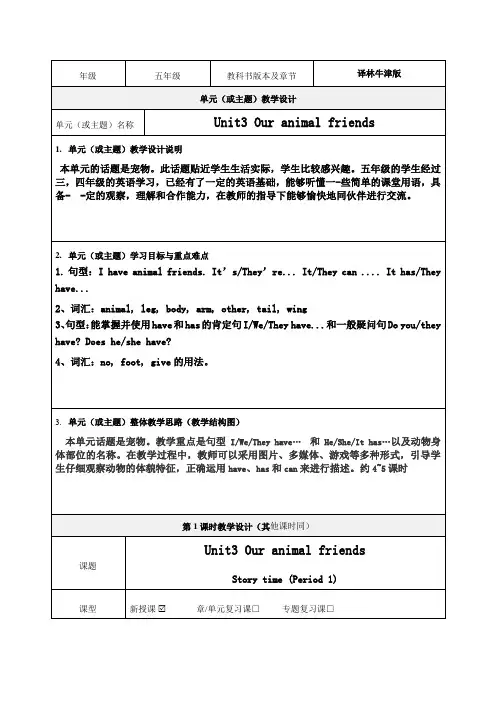
教学过程:Step1 Warm up & Lead in课前播放Body songT: You sing very well just now. From the song, We know we can see with our ... We can eat with our ... We can hear with our .. We can write with our .. We can walk with our.. We can speak with our ...So let’s speak English with our mouth in class.(课前说,并带学生练习单词leg arm foot body)1 T: Good morning, boys and girls.Just now you sing very well. And I think you’re good at playing games too. Let’s play a game. “Train, train, go away”.Look, there are four toy trains. On each train, I give you a word, you say other words of the same kind. Try to full fill the trains.The first train: black ( 学生说单词)Can you say some words of the same kind? You’re so great. Let’s say “train train go away”The second train: jump You can act and say.You’re so active.The third train: big eyes It’s a little difficult. You can point and say.I have some words here. Please read the red words together.学习单词body leg armThe last train: tigerT: These words are about animals.Step2 PresentationT: I have an animal friend at home. What is it? Let’s guess!Riddle :It’s yellow and brown.It has four legs .It has a long tail .It has a small body.It can catch(抓) a mouse.T: What’s it? It is a cat. It’s my animal friend.So today we’re going to talk about our animal friends.(出示题目,学生读题目)Step3 Story time(1) 整体感知T: Look, here comes four students,. Who are they?S:Nancy, Liu Tao, Su Yang and Mike.T:They have some animal friends, too. Look at the pictures. What animals are they? S: fish dog rabbit parrot教授单词rabbitT: What are their animal friends? Let’s watch the cartoon firstT: Open your books, turn to page 28. Finish the exercise 学生完成题目T:.What animals does Nancy have?S:Nancy has two fish.What does Mike have? Who knows?S: Mike has a dog. Liu Tao has a rabbit. Su Yang has a parrot.(2)学习第一段A)T: We know Nancy has two fish. Let’s listen to tape and answer the two questions. Q1: What colours are the fish?Q2: Do they have any legs or arms?学习句型One is red and the other is black.举例I have two ... One is...the other is...They have no legs or arms.OK. Now, look at the fish. One is red and the other is black. Can you say more details about Nancy’s fish?学生看图说句子:They have big eyes and big bodies.They have big tails. They can swim.Look,I have designed a tree for Nancy’s fish, please take out your trees.Now we are all Nancy, let’s look at the trees and talk about the fish together.学生一起看树说第一段话。
(3)学习第二段A)T:What about Mike’s animal friend? Open your books and read Para2, then answer the three questions.Q1:What colour is the dog?( It is...)Q2:What does it have?( It has...)Q3: What can it do?( It can...)边问边贴It is/can/has...Now four in a group and stick the information paper on the tree. I want one group to design the big tree. Any volunteers?(贴大树的小组谈论)Have you finished? Now we are all Mike, Let’s say it together.(4)学习三四两段A)T:What about Liu Tao’s and Su Yang’s animal friends? Now boys and girls, close the books. Discuss in 4 and try to design the other two trees. I will ask two groups to design the big trees for me. Which groups would like to come here?上来的小组讨论,或者集体说学习单词wingDo you have wings?(5)ReadingT: Now it’s time to read books.Open your books, let’s listen and repeatThis time read the passage in groups,choose one you like.Let’s read the text together.(5)Retell the textT:Boys and girls, look at the blackboard and try to retell the text.一起说Step 4 Consolidation出示图片和四个学生的图片They are at the English Club.出示Wang Bing 和Yang LingWho are they?T: Our old friends.Yang Ling and Wang Bing are at the English Club. They are doing a survey. They want to know their classmates’ animal friends. Look, they are interviewing the four students. 6 in a group and make a dialogue.Do you have an animal friend? Yes, I do.Do you have any animal friends?What colour is it/are they? They are/It is...What do they have/What does it have? They have/It has...What can they do/What does it do? They can/It can...Look, they’re/it’s my ...Do you like them/it?Yes, I do. They’re/It’s cute/lovely...Step5. Homework1)朗读课文五遍,会背诵。
2)完成28页的练习3)预习fun time、grammar time。
Unit3《 Our animal friends》教学设计-优质教案
T:Our friends are talking about their animal friends, too. Who are they?Let’s watch and tick: What animal friends are they talking?2.Learn the first paragraph. (1) Read and tick.Q1.What do the fish have?Q2.What can the fish do?小提示:自读第一段,用查阅的方式,将选项弄明白后,在第1段中找答案。
图片也可以帮助你哦!(2) Let’s talk.They have________.They can________.3.Learn the second paragraph.(1) Listen and choose.T:We know Nancy’s animal friends are fish .How about Mike’s animal friend? Do you want to know? But wait a minute, let’s choosefirst .T: Let’s check, who can read it? T: Great! What is it?Can you say something about the dog? You can use:It has…It can...(2) Summary.T:Just now , you did it well. How to describe the animals?T:So ,we can describe the animals from colour, feature, ability and Ss read and tick.Ss talk.Ss talk.Ss think and talk.看图片,利用已有知识,运用句型尝试介绍。
五年级上册英语教案-Unit 3Our animal friends(period1 Storyti
五年级上册英语教案-Unit 3 Our animal friends (period 1Storytime)译林版课时目标•通过阅读故事和听力训练,学生能够了解动物朋友的生活习性和基本特征;•学生能够按照故事情节用正确的语音、语调和节奏朗读故事;•通过小组活动,锻炼学生的合作意识和表达能力。
教学重点•阅读和听力训练•朗读故事•小组合作活动教学难点•理解和运用新生词汇和短语;•自信地朗读故事。
教学准备•学生本人教材•电脑投影仪•PPT讲义•小组合作任务卡片教学过程1. 导入新知教师通过过渡动画展示教案主题,激发学生的学习兴趣。
2. 讲解故事简介教师通过PPT展示故事梗概,并阐述故事的主要情节,并将以下重点介绍给学生:1.了解故事情节,理解新单词和短语;2.练习口语语音、语调和节奏,自信地朗读故事;3.分组完成小组合作任务。
3. 阅读和听力训练教师播放听力,并跟读故事。
学生听故事,跟着教师的朗读声音读故事,理解故事情节,了解动物朋友的生活习性和基本特征。
同时,教师向学生介绍新生词、短语和词组。
4. 朗读故事学生进行分组合作任务。
每组4人,选择其中一人朗读故事,在主题的基础上进行扩展。
学生需要询问、讨论、分享动物朋友的生活习性和日常生活,并进行原创性课堂演示。
5. 总结和检查教师回归主题,综合介绍本课的教学要点,提问、对话、小结和检查。
学生通过板书内容,进行合作性学习和分享小结。
课堂延伸1.给同学分享你家里的宠物,让大家了解更多动物的生活和特点。
2.选取自己喜欢的动物,查找相关知识和图片,并制作PPT展示。
Unit3 Our animal friends(Period3)教案-译林版(三起)英语五年级上册

Unit3 Our animal friends(Period3)教案教学重点:1.进一步掌握句型I/We/They have…和He/She/It has…的用法,会用句型进行描述动物,询问动物特征等。
2.能听懂、会说并理解cartoon time 对话并能表演。
3.了解不同国家的不同动物,并能试着描述动物。
教学难点:1.能听懂、会说并理解cartoon time 对话并能表演。
2.能用前两节课所学句型进行描述动物。
教学准备:多媒体课件、单词卡片等。
教学过程:Step1 Free talkT:Boys and girls, do you have any animal friends?Ss: Yes, I do.T:What animal friend do you have?S1: I have …Ss He/She has…Step2 Play a PK gameT: We will have a competition between boys and girls. I will give you one minute. You can use ‘It has..’or ‘They have…’to say something about the pictures.(1 minute non-stop talking)Step3 Guessing gameT:This time, I want to give you some key words about animals. You can ask some questions and guess.Do they have…?Yes, they do./No,they don’t.Does it have…?Yes, it does./No, it doesn’t.引出SamStep4 Learn cartoon time1.T: Sam and Bobby are on the beach. They are talking about the animal friend, too. Who is their new friend. Let’s watch the cartoon.S: It’s the crab.教学crab.2.T: What does the crab have? Maybe it has ten legs. Maybe it has eight legs. Please read and think.How many legs/arms does the crab have?How is its body?引出It has eight legs and two big arms. It has a big and hard body.Ss try to describe the crab.3.Listen and repeat.4.T: Does the crab like the cake?S:No, it doesn’t .T:What does it like?S: It likes Sam’s fingers.学习fingers.5.Let’s imitate. Boys Sam, Girls Bobby.6.Let’s act.(choose two or three groups to act)7.Look at the blackboard and describe the crab together.Step5 Learn culture time1. T:Boys and girls, do you remember them?Ss try to read panda, kangaroo, polar bear, bald eagle2.T: Look at the pandas, what color are they?引出They are black and white.What do they have?They have…What can they do?They can…同法描述袋鼠,北极熊,秃鹰(注意单复数)3.T:Where can we see these animals?Ss:…(Read and match)教学Australia, the US, China, Canada.4.Ss try to say ‘You can see…in …’5.T:You can see different animals in different countries.You can also see South China tigers in China. 介绍泰国大象,非洲长颈鹿,南极企鹅。
五年级英语上册Unit 3 Our animal friends 教案

五年级英语上册Unit 3 Our animalfriends 教案五年级英语上册Unit 3 Our animal friends 教案五上 Unit3 Our animal friends (Grammar time Fun time)Ⅰ. Teaching: Grammar time FuⅡ. Teaching aims and learning objectives:Bdluduld be able to:Talk about animal2. Use ‘have’ and ‘has’Use ‘do’ and ‘does’ to ask ‘Yes/No’ quⅢ. Foculesson:To use ‘have’ and ‘has’ to talk about animal2. To use ‘do’ and ‘does’ to ask ‘Yes/No’ quⅣ. Predicted area of difficulty:To use ‘do’ and ‘does’ to ask ‘Yes/No’ quly.Ⅴ. Teaching aids: Pictures, PPTwarming ug a song2. GreetingFree talk1) Do you have a tail or wings? Who have tails or wings?2) Animals are our friends. Do you have an animal friend?3) What is it? Dat ...? Ca?Step 2. RevWhat animal friends dave?T: You have some animal friends. Dave any animal friends? (Show the chara):T: What animal friends dave?: ... ha2. Retell Mike’s dogT: Do you l’s dog? Let’s talk about it tog:animal you like retellT: Do you l/...?u like and talk abou:Grammar time: have/haFree talkT: So you labbit, right? Do you have a rabbit? What animal friend do you have?/ Dave ...?/Can it jump high?S:T: I lThey have big bodies and big tails.2. RulT: Look aHere is ‘have/has’, what dan? S:(PPT: ...)T: When do we use ‘have’? When do we use ‘has’? Look aarefullll: (think and say)(PPT ...)The thirdgulaT: Wubdgulawe use‘has’. But, whadgular form?S:T: Adgular forms? (Show some words) Can you put them alaces? And the you can mawords on your pa Ss maT: ... adgulaaThey aAre your answersright?DrillT: We know Mike’s animal friend is a dog. What animal friends do Helen and Tim have? Let’s fillblanks and gullblanks andT: What animal friends dave? You can ask me l‘Dave a ...?S: Dave a ...?T:/she does. /Grammar time: Do/Does ...?Free talkT: Do you lat? Do you have a cat? What animal friend do you have?S:2. GaT:u took animalDo you waw what they are? Who’d land tell us about it?and read the owner’s name. Talk aboudetail: S2. IIt has ... It caT: Can you ask? Does S2 have a ...?: Does S2 have a ...?:/she does. /T: Let’s have a look. Wow, it’s lovely/cute. Do you like it?RulT: We asked Qs with ‘do/does’. When do we use ‘do’? When do we use ‘does’? Think aboull us?and sayT: Should we change ‘have’ wubdgular form? S:T: Why?S:Help TblackboardFu’s animal friendT: I know some about your animal friends. I havean animal friend, too. Do you waw what it is? Can you ask me Qs about it?S: ...?T: It’u also can ask: ...?S: Is it a ...?T: Yes/NoIt’s a crab. Do you like it?2. Do a survT: Let’s do a survey about your animal friends. Who can try?T: Let’s ask him Qs about his animal friend-T: Can you show us your picture? WowGroup wake a:2 showuummado/does,have/haay the rules freely2. Two new friendsHomew朗读 Grammar的句子,向你的好朋友说一说do/does, have/has的用法。
Unit 3 Our animal friends教案
Unit 3 Our animal friends教学目标:1. 能理解文章内容,用正确的语音语调朗读短文,并初步复述。
2. 正确运用日常交际用语I have animal friends. It’s/They’re…It/They can... It has/They have …3. 能正确的听、说、读单词:animal, leg, body, arm, other, tail, wing。
4. 通过学习培养学生对动物的喜爱之情。
教学重难点:重点:1. 能正确文章内容,用正确的语音语调朗读短文,并初步复述。
2. 会说会读单词:animal, leg, body, arm, other, tail, wing。
难点;能正确运用have与has描述物品的外貌特征。
教学过程:Step1 Warm up & Lead in课前播放Body songT: You sing very well just now. From the song, We know we can see with our ... We can eat with our ... We can hear with our .. We can write with our .. We can walk with our.. We can speak with our ...So let’s speak English with our mouth in class.(课前说,并带学生练习单词leg arm foot body)1 T: Good morning, boys and girls.Just now you sing very well. And I think you’re good at playing games too. Let’s play a game. “Train, train, go away”.Look, there arefour toy trains. On each train, I give you a word, you say other words of the same kind. Try to full fill the trains.The first train: black ( 学生说单词)Can you say some words of the same kind? You’re so great. Let’s say “train train go away”The second train: jump You can act and say.You’re so active.The third train: big eyes It’s a little difficult. You can point and say.I have some words here. Please read the red words together.学习单词body leg armThe last train: tigerT: These words are about animals.Step2 PresentationT: I have an animal friend at home. What is it? Let’s guess!Riddle :It’s yellow and brown.It has four legs .It has a long tail .It has a small body.It can catch(抓) a mouse.T: What’s it? It is a cat. It’s my animal friend.So today we’re going to talk about our animal friends.(出示题目,学生读题目)Step3 Story time(1) 整体感知T: Look, here comes four students,. Who are they?S:Nancy, Liu Tao, Su Yang and Mike.T:They have some animal friends, too. Look at the pictures. What animals are they?S: fish dog rabbit parrot教授单词rabbitT: What are their animal friends? Let’s watch the cartoon firstT: Open your books, turn to page 28. Finish the exercise 学生完成题目T:.What animals does Nancy have?S:Nancy has two fish.What does Mike have? Who knows?S: Mike has a dog. Liu Tao has a rabbit. Su Yang has a parrot.(2)学习第一段A)T: We know Nancy has two fish. Let’s listen to tape and answer the two questions.Q1: What colours are the fish?Q2: Do they have any legs or arms?学习句型One is red and the other is black.举例I have two ... One is...the other is...They have no legs or arms.OK. Now, look at the fish. One is red and the other is black. Can you say more details about Nancy’s fish?学生看图说句子:They have big eyes and big bodies.They have big tails. They can swim.Look,I have designed a tree for Nancy’s fish, please take out your trees.Now we are all Nancy, let’s look at the trees and talk about the fish together.学生一起看树说第一段话。
unit3 our animal friends教案
unit3 our animal friends教案一、教学目标1.能听懂、会读、会说单词arm,body,leg,tail,wing。
2.能听懂、会读、会说、会初步运用句型I have…They have…It has…来描述动物特征。
3.能正确理解文本,并能灵活运用本课句型描述动物朋友。
二、教学重点1.能正确理解文本,并能流畅地朗读与表述。
2.掌握文中的重点句型I have…They have…It has…,并运用于实际生活当中。
三、教学难点正确理解句型:One is red and the other is black。
They have no legs or arms。
并能尝试运用。
四、教学准备板书、Smart课件。
五、教学过程A。
Pre-reading1.LeadinTodaywe'll learnU3—-Our animal friends。
2.AguessinggameT:Do you have any animal friends?T:What animal friend do I have?Can you guess?Maybe it has…(Show and learn:a body,a tail,an arm,a leg。
)B。
While-readingT:Look,here are the four children。
They are Su Hai,Mike,Nancy and Liu Tao。
They're also talking about their——animal friends。
Unit 3 Our animal friends 教学设计-五年级英语上册同步备课 译林版(三起)
Unit 3 Our animal friends 教学设计-五年级英语上册同步备课译林版(三起)一、教学目标1.通过本单元教学,让学生能够正确掌握动物的名称,形态及其基本习性。
2.学习基本句型,能够用英语简单描述某些动物的习性与外貌特征。
3.培养学生的学习兴趣和英语语感,引导学生对动物产生浓厚的兴趣,进一步培养学生的爱护动物的意识。
二、教学内容1.熟练掌握动物的名称及其基本习性。
2.听、说、读、写本单元内容,能够用英语描述某些动物的外形和习惯。
3.培养学生的观察能力和语感。
4.四会新单词:panda, elephant, giraffe, zebra, hippo, kangaroo, monkey。
5.句型:What do you see? I see a/an _______。
What is it doing? It is ________。
三、教学方法1.看图说话法2.观察法3.课堂问答法4.小组合作法四、教学步骤Step1:Warm-up在课堂上介绍学生们宠物,鼓励他们陈述他们所拥有宠物的一些简单的特征和习性。
然后教授学生们四项新单词:panda, elephant, giraffe, zebra,并帮助学生们正确掌握他们的拼读及基本意思。
Step2:Presentation学生们通过观察课件中的图片,掌握各种不同动物的名称以及它们的形态特征和基本习性。
在这个环节,教师可以运用看图说话法以及观察法介绍新知,以激发学生们对动物的好奇心,从而引导他们运用英语描述这些动物的特征和习性。
Step3:Practice在这个环节,教师可以通过创造有意义的场景,让学生在语言交际中运用所学的新单词和句型。
可以分小组,让学生们互相了解彼此所钟爱的动物,并通过模拟情景介绍他们所拥有动物的特征和习性。
Step4:Production学生利用所学的单词和句型,模仿课本中的句型,描述他们看到的动物。
然后在小组内进行评审和反馈。
五年级上册英语教案-Unit3OurAnimalfriends译林版(三起)
教案:五年级上册英语教案 Unit 3 Our Animal Friends一、教学目标1. 知识目标:(1)能够听懂、会说、会读本单元的生词和重点句子。
(2)能够用英语简单描述自己喜欢的动物,并能够询问他人喜欢的动物。
2. 能力目标:(1)能够通过图片和文字,正确识别并描述各种动物的特点和习性。
(2)能够运用本单元所学知识,进行简单的英语交流。
3. 情感目标:(1)培养学生对动物的热爱和保护意识。
(2)培养学生积极参与课堂活动,乐于合作的精神。
二、教学内容本单元主要介绍了一些常见的动物及其特点。
通过学习,学生能够认识和描述这些动物,并能够用英语询问他人喜欢的动物。
三、教学重点与难点1. 教学重点:(1)能够听懂、会说、会读本单元的生词和重点句子。
(2)能够用英语简单描述自己喜欢的动物,并能够询问他人喜欢的动物。
2. 教学难点:(1)能够正确使用一般疑问句询问他人喜欢的动物。
(2)能够用英语描述动物的特点和习性。
四、教具与学具准备1. 教具:(1)教材、课件、黑板。
(2)动物图片、卡片。
2. 学具:(1)课本、练习册。
(2)笔记本、彩色笔。
五、教学过程1. 热身(5分钟)(1)引导学生复习上一单元的知识,如颜色、数字等。
(2)进行简单的英语对话,检查学生的英语水平。
2. 引入(10分钟)(1)利用课件或实物展示本课的主题 Our Animal Friends。
(2)引导学生观察图片,猜测动物的名字,并简单描述动物的特点。
3. 教学新课(20分钟)(1)教授本课的生词和句子,让学生跟读并模仿。
(2)通过情景模拟和小组活动,让学生练习使用英语描述动物的特点和习性。
4. 巩固练习(10分钟)(1)利用课件或卡片,进行动物名称和特点的问答游戏。
(2)让学生分组进行角色扮演,用英语描述动物的特点和习性。
(2)鼓励学生积极参与课堂活动,继续努力学习。
六、板书设计板书设计应简洁明了,突出本课的主题和重点内容。
Unit3 Our animal friends教案教学设计-精品教案
Unit3 Our animal friends单元教材分析:本单元围绕的主要话题是介绍动物特征,通过学习小动物的外貌特征和行为能力,学习运用身体部位名词、形容词、动词和They have…They can…等句型,并将自己喜爱的动物特征用一个完整的语段描述出来。
文本中的长句It has…and…They have no…or …but they have…是学生表达的难点。
另外教师可以结合学生四年级上册Unit8的五官和体貌特征的词汇,设计教学活动,鼓励学生综合运用这些词汇描述动物。
也可以让学生搜集与动物相关的信息、玩具等,做教学的拓展和巩固活动等。
学情分析:本单元学习的内容也是学生比较感兴趣的话题内容,只要在上课时老师正确地引导学生去学习,学生的学习积极性一定会很高。
因为牵涉到介绍动物的特征,所以涉及到第三人称单数形式“has”,可能在教学中会有部分学生掌握得不是很好,课堂上应该和学生多进行操练。
本单元的内容,也牵涉到其他的一些第三人称单数形式,例如“likes, comes”,教师需要好好指导与引导,可结合这些做一些相关的口语练习。
只要为学生多创设情境,再加上老师有正确到位的指导,那么学生的学习就会更轻松、简单一些。
教学目标:1.掌握并使用have和has的肯定句I/We/They have...和一般疑问句Do you/they have…?Does he have…?2.能听懂、会说、会读、会写的句型:I/We /They have...., He/She/It has...3. 能听懂、会说、会读单词和词组:one...,the other..., body, or, wing, rabbit, finger;4.能听懂、会说、会读、会写单词no, leg, foot, give。
5.能知道字母U在单词中的读音。
教学重点:1.句型:I have animal friends. It’s/They’re.... It/They can . (I)t has/They have ….here…?2.词汇:animal, leg, body, arm, other, tail, wing。
五年级上册英语教案- Unit3Our animal friends(period4 Culture
五年级上册英语教案 - Unit 3 Our Animal Friends (Period 4Culture)教学目标1.学习并掌握有关动物的英语词汇;2.学习并掌握描述动物特征的句型;3.学习并掌握介绍自己喜欢的动物的句型;4.能够听懂有关动物的英语对话,并进行简单的回答;5.展示对动物的爱护和保护意识。
教学重点1.学习并掌握有关动物的英语词汇;2.学习并掌握描述动物特征的句型;3.能够听懂有关动物的英语对话,并进行简单的回答。
教学难点1.学习并掌握介绍自己喜欢的动物的句型;2.展示对动物的爱护和保护意识。
教学准备1.教师准备动物图片、动物卡片等教具;2.确保课堂设施齐备。
教学过程Step 1. Warm-up1.Greet the students and sing the song“Old MacDonald Had aFarm”together;2.Ask the students to introduce their own pets or favorite animals.Step 2. Learn the Vocabulary1.Show some pictures of different animals and teach the students the vocabulary;2.Teach the students how to make the animal sounds.Step 3. Learn the Sentences1.Teach the students the sentence pattern: “What’s your favorite animal? My favorite animal is a…”;2.Teach the students the sentence p attern: “The _____ has _______ (feature adjective, e.g., big, long, short, etc.) _____ (body part, e.g., ears, nose, tail, etc.).”Step 4. Listening Practice1.Play a listening tape about animal introduction;2.Ask the students to practice listening and answering.Step 5. Group Discussion1.Ask the students to form a group to discuss and choose an animal they like;2.Ask them to prepare a brief introduction about the animal they chose.Step 6. Class Presentation1.Ask each group to present their animal and introduce it in frontof the class.;2.Encourage the students to use the sentences they learned and the information they collected to introduce their animal.Step 7. Reflection1.Ask the students to reflect on what they’ve learned and how they can protect animals;2.Encourage the students to write an article about how to protectthe favorite animal they introduced in class.课后作业1.Recite the animal vocabulary;2.Practice the sentence patterns;3.Write an article about how to protect the favorite animal they introduced in class.总结通过本节课的学习,学生们能够掌握一些有关动物的英语词汇和描述动物特征的句型。