
Unit6lesson32Trains_Go_Faster冀教版八年级英语上册课件
enjoy the sceneries along the railway station.
• Secondly, I'd like to choose the fastest trains because I want to challenge so thrilling feelings. • Thirdly, if the future trains produces out I 'll try, too. Because they can make me ride on air like angels fly in sky. It's so free and romantic.
Countries all over the world started build railways
Many countries had railways after 50 years and many train stations
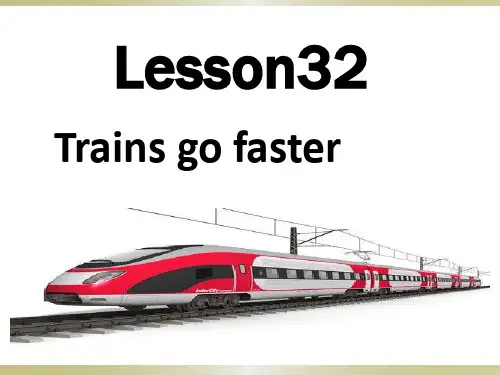
2. How fast do trains go? Kinds of Trains Early trains Speed 15 kilometres in two hours 500 kilometres per hour about 300 kilometres per hour have no wheels, ride on air
Review
How do you go to school?
Correct the mistakes:
_____ 1. On Sunday we often go to the park on feet.
on foot
2. It _____ nearly never rains in Kuwait(科威特). almost
பைடு நூலகம்究点四
• 9. During the 1830s, countries all over the world started to build railways. ⑴ all over the world为固定短语,意为“全世界”,也 all the world/the whole world 可以用 _____________________ 来表示,但一定要 注意冠词的位置。 The people all over the world love peace. (和平)。 ⑵ start to do sth. (start doing sth.) 为固定短语,意为 “开始做某事”。后面可以用不定式作宾语,也可用动 词的-ing 形式作宾语。 The students come to school and start to clean the classroom =The students come to school and startcleaning the
In 1804, the first train engine was born in England.
In 1825, the first passenger railway opened.
People built many train stations to help passengers get on and get off the trains easily.
begin和start均可接不定式和动词的-ing形式, 但在下列三种情况下必须用动词不定式作宾语。 ①当主语是物而不是人时。 ● The ice begins / starts to melt. 冰开始融化。 ● The rain begins / starts to rain. 雨开始下了起来。 ② 当本身在句中是-ing形式时。 ● He was beginning / starting to set off. 他就要出发了。 ● He is just beginning / starting to sleep. 他刚刚开始入 睡。 ③ 当begin 后面的多次是表示心理活动的词如 realize,know, think, understand等时。 ● He began / started to realize how his parents loved him.他开始意识到他的父母是多么爱他。 ● I began / started to understand it. 我开始明白 这件事了。
anywhere
_______ my homework. 6. It will take me half an hour finishing to finish
Lesson 32 Trains Go Faster !
Study Goals:
1.熟记本课10个短语,7个句子; 2.掌握并能灵活运用世纪、年代和速度的表达 方式; 3.了解火车的发展进程并能根据实际需求选择 自己喜欢的火车速度进行旅行。
_____ enough people to do the work. 3. There are not almost nearly
4. I’m going there by __ my car.
in _________ 5. I can’t find my book. Have you seen it somewhere?
探究点二/三
2.In 1804,the first train engine was born in England. 翻译: be born意思是_______ 系动词be常用was/were, 后面可跟介词on/in/at等。 例:①.be born on August18._________________ ②.be born in 1981/China _______________ ③ be born at 7:40 am____________
蒸汽发 动机
In the 1700s, many scientists worked on steam engines ______________.
Steam engine
wheel
In 1760s, a scientist put_____________ steam engines wheels and _________ together.
预习前测:
be born 1.出生 work on 2.从事于 3.上下火车 get on and off the train all over the world 4.全世界 5.在18世纪60年代 in the 1760s/1760's 6.根据今天的标准 by today's standards 7.把...和...结合在一起 put ...and ...together fifty years later 8.50年后 9.以...的高速 at a top speed of.... 10. 现在的高速列车 today's high-speed trains
探究点五
10. People built many train stations to help passengers to get on and off the trains easily. 为了方便乘客上车和下车, 建立了许多火车站。 ⑴ built 是build过去式一般过去时态。 ● People built this school in 1976. (2) __________ get on /get off 为固定短语,意为“上下车”。 让我们上车吧。我们将在哪里下车? Let’s get on the bus Where will we get off the bus? get on/off 用于上、下公共汽车、火车、船只和飞机,而上、下 小汽车则说成get into the car和get out of the car. You can get off the bus when it stops at the next station.
Today`s high-speed trains can travel at about 300kilometres per hour.翻译:_____________________________ “速度” 加速度, 急行,增加”。 其中,speed 意思是_______ ________________ 例: at high speed 意思是_____________ at low speed 意思是______________ at a high speed of____________ a full speed ____________ at a speed of 意为“以……的速度”
探究点一
In the 1760s,a scientist in England found a way to put steam engines and wheels together. 翻译:_______________________________ 其中,in the 1760s意思是在18世纪60年代,也就 是1760-1769年, in the +年份复数 表示 _______________________. 例:①.in the 1990s_______________ ②.in the 1830s______________ ③ in 1825____________ ④ in 1804_______________
railway
most
n. 铁路
n. 车站 adv. 容易地
adj. 大多数的,最多的
station
easy--easily
standard
speed per
n. 标准
n.速度
prep. 每,每一
• How do you usually travel to other cities? • Talk about your first time taking a train.
新冀教版八年级上册英语Lesson 32 Trains Go Faster!课件
新课讲解
Read quickly and find the answers to the questions: What happened at that time?
Time in the 1700s in the 1760s in 1804
What happened?
Many scientists worked on steam engines. A scientist in England put steam and wheels together, the stream train. The first train engine was born in England.
2.When did the first passenger railway open?
In 1825.
3.How fast do today's trains go?
Today's trains can go at about 300 kilometres per hour. The fastest trains can go about 500 kilometres an hour.
修建火车站的目的是帮助乘客。不定式(短语)作目的状语是不 定式(短语)的一个重要功能,在英语中很常见。e.g. I got up early to do morning exercises.
为了做早操我起得很早。
第八页,共十八页。
新课讲解
◆get on/ off意为“上/下(车、船等)”。 e.g.I saw him get on the bus.我看见他上了公共汽车。
Tom: That's really fast! I hope to ride it soon.
2019-冀教版八年级英语上册 Unit 6 Lesson 32 Trains Go Faste课件(共16张PPT)-文档资料
Read and answer What happened at that time?
Time
Many countries had railways and train s tations.
What do you know about trains?
In 1801,a steam locomotive(蒸汽机车)built by Englishman Richard Trevithick ran on rails for the first time. Trevithick planned his steam engine to take 10 tons of iron 15 kilometers along a railroad. But in fact his engine carried not only the iron, but also 70 workers. Twenty-four years later, another engineer, George Stephenson, built a new locomotive. This was the beginning of the passenger train.
4. How fast can today’s high-speed trains travel?
Today’s high-speed trains can travel at about 300 kilometres per hour. / At about 300 kilometres per hour.
冀教版八上英语 unit6 Go with Lesson 32 Trains Go Faster!
3. Thereis_____B___foodinthefridge. Let’sbuysome. A. anyB. noC. muchD. few
4. Weweretraveling______A___ofthirtymilesperhour. A. ataspeedB. inaspeed C. withspeedD. atspeed
B I’malways________bythesepeople’sgreatbrainpower. 【中 考·连云港】 A. tiredB. amazedC. boredD. satisfied
11. 真是令人惊讶,他将放弃执导这部电影。
It_____is_r_e_a_ll_y_a_m__a_z_in_g_t_h_a_t_h_e_w_i_ll_g_iv_e_u_p____ ____________thisfilm. 【中d考ir·e常cti州ng】
9.
C
He________anartistinthefuturebecauseheisgood
atdrawing.
A. isB. was
C. willbeD. isgoingto
10. We’re_____D____aboutthe_________story. A. amazing; amazingB. amazing; amazed C. amazed; amazedD. amazed; amazing
oexercise. 【中考·资阳】
A. getupB. geton
C. getoffD. getdown
Unit6lesson32Trains_Go_Faster冀教版八年级英语上册课件

enjoy the sceneries along the railway station.
• Secondly, I'd like to choose the fastest trains because I want to challenge so thrilling feelings. • Thirdly, if the future trains produces out I 'll try, too. Because they can make me ride on air like angels fly in sky. It's so free and romantic.
探究点四
• 9. During the 1830s, countries all over the world started to build railways. ⑴ all over the world为固定短语,意为“全世界”,也 all the world/the whole world 可以用 _____________________ 来表示,但一定要 注意冠词的位置。 The people all over the world love peace. (和平)。 ⑵ start to do sth. (start doing sth.) 为固定短语,意为 “开始做某事”。后面可以用不定式作宾语,也可用动 词的-ing 形式作宾语。 The students come to school and start to clean the classroom =The students come to school and startcleaning the
high-speed train
冀教版八年级上册英语unit 6《lesson 32 trains go faster》ppt课件
二.电压的测量——电压表
电压表的使用方法:
较零:检查电压表的指针是否对准零刻度 线,如有偏差,进行较正
并联:电压表必须并联在电路中,使电流从 标有“3” 或“15”接线柱流入电流表,从 “-”接线柱流出电压表。
使被测电压不超出电压表量程:在已知电 路中电压大小时,直接选择合适的量程;若
不能判断,则先试用大量程,然后进行选择。
6.如图所示电路中,电源电压为4.5v,
当接通开关S后,如果L1两端的电压为 2v,L2两端的电压为2.5v,则电压表 的读数为( B )
A.2v
B.2.5v
C.4.5v D.无法确定
7.如图所示的电路中,已知电池组有3
节铅蓄电池串联组成,合上开关,电
压表V1的示数是4V。V2的示数是____ V, 灯L1两端的电压是_____V .
5.如图电路,当S1、S2都接通后,电压 表所测量的是 ( B )
A.L1两端的电压 C.电源电压
B.L2两端的电压 D.无法确定
串并联电路电压的规律:
1、串联电池组的电压等于各节电池 的电压之和.
2、串联电路的总电压等于各部分电 路两端的电压之和.
3、并联电路两端的总电压跟各支路 两端的电压都相等.
vV22
L1
L2
vV11
8.如图所示电路中,当接通开关S后,发现电流 表指针偏转,电压表指针不动,则故障可能是 () A.L1的灯丝断了 B.L2的灯丝断了 C.L1的接线短路 D.L2的接线短路
2.4有理数的加法(二)
复习:
1.有理数加法分几类?
2.有理数加法法则
3.计算:
(1) (-17)+(-7) (2) (-12)+9
Unit 6 Trains Go Faster教案冀教版八年级上册英语

UNIT 6 Go with Transportation!Lesson 32: Trains Go Faster!教学目标通过本课节的教学,学生达成以下目标:1.知识目标:掌握单词:wheel,born ,passenger ,railway,most,station,standard,speed接触单词:steam,engine,easily,per,steam engine短语和句型:be born,get on/off2.能力目标:能读懂描述火车发展史的短文;能向他人介绍火车的发展史。
3.情感目标:让学生学会用发展的眼光看待世界。
重点难点1. 重点:掌握本课节的重点单词、短语和句型。
2. 难点:向他人介绍火车的发展史。
教学准备PPT课件;课文朗读的音频。
授课时数1课时教学过程Step 1 Warming upShow the students the pictures of trains and get the students to think about the following questions:1.When was the first railway born?2.What is the fastest speed of today’s trains?Answers:1. In 1804.2. About 500 kilometres an hour.Step 2 PresentationLearn the new words.wheel n.车轮;轮子born v.出生;诞生;产生(仅用于被动语态)passenger n.乘客railway n.铁路most adj.(many或much的最高级)大多数的;最多的adv.(much的最高级)最n.最大量;最多数station n.站;所;车站standard n.标准;规格speed n.速度steam n.蒸汽engine n.发动机;引擎easily adv.容易地per prep. 每,每一steam engine蒸汽机be born 出生;产生;形成get on/off 上/下(车、船等)Step 3 Pair work1.Get the students to think about the following questions:How do you usually travel to other cities?Talk about your first time taking a train.2. Ask the students to talk about their experiences in pairs.3. Choose some students to talk about their experiences.Step 4 Listening1.Play the recording of the text on page 84.2. Ask the students to fill in the blanks with the words they hear.(1) During the 1830s,countries all over the world started to build________.(2) Trains may have no________in the future.3. Check the answers in groups.Answers: (1)railways (2)wheelsStep 5 ReadingTask 11. Play the recording of the text on page 84.2. Ask the students to listen to the text and repeat.Task 21. Get the students to read the text again.3. Check the answers in groups.Answers:1. Ask the students to read the text and answer the questions. (Let’s Do It! No. 1)(1) Where was the first train engine built?(2) When did the first passenger railway open?(3) How fast do today’s trains go?(4) What might future trains be like?2. Check the answers in groups.Answers:(1) In England.(2) In 1825.(3) Today’s high-speed trains can travel at about 300 kilometres per hour. The fastest trains cango about 500 kilometres an hour.(4) Maybe trains will have no wheels and ride on air in the future.Step 6 Listening1.Listen to the dialogues and tick the correct information. (Let’s Do It! No. 2)(1) □ in 1804 in 1825 in 1830(2) □ 30 kilometres an hour45 kilometres an hour54 kilometres an hour(3) □ seven seventeen seventy(4) □ 50 kilometres an hour 500 metres an hour500 kilometres an hour2. Check the answers in groups.Answers:(1) in 1804 (2) 45 kilometres an hour (3) seventy (4) 500 kilometres an hourStep 7 Practice1. Complete the dialogue with the correct forms of the words in the box.(Let’s Do It! No. 3)Tom: Hello John. How are you doing?John: Hi Tom. I’m doing well. Have you been toour new______________ ______________?Tom: Not yet. How about you?John: I went there last month. It’s bright and beautiful. It’s easy for___________to get on and offthe train. It was exciting. The train went really fast. It can reach a top _____________of 500 kilometres an hour.Tom: That’s really fast! I hope to ride it soon.2. Check the answers in groups.Answers: railway station,passengers,speed3.Read the passage and answer the questions. (Let’s Do It! No. 4)Over two thousand years ago, Chinese people invented kites. Kites can fly like birds, but they can’t take people up into the sky. Hundreds of years later, the Wright brothers made the first successful experiment. A machine carrying a man rose into the sky using its own energy. It was the first plane. Inventors went on to improve planes. Two engineers, Frank Whittle of the U.K. and Hans V on Ohain of Germany, developed the jet plane during the late 1930s.(1) Who invented kites?(2) Can kites take people up into the sky?(3) Where was Frank Whittle from?4. Check the answers in groups.Answers:(1) Chinese people invented kites.(2) No, they can’t.(3) He was from the U. K.Step 8 Language points1. In the 1700s, many scientists worked on steam engines.18世纪,许多科学家致力于发明蒸汽机。
Unit6Lesson32TrainsGoFaster!学案冀教版英语八年级上册
Lesson 32 Trains Go Faster!【学习目标】1.了解get on与get off的共同点和区别,并能正确运用。
2.能够听懂和读懂介绍火车发展历史和现状的课文内容。
3.学会运用所学知识,根据时间的顺序介绍某件事。
【预习导学】一、填一填1.How many (轮子) can you see on a truck?2.Jane ordered a (标准的) room for her parents in the hotel.3.The car is travelling at a (速度) of 120 kilometres an hour.二、连一连三、用括号中所给词的适当形式填空1.Sorry, I can’t work the physics problem (easy).2.It is (amaze) to see so many horses on the grass.3.Luckily, there are not many (passenger) on the train.四、想一想不定式在句子中可做什么成分?、、、、和。
【答案】一、1.wheels2.standard3.speed二、三、1.easily2.amazing3.passengers四、主语宾语表语定语状语宾语补语【合作探究】任务驱动一 听力训练1.听课文,回答问题。
(1)When was the first train engine born in England?______________________________________________________________(2)What was the most famous early engine?______________________________________________________________(3)Why did people build many train stations?______________________________________________________________2.听课文,模仿语音语调。
冀教版八年级英语上册 Unit 6 Lesson 32 Trains Go Faster(共20张PPT)
3.The bike has two _w__h_e_e_ls_(轮子).
4.They can work out the question
easily __________(容易地) (1)、直接加ed. (2)、以不发音的e结尾的动词,先双写该字母,
5.Yes再(t加3e)ed、r. 以d辅a音y字母I加wy结e尾n的动t词t,o改 the y为I, 再 new railway
Speed
The Rocket
45kilometres per hour
today’s high-speed trains
300 kilometres perhour
500 kilometres an hour today’s fastest trains
Language notes:
1.In the 1700s, many scientists worked on the steam engine.在18世纪,许多科学家从事蒸汽机研究。
speed n.速度 per prep. 每,每个
Let’s do it:
Let’s do it 1. talk about
根据汉语提示或首字母填空: 2. have a good rest 概念:过去某个时间发生的动作或存在的状态。
• 1. talk about
3. so much 4. be ready to do/ for doing
tation 加ed.
s______. (4)、以不发音的e结尾的动词直接加d.
Task-based Reading :read and answer
1.Where was the train engine build?
冀教版英语八上Unit6《Lesson32TrainsGoFaster》说课稿
冀教版英语八上Unit 6《Lesson 32 Trns Go Faster》说课稿一. 教材分析冀教版英语八上Unit 6《Lesson 32 Trns Go Faster》是一篇关于火车速度的阅读文章。
本课的主要内容是通过介绍不同年代火车的速度,让学生了解科技的发展对交通出行的影响。
文章中涉及到了一些与速度相关的词汇和表达方式,如“fast”,“slow”,“speed up”,“slow down”等。
此外,本课还要求学生能够运用所学知识,就火车的速度进行简单的交流和讨论。
二. 学情分析根据我对学生的了解,他们在学习本课之前已经掌握了基本的英语语法和词汇知识,能够进行简单的英语交流。
但是,他们对火车的速度和科技的发展方面的知识了解较少,可能会对文章中的一些概念和表达方式感到困惑。
因此,在教学过程中,我需要注重引导学生理解和运用相关词汇和表达方式,同时激发他们对科技发展的兴趣。
三. 说教学目标1.知识目标:通过学习本课,学生能够掌握与火车速度相关的词汇和表达方式,如“fast”,“slow”,“speed up”,“slow down”等。
2.能力目标:学生能够运用所学知识,就火车的速度进行简单的交流和讨论。
3.情感目标:通过学习本课,学生能够认识到科技的发展对交通出行的影响,激发他们对科技发展的兴趣。
四. 说教学重难点1.重点:学生能够掌握与火车速度相关的词汇和表达方式。
2.难点:学生能够运用所学知识,就火车的速度进行简单的交流和讨论。
五. 说教学方法与手段在本课的教学过程中,我将采用任务型教学法,引导学生通过完成一系列任务,来学习和运用相关词汇和表达方式。
同时,我还将运用多媒体教学手段,如图片、视频等,来帮助学生更好地理解和记忆文章内容。
六. 说教学过程1.导入:通过展示一些火车的图片,引导学生谈论火车的速度,为新课的学习做好铺垫。
2.呈现:通过阅读文章,让学生了解不同年代火车的速度,以及科技发展对火车速度的影响。
冀教八年级英语上册Unit6 Lesson32 Trains go faster! 课件
3.During the 1830s, countries all over the world started to
build railways. 在19世纪30年代期间,世界各国开始修建铁路。 during介词,意为“在…期间”。 We go to swim in river during the summer. 在夏天,我们 去河里游泳。
4.People built many train stations to help passengers
get on and off the trains easily. 人们建了很多火车站以方便乘客上下火车。 get on /off 用于“上/下公共汽车、火车、船只和飞机”, 而“上轿车、出租车”则为get in/ into the car, “下轿车、 出租车”为“get out of the car”。
2.In 1804, the first railway was born in England 1804年,第一条铁路在英国诞生。 be born 出生;诞生;产生,当我们说某人出生 于某时或某地时,总是用一般过去时was/ were, 不能用一般现在时。
My sister was born on June 20, 1999. 我的姐姐出生于1999年6月20日。
steam n.蒸汽 engine n.发动机 wheel n.车轮;轮子 born v.出生;诞生;
产生
passenger n.乘客 railway n.铁路 most 大多数的;最
多的
station n.站;所;车 站
easily adv.容易地 standard n.标准;规
格
speed n.速度 per n.速度