
【小初高学习】八年级英语下册 Unit 9 Have you ever been to a muse
Have you ever been to a museum
Section A 第 2 课时(3a〜4c)
自主学习方案
1.自学生词,并记住拼读及拼写。
2.预习课本,找出重点短语及句子。
3.读记后完成自学导练作业。
课堂导学方案
Step 1情景导入
T :Do you want to know more about computers? Do you want to know about the history and the de¬velopment of toilets? Do you want to watch the tea art performances? If your answers are yes,please let’ s learn together today and learn more about them.
环节说明:以三个短文简单的内容概括作为导入,既能让学生对三个文段有了大概的了解,又能够让学生更好地来理解节选段落,降低了学习难度,同时也能激起学生的阅读兴趣。
Step 2完成教材3a—3c的任务
1.快速阅读短文,回答方框中的两个问题,完成后让学生展示答案,教师点拨。
2.认真阅读短文,在文中找出3b中三个问题的答案,请几名学生展示答案,教师点拨。
3.再次认真阅读短文,从3c方框中选择出与文中画线单词意思一样的单词,完成后请学生展示答案,教师点拨。
4.细心阅读短文,理解每一句话的意思,小组合作解决遇到的疑难问题。
教师点拨文中出现的重点和难点。
5.小结训练。
( A )—I am sorry to keep you waiting.
—Oh,not at all. I just here.
A.have been B . had been
C. was D .am
Step 3 完成 Grammar Focus—4c 的任务
1.学生读Grammar Focus中的句子。
2.引导学生参考学案上的单元语法精讲精练,归纳语法知识,并完成对应的练习。
3.认真阅读4a对话,然后用括号内所给的单词来补全对话,完成后小组内互相交流答案,教师点拨易错点。
4.两人一组练习4a中的对话,并邀请几组学生表演对话。
5.认真阅读4b短文,然后用括号内所给单词的正确形式填空,完成后请学生说出答案,教师点拨重难点。
6.以对话的形式和你的搭档互相询问对方问题并把对话内容记录在4c表格中。
参考案例
7.小结训练。
(1)Mary lost (lose) her pen . Have you seen (see) it here and there?
(2) Have you found (find) your watch yet?
Step 4问题探究
( D )1. My mother often encourages me English as much as possible.
A speak
B speaks
C . speaking D. to speak
“鼓励某人做某事”用encourage sb. to do sth.。
两三周(汉译英) a couple of weeks
a couple of 相当于 a few 或 a small number of,翻译成汉语就是“两个,几个,两三个”,是不确定的说法。
教学反思
本课时以三篇杂志文章选段引出对三个博物馆的介绍,从而引起学生的学习兴趣。
在学习文章过程中也注重了对重点单词的理解,同时讲练结合,一定程度上加强了学生对动词时
态的理解。
英语人教版八年级下册Unit 9 Have you ever be
人教版英语八年级下册Unit 9 Have you ever been to a museum?教学目标知识与能力掌握现在完成时态句型Have you ever…? 的答语形式;学会谈论过去发生的事。
过程与方法通过情景导入来引导学生谈论过去发生的事,提出Have you ever…? 问题,继而引出一些新的词汇和句型,然后通过精讲多练的课堂教学来达到本节课的教学目标。
情感态度价值观谈论过去发生的事应是学生很感兴趣的课堂活动,大多数学生喜爱回忆过去并会讲故事。
教学重、难点及突破重点重要句型Have you ever been to Europe? Yes, I have./No, I haven never been to Europe.重点词汇theme park, boats, zoo, European, Holland, houses, travel, space, cartoons, culture, neither,old-fashioned, Peru, rent, South America, visitors, wonderful难点现在完成时态句型Have you ever…? 的答语形式。
教学突破通过情景导入提出Have you ever…? 问题,引导学生积极参与课堂口语交际,学习使用新的词汇和短语,来训练和强化现在完成时态句型Have you ever…? 的答语形式。
教学准备教师准备制作课本2a部分的插图,使用大白纸制作,或制作幻灯片。
也可以直接使用教学挂图。
学生准备预习课本内容,初识新词汇。
教学步骤(第1课时)第一课时教学流程设计教师指导1.情景导入谈论过去发生的事。
2.引导学生进行听力训练。
3.Pairwork小组活动。
学生活动1.谈论过去发生的事。
2.进行听力训练活动。
3.Pairwork小组活动:对话交流和问卷调查。
一、第一教学环节情景导入谈论过去发生的事(约分钟)二、第二教学环节听力训练活动(约分钟)三、第三教学环节Pairwork小组活动(约分钟)四、本课小结引导学生学习Have you ever…? 的答语形式和现在完成时态的用法。
八年级英语下册Unit_9_Have_you_ever_been_to_museum_讲解+练习题目+答案

Unit9 知识点和练习附详细参考答案1. invent(1)invent 作动词,意为“发明;创造”。
例如:Edison invented the light bulb. 爱迪生发明了电灯。
(2)invent还可以表示“虚构”。
例如:The whole story was invented. 整个故事是虚构的。
(3)invent的名词形式有两个,一个是inventor(发明者;发明家),另一个是invention (发明物)。
例如:Edison is a great inventor in history.爱迪生是历史上伟大的发明家。
Human history is also a history of great inventions.人类的历史也是一个伟大发明的历史。
【拓展】invent和discover的辨析:(1)invent 意为“发明,发明之物”指“从无到有”。
例如:Alexander Graham Bell invented the telephone in 1876.亚历山大•格雷厄姆•贝尔在1876年发明了电话。
(2)discover 意为“发现”,指“本来就已经存在,但不为人知”的事物。
例如:Columbus discovered America in 1492. 哥伦布在1492年发现了美洲。
2. unbelievableunbelievable作形容词,意为“难以置信的;不真实的”,是由believable“可相信的;可信任的”加否定前缀un-派生而来的。
其动词形式为believe,意为“相信;以为”。
例如:It's unbelievable that you are a writer. 我难相信你是一个作家。
【拓展】un-是个前缀,意为“不”。
例如:happy“高兴的”— unhappy“不高兴的”;lucky“幸运的”— unlucky“不幸的”;important“重要的”— unimportant;“不重要的”;healthy“健康的”— unhealthy“不健康的”。
初中英语人教版八年级下册Unit 9 Have you ever been to a
Unit 9 Have you ever been to a museum? Section B Reading Singapore- A place you will never forget! 教学设计Learning aims:Knowledge aims:To enable students to grasp the new words and phrases: thousands of, on the one hand…on the other hand, whether…or, Indian, Japanese, fox, whenever, mostly…Ability aims: Gradually improve stud ents’ reading ability :skimming,scanning ,making notesEmotional aims: To enable students to learn about the culture of different countries and love their own hometown better.Learning important points: 1.to master the important words, phrases.2. To enable Making notes after readingLearning difficult points: to introduce a place especially one’s own hometown freely Teaching methods: 1.Situational approach ;2. Communicative and activity-based teaching method ;3. Audio-visual teaching methodLearning methods: 1.Self-learning method2. Cooperative learning methodTeaching ProceduresBefore reading , I play a short video about Singapore to lead in the text. And ask students to search some information about Singapore, so that they can go into the text easily.While reading, I use three activities to explain the text. First, through skimming, catch the main key words in each paragraph. Then, through scanning, find the main sentence each paragraph. At last, through careful reading, correct the sentences.After reading, ask students to make notes according to the text. Play a card game to check some language points. Singapore is so wonderful, but in my heart my own home town is much better. Ask students to introduce his or her hometown.。
部编版八年级英语下册Unit9Haveyoueverbeentoamuseum必考知识点归纳
(名师选题)部编版八年级英语下册Unit9Haveyoueverbeentoamuseum必考知识点归纳单选题1、—Could you tell me ________? I must find him.—Sorry. I have no idea. But he was here just now.A.where Tom wasB.where Tom has goneC.where can I find TomD.where Tom has been答案:B句意:——你能告诉我汤姆去了哪里吗?我必须找到他。
——对不起。
我不知道。
但他刚才还在这里。
考查宾语从句和现在完成时。
根据题干“Could you tell me…”可知,此处应为宾语从句,要用陈述句语序,可排除C选项;主句中的“Could you tell…”是委婉语气,结合“I must find him”和语境,可知汤姆不在说话现场,需用现在完成时“has gone”结构。
故选B。
2、—Do you mind my smoking here?—___________. Look at the sign. It says “No smoking”.A.It doesn’t matterB.No, not at allC.You’d better notD.Never mind答案:C句意:——你介意我在这吸烟吗?——你最好不要。
看指示牌。
它标明禁止吸烟。
考查情景交际。
It doesn’t matter没关系; No, not at all不,根本不;You’d better not你最好不; Never mind 不要介意。
根据“It says ‘No smoking’.”可知,应是反对在这吸烟,通常用“You’d better not.”表示委婉拒绝。
故选C。
3、There are about three ________students in our school.A.thousandsB.thousands ofC.thousandD.thousand of答案:C句意:我们学校大约有三千名学生。
新目标英语八年级下册Unit 9 Have you ever been to an amusement park讲解与练习
第 1 页 (共4 页) 第 2 页 (共4 页)学校 姓名 班级 考场 考号---------------------------------○密------------------ -------------------○封----------------------------- -- --○线----------------------------※※※※※※※※※※※※※※※答※※※※※※※※※※※※※※※※※※题※※※※※※※※※※※※※※※※线※※※※※※※※※※※※※新目标英语八年级下册Unit 9 Have you ever been to an amusement park?讲解与练习重要短语1. have been to 到过某处2. an amusement park 游乐园3. a water park 水上公园4. a roller coaster 过山车5. see sb. doing sth. 看见某人正在做某事 see sb. do sth. 看见某人做了某事6. walk around 四处走动7. take a ride 兜风 8. on board 在船上 9. take different routes 走不同的路线 10. end up 结束 11. argue with sb. 与某人争吵 12. an English-speaking country 说英语的国家 13. an exchange student 交换生 14. a flight attendant 一名机组乘务员 15. a tour guide 导游 16. such as 例如 17. listening skills 听力技能 18. in Southeast Asia 在东南亚 19. take a holiday 度假 20. three quarters 四分之三 21. have problems (in) doing sth. 做某事很费劲 22. during the daytime = in the day 在白天 23. all year round 全年,一年到头 24. wake up 醒来,唤醒,叫醒 句子讲解1.Have you ever been to an amusement park?你曾到过游乐场吗?(1)amusement park 游乐场,游乐园 (2)本句用现在完成时表示过去发生的事情对现在造成的影响或结果。
人教新目标版初中英语八年级下册Unit9Haveyoueverbeentoamuseum要点讲解
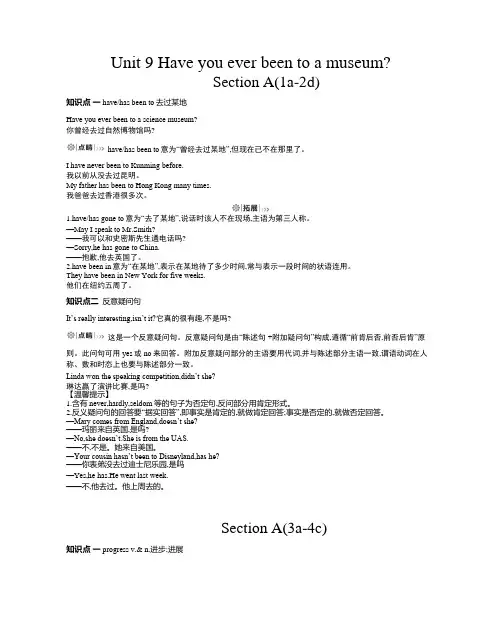
Unit 9 Have you ever been to a museum?Section A(1a-2d)知识点一have/has been to去过某地Have you ever been to a science museum?你曾经去过自然博物馆吗?have/has been to意为“曾经去过某地”,但现在已不在那里了。
I have never been to Kunming before.我以前从没去过昆明。
My father has been to Hong Kong many times.我爸爸去过香港很多次。
1.have/has gone to意为“去了某地”,说话时该人不在现场,主语为第三人称。
—May I speak to Mr.Smith?——我可以和史密斯先生通电话吗?—Sorry,he has gone to China.——抱歉,他去英国了。
2.have been in意为“在某地”,表示在某地待了多少时间,常与表示一段时间的状语连用。
They have been in New York for five weeks.他们在纽约五周了。
知识点二反意疑问句It’s really interesting,isn’t it?它真的很有趣,不是吗?这是一个反意疑问句。
反意疑问句是由“陈述句 +附加疑问句”构成,遵循“前肯后否,前否后肯”原则。
此问句可用yes或no来回答。
附加反意疑问部分的主语要用代词,并与陈述部分主语一致,谓语动词在人称、数和时态上也要与陈述部分一致。
Linda won the speaking competition,didn’t she?琳达赢了演讲比赛,是吗?【温馨提示】1.含有never,hardly,seldom等的句子为否定句,反问部分用肯定形式。
2.反义疑问句的回答要“据实回答”,即事实是肯定的,就做肯定回答;事实是否定的,就做否定回答。
—Mary comes from England,doesn’t she?——玛丽来自英国,是吗?—No,she doesn’t.She is from the UAS.——不,不是。
人教版 八年级英语 下册 Unit_9_Have_you_ever_been_to_a_museum
dish.
Tapescripts:
Boy 1: So, Peter, how long have you been in China? Peter: I’ve been here for two weeks, but I’m going back to Australia tomorrow. Boy 1: Have you traveled much? Peter: Yes, I have. I’ve seen many interesting things. Boy 1: Have you visited the Palace Museum? Peter: Yes, I have. I went there last week. It was wonderful. There were so many beautiful treasures. Boy 1: And have you been to the Great Wall?
1st listening
1b
Listen to a student interviewing a foreign student. Check (√) the questions you hear.
___√_ Have you visited the Palace Museum?
___√_ Have you been to the Great Wall?
人教版八年级英语下册Unit9 Have you ever been to a museum知识点梳理及单元复习
Unit 9知识点梳理和单元复习附参考答案1. 单元重点短语归纳:have/has been to曾经去某地;have/has been in+地点待在某地;me neither.我也没;have/has gone to去某地了;somewhere different不同的地方;close to贴近,邻近;encourage sb. to do sth.鼓励某人做某事;thousands of 数以千计的,许许多多的;on the one hand...on the other hand一方面......另一方面......;put up搭建,举起,张贴;take the subway乘地铁;three quarters四分之三;practice doing sth. 练习做某事;have problem doing sth. 做某事遇到困难;2. Have you ever been to a science museum? 你曾经去过科学博物馆吗?【重点】【辨析】have/has been to;have / has gone to ;have/ has been in;(1). have/ has been to 表示“某人曾经去过某地”强调现在已经回来了,不在那里了。
E.g.: We have been to Qingdao. 我们去过青岛。
(现在不在青岛)(2). have gone to表示“某人到某地去了”,强调现在还没有回来,可能在那里或途中。
E.g.: They have gone to Sydney. 他们去悉尼了。
(现在在悉尼或途中)(3). have been in +地点:表示“某人在某地待了很长时间”,常与时间段搭配。
E.g.: I have been in Nanchang for three years. 我在南昌待了3年了。
How long have you been in China? 你在中国待了多长时间?3. 一般过去时与现在完成时的用法比较【重点】&【难点】(1). 一般过去时表示过去某个时间发生的事、存在的状态或经常发生的动作。
河南省八年级英语下册Unit9Haveyoueverbeentoamuseum必考知识点归纳
河南省八年级英语下册Unit9Haveyoueverbeentoamuseum必考知识点归纳单选题1、The Great Wall is a place of interest. All of us ________ there before.A.has beenB.have beenC.has goneD.have gone答案:B句意:长城是个名胜古迹。
我们所有人以前都去过那里。
考查现在完成时。
have/has been表示去过某地又回来了;have/has gone表示去了某地还没回来。
主语“All of us”是复数,用have而不用has,排除AC;根据before可知应该是去过,现在已经回来,用have been而不用have gone,排除D。
故选B。
2、—I have ________ been to Tibet. How about you?—Me. neither.A.neverB.everC.already答案:A句意:--我从没去过西藏。
你呢? --我也没有去过。
根据neither “我也没有去过”提示,可知问句是没去过,never从不,ever曾经,already已经;故选A。
3、David has never been to Australia, ________?A.hasn’t heB.doesn’t heC.has heD.does he答案:C句意:大卫从未去过澳大利亚,是吗?考查反义疑问句。
题干中“has never been”是现在完成时,助动词为has,never表否定。
反义疑问句中如果陈述句为否定,反义疑问句的后半部分应用肯定疑问句。
故选C。
4、— ________ you ever ________ to Hong Kong?— Yes, only once.A.Did; goB.Have; goneC.Do; goD.Have; been答案:D句意:——你去过香港吗?——是的,只有一次。
初中英语人教版八年级下册unit9 Have you ever been to a
Unit9 Have you ever been to a museum?Section A(3a-3c)教案Teaching aimsKnowledge aims:Ss can master new words and language chunksAbility aims:1.Ss can understand the passage.2.Ss practice reading and writing.Moral aims:Educate students to care about things around them.Teaching key points1.Be able to understand the passage.2.Learn to talk about things about them and learn to use “have/has been to…”Teaching difficulties:1.Learn to talk about things in their lives2.Learn to use “have/ has been to …”Teaching stepsStep 1, Warming upShow Ss a picture about a museum ,ask Ss to guess what kind of mesuem i t is.Step 2, Before reading1.Show Ss a picture of new words to consolidate the new word s.2.Show Ss three p ictures about 3a. Ask Ss to talk about every picture.Eg:T: What can you see in the first picture ?S1: I can see three computers.T: What do you think we will read in the passage ?S2: About a computer museum.T: Great ! What can we learn in a computer museum ?S3: The story of comput ers.S4: The usage of computers.S5: ….Step 3, While reading1.First reading1)Give Ss 1 or 2 minutes to ask them to read the passage quickly and answer the question.Which three museum do you think about ?2.Careful reading1)Read Para. 1 to answer the 2 questionsWhat do they have in the American Computer Museum?What’s the differences between the old computers and the new ones ?2)Read Para 2 to answer the 2 questionsWhat did Amy see in the International Museum of Toilets in India ?What does the International Museum of Toilets encourage people to do ?3)Read Para.3 to answer the following questionsWhat do the tea art performances show?Why does LinLin’s grandpa love collecting tea sets ?4)Read the article again and answer the following questions (3b).What does Ken say about the American Computer Museum?What can we learn at the International Museum of Toilets?Why is the Hangzhou National Tea Museum a nice place to enjoy tea ?5)Read the passage and find out the difficult points. Disc uss them in groups.7) Share the whole story with students according to the chart.8) Retell the story according to the charts.Step4, After readingAsk Ss to finish 3c by themselves , then check the answers. Step5, HomeworkSearch other museums and try to write a report.。