
2019春译林版九年级英语下册Unit3单元精品解析()
Unit 3单元检测卷(120分90分钟)第一部分英语知识运用(共两大题,满分45分)Ⅰ.单项填空(共15小题;每小题1分,满分15分)从每小题所给的A、B、C、D四个选项中选出一个可以填入空白处的最佳选项。
(B)1.—the way,can you offer me some advice on how to improve my English?—Why not buy an English dictionary?It can help you many ways.A.In;byB.By;inC.On;inD.By;with(C)2.There are more and more cars in our cities,but they cause many traffic accidents.A.singleB.oldC.privateD.certain(D)3.If the customer rings up for me again,please the call to the sales department.A.run throughB.look throughC.go throughD.put through(A)4.—Will you please it to me on Friday?—OK.I’ll go to the post office that day.A.postyC.serveD.buy(C)5.—You aren’t supposed to smoke in public.It’s bad for our health.—Sorry,I will my cigarette right now.A.give upB.put downC.put outD.give away(C)6.Our teacher often asks us time.A.not wasteB.don’t wasteC.not to wasteD.doesn’t waste(D)7.—I tried to make Alice her mind but I found it difficult.—Well,I saw you that when I went past.A.changed;doB.changes;doingC.change;to doD.change;doing(A)8.The book is interesting I can’t put it down.A.so;thatB.such;thatC.too;toD.very;that(D)9.—What happened to you yesterday,Jane?—I fell down and hurt.A.myB.mineC.ID.myself(A)10.—Excuse me.I’d like to exercise but I’m new here.Could you please tell me?—Follow me.I will show you there.A.how I can get to the sports centreB.how can I get to the sports centreC.when I can get to the sports centreD.when can I get to the sports centre(C)11.—Jack,did you find our school yesterday?—Yes,but with police’s help,for it has changed over these years.A.hardlyB.partlypletelyD.never(D)12.Though the dishes were just OK,it seemed that my father was pleased with his journey.A.for exampleB.so farC.in allD.in general(B)13.—Excuse me.Could you please tell me my car?—Sure.Park it right here.I’ll help you.A.how to stopB.where to parkC.when to parkD.what to do(B)14.—The cookie tastes good.How did you make it?—It’s easy.Just follow the.A.discussionsB.instructionsC.resolutionsD.attentions(C)15.—My robot has caught a virus and it has gone wrong.—.You’d better have it checked.A.Don’t mention itB.No problemC.I’m sorry to hear thatD.That’s OKⅡ.完形填空(共20小题;每小题1.5分,满分30分)阅读下列短文,从每小题所给的A、B、C、D四个选项中选出一个最佳选项。
AWhat do you usually use mobile phones for?Sending text messages for fun?Playing games?Well,mobile phones can do far more than that.16this year’s Asian tsunami(海啸),mobile phones saved many17.More than 10,000 international phones were18 when the tsunami hit.Police sent text messages to them and found more than 2,000.But how?People19the signal and found out20the tourists were.So,how can21so small be so smart?Well,here’s how! When you turn the phone22,it tries to find a signal.This signal comes from the telephone network.If you have a signal you can see it on the phone’s screen.Sometimes,if the signal is weak,23can be difficult to make a phone call.When the phone is finding a signal,it also sends a(n)24to the telephone network.This message tells the station where the phone is.When you start to make a phone call,the telephone network tells telecommunications offices where you are.The office will find out who you’re calling then put you25to your friend!(B)16.A.While B.During C.At D.When(A)17.A.lives B.animals C.houses D.troubles(D)18.A.doing ing C.functioning D.working(C)19.A.heard B.listened C.followed D.examined(B)20.A.how B.where C.what D.why(A)21.A.something B.anything C.everything D.nothing(A)22.A.on B.off C.in D.at(B)23.A.he B.it C.they D.you(C)rmation B.word C.message D.note(D)25.A.off B.up C.on D.throughBIn some science fiction film,people in the future have their own robots.These robots are just like humans.They help with the housework and do the most26jobs.Some scientists believe that there will be such robots in the future.However,they agree it may take hundreds of years.Scientists are now trying to make robots look like people and27the same things as us.Japanese companies have already made robots walk and dance.This kind of robot will also be fun to watch.But robot scientist James White disagrees.He thinks that it will be28for a robot to do the same things as a person.For example,it’s easy for a child to29and know where he or she is.Mr White thinks that robots won’t be able to do this.But other scientists disagree.They think that robots will be able to talk to people3025 to 50 years.Robots scientists are not just trying to make robots look like people.For example,there are already robots31in factories.These robots look more like huge arms.They do simple jobs over and over again.People would not like to do such jobs and would get bored.But robots will32get bored.In the future,there will be more robots everywhere,and humans will have33work to do.New robots will have many different34.Some will look like humans,and others might look like35.After an earthquake,a snake robot could help look for people under buildings.That may not seem possible now,but computers,space rockets and even electric toothbrushes seemed impossible a hundred years ago.We never know what will happen in the future!(A)26.A.unpleasant B.unknownC.amazingD.interesting(C)27.A.like B.have C.do D.make(D)28.A.easy B.possible C.exciting D.hard(B)29.A.look up B.wake up C.turn up D.put up(D)30.A.after B.before C.about D.in(B)31.A.looking B.working C.sleeping D.walking(C)32.A.no B.ever C.never D.always(A)33.A.less B.a little C.fewer D.a few(D)s B.colours C.sizes D.shapes(B)35.A.turtles B.snakes C.monsters D.spiders第二部分阅读理解(共两大题,满分45分)Ⅲ.补全对话(共5小题;每小题1分,满分5分)根据对话内容,从方框内的选项中选出能填入空白处的最佳选项,其中有两个为多余选项。
(word完整版)译林牛津英语九年级下册9B第三单元Unit3Robots详细要点解析.docx

Unit 3’ s needs.(P39,Lines17)1. It seemed that in general that the robot satisfied Mr Jiang看起来个机器人大体上足了江先生的要求。
&satisfy one ’s needs知点:seem的用法seem的用法seem可用作系或不及物,意“似乎;好像”,其常用法如下:①“主 + seem +( to be ) +表”,表多名或形容,有是其他的或短,以明主的特征或状。
例如: Tom seems (to be ) a very clever boy. 姆看上去是一个非常明的男孩。
The man over there seems to be a new teacher. 那的那个人看上去像一个新老。
Mr Black seemed to be quite happy. 布莱克先生好像十分快。
This small town seems changed a little. 个小城似乎有点儿化。
②“主 + seem + 不定式”,此句型中的seem与不定式一起构成复合。
例如:Mrs Green doesn’t seem (或 seems not ) to like the idea. 格林夫人似乎不太喜个主意。
The children seemed to be eating something in the room. 孩子好像正在房里吃西呢。
The young man seemed to have changed much. 个年人看起来化很大。
③“ It seems + that 从句”,其中it 是形式主, that 引主从句。
例如:It seems that no one knows what has happened in the park. 似乎没有人知道在公园里生了什么事。
It seems to me that Mr Brown will not come again.在我看来布朗先生不会再来了。
九年级英语下译林unit3知识点
九年级英语下译林unit3知识点Unit 3 Knowledge Points in Yilin English Textbook for Ninth GradersIntroductionIn the ninth grade English curriculum, students explore various themes and topics to enhance their language skills. Unit 3 of the Yilin English textbook covers a range of knowledge points that help students strengthen their understanding and application of the English language. This article will delve into the key knowledge points in Unit 3, providing insights and examples.Vocabulary ExpansionOne of the fundamental aspects of language learning is vocabulary. Unit 3 introduces students to a host of new words, increasing their vocabulary repertoire. Some key words include "mysterious," "traditional," "beliefs," "customs," and "superstitious." Understanding these words not only aids in comprehension but also allows students to express themselves more precisely.Idioms and PhrasesIn addition to expanding vocabulary, Unit 3 provides students with a glimpse into the world of idioms and phrases. This figurative language adds flair to one's spoken and written English. Some idioms covered in this unit are "the ball is in your court," "cross that bridge when you come to it," and "let the cat out of the bag." By understanding and using these idioms appropriately, students can enhance their communication skills and fluency.Grammar FocusUnit 3 of the Yilin English textbook places emphasis on certain grammar points, which are crucial for forming grammatically correct sentences and conveying meaning accurately. Some key grammar points covered in this unit include the usage of "used to" and "be/get used to," the present perfect tense, modal verbs to express prohibition or permission, and the passive voice. By mastering these grammar concepts, students can construct more sophisticated and nuanced sentences.Listening SkillsListening skills form an integral part of language acquisition. Unit 3 offers various listening activities to enhance students' ability to comprehend spoken English. These activities may include listening for specific information, understanding conversations, and following instructions. By attentively listening to native speakers, students can improve their pronunciation, vocabulary, and overall comprehension abilities.Reading ComprehensionUnit 3 provides students with engaging reading materials that allow them to practice their comprehension skills while expanding their knowledge on different topics. The texts cover a range of themes, such as cultural customs, historical events, and personal anecdotes. By analyzing and understanding the texts, students develop their reading strategies, such as skimming, scanning, and inference.Speaking ActivitiesSpeaking activities in Unit 3 encourage students to communicate in English both individually and in groups. These activities aim to improve students' fluency, pronunciation, and overall confidence in using English for communication. Some activities may involve givingshort presentations, participating in debates, or discussing thought-provoking topics. Through these activities, students develop their critical thinking skills and practice expressing their opinions effectively.Writing TasksUnit 3 also provides opportunities for students to hone their writing skills. Writing tasks may include composing formal letters, personal narratives, persuasive essays, or descriptive passages. These tasks not only improve students' written expression but also foster their creativity and organization of ideas. By practicing these writing tasks, students learn to effectively structure their thoughts and convey their messages to different audiences.ConclusionUnit 3 of the Yilin English textbook for ninth graders encompasses a wide range of knowledge points, including vocabulary expansion, idioms and phrases, grammar focus, listening skills, reading comprehension, speaking activities, and writing tasks. By engaging with these knowledge points, students can enhance their language skills holistically. The various activities and exercises in this unit promoteactive learning and provide opportunities for students to apply their knowledge in meaningful and practical ways.。
译林版九年级下册unit3知识点
译林版九年级下册unit3知识点Unit 3: EnvironmentIntroduction:In the ninth grade, students are introduced to various topics that not only expand their knowledge but also cultivate critical thinking skills. One such topic is the environment, which is the focus of Unit 3 in the textbook series "Translation Forest". This unit aims to educate students about the importance of protecting the environment and sustainable living. Through engaging content and thought-provoking discussions, students will develop a deeper understanding of the impact of human activities on the planet and learn about potential solutions to address environmental challenges.Understanding Climate Change:Climate change has become one of the most pressing issues of our time. The first section of Unit 3 delves into the causes and consequences of climate change. Students will explore the role of greenhouse gases, such as carbon dioxide and methane, in trapping heat and altering the Earth's climate. They will also learn about theconsequences of global warming, including rising sea levels, extreme weather events, and the endangerment of countless animal species. By understanding these key concepts, students will gain awareness of the urgent need for action to mitigate climate change.Sustainable Development:To combat climate change and preserve the environment, sustainable development is crucial. The next section of Unit 3 focuses on sustainable living practices that can help achieve a balance between economic growth and environmental protection. Students will discover the concept of the "three R's" – reduce, reuse, and recycle – as effective strategies to minimize waste and conserve resources. Additionally, they will learn about renewable energy sources such as solar and wind power, as well as the importance of energy conservation in combating climate change.Preserving Biodiversity:Biodiversity refers to the variety of plant and animal species on Earth, and it is vital for maintaining ecosystem stability. The third section of Unit 3 explores the causes of biodiversity loss and its dire consequences. Students will explore how deforestation, overfishing,and pollution are threatening the delicate balance of ecosystems. They will also delve into the significance of preserving biodiversity for human well-being, including the provision of food, medicine, and other ecosystem services. By recognizing the importance of biodiversity, students will be motivated to protect and restore it.Environmental Activism:The final section of Unit 3 highlights the power of activism in driving change. Students will learn about influential environmental activists from around the world who have dedicated themselves to protecting the Earth and inspiring global action. They will explore various methods of environmental activism, including grassroots movements, lobbying, and awareness campaigns. Through case studies and discussions, students will recognize that collective action can lead to significant positive outcomes for the environment.Conclusion:Unit 3 of the ninth-grade textbook series "Translation Forest" offers a comprehensive and in-depth exploration of environment-related topics. By understanding climate change, sustainable development, biodiversity, and environmental activism, students will gain theknowledge and awareness required to become responsible global citizens. This unit not only provides valuable information but also encourages students to think critically, fostering a sense of stewardship towards the Earth and inspiring them to take action to protect the environment. By equipping students with the necessary tools, education plays a pivotal role in shaping a sustainable and greener future.。
牛津译林版英语九年级下册Unit3知识点

9B Unit 3知识点单词:explore 探索explorer 探索者smooth 光滑的smothly 光滑地satisfy 满意n. satisfied 满意的adj. satisfing令人满意的adj.private 私人的adj. public 公共的adj.proper 正确的properly 正确地complete 完成v. completely 完全地adv.paper 纸不可数论文可数product 生产v. production生产n.order v.预定、命令medicine 药n.不可数medicial 医学的adj短语:complain about sth to sb… 向…投诉你explain sth to sb=explain to sb sth 向… 解释post sb sth =post sth to sb 邮寄… 给…put out 扑灭put up 张贴put in 安装put on 穿上help sb do sth 帮助…做…help sb with sth 帮助…方面sound smell taste look feel+agjbe busy with sth 忙于…be busy doing sth 忙于做…make sb do sth /make +adj 使某人做…knock things over 撞翻in the end=finally=at last 最后be pleased with… 对…满意=be happy with =be satisfied withremind sb. to do sth. 提醒…做…remind sb of sth 使某人想起…first of all =in the beginning=at first 首先expect sb. to do sth 期望…做…last for at least two months 至少延续两个月up to standard 达到标准,合格on business 出差as well too also eitherreturn to sp 返回be ready for sth 为… 准备be ready to do sth 准备做…tidy up 整理干净in general=generally 总的来说go wrong with sth 出故障not…any more=…no longer 不再have a better sleep 有一个更好的睡眠put through 接通be sorry to do sth 抱歉做…look forward to doing sth 期待做…need to do sth 需要做… need doing sth 需要被做…regret to do sth遗憾去做… regret doing sth后悔做过…sth in a mess 处于混乱what a mess 多么混乱what to do with=how to deal with 处理decide to do sth=make a decision to do sth 决定做…make trouble/problem/difficulty (in) doing sth有困难做…语法:too adj/adv to do sthadj/adv enough to do sth主语+V+that 句子主语+V+特殊疑问词+to do sthso adj/adv that+句子such+(a/an) adj+N+ that+句子。
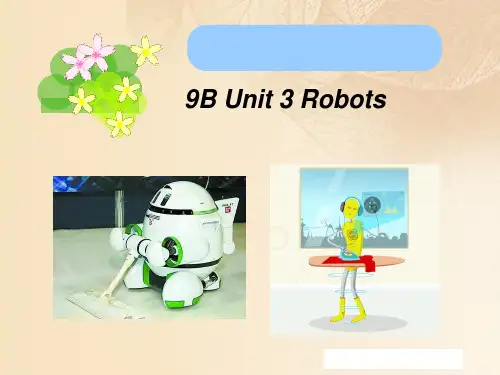
译林9年级下册 Unit3 知识点归纳复习总结23PPT
live in the city centre. 钟出毛病了
Something has gone wrong with the clock.
2. 中病毒 catch a virus
3. 不再
no longer=not...any more
4. 正常运转 work properly proper ---properly
• Liu Ping saw that a wallet was lying on the ground. • →Liu Ping saw a wallet lying on the ground.刘平看见地
上有一个钱包。
• I found he had already been in the office. • →I found him already in the office.我发现他已经在办公室
1. 在上班 be at work
1.下班回家 return home from work 2. 看起来和新的一样 look as good as new 3. 收拾妥,整理好 tidy up 4. 做某人喜欢的任何事
do whatever sb. like(s)
5. …and a delicious dinner would be ready for him.
一. 根据提示完成句子。 1.Mr. Jiang’s shirts are ______ (熨烫) by
the robot every day.
2. Tom, don’t ______ (cover a large area)
coins everywhere. Put them away. 3. His robot can _________ (不再) work.
牛津译林版九下Unit 3知识点总结梳理
Unit 3 Robots3.1 Comic strip& Welcome to the unit【知识点精讲】【词汇点拨】●1complain v i.抱怨;埋怨;投诉;发牢骚[观察] I'm complaining about you to the robot shop.我在向机器人商店投诉你。
[探究] complain 用作不及物动词,意为“抱怨;埋怨;投诉;发牢骚”。
complain about sth 意为“抱怨某事”;complain to sb 意为“向某人抱怨”;complain about sth to sb 意为“向某人抱怨某事”。
complain 后面也可接宾语从句。
Almost immediately he began to complain about the weather.他几乎马上就开始抱怨天气了。
They complained about the terrible food to the boss.他们向老板抱怨这糟糕的食物。
[拓展] complain的名词形式为complaint,意为“抱怨;埋怨;投诉;控告”。
You're always having complaints. 你一直都有怨言。
[注意] complain用作及物动词时,可接that从句,但不能接动词不定式。
She complained that the room was cold.她抱怨屋子冷。
活学活用1.根据汉语意思完成句子(1)她总是怨天尤人。
She is always __________________ something.(2)我们收到了来自顾客的许多投诉。
We________a number of________ from customers.●2whatever pron.任何,一切事物[观察] So they could do w hate v er they're asked to.所以它们可以做任何它们被要求做的事情。
第10讲 九年级下册Unit 3 重点短语和句型(解析版)-九年级英语(牛津译林版)
第10讲九年级下册Unit 3 重点短语和句型九年级英语(译林牛津版)【基础知识】(Comic strip and Welcome to the unit)1.amazing = surprising 令人惊讶的(和物有关)amazed=surprised 感到惊讶的(和人有关)be amazed at = be surprised at 对……感惊讶2.* a long way to go 一段很长的路要走3.* continue to the end 坚持到底4.continue doing sth = go on doing sth 继续做某事* continue to do sth = go on to do sth 继续做(另一件事情).5.take a rest = have a rest 休息一下6.* on one’s way back 在某人回来的路上* on one’s way home 在某人回家的路上* on one’s way to 在某人去……的路上7.* dragon dance tgl舞龙* paper cut 剪纸8.learn about sth 了解某事(Reading)1.unless 除非=if… not2.in northern China 在中国北部=in the north of China = in North China3.the capital of China 中国的首都4.get lost = lose one’s way 迷路5.at the centre of = in the middle of 在……中心6.Forbidden City 紫禁城,故宫7.the Ming dynasty 明朝ed to do sth 过去常常做某事9.in the past 在过去10.be attracted by 被……迷住11.next to =close to= beside 在……旁边12.be filled with = be full of 充满着,装满着13.so that 以便(so that +从句,in order to +动词原形)14.the raising of the national flag 升国旗15.take a walk = have a walk 散步16.Chinese-style garden 中国式园林17.natural landscape 自然景观18.consist of = be made up of 由……组成19.step by step 一步一步地,逐步地20.Chinese painting中国画21.in different shapes 形状各异的* in strange shapes 奇形怪状的in the shape of = in the form of 以……形状see sth with one’s own eyes 亲眼看见某事22.take a boat trip 乘船旅游23.lie n.谎言;tell a lie 撒谎lie (lay, lain, lying)v. 平躺;撒谎;位于24.be open to the public 向公众开放25.at sunrise 在日出时26.be famous for 因……而闻名(Grammar)1.in spite of 尽管,不管(后接名词或代词或Ving)* although / though 虽然,尽管为(后接从句)It was still hot although it rained heavily.=It was still hot in spite of the heavy rain.2.tour manual = tour guide 旅游指南3.tear sth into pieces 把某事撕碎4.by accident 偶然I saw one of my good friends by accident yesterday.=I happened to see one of my good friends yesterday.5.take sth with sb 带上某物You had better take an umbrella with you. 你最好带上一把雨伞。
译林版英语九年级下册第三单元知识点和练习
译林版英语九年级下册第三单元知识点和练习Unit 3 Robots一、Comic Strip & Welcome to the Unit(一)、单词内容序号英语音标词性汉语四会单词1 robot ['r??b?t] n. 机器人2 post(英)mail(美)[p??st][me?l]vt. 邮寄3 brain [bre?n] n. 大脑4 whatever [w?t'ev?] pron. 任何,一切事物三会单词* 5 explore [?k'spl?:; ek-] vt. 探索;探讨6 outer space ['a?t?] [spe?s] n. 太空(二)、对话1. Hobo: What are you doing ,Eddie?Eddie: I’m writing a letter.Eddie : You’re too lazy.I’m complaining about you to the robot shop.Hobo: Oh dear!I can explain!Eddie : No,Hobo.It’s too late.Post this for me.Hobo: All right,Eddie.Hobo: Eddie,I don’t know when I’ll post the letter for you.2. Amy: Would robots have brains in the future,Daniel?Daniel: Yes,they would.So they could do w hatever they’re asked to.Amy: That sounds useful.How could robots help us?Daniel: They could do dangerous jobs like putting out firesor working on high buildings.Amy: That’s great!Could robots help you and me in any way?Daniel: Of course.They could help us with our homework.Amy: Wow!I’d like to have one!二、Reading(一)、单词内容序号英语音标词性汉语四会单词1 order ['?:d?] vt. 订购2 smoothly ['smu:el?] adv. 平整地;顺利地3 in general 总的来说;大体上4 satisfy ['s?t?sfa?] vt. 满足;使……满意5 need [ni:d] n. 需要的事物;欲望6 no longer 不再7 properly ['pr?p(?)l?] adv. 正确地,适当地8 complete [k?m'pli:t] adj. 完全的,彻底的9 mess [mes] n. 乱七八糟10 lay [le?] vt. 放,搁11 store [st??] vt. 储藏,存储12 coin [k??n] n. 硬币13 bill [b?l] n. 账单14 private ['pra?v?t] adj. 私人的15 paper ['pe?p?] n. 文件,证明16 spread [spred] vt.&vi. (使)散开;扩散17 wheel [wi:l] n. 轮子;车轮三会单词* 18 suit [su:t] n. 套装19 iron ['a??n] vt. 熨烫20 virus ['va?r?s] n. 病毒(二)、课文The home robotMr Jiang is a manager of a big company in Sunshine Town.He is always too busy to have any time to relax.I have to buy a robotso that I can have more free time,”Mr Jiang thought.So he ordered one from a robot shop.The robot made Mr Jiang’s life much easier.When he got up in the morning,breakfast was made,his business suit was smoothly ironed,and his lunch box was already prepared.That made him very happy.While Mr Jiang was at work,the robot would do all the housework.It would go shopping at the supermarket as well.When Mr Jiang returned home from work,his flat would look as good as new,and a delicious dinner would be ready for him.After dinner ,the robot would tidy up.That allowed Mr Jiang to do whatever he liked.He would watch Tv or do some reading.It seemed that in general the robot satisfied Mr Jiang’s needs.After a few comfortable weeks,however,things started to go wrong.The robot caught a virus and no longer worked properly.It began to make stupid mistakes.Sometimes it woke Mr Jiang up at four o’clock in the morning.When Mr Jiang got home, he would find his flat in a complete mess:food was laid on the bed;milk was stored in the rubbish bin;coins,bills and his private papers were spread all over the floor.Moreover,the robot moved too fast on its wheels and often knocked things over. Mr Jiang did not know what to do with it.In the end, Mr Jiang decided to return the robot to the robot shop.Robots can help people a lot,but they can also be too much trouble!三、Grammar:大声朗读背诵书后P78语法及例句简单句和复合句之间的转换(一)将复合句改为简单句1. She heard that the boy cried all night.She heard the boy ______ all night.2. I wonder how I can go there.I wonder ______ ______go there.3. I saw that he was playing computer games.I saw ______ ______ computer games.4. I feel that it is dangerous to play with fire.I feel ______ ______ to play with fire.5. Marx found that it was necessary to study Russia.Marx found______ ______ ______ study Russia.6. My father got up early so that he could catch the first bus.My father got up early ______ ______ ______ catch the first bus.7. The girl is so short that she cannot be a model.The girl is ______ short ______ be a model.8. The box is so heavy that we can’t carry it.The box is ______ ______ ______ us to carry.9. The problem is so easy that I can work it out.The problem is ______ ______ ______me ______ work out.将简单句改为复合句1. The problem is too difficult for us to work out.The problem is _______ ______ that we _______ work it out.2. The tree is too tall for us to reach .The tree is _______tall _______ we can’t reach_______ .3. The water was too dirty for us to drink.The water was ______dirty that we ______ drink ______.4. The teacher told us to do the experiment.The teacher told us how ______ ______ ______ the experiment.5. Could you tell me how to get to the station?Could you tell me ______ ______ ______ get to the station?6. She likes pork a little, but she likes beef better.She ______ beef ______ ______ pork.7. Mike is the tallest student in his school.______ ______ in the school is taller than MikeMike is ______ ______ ______ ______ student in his school.四、Speak up and Task(一)、单词内容序号英语音标词性汉语四会单词1 unsure [?n'] adj. 不确定,没把握2 customer ['k?st?m?] n. 消费者,顾客3 hold [h??ld] vi. (打电话时)等待,不挂断4 through [θru?] adv. (电话)接通5 put through 给…接通(电话)6 satisfied ['s?t?sfa?d] adj. 满意的,满足的7 be satisfied with 对……感到满意8 first of all 首先9 up to standard 达到标准10 completely [k?m'pli?tl?] adv. 完全地11 regret [r?'gret] vt.&vi 后悔;遗憾12 product ['pr?d?kt] n. 产品;成果三会单词* 13 pill [p?l] n. 药片;药丸14 forgetful [f?'getf?l; -f(?)l] adj. 健忘的15 stair [ste?] n. 楼梯16 battery ['b?t(?)r?] n. 电池17 quality ['kw?l?t?] n. 质量(二)、Speak up My robot has caught a virus.Woman 1: Hello! Can I help you?Mr Jiang: Hello!I’d like to speak to the Customer Service Department.Woman 1: Please hold and I’ll put you through.(5 seconds later)Woman 2: Hello!This is the Customer Service Department.What can I do for you?Mr Jiang: My robot has caught a virus and it has gone wrong.Woman 2: I’m sorry to hear that.Would you like us to have it checked?Mr Jiang: Yes,please.Thanks.Woman 2: OK.Our robot engineer will contact you soon.(三)、Task(P49 Part B) The robot shop sent a reply to Daniel.Read the reply with Daniel. Dear Mr Chen,We are sorry to hear that you are not satisfied with your robot.We understand why you are so angry.We would like to send you a new robot.You will only need to put the batteries in to make it work.Of course,you can have your money back if you would not accept our new product.However,we hope that you give it a try.We are sure that you will like it.You are welcome to let us know whenever you are not satisfied with it.Please tell us your decision.If the new robot is your choice,please let us know when we can send it to you.We look forward to hearing from you soon.Yours sincerely,Lin FangManager。
牛津译林版英语九年级下册Unit3 Study skills精品课件 (共27张PPT)
Study skills
People speak English in both Britain and the USA. However, there are some differences between their English.
English
Spelling British -mme / -m -ll- / l -gue / -g -our / -or -re / -er programme travelling dialogue colour theatre American program traveling dialog color therter
British English
American English
pronunciation (发音) Grammar (语法)
spelling (拼写)
vocabulary (词汇)
Pronunciation
British English American English
/kɑ:(r)/ car tomato /təmɑ:təu/ dance /dɑ:ns/
/kɑr/
/təmeto/
/dæns/
/kænt/
can’t
/kɑ:nt/
Spelling
theatre centre colour humour favourite jeweller (珠宝商) traveller kilogramme programme(节目)
theater center color humor favorite jeweler traveler kilogram program
—red, blue and white.
苏教译林版初中英语九年级下册Unit 3单词、课文跟读+知识点梳理
苏教译林版初中英语九年级下册Unit 3单词、课文跟读+知识点梳理Unit 3 词汇表(以下内容仅供参考,如有错漏,请以课本词汇表为准)▼▼▼▼robot [ˈrəʊbɒt] 机器人post [pəʊst] 邮寄explore [ɪks plɔː] 探索;探讨outer space 太空brain [breɪn] 大脑whatever [wɒtˈevə] 任何,一切事物order [ ɔːdə] 点菜,订购,命令,有效安排suit [suːt] 套装smoothly 平整地,顺利地iron [ˈaɪən] 熨烫in general 总的来说;大体上satisfy [ˈsætɪsfaɪ] 满足,使…满意need [niːd] 需要virus [ˈvaɪərəs] 病毒no longer 不再properly [ˈprɒpəli] 正确地,适当地plete [kəmˈpliːt] 完全的,彻底的mess [mes] 乱七八糟,混乱,困境lay [leɪ] 放,搁store [stɔː] 储藏,存储coin [kɔɪn] 硬币bill [bɪl] 账单;钞票private [ˈpraɪvɪt] 私人的paper [ peɪpə] 文件,证明spread [spred] 使散开;扩散wheel [hwiːl] 轮子,车轮pill [pɪl] 药片;药丸unsure 不确定,没把握forgetful [fəˈɡetfʊl] 健忘的stair [steə] 楼梯battery [ˈbætəri] 电池customer [ˈkʌstəmə] 消费者,顾客hold [həʊld] (打电话时)等待,不挂断through [θruː] (电话)接通者put through 给…接通(电话)satisfied 满意的,满足的be satisfied with 对…感到满意first of all 首先quality [ˈkwɒlɪti] 质量up to standard 达到标准pletely 完全地regret [rɪˈɡret]后悔;遗憾product [ˈprɒdʌkt] 成品,成果。