
人教新目标版八年级上册 Unit 5 Period 4 Reading(共22张PPT)
round ears ________________
Walt Disney---the man behind Mickey
• He was an American cartoonist, and film producer. He is famous for Mickey Mouse. • In the 1930s, he made ____ 87 cartoons with Michey. rich • He is ______and ___________. successful
Mickey Mouse is a famous symbol in American culture.
Monkey King
Fast reading
Read and find out the main idea of each paragraph.
Mickey Mouse is still famous today
He is a black mouse with two large round ears. The main reason is that he tries his best to help others.
Where can we see Mickey Mouse?
the Hollywood Walk of Fame
Questions: 1. Why did Mickey become so popular? Why did people want to be like Mickey? One of the main reasons is that Mickey was like a common man, but he always tried to face any danger. He was always ready to try his best. 2. What was Mickey like in his early films? He was unlucky and had many problems such as losing his house or girlfriend, Minnie.
Para 2. Some people might ask how this cartoon animal became so popular. One of the main reasons is that Mickey was like a common man, but he always tried to face any danger. In his early films, Mickey was unlucky and had many problems such as losing his house or girlfriend, Minnie. However, he was always ready to try his best. People went to the cinema to see the “little man” win. Most of them wanted to be like Mickey.
para 1
para 2
Mickey Mouse is a famous symbol in American culture
ቤተ መጻሕፍቲ ባይዱ
para 3
Why was Mickey Mouse so popular
Careful reading Para 1.
When people say “culture”, we think of art and history. But one very famous symbol in American culture is a cartoon. We all know and love the black mouse with two large round ears-Mickey Mouse. Over 80 years ago, he first appeared in the cartoon Steamboat Willie. When this cartoon came out in New York on November 18, 1928, it was the first cartoon with sound and music. The man behind Mickey was Walt Disney. He became very rich and successful. In the 1930s, he made 87 cartoons with Mickey.
Unit 5
Do you want to watch a game show?
Period 4 Section A 2a-2e
Enjoy a video
Steamboat Willie
It was the first cartoon
with sound and music.
What do you think of him? What does he look like?
Information Card Mickey Mouse Name:____________
Over 80 years old Age:______________
in the First appeared______ cartoon Steamboat Willie _________________ Walt Disney "Father":__________ a black Appearance(外貌): ___ mouse with two large _________________
we can see Mickey Mouse in the cartoons. (in the Disneyland /…) He appears in the cartoons. cartoon character Mickey is so popular that he has a star on … Mickey Mouse is the first cartoon character to have ...
人教版新目标英语(Go_for_it)八年级上册教案(全册)
Unit 1 How often do you exercise ?Teaching goals:1.Words &phrases: how often , hardly , twice , once , difference , lookafter , although ,etc .2.Learn to talk about how often do you do things .3.一些表示频率的副词: always , usually , often , never , hardly ever ,sometimes .4.句子结构: What do you usually do on weekends ?How often ··· ?及回答.Important and difficult points :What does she /he do on weekends ?She often goes to the movies .How often do you shop ?Once a week / Twice a week ··· .Teaching aids : cards , pictures and a tape recorder .Period 1Teaching procedures :Step 1 Leading-in1.Greetings:Talk about something the students did onsummer vacation .Step 2 Pre-taskSB Page 1 , 1a .1.Look at the picture (学生识图). each activity .T: What are they doing ?They are shopping /reading /exercising /watching TV /skateboarding .(Help the students to answer )3.Write the activities on the line .4.Check the answers on the Bb .Correct their own activities .5.Practise reading .SB Page 1 , 1c .1.Focus on the conversation in the box .2.Practise reading .3.Pairwork : What do you do on weedends ? I ··· .4.Groupwork :Divide the class into groups of four or five .Makeconversations .First S1 to S2:S1:What do you do on weekends ?S2:I ··· .S1:What does she /he do on weekends ?S2:She /He ··· .5. Act out their own dialogues .Step 3 While-taskSB Page 1 , 1b .1.Look at each picture in 1c.Tell what the person does on weekends .Checkthe Ss orally.2.Make sure what they will hear and do .3.Read these adverbs and explain.4.Play the tape twice .Write the letters on the line.SB Page 2 , 2a & 2b .1.read the activities and the answers of “how often” first .2.Practise reading .3.In 2a we should know the activities you hear .In 2b we should know theanswers of how often he does the activities.4.Play the tape for a first time .Ss only listen .5.Play the tape a second time .Ss do 2a .6.Play the tape a third time .Check the answers .7.Play the tape .Ss do 2b .8.Check the answers .In this part ,we should pay attention to how often引起的特殊疑问句及回答.Step 4 Post-taskSB Page 2 , 2c .1.Focus on the conversation .2.Practice reading .3.Read the activities in the left box .4.Fill in the chart .5.Pairwork: Make conversations .Period 2Teaching procedures :Step 1 Leading-in1.Greetings2.Drills:T: What do you usually do on weekends ?S1: I usually play soccer .T: How often do you play soccer ?S1: I play soccer twice a week .T: How often does he play soccer ?The other Ss: He plays soccer twice a week .Repeat for three times .Step 2 Pre-taskSB Page 2 ,Grammar Focus .1.Review the grammar box .Ss say the questions and answers .2.Practise reading .Step 3 While-taskSB Page 3 , Part 3 .1.Call attention to the survey .Make sure the Ss understand the chart .T: What activity do ninety-five percent of Green High students do every day ?Ss answer .If necessary , give them help .2.Review the information in the green box with Ss .3.Read the article first by the Ss .4.Read it to the class .5.Look at the survey and fill in the blanks in the article .6.Finish the activity individually .7.Check the answers .8.Practise reading .Step 4 Post-taskSB Page 3,Part 4 .1.T: What can you do to improve your English ?(e.g. read English books,practice reading and speaking ) How often do you ··· ?2.Think of more things you can do to improve your English and write themhere .3.Ask several Ss each question .4.See: Who is the best English students in the classHomework:Revise the new words .Period 3Teaching procedures :Step 1 Leading in1.Greetings & free talk .2.Practise reading the article in Page3.3.Check the homework.Step 2 Pre-taskSB Page4 , 1a .1.Point out the five phrases .2.Ss read after the teacher .3.Make sure the Ss understand what do they mean .4.Call attention to the pictures .Say something about the pictures .5.Match the words with the pictures .6.Check the answers .7.Practice reading .Step 3 While-taskSB Page 4 , 1b .1.pay attention to the conversation in the box on the right .2.Read it to the class .3.Explain : “be good for” means :有益于…,对…有好处.4.Pairwork. Choose a new partner .Use the words in Activity 1a to makeconversations .5.Share the students’ conversations.SB Page 4 ,2a&2b .1.T : Now you will hear a reporter interview two people ,Katrina &Bill .Read the two names for the Ss. In 2a ,we’ll know who is healthy , Bill or Katrina ?2.Read the questions in 2a .3.Listen to the tape carefully twice .Circle “yes” , “no” or “I don’tknow” in the chart .4.Before we check the answers in 2a,we’ll read through the questions in2b .Pay attention to Katrina’s and Bill’s answers .5.Play the tape again .This time ,if we have heard one questions and wehave a pause .Make sure Katrina’s and Bill’s answer.6.From the answers in 2b ,we can tell who is healthy Bill or Katrina ? Step 4 Post-taskRole-play .Groupwork .Divide the Ss into groups of three .S1 is interview,S2 is Katrina ,S3 is Bill .S1: How often do you exercise ?S2: I exercise every day .S3: … .With the help of 2b .Homework请同学们用2b里面的问题调查你熟悉的两位同学,写出答案并做比较.Unit 2 What’s the matter ?Teaching goals:1.词汇.让学生熟记这些单词,能够很熟练地指出表示身体部位的某些单词.2.能够用所学的单词谈论身体并且能给出中肯的建议.3.通过听力练习,争取能够提高学生的听力能力.4.文化欣赏,中国文化.Important and difficult points:1.words .2.How to talk about the health and give the advice .Period 1Teaching procedures:Step 1 Leading in1.T :How many parts of the body can you name ?What’s this ?(head , mouth etc.)Today we’ll learn some parts of the body .2.This is my head .Oh ,I have a headache .Step 2 Pre-task1.Read the new words by the Ss first .2.Then check the Ss if they can read the new words by themselvescorrectly .if there is a mistakes ,correct .3.Practice reading the new words .Give them 6 minutes .4.Have a competition between boys and girls .Write the words you rememberedjust now on the blackboard .5.Page7,1a.Do this part by the Ss first. Write the correct letter afterthe name of each body part on the list .6.Check the answers .7.Play a game .All the Ss close your books ,we’ll have a instructor tosay :Touch your nose /head /r ight ear … .Let’s see which student do it correctly and quickly .First all the Ss do this game .Then have competitions between boys and girls .5 boys and 5girls to the front to do what the instructor said .if you are wrong ,please go back to your seats ,the last one who stands at the front is the winner .Step 3 While-taskSB Page 7, 1b .Listen and check the answers .SB Page 7,1c .Work in pairs and act out .SB Page 8, 2a .1.Point out the eight items in this activity .Read the item to the class .Ssrepeat .2.There are different conversations .Listen carefully . people are talkingabout health problems they have and getting advice .3.Match the problems with the advice .4.Play the tape twice .5.Check the answers .Step 4 Post-task同桌之间设计一个医生与病人之间的对话.Step 5 Homework1.Remember the name of your body part .2.Write conversations between the doctor and the patient .Period 2Teaching procedures :Step 1 Leading in1.Free talk .2.Revise playing the game .3.Practice reading the dialogues .Step 2 Pre-taskSB Page 8, 2b .1.Pay attention to the four pictures .Each of these pictures illustratesone of the conversations .2.Play the tape ,write the missing words on the blank lines .3.Play the tape again and check the answers .4.Pairwork .Practice reading the dialogues in the pictures .Take turnshaving the problem and giving the advice .5.Practice reading the dialogue in 2c ,and make their onw conversations .6.Act out the dialogue .Step 3 While-taskSB Page 9, 3a .1.Point out the picture and ask Ss to describe it .(There is a boy sittingon a bench .He’s sick .A teacher is talking to him )2.Pay attention to the dialogue and the blanks in the dialogue .3.Fill in the blanks in the conversation .4.Go over the answers.5.Practice reading the dialogue with a student, then work in pairs . Step 4 Post-taskSB Page 9 , 3b .1.Look at the picture with activity .A: What’s the matter ?B: I’m not feeling well . I have a toothache /fever/sore throat /sore back .2.Pairwork.Make your own dialogues setting 3a as an example .3.Act out the dialogue .Ask some pairs to come to the front to act out theironw dialogues .SB Page 9, Part 4.1.Read the instructions and demonstrate what a “mime” is .2.Read the dialogue by the Ss .3.Ask a student to come to the front and mime an illness ,the other Ss guesswhat the illness is .4.Ask one student to give advice .5.Give several students an opportunity to come to the front and mime anillness .Step 5 Homework1.When you had some problems.please remember what the doctor said .2.Remember the new words .Period 3Teaching procedures :Step 1 Leading in1.Free talk .2.Play the game :One student mimes an illness , the other students guessthe illness and give advice .What’s the matter? Do you have a sore throat ?Step 2 Pre-taskSB Page 10 ,1a .1.Look at the picture .Point out the four new words and expressions .Sayeach word and ask Ss to repeat .2.The first picture .Explain something about it using one of the four wordsand expressions .3.Match the words with the pictures by the Ss .4.Check the answers .5.Practice reading and make sure the Ss understand the meaning of thewords .Step 3 While-taskSB Page 10,1b .1.Read the four sentences ,Ss practice reading .2.Look at the picture and match each picture with advice.3.Check the answers .SB Page 10 ,2a & 2b .1.First ,make sure the Ss understand what they will hear .2.Then read the four names3.Listen and write the problems on the bland lines .If possible ,write whateach person “should” and “shouldn’t” do for their problem.4.Check the answers .Step 4 Post-taskSB Page 10,2c .1.Ask two students to read the conversation to the class .2.Pairwork .Make conversations with your partner .3.Act out the conversations for the class .4.Write two dialogues in the exercise book .SB Page 11, 3a &3b .1.3a .Read the article and underline the things you should do . Check the answers .2.3b .Let the Ss read the paragraph and fill in the blanks .Check theanswers .SB Page 11 ,Part 4.Play the gameStep 5 SelfcheckSB Page 12 ,Part 1 .1.Fill in the blanks on their own .2.Make your own sentences with the words .SB Page 12,Part 2.Read the letter .Make sure Ss can understand it .Step 6 Homework1.Remember the words in this unit .2.Do the exercises on Pages 6-8of the workbook .Unit 3 What are you doing for vacation ?Teaching goals :1.Words & phrases: babysit ,get back , fishing , rent , think about ,decide(on) , tourist etc.2.How to talk about future plans .3.现在进行时表示将来计划或行动.4.特殊疑问句(where , when , how long引导)Important and difficult points :Drills :What are you doing for vacation ?I’m watching TV .When are you going ?I’m going … .How long are you staying ?We’re staying for five days .Teaching aids : cards and a tape ,a large wall calendar .Period 1Teaching procedures :Step 1 Leading in1.Free talk .2.Put up the wall calendar .T: I’m staying home on Saturday (pointing to next Saturday ). Ss repeat .Ss: I’m staying hom e on Saturday .T: OK. Today we’ll learn how to talk about future plans.Step 2 Pre-taskSB Page 13 , 1a .1.Look at the picture carefully and tell what you see in the picture .2.Write the activities from the pictures in the box and add some more .3.Practice reading .Step 3 While-tasking the activities we write in 1a to make conversations .Forexample :What are you doing for vacation ? I’m visiting my uncle . 2.Pairwork .Practice in pairs .3.用第三人称练习对话.4.Groupwork . Divide the Ss into groups of four or five .Makeconversations .5.Listening Page 13,1b. Check the answers .SB Page 14 ,2a & 2b .1.First ,read the names of the people .2.Play the recording and let Ss fill in the chart .3.Check the answers .Step 4 Post-taskSB Page 14,2c .Read the conversations first .Groupwork and fill in the chart .Step 5 Homework1.如果没填完上面的表格回去接着做完.2.记单词.Period 2Teaching procedures :Step 1 Leading in1.Free talk .2.Revise : Make conversations with the setences what are you doing forvacation ?When are you going ?Who are you going with?Step 2 Pre-taskSB Page 14,Grammar focus .1.Call attention to the sentences together .Read them by the Ss .Ask astudent to say the question using the word he and then again using a boy’s name .2.Do in the same way with “she” and a girl’s name.Step 3 While-taskSB Page 15, 3a .1.Read the conversation by the Ss and practice reading .2.Listen and fill in the chart .3.Check the answers .SB Page 15, 3b .1.Look at the conversation in the box .2.Practice reading .3.Pairwork . Make conversations using the information in 3b .4.Act out your conversations .Step 4 Post-taskVacation Dreams .Imagine your dream vacation .Write something on a piece of paper using what we learnt .Share the dreams .Step 5 HomeworkWrite 2 conversations about 3b in the exercise books .If you don’t finish your dream writing, do it at home .Period 3Teaching procedures :Step 1 Leading in1.Free talk .2.Check the homework :Ask one or two Ss to say something about their dreamvacation .并给出全适的评价.Step 2 Pre-taskSB Page 16, 1a .1.Say each phrase and ask Ss to repeat .2.Call attention to the pictures .Say something about the pictures .Matcheach phrase with a picture .3.Check the answers .Step 3 While task1.Make conversation. Work with your partner .Talk about what you would liketo do on vacation .2.Share their conversations.SB Page 16 , 2a&2b .1.Read the reporter’s questions together .2. Play the recording and check the answers .Step 4 Post-task1. Find a new partner .Student A is the reporter .Student B is He Yu . A interview B .2. Read the conversation in 2c and with the help of the listening . Step 5 Homework1. Remember the new words .2. Write the conversations about your interview .Period 4Teaching procedures :Step 1 Leading in1.Greetings .2.Make an interview with a student .Step 2 Pre-taskSB Page 17 ,Part 4 .T: What are you doing this weekend ?1.Ask each other ,write down their answers .2.One student to present his /her exercise .Step 3 While-taskSB Page 17 , 3a .1.Read the article about Ben Lambert’s vacation plans by the Ss .Tick outthe new words .2.Read the article to the class .3.Explain the new words .4.Play the tape .Ss listen and repeat .5.Point out the five numbered pictures .Ss identify the items .6.Check the answers .7.Play the tape again .Practice reading .SB Page 17, 3b .T: This is an article about Julia’s vacation plans .Call attention to the blanks in the paragraph .Read the paragraph to the class ,saying blank eachtime when we come to a bland line .Read the paragraph and fill in the blanks .Step 4 Post-taskSB Page 17 , 3c .T: We read about Julia’s vacation and Ben’s vacation .If you are a famous singer or football player ,What are your vacation plans ?Write about your vacation plans .Give them help if they need .Step 5 HomeworkComplete the Selfcheck .Unit 4 How do you get to school?Teaching goals :1.Words & phrases: get to , how far , bicycle , subway , minute , mile ,bus stop .2.Talk about how to get to places (谈论出行方式)take the bus /subway /train /taxi , ride a bike /walk .3.how引导的特殊疑问句,表示乘坐何种交通工具的方式.how far ,how long 引导的特殊疑问句.4.复习基数词及时间的表示方法.5.了解中外文化的差异.Important and difficult points :1.how /how far /how long 引导的特殊疑问句.2.乘坐交通工具的表示方法.3.It takes /will take/took sb some time to do sth .Teaching aids: cards and a tape-recorder .Period 1Teaching procedures :Step 1 Leading in1.Greetings and free talk .3.T: How do we get to school ? Some students walk ,some students take thebus ,some students ride a bike .Does anyone take the subway ? No , we have no subway .OK ,today we will learn Unit 4 .Explain : get toStep 2 While-taskSB Page19 ,1a&1c .1.Write down how you get to school .2.Look at the picture .Write down how the students get to school.3.Make dialogues with the phrases .4.Groupwork: Divide the students into groups of three or four .Practicereading the dialogues.5.Act out their dialogues .SB Page 19 , 1b .Listening1.Make sure the Ss know what ot do .Give them an example orally if possible .2.Read the names .3.Play the tape and check the answers .SB Page 20 , 2a&2b .1.Revise the numbers .2.Teach the new word :minute .3.Play the tape for the students to finish 2a&2b .Then play again and checkthe answers .Step 3 Post-taskIf there is time ,make conversations .Step 4 Homework用对话的形式告诉老师你是怎么到达学校并需要多长时间,then please tell me how you get to school and how long it takes .Period 2Teaching procedures :Step 1 Leading in1.Greetings .2.Check the homework .3.Go over the dialogue in Page20 ,2c .Step 2 Pre-taskSB Page 20 ,Grammar focus .1.Review the grammar box .Ask students to say the statements and responses .2.Practice reading .3.Explain the usage of “take” in “take the train” and “take sb sometime to do sth” .Step 3 While-taskSB Page 21,3a .1.Pay attention to the speech bubbles .Read the questions .2.Read the passage by the Ss. Find the answers to the questions and writethe answers on the lines .3.Check the answers .SB Page 21, 3b .1.Show Ss the example in the box .Two students read it to the class .2.Pairwork: Make your own conversations using the information in the leftbox.3.Ask some pairs to present the conversations to the classStep 4 Post-taskSB Page 21 ,Part 4 .Groupwork.Divide the Ss into groups of three .In each group ,one is A,who look at Page 21.One is B,who look at Page 85,the other is C,who look at Page 86 .Fill in the blanks .The group who fill in the blanks first wins .Step 5 HomeworkWrite two conversations in 3b in the exercise books .Period 3Teaching procedures :Step 1 Leading in1.Greetings and free talk .2.Check the homework.3.Go over the passage in 3a Page 21 .Step 2 Pre-taskSB Page 22 ,1a .1.Say the four new phrases and Ss repeat .2.Match the words with the pictures .3.Check the answers .Step 3 While-taskSB Page 22,2a&2b .1.Play the tape for the students to finish them .2.Point out the two sets of pictures with a blank line in front of each .3.Check the answers .SB Page 22, 2c .Talk about how Nina gets to school .Step 4 Post-taskSB Page 23, 3a .1.Read the instructions to the class and read through the statements abutthe article .2.Read the article again by the Ss .Write if the statements are true orfalse in your exercise books.3.Do the activity individually and check the answers .SB Page 23 ,3b .Read the article and fill in the blanks .Check the answers.Selfcheck Part 2 .1.Look at the picture .Make sure what the people in the picture doing .2.Finish the conversation .3.Practice reading .Step 5 Homework1.Write a newspaper article .2.Go over this unit .Unit 5 Can you come to my party ?Period 1Teaching contents :Section A:1a , 1b ,1c ,2a ,2b.Teaching goals :1.vocabubary: lesson , hey , baseball game ,test , piano , guitar , aunt ,concert , party .2.Patterns: Can you come to my party ?zSure, I’d love to .Sorry ,I can’t . I have to … .3.能力目标:学会邀请别人以及回答的方式.4.情感目标:培养学生礼貌用语的习惯.Teaching procedures :Step 1 leading inPlay the song : Happy birthday .Say ,today it’s Meimei’s birthday .She wants to invite you to her birthday party .Can you tell me what she should say ?Ask students to say .Step 2 Pre-taskPage 25 ,1a ,1b .Ask ,Can you come to my party ?Ask some students to answer .Ask the students who say I can’t go to say why .Call attention to the words in Activity 1a. Read together .Say ,look at the picture .Ask Ss to tell what they see in each scene . Match the words with the picture and check the answers .Say ,now listen to the recording .Write the name of each person next to his or her picture .Play the recording .Ask Ss to complete the activity individually .Correct the answers .Step 3 While-taskSB Page25 , 1c.Point to the example in the box .Ask Ss to do a practice with partners . Ask some groups to act .Game:One student invite some students to his/her party .The other students answer .SB Page 26, 2a .Point to the five sentences .Say ,listen to each conversation and then circle the word that makes the sentences correct .Play the recording .Check the answers .SB Page 26 ,2b .Call attention to the five sentences in activity 2a ,ask a student to read these sentences to the class saying the correct word “can” or “can’t” . Say ,now listen to the recording again .Write the number of the conversation (1 through 3) in front of the reasons .Play the recording .Write down these answers .Check the answers .Step 4 Post-taskSB Page 26 ,2c .Call attention to the points listed in activity 2b .Ask students to make their own conversation like the example .As students work ,move around the room and monitor .Ask some students to present their dialogue .Step 5 HomeworkPractice :Invite your friends to come to your party .Write down their answers .Period 2Teaching contents :Section A Grammar focus , 3a , 3b , 4 .Teaching goals :1.vocabulary : whom , start , join , practice , math test , mall , calendar .2.Patterns : Can you go to the mall this week ?Can she/he/they go to movies ?3.能力目标:学会写请贴,会制做日程表.4.情感目标:学会人际交往的基本常识.Teaching procedures :Step 1 Leading inAsk :How many people did you invite yesterday ?What did they say ?Ask one student to show his answer .Step 2 Pre-taskSB Page 26 , Grammar focus .Review the grammar box .Ask Ss to say the questions and answers .Talk about the two ways people give reasons for saying no to an invitation . Call attention to “has to” and “have to” ,under the words write “I’m ing , and she’s ing .”Step 3 While-taskSB Page 27 , 3a .Call attention to the invitation .Ask questions about it .eg.What kind of invitation is it ?Call attention to the dialogue .Ask a pair of students to read it to the class ,saying blank each time they come to a blank line .Ask students to fill in the blanks according to the invitation .Check the answers .SB Page 27 , 3b .Ask two students to act the conversation you just completed .Call attention to the blank invitation card .Complete this card .Ask some pairs to present their conversations to the class .Step 4 Post-taskSB Page 27 ,Part 4 .Read the instructions for this activity to the class .Read the dialogue with a student .Point out Eliza’s calendar on page 27 and Lu Qing’s calendar on Page 87. Ask students to make conversations.Discuss the answer with the class .Step 5 Homework1.Make your own calendar .2.Make an invitation .Period 3Teaching contents: Section A 1a,1b,1c,2a,2b,2c.Teaching goals:1.vocabulary:Sunday ,Monday ,Tuesday ,Wednesday ,Thursday ,Friday ,Saturday ,tomorrow .2.Pattern: Can you play tennis with me ?What’s today ?3.能力目标:能训练地用英语和别人进行交际.Teaching aids :Step 1 Leading inAsk the student who is on duty to say something to the class .Step 2 Pre-taskSB Page 28 ,1a , 1b .Show the days of the week in a large monthly calendar .Point out the days of the week at the top of the calendar and ask a student to read these words aloud .Ask a student to point out today’s date ,tomorrow’s date ,the day after tomorrow’s date and yesterday’s date.Complete activity 1a ,check the answer .Ask students to write the words today ,tomorrow , yesterday and the day after tomorrow in the correct spaces on the calendars in their books .Step 3 While-taskSB Page 28, 1c .Call attention to the example in the box .Ask two students to read it to the class .Ask Ss to work in pairs .Ask :What do you want to do on Monday , Tuesday … ?Write down your answers .Make some conversations with your partner .Ask some Ss to present their conversations .SB Page 28, 2a, 2b .Point to the picture .Listen to the conversation .Can Vince play tennis with Andy ?Circle “yes” or “no” .Play the recording .Ask what can Vince do today .Pay attention to the list of five activities ,and the threelettered words .Point out the sample answer ,say, Number 1 is b ,that means that Vince is playing soccer tomorrow .Play the recording .Correct the answers .Step 4 Post-taskSB Page 28, 2c .Help student find partners .Say ,one student is Andy ,the other is Vince . Ask the pairs to practice for a few minutes like the example.Ask some pairs to present their conversation .Period 4Teaching contents :Section B 3a, 3b ,3c ,4, selfcheck .Teaching goals :1.vocabulary: e-mail message , invitation , science , match ,whole ,comeover to ,till2.Patterns: Thank you for your invitation. I’m sorry I can’t . I haveto … .3.能力目标:学会以“邀请”为主题的书面表达形式,弄懂E-mail 的写作法.4.情感目标:理解“义务”涵义.Teaching aids : tape , tape-recorder , cards .Teaching procedures:Step 1 Leading inShow an article to the class .Say ,this is a e-mail message .Call attention to the form .Read the article individually .Step 2 Pre-taskSB Page 29 ,3a .Say ,there is another e-mail message .Ask a student to read it to the class .Call attention to the blank calendar .Say ,Now read it again .Then complete Sonia’s calendar .Check the answers .Step 3 While-taskSB Page 29 ,3b .Point out the e-mail message .Ask a student to read it aloud .Say ,Fill in the blanks in the e-mail message ,use “I’m+verb+ing” or “I have to +verb”.Ask students to complete the activity on their own .Ask some Ss to present the answers to the class .SB Page 29 ,3c .Say ,now write your own e-mail message to a friend .say why you can’t visit next week , give some reasons you wish .As Ss work ,move around the room monitoring their work.Ask some Ss to read their message to the class .Step 4 Post-taskSB Page 29 ,Part 4 .Read the instruction to the class.Complete the calendar on Page 88 .Say ,now go around the class .Ask Ss if they can come to your party at the time you are free .Step 5 Exercise。
人教新目标8年级英语上册课件:Unit 5 Do you want to watch a game show Section A-Period 2 (3a-3c)
Grammar Focus
Do you want to watch the news? Yes, I do./ no, I don’t. What do you plan to I plan to watch Days of Our watch tonight? Past. What can you expect You can learn some great to learn from sitcoms? jokes. Why do you like Because I hope to find out watching the news? what’s going on around the world. What do you think of I don’t mind them. / I can’t talk shows? stand them./ I love watching them.
What do you plan to watch tonight?
I plan to watch the sitcoms.
What does your partner think of talk shows? Why?
He / She likes talk shows. Because …
What do you think of talent shows? Why?
4. 你期望从情景喜剧中学到什么? What can you ______ ______ expect_____ to learn from sitcoms? 5. 你能学到一些很好的笑话。 You can ______ learn some great _____. jokes 6. 你为什么喜欢看新闻呢? Why do you like _______ ______? watching_____ the news 7. 因为我希望了解在世界各地发生了什么 事情。 hope_____ to find out Because I _____ _____ _____ what’s going on around the world.
人教新目标英语八年级上册unit5全单元教学设计

人教新目标英语八年级上册Unit 5 What were you doing when the rainstorm came?Section A(1a-2d)Section A(3a-3c)Unit 5 What were you doing when the rainstorm came?Section A(Grammar Focus-4c)Unit 5 What were you doing when the rainstorm came?Section B (1a-2e)Unit 5 What were you doing when the rainstorm came?Section B (3a-Self Check)Step 6 Self CheckSelf Check 1 Fill in the blanks with when &while. Check your sentences with your partner.Self Check 2 . Fill in the blanks with the correct forms of the words in brackets.Check the answers with the class.Step 9 Homework某英语论坛发起了一个主题为“自己曾做过的一件好事”的讨论。
请你将自己曾做过的一件好事写出来,发表在该论坛里,与大家一起分享。
不少于80词,可适当发挥。
该写作任务要求用英语写一件过去发生的事情,即要求写一篇记叙文。
写作时要注意记叙文的六要素:时间、地点、人物、事件起因、经过和结果。
可以采用正叙、倒叙或插叙的方式来写。
因为事情发生在过去,所以文章宜用一般过去时或过去进行时。
文章的整体结构可如下:引出文章话题→Here is something ...交代事情的具体经过→It was a sunny afternoon. I was ...收尾,浅谈感悟→On that day, we went back home late, but ...59。
2020高中英语 Unit 5 Music Period 4 Using Language课后阅读训练 新人教版必修2
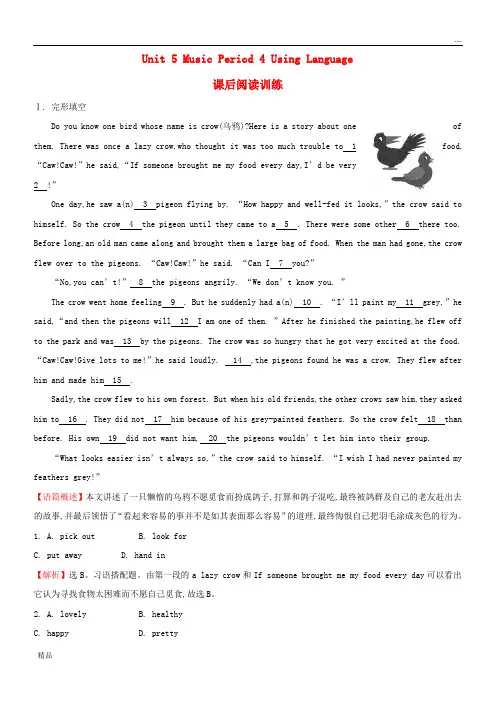
Unit 5 Music Period 4 Using Language课后阅读训练Ⅰ. 完形填空Do you know one bird whose name is crow(乌鸦)?Here is a story about one ofthem. There was once a lazy crow,who thought it was too much trouble to 1 food. “Caw!Caw!”he said,“If someone brought me my food every day,I’d be very2 !”One day,he saw a(n) 3 pigeon flying by. “How happy and well-fed it looks,”the crow said to himself. So the crow 4 the pigeon until they came to a 5 . There were some other 6 there too. Before long,an old man came along and brought them a large bag of food. When the man had gone,the crow flew over to the pigeons. “Caw!Caw!”he said. “Can I7 you?”“No,you can’t!”8 the pigeons angrily. “We don’t know you. ”The crow went home feeling 9 . But he suddenly had a(n) 10 . “I’ll paint my11 grey,”he said,“and then the pigeons will12 I am one of them. ”After he finished the painting,he flew off to the park and was 13 by the pigeons. The crow was so hungry that he got very excited at the food. “Caw!Caw!Give lots to me!”he said loudly. 14 ,the pigeons found he was a crow. They flew after him and made him 15 .Sadly,the crow flew to his own forest. But when his old friends,the other crows saw him,they asked him to 16 . They did not 17 him because of his grey-painted feathers. So the crow felt 18 than before. His own 19 did not want him, 20 the pigeons wouldn’t let him into their group.“What looks easier isn’t always so,”the crow said to himself. “I wish I had never painted my feathers grey!”【语篇概述】本文讲述了一只懒惰的乌鸦不愿觅食而扮成鸽子,打算和鸽子混吃,最终被鸽群及自己的老友赶出去的故事,并最后领悟了“看起来容易的事并不是如其表面那么容易”的道理,最终悔恨自己把羽毛涂成灰色的行为。
人教版八年级英语上册(初二)Unit5 Reading课件
Read Para. 2 and choose the right answers.
Why did Mickey become so popular?
The main reasons are _C____D___E__.
A. Mickey was friendly, and he had a girlfriend. B. Mickey was like a superman, and he could do anything. C. Mickey was like a commom man, but he was not afraid
of any problems. D. Mickey was unlucky, but he never gave up. E. People liked to see the “little man” win and wanted to
be like Mickey . Reading tip: Try to find out the key(关键的) or similar(相似的) sentences.
Which cartoon character does Ruby like?
Ruby
WRuhbicyIh'tshcfaasrvIttoa'sropitnfIaertoicircsmhhoabafArlrlamaccrektgter.eerircrdahoo.auesnsdaRteuaabirl(ys尾.lik巴e?).
Task 2 Read for main ideas and choose the right key words.
Para. Leabharlann is about Mickey's_____.
英语人教PEP版八年级(上册)Unit5(Period4)(2024版新教材)
What’s the passage mainly about?
One very famous symbol in American culture: Mickey Mouse (Para 1)
the history of Mickey Mouse (Para 1)
the reasons why people like it (Para 2)
2b. Listen to the recording and read the passage. Then complete the time line.
Some people might ask how this cartoon animal became so popular. One of the main reasons is that Mickey was like a common man, but he always tried to face any danger. In his early films, Mickey was unlucky and had many problems such as losing his house or girlfriend, Minnie. However, he was always ready to try his best. People went to the cinema to see the “little man” win. Most of them wanted to be like Mickey.
On November 18, 1978, Mickey became the first cartoon character to have a star on the Hollywood Walk of Fame.
人教版英语八年级上册:unit 5 Section B (2a-2e) Reading教案
Unit 5 Do you want to watch a game show? 阅读课教学设计及课堂实录遵义市第十一中学教学年级:八年级上册课题名称: Do you want to watch a game show?Period Four Section B (2a-2e) Reading教材版本:人教版新目标授课时间:45分钟(一)学情分析任教的2018届(1)班的学生在和老师一年的共同努力下,对英语产生了浓厚的兴趣,学生的英语语言综合运用能力比较强。
踏实、勤奋、灵活、好奇是这个班学生的特点,英语课上他们敢于大胆提问,主动参与,并积极配合老师。
但由于学生日常英语学习的纯英语环境不够充分,所以学生的听说能力略显不足。
在口语表达上,学生习惯于用只用单词或者短语来回答问题,对于整句输出和观点阐述的段落输出能力还有待进一步提高。
这就需要老师最大程度地去创设英语语言环境,学生需要老师更多鼓励。
(二)教材分析本节课是“Go for it”教材八年级上第五单元第四课时阅读课。
整个单元围绕学习表达自己对电视节目的喜好展开讨论,通过学习各种不同的电视节目的表达,不同喜好程度的表达,教材设计情景学习,熟练运用句型,从而达到能用所学语言交流的目的。
本节课是本单元最难的部分—阅读课;同时本节课的文章也是学生们进入初中以来教材中遇到的最长的一篇阅读文章。
教学内容和教学重点就是通过学习Section B的文章,意识到电视节目或各种卡通人物是文化的象征,同时。
通过讨论、阅读策略(skim,scan, carefully reading)的训练、答题竞赛、采访与被采访等方式达到能用英语表达自己的思想的目的。
本节课内容虽然多,教学任务重,但Mickey这个卡通角色很受学生喜欢,有利于激起学生的参与意识和表达自己的想法,更主要的是通过了解Mickey的更多内容及卡通折射文化,扩大学生的知识面,培养学生的文化意识。
第四课时在整个单元中起到了深化和扩展的作用。
人教英语八年级上册Unit5 Reading (共25张PPT)
Which cartoon character does Ruby like?
Ruby
WRuhbicyIh'tshcfaasrvIttoa'sropitnfIaertoicircsmhhoabafArlralmaccrektgter.eerircrdahoo.auesnsdaRteuaabirl(ys尾.lik巴e?).
We love this character because ...
Happy Sheep
An optimist sees the rose; a pessimist sees the thorn.
乐观主义者看到的是玫瑰, 悲观主义者看到的是荆棘。
Homework
• Write a short passage to introduce one of your favorite Chinese cartoon characters.
Read Para. 2 and choose the right answers.
Why did Mickey become so popular?
The main reasons are _C____D___E__.
A. Mickey was friendly, and he had a girlfriend. B. Mickey was like a superman, and he could do anything. C. Mickey was like a commom man, but he was not afraid
Monkey King
Blue Cat
['kæləbæʃ]
Calabash Brothers
Happy Sheep
人教新目标八年级英语上册Unit 5 Section B(Reading)课件
Cartoon Characters
Lazy Goat Pretty Goat
Fit Goat
Enjoy Reading
One of the main reasons is that Mickey was like a common man, but he always tried to face any danger.
Guess: my favorite cartoon character
Gourd Brothers
Haier Brothers
Bear Brothers
Para 3
Para 1 Wh_o_ is Micky ? Para 2 W_h_y is Mickey popular? Para 3 W_h_a_t is Mickey like today?
Why did Mickey became so p_o_p_u_la_r_? One of the m_a_in___ r_e_a_s_o_n_s_ is that Mickey was like a c_o_m_m__o_n_ man. He was always re_a_d__y_ to try his b_e_s_t _. He was the first cartoon c_h_a_ra_c_t_e_r_ to have a star on the Hollywood Walk of Fame. He is a s_ym__b_o_l_ of American c_u_lt_u_r_e__ .
Sponge Bob
Monkey King
Kongfu Panda
……
The Wise Guy
Pleasant Goat
Kongfu Panda
人教新目标版八年级上册 Unit 5 Period 4 教案
精品"正版〞资料系列,由本公司独创 .旨在将"人教版〞、〞苏教版"、〞北师大版"、〞华师大版"等涵盖几乎所有版本的教材教案、课件、导学案及同步练习和检测题分享给需要的朋友 .本资源创作于2021年8月,是当前最|新版本的教材资源 .包含本课对应内容,是您备课、上课、课后练习以及寒暑假预习的最|正确选择 .Unit 5 Do you want to watch a game show?The Fourth Period SectionB ( 2a–2e)Teaching aims (教学目标)1. 通过阅读对世|界经典动画有更深的了解.2. 能够通过when/how/what/why问题进行文章的构思写作.3.通过文章阅读提高scanning/skimming阅读策略能力.4.要求掌握以下词汇:1)名词n.culture, reason, film,2) 形容词adj.famous, rich, successful, main, common, unlucky, readyTeaching steps (教学步骤)1. Warm -upHave Ss look at 2a and get into groups of three or four to discuss the three questions.(2)Let ,s Meet Mickey!(设计意图:由于阅读文章是以一个广为人知的卡通形象为核心的,此处将2a的读前活动稍作调整,先让学生观察图片,通过图片引发一系列有关卡通片,特别是有关米老鼠的问题,从而充分激活学生的背景知识,为后面的阅读活动做准备. )Have Ss read the passage in 2b quickly and scan for information. Then have Ss look at the screen and guess the main idea of the passage.(设计意图:该步骤旨在调动学生阅读的积极性和主动性,让他们带着期待去阅读,并在阅读中检验自己的预测,这种交互性阅读能够促进学生对文章内容的深刻理解. )Now, have Ss close their textbooks and look at the questions on the screen. Ask them to get into pairs and say their answers.1. How many cartoons did Walt Disney make with Mickey?A. 80.B. 87.C. 90.D. 97.2. When did Mickey first appear?A. November 18, 1928.B. November 18, 1930.C. November 18, 1938.D. November 18, 1978.3. Who is Mickey ,s girlfriend?A. DaisyB. Sleeping BeautyC. MinnieD. Snow White4. Does he always do something good?A. No, he sometimes hurts others.B. Yes, he is always ready to help others.(根据学生已有的动画片的知识,激发他们的美好回忆,同时激发他们对于新语篇的阅读兴趣.)2. Work on 2b.Have Ss open their books again and skim through the passage one more time. Then, ask them to complete the time line on page 38.(以时间开展的形式,清晰地帮助学生抓住时间的开展顺序来理解文章内容,是种阅读策略的渗透,通过快速阅读寻找文章的时间脉路.)3.Work on 2c.Have Ss read the passage again and fill in the facts in the chart about Mickey.(通过scanning阅读策略寻找具体信息. )4.Work on 2d.Read the passage again and discuss the questions with a partner.5. Summarize(通过这个环节即可以稳固所学的重要词汇,又可以提高学生总结文章的能力,同时还为怎样写影评做好了框架铺垫)Have Ss look at the screen and fill in the blanks as a class. Tell them that this is a summary of the passage in 2b.6.Homework1. Oral:Do you think Walt Disney is a smart man? Why or why not? Get into pairs and discuss.2. Written:Complete Activity 2e.当我们在日常办公时,经常会遇到一些不太好编辑和制作的资料.这些资料因为用的比较少,所以在全网范围内,都不易被找到.您看到的资料,制作于2021年,是根据最|新版课本编辑而成.我们集合了衡中、洋思、毛毯厂等知名学校的多位名师,进行集体创作,将日常教学中的一些珍贵资料,融合以后进行再制作,形成了本套作品.本套作品是集合了多位教学大咖的创作经验,经过创作、审核、优化、发布等环节,最|终形成了本作品.本作品为珍贵资源,如果您现在不用,请您收藏一下吧.因为下次再搜索到我的时机不多哦!本资源的初衷,是希望通过网络分享,能够为广阔读者提供更好的效劳,为您水平的提高提供坚强的动力和保证 .内容由一线名师原创,立意新,图片精,是非常强的一手资料 .。