
深港版五年级上册《Unit 5 Faster,higher,and stronger》ppt课件1
• runner [‘rʌnə] • jumper [‘dʒʌmpə]
• hurdle [’hə:dl] n.跨栏
the 60m hurdles
medal [‘medəl ]
Let’s talk about Liuxiang :
Liu Xiang is good at_______. He is runner jumper a good _____and a good ____.He first won the _____prize in 2004 Olympic medal games so he got a golden______.
Homework
Read Part A by listening to the tape . Write down your familiar sports in English as much as possible. Write a speech: My favourite sports
• • • • •
She likes the long races./Her favourite is the 800m race .
• Koko:Sports Day is tomorrow.I love Sports Day! • Tim:Me too.KoKo,what’s your favourite event? • KoKo:I like the 60m race.The runners must be very fast. • Tim:I like the 60m hurdles.They’re not easy.You must run very fast and jump very well. • Pat:I like longer races.My favourite is the 800m race
the 60m hurdles the 60mrace
the high jump the long jump
the 800m race
There will be a Sports Day at school. Read, listen and act.
Read the dialogue and answer these questions: 1.What is Koko’s favourite event?
the long jump
the high jump
the 60m race
metre(m) [‘mi:tə] 米
the 800m race
Do you know them? What events are they good at?
This is….He\She is good at...
Work in pairs:
Lily: Sports Day is coming soon. What is your favourite event? Tim: My favourite event is..., But it's not easy. How about you? Mary: I like …and you? Pat : My favourite event is..., Lily:OK,Let’s enjoy Sports Day together! we will be faster ,higher and stronger!
Summary
New words:
Sports Day runner jumper medal event the high jump the long jump the 60m race the 800m race the 60m hurdles
Language focus:
What’s your favourite event? 你最喜欢的项目是什么? I like … My favourite event is … 我喜欢……
He likes the 60m race. /His favourite is the 60m race.
2.What is Tim’s favoruite event?
3.What is Pat’s favourite event?
He likes the 60m hurdles./His favourite is the 60m hurdles.
Test (随堂测试)
• • • • •
1.翻译: 跳高 —— 运动会—— 60米赛跑—— 60m米跨栏—— 金牌—— 800米赛跑—— 跳高—— 跳远—— 长跑—— shorter races___ 2.填空(补全单词):
There will be a S________ _Day at school. What’s your favourite e________?. You must run very f ______and j_______ very well. My f________event is the 60m race. Liuxiang is good at the 60m h_________.he is a good ______and a good _______.in 2004 Olympic games he won first p_____ so he got golden m______.
the 60m hurdles
the 60m race
the 60m hurdles
the 800m race the long jump
the high jump
Work in pairs: A: What’s your favourite event?
B:My favourite event is…/ I like…
Survey:(调查报告)
xxx likes…xxx likes…we will be faster, higher and stronger.
name
the 60m race the 60m hurdles the 800m race the high jump the long jump other events
Group leader: We all like sports .I like…xxx likes…
( other event: football volleyball badminton table tennis swimming basketball do pull-ups weight lifting and so on.)
Let’s ---Beijing
the Motto(口号) of the 2008 Olympic Games
Unit 5
Faster, higher and stronger
Free Talk: What events do you know?
你知道哪些奥运运动项目?
最新深港版英语五年级上册《unit 5 dinosaurs》教案一.doc
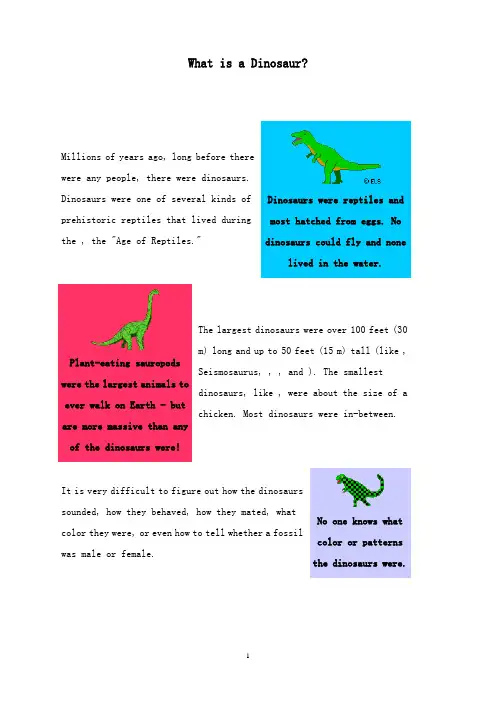
What is a Dinosaur?Millions of years ago, long before there were any people, there were dinosaurs. Dinosaurs were one of several kinds of prehistoric reptiles that lived duringthe , the "Age of Reptiles."Dinosaurs were reptiles and most hatched from eggs. No dinosaurs could fly and nonelived in the water.Plant-eating sauropods were the largest animals to ever walk on Earth - but are more massive than any of the dinosaurs were!The largest dinosaurs were over 100 feet (30m) long and up to 50feet (15 m) tall (like , Seismosaurus, , , and ). The smallest dinosaurs, like , were about the size of a chicken. Most dinosaurs were in-between.It is very difficult to figure out how the dinosaurs sounded, how they behaved, how they mated, what color they were, or even how to tell whether a fossil was male or female.No one knows what color or patterns the dinosaurs were.Most dinosaurs were plant-eaters (also called herbivores). For example, was a plant-eatingdinosaur.Some dinosaurs were meat-eaters (also called carnivores). Forexample, was a meat-eatingdinosaur.There were lots of different kinds of dinosaurs that lived at different times.∙Some walked on two legs (they were bipedal), some walked onfour (they were quadrupedal).Some could do both.∙Some were speedy (like ), and some were slow and lumbering(like ).∙Some were armor-plated, some had horns, crests, spikes, orfrills.∙Some had thick, bumpy skin, and some even had .The dinosaurs dominated the Earth for over165 million years during the , but mysteriously went extinct 65 million years ago. study their fossil remains to learn about the amazing prehistoric world of dinosaurs.When the dinosaurs lived, the Earth's continents were jammed together into asupercontinent called Pangaea and the Earth waswarmer than it is now.The dinosaurs went extinct 65 million years ago, probably because of the environmental changes brought about by an asteroid hitting the Earth.The dinosaurs went about 65million years ago, at the end of the , which was a time of high volcanic and . There are a lot of theories why the extinction occurred. The most widely accepted theory is that an asteroid impact caused major climactic changes to which the dinosaurs couldn't adapt.Dinosaurs probably live on today as the . Allthat's left of the dinosaurs are and, perhaps,the birds. Dinosaur fossils have been found all over the world,Some dinosaurs were very bird-like and may be the ancestors of today's birds.haveACTIVITIES THAT ACCOMPANY THIS PAGE∙ - A print-out for 2nd Graders. Skills: reading,writing, research, and comprehension.∙ - A print-out for 3rd Graders. Do this writing/spelling activity after (or while) reading this page. Unscramble the words to answer questionsabout dinosaurs.Just click on an animal's name to go to that information sheet. If the dinosauryou're interested in isn't here, check the or the list of . Names with anasterisk (*) were not dinosaurs..。
深港版英语五年级上册《unit 5 dinosaurs》优秀教案(重点资料).doc
Unit 5 DinosaursObjectivesGet to know different kinds of dinosaurs.Students can tell about the dinosaurs.Students can use simple past tense of irregular verbs freely and correctly.TasksMake a dinosaur and give a description of it.Listen and chant to practice talking about dinosaurs.Language FocusLanguage skillsCommunicate freely with others by using simple expressions and structuresIntroduce a topic and briefly interact with othersWrite short paragraphs following sample writingTopic vocabularyResourcesComputer learning programsPosters, flash cards, plastic toy dinosaurs, Overhead Transparencies, etc.Interactive CD-RomCassette TapePeriod 1 --- Part ATeaching procedures1.Warming-upA guessing game: Millions of years ago, long before there were any people, what kind of animal lived on Earth? Do you know?2.PresentationComputer learning program --- introduce different kinds of dinosaurs.3.Practicea. Show out a plastic toy dinosaur. Pretend to be the dinosaur and introduce yourself.b. Describe yourself as the dinosaur, e.g. I am tall. I have a long tail. I have small teeth. I have two legs and two arms.c. Describe what you do as the dinosaur, e.g. I run and swim. I eat meat.d. Ask the students questions about the dinosaur. Get the students to ask the dinosaur questions about what it looks like and does.4.More to doShow Transparency. Play the Pupils’ Book Cassette and point to the speech bubbles. Ask the students to repeat after the cassette.5. ConsolidationAsk the students to take turns to make sentences about Tyrannosaunus Rex and Baryonyx.6.Wrapping-upShow out posters, revise functions and language focus. Divide class into 3 groups to describe the three dinosaurs.7.Homeworka. Ask the students to research a dinosaur for homework. They should find a picture and find out what it can do and what it eats.b. Copy and memorize the new words.Period 2 --- Part B1Teaching procedures1. Warming-upComputer learning program --- different kinds of dinosaurs. Let the students say out the names of dinosaurs they see.2. RevisionAsk the students questions about the dinosaur. Get the students to ask the dinosaur questions about what it looks like and does.3. Presentationa. Write sentences strips for the present tense sentences aboutBaryonyx.b. Display the sentence strips on the board. Tell the students thatthis isthe information about Baryonyx on the previous. Show the students the picture of Baryoryx on the previous page.c. Ask the students Can we see Baryonyx now? When they answer No, explain that dinosaurs lived on the Earth over 100,000,000 years ago. Write the number of years on the board. Write on the board, Dinosaurs lived 100,000,000 years ago.d. Explain that we must use the past tense for describing Baryonyx.Writethe past tense of the verb in a contrasting color next to each sentence strip on the board. Take down each sentence strip and write in the restof the sentence using a different color. Ask the students to say the pasttense sentences after you.4. Practicea. Show Transparency. Play the cassette and ask the students tolisten toand repeat.b. Tell the students to match the present tense notes and the pasttensesentences correctly.5. Consolidationa. Check that the students have matched the notes and sentences correctly.b. Ask the students to read Tim’s notes and his report aboutTyrannosaurusRex at the bottom of the page. Ask them to check his notes and write either T for true of F for false next to each sentence.6. Sum up.7. HomeworkUsing the past tense to write notes and a report about Diplodocus..Period 3 ---Part B2 & B3Teaching procedures1. Warming-upTravel back to dinosaur times. Use clues to place dinosaurs into the correct time periods on a time line.2. Revisiona. Listen, read and act Part A.b. Ask students to say out their reports about Diplodocus in groups.3. Practicea. Show Transparency and the notes on Dinosaur K and dinosaur S.b. Ask the students to work in pairs to write the sentences.c. Check the sentences as you walk round to ensure that that thestudentsare using the correct past tense forms.d. Ask some students to read aloud their sentences to check theanswerswith the whole class.4. Consolidationa. Read the rubric to the students. Remind them that they shouldfamiliarize themselves with the words and the pictures on the page in thetime they have before listening. They should listen and circle the wordsthey hear. Play the cassette.b. Ask the students to listen to the tape once more to check theiranswers.Then they need to choose the correct dinosaur picture.5. Sum up.Read about Dinosaur K & Dinosaur S. Then tell them about the past Tense form.6. Homeworka. Make a picture card for Dinosaur K or Dinosaur S. Write aboutit onthe bottom of the card.b. Finish Workbook (P. 33)Period 4 --- Part C & DTeaching procedures1. Warming-upTell students some dinosaur jokes.2. RevisionShow Transparency and the notes on dinosaur k and dinosaur S. Ask the students to work in pairs to say about them.3. Presentationa. Ask the students some questions, e.g.Have you ever seen a real dinosaur? Are there any dinosaurs on earth now?b. Tell the students All the dinosaurs died 65 million years ago.Theydied in just a few years. No one knows why. Some people have ideas about what happened.c. Students listen to the tape twice.d. Ask the students How many different ideas are there? What arethey?4. Practicea. Let the students read the text silently. Then play the tapefor thestudents and ask them to say the sentences after the tape.b. Read the question at the end of the page. Ask the students toshowtheir hands if they agree with the ideas. Ask if the students know ofany other ideas.5. More to doa. Ask the students to read the story again and to answer thequestions.b. Check the answers with the students. Ask some students to read aloud their answers.6. Sum upThe dinosaurs went about 65 million years ago, at the end of the , which was a time of high volcanic and .There are a lot of theories why the extinction occurred. The most widely accepted theory is that an asteroid impact caused major climactic changes towhich the dinosaurs couldn't adapt.7. Homeworka. Copy the story.b. Listen and follow the tape. Try to recite the story.Period 5 --- Part FTeaching procedures1. Warming-upDinosaurs probably live on today as the . All that's left of the dinosaursare and, perhaps, the birds. Dinosaur fossils have been found all over the world, If dinosaurs were alivetoday…Let the students use their imagination to say short pieces.2. RevisionListen and repeat the story. Ask some students to retell the story.3. Taska. Tell the students No one knows what color dinosaurs were. Youcanchoose any colors.b. Ask the students to choose some notes on Page 47 that they wouldliketo describe the dinosaur which they have just drawn and colored.c. The students use the information from their notes and drawingto write aparagraph about their dinosaur and give it a name. Ask them to write aversion in rough first. Check that they are using past tense forms ofthe verbs.d. After that, the students should group together the sentencesabout thesize and the body of the dinosaur and the sentences about what it did. This is called editing. It is the reason why the students should write their work in rough first.e. Then tell the students there is one more step calledproof-reading. Tellthem to check their work for any errors. Ask them to exchange theirwriting with a partner to check for errors.f. Tell the students to display their pictures. Ask them to tryto makesentences, using their notes for support. Praise the students who manage to do this.4. Sum upShow some students’ task papers, talk about them.5. HomeworkThe students write up their paragraph in neat copy.Period 6 --- Part G & HTeaching procedures1. Warming-upTell the students some dinosaur jokes.2. RevisionShow some students’ work sheets My Super Dinosaur. Ask them to readtheir writing outloud.3. Presentationa. Play the Pupil’s Book Cassette for the students to listen to the chant.b. Play the cassette again and encourage the students to join in withthewords. Then divide the class into three groups. Assign a different verse to each group. Ask each group to practice chanting.4. PracticeAsk the students find out when man started to live on the Earth and if there were any duck dinosaurs. The first men walked on the earth four million years ago. There were no ducks in the time of the dinosaurs. Cockroaches have been around for many more millions of years and have not changed much since the days of the dinosaurs. 5. Listening exercisesAsk the students to look at the pictures and listen to the Workbook Cassette. Then finish the exercises P.34 ~ 35.6. Homeworka. Listen, repeat and try to recite the dinosaur chants.b. Finish the exercises of Workbook P.37~38.Period 7 --- Part ITeaching procedures1. Warming-upWhat would it be like to live with the dinosaurs? Invite students to use their imaginations and our fun, fact-finding activities to find out everything about Dinosaurs!2. RevisionAsk the students to recite the dinosaur chants.3. Further readinga. Ask the students, How do we know about dinosaurs? Accept theirideasbut remind them that no men were around to see the dinosaurs. Ask them to read the passage to find two ways in which we know about dinosaurs.b. Ask the students to point to a bone. Ask them Where do we find bones? What can we know about this dinosaur from its bones?c. Ask the students Which animals have eggs? What can we find out from their nests?d. Tell the students to write ‘T’ next to the true statements ’F’next to the false ones and ‘D’ for the ones they are not sure. Check the answers with the students.4. PracticeRead Tom’s diary and write the answers. (Workbook P39)5. HomeworkFinish Workbook P40Period 8 --- Part E & JTeaching procedures1. Warming-upPick a genre and write a piece that includes three dinosaur facts. Practice in groups.2. RevisionListen and repeat Part I Further reading. Then ask the students to answer some questions.3. Presentationa. Write the symbols for the sounds on the board. Write the wordson the page under each symbol. Ask the students to tell you other words with the same sounds and add them to the list.b. Play the tape and ask the students to listen to the sounds andthe words.c. Say the works slowly and clearly. Check that the students aremaking a distinction between the two short sounds correctly.d. Point to the pictures and check that the students can say thewords without your model.e. Play he tape again. Ask the students to listen to the poem.f. Play the tape again. Ask the students to join in with the wordsof the poem this time.g. Play the tape. Ask the students to listen to the words and themwrite them under the correct symbols.4. Progress check(P.50)a. Find the past form of the verbs. Circle them.b. Fill in each blank with the correct form of a verb from the box.You can use some verbs more than once.5. Sum upWe learn about dinosaurs through literature, poetry, science, math, art, drama, and movement. Students will discover thecharacteristics of many kinds of dinosaurs.6. Homeworka. Listen and repeat the whole text.b. Finish Workbook P.36★祝学习顺利★。
六年级上英语课件Unit 5 Faster,higher,and stronger_深港朗文版
•
the 60m race
单词
the 60m hurdles
medals
gold medal
单词
the high jump
How about you ? A: I like longer races.
My favourite is the 800m race.
judo
table tennis
tennis
swimming
basketball
diving volleyball
校运会就要来临了,让我们用 刚才所学的句子谈谈你所喜欢 的运动项目或你参加的运动项 目吧.
单词
the long jump
单词
the 800m race
the 60m race
the 60m hurdles
the long jump
the high jump
the 800m race
1
A: What’s your favourite event? B: I like the 60m race.
Sports Day the 60m race the longer race the long jump the 60m hurdles the 110m hurdles the high jump
三.看图片, 完成句子
1. I like the 800m race
.
2. He likes the 110m hurdles .
the Olympic flag five rings
六年级上英语课件-Unit 5 Faster,higher,and stronger_深港朗文版
My favourite is the 800m race.
judo
table tennis
tennis
swimming
basketball
diving volleyball
校运会就要来临了,让我们用 刚才所学的句子谈谈你所喜欢 的运动项目或你参加的运动项 目吧.
60m
400m
Survey
Work in groups and fill in the charts:
Name
Favourite event
The 29th Olympic Games were held in Beijing.
the first gold medal
Exercises
一.汉译英 • 运动会 • 60米赛跑 • 长跑 • 跳远 • 60米跨栏 • 110米跨栏 • 跳高
Sports Day the 60m race the longer race the long jump the 60m hurdles the 110m hurdles the high jump
三.看图片, 完成句子
1. I like the 800m race
.
2. He likes the 110m hurdles .
2. Sentence patterns:
--What’s your favourit event? --I like …\ --My favourite is …
We should exercise very often.
我们应该经常锻炼。
单词
the long jump
最新深港版英语五年级上册《unit 5 dinosaurs》教案.doc

Unit 5 DinosaursObjectivesGet to know different kinds of dinosaurs.Students can tell about the dinosaurs.Students can use simple past tense of irregular verbs freely and correctly.TasksMake a dinosaur and give a description of it.Listen and chant to practice talking about dinosaurs.Language FocusLanguage skillsCommunicate freely with others by using simple expressions and structures Introduce a topic and briefly interact with othersWrite short paragraphs following sample writingTopic vocabularyResourcesComputer learning programsPosters, flash cards, plastic toy dinosaurs, Overhead Transparencies, etc. Interactive CD-RomCassette TapePeriod 1 --- Part ATeaching procedures1.Warming-upA guessing game: Millions of years ago, long before there were any people, what kind of animal lived on Earth? Do you know?2.PresentationComputer learning program --- introduce different kinds of dinosaurs.3.Practicea. Show out a plastic toy dinosaur. Pretend to be the dinosaur and introduce yourself.b. Describe yourself as the dinosaur, e.g.I am tall. I have a long tail. I have small teeth. I have two legs and two arms.c. Describe what you do as the dinosaur, e.g. I run and swim. I eat meat.d. Ask the students questions about the dinosaur. Get the students to ask the dinosaur questions about what it looks like and does.4.More to doShow Transparency. Play the Pupils’ Book Cassette and point to the speech bubbles. Ask the students to repeat after the cassette.5. ConsolidationAsk the students to take turns to make sentences about Tyrannosaunus Rex and Baryonyx.6.Wrapping-upShow out posters, revise functions and language focus. Divide class into 3 groups to describe the three dinosaurs.7.Homeworka. Ask the students to research a dinosaur for homework. They should find a picture and find out what it can do and what it eats.b. Copy and memorize the new words.Period 2 --- Part B1Teaching procedures1. Warming-upComputer learning program --- different kinds of dinosaurs. Let the students say out the names of dinosaurs they see.2. RevisionAsk the students questions about the dinosaur. Get the students to ask the dinosaur questions about what it looks like and does.3. Presentationa. Write sentences strips for the present tense sentences about Baryonyx.b. Display the sentence strips on the board. Tell the students that this is the information about Baryonyx on the previous. Show the students thepicture of Baryoryx on the previous page.c. Ask the students Can we see Baryonyx now? When they answer No,explain that dinosaurs lived on the Earth over 100,000,000 years ago.Write the number of years on the board. Write on the board, Dinosaurslived 100,000,000 years ago.d. Explain that we must use the past tense for describing Baryonyx. Write the past tense of the verb in a contrasting color next to each sentencestrip on the board. Take down each sentence strip and write in the restof the sentence using a different color. Ask the students to say the past tense sentences after you.4. Practicea. Show Transparency. Play the cassette and ask the students to listen to and repeat.b. Tell the students to match the present tense notes and the past tensesentences correctly.5. Consolidationa. Check that the students have matched the notes and sentencescorrectly.b. Ask the students to read Tim’s notes and his report about Tyrannosaurus Rex at the bottom of the page. Ask them to check his notes and write either T for true of F for false next to each sentence.6. Sum up.7. HomeworkUsing the past tense to write notes and a report about Diplodocus..Period 3 ---Part B2 & B3Teaching procedures1. Warming-upTravel back to dinosaur times. Use clues to place dinosaurs into the correct time periods on a time line.2. Revisiona. Listen, read and act Part A.b. Ask students to say out their reports about Diplodocus in groups.3. Practicea. Show Transparency and the notes on Dinosaur K and dinosaur S.b. Ask the students to work in pairs to write the sentences.c. Check the sentences as you walk round to ensure that that the students are using the correct past tense forms.d. Ask some students to read aloud their sentences to check the answers with the whole class.4. Consolidationa. Read the rubric to the students. Remind them that they should familiarize themselves with the words and the pictures on the page in thetime they have before listening. They should listen and circle the wordsthey hear. Play the cassette.b. Ask the students to listen to the tape once more to check their answers. Then they need to choose the correct dinosaur picture.5. Sum up.Read about Dinosaur K & Dinosaur S. Then tell them about the pastTense form.6. Homeworka. Make a picture card for Dinosaur K or Dinosaur S. Write about it on the bottom of the card.b. Finish Workbook (P. 33)Period 4 --- Part C & DTeaching procedures1. Warming-upTell students some dinosaur jokes.2. RevisionShow Transparency and the notes on dinosaur k and dinosaur S. Askthe students to work in pairs to say about them.3. Presentationa. Ask the students some questions, e.g. Have you ever seen a real dinosaur? Are there any dinosaurs on earth now?b. Tell the students All the dinosaurs died 65 million years ago. They died in just a few years. No one knows why. Some people haveideas about what happened.c. Students listen to the tape twice.d. Ask the students How many different ideas are there? What are they?4. Practicea. Let the students read the text silently. Then play the tape for the students and ask them to say the sentences after the tape.b. Read the question at the end of the page. Ask the students to show their hands if they agree with the ideas. Ask if the students know ofany other ideas.5. More to doa. Ask the students to read the story again and to answer the questions.b. Check the answers with the students. Ask some students to readaloud their answers.6. Sum upThe dinosaurs went about 65 million years ago, at the end of the, which was a time of high volcanic and .There are a lot of theories why the extinction occurred. The most widely accepted theory is that an asteroid impact caused major climactic changes to which the dinosaurs couldn't adapt.7. Homeworka. Copy the story.b. Listen and follow the tape. Try to recite the story.Period 5 --- Part FTeaching procedures1. Warming-upDinosaurs probably live on today as the . All that's left of the dinosaurs are and, perhaps, the birds. Dinosaur fossils have been found allover the world, If dinosaurs were alivetoday…Let the students use their imagination to say short pieces.2. RevisionListen and repeat the story. Ask some students to retell the story.3. Taska. Tell the students No one knows what color dinosaurs were. You can choose any colors.b. Ask the students to choose some notes on Page 47 that they would like to describe the dinosaur which they have just drawn and colored.c. The students use the information from their notes and drawing to write a paragraph about their dinosaur and give it a name. Ask them to write a version in rough first. Check that they are using past tense forms ofthe verbs.d. After that, the students should group together the sentences about the size and the body of the dinosaur and the sentences about what it did.This is called editing. It is the reason why the students should writetheir work in rough first.e. Then tell the students there is one more step called proof-reading. Tellthem to check their work for any errors. Ask them to exchange theirwriting with a partner to check for errors.f. Tell the students to display their pictures. Ask them to try to make sentences, using their notes for support. Praise the students whomanage to do this.4. Sum upShow some students’ task papers, talk about them.5. HomeworkThe students write up their paragraph in neat copy.Period 6 --- Part G & HTeaching procedures1. Warming-upTell the students some dinosaur jokes.2. RevisionShow some students’ work sheets My Super Dinosaur. Ask them to readtheir writing outloud.3. Presentationa. Play the Pupil’s Book Cassette for the students to listen to the chant.b. Play the cassette again and encourage the students to join in with the words. Then divide the class into three groups. Assign a different verse to each group. Ask each group to practice chanting.4. PracticeAsk the students find out when man started to live on the Earth and if there were any duck dinosaurs. The first men walked on the earth four million years ago. There were no ducks in the time of the dinosaurs. Cockroaches have been around for many more millions of years and have not changed much since the days of the dinosaurs.5. Listening exercisesAsk the students to look at the pictures and listen to the Workbook Cassette.Then finish the exercises P.34 ~ 35.6. Homeworka. Listen, repeat and try to recite the dinosaur chants.b. Finish the exercises of Workbook P.37~38.Period 7 --- Part ITeaching procedures1. Warming-upWhat would it be like to live with the dinosaurs? Invite students to use their imaginations and our fun, fact-finding activities to find out everything about Dinosaurs!2. RevisionAsk the students to recite the dinosaur chants.3. Further readinga. Ask the students, How do we know about dinosaurs? Accept their ideas but remind them that no men were around to see the dinosaurs. Askthem to read the passage to find two ways in which we know aboutdinosaurs.b. Ask the students to point to a bone. Ask them Where do we find bones? What can we know about this dinosaur from its bones?c. Ask the students Which animals have eggs? What can we find out from their nests?d. Tell the students to write ‘T’ next to the true statements ’F’ next to the false ones and ‘D’ for the ones they are not sure. Check the answers with the students.4. PracticeRead Tom’s diary and write the answers. (Workbook P39)5. HomeworkFinish Workbook P40Period 8 --- Part E & JTeaching procedures1. Warming-upPick a genre and write a piece that includes three dinosaur facts. Practice in groups.2. RevisionListen and repeat Part I Further reading. Then ask the students to answer some questions.3. Presentationa. Write the symbols for the sounds on the board. Write the words on the pageunder each symbol. Ask the students to tell you other words with the same sounds and add them to the list.b. Play the tape and ask the students to listen to the sounds and the words.c. Say the works slowly and clearly. Check that the students are making adistinction between the two short sounds correctly.d. Point to the pictures and check that the students can say the words withoutyour model.e. Play he tape again. Ask the students to listen to the poem.f. Play the tape again. Ask the students to join in with the words of the poemthis time.g. Play the tape. Ask the students to listen to the words and them write themunder the correct symbols.4. Progress check(P.50)a. Find the past form of the verbs. Circle them.b. Fill in each blank with the correct form of a verb from the box. You canuse some verbs more than once.5. Sum upWe learn about dinosaurs through literature, poetry, science, math, art, drama, and movement. Students will discover the characteristics of many kinds of dinosaurs.6. Homeworka. Listen and repeat the whole text.b. Finish Workbook P.3611。
深港版英语五上《Unit 5 Dinosaurs》word教案(一)

What is a Dinosaur?Millions of years ago, long before there were any people, there were dinosaurs. Dinosaurs were one ofseveral kinds of prehistoricreptiles that lived during theMesozoic Era , the "Age ofReptiles."Dinosaurs were reptiles and most hatched from eggs. No dinosaurs could fly and none lived in the water.Plant-eating sauropods were the largest animals to ever walk on Earth - but blue whales are more massive than any of thedinosaurs were!The largest dinosaurs were over 100 feet (30 m) long and up to 50 feet (15 m) tall (like Argentinosaurus , Seismosaurus,Ultrasauros , Brachiosaurus , and Supersaurus ). The smallest dinosaurs, like Compsognathus , were about the size of a chicken. Most dinosaurs were in-between.It is very difficult to figure out how the dinosaurs sounded, how they behaved, how theymated, what color they were, or even how totell whether a fossil was male or female.No one knows whatcolor or patterns the dinosaurs were.over 165 million years during the Mesozoic Era , but mysteriously went extinct 65 million years ago. Paleontologists study their fossil remains to learn about the amazing prehistoric world of dinosaurs.The dinosaurs went extinct about 65 million years ago,at the end of the Cretaceous period , which was a time of high volcanic andtectonic activity . There are a lot oftheories why the extinction occurred.The most widely accepted theory isthat an asteroid impact caused major climactic changes to which the dinosaurs couldn't adapt.Dinosaurs probably live on today asbirds . All that's left of the dinosaurs fossils and, perhaps,the birds. Dinosaurfossils have been found all over the maybe even near where you live!1818,means lizard) was coined by the English anatomistACTIVITIES THAT ACCOMPANY THIS PAGEFind It! - A print-out for 2nd Graders. Skills: reading, writing, research, and comprehension.∙Word Unscramble - A print-out for 3rd Graders. Do this writing/spelling activity after (or while) reading thispage. Unscramble the words to answer questions aboutdinosaurs.Just click on an animal's name to go to that information sheet. If the dinosaur you're interested in isn't here, check the Dinosaur Dictionary or the list of Dinosaur Genera. Names with an asterisk (*) were not dinosaurs.How to write a great dinosaur report.。
深港版五年级上册《unit 5 dinosaurs》教学设计.doc
Unit5 Dinosaurs周玲玲教学内容:Unit5 Dinosaurs A教学目标:引导学生学习有关恐龙的知识和观察不同恐龙的外部特征,用I like Dinosaur T. It eats meat. It has sharp teeth. It runs fast. ...描述观察到的恐龙。
教学重难点:1.教学重点:◆词汇:dinosaur, sharp teeth, small teeth, run fast, walk slowly, lives near lakes.2.教学难点:◆会用所学句型描述看到的恐龙:I like Dinosaur T. It eats meat. It has sharp teeth. It runs fast…..教学辅助:多媒体课件、写着谜语的纸片教学过程:一、Pre-task preparation1、Free talk(1)T:What is your favourite animal?S: I like.....T: Do you konw what animal do I like? I like fish. It’s nice.(2)T: Let’s listen to the sound and guess what animal is it?( Click the bubbles. Listen and guess.)S: It’s chicken, cow, tiger......(最后一个是恐龙的声音)设计意图:老师和学生一起谈论各自喜欢的动物,让孩子们听声音猜动物,复习已学的动物单词,与学生拉近距离,活跃课堂气氛.,自然而然地引入今天的学习内容。
预设时间:2’2、Watch a video and tell what animal it is.T: Do you know what is it?Ss: Dinosaurs.T: Good. You got it. Look, here, one dinosaur, and here, two dinosaurs. ( Write the title and read it)设计意图:以视频引入即将学习的恐龙,激发学生兴趣。
深港版五年级上册《Unit 5 Faster,higher,and stronger》ppt课件
第三课(1)
(6)
2、question 问题 4、 gravity 、万有引力 6、 bright 、明亮的
1、 planet 、行星 3、 fact 、事实,现实 5、 huge 、巨大的
7、 talk 、谈话
9、 fix 、修理
8、 sun 、太阳
10、 moon 、月亮
第三课(2)
(7)
2、living 活着的 4、 、在 around …周围 6、 、漂浮,浮动 float
第六课 (1)
1、 honest 、诚实的 3、 beautiful 、美丽的 5、 funny 、滑稽可笑的
(11)
2、 interesting 、有趣的 4、 smart 、聪明的 6、 brave 、勇敢的 8、 kind 、善良的
7、 hard-working 、努力工作的
9、 famous 、著名的
66 、 sugar 、糖
10 、 finish line 10 、终点线
77 、 congratulation 88 、 lazy 、祝贺,庆贺 、懒惰的
第二课(1)
(3)
2、 、世界 world 4、 、民间的 folk 6、 、国家,农村 country
1、 、比赛,竞赛 contest 3、 、村庄,乡村 village 5、 、令人惊异的 amazing
第四课
(8)
(1)
longest bridge in in the city This is -the longest bridge the city. It is much longer than the the other bridges. -- much longer than other bridges
深港版五年级英语上册 整册教案
第一学期英语教案第一学期英语教案Book 9 (五年级)Unit 1 Good friendsUnit 2 Things in the kitchenUnit 3 A rainy weekendUnit 4 RevisionUnit 5 DinosaursUnit 6 At Animal LandUnit 7 Holiday postcardsUnit 8 RevisionBook 9 (五年级)Unit 1 Good friendsTask objectives1. Complete simple tasks following a series of instructions2. Relate personal experience and opinions with the help of the teacher3. Understand and explain information provided in tables and graphs Language focus1. What do you do in your spare time ?2. I like playing the piano .3. Allan likes fishing .4. He doesn’t like shopping .5. What are your favorite hobbies ?Topic wordsfish, play the piano, play chess, shop , have a picnic , listen to CDs Pre-task stageA. It’s the weekend. What do the children want to do with their friends ?Look , listen and act .Presentation1.Bring in some pictures of people doing things that make themhappy .2.( Books closed )Show the students the pictures like fishing ,shopping , ect. Ask the students what are these people doing ?Encourage the students to answer like this : He is fishing . She islistening to CDs. And practice other sentences .3.Write the verbs for the activities .Ask the students What do youwant to do this weekend ?4.Show Tranaparency. Play the tape .And ask the students torepeat after it .Practice1.Show Tranaparency. Point to the people on the page and reviseor teach the verbs and the places .2.Read aloud or play the tape . Ask the students to repeat thewords after you .5.Ask the students to take turns or work in pairs to ask each otherand answer about what they want to do .B1 Tim received a letter from his new pen friend . Read the letter and complete Tim’s notes.Presentation1.Photocopy the letter , put it in an envelope addressed to Tim .2.Show the students the envelope . Ask them to guess what isinside .3.Repeat the name on the envelope .Tell the students it is fromTim’s pen friend .Practice1.Show Transparency. Point out to the students that when sb likesa hobby or an activity and often does it , we put –ing on theverb , e.g. Allan likes playing the piano . I like swimming . Helikes reading . etc.2.Tell the students to read the letter again .Ask them to completeTim’s note about Allan’s hobbies by writing likes or doesn’t likenext to each of the activities .3.Check the answers with the students .4.Ask the students to work in pairs and take turns to makesentences using the notes to check if they have the sameanswers .B2 The students are talking about what they like doing in their spare time . Listen ,say and act .Presentation1.Find out some interesting activities the members of the classlike doing .2.Tell the students about one hobby a member has e.g. ___ likes–ing . He or she thinks it’s fun . Then ask another member ofthe class Do you like –ing ? Do you think it is fun ? If thestudent answers negatively , tell the class ___ doesn’t like –ing .He or she thinks it is boring .3.Write the words fun and boring on the board .Practice :1.Show Transparency. Read the conversation and ask thestudents to read after the teacher .2.Tell the students to work in pairs and continue theconversation .B3 Listen to Candy . Then write T for true or F for false after each sentence.1.Read the rubric to the students . Ask them to take time to readthe sentences.2.Play the tape for the students.3.Check their answers .C A story Does Bob like sports ?1.Ask the students to describe the boys .2.Ask the students to cover picture 6 . Read the characters’words with the students up to and including picture 5. Askthe students to re-read and tell the teacher what games Bobsays he likes playing in picture 1.3. Play the tape and they repeat the sentences .4. Role – play and act in pairs .D . Read the story again . and then read the sentences below .Write T foror F for false .1.Read the story again .2.Check the answer with the students . Ask them to make thecorrect sentences for false sentences .E. Read the symbols and say the words .1.Write and explain the words to the students .2.Play the tape .3.Say the words slowly and clearly .While – task stageDo a survey .1.Tell the students to work in groups of four and choose agroup leader .2.The group leader make a survey what his members like orare their favorite hobbies .3.The group leader tells the class about their activities .G . Listen and chant and write the correct days .1.Play the tape for the students to listen to the chant .2.Ask the students to join in with the words .Then ask thestudents to write the correct day of the week under eachpicture .3.Tell the students to say the chant again to check theiranswers .H . Think about it .Tell the students that different countries have different names forthe money they use .With more able classes the teacher can teachthe names of the countries : Ireland, Australia and the UnitedKingdom ( the UK). Get the students to match the flags of thecountries and the money signs underneath .Post – task stageF. Further reading1.Arouse interest in the passage by asking Who likes collectingstamps ? Tell the students that they can learn many things fromstamps . Ask Do you know where these stamps are from ?2.Tell the students to find out more about the two stamps on thepage as they read .3.Ask the students to answer the questions .Check the answerswith the students .Homework :1.Copy the words twice .2.Make a survey . What do your parents or your neighbourslike doing best ? Write them down .3.Copy the text .4.Recite the words and phrases .课后记:本单元的重点在一般将来时态: What are you going todo? I’m going to….学生对这个句型掌握得较好,特别是说这个句型说得很流利,很上口。
Unit5 Faster,higher and stronger part E and H
奥运五环知多少?
Blue =Europe
Yellow =Asia
Black Green Red =Africa =Australia =America
The Olympic rings are the official
trademark of the I. O.C.
国际奥委会选择五个相连的圆环作为其标志, 并选择了相应的色彩。五个圆环代表五大洲:澳 洲、非洲、美洲、亚洲和欧洲。更深一层的意思 是代表着全世界的运动员都聚集在奥林匹克运动 会上。 朴素的白色背景寓意着和平。 五种颜色从左到右分别是:上方三个蓝、黑、 红,下方黄和绿。这五种颜色都为各国国旗 上的常见颜色,而且没有被赋予特殊含义。 但是也有人认为,这五种颜色分别代表着五 大洲。
They won more medals than Dragon Team. They won the most medals and they are in the first place.
Teaching aims: 1.Learning the symbols /l/, /r/. 2.Learning the words and saying the rhyme.
Practice
What do the Olympic rings mean? 奥运五环代表什么?
The colours of the interlinked Olympic rings were chosen by the International Olympic Committee (IOC) , to represent the union of the 5 continents , Australia , Africa , America , Asia and Europe and further signify the meeting of the worlds athletes at the Olympic Games. The plain white background of the Olympic flag is symbolic of peace throughout the games . The five colours of the rings from left to right are blue, black and red across the top with yellow and green along the bottom , these colours may be found on most flags of the world and officially hold no other particular significance , although some believe each colour represents a particular continent.