
北师大版小学英语四年级下全册教案
Unit 7 At the restaurantTeaching aims:Can read and write the words for this unit.Can understand and read the new sentences.Importance and difficulty:Can use the dialogs.Lesson 1PreparationPrepare student cards.You will also need:flashcards for this Unit.1.Set the sceneAsk the children if they have a favorite restaurant. Then ask them what dish they usually order. Try to elicit the words for chicken and vegetables in Chinese. Write the words on the board.Point to the word for chicken and say, “The English word for this food is chicken.” Write the English word next to the word you have already written. Model the word for the children and have them repeat it after you.Repeat the procedure for vegetables.Now explain the meaning of the word food. Write the word on the board. Read the word aloud and have the children repeat it after you.Present the flashcards for this Unit. Hold up the flashcard for restaurant. Model the word for the children and have them repeat it after you.Repeat the procedure for menu, fruit, fried rice, corn, noodles, and hot dog.2.Model the dialogWrite the question What food do you like? on the board. Read the question aloud to the children, pointing to each word as you do so. Explain its meaning and have the children repeat the question after you.Now present the structures “I like (hot dogs).” and “I don't like (chicken).” Repeat the procedure used to model the question.Present the question “Do you like (fruit)?” and the answers “Yes, I do./No, I don't.”Repeat the procedure used to present the other structures.3.Talk about the storyStudent Book pages 2 and 3Have the children open their books at pages 2 and 3. Ask these questions about the pictures:Picture 1: “Who can you see in the pictures?”“Where are they going?”Picture 2: “What are they reading?”Pictures 3/4/5: “What do you think Mocky, Ken, and Annare talking about?”Picture 6: “Does Mocky look happy?”Pictures 7/8: “Do you think Mocky likes the food on the menu?”Picture 9: “What is happening now?”4.StoryStudent Book pages 2 and 3Say, “Now we're going to hear what the characters said.” Play the tape without stopping. Have the children look at the pictures as they listen.Play the tape again, pausing after each new picture. Have the children repeat the words each time.5.Set homeworkEncourage the children to tell the story to their families.Lesson 2PreparationYou will need:flashcards for this Unit.1.ReviewReview the flashcards for this Unit.Hold up the flashcard for restaurant.Ask, “What's this?” Elicit, “It's a restaurant.”Repeat for menu and hot dog.Now hold up the flashcard for vegetables.Ask, “What are these?” Elicit, “They are vegetables.”Hold up the flashcard for fruit and elicit the correct word from the children.2.Words to learnStudent Book page 4Have the children open their books at page 4. Draw their attention to the pictures at the top of the page. Show your copy of the page.Point toeach picture in turn and elicit the words the children already know (food, fruit, vegetables, chicken, noodles, French fries, restaurant, and menu).Now point to the picture of the hamburger. Model the word and have the children repeat it after you.Repeat the procedure for fried rice, hot dog, and corn.Play the tape and have the children touch the matching pictures as they hear them mentioned on the tape.Replay the tape.Pause after each word. Have the children repeat the word each time.3.Listen to thisStudent Book page 4Have the children look at the pictures at the bottom of page 4. Point to the picture of Ken. Ask, “Who's this?” Elicit, “It's Ken.”Now point to the bowl of fruit in the same picture. Ask, “What's this?” Elicit the word fruit.Repeat the procedure for the other pictures.Tell the children that they will hear each picture described on the tape. They must match each sentence to the correct picture.Play the tape, stopping after each sentence, and have the children point to the corresponding picture. Make sure they are all doing this correctly.Play the tape again, stopping after each sentence. Explain that this time you want the children to write the sentence number in the box next to the matching picture.Check the answers in a class drill.4.Let' s singStudent Book page 5Have the children open their books at page 5. Show your copy of the page. Point to the train. Ask, “What's this?” Elicit, “It's a train.”Repeat the procedure for hot dog and soup.Point to the French fries. Ask, “What are these?” Elicit, “They're French fries.”Now point to the song' s title, The Food Train. Read the words aloud to the children.Read the words of the first verse to the children, pointing to each word as you read.Have the children repeat the words, touching them in their books as they do so.Play the song without stopping. Have the children clap along.Now play the tape again, stopping after each line. Have the childrenecho each phrase after hearing it on the tape.Play the song again from the beginning. Encourage the children to touch the words in their books as they sing along.Divide the children into three groups. Play the tape again. Have each group sing a different verse.Have the groups change verses so that all the children have a chance to sing each verse.5.Set homeworkStudent Book page 5Explain to the children that you want them to sing the new song to their families.Lesson 3PreparationYou will need:•flashcards for this Unit.1.Review•Review the flashcards for this Unit. Hold up the flashcard for restaurant. Ask, “What’s this? Elicit, “It’s a restaurant.”•Repeat for menu, hot dog, and fruit.•Now hold up the flashcard for vegetables. Ask, “What are these?” Elicit, “They are vegetables.”2Talk togetherStudent Book page 6•Have the children open their books at page 6. Draw their attention to the top of the page. Show your copy of the page. Point to the first picture. Ask, “Who are they?” Elicit, “Ken and Ann.” Now ask what Ken and Ann are reading. Elicit the word menu.•Point to Ann’s speech bubble. Read the question aloud to the children. Repeat for Ken’s answer.•Have the children repeat the question and answer in a class drill. •Draw the children’s attention to the second picture. Point to each food item in turn and ask, “What’s this?” Elicit the correct words.•Put the children into pairs to practice the questions and answers. Encourage them to substitute the foods illustrated in the second picture for chicken. Tell them that they can answer truthfully for each kind of food (Yes, I do./No, I don’t.)Student Book page 6•Have the children open their books at page 6. Show your copy of the page. Point to the food in each picture and elicit its correct name.•Explain to the children that they will hear a sentence on the tape, and they must match it to the correct picture.•Play the tape. Have the children point to the matching picture. •Play the tape again, stopping after each sentence. This time the children need to write the correct sentence number next to the corresponding picture.•Have the children repeat the sentences in a class drill.4Trace, match, and copyStudent Book page 7•Have the children open their books at page 7. Show your copy of the page. Draw the children's attention to the first picture. Point to the hot dog. Ask, “What's this?” Elicit, “It's a hot dog.”•Now point to Ann's speech bubble and read the words to the children. Have them repeat the words after you. Ask the children which word is missing. They should answer, “Hot dogs.”•Have the children find the correct word in the box and trace it. Then have them copy the word in the space provided to complete the sentence. •Repeat the procedure for the other pictures and words.•Check that all the children have completed the sentences correctly.5Set homeworkStudent Book page 6Tell the children to color the pictures on the page.Lesson 41.Introduce hard /c/and soft /c/Student Book page 74 (Uncle Booky’s A BC)•Write the letter c on the board. Explain that you are going to say two words with the letter c in them. One word has a hard /c/ sound (cat) and the other word has a soft /c/ sound (cent). Ask the childrento listen and watch as you model hard /c/ and soft /c/. Ask them to listen for the difference between the two sounds, and then have them repeat the two sounds after you.•Turn to Uncle Booky’s ABC at the back of the Student Book and point to the hard /c/ and soft /c/ words. Say each word in turn and model the hard and soft sounds.•Repeat the procedure with the letter k.2.Sounds and lettersStudent Book page 8•Draw the children’s attention to the pictures at the bottom of the page. •Play the tape for kite and camera. Ask, “Do these words hav e a hard /c/ sound or a soft /c/ sound?”•Play the tape again and have the children say the words aloud. •Repeat the procedure for the soft/c/words.3.Listen for /c/Student Book page 8•Direct children’s attention to the middle of the page. Show yo ur copy of the page and point to the first row of words. Say that one of the words have a different /c/ sound.•Play the first four words on the tape and have the children point to each word as they hear it.•Play the tape again. This time the children cross(×)the word that has a different /c/ sound.•Repeat the procedure for the second row.4.Read with Uncle BookyStudent Book page 8•Direct children’s attention to the two rows of words at the bottom of the page. Show your copy of the page and point to the first row of words.•Play the tape for the first 5 words. Have the children point to each word that they hear in the tape.•Ask the children if they can find that the letter c in all the words has the same sound.•Tell the children to find out how t o read the last two words.•Play the tape for the last two words and have children repeat after the tape.•Repeat the procedure for the second row of words.5.Model the structures•Hold up the flashcard for hot dog. Ask one of the children, “Do you like ho t dogs?” The child should answer either, “Yes, I do.” or “No, I don’t.”•Pin up the necessary drillcards on the board to form the question and answer. Read the sentences aloud to the children, pointing to each word as you do so. Have the children repeat the question and answer after you.•Now ask another child the same question. Continue until you find a child who gives a different answer from the first child.•Substitute the necessary drillcards to form the new answer. Repeat the procedure used to model the first answer. Then have the children repeat the question and answer after you.•Now review the question, What food do you like? Pin up the necessary drillcards on the board. Repeat the procedure used to model the first question.•Repeat the procedure for the sentences, I like (fruit). and I don’t like (vegetables).6.Uncle Booky’s blackboardStudent Book page 9•Have the children open their books at page 9. Model the structures on Uncle Booky’s Blackboard by reading them aloud to the class.•Have the children repeat the structures in a class drill. Use all possible combinations.7.Touch, ask, and answerStudent Book page 9•Draw the children’s attention to the pictures at the bottom of the page. Show your copy of the page. Point to Ken’s name and th e six pictures below it. Explain that Ken likes all the foods with a black check (??) next to them. He doesn’t like the foods with a red cross (×) next to them. •Review the names of each kind of food pictured (chicken, hotdogs,corn,apples, watermelon, and French fries).•Now point to the question, Does Ken like apples? Read the question aloud. Point to the picture of the apples. Then elicit the answer, “Yes, he does.” Have the children read the answer.•Substitute the other foods pictured for apples an d repeat the procedure.•Draw the children’s attention to the second collection of pictures (beans, hot dogs, bananas, pears, chicken, and corn).•Repeat the procedure used for the first question and picture.•Put the children into pairs to pract ice the questions and answersLesson 5Preparation•You will need flashcards for this Unit.1 Review•Review the flashcards for this Unit. Hold up the flashcard for restaurant. Elicit the correct word from the children.•Repeat the procedure for other flashcards.2 Read and checkStudent Book page 10•Have the children open their books at page 10. Show your copy of the page. Explain that you will read the questions and answers together. Tell the children that only one answer is correct for each question.•Point to the first picture. Ask the children what Ken is eating. Elicit the word, chicken. Read the first question aloud. Have the children repeat the question as they touch each word in their books.•Repeat the procedure for the first answer. Then ask the children if the answer is correct. The children should say, “Yes.”•Now read the second answer. Again, ask if the answer is correct. The children should say, “No.”•Have the children check (??) the box next to the correct answer. •Repeat the procedure for the other questions and answers.3.Let’s chantStudent Book page 11•Ask children what food they like. Elicit the phrase “I like vegetables.”“I don’t like chicken.” from the children.•Tell them that we are going to learn a rhyme about food.•Read the rhyme to the children, pointing to each word.•Play the tape for the whole rhyme several times. Have children listen. •Play the tape again and have children join in, encouraging them to hum or clap with the rhyme.4.Let’s doStudent Book page 11•Tell the chidren think about the food they like and they don’t like. •Write the phrase “I like” and “I don’t like” on the blackboard. •Encourage the children to speak out the food they like. Write the words under “I like”.•Have the children list out the food they like on their own book. Tell them they can turn to page 4 for reference, and they need also to draw out the food if they can.•Repeat the procedure for the food they don’t like.•Have the children work in pairs and tell each other what they like and what they don’t like.5.Set homeworkStudent Book page 10Explain to the children that you want them to color the pictures on page 10.Lesson 61.Uncle Booky’s storytimeStudent Book page 12•Tell the children that they are going to listen to a story.•Play the tape, ask the children to listen to the story with their books closed.•Have the children open their books, and look at the pictures.•Ask them to look for familiar words in the story.•Have children read the story silently, encourage them to try to guess the meaning of unfamiliar words.•It doesn’t matter if they don’t know the words. The requirement for this part is to understand the story.2.Spelling gameUse the following game to review some of this Unit’s core vocabulary words and their correct spellings.•Ask the children to tell you the English name for a place where people go when they want to eat out. Elicit the word restaurant.•Write the word on the board. Now spell the word aloud as you point to each letter in turn (r-e-s-t-a-u-r-a-n-t).•Ask the children to look in their books and find a word beginning with each letter. For example:•After you have elicited a word, write it in its correct place on the board. Then spell the word aloud for the children, pointing to each letter as you do so.•You can extend this game by eliciting another core vocabulary word from this Unit and repeating the procedure.3.BingoThis is a vocabulary drill in the form of a game.•Have each child draw a Bingo gameboard (3×3 boxes), and take out their small cards for this Unit.•Tell the children to put nine cards onto the box of their game board. •Tell the class that you will call out a word. The children must find the correct card in their set.(Make sure that you call out the words in a random order.)The children then turn over the card and say the word aloud. •Have the children call out “Bingo!” each time they have turned over a full column down their Bingo boards. Continue until all the cards have been turned over.•At the end of the game, review all the vocabularies in a class drill.4.Snap!This game reviews new vocabulary introduced in this Unit. It is best played in pairs.•Ask the children to take out their small flashcards for this Unit. •See previous unit, for the rules and procedure.5.Self-assessmentStudent Book page 13In self-assessment children need to assess themselves by their own so that they can have an idea of what they have achieved. Children can do thispart by their own after class or the teacher can choose to assess the children within class time.•Ask the children to look at the pictures in the first activity. Ask if they know all of these food. Say, “I like vegetables.”“I don’t like noodles.” Have children to work in pairs to talk about their preference of food with the help of the pictures. If necessary ask a confident pair to give one more example. At the end of the activity ask several pairs to check how well they could finish it.•In the second activity children need to finish the sentences. Say, “We are going to write out what we said just now.” Draw the children’s attention to the sentences under the pictures. Tell them to finish the sentences. The children can read out their sentences and check in pairs.6.My notes and teacher’s notesStudent Book page 13•This activity helps children have a look at what they have done in this Unit. Ask them to assess themselves according to the items in My Notes individually. Explain to them that the stars here only indicate how well they have done in their learning and the stars should not be changed to scores.•The teacher should evaluate the children positively in the part of Teacher’s Notes. The purpose is to have children realize that they are making progress and to help them build up a sense of achievement and confidence. Stickers provided at the end of the Teacher’s Resouce Book can be used here.7.Set homeworkStudent Book page 12Tell the children to read the story again with their parents.Unit 8 Big bird!Teaching aims:Can read and remember the new words for this unit.Can understand the differences between the sounds “k”and “c”. Can read the new sentences.Importance and difficulty:Use the new sentences.Lesson 1PreparationPrepare student cards.You will also need:•flashcards for tree and animals.1.Introduce opposites•Have children turn to the Opposites Master at the back of Student Book. Show your own copy. Explain that the pairs of pictures are of opposites. Draw the children’s attention to the first two pictures. Ask them to describe what they see. Introduce the words girl(s) and boy(s). •Indicate the arrow and the person it is pointing to in the first picture. Say, “He is a tall boy.” Write the sentence on the board. Read it aloud as you point to each word. Have the children repeat the sentence. •Now have the children look at the second picture. Repeat the procedure substituting the structure, She is a short girl.•Draw the children’s attention to the pictures of the birds. Follow the procedure used for tall and short, substituting big and small. •Introduce the word turtle. Point to each of the pictures of a turtle and say, “This is a turtle.” Have the children repeat the word. •Repeat the procedure for This is a young/old turtle.•Draw the children’s attention to the pictures of Mocky. Ask, “Who’s this?” Elicit, “It’s Mocky.” Then ask the children what he is doing. In their own language tell them that he is being good because he is doing his homework.•Repeat the procedure used for the other pictures. Substitute the structure, Mocky is a good/bad monkey.2.Set the scene•Ask the children if they ever go walking in a park or a forest. Have them describe what they can see there. Present the flashcards for tree and animals. Model the words and have the children repeat them after you. •Hold up your Opposites Master. Point to the picture of a bird. Say, “What is this?” Elicit, “It’s a bird.”•Repeat for turtle. Write turtle on the board and have the children repeat the word after you.•Ask the children how they would feel walking in the forest. Try to elicit “happy” in their own language. Present the English word, happy. Write it on the board. You could also draw a smiling face.3.Model the dialog•Using the Opposites Master, review the structure, “He is a tall boy.”Have the children repeat the sentence.•Use the same picture to present the structure, “He’s not a short boy.”Have the children repeat the sentence.•Repeat the procedure for the other pictures.4.Talk about the storyStudent Book pages 14 and 15Have the children open their books at pages 14 and 15.Ask thesequestions about the pictures:Picture 1: .“Where are Ken, Ann, and Mocky?”Picture 2:.“What are they looking at?”Picture 3: .“Who is Mocky talking to?”Pictures 4/5: .“What do you think Mocky is saying?”Pictures 6/7: .“What are Ann and Mocky look ing at?”Picture 8: “What do you think Ann is saying?”“What is Mocky’s answer?”Pictures 9/10:“What is happening now?”5.StoryStudent Book pages 14 and 15•Say, “Now we will hear what the characters said.” Play the tape and have the children look at the pictures as they listen.•Play the tape again, pausing at each picture. Have the children repeat the words each time.6.Set homeworkExplain that you want them to color the pictures on Opposites Master and bring them to the next lesson.Lesson 2PreparationYou will need:•children’s homework (Opposites Master) from Lesson 1.•flashcards for man, woman, and animals.1.Review•Have the children look at their Opposites Master. Show your own copy. •Point to the first picture. Elicit the sentences, “(He) is a (tall boy).”“(He) isn’t a (short boy).” Repeat for the other pictures.•Put the children in pairs to practice the structures. They should point to the matching pictures as they do so.•Collect the children’s Opposites Master and keep them for use in Lesson 4.2.Words to learnStudent Book page 16•Present the flashcards for man and woman. Model the words and have the children repeat them after you.•Review the flashcard for animals. •Have the children look at the pictures at the top of the page. Before you play the tape, review the words girl and boy. Then point to each picture in turn and elicit the correct word.•Play the tape and have the children touch the matching pictures. •Replay the tape. Stop the tape after each phrase and have the children repeat the phrase.•Play the tape again without stopping. Have the children say the words along with the tape.•Without the tape, point to one of the pictures and elicit the correct phrase from the children. Repeat for the other pictures.3.Listen to thisStudent Book page 16•Have the children look at the picture at the bottom of the page. Show your copy of the page. Point to the first bear and ask,“What’s this?”Try to elicit,“It’s a fat bear.” If necessary, refer the children to the vocabulary (a fat bear) at the top of the page to help them answer the question. Repeat the procedure for the other bears in the picture. •Explain to the children that they will hear a phrase on the tape and that they must match it to the correct bear in the picture.•Play the tape,stopping after each phrase,and have the children point to the corresponding bear. Make sure they are indicating the correct bear before continuing.•Play the tape again,stopping after each phrase. Explain that this time you want the children to write the sentence number next to the matching bear.4.Let’s singStudent Book page 17•Have the children open their books at page 17.Show your copy of the page. Point to the bear. Say,“What’s this?” Elicit, “It’s a bear.”•Repeat for the deer and the fish.•Now read the first line of the song,pointing to each word as you do so. Have the children repeat the words and touch them in their books.•Repeat the procedure for the rest of the lines in the song.•Play the tape straight through. Have the children listen and clap along with the words.•Play the song again from the beginning. Encourage the children to sing along and touch the words in their books as they listen.•Play the tape again. Have the children sing along and clap in time. •Divide the class into three groups,bear,deer,and fish. Have each group sing the verse that matches their animal as they listen to the tape.•Have the groups change roles to give all the children a turn to sing all the lines.5.Set homeworkStudent Book page 17Explain to the children that you want them to: Sing the new song to their families.Lesson 31.Review•Prepare the flashcards for animals that the children have already known. Present the flashcards and elicit the animal names from the children. •Present the flashcard for duck. Cover it with a blank sheet of paper. Show the flashcard bit by bit. Have the children guess the animal. •Repeat the procedures with other animal flashcards.2.Talk togetherStudent Book page 18•Have the children turn to page 18. Draw their attention to the top of the page. Ask the children what Tommy is thinking about. Elicit, “A duck.”•Tell the children that Peter and Tommy are playing a game. Peter is trying to guess what animal Tommy is thinking about.•Show your copy of the page. Point to Tommy’s speech bubble. Read the words aloud as you touch each one. Have the children repeat the question as they touch each word in their books.•Repeat for Peter’s speech bubble.•Draw the children’s attention to the questions and answers on the right hand side of the page. Read each question aloud with the children. Elicit the correct answers (for a duck).•Draw a bird, a turtle, and a monkey on the board. Point to each picture in turn and elicit the animal’s English name.•Tell the children that you are thinking of one of these animals and that you want them to try to guess which one it is. The children must ask you questions in English. Explain that you will only answer “Yes, it is.”or “No, it isn’t.”•The children should continue to ask questions until they have guessed the correct animal.•Choose another animal on the board and repeat the procedure.•Now put the children into pairs. One of the children should think of one of the animals on the page. The other child must try to guess which one it is.•Have the children change roles so that they each have a turn asking and answering the questions.3.Listen and numberStudent Book page 18•Have the children open their books at page 18. Show your copy of the page. Point to each picture and ask what it is. For example, “What’s this?”“It’s a small bear.”•Explain to the children that they will hear a sentence on the tape, and they must match it to the correct picture.•Play the tape. Have the children point to the matching picture. •Play the tape again, stopping after each sentence. This time the children need to write the correct sentence number next to the correct picture. •Have the children repeat the sentences in a class drill.4.Trace, match, and copyStudent Book page 19•Have the children open their books at page 19. Show your copy of the page. Draw the children’s attention to the first picture. Point to the girl. Say, “Is she a tall girl?” Elicit, “No, she’s a short girl.”•Read the words in the speech bubble to the class. Have them repeat the words after you. Ask the children which word is missing. Elicit short. •Have the children trace the correct word and then copy it to complete the sentence in the speech bubble.•Repeat the procedure for the other pictures and words.5.Set homeworkStudent Book page 19Tell the children to finish the work on page 19 and then color the page.Lesson 41.Introduce hard /g/and soft /g/Student Book page 74 (Uncle Booky’s ABC)•Write the letter g on the board. Explain that you are going to say two words with the letter g in them. One word has a hard /g/ sound (gate) and the other word has a soft /g/ sound (page). Ask the children to listen and watch as you model hard /g/ and soft /g/. Ask them to listen for the difference between the two sounds, and then have them repeat the two sounds after you.•Turn to Uncle Booky’s ABC at the back of the Student Book and point to the hard /g/ and the soft /g/ words and their matching pictures. Say each word in turn and model the hard and soft sounds.2.Sounds and lettersStudent Book page 20。
北师大版四年级英语下册教案
Unit 7 At the Restaurant个人增单元教学目标:技能目标1、能指认、说出食物名称;2、能询问、说明对食物的喜好;3、能理解故事内容;4、能朗读故事。
知识目标1、语音能区别辅音字母k和c在单词中的发音。
2、词汇话题词汇:能指认、说出noodles, fried rice, vegetables, chicken, hamburger, French fries, fruit, bread, dumplings, hot dog等食物名称。
情景词汇:能在语境中理解并排认restaurant, hungry, menu, love等词汇。
3、句型能在语境中运用“What do you like? I like….Do you like…? Yes, I do./No, I don’t.”询问或说明对食物的喜好。
情感、策略、文化意识目标能通过对食物话题的学习,培养健康饮食、合理饮食的意识和习惯,并能通过比较初步了解中西方饮食的差异。
单元内容分析本单元话题是食物,属于《标准(2011年版)》中“饮食”的话题项目。
三年级教材中的“Fruits ”和“Vegetables ”等单元都属于该话题,而且说明个人喜好的句型“I like beans.”以及noodles 等相关词汇在前面的学习中也已渗透。
教师可以结合这些相关内容,引导学生学习新语言。
在语境中学习和使用“What do you like? I like/I don ’t like ….Do you like …? Yes, I do./No, I don ’t.”询问和回答对食物的喜好是本单元主要语言学习内容。
以上主要句型都是在Mocky 和Ken 一家人到餐馆就餐,相互询问喜欢什么食物的过程中自然呈现。
Mocky 想知道Ken 和Ann 喜欢什么食物,于是引出了“What do you like? I like …,”句型。
后来,Ken 和Ann 意识到Mocky 不认识菜单,在帮助Mocky 点菜时,引出“Do you like noodles? Yes, I do./ No, I don ’t.”等一般疑问句及回答。
2020年最新北师大版四年级英语下册全册教案101
Unit 7 At the Restaurant个人增减单元教学目标:技能目标1、能指认、说出食物名称;2、能询问、说明对食物的喜好;3、能理解故事内容;4、能朗读故事。
知识目标1、语音能区别辅音字母k和c在单词中的发音。
2、词汇话题词汇:能指认、说出noodles, fried rice, vegetables,chicken, hamburger, French fries, fruit, bread,dumplings, hot dog等食物名称。
情景词汇:能在语境中理解并排认restaurant, hungry,menu, love等词汇。
3、句型能在语境中运用“What do you like? I like….Do youlike…? Yes, I do./No, I don’t.”询问或说明对食物的喜好。
情感、策略、文化意识目标能通过对食物话题的学习,培养健康饮食、合理饮食的意识和习惯,并能通过比较初步了解中西方饮食的差异。
单元内容分析本单元话题是食物,属于《标准(2011年版)》中“饮食”的话题项目。
三年级教材中的“Fruits”和“Vegetables”等单元都属于该话题,而且说明个人喜好的句型“I likebeans.”以及noodles等相关词汇在前面的学习中也已渗透。
教师可以结合这些相关内容,引导学生学习新语言。
在语境中学习和使用“What do you like? I like/I don’tlike….Do you like…? Yes, I do./No, I don’t.”询问和回答对食物的喜好是本单元主要语言学习内容。
以上主要句型都是在Mocky和Ken一家人到餐馆就餐,相互询问喜欢什么食个人增减物的过程中自然呈现。
Mocky想知道Ken和Ann喜欢什么食物,于是引出了“What do you like? I like…,”句型。
后来,Ken和Ann意识到Mocky不认识菜单,在帮助Mocky点菜时,引出“Do you like noodles? Yes, I do./ No, I don’t.”等一般疑问句及回答。
北师大版小学英语四年级下册全册教学设计
北师大版四年级下册全册教案Unit 7 At the Restaurant单元教学目标:技能目标1、能指认、说出食物名称;2、能询问、说明对食物的喜好;3、能理解故事内容;4、能朗读故事。
知识目标1、语音能区别辅音字母k和c在单词中的发音。
2、词汇话题词汇:能指认、说出noodles, fried rice, vegetables, chicken, hamburger, French fries, fruit, bread, dumplings, hot dog等食物名称。
情景词汇:能在语境中理解并排认restaurant, hungry, menu, love等词汇。
3、句型能在语境中运用“What do you like? I like….Do you like…? Yes, I do./No, I don’t.”询问或说明对食物的喜好。
情感、策略、文化意识目标能通过对食物话题的学习,培养健康饮食、合理饮食的意识和习惯,并能通过比较初步了解中西方饮食的差异。
单元内容分析本单元话题是食物,属于《标准(2011年版)》中“饮食”的话题项目。
三年级教材中的“Fruits”和“Vegetables”等单元都属于该话题,而且说明个人喜好的句型“I like beans.”以及noodles 等相关词汇在前面的学习中也已渗透。
教师可以结合这些相关内容,引导学生学习新语言。
在语境中学习和使用“What do you like? I like/I don’t like….Do you like…? Yes, I do./No, I don’t.”询问和回答对食物的喜好是本单元主要语言学习内容。
以上主要句型都是在Mocky和Ken一家人到餐馆就餐,相互询问喜欢什么食物的过程中自然呈现。
Mocky想知道Ken和Ann 喜欢什么食物,于是引出了“What do you like? I like…,”句型。
后来,Ken和Ann意识到Mocky 不认识菜单,在帮助Mocky点菜时,引出“Do you like noodles? Yes, I do./ No, I don’t.”等一般疑问句及回答。
北师大版四年级英语下册全册精品教案(教学设计)

T: In this holiday, I went to some supermarket, hotel and many friends’house for Chinese new year. So I’mso happy. Did you have a good holiday?
4.Let students know they should save the time and helpeach other.
课前准备
Courseware, audiocassette recorder, new words cards
板书设计
Unit 7 Today is Monday
Monday What day is it today? It’s Monday. / Today is Monday.
Ask the students to make a new dialogue in their groups. And then act it out.
Who’d like to introduce yourself?
Step 2. Flashcard activity
1. Present the flashcards for this Unit. Play the courseware for Monday. Model the word and have the children repeat it after you.
3. Now present the question form, What day is it today? Write the question on the board and explain its meaning. Read the question aloud. Point to the words as you do so. Have the children repeat the question after you.
北师大版四年级英语下册教案.doc
Unit 7 At the Restaurant个人增减单元教学目标:技能目标1、能指认、说出食物名称;2、能询问、说明对食物的喜好;3、能理解故事内容;4、能朗读故事。
知识目标1、语音能区别辅音字母k和c在单词中的发音。
2、词汇话题词汇:能指认、说出noodles, fried rice, vegetables,chicken, hamburger, French fries, fruit, bread,dumplings, hot dog等食物名称。
情景词汇:能在语境中理解并排认restaurant, hungry,menu, love等词汇。
3、句型能在语境中运用“What do you like? I like….Do youlike…? Yes, I do./No, I don’t.”询问或说明对食物的喜好。
情感、策略、文化意识目标能通过对食物话题的学习,培养健康饮食、合理饮食的意识和习惯,并能通过比较初步了解中西方饮食的差异。
单元内容分析本单元话题是食物,属于《标准(2011年版)》中“饮食”的话题项目。
三年级教材中的“Fruits”和“Vegetables”等单元都属于该话题,而且说明个人喜好的句型“I likebeans.”以及noodles等相关词汇在前面的学习中也已渗透。
教师可以结合这些相关内容,引导学生学习新语言。
在语境中学习和使用“What do you like? I like/I don’tlike….Do you like…? Yes, I do./No, I don’t.”询问和回答对食物的喜好是本单元主要语言学习内容。
以上主要句型都是在Mocky和Ken一家人到餐馆就餐,相互询问喜欢什么食个人增减物的过程中自然呈现。
Mocky想知道Ken和Ann喜欢什么食物,于是引出了“What do you like? I like…,”句型。
后来,Ken和Ann意识到Mocky不认识菜单,在帮助Mocky点菜时,引出“Do you like noodles? Yes, I do./ No, I don’t.”等一般疑问句及回答。
北师大版四年级英语下册教案
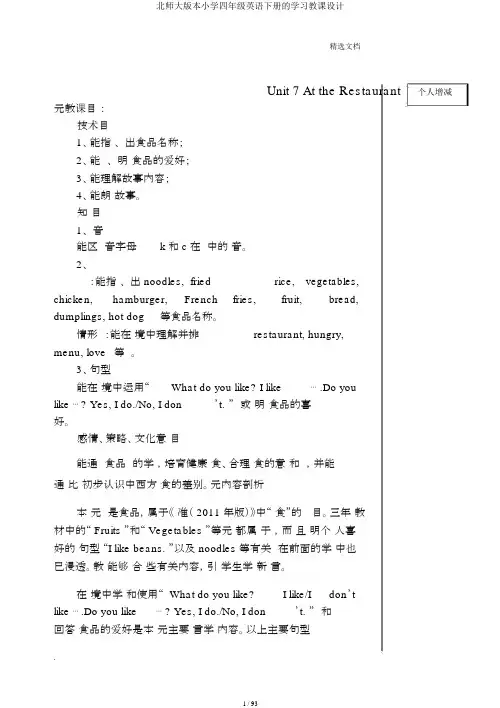
Unit 7 At the Restaurant个人增减元教课目:技术目1、能指、出食品名称;2、能、明食品的爱好;3、能理解故事内容;4、能朗故事。
知目1、音能区音字母k 和 c 在中的音。
2、:能指、出 noodles, fried rice,vegetables,chicken,hamburger,French fries,fruit,bread,dumplings, hot dog等食品名称。
情形:能在境中理解并排restaurant, hungry,menu, love等。
3、句型能在境中运用“What do you like? I like⋯.Do youlike ⋯ ? Yes, I do./No, I don’t.” 或明食品的喜好。
感情、策略、文化意目能通食品的学,培育健康食、合理食的意和,并能通比初步认识中西方食的差别。
元内容剖析本元是食品,属于《准( 2011 年版)》中“ 食”的目。
三年教材中的“ Fruits ”和“ Vegetables ”等元都属于,而且明个人喜好的句型“I like beans. ”以及 noodles 等有关在前面的学中也已浸透。
教能够合些有关内容,引学生学新言。
在境中学和使用“ What do you like? I like/I don’tlike ⋯ .Do you like⋯? Yes, I do./No, I don’t.”和回答食品的爱好是本元主要言学内容。
以上主要句型都是在 Mocky和 Ken 一家人到餐就餐,互相喜什么食个人增减物的程中自然呈。
Mocky想知道 Ken和 Ann喜什么食品,于是引出了“ What do you like? I like⋯,”句型。
以后,Ken 和 Ann 意到 Mocky 不菜,在帮助Mocky 点菜,引出“ Do you like noodles? Yes, I do./ No, I don’t.”等一般疑句及回答。
北师大版小学四年级下册英语教案
Unit Function Structure Vocabulary7 At the restauran t Askingandansweringquestions aboutlikes anddislikeDo you like (’tWhat food do youlike?I like (chicken).I don’t like(vegetables).(Ken) likes(bananas).Core: food, fruit, vegetables,chicken, , restaurant, menuPhonics: camera, cat, kite, cabbage,circle, circus, CD, cent, kangarooContextual: Here’s the restaurant.8 Big bird! DescribingpeopleandanimalsHe is a tall boy.He’s not a short boy.Is she a short girl?Yes, she is.No, she isn’t.What animal is it?Is it a big animal?Core: tall, short, thin, fat, young,old, long, short, big, small, good,bad, girl, boy, woman, man, animal,turtle, giraffe, treePhonics: gate, goat, girl, cabbage,orange, page, giraffeContextual: beautiful, forest,peacock9 Hot soup! Askingandansweringquestions aboutfoodThis soup is ’t.I’m hungry.Core: orange, , vest, vanContextual: I’m all right now. Wait!jug, bowl.Unit 7 At the restaurant Lesson 1 教学内容: 1、 Structures (New)What food do you like? I like (chicken).10 Mock y’s storeAsking and answerin g questions about objectsCan I ’t. Can I have the blue one, please?What does Mocky have?He has a (watch). Core: store, cap, clock, magazine,selling, thing newspaper, comic, purse, watch, T-shirt, umbrella, old,new, do, want, , quilt, question Contextual: Good morning. That ’s great! On, good. Here you are. farm11 Green berriesAsking and answerin g questions about healthHow are you today? What ’s the matter? I ’m not well. My stomach better. How is he today?He ’s not well. His (eye) hurts. Core: stomach, tongue, your mouth. Say aaaah. Uncle Booky can12 Review ReviewReviewReviewDo you like (fruit)?Yes, I do. No, I don’t.2、VocabularyCore: a restaurant, a menu, food, fruit, vegetables, chicken, aContextual: Here’s the restaurant.教学目标:掌握询问对方喜欢什么食品的句型。
北师大版四年级英语下册教案
donI like…?…,”likerice,问和表达,在语境中体会句子的语义功能,并尝试运用语言。
Talk Together是小朋友看菜单、准备点菜的场景,图中的小朋友正在相互询问对方喜欢什么食物。
为了增强语言学习的实用性并体现对学生思维能力的培养,教师可以引导学生观察菜单的内容,如食物和价钱等。
也可设计新的菜单,添加学生学过的蔬菜、水果和食品。
教学中注意引导学生在真实的情境下指认食物,并尝试运用“Do you like…?Yes,配套教学光盘,教学卡片,人物头像。
教学建议:Get Ready1、猜谜游戏教师出示食物的剪影图片,学生猜测食物名称,如apple, banana, orange, icecream 等。
T:Guess. What food is it?(设计意图:复习一些简单的食物名词,建立新旧知识间的联系。
通过就本课话题进行预先讨论,为新知学习做铺垫。
并呈现情景图片,为学生理解故事话题和情景做铺垫。
)2、说一说,“I分别喜(3)学生独立朗读对话。
(4)让学生根据图片和语言提示,补全对话。
教师可以删除部分人物对话,让学生看…?Idon说出所缺的句子。
(3)学生四人一组朗读或表演故事(I)。
(设计意图:通过复习做事(I)的主要情节,迅速回忆询问和回答对食物喜好的句型的意义和用法。
)Listen and ReadStep 2(1)告诉学生接下来学习故事第二部分,猜测Mocky是否像Ann和Ken那样喜欢noodles 或者chicken(用第一人称问答)。
T: Mocky,do you like noodles?Ss: Yes(I do)./No(I don’t).MockyMockyMocky(设计意图:通过跟读、大声朗读、分角色朗读或表演等操练方式,促使学生达成对情节和语言的内化与记忆。
)Talk TogetherStep 5(1)呈现并让学生看插图,猜一猜图中的人物在哪里,说说他们在看什么。
北师大版小学英语四年级下册全册教案
北师大版小学英语四年级下册全册教案目录Unit 7 At the Restaurant《Lesson 1 What do you like》 (2)Unit 7 At the Restaurant《Lesson 3 Have fun.》 (12)Unit 7 At the Restaurant《Lesson 6 Round up.》 (17)Unit 8 Talent Show《Lesson 1 I'm from China.》 (21)Unit8 Talent Show《Lesson 2 He's thin,but he's strong.》 (28)Unit 9 Hot Soup《Lesson 1 I'm thirsty.》 (36)Unit 9 Hot Soup《Lesson 2 What's your favorite food》 (40)Unit 9 Hot Soup《Lesson 3 Have fun.》 (49)Unit 10 Mocky’s Store《Lesson 1 Can I help you》 (55)Unit 10 Mocky’s Store《Lesson 2 Can I have the blue one,please》 (66)Unit 11 Illness《Lesson 1 My tumny hurts.》 (69)Unit 12《Review》 (72)Unit 7 At the Restaurant《Lesson 1 What do you like?》1教学目标1.知识与技能。
能听,会说,拼读词汇:noodles, chicken, vegetable, bread,fruit.会认读hamburger, French fries, fried rice。
能用句型“what do you like ?”“I like.....”来询问别人喜欢什么及表达自己的喜好。
北师大版四下英语教案
北师大版四下英语教案I. 引言本文档是关于北师大版四下英语教案的详细介绍和使用指南。
II. 教案概述北师大版四下英语教案旨在帮助学生提高英语听说读写的能力。
教案内容涵盖语言知识、语言技能和语言情感三个方面,通过多种教学活动和资源来激发学生的兴趣和研究动力。
III. 教案结构北师大版四下英语教案按照教材的不同单元划分为多个教学单元,每个教学单元包括以下几个部分:1. 教学目标:明确阐述该教学单元的教学目标,涵盖所要掌握的语言知识和语言技能。
2. 教学重点:列举本单元的教学重点,帮助教师更好地引导学生的研究。
3. 教学内容:介绍本单元的教学内容,包括课文、词汇、语法等方面的内容安排。
4. 教学活动:提供多种教学活动的设计,如听力训练、口语练、阅读理解等,以促进学生的全面发展。
5. 自主研究:鼓励学生在课后通过自主研究继续巩固和拓展知识,提供相关的练题和参考答案。
IV. 教案使用指南北师大版四下英语教案的使用指南如下:1. 教师应认真研读每个教学单元的教案,了解教学目标和重点,以便于准确引导学生研究。
2. 教师可以根据实际情况调整教案中的教学活动,适应学生的实际水平和研究需求。
3. 教师应关注学生的研究进展,及时给予指导和反馈,帮助学生解决问题。
4. 学生在课后应认真完成教案中的自主研究部分,并及时与教师沟通研究中的困惑。
V. 结论北师大版四下英语教案是一份详细介绍了教学内容和教学活动的教案,可以为教师和学生提供有效的研究指导。
希望本教案能够对英语教学工作有所帮助,提高学生的英语水平。
*(以上为示例文档,实际内容请根据教学需要和教材来编写)*。