
中医英语翻译的原则分析
English translation of the principles of Traditional Chinese Medicine AnalysisChinese medicine foreign exchange and business activities have become increasingly frequent, while the English translation of traditional Chinese medicine is Chinese Medicine with the rest of the world exchange a link. How to master Chinese translator English translation of the principles and techniques? What is English translation of the principles of traditional Chinese medic ine? English translation of this paper, analysis of practice in traditional Chinese medicine, try to put the principles of traditional Chinese medicine in English translation. According to the characteristics of traditional Chinese medicine in English translation, Chinese English translation should observe the following principles: loyalty (faithfulness), accurate (exactness), Unity (consistency). English translation of traditional Chinese medicine "a faithful, accurate and unified" principle, fundamentally speaking, is to adapt to the Chinese language and content specificity. The translation of the standard is basically reflects the transformation of Chinese-English language standards, to meet the standards for Chinese-English translation of the special needs. An English translation of traditional Chinese medicine, "faith" principle and application of traditional Chinese medicine in the English translation of "faithful" is rightly the original language of the express language of the translation. The "faithful" not demanding the same grammar and sentence structure, but requires Information on the connotation of the same weight. Literary Translation in the "similar" or "close" statement can not be set into the English translation of traditional Chinese medicine in the "faithful." Rely on information transmission are equal, that is, the information equivalent, rather than simply "semantic equivalence" [1]. See the following translation of "faithful" on the problem: the original: As the ferrite weak stomach, or blood loss Shangyin long illness, caused by Yinxue lack of cell pulse dystrophy. The original translation: The disease results from chronic splenogastric as2t henia, or yin2blood consumption by bleeding wit h chronic ill2ness, leading to insufficiency and failure to nourish t he uterinecollaterals. On the surface, yet fluent translation. In comparing the "true" principle, we find that the lack of a number of points: First, the original "Yinxue" The information in the translation as "yin2blood", actually "Yinxue" refers to the "blood", translation can not be "Yin" also translated them. "Yin2blood" is clearly the concept of repetition. The second, "Yinxue deficient" refers to blood deficiency, with the insufficiency of the translation misleading impression that there is substantial lack of human blood. In fact, "blood deficiency" does not necessarily the actual reduction of blood volume. Hemopenia can be used to translate the word. The sentence should be translated as follows: new translations: The disease results from chronic splenogastric as2t henia, or yin2consumption by bleeding wit h chronic illness, leading to hemopenia and failure to nourish t he uterine collater2als.2 English translation of traditional Chinese medicine "accurate" principle and application of Chinese English translation of "accurate" principle means: the translator that will convert the contents of the original language to the language translation process of the contents of selected words accurately express the concept of precise, complex and were referred to the right. Literary Translation often encountered exaggeration, metaphor, metonymy and other modification method, the concept of expression is not necessarily very accurate. English translation of traditional Chinese medicine involving the contents of the serious and specific, not the translator on the casual expression. With this principle as the core, you can regulate the current English translation of traditional Chinese medicine practice, some of the less "accurate" translation. Such as: Original: If the gasification dysfunction, will affect the qi, blood, body fluid metabolism, affecting digestion and absorption of dietary compounds affect the sweat, urine and feces excretion, and thus form a variety ofmetabolic disorders. The original translation: The disorder of qi activity can affec t themetabolism of qi, blood and body fluid, affect t he digestion andabsorption of food, and affect sweating, urination and defeca2tion, resulting in various metabolic diseases. Translation will appear in the original three " impact ", all translated, appeared stiff, does not meet the language used in English. To avoid these problems, according to the actual semantics of the original three synonyms were used to translate "impact", affect, impair, inhibit accurate expression of the concept of a complete solution to the problem. The sentence should be translated as follows: new translations: The disorder of qi activity can affect themetabolism of qi, blood and body fluid, impair t he digestion andabsorption of food, and inhibit t he excretion of sweat, urine andfeces, resulting in various metabolic diseases. Chinese English translation of "accurate" principle embodied in the choice of words on the first. And accurate selection of translation words is based on correct understanding of the original. More than just the choice of words from English dictionary to find the corresponding words only. It reflects the translators of the Chinese medicine knowledge and understanding of the depth of Chinese-English bilingual glossary. For example: Original: Semi-pin, one of the ancient practice of acupuncture, which is characterized as a shallow stab and was only half the normal depth, a needle quickly. Translation: "Half2needling" is one of the ancient needingmanipulations, characterized by shallow needling at only halft he usual dept h wit h quick wit hdrawal. Chinese term "acupuncture" in a different mix of English have different expressions. needling is a common translation, acupuncture, and puncture for the more formal concepts such as acupuncture (acupuncture), acupuncture body position (acupuncture pos2ture), acupuncture anesthesia (acupuncture anest hesia), acupuncture (acupuncturet herapy) and so on. This translation, according to the principle of an accurate choice of English words, choose the needling. Translation, only in accordance with its connotations of "accurate" choice of English words in order to ensure that information and concepts of the corresponding conversion. Sometimes, the original lacks accuracy, according to the translator if the original hard-translation, translation will inevitably lead to ambiguity. In this case, the translator also responsible for the verification of the original concept, to determine the original meaning of the task. English Translation of the many errors in traditional Chinese medicine seems to be caused by the original. Some of the original concept and expression does not give rise to misunderstanding the original readers, but the literal translation in the past may make the reader misunderstanding. Only to verify the original translator, accurate translation, translation will reduce the ambiguity. For example: Original: its symptoms of cold and heat exchanges, Xiong Xie bitter full, upset hi vomit quietly do not want to diet, mouth pain throat, dizziness, pulse string and so on. PRESIDENT: Its topical symptoms are alternative chills and fever, hypochondriac and t horacic stuffiness, irascibility, frequent hic2cups, depression, poor appetite, somatic bitterness, dry t hroat, blurred vision and a tense pulse. Text used the word "bitter Xiongxie Man" The term "hard over" to describe the extreme discomfort Xiongxie sense of fullness, vague concepts, translation using the stuffiness, general translation of this concept, so that the original fuzzy get an accurate translation. Chinese English translation of "accurate" principle, the main text and the translation is to provide an accurate flow of conceptual terms, but does not require the wording and Structure of the corresponding surface. To achieve translation of "accurate", the translator should be a solid way to learn Chinese and English language expertise. Similarly, a concept in a different language environment requires a different expression. Translator grasp the translation of "accurate" is just to the original text in translation smooth and appropriate. The general literature on Chinese-English translation, the translator often from an entry on theChinese-English dictionary effectively to find a few translations, a brief screening requirements can be selected. Traditional Chinese medicine is definitely not like the English translation of Chinese-English dictionary from the options that simple. The translator must be based on traditional Chinese medicine expertise to make a choice of English, some word equivalent on the surface actually is a big difference. Some English words, the translator that can translate a text for the concept, but the reader is asked not understand. Chinese English translation of the concept of more stringent limits, but also to the translator's knowledge of languages other than put a higher demand. Meet the need for a translator is only a general understanding of the English word, is far from the English translation of Chinese medicine practitioners, Chinese English translation must be consistent with the needs of English readers. The translator can make the right choice is the key not only to be familiar with traditional Chinese medicine and Chinese, but also be familiar with traditional Chinese medicine in English. 3 English translation of traditional Chinese medicine "unified" principle and the use of TCM English translation of "unity" principle, which is Chinese-English translation of terminology in the translation process at all times should maintain a unified, does not allow arbitrary transformations of the same terminology translation. Of course, Chinese English translation of the "unified" principle to some extent dependent on the concerted efforts of the translator as well as the general authority of department of uniform provisions. Some words in his popularity is often the initial cause trouble to the translators. In the end these words to what to say, really easy, so the translator had to demonstrate their individual had. Such as the Chinese term "triple burner" had been variously translated: triple energizer, tri2energizer, the Sanjiao, the warmers, the heaters and so on. Such non-uniform phenomenon, so that we spend much effort to understand the relevance of the various translations. The World Health Organization promulgated "acupuncture meridians of the International Standardization Program" will "triple burner" be translated as triple energizer, we should be internationally harmonized standards in accordance with this translation. With the "unification" of the translation, Chinese English translation could not be easier. At the same time, maintaining the unity of translation is also to facilitate readers in understanding and smoothly convey information. The principle of unity should be the English translation of traditional Chinese medicine and international bi-directional integration [2]. English translation of traditional Chinese medicine to maintain translation of the term "reunification" There are three ways: (1) with reference to international TCM English monographs and literature, such as the World Health Organization promulgated the "acupuncture meridians of the International Standardization Program" and so on, to keep Chinese English nouns Chinese-English translation of the term unity, international and stability. (2), the most authoritative reference to the new Chinese medicine Chinese-English dictionary. (3) The terms and expressions in English translation must be a long time that people use, the basic convention only after unification. Chinese-English translation of traditional Chinese medicine Chinese medicine is the most difficult terms and phrases properly translated into English, the translator must study harder, continue to read Chinese at home and abroad in English magazines, to grasp the translation movement. Professional Chinese-English Dictionary in English, traditional Chinese medicine field has a strength and authority of the translation has been convention, we should be consciously applied to our translation practice. Some translation is not perfect, but the translator for the time being follow these conventions translation. Because they followed the use of English translation of the long-standing, forming a fixed term, the best of their first with him. To introduce new, not a translator can call the shots, nor is it overnight, need long-term effort [3]. In short, thetransmission of information because of TCM English with the special nature of the existing principles and standards of the various translations is not very appropriate English translation of traditional Chinese medicine, the authors propose a "faithful (faithfulness), accurate (exactness), Unity (consisten2cy)" The English translation of the principles of traditional Chinese medicine, with a view to some standard English translation of Chinese medicine. This principle should be to return to English translation in the practice of traditional Chinese medicine to be tested. [References]1 Li Zhao-guo. TCM English translation techniques [M]. Beijing: People's Health Press, 1997.123.2 Lei Luo. Modern Chinese medicine Chinese-English translation skills [M]. Beijing: Chinese Ancient Books Publishing House, 2003. Chen Keji preamble.3 Xie Zhu-fan. With regard to the English translation of TCM terminology discussion [J]. Chinese Journal of Medicine, 2000,20 (9): 7062709中医英语翻译的原则分析中医药对外交流和商务活动日益频繁,而中医英译则是中国与世界其他国家中医药交流的一条纽带。
浅谈中医英语翻译的特点、问题及原则【文献综述】

文献综述英语浅谈中医英语翻译的特点、问题及原则一、前言部分(说明写作的目的,介绍有关概念,扼要说明有关主题争论焦点)自从改革开放以来,国外人士对中国的态度友好起来,随之他们对于中国文化、习俗、艺术等越来越感兴趣。
传统中医学也以其独特的理论系统和有效的治疗方法吸引着他们。
然而,当西医在中国盛行,大赚其钱的时候,中国传统的中医却一直未能在西方国家得到推广和应用。
导致这种现象发生的原因之一就是中医在翻译成英语时出现了很多问题。
众所周知,翻译在技术、艺术、文化等各个国际交流中扮演着很重要的角色。
由于语言不同,国外人士要是想了解中国的传统中医学,必须要借助翻译这个工具。
翻译的准确和明了,对于国外人士了解中国文化,中国传统有着至关重要的作用。
也是传播中华五千年文明的一种方式。
然而,中医英语翻译是一件极其不易的事,在翻译过程中存在着很多问题。
如何解决好这些问题是做好中医英语翻译的基础和保障。
本文从中医英语翻译仿造化,多样性以及定义化这三个特点折射出其在翻译过程中的对应词缺乏和理解偏差这两个问题进行仔细探讨。
并结合国内外学者提出的解决这些问题的三原则,即薄文重医,得“意”忘“形”;比照西医,求同存异;尊重国情,保持特色对中医翻译中存在的问题进行更加深入的分析和研究。
相关概念:中医英语:就是英语语言在中医药对外翻译及交流过程中逐渐形成的一种独特的表达语系,是ESP(English For Specific Purpose,即“专门用途英语”)家族中的一个新成员。
仿造化:所谓仿造,是指翻译原语的无等值词汇时,用译语中的直接对应词代替无等值词汇的组成部分——词素或词。
定义化:基于中医用语言简意赅,浓缩性强,翻译过程中较难采用相当单位的英语词语,翻译变成了解释,即用英语给中医下定义。
多样化:是指中医术语在不同情况下,就可能有不同的翻译形式。
争论焦点:不管是国内还是国外,对于中医英语翻译的研究起步较晚,现在在处于初级阶段。
中医英语翻译重点

中医英语翻译句子翻译重点1.由于证包括了病变的部位、原因、性质以及邪正关系,反映出疾病发展过程中某一阶段的病理变化的本质,因而它比症状更全面、更深刻、更正确地揭示了疾病的本质。
Since syndrome, covering the location, cause and nature of disease and conditions of healthy and pathogenic qi, indicates the nature of pathological changes in a phase during the disease progress, it more comprehensively, profoundly and correctly uncovers the nature of disease than symptom does.2.所谓辨证,就是将四诊(望、闻、问、切)所收集的资料、症状和体征,通过分析、综合、辨清疾病的原因、性质、部位以及邪正之间的关系,概括、判断为某种性质的证。
The so-called syndrome differentiation refers to the process of figuring out the location, cause and nature of disease and conditions of healthy and pathogenic qi by analyzing the information, symptoms and signs of the patients collected by four examinations including inspection, listening and smelling examination, inquiry and palpation, and finally identifying the disease as a certain syndrome.3.辨证和论治,是诊治疾病过程中相互关系不可分割的两个方面,是理论和实践相结合的体现,是理法方药在临床上的具体体现,是指导中医临床工作的基本原则。
中医英译中的问题_难点与原则
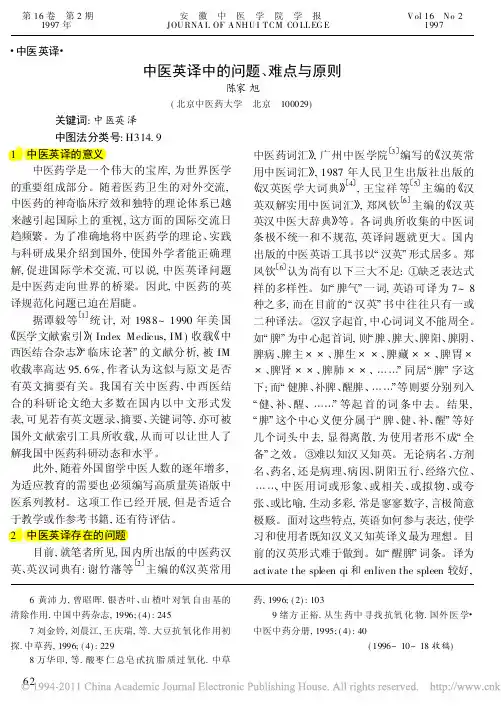
第16卷 第2期 安 徽 中 医 学 院 学 报 V ol16 N o2 1997年 JOU RNA L OF A NHU I T CM CO LL EG E 1997中医英译中医英译中的问题、难点与原则陈家旭(北京中医药大学 北京 100029)关键词:中医英泽中图法分类号:H314.91 中医英译的意义中医药学是一个伟大的宝库,为世界医学的重要组成部分。
随着医药卫生的对外交流,中医药的神奇临床疗效和独特的理论体系已越来越引起国际上的重视,这方面的国际交流日趋频繁。
为了准确地将中医药学的理论、实践与科研成果介绍到国外,使国外学者能正确理解,促进国际学术交流,可以说,中医英译问题是中医药走向世界的桥梁。
因此,中医药的英译规范化问题已迫在眉睫。
据谭毅等1!统计,对1988~1990年美国∀医学文献索引#(Index Medicus,IM)收载∀中西医结合杂志#∃临床论著%的文献分析,被IM 收载率高达95.6%,作者认为这似与原文是否有英文摘要有关。
我国有关中医药、中西医结合的科研论文绝大多数在国内以中文形式发表,可见若有英文题录、摘要、关键词等,亦可被国外文献索引工具所收载,从而可以让世人了解我国中医药科研动态和水平。
此外,随着外国留学中医人数的逐年增多,为适应教育的需要也必须编写高质量英语版中医系列教材。
这项工作已经开展,但是否适合于教学或作参考书籍,还有待评估。
2 中医英译存在的问题目前,就笔者所见,国内所出版的中医药汉英、英汉词典有:谢竹藩等2!主编的∀汉英常用中医药词汇#,广州中医学院3!编写的∀汉英常用中医词汇#,1987年人民卫生出版社出版的∀汉英医学大词典#4!,王宝祥等5!主编的∀汉英双解实用中医词汇#,郑凤钦6!主编的∀汉英英汉中医大辞典#等。
各词典所收集的中医词条极不统一和不规范,英译问题就更大。
国内出版的中医英语工具书以∃汉英%形式居多。
郑凤钦6!认为尚有以下三大不足:&缺乏表达式样的多样性。
试析中医术语的翻译原则及其方法
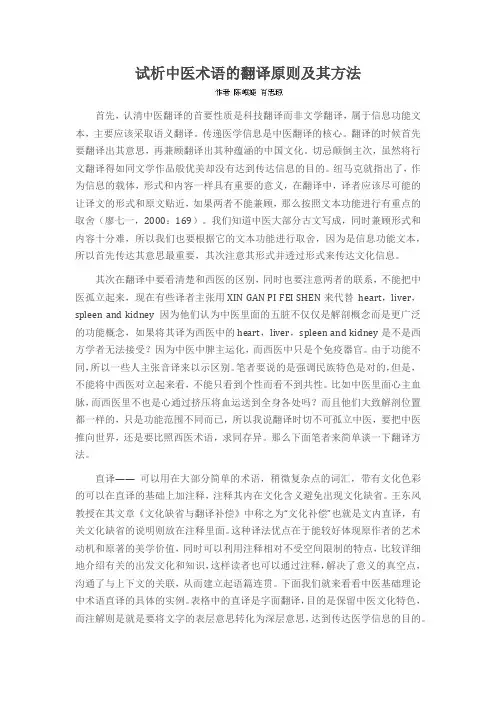
试析中医术语的翻译原则及其方法首先,认清中医翻译的首要性质是科技翻译而非文学翻译,属于信息功能文本,主要应该采取语义翻译。
传递医学信息是中医翻译的核心。
翻译的时候首先要翻译出其意思,再兼顾翻译出其种蕴涵的中国文化。
切忌颠倒主次,虽然将行文翻译得如同文学作品般优美却没有达到传达信息的目的。
纽马克就指出了,作为信息的载体,形式和内容一样具有重要的意义,在翻译中,译者应该尽可能的让译文的形式和原文贴近,如果两者不能兼顾,那么按照文本功能进行有重点的取舍(廖七一,2000:169)。
我们知道中医大部分古文写成,同时兼顾形式和内容十分难,所以我们也要根据它的文本功能进行取舍,因为是信息功能文本,所以首先传达其意思最重要,其次注意其形式并透过形式来传达文化信息。
其次在翻译中要看清楚和西医的区别,同时也要注意两者的联系,不能把中医孤立起来,现在有些译者主张用XIN GAN PI FEI SHEN来代替heart,liver,spleen and kidney因为他们认为中医里面的五脏不仅仅是解剖概念而是更广泛的功能概念,如果将其译为西医中的heart,liver,spleen and kidney是不是西方学者无法接受?因为中医中脾主运化,而西医中只是个免疫器官。
由于功能不同,所以一些人主张音译来以示区别。
笔者要说的是强调民族特色是对的,但是,不能将中西医对立起来看,不能只看到个性而看不到共性。
比如中医里面心主血脉,而西医里不也是心通过挤压将血运送到全身各处吗?而且他们大致解剖位置都一样的,只是功能范围不同而已,所以我说翻译时切不可孤立中医,要把中医推向世界,还是要比照西医术语,求同存异。
那么下面笔者来简单谈一下翻译方法。
直译——可以用在大部分简单的术语,稍微复杂点的词汇,带有文化色彩的可以在直译的基础上加注释,注释其内在文化含义避免出现文化缺省。
王东风教授在其文章《文化缺省与翻译补偿》中称之为“文化补偿”也就是文内直译,有关文化缺省的说明则放在注释里面。
论中医方剂名的翻译原则和英一模式

论中医方剂名的翻译原则和英一模式摘要】中医方剂名能否准确译成英文,对于中医走向世界具有特殊意义。
本文旨在探讨中医方剂名翻译的简洁性原则、信息性原则和回译性原则,以总结出规范而有效的方剂英译模式。
【关键词】中医方剂名翻译原则英译模式方剂学作为中医学的主要基础学科,旨在研究中医方剂的组成、变化和临床运用规律。
方剂一般由君药、臣药、佐药、使药组成。
规范方剂名翻译是医学翻译最为关注的问题。
由于方剂命名复杂,给翻译带来很大困难。
为使方剂学走出国门,促进国际学术交流,中药方剂名的英译尤为重要,翻译时应遵循一定的翻译原则和英译模式。
1、中医方剂名的翻译原则中药方剂名的构成方式有十几种,如由所含诸药名称构成的方剂名——麻杏石甘汤、以功效命名的方剂名——温脾汤等。
由于构成复杂,目前中医方剂名翻译中存在俗而不真、合名法却失原意的翻译问题。
因此在翻译时要用简洁性、信息性与回译性三原则来指导中医方剂名的翻译。
1.1简洁性原则中医用语突出特点是简明扼要,用字少而表意深。
方剂译名也应保持这一特点。
由于中英文字的差异,有时将相当简洁的中医方剂直译成英语时会有烦琐冗长之弊。
如英译方剂名时,可省略入药部分的拉丁语名称(注意翻译组方时不能省略)以简化译名的音节。
如:金铃子散Meliae Toosendan Powder(省略Fructus);灸甘草汤Glyeyrrhiza Praeparata Decoction (省略Radix)。
从某种意义上讲,这种删繁就简符合英文的构词法。
1.2信息性原则从对中医方剂命名的分析来看,方剂名除具有指代功能外,一般都承载一定信息,即能对其所指代方剂的组成或功效具有直接的或间接的说明。
这样的名称使人能见词明意,很有实用性。
因此翻译时应使译名同具信息性,在方剂实际翻译中应灵活运用这一原则。
例如,碧玉散译作Jasper Power,对泰山磐石散这一方剂名可根据药物的功效译作Power for calming Fetus,不但满足了简洁性原则,而且也符合信息性原则。
中医英语翻译标准化原则研究

中医英语翻译标准化原则研究引言中医药是中国传统医学的重要组成部分,具有悠久的历史和独特的理论体系。
随着中医药在国际上的关注度不断提高,中医药英语翻译的需求也日益增长。
然而,由于中医药的特殊性,中医药英语翻译面临着诸多挑战。
为了提高中医药英语翻译的质量和准确性,需要制定一套标准化的翻译原则。
本文旨在探讨中医药英语翻译标准化原则。
一、辞汇翻译的准确性原则中医药英语翻译的准确性是其质量的基础。
中医药术语是中医药翻译的重要组成部分,其准确性直接影响到中医药理论的传播和理解。
因此,在中医药英语翻译中,必须遵循准确性原则,确保术语的翻译准确无误。
为了保证翻译的准确性,首先需要建立起科学严谨的中医药术语词典和数据库,以便查证和参考。
此外,还需要充分了解中医药的理论和实践,对中医药术语的内涵和特点有充分的了解。
在翻译过程中,应注重对中医药术语的原义和义项进行准确把握,并避免使用与中医药无关的术语进行翻译。
二、文化转换的原则中医药是中华民族智慧的结晶,具有深厚的历史和文化背景。
因此,中医药英语翻译需要注重文化转换的原则,将中医药的理论和实践积淀融入到英语翻译中。
在翻译中,应通过恰当的解释和注释,将中医药理论和概念准确地传达给英语读者。
同时,还应注意中医药文化的特殊性,避免将中医药的理论和实践简化为西方药学或医学的概念。
此外,在翻译中应注重与中医药相关的历史、哲学、宗教和艺术等领域的对接,以便更好地传递中医药的内涵和价值。
三、语言风格的一致性原则中医药英语翻译需要保持一定的语言风格一致性,以确保翻译的连贯性和可读性。
一致的语言风格不仅有助于读者理解翻译内容,还可以提高中医药英语翻译的专业性和可靠性。
在翻译中,应统一使用专业术语,并遵循一定的翻译规范和风格,如遵循英语语法规则、避免使用生硬的直译等。
同时,还应注意翻译的语言流畅性和自然性,以确保翻译内容符合英语读者的习惯和阅读习惯。
四、可读性和可理解性的原则中医药英语翻译应注重可读性和可理解性,以便更好地传达中医药的理论和实践。
中药名翻译的原则和方法探讨
中药名翻译的原则和方法探讨
中药名翻译的原则和方法有很多,以下是其中的一些:
一、实词译法。
根据特定的中药名的实际意义来确定其英文表达形式,这是最常用的译法。
例如,柴胡的英文表达就是“Bupleurum”。
二、形声译法。
根据特定的中药名的形声来确定其英文表达形式,这种译法常常模糊。
例如,浙贝母的英文表达就是“Gentian”。
三、多义译法。
根据特定的中药名的多种义项来确定其英文表达形式,这种译法有时会使英文表达不够准确。
例如,当归的英文表达可以是“Angelica”或者是“Chinese Angelica”。
四、同形略译法。
根据特定的中药名的意义类似而英文表达略有不同的情况,使用同形略译法来确定其英文表达形式,这种译法有时会使英文表达不够准确。
例如,金银花的英文表达是“Jin Yin Hua”,而金银藤的英文表达却是“Jinyingtian”。
五、专有词译法。
根据特定的中药名的专有名词来确定其英文表达形式,这种译法有时会使英文表达不够准确。
例如,木香的英文表达就是“Mu Xiang”。
总之,对于中药名翻译的原则和方法,以上就是其中的几个。
实词译法是最常用的译法,而另外几种译法有时会使英文表达不够准确,因此需要格外小心。
中医英语翻译
Back
2.1 对等翻译法
生理解剖术语: “心”—— “肝”—— heart liver “肺”—— “胆”—— lung gall “脾”—— “胃”—— spleen stomach
病因病机术语
伤风,感冒——cold 病邪,疾病——disease 症,症状——symptom 征,体征——sign 虚——asthenia 发热——fever 证候,综合征——syndrome
科技英语翻译之
中医英语翻译
中医药英译的方法
1.中医药英译方法的标准
2.中医药英译标准方法示例 3.翻译实例
1.中医药英译的方法的标准1.1 中医药英译标准的原则
Go
1.2 中医药英译标准的分类
Go
1.1 中医药英译标准的原则
要制定一个学科的标准,首先要制定原则。
①能用现代西医的对应英语单词或词组就不要另用其他的翻译方法,不必 强求“形似”与“神似”两全; ②对基础理论名词术语、四字句词语尽可能用信息密度高的构词方法,简 约、精炼,具有良好的回译性,避免使用解释性翻译;
e.g. 阴无阳不生,阳无 阴不长。
Without yang there would be no production of yin. Without yin there would be no production of yang.
3.4 条件句 (conditional adverbial clause)
3.3 语气(mood)
在翻译过程中,常使用 should,must, can,would等情态 动词(modal verb)。
e.g. 阴和阳都不能脱离对方而单独存在。 Neither yin or yang can exist in isolation.
浅议中医病名的英译原则和方法
文◎
摘要 :本 文 探 讨 了中 医 病名 的 翻译 原 则 和方法 在 翻译 中 医病名 时 ,我 们应遵循
忠 实、准确 和比照 的原则 ,并适 时采用直译 法 、意 译 法 、音译 法和 象译 法 的翻 译 方 法 。 关键 词 : 中 医病 名 ; 原 则 : 方 法
达方式。
[】 ie W m n e g e 实用英文 1 N g l ie a F n Y . s 中医辞典 [] M .北京:人民卫生出版社 ,2 0 02
【】 2 李春 梅 医学英语 的特 点及翻译 [】 J
河北职工医学院学报,1 9 1 ):5— 0 9 9( 2 9 6
【】 3 南燕 英语医学术语翻译技巧 【】 卫 J.
生职 业教 育 ,2 0 1 03( 0): 1 8 0
如 痿 病 。 痿病 指 肢 体 筋 脉 弛 缓 , 软 弱
2 2 4
医的概 念 的。如 心悸 ,它 的英 文名为 h a t w t h r q i k b e t s 指 喘 息 。 (《 e r i h s o t u c r a h 牛
p l j a in a P t t o ,而 在 中 医 理 论 a p t o 。P 1 i a i n t 叶 ,心 悸 进 一 步 被 划 分 为 惊 悸 、 怔 忡 。 惊 悸 1 津 高 阶 英 汉 双 解 词 典 》 )这 样 就 可 以 把 哮 和
sn r m  ̄可 。 yd o e 24 象 译法 .
元 代的朱 丹溪 首创 “ 喘 ”之 名 ,阐 明 哮 病机 专主于痰 ,提 出 “ 发以扶正气 为主 , 为 既发 以攻邪 气为急 ”的治疗 原则 ,后来 的医 家鉴 于哮必兼 喘 ,故一般称之 为哮 喘 ,为 与
论中医名词术语英译国际标准化的概念、原则与方法
论中医名词术语英译国际标准化的概念、原则与方法中医名词术语英译国际标准化原则是将中国文化和语言特色与英语翻译相结合,以建立一个统一的、易于全球理解的及易于实施的国际标准。
以下旨在介绍这些原则:首先,中医名词术语的英译国际标准化应坚持严格按照词义进行翻译。
尽管中医术语具有不同的语言特点,但翻译时应尽量按原词义准确翻译,如中文四诊翻译为:Four Diagnostic Procedures,遵循原义,不参杂任何多余信息。
其次,中医名词术语的英语标准应坚持采用简练、清晰的表达形式,避免使用复杂的表达,原词意不变,避免了其他文化理解和国际趋势不稳定的影响。
再次,中医名词术语的翻译要尽可能简洁,尽量缩短单词的字数,只强调单词的核心含义。
在中医药学中,有很多词语与七十二经脉和四诊等较为特殊知识相关,在此情况下,要尽量简短、稳定,而不是把翻译结果变得更复杂。
此外,翻译中要充分考虑中华文化的组成元素,及其在形成和发展的背景及其功能,并考虑其与英语表达的对应,不能孤立于其语言本身而不能讲清楚。
按照以上原则,中医名词术语的英译国际标准化遵循一定的方法进行翻译。
首先,收集大量可供翻译的源文,然后根据源文原意匹配、修改其英译术语,最后能够达到英语翻译词语既保留中医特有文化又更加易懂。
其次,要结合实际情况,因地制宜,结合实际情况改变或简化词语,以减少理解成本。
最后,要重视相关学术研究的协作性,在收集、审查和修订文本时,以紧密协作的方式进行协作,以确保源文的准确性和翻译的可操作性。
综上所述,中医名词术语英译国际标准化是一项值得引进的国际化标准,其核心原则是坚持按照源文义翻译,做到简洁清楚,结合当地文化特点,协同进行,以减少理解成本,使全球使用更加快捷和便捷。