
美国文学作品选读
作品选读分析:Passage 1…Suddenly there shot along the path a wild light, and I turned to see whence a gleam so unusual could have issued—for the vast house and its shadows where alone behind me. The radiance was that of the full, setting, and blood-re moon, which now shone vividly through that once barely-discernible fissure, of which I have before spoken, as extending from the roof of the building, in a zigzag direction, to the base. …Questions:1.From which short story is this passage taken? Who is the author of this short story?2.what kind of story is it? What’s features of this kind of story?3.What’s the symbolic meaning of the “House” and the “Fissure”?Passage 2“Standing on the bare ground, -- my head bathed by the blithe air and uplifted into infinite space, -- all mean egotism vanishes. I become a transparent eyeball; I am nothing; I see all; the currents of the Universal Being circulate through me; I am part or particle of God.”Questions:1. Which work is this fragment taken from? Who’s the author?2. What does “Universal Being” refer to?3. How to appreciate it?Passage 3The runaway slave came to my house and stopt outside,I heard his motions crackling the twigs of the woodpile,Through the swung half-door of the kitchen I saw him limpsy and weak,And went where he sat on a log and led him in and assured him,And brought water and fill’d a tub for his sweated body and bruis’d feet,And gave him a room that enter’d from my own, and gave him some coarse clean clothes,…Questions:1. What’s the title of the poem? From which collection of poetry is the poem taken from?2. What’s the form of the poem? What’s the poet’s writing technique?3. What’s the symbolic meaning of the title of the collection? What’s the theme of the poem? Passage 4Because I could not stop for Death—He kindly stopped for me—The Carriage held but just Ourselves—And Immortality.…We passed the School, where Children stroveAt Recess—in the Ring—We passed the Fields of Gazing Grain—We passed the Setting Sun—…Questions:1. Who is the poet of this poem?2. What do “He” and “Carriage” refer to? What do “School”, “Fields of Gazing Grain”and “Setting Sun” symbolize?3. What’s the poet’s attitude towards Death?4. What are the poetic feature of the poet?Passage 5The apparition of these faces in the crowd;Petals on a wet, black bough.Questions:1. What’s the title of the poem? Who’s the poet?2. What are the objects and images in this poem?3. How do you appreciate the form and words used in this poem?Passage 6Two roads diverged in a yellow wood,And sorry I could not travel bothAnd be one traveller, long I stoodAnd looked down one as far as I couldTo where it bent in the undergrowth;…I shall be telling this with a sighSomewhere ages and ages hence:Two roads diverged in a wood, and I —I took the one less traveled by,And that has made all the difference.Questions:1. What’s the poem? Who is the poet?2. What does the poet mean symbolically by “road”?2. What does the poet refer to by saying “I took the one less travelled by”?Passage 7Let us go then, you and I,When the evening is spread out against the skyLike a patient etherized upon a table;Let us go, through certain half-deserted streets,The muttering retreatsOf restless nights in one-night cheap hotelsAnd sawdust restaurants with oyster-shells:Streets that follow like a tedious argumentOf insidious intentTo lead you to an overwhelming question. . .Oh, do not ask, "What is it?"Let us go and make our visit.…Questions:1. What do “you” and “I” refer to? What’s the form of this poem?2. What’s the ironic meaning of the title?3. What is the significance of the image of “I”?Passage 8“This is an unusual party for me. I haven’t even seen the host. I live over there--” I waved my hand at the invisible hedge in the distance. “and this man Gatsby sent over his chauffeur with an invitation.”For a moment he looked at me as if he failed to understand.“I’m Gatsby,” he said suddenly.“What!” I exclaimed. “Oh, I beg your pardon.”“I thought you knew, old sport. I’m afraid I’m not a very good host.”…Questions:1. Identify the novel and the author.2. Why Gatsby say he is “not a very good host”?3. What’s the significance of the image of Gatsby?Passage 9He went down the hall. I went to the door of the room.“Y ou can’t come in now,” one of the nurses said.“Y es I can,” I said.“Y ou can’t come in yet.”“Y ou get out,” I said, “The other one too.”But after I had got them out and shut thedoor and turned off the light it wasn’t any good. It was like saying good-by to a statue. After a while I went out and left the hospital and walked back to the hotel in the rain.Questions:1.Identify the author and the novel.2.What’s the theme of it?3.How does the character reveal the typical “hero” created by the author?Passage 10When Caroline Meeber boarded the afternoon train for Chicago, her total outfit consisted of a small trunk, a cheap imitation alligator-skin satchel, a small lunch in a paper box, and a yellow leather snap purse, containing her ticket, a scrap of paper with her sister’s address in V an Buren Street…Questions:1. Which novel is this passage taken from? Who is the author?2. What’re the features of the naturalistic novel?3.How is the naturalistic color revealed in the fate of Caroline Meeber?。
美国文学选读--作家作品

美国文学选读------作家作品Benjamin FranklinPoor Richard’s AlmanacThe AutobiographyEdgar Allan PoeTamerlane and Other PoemsPoemsThe Raven and Other PoemsTales of the Grotesque and ArabesqueTales“The Fall of the House of Usher”“The Masque of the Red Death”“Ligeia”, “The Black Cat”, “The Cask of Amontillado”“Murders in the Rue Morgue”, “The Purloined Letter”, “The Gold Bug”“The Philosophy of Composition”, “The Poetic Principle”Annabel LeeThe RavenRalph Waldo EmersonNatureThe American ScholarThe Divinity School AddressEssays: First SeriesEssays: Second SeriesRepresentative MenEnglish TraitsThe Conduct of LifePoems, 1846May-Day and Other PiecesNathaniel HawthorneFanshaweTwice-told TalesMosses from an Old ManseThe Scarlet LetterThe House of the Seven GablesThe Blithedale RomanceThe Marble FaunHerman MelvilleTypeeOmooMardiRedburnWhite JacketMoby DickThe Confidence ManBattle PiecesClarelJohn Marr and Other SailorsTimoleonBilly BuddHenry David ThoreauOn the Duty of Civil DisobedienceA Week on the Concord and Merrimack RiverWalden19th-Century American PoetsHenry Wadsworth LongfellowVoice of the NightBallads and Other PoemsEvangelineThe Song of HiawathaWalt WhitmanLeaves of Grass“One’s Self Sing”, “O Captain! My Captain!”Emily Dickinson“To Make a Prairie…”“Success Is Counted Sweetest”“I’m Nobody!”Mark TwainThe Celebrated Jumping Frog of Calaveras County The Innocents AbroadThe Gilded AgeThe Adventures of Tom SawyerLife on the MississippiThe Adventures of Huckleberry FinnA Connecticut Yankee in King Arthur’s CourtThe Tragedy of Pudd’nhead WilsonThe Man That Corrupted HadleyburgHenry JamesA Passionate PilgrimRoderick HudsonThe Novels and Tales of Henry JamesThe AmericanDaisy MillerThe Portrait of a LadyBostoniansThe Princess of CasamassimaThe Spoils of PoyntonThe Turn of the ScrewThe Awkward AgeThe Wings of the DoveThe AmbassadorsThe Golden BowlThe American SceneStephen CraneMaggie: A Girl of the StreetsThe Red Badge of CourageThe Open BoatThe Bride Comes to Yellow SkyThe Blue HotelWilla CatherSherwood AndersonWindy McPherson’s SonWinesburg, OhioMarching MenPoor WhiteThe Triumph of the Egg and Other Stories Horses and MenMany MarriagesDark LaughterBeyond DesireDeath in the Woods and Other StoriesKatherine Anne PorterThe Flowering JudasPale Horse, Pale RiderThe Leaning TowerThe Old OrderOld MortalityA Ship of FoolsF. Scott FitzgeraldThis Side of ParadiseThe Beautiful and the DamnedFlappers and PhilosophersTales of the Jazz AgeThe Great GatsbyTender is the NightWilliam FaulknerThe Marble FaunSoldier’s PayMosquitoesThe Sound and the FuryAs I Lay DyingLight in AugustAbsalom, Absalom!SartorisThe Hamlet 《村子》The TownThe MansionErnest HemingwayIn Our TimeThe Sun Also RisesA Farewell to ArmsFor Whom the Bell TollsThe Old Man and the Sea20th-Century American PoetsEzra PoundExultationsPersonaeCathayCantosDes ImagistesWallace StevensThe Necessary AngelWilliam Carlos WilliamsCollected Later PoemsCollected Early PoemsPatersonRobert FrostA Boy’s WillNorth of BostonNew HamphshireCollected PoemsA Further RangeA Witness TreeLangston HughesThe Weary BluesFine Clothes to the JewThe Dream Keeper and Other Poems Shakespeare in HarlemArchibald MacLeishThe Happy MarriageThe Poet of EarthConquistadorCollected Poems, 1952J.B.Eugene Glastone O’NeillBound East for CardiffIn the ZoneThe Long Voyage HomeThe Moon of the CaribeesEmperor JonesThe Hairy ApeThe Great God BrownStrange InterludeDesire Under the ElmsMourning Becomes ElectraThe Iceman ComethA Touch of the PoetLong Day’s Journey Into NightThe Moon for the MisbegottenHughieMore Stately MansionsElwyn Brooks WhiteTalk of the TownIs Sex Necessary?Elements of StyleStuart LittleCharlotte’s WebQuo Vadimus or The Case for the Bicycle One Man’s MeatThe Points of My CompassLetters of E. B. WhiteEssays of E. B. WhitePoems and Sketched of E. B. WhiteWritings from The New YorkerTennessee WilliamsThe Glass MenagerieA Streetcar Named DesireCat on a Hot Tin RoofSummer and SmokeThe Rose TattooCamino RealOrpheus DescendingSuddenly Last SummerThe Sweet Bird of YouthThe Night of the LguanaRalph Waldo ElisonInvisible ManShadow and ActGoing to the Territory欢迎您的下载,资料仅供参考!致力为企业和个人提供合同协议,策划案计划书,学习资料等等打造全网一站式需求。
美国文学史及选读作品作者

一、殖民主义时期 The Literature of Colonial America
1.船长约翰•史密斯 Captain John Smith
《自殖民地第一次在弗吉尼亚垦荒以来发生的各种事件的真实介绍》
“A True Relation of Such Occurrences and Accidents of Note as Hath Happened in Virginia Since the First Planting of That Colony”
或叫《美洲新英格兰部分土著居民语言指南》
Or “ A Help to the Language of the Natives in That Part of America Called New England ”
5.安妮•布莱德斯特 Anne Bradstreet
《在美洲诞生的第十个谬斯》
《查理二世》或《快乐君主》 “Charles the Second” Or “The Merry Monarch”
《克里斯托弗•哥伦布生平及航海历史》
“A History of the Life and Voyages of Christopher Columbus”
《格拉纳达征服编年史》”A Chronicle of the Conquest of Grandada”
《弗吉尼亚地图,附:一个乡村的描述》
“A Map of Virginia: with a Description of the Country”
《弗吉尼亚通史》 “General History of Virginia”
2.威廉•布拉德福德 William Bradford
自考 英美文学选读 书单

自考英美文学选读书单全文共四篇示例,供读者参考第一篇示例:自考英美文学选读书单:自考英美文学选读一直是自考英美文学专业的核心课程之一,对学生的文学修养和英语水平提升起着非常重要的作用。
下面给大家推荐一份【自考英美文学选读】书单,希望对大家学习和备考有所帮助。
1. 《简·爱》(Jane Eyre)- 夏洛蒂·勃朗特(Charlotte Bronte)《简·爱》是英国文学史上的经典之作,描写了主人公简·爱的一生遭遇及成长历程。
小说通过简·爱的内心世界、对生活的思考和对爱情的追求,展示了女性独立、坚强和自由的形象,被誉为女性主义文学的杰作。
2. 《傲慢与偏见》(Pride and Prejudice)- 简·奥斯汀(Jane Austen)《傲慢与偏见》是英国文学史上的又一经典之作,讲述了伊丽莎白·班奇和达西先生之间的爱情故事。
小说通过调侃社会习俗、揭示人性弱点和倡导女性独立,展现了简·奥斯汀的精湛文学功底和对人性深刻洞察的能力。
3. 《了不起的盖茨比》(The Great Gatsby)- F·司各特·菲茨杰拉德(F. Scott Fitzgerald)《了不起的盖茨比》是美国文学史上的代表作之一,讲述了上世纪20年代美国高盛时期的繁荣与荒诞。
小说通过主人公盖茨比的爱情故事、社会地位和金钱的探讨,揭示了美国梦的虚幻和人性的贪婪,具有较高的文学价值和社会意义。
《呼啸山庄》是英国文学史上的经典之作,描绘了希斯克利夫和凯瑟琳之间的爱恨纠葛。
小说通过家族恩怨、爱情悲剧和人性探讨,展现了勃朗特姐妹的文学才华和对人性矛盾的深刻理解。
《去吧,告诉她们,我在这里》是美国文学史上的力作之一,讲述了黑人青年约翰尼的成长经历和对信仰的追求。
小说通过种族歧视、家庭纠葛和自我认同的挣扎,反映了美国社会的种族问题和对人类命运的深刻思考。
美国文学作品选读 《了不起的盖茨比》

美国文学作品选读结课论文Symbolism in The Great GatsbyF.Scott Fitzgerald, as one of the great stylists in Americanliterature and is the spokesman of a crucial and revealing period in the cultural history of his country. His masterpiece, The GreatGatsby, written in1925, is often referred to as “The Great American Novel", and as the quint essential work which captures the mood of the "Jazz Age". T.S.Eliot read this book several times and commented that it was "the first step that American fiction has taken since Henry James".The Great Gatsby drew a picture of American people pursuing wealth, statute and pleasure of the Jazz Age. In this novel, Fitzgerald expressed that the American dream has been destroyed by the desire for materialism. At the beginning, Gatsby has a pure dream, but he becomes corrupted in his quest towards that dream. In order to fully express his ideas Fitzgerald wisely applies many meaningful symbols to accentuate the story.In The Great Gatsby, F. Scott Fitzgerald uses symbols wildly, which cleverly depicts the decay of the people’s American Dream. The author expresses his feelings or ideas to the readers by employing many symbolic objects, which are employed to express meanings beyond what may be literally described. These symbols make the story complete and excellent.In The Great Gatsby, F. Scott Fitzgerald is a capable artist, his emotions and feelings are conveyed through colors. Different color symbolisms not only enlivens the characters but also deepens the theme of the novel that can make readers fully and vividly understand the atmosphere in America at that time.First, the color of white appears many times in this novel. When Daisy and Gatsby meet for the first time, Daisy is dressed in white and she has a little white roadster. On many occasions, she often drives a white car. She even tells others that she has a “white childhood”. This color represents her purity, her innocence, her unperturbed self. However, under the beautiful appearance, Daisy actually has a hollow, grim and selfish heart. White is a kind of color without real color conparing with other colors, so it reveals the emptiness of Daisy as well as Gatsby’s dream.Second, the color of green, the green light runs through the whole life of Gatsby and it deeply symbolizes the hope, belief and faith of him. Daisy, in some degree, represents his greatdream.Gatsby’s quest for Daisy is broadly associated with the American dream. The most obvious interpretation is that the light is symbolic of Gatsby’s longing for Daisy. However, that is too simplistic, Daisy is a part of it , but the green light means much more. It is one of the most important symbols in this novel and can be interpreted in many ways. The green light also means the American Dream itself. Gatsby wants to pursuit of money and material sucess.Each time the green light occurs, it will play a very important role in the process of modeling the protagonist Gatsby.Third, yellow is also a main symbolic color. It represents the treasure and luxury. Daisy and Tom Buchanan’s house was decorated with reflected gold, Daisy uses a gold pencil,actually she is called “the golden girl”, the two girls in the party wear “twin yellow dresses”, Gatsby’s is yellow......It seems that this society is full of yellow, echoing the sound of the mThe two girls in the party wear “twin yellow dresses”, Doctor T. J. Eckleburg‟s spectacles are yellow, the orchestra in the party plays “yellow cocktail music”, Jordon‟s arm is gold, and Gatsbys car is yell ow……it seems that this society is full of yellow, echoing the sound of the money. F. Scott Fitzgerald said that, “In Jazz Age, money is the tool to become successful”. For money, people cheat each other, abandon their morality and belief. Yellow is the most glorious color in Jazz Age.Throughout the novel, places and settings epitomize the various aspects of the 1920s American society that Fitzgerald depicts.The fist one is the vally of ashes, it resembles something dark and lifeless. It represents the totally destructi on of the “American Dream”, where money is valued above all else including morals such as gold and religion. Thus, the total corruption of the American Dream is symbolically seen in the valley as a pile ashes, watched over by the eyes of Dr. Eckleburg. This can be seen as a punishment from ahigher power that is unhappy with the path that humankind is taking. The vally of ashes also symbolizes the morass of the poor, like George Wilson, who live among the dirty ashes and lose their vitality as a result.Second, East Egg and West Egg also have symbolic meanings in this novel. East aeagg is the location where the rich people live in, who have family money and prestige, what would be called “old money”. People there move within their own narrow, snobbish socia l circle and feel superior to those who are not member of their priviledged class. Gatsby is the typical of West Eggers. He was born with poverity in North Dakota. The West Eggers will never enter into the exclusive “old money” upper class. So the East Egg symbolizes the fashionable life, sophistication, the modern society and the land where anything can happen. This world is full of brutality, corruption, carelessness, materialism and failure of emotion. In contrast, the West Egg where Nick and Gatsby live represents the American Dream containing a moral existence and basic values. These two “worlds” are in constant conflict throughout the novel.In The Great Gatsby, by using symbolic images, F. Scott Fitzgerald reveals the contraditiona and inner confilict of the characters as well as displays intelligence and excellent writting skill. The entire story concerns with the effect the roaring age brings to people’s value of being a man, causing the deterioration of morality and running after money even one undeserved. Gatsby deadly accumulated great wealth in illegal way in order to get Daisy’s love, but he didn’t recognize people’s ugly inward -- the greedy to money and mean of kindness, and finally he died with everything lost.。
《美国文学选读》第二版
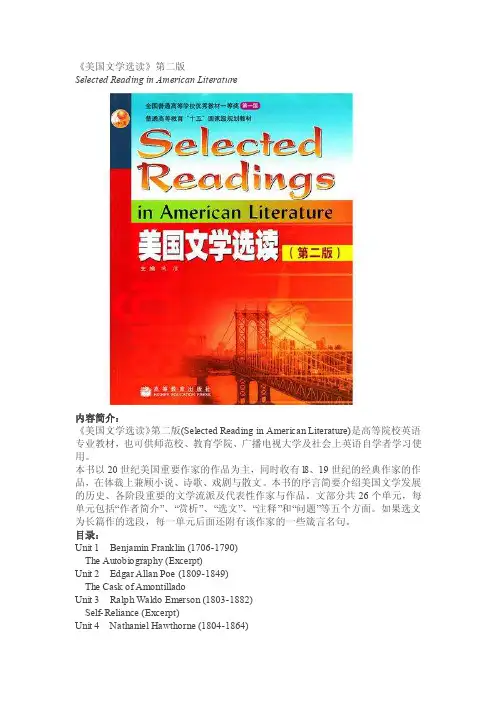
《美国文学选读》第二版Selected Reading in American Literature内容简介:《美国文学选读》第二版(Selected Reading in American Literature)是高等院校英语专业教材,也可供师范校、教育学院、广播电视大学及社会上英语自学者学习使用。
本书以20世纪美国重要作家的作品为主,同时收有l8、19世纪的经典作家的作品,在体裁上兼顾小说、诗歌、戏剧与散文。
本书的序言简要介绍美国文学发展的历史、各阶段重要的文学流派及代表性作家与作品。
文部分共26个单元,每单元包括“作者简介”、“赏析”、“选文”、“注释”和“问题”等五个方面。
如果选文为长篇作的选段,每一单元后面还附有该作家的一些箴言名句。
目录:Unit 1Benjamin Franklin (1706-1790)The Autobiography (Excerpt)Unit 2Edgar Allan Poe (1809-1849)The Cask of AmontilladoUnit 3Ralph Waldo Emerson (1803-1882)Self-Reliance (Excerpt)Unit 4Nathaniel Hawthorne (1804-1864)The Scarlet Letter-- Chapter 2Unit 5Herman Melville (1819-1891)Moby Dick -- Chapter 41Unit 6Henry David Thoreau (1817-1862) Walden -- Chapter 2 (Excerpt)Unit 719th-Century American PoetsHenry Wadsworth Longfellow (1807- 1882) Edgar Allan Poe (1809-1849)Walt Whitman (1819-1892)Emily Dickinson (1830-1886)Unit 8Mark Twain (1835-1910)The Celebrated Jumping Frog of Calaveras County Unit 9Henry James (1843-1916)The Jolly CornerUnit 10 Stephen Crane (1871-1900)The Open BoatUnit 11 Willa Cather (1873-1947)Miss JewettUnit 12 Sherwood Anderson (1876-1941)The Triumph of the EggUnit 13 Katherine Anne Porter (1890-1980)The Jilting of Granny Weatherall 143Unit 14 F.Scott Fitzgerald (1896-1940)The Great Gatsby -- Chapter 9Unit 15 William Faulkner (1897-1962)Barn BurningUnit 16 Ernest Hemingway (1899-1961)A Clean, Well-Lighted PlaceUnit 1720th-Century American Poets (I)Ezra Pound (1885-1972)Wallace Stevens (1879-1955)William Carlos Williams (1883-1963)Robert Frost (1874-1963)Langston Hughes (1902-1967)Archibald MacLeish (1892-1982)Unit 18Eugene Glastone O'Neill (1888-1953) Desire Under the Elms -- Scene IVUnit 19 Elwyn Brooks White (1899-1985)Once More to the LakeUnit 20Tennessee Williams (1911-1983)A Streetcar Named DesireUnit 21Ralph Waldo Ellison (1914-1994) Invisible Man -- ChapterUnit 2220th-Century American Poets (II)Robert Lowell (1917-1977) Elizabeth Bishop (1911-1979) ……Unit 23Arthur Miller(1915- ) Unit 24Saul Bellow(1915-2005) Unit 25 Joseph Heller(1923-1999) Unit 26 Toni Morrison(1931- )。
美国文学史及选读

美国文学史及选读
美国文学史及选读,作为一个有数百年歷史的文学流派,有许多伟大的作家,他们的作品塑造了美国文学的发展;最具有代表性的作者是乔治·梭罗,他的作品集中反映了美国社会和人文的发展;詹姆斯·菲茨杰拉德则有其独特的写作风格,表现出美国南方独特的生活理念;现代作家斯蒂芬·金则反映了现代社会的变化,以及老百姓们的故事;另外,特洛伊·萨索洛也有许多优秀的作品,如《失落的一代》,这部作品讲述了美国父辈们如何在战争中战胜同时又被战争毁灭了的故事。
此外,美国20世纪文学也有许多精彩作品,如厄休拉·哈里斯的《百年孤独》就反映了拉美社会发展的全貌;乔纳森·艾默生的《小妇人》描述了美国南方小镇的现实生活;詹姆斯理查德森的《春风沉醉的晚上》赢得了普利策奖,描述了一系列发生在美国农村的故事;克莱尔·麦卡锡更是凭借其《麦田里的守望者》荣膺诺贝尔文学奖,这本书反映了美国童年的美好。
当然,美国文学史不仅体现在各种优秀作品上,它生动有趣的故事也吸引了很多读者,如詹妮弗·洛夫的《歿日的比萨店》等,这些作品彰显着美国文学史所流行的特点:思想作家们对美国文化、宗教、历史和社会的深刻观察,以及深入探讨人性、价值和价值观念。
可以说,美国文学史和各种优秀作品是美国历史发展和发展潮流的最初考验,也是美国文学君主制以及点明美国道路的象征。
总而言之,美国文学史及选读有助于人们更好地了解美国文学,了解美国社会历史、文化现象,增进现代人的文化觉悟。
美国文学选读作家-作品
美国文学选读作家-作品UNIT【1-10】本杰明·富兰克林(Benjamin Franklin,1706—1790)1732年,他用笔名发表了《格言历书》(Poor Richard's Almanac),内容除历书之外还附有谚语,格言、警句,非常畅销,后作为系列出版物发行25年。
《自传》(The Autobiography)著于1771年至1790年,较为全面、生动而深刻地记载了他个人的生活经历,历来被公认为美国文学中的经典之作。
埃德加·爱伦·坡(Edgar Allan Poe,1809—1849)《帖木尔》(Tamerlane and Other Poems),诗集《艾尔·阿拉夫》(Al Araaf, 1829)《诗集》(Poems, 1831)和《乌鸦及其他诗篇》(The Raven and Other Poems, 1845) ,短篇小说方面的成就更为显著,尤其长于创作哥特式的小说和侦探小说《述异集》(Tales of the Grotesque and Arabesque, 1840)《故事集》(Tales, 1845)《厄舍古厦的倒塌》(“ T he Fall of the House of Usher”)、《红色死亡假面舞会》(“ The Masque of the Red Death”)、《莉盖亚》(“Ligeia”)、《黑猫》(“ The Black Cat”)、《阿芒提拉多的酒桶》(“ The Cask of Amontillado”)、《莫格街谋杀案》(“ Murders in the Rue Morgue”)、《被窃的信件》(“ The Purloined Letter”)和《金甲虫》(“ The Gold Bug”)。
他的侦探小说情节常跌宕起伏, 诡谲多变,结局常常是在情理之中而又在意料之外,人物城府深邃,个性分明,历来为人称道,一般认为他是西方侦探小说的开山鼻祖。
《美国文学作品选读》课程教学大纲
《美国文学作品选读》课程教学大纲、课程信息二、课程目标通过本课程的学习,学生应达成以下目标:1.运用所掌握的英语技能学习了解具体作家的文学生涯,创作思想,艺术特色和所属流派。
2.运用习得的学科技能理解代表作家的经典作品,并能分析评价作品的主题思想,人物形象,篇章结构、语言特点、修辞手法、文体风格,从而提高文学作品阅读鉴赏力。
3.掌握文学批评的基本知识和方法,对重要的文学术语有相当的了解并能在文学批评中加以运用。
4.了解西方文学及文化,提高对文化差异的敏感性、宽容性,培养对作品的洞察批判能力,从而丰富提升学生人文素养。
5.形成正确的人生观、世界观和价值观及较强的批判思维能力。
课程目标对毕业要求的支撑关系表三、教学内容与预期学习成效四、成绩评定及考核方式[1]陶洁.《美国文学选读》(第三版).北京:高等教育出版社,2011.1.主要参考书[1]常耀信.《美国文学简史》(第三版)南开大学出版社,2008.[2]刘海平、王守仁.《新编美国文学史》:上海外语教育出版社,2002.[3]隋刚.《美国文学旧作新读》.北京:外文出版社,1998.[4]常耀信.《漫话英美文学》.天津:南开大学出版社,2004.[5]杨金才.《新编美国文学史》(第三卷).上海外语教育出版社,2000.[6]童明.《美国文学史》.南京:译林出版社,2002.[7]董衡巽.《美国文学史》.北京:人民文学出版社,1986.[8]杨岂深,龙文佩.《美国文学选读》.上海:译文出版社,1985.[9]钱青等.《美国文学名著精选》,(上,下).商务印书馆,1995.[10]姜涛.《美国诗歌赏析》.北京:新华出版社,2006.[11]蒋洪新.《英美诗歌选读》.长沙:湖南师范大学出版社,2004.[12]吴伟仁.《美国文学史及选读》,(一、二册)(第一版).北京:外语教育与研究出版社,1998.[13]程爱民.《美国文学阅读教程》.南京:南京师范大学出版社,1999.[14]庞好农、陈许.《新编英美文学概论》.汕头:汕头大学出版社,2001.[15]常耀信.《美国文学选读》.天津:南开大学出版社,1991.[16]李正栓、李翠婷.《美国文学学习指南》.清华大学出版社,1998.[17]胡荫桐、刘树森.《美国文学教程》.天津:南开大学出版社,1995.。
英美文学选读---美国文学部分(作家作品)
Chapter I The Romantic Period 浪漫主义时期I. Washington Irving 华盛顿。
欧文1.The Letters of Jonathan Oldstyle, Gent.《江奈生。
欧德斯黛尔先生书信集》《江奈生。
欧德斯黛尔先生书信集》2.A History of New Y ork from the Beginning of the World to the End of the Dutch Dynasty 《自古至荷兰人占领为止的纽约史》人占领为止的纽约史》3. The Sketch Book of Geoffrey Crayon, Gent.《见闻札记》《见闻札记》4."Rip V an Winkle"《瑞普。
凡。
温克尔》《瑞普。
凡。
温克尔》5."The Legend of Sleepy Hollow."《睡谷的传说》《睡谷的传说》6.Bracebridge Hall 《布雷斯桥之厅堂》《布雷斯桥之厅堂》, 7.Tales of a Traveler 《一个旅行者的故事》《一个旅行者的故事》8.The Alhambra 《艾尔哈布拉》《艾尔哈布拉》II. Ralph Waldo Emerson 拉尔夫。
华尔多。
爱默生 1.Nature 《论自然》《论自然》2.The Dial 《日咎》《日咎》《日咎》3.Essays 《散文集》《散文集》4.The American Scholar,《论美国学者》《论美国学者》《论美国学者》 5.Self-Reliance, 《论自然》《论自然》6.The Over-Soul.《论超灵》《论超灵》《论超灵》 7.Second Series 《散文续集》II. Nathaniel Hawthorne 纳撒尼尔。
霍桑1.Twice-Told Tales 《尽人皆知的故事》《尽人皆知的故事》2.Mosses from an Old Manse 《古屋青苔》《古屋青苔》3.The Snow-Image and Other Twice-Told Tales 《雪的形象及其他尽人皆知的故事》《雪的形象及其他尽人皆知的故事》4.The Scarlet Letter 《红字》《红字》《红字》 5.The House of. the Seven Gables 《有七个尖角阁的房子》《有七个尖角阁的房子》6.The Blithedale Romance 《福谷传奇》《福谷传奇》《福谷传奇》 7.The Marble Faun 《玉石雕像》《玉石雕像》《玉石雕像》 8."Y oung Goodman Brown,"《小伙子布朗》《小伙子布朗》9."The Minister's Black V eil"《牧师的黑面纱》《牧师的黑面纱》10."The Birthmark"《胎迹》《胎迹》I V . Walt Whitman 华尔特。
陶洁《美国文学选读》(第3版)笔记和课后习题考研真题详解
陶洁《美国文学选读》(第3版)笔记和课后习题(含考研真题)详解攻重浩精研学习网提供资料第1单元本杰明•富兰克林1.1复习笔记I.Introduction to author(作者简介)Benjamin Franklin(1706—1790)was a rare genius in human history.He became everything: a printer,postmaster,almanac maker,essayist,scientist,inventor,orator,statesman, philosopher,political economist,ambassador,—“Jack of all trades.”本杰明·富兰克林(1706—1790)是人类历史上少有的天才。
他是出版家、邮政总长、历书作者、散文家、科学家、发明家、演说家、政治家、哲学家、政治经济学家、大使等等。
1.Life(生平)He was born into a poor family.He was a voracious reader.At16he published essays under the pseudonym Silence Dogood.At17he ran away to Philadelphia to make his own fortune. He became a printer.He helped found the Pennsylvania Hospital,an academy which led to the University of Pennsylvania,and the American Philosophical Society.He was a preeminent scientist of his day.He signed the Declaration of Independence.He was one of the makers of the new nation.富兰克林出生于一个贫穷的家庭。