
仁爱版七年级下册英语课件:Unit5 Topic1 Section A(共36页)
It’s time to work. I often go to work by bike.
bike car foot bus boat
by bike, by car, on foot, by bus, by boat, by plane
plane
train subway
by bike by bus by car
Review.
Welcome back to school, boys and girls. Happy New Good morning, Year! madam/sir! Happy New Year! / The same to you!
What’s the time?
It’s eight twenty-five./It’s twenty-five past eight.
Happy New Year! Nice to see you! How do you usually come/go to school?
I usually come/go to school by bus/subway..
2a
Work alone A.by subway B.by bike C.by plane D.on foot E.by car F.by train G.by ship D H E C G
C
D
A
B
A. He comes to school on foot. B. She goes to school by bus. C. He comes to school by bike. D. She goes to school by subway.
1C
Group work
Work in groups and practice 1a. Then make up a new conversation with the following structures..
(2) Learn other new words and phrases:
New words
2. Learn adverbs of frequency:
often, usually, always
3. Review the present simple tense.
—Do you often come to school by bike?
Kangkang: You mean you usually come to school by underground? Helen: You’re right. How about you, Jane? Jane : I always come to school by bus. Oh, it’s the time for class. Come on!
I go to school by bike. What about you?
How do you go to school?
I go to school on foot.
How does Lucy go to school?
She goes to school by bus.
1b. Read the sentences and choose the correct one for each picture.
Unit 5 Our school life!
Topic 1
I usually come to school by subway.
Section A
Teaching aims and demands
1.(1) Learn some ways of transportation:
by bike, by subway, by bus, on foot, by plane, by car, by train, by ship, by boat
by subway
on foot
by plane
1a
Look ,listen and say
Kangkang meets Jane and Helen at the school gate.
Kangkang: Happy New Year! Jane and Helen: The same to you. Nice to see you again, Kangkang. Kangkang: Nice to see you, too. Helen: Oh, your new bike looks very nice!
—Yes. I do./No, I don’t. 4. Talk about how to go to school. —How do you usually come to school? —I usually come to school by subway./
I always come to school by bus.
A F B
H.by bus
I .by boat
Listen and match.
Kangkang: Thank you. Helen: Do you often come to school by bike. Kangkang: Yes, I do. How do you usually come to school? Helen: I usually come to school by subway.
Read 1a again and find out the answers to the questions:
(1)Where do Kangkang, Jane and Helen meet? They meet at the school gate. (2)How does Helen usually come to school? Helen usually comes to school by subway. (3)How does Jane usually come to school? Jane always comes to school by bus.
仁爱版七年级下册英语课件Unit5Topic1SectionB共31张PPT

( C )3.My brother often ______ TV at home on Sundays. A.Sees B.looks C.watches
看图片,编对话
Fill in the blanks after the example.
We usually go to the park on foot . We usually __w__al_k_ to the park.
Fill in the blanks after the example.
They always go to the zoo by bus. They always ___ta_k_e__a___ b_u_s___to the zoo.
Activity walk to school
Frequency
always
take a bus to school
usually
often
√
sometimes
√
seldom never
do her homework in the evening
√
Listen and check (√) the correct answers.
频度副词在句中的位置
1.放在be动词、情态动词、助动词之后, 实义动词之前。
My father is always busy.
Jack doesn't often help his mother cook.
2.有时也可以放在句首、句尾。 Sometimes I go to school by bus. I walk to school sometimes .
仁爱版英语七年级下册 Unit5 Topic1 Section A 教案设计
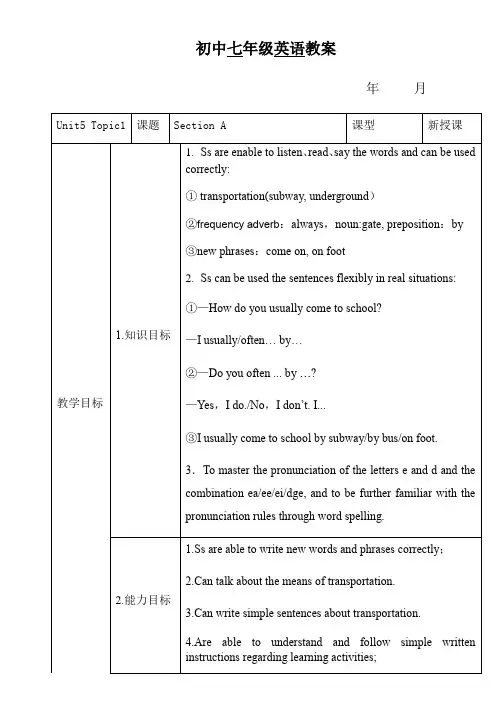
4.Are ableto understand and follow simple written instructions regarding learning activities;
3.情感目标
Cultivate a spirit of friendship and mutual assistance;
e.g.
A: Happy New Year!
B: The same to you. Nice to see you again.
A: Nice to see you, too.
B: Do you go to school by bike?
A: Yes. What about you? How do you often go to school?
②frequencyadverb:always,noun:gate, preposition:by
③new phrases:come on, on foot
2.Ss can be used the sentences flexibly in real situations:
①—How do you usually come to school?
5.Try to read the words in 3b. Circle the words with the sound /i:/ or /e/ individually. Then listen to the tape and check the answersin pairs.
Ⅴ.Make a report and conversation:(10 minutes)
仁爱英语七年级下册Unit5_Topic1_SectionA_优教精品课件

二、句型转换 1. It’s time for breakfast.(同义句转换) It’s time __to____ _h_a_v_e__ breakfast. 2. They go home by subway.(同义句转换) They go home ___b_y__u_n_d_e_r_g_ro_u_n_d_. 3. My sister goes to school by train.(对画线部分提问) _H__o_w__ _d_o_e_s__ your sister go to school?
D. She goes to school by subway.
Choose correct answers according to 1b.
A. by bus B. by bike C. on foot D. by subway/ underground
Kangkang comes to school ___B____. Jane comes to school ___A____. Helen comes to school ___D____. Michael comes to school____C____.
Homework
1. 登录“优教 同步学习网”完成 SectionA随 堂练习。 2. Review the means of transportation. 3. Read the sounds and words in 3a. 4. Memorize the new words.
2.—_D_o_ you often come to school _b_y_ bike? —Yes, I do.
3.—_H_o_w_ do you usually come to school? —I usually come to school _b_y_ subway.
仁爱英语七下Unit5Topic3SectionA课件

Key vocabulary and phrase explanations
Key Vocabulary
Effective communication : The ability to communicate clearly and honestly with your partner
Healthy romantic relationship : a relationship that is emotionally and physically satisfying for both partners
Overview of teaching content
Unit 4
Business English - prepare learners for the language demands of the workplace, covering areas such as emails, reports, meetings, and negotiations
Arranging grammar points in a logical order to facilitate learning and understanding
Example of using grammar points
Giving examples of real life situations where the grammar point can be applied
It focuses on enhancing learners' ability to communicate effectively in English through a variety of speaking, listening, reading, and writing activities
Unit 5 Topic 1 Section B(22页)仁爱版七年级下册英语课件

Read 1a again and fill in the blanks.
Helen: Michael,what time do you usually _g_e_t _u_p__?(起床) Michael: I always get up _a_t about six o'clock. Helen: The early bird catches the worm. _H_o_w_do you usually come to school? Michael: I usually come to schoolo_n__fo_o_t, but _so_m__e_ti_m_e_sby bike. How about you ? Helen: I _s_e_l_d_o_m_ walk to school . I _o_f_t_en___ come by subway. What about you Sally? Sally: I _n_e_v_e_r _come to school by subway. I _a_lw__ay_s_ take a bus.
Hale Waihona Puke Activity watch TV in Frequency the afternoon
always
usually
often
sometimes
seldom
never
√
play soccer on Sundays
√
see a movie √
课堂总结
We learn: 1. some words: weekday, early, bird, catch, seldom, walk, never, ride, park, watch 2. some phrases: take a bus/car, do one’s homework watch TV, see a movie, play soccer 3. some sentences: The early bird catches the worm. I never come to school by subway.
仁爱版七年级下册英语课件:Unit5 Topic3 Section D(共31页)

Present Continuous I am reading an English book.
They are having a music class. I think they are having an English class.
Functions
_______ What ________ class are they having? They are having a music class. _______ What ________ time does the next class begin? At ten fifty. _______ How ________ many English lessons does he have every week? Five. I don’t like it. It's a little difficult. My school life is very interesting. At school, My teachers and classmates are very kind to me.
Unit 5 Our school life! Topic 3 My school life is very interesting . Section D
Teaching aims and demands 1.Learn the vowels: //, //, //, //, // 2.Learn new words:
Listen to the conversations and complete the table.
Name Day Activity Place playground library
have a P.E. class Kangkang Wednesday /play soccer Maria Li Yang Ellen Monday Sunday read books
Unit 5 Topic 1 Section A(29页)仁爱版七年级下册英语课件
02 新 课 讲 授
What are these?
bike
car
What are these?
subway/underground
bus
What are these?
boat
ship
骑自行车 by bike
(1) look“看起来,好像”,是系动词,后加形容词。 e.g. She looks very beautiful. 她看起来很漂亮。 (2) look 用作行为动词,表示“看”,当后面要跟宾语时,必须要跟介词at。 (3) look 还可以做名词,表示“外貌,长相”。 (4) 与look有关的短语: look at… =have a look at…看一看 look like 看起来像 look the same 看起来一样
I usually come to school by subway.
04 当 堂 检 测
一、根据句意及汉语提示,完成句子 1. Let’s meet at the school gate (大门口). 2. Look at that nice boat (小船). That’s my uncle’s. 3. Mr. Ge often goes to Canada by plane (飞机). 4. Do you usually come to Jinan by train (火车)? 5. Jim wants to go to Shanghai from Chongqing by ship (轮船).
Enjoy the பைடு நூலகம்ideo
Listen again and answer the questions.
仁爱版英语七年级下册 第五单元 知识点汇总
Unit5 Topic1Section A1.在学校大门口at the school gate2.来/去学校come/ go to school3.上课have class / have classes4.步行on foot骑自行车by bike坐公交by bus坐地铁by subway坐飞机by plane坐小汽车by car坐轮船by ship坐小船by boat坐火车by train5.该做某事了It’s time for sth./doing sth.=It’s time to do sth.6.加油,快点,来吧come onby +交通工具单数还可以替换成:in/on + a/an/the/one’s+交通工具单数(on foot除外)by car= in a car by bike=on his bikeby bus=on the bus by plane=on the planeby subway=on the subway by ship/boat=on the ship/boat by train= on the train 记忆小技巧:除了car是in,其他都是on;公共交通工具是the,其他的可以是a/an或所有格重点句子1. 你也一样The same to you.2. 你的新自行车看起来非常漂亮!谢谢!Your new bike looks very nice! Thank you.3. 你经常骑自行车来上学吗?Do you often come to school by bike?4. 你/他通常如何来上学?乘地铁。
How do/does you/he usually come to school?I/ He usually come/comes to school by subway.5. 你呢?How/ What about you?6. 该上课了。
It’s time for class.=It’s time for having class.=It’s time to have class.7. 他步行来上学。
仁爱版七年级下册Unit5 Topic1-3【复习课件】-2023年中考英语一轮大单元复习(仁爱版)
05
高频话题写作点拨 PART FIVE
PART ONE基础知识过过过
➢ 重点单词
星期相关
1.____w_e_e_k___星期,周
2.____M__o_n_d_a_y__星期一
3.__T_u_e_s_d__a_y_星期二
4.__W__e_d_n_e_s_d_a__y星期三
5._T__h_u__r_sd__a_y星期四
n.小船,舟
[bəʊt]
n.工作日
['wiːkdeɪ]
adj.早的;提早的adv.
早地;提早
['ɜːli]
n.鸟
[bɜːd]
PART ONE基础知识过过过
catch
worm
sometimes seldom walk never ride
v.捉住;接住;染上
(疾病)
[kætʃ]
n.软体虫,蠕虫(尤指
use
look for
v.跑,奔跑 v.& n.跳舞 v.借,借用 n.练习册 n.过程;课程 当然
[rʌn] [dɑːns] [ˈbɒrəʊ]
[kɔːs] [ɒv//kɔːs]
V.用,使用n.用,使用 [juːz]
寻找
['lʊkfər]
PART ONE基础知识过过过
shelf
Unit 5 Topic 2
make card boring soon classroom playground lab computer
v.做,制造;使成为 n.卡片;贺卡 adj.没趣的,无聊的 adv.很快,马上 n.教室 n.操场 n.实验室=laboratory n.计算机;电脑
[meɪk] [kɑːd] ['bɔːrɪŋ] [suːn] ['klɑːsrʊm]
2020年仁爱版英语七年级下册Unit5 Topic1 动词课件(共32张PPT)
go
go 做“去”的时候,与come的用法一样 go to +地点 表示去某个地方 当遇到home,there 这些点副词前面不加to。 如: He usually _g_o_e_s _t_o Beijing by plane. 他通常乘飞机去北京。 They usually __g_o_ t_o_ Beijing by plane. Miss Wang usually __g__o_e_s home on foot. He doesn't want to ___g_o___there, because it's too far from his home.
①She _c_o_m__es_ _t_o_ school by bike.她骑自行车去上学。 ②You mean(that) you usually _c_o_m__e_ _t_o_ school by underground. 你的意思是,你通常乘地铁去学校。
总结:come to +地点,表示到某个地方去。
We train them to make use of reference booa_t_c_h____ The early bird _c_a__tc_h__e_s_ the worm.早起的鸟儿捉虫。 The cat _c__a_tc_h__e_s__ a big mouse.那只猫捉住了一只大老鼠。 They ___c_a_t_c_h___ the thief(贼) quickly.他们很快抓住了那个贼。
练习
1._D__o_______you usually _c_o_m_e_/_g_o___t_o__school by bike? 你通常骑自行车去学校吗? 2.___D_o_e_s____Xiaohua usually _c_o_m__e_/g__o___to__school by underground? 小华通常乘地铁去学校吗? 3.Li Ping usually go to school by bus but she __d_o_e_s_n_'t___