
故宫的英文介绍
故宫的英文介绍What strikes one first in a bird's -eye view of Beijing proper is a vast tract of golden roofs flashing brilliantly in the sun with purple walls occasionally emerging amid them and a stretch of luxuriant tree leaves flanking on each side. That is the former Imperial Palace, popularly known as the Forbidden City, from which twenty-four emperors of the Ming and Qing Dynasties ruled China for some 500 years——from1420 to 1911. The Ming Emperor Yong Le, who usurped the throne from his nephew and made Beijing the capital, ordered its construction, on which approximately 10,000 artists and a million workmen toiled for 14 years from 1406 to 1420. At present, the Palace is an elaborate museum that presents the largest and most complete ensemble of traditional architecture complex and more than 900,000 pieces of court treasures in all dynasties in China.Located in the center of Beijing, the entire palace area, rectangular in shape and 72 hectares in size, is surrounded by walls ten meters high and a moat 52 meters wide. At each corner of the wall stands a watchtower with a double-eave roof covered with yellow glazed tiles.The main buildings, the six great halls, one following the other, are set facing south along the central north-south axis from the Meridian Gate, the south entrance, to Shenwumen, the great gate piercing in the north wall. On either side of the palace are many comparatively smallbuildings. Symmetrically in the northeastern section lie the six Eastern Palaces and in the northwestern section the six Western Palaces. The Palace area is divided into two parts: the Outer Court and the Inner Palace. The former consists of the first three main halls, where the emperor received his courtiers and conducted grand ceremonies, while the latter was the living quarters for the imperial residence. At the rear of the Inner Palace is the Imperial Garden where the emperor and his family sought recreation.The main entrance to the Palace is the Meridian Gate(1), which was so named because the emperor considered himself the "Son of the Heaven" and the Palace the center of the universe, hence thenorth-south axis as the Meridian line going right through the Palace. The gate is crowned with five towers, commonly known as the Five-Phoenix Towers(2), which were installed with drums and bells. When the emperor went to the Temple of Heaven, bells were struck to mark this important occasion. When he went to the Ancestral Temple, it was the drums that were beaten to publicize the event.Beyond the Meridian Gate unfolds a vast courtyard across which the Inner Golden Water River runs from east to west. The river is spanned by five bridges, which were supposed to be symbols of the five virtues preached by Confucius——benevolence, righteousness, rites, intelligence, and fidelity(3).At the north end of the courtyard is a three-tiered white marble terrace, seven meters above the ground, on which, one after another, stand three majestic halls; the Hall of Supreme Harmony(4), the Hall of Complete Harmony(5), and the Hall of Preserving Harmony(6).The Hall of Supreme Harmony, rectangular in shape, 27 meters in height, 2,300 square meters in area, is the grandest and most important hall in the Palace complex. It is also China's largest existing palace of wood structure and an outstanding example of brilliant color combinations. This hall used to be the throne hall for ceremonies which marked great occasions: the Winter Solstice, the Spring Festival, the emperor's birthday and enthronement, and the dispatch of generals to battles, etc. On such occasions there would be an imperial guard of honor standing in front of the Hall that extended all the way to the Meridian gate.On the north face of the hall in the center of four coiled-golden dragon columns is the "Golden Throne", which was carved out of sandalwood. The throne rests on a two-meter-high platform with a screen behind it. In front of it, to the left and right, stand ornamental cranes, incense burners and other ornaments. The dragon columns entwined with golden dragons measure one meter in diameter. The throne itself, the platform and the screen are all carved with dragon designs. High above the throne is a color-painted coffered ceiling whichchanges in shape from square to octagonal to circular as it ascends layer upon layer. The utmost central vault is carved with the gilded design of a dragon toying with pearls. when the Emperor mounted the throne, gold bells and jade chimes sounded from the gallery, and clouds of incense rose from the bronze cranes and tortoises and tripods outside the hall on the terrace. The aura of majesty created by the imposing architecture and solemn ritual were designed to keep the subjects of the "Son of the Heaven" in awe and reverence.The Hall of Complete Harmony is smaller and square with windows on all sides. Here the emperor rehearsed for ceremonies. It is followed by the Hall of Preserving Harmony in which banquets and imperial examinations were held.Behind the Hall of Preserving Harmony lies a huge marble ramp with intertwining clouds and dragons carved in relief. The slab, about 6.5 meters long, 3 meters wide and 250 tons in weight, is placed between two flights of marble steps along which the emperor's sedan was carried up or down the terrace. It is the largest piece of stone carving in the Imperial Palace. Quarried in the mountains scores of kilometers southwest of Beijing, this gigantic stone was moved to the city by sliding it over a specially paved ice road in winter. To provide enough water to build the ice road, wells were sunk at very 500 meters along the way.The three halls of the Inner Palace are replicas of the three halls in the front, but smaller in size. They are the Palace of Heavenly Purity(7), the Hall of Union(8), and the Palace of Earthly Tranquility(9).The Palace of Heavenly Purity was once the residence of the Ming emperors and the first two of the Qing emperors. Then the Qing Emperor Yong Zheng moved his residence to the Palace of Mental Cultivation and turned it into an audience hall to receive foreign envoys and handled the state affairs. The promotion and demotion of officials were also decided in this hall. After the emperor's death his coffin was placed here for a 49-day period of mourning.The Palace of Union was the empress's throne room and the Hall of Earthly Tranquility, once a private living room for the empress, was partitioned. The west chamber served religious purposes and the east one was the bridal chamber where the newly married emperor and empress spent their first two nights after their wedding.The Imperial Garden was laid out during the early Ming dynasty. Hundreds of pines and cypresses offer shade while various flowers give colors to the garden all year round and fill the air with their fragrance. In he center of the garden is the Hall of Imperial Peace, a Daoist temple, with a flat roof slightly sloping down to the four eaves. This type of roof was rare in ancient Chinese architecture. In he northeastern corner of the garden is a rock hill, known as the Hill of the Piled-up Wonders,which is topped with a pavilion. At the foot of the hill are two fountains which jet two columns of water high into the air. It is said that on the ninth night of the ninth month of the lunar calendar, the empress would mound the hill to enjoy the autumn scene. It is also believed that climbing to a high place on that day would keep people safe from contagious diseases.The six Western Palaces were residences for empresses and concubines. They are kept in their original way for show. The six Eastern Palaces were the residences for them too. But now they serve as special museums: the Museum of Bronze, the Museum of Porcelain and the Museum of Arts and Crafts of the Ming and Qing dynasties. In the northeastern-most section of the Inner Palace are the Museum of Traditional Chinese Paintings and the Museum of Jewelry and Treasures where rare pieces of imperial collections are on display.Now the Forbidden City is no longer forbidding, but inviting. A visit to the Palace Museum will enrich the visitors' knowledge of history, economy, politics, arts as well as architecture in ancient China.Notes:1. the Meridian Gate 午门2. the Five-Phoenix Towers 五凤楼3. benevolence, righteousness, rites, intelligence, and fidelity 仁、义、礼、智、信4. the Hall of Supreme Harmony 太和殿5. the Hall of Complete Harmony 中和殿6. the Hall of Preserving Harmony 保和殿7. the Palace of Heavenly Purity 乾清宫8. the Hall of Union 交泰殿9. the Palace of Earthly Tranquility 坤宁宫。
介绍故宫的英文作文
介绍故宫的英文作文介绍故宫的英文作文想必大家都知道故宫吧,那么,用英文如何介绍故宫呢?下面请看小编给大家整理收集的介绍故宫的英文,供大家阅读参考。
介绍故宫的英文作文1What strikes one first in a bird's -eye view of Beijing proper is a vast tract of golden roofs flashing brilliantly in the sun with purple walls occasionally emerging amid them and a stretch of luxuriant tree leaves flanking on each side. That is the former Imperial Palace, popularly known as the Forbidden City, from which twenty-four emperors of the Ming and Qing Dynasties ruled China for some 500 years——from1420 to 1911. The Ming Emperor Yong Le, who usurped the throne from his nephew and made Beijing the capital, ordered its construction, on which approximately 10,000 artists and a million workmen toiled for 14 years from 1406 to 1420. At present, the Palace is an elaborate museum that presents the largest and most complete ensemble of traditional architecture complex and more than 900,000 pieces of court treasures in all dynasties in China.Located in the center of Beijing, the entire palace area, rectangular in shape and 72 hectares in size, is surrounded by walls ten meters high and a moat 52 meters wide. At each corner of the wall stands a watchtower with a double-eave roof covered with yellow glazed tiles.The main buildings, the six great halls, one following the other, are set facing south along the central north-south axis from the Meridian Gate, the south entrance, to Shenwumen, the great gate piercing in the north wall. On either side of the palace are many comparatively small buildings. Symmetrically in thenortheastern section lie the six Eastern Palaces and in the northwestern section the six Western Palaces. The Palace area is divided into two parts: the Outer Court and the Inner Palace. The former consists of the first three main halls, where the emperor received his courtiers and conducted grand ceremonies, while the latter was the living quarters for the imperial residence. At the rear of the Inner Palace is the Imperial Garden where the emperor and his family sought recreation.The main entrance to the Palace is the Meridian Gate(1), which was so named because the emperor considered himself the "Son of the Heaven" and the Palace the center of the universe, hence the north-south axis as the Meridian line going right through the Palace. The gate is crowned with five towers, commonly known as the Five-Phoenix Towers(2), which were installed with drums and bells. When the emperor went to the Temple of Heaven, bells were struck to mark this important occasion. When he went to the Ancestral Temple, it was the drums that were beaten to publicize the event.Beyond the Meridian Gate unfolds a vast courtyard across which the Inner Golden Water River runs from east to west. The river is spanned by five bridges, which were supposed to be symbols of the five virtues preached by Confucius——benevolence, righteousness, rites, intelligence, and fidelity(3).At the north end of the courtyard is a three-tiered white marble terrace, seven meters above the ground, on which, one after another, stand three majestic halls; the Hall of Supreme Harmony(4), the Hall of Complete Harmony(5), and the Hall of Preserving Harmony(6).The Hall of Supreme Harmony, rectangular in shape, 27 meters in height, 2,300 square meters in area, is the grandest andmost important hall in the Palace complex. It is also China's largest existing palace of wood structure and an outstanding example of brilliant color combinations. This hall used to be the throne hall for ceremonies which marked great occasions: the Winter Solstice, the Spring Festival, the emperor's birthday and enthronement, and the dispatch of generals to battles, etc. On such occasions there would be an imperial guard of honor standing in front of the Hall that extended all the way to the Meridian gate.On the north face of the hall in the center of four coiled-golden dragon columns is the "Golden Throne", which was carved out of sandalwood. The throne rests on a two-meter-high platform with a screen behind it. In front of it, to the left and right, stand ornamental cranes, incense burners and other ornaments. The dragon columns entwined with golden dragons measure one meter in diameter. The throne itself, the platform and the screen are all carved with dragon designs. High above the throne is a color-painted coffered ceiling which changes in shape from square to octagonal to circular as it ascends layer upon layer. The utmost central vault is carved with the gilded design of a dragon toying with pearls. when the Emperor mounted the throne, gold bells and jade chimes sounded from the gallery, and clouds of incense rose from the bronze cranes and tortoises and tripods outside the hall on the terrace. The aura of majesty created by the imposing architecture and solemn ritual were designed to keep the subjects of the "Son of the Heaven" in awe and reverence.The Hall of Complete Harmony is smaller and square with windows on all sides. Here the emperor rehearsed for ceremonies. It is followed by the Hall of Preserving Harmony in whichbanquets and imperial examinations were held.Behind the Hall of Preserving Harmony lies a huge marble ramp with intertwining clouds and dragons carved in relief. The slab, about 6.5 meters long, 3 meters wide and 250 tons in weight, is placed between two flights of marble steps along which the emperor's sedan was carried up or down the terrace. It is the largest piece of stone carving in the Imperial Palace. Quarried in the mountains scores of kilometers southwest of Beijing, this gigantic stone was moved to the city by sliding it over a specially paved ice road in winter. To provide enough water to build the ice road, wells were sunk at very 500 meters along the way.The three halls of the Inner Palace are replicas of the three halls in the front, but smaller in size. They are the Palace of Heavenly Purity(7), the Hall of Union(8), and the Palace of Earthly Tranquility(9).The Palace of Heavenly Purity was once the residence of the Ming emperors and the first two of the Qing emperors. Then the Qing Emperor Yong Zheng moved his residence to the Palace of Mental Cultivation and turned it into an audience hall to receive foreign envoys and handled the state affairs. The promotion and demotion of officials were also decided in this hall. After the emperor's death his coffin was placed here for a 49-day period of mourning.The Palace of Union was the empress's throne room and the Hall of Earthly Tranquility, once a private living room for the empress, was partitioned. The west chamber served religious purposes and the east one was the bridal chamber where the newly married emperor and empress spent their first two nights after their wedding.The Imperial Garden was laid out during the early Mingdynasty. Hundreds of pines and cypresses offer shade while various flowers give colors to the garden all year round and fill the air with their fragrance. In he center of the garden is the Hall of Imperial Peace, a Daoist temple, with a flat roof slightly sloping down to the four eaves. This type of roof was rare in ancient Chinese architecture. In he northeastern corner of the garden is a rock hill, known as the Hill of the Piled-up Wonders, which is topped with a pavilion. At the foot of the hill are two fountains which jet two columns of water high into the air. It is said that on the ninth night of the ninth month of the lunar calendar, the empress would mound the hill to enjoy the autumn scene. It is also believed that climbing to a high place on that day would keep people safe from contagious diseases.The six Western Palaces were residences for empresses and concubines. They are kept in their original way for show. The six Eastern Palaces were the residences for them too. But now they serve as special museums: the Museum of Bronze, the Museum of Porcelain and the Museum of Arts and Crafts of the Ming and Qing dynasties. In the northeastern-most section of the Inner Palace are the Museum of Traditional Chinese Paintings and the Museum of Jewelry and Treasures where rare pieces of imperial collections are on display.Now the Forbidden City is no longer forbidding, but inviting.A visit to the Palace Museum will enrich the visitors' knowledge of history, economy, politics, arts as well as architecture in ancient China.介绍故宫的英文作文2Situated in the western outskirts of Haidian District, the Summer Palace is 15 kilometers (9.3 miles) from central Beijing. Having the largest royal park and being well preserved, it wasdesignated, in 1960 by the State Council, as a Key Cultural Relics Protection Site of China. Containing examples of the ancient arts, it also has graceful landscapes and magnificent constructions. The Summer Palace is the archetypal Chinese garden, and is ranked amongst the most noted and classical gardens of the world. In 1998, it was listed as one of the World Heritage Sites by UNESCO.Constructed in the Jin Dynasty (1115-1234), during the succeeding reign of feudal emperors; it was extended continuously. By the time of the Qing Dynasty (1644-1911), it had become a luxurious royal garden providing royal families with rest and entertainment. Originally called 'Qingyi Garden' (Garden of Clear Ripples), it was know as one of the famous 'three hills and five gardens' (Longevity Hill, Jade Spring Mountain, and Fragrant Hill; Garden of Clear Ripples, Garden of Everlasting Spring, Garden of Perfection and Brightness, Garden of Tranquility and Brightness, and Garden of Tranquility and Pleasure). Like most of the gardens of Beijing, it could not elude the rampages of the Anglo-French allied force and was destroyed by fire. In 1888, Empress Dowager Cixi embezzled navy funds to reconstruct it for her own benefit, changing its name to Summer Palace (Yiheyuan). She spent most of her later years there, dealing with state affairs and entertaining. In 1900, it suffered again, being ransacked by the Eight-Power Allied Force. After the success of the 1911 Revolution, it was opened to the public.Composed mainly of Longevity Hill and Kunming Lake, The Summer Palace occupies an area of 294 hectares (726.5 acres), three quarters of which is water. Guided by nature, artists designed the gardens exquisitely so that visitors would see marvelous views and be amazed by perfect examples of refinedcraftwork using the finest materials.Centered on the T ower of Buddhist Incense (Foxiangge) the Summer Palace consists of over 3,000 structures including pavilions, towers, bridges, and corridors. The Summer Palace can be divided into four parts: the court area, front-hill area, front-lake area, and rear-hill and back-lake area.Front-Hill Area: this area is the most magnificent area in the Summer Palace with the most constructions. Its layout is quite distinctive because of the central axis from the yard of Kunming Lake to the hilltop, on which important buildings are positioned including Gate of Dispelling Clouds, Hall of Dispelling Clouds, Hall of Moral Glory, Tower of Buddhist Incense, the Hall of the Sea of Wisdom, etc.Rear-Hill and Back-Lake Area: although the constructions are fewer here, it has a unique landscape, with dense green trees, and winding paths. Visitors can feel a rare tranquility, and elegance. This area includes scenic spots such as Kunming Lake and Back Lake , which presents a tranquil beauty, Garden of Harmonious Interest , built by imitating the layout of Southern China’s classical gardens, and Suzhou Market Street, endowed with a strong flavor of the water town Suzhou.Court Area: this is where Empress Dowager Cixi and Emperor Guangxu met officials, conducted state affairs and rested. Entering the East Palace Gate, visitors may see the main palace buildings: the Hall of Benevolence and Longevity served as the office of the Emperor, the Hall of Jade Ripples where Guangxu lived, the Hall of Joyful Longevity, Cixi's residence, the Garden of Virtue and Harmony where Cixi was entertained, Yiyun House , where once lived the Empress Longyu, and Long Gallery, which measures the longest in Chinese gardens.Front Lake Area: covering a larger part of the Summer Palace, opens up the vista of the lake. A breeze fluttering, waves gleam and willows kiss the ripples of the vast water. In this comfortable area there are the Eastern Bank and Western Bank, Seventeen-Arch Bridge, Nanhu Island, the largest island in Summer Palace, Bronze Ox, an imposing statue beside the lake, and Marble Boat, built in western style with elaborate decorations . On the western bank float six distinct bridges amongst which the Jade-Belt Bridge is the pretty!介绍故宫的英文作文3The Palace Musieum is also known as "forbbitom City which was built in 1408 . it took 14 years for twenty thousand workers to finish the constraction. it covers an area of 720000 square meters. And it is also one of the five greatest imperial palaces in the world.There are 9999 rooms in the whole Palace. In China the figure 9 is traditionally considered a lucky one.Nowadays, every Tuesday the palace is open to Chinese students without charge.In the Palace, there are treasures with history of 5000 years. It is a 'must' for the visitors both home and abroad. I have been very happy since I knew that you would come to Beijing for travelling. Please let me know when you arrive here so that I will be ready to be your guide.。
介绍故宫英语作文
The Imperial Palace Museum, the beautiful scenery everywhere, not to say that, I hope you have a chance to appreciate.
雄伟壮观的故宫博物院是世界闻名的皇家建筑群之一。
走进天安门,经过端门,午门,就来到太和门,一座高大的宫殿展现在我的眼前,这就是皇上办公的太和殿,经过太和殿就来到中和殿,过了中和殿就是保和殿。每个殿都有朱红的宫墙和大门,屋顶上盖的是黄色的琉璃瓦。过了保和殿,再拐个弯,就看到一个小门,进了门,向右看,就看见九龙壁,九龙壁上刻着九条龙,它们的颜色分别是白,蓝,黄,黑四种,它们的形状各异,没有哪两条是相同的。过了九龙壁,再从左边小门进去,就来到钟表室。当我进入钟表室时,我不禁愕然,分明是来到钟的王国,钟的海洋,大大小小的古钟鳞次栉比,琳琅满目,有红木人物风扇钟,铜镀金绿鲨鱼皮天文钟,铜壶滴漏,硬木雕花自名钟等,一共有钟表1000多种。过了钟表室,转个圈儿就来到御花园,御花园景色优美,四季都有花开,这一种花还没有谢,那一种又开了。花园中间有个假山,在周围小草的掩映下,假山更漂亮了。
旅游景点英文介绍:故宫
旅游景点英文介绍:故宫旅游景点英文介绍:故宫作为一位中国人,你对我们的故宫了解多少?面对外国友人,你要如何介绍这座古都?下面这篇英文阅读也许可以帮到你。
此外,还有更多精彩阅读尽在店铺。
FORBIDDEN CITY(紫禁城)(In front of the meridian gate)Ladies and Gentlemen:I am pleased to serve as your guide today.This is the palace museum; also know as the Purple Forbidden City. It is the largest and most well reserved imperial residence in China today. Under Ming Emperor Yongle, construction began in 1406. It took 14years to build the Forbidden City. The first ruler who actually lived here was Ming Emperor Zhudi. For five centuries thereafter, it continued to be the residence of23 successive emperors until 1911 when Qing Emperor Puyi was forced to abdicate the throne .In 1987, the United Nations Educational, Scientific and Cultural Organization recognized the Forbidden City was a world cultural legacy.It is believed that the Palace Museum, or Zi Jin Cheng (Purple Forbidden City), got its name from astronomy folklore, The ancient astronomers divided the constellations into groups and centered them around the Ziwei Yuan(North Star). The constellation containing the North Star was called the Constellation of Heavenly God and star itself was called the purple palace. Because the emperor was supposedly the son of the heavenly gods, his central and dominant position would be further highlighted the use of the word purple in the name of his residence. In folklore, the term ”an eastern purple cloud isdrifting” became a metaphor for auspicious even ts after a purple cloud was seen drifting eastward immediately before the arrival of an ancient philosopher, LaoZi, to the Hanghu Pass. Here, purple is associated with auspicious developments. The word jin (forbidden) is self-explanatory as the imperial palace was heavily guarded and off-explanatory as the imperial palace was heavily guarded and off-limits to ordinary people.The red and yellow used on the palace walls and roofs are also symbolic. Red represents happiness, good fortune and wealth. Yellow is the color of the earth on the Loess Plateau, the original home of the Chinese people. Yellow became an imperial color during the T ang dynasty, when only members of the royal family were allowed to wear it and use it in their architecture.The Forbidden City is rectangular in shape. It is 960 meters long from north to south and 750 meter wide from east west. It has 9,900 rooms under a total roof area 150,000 square meters .A 52-meter-wide-moat encircles a 9.9-meter—high wall which encloses the complex. Octagon —shaped turrets rest on the four corners of the wall. There are four entrances into the city: the Meridian Gate to the south, the Shenwu Gate(Gate of Military Prowess) to the north, and the Xihua Gate(Gate of military Prowess) to the north, and the Xihua Gate(Western Flowery Gate )to the west ,the Donghua (Eastern Flowery Gate) to the east.Manpower and materials throughout the country were used to build the Forbidden City. A total of 230,000 artisans and one million laborers were employed. Marble was quarried from fangshan Country Mount Pan in Jixian County in Hebei Province. Granite was quarried in Quyang County in Hebei Province. Paving blocks were fired in kilns in Suzhou in southern China. Bricks and scarlet pigmentation used on the palatial walls came from linqingin Shandong Province .Timber was cut ,processed and hauled from the northwestern and southern regions.The structure in front of us is the Meridian Gate. It is the main entrance to the forbidden City. It is also knows as Wufenglou(Five-Phoenix Tower). Ming emperors held lavish banquets here on the 15th day of the first month of the Chinese lunar year in hornor of their counties .They also used this place for punishing officals by flogging them with sticks.Qing emperors used this building to announce the beginning of the new year. Qing Emperor Qianglong changed the original name of this announcement ceremony from ban li(announcement of calendar)to ban shou(announcement of new moon )to avoid coincidental association with another Emperor` s name, Hongli, which was considered a taboo at that time. Qing Dynasty emperors also used this place to hold audience and for other important ceremonies. For example,when the imperial army returned victoriously from the battlefield ,it was here that the Emperor presided over the ceremony to accept prisoners of war.(After entering the Meridian Gate and standing in front of the Five Marble Bridges on Golden Water River)now we are inside the Forbidden City.Before we start our tour, I would like to briefly introduce you to the architectural patterns befour us .To complete this solemn, magnificent and palatial complex, a variety of buildings were arranged on a north-south axis, and 8-kilometer-long invisible line that has become an inseparable part of the City of Beijing. The Forbidden City covers roughly one –third of this central axis. Most of the important building in the Forbidden City weree arranged along this line. The design and arrangement of the palaces reflect the solemn dignityof the royal court and rigidly –stratified feudal system.The Forbidden City is divided into an outer and an inner count.We are now standing on the southernmost part of the outer count. In front of us lies the Gate of supreme Harmony .The gate is guarded by a pair of bronze lions ,symbolizing imperial power and dignity. The lions were the most exquisite and biggest of its kind. The one on the east playing with a ball is a male, and ball is said to represent state unity. The other one is a female. Underneath one of its fore claws is a cub that is considered to be a symbol of perpetual imperial succession. The winding brook before us is the Golden Water River. It functions both as decoration and fire control .The five bridges spanning the river represent the five virtues preached by Confucius :benevolence, righteousness, rites, intellence and fidelity. The river takes the shape of a bow and the north-south axis is its arrow. This was meant to show that the Emperors ruled the country on behalf of God.(In front of the Gate of Supreme Harmony)The Forbidden City consists of an outer countyard and an inner enclosure. The out count yard covers a vast space lying between the Meridian Gate and the Gate of Heavenly Purity. The “three big halls” of Supreme Harmony, Complete Harmony and Preserving Harmony constitute the center of this building group. Flanking them in bilateral symmetry are two groups of palaces: Wenhua (Prominent Scholars) and Wuying (Brave Warriors) . The three great halls are built on a spacious “H”-shaped, 8-meter-high, triple marble terrace, Each level of the triple terrace is taller than the on below and all are encircled by marble balustrades carved with dragon and phoenix designs. There are three carved stone staircases linking the three architectures .The hall ofsupreme Harmony is also the tallest and most exquisite ancient wooden-structured mansion in all of China. From the palace of Heavenly Purith northward is what is known as the inner court, which is also built in bilaterally symmetrical patterns. In the center are the Palace of Heavenly Purity, the Hall of Union and Peace and Palace of Earthly Tranquility, a place where the Emperors lived with their families and attended to state affairs. Flanking these structures are palaces and halls in which concubines and princes lived. There are also three botanical gardens within the inner count, namely, the imperial Garden, Caning garden and Quailing garden. An inner Golden Water River flows eastwardly within the inner court. The brook winds through three minor halls or palaces and leads out of the Forbidden City. It is spanned by the White Jade Bridge. The river is lined with winding, marble –carved balustrades. Most of the structures within the Forbidden City have yellow glazed tile roofs.Aside from giving prominence to the north-south axis, other architectural methods were applied to make every group of palatial structures unique in terms of terraces, roofs, mythical monsters perching on the roofs and colored, drawing patterns. With these, the grand contour and different hierarchic spectrum of the complex were strengthened. Folklore has it that there are altogether 9,999 room-units in the Forbidden City. Since Paradise only has 10,000 rooms, the Son of Heaven on earth cut the number by half a room. It is also rumoured that this half –room is located to the west of the Wenyuange Pavilion (imperial library). As a matter of fact, although the Forbidden City has more than 9,000 room-units, this half-room is nonexistent .The Wenyuange Pavilion is a library where “Si Ku Quan Shu”- China `s first comprehensive anthology-was stored.(After walking past the Gate of Supreme Harmony)Ladies and Gentlemen, the great hall we are approaching is the Hall of Supreme Harmony, the biggest and tallest of its king in the Forbidden City. This structure covers a total building space of 2,377 square meters, and is know for its upturned, multiple counterpart eaves . The Hall of Supreme Harmony sits on a triple “H”-shaped marble terrace the is 8meters high and linked by staircases. The staircase on the ground floor has 21 steps while the middle and upper stairways each have 9.The construction of the Hall of Supreme Harmony began in 1406. It burned down three times and was severely damaged once during a mutiny. The existing architecture was built during the Qing Dynasty. On the corners of the eaves a line of animal-nails were usually fastened to the tiles. These animal-nails were later replace with mythical animals to ward off evil spirits. There are altogether 9 such fasteners on top of this hall. The number nine was regarded by the ancients to be the largest numeral accessible to man and to which only the emperors were entitled.There was a total of 24 successive emperors during the Ming and Qing dynasties who were enthroned here. The ball was also used for ceremonies which marked other great occasions: the Winter Solstice, The Chinese Lunar New Year, the Emperor` s birthday, conferral of the title of empress, the announcement of new laws and policies, and dispatches of generals to war .On such occasions, the Emperor would hold audience for his court officials and receive their tributes.This area is called the Hall of Supreme Harmony Square, which covers a total of 30,000 square meters, Without a single tree or plant growing here, this place inspires visitors to feel its solemnity and grandeur. In the middle of the square there is acarriageway that was reserved for the Emperor. On both sides of the road the groud bricks were laid in a special way seven layers lengthwise and eight layers crosswise, making up fifteen layers in all. The purpose of this was to prevent anyone from tunneling his way into the palace. In the count yard there are iron vats for storing water to fight fires. In the whole complex there are altogher 308 water vats. In wintertime, charcoal was burned underneath the vats to keep the water from freezing .Why so vast a square? It was designed to impress people with the hall` s grandeur and vastness. Imagine the following scene. Under the clear blue sky, the yellow glazed tiles shimmered as the cloud-like layers of terrace, coupled with the curling veil of burning incense, transformed the hall of supreme Harmony into a fairyland. Whenever major ceremonies were held, the glazed, crane-shaped candleholders inside the hall would be it, and incense and pine branches burnt in front of the hall. When the Emperor appeared, drums were beaten and musical instrument played. Civilian officials and generals would kneel know in submission.The last Qing emperor Puyi assumed the throne in 1908, at the age of three, His father carried him to the throne. At the start of the coronation, the sudden drum-beating and loud music caught the young emperor unprepared .He was so scared that he kept crying and shouting,”I don’t want to stay here. I want to go home.” His father tried to soothe him, saying, ”It` all soon be finished .It` all soon be finished ”The ministers present at the event considered this incident inauspicious. Coincidentally, the Qing dynasty collapsed three years later and there with concluded China `s feudal system that had lasted for more than 2,000 years.(On the stone terrace of the Hall of Supreme Harmony)This is a bronze incense burner. In it incense made of sandalwood would be burnt on important occasions. There are altogether 18 incense burners, representing all of the provinces under the rule of the Sing monarchs. On either side of the Hall, 4 bronze water-filled vats were placed in case of fire. Next to the terrace on either side, there is a bronze crane and tortoise, symbols of longevity. This copper-cast grain measure is called ”jialiang.” It served as the national standard during the Qing dynasty. It was meant to show that the imperial ruler were just and open to rectification. On the other side there is a stone sundial, an ancient timepiece. The jialiang and the sundial were probably meant to show what the Emperor represented: that he was the only person who should possess the standards of both measure and time.In the very forefront of the Hall of Supreme Harmony , there are 12 scarlet , round pillars supporting the roof. The hall is 63 meters from east to west and 37 meters from north to south, It is 35 meters in height. In front of this architechture, there stands a triple terrace with five staircases leading up to the main entrance .It has 40 gold doors and 16 gold-key windows with colored drawings on the pillars and beams. In the middle of the hall, a throune carved with 9 dragons sits on a 2-meter-high platform. Behind the throne there is a golden screen and in front of it, there is a imperial desk . The flanks are decorated with elephants, Luduan(a legendary beast), cranes, and incense barrels. The elephant carries a vase on its back that holds five cereals(i. e. rice, two kinds of millet, wheat and beans),which was considered a symbol of prosperity. As ancient legend has it that luduan can travel 18,000 li (9,000 kilometers )in one day andknows all languages and dialects. Only to a wise adjust monarch will this beast be a guardian.The Hall of Supreme Harmony is also popularly known as Jinluan Dian (gold bell hall or the throne hall). The floor of the hall is laid with bricks that turn it into a smooth, fine surface as if water has been sprinkled on it .The so-called golden brick, in fact, has nothing to do with gold. Reserved exclusively for the construction of the royal court, it was made in a secretive, and complex way, and, when struck, sounds like the clink of a gold bar. Each brick was worth the market price of one dan (or one hectoliter ) of rice.The hall is supported by a total of 72 thick pillars .Of these, 6 are carved in dragon patterns and painted with gold and surround the throne. Above the very center of this hall there is a zaojing, or covered ceiling, which is one of the Specialities of China `s ancient architure. In the middle of the ceiling is a design of a dragon playing with a ball inlaid with peals. This copper ball, hollow inside and covered with mercury, is known as the Xuanyuan Mirror and is thought to be made Xuanyuan, a legendary monarch dating back to remote antiquity. The placing of the caisson above the throne is meant to suggest that all of China` s successive emperors are Zuanyuan` s descendants and hereditary heirs. Now you might have noticed that the Xuanyuan mirror is not directly above the throne. Why? It is rumored that Yuan Shikai, a self-acclaimed warlord-turned emperor moved the throne further back because he was afraid that the mirror might fall on him .In 1916 when Yuan Shikai became emperor, he removed the original throne with a Western-style, high-back chair. After the foundation of the People` s Republic of China in 1949 the throne was found in a shabby furniture warehouse. Itrepaired and returned to the hall.(Leading the tourist to the bronze vats either on the east or the west)the water vats in front of the palaces or house were called “menhai,” or sea before the door by the ancient Chinese. They believed that with a sea by the door, fire could not wreak havoc. The vats served both as a decoration and as a fire extinguisher. They were kept full of water all year round.During the Qing Dynasty, they were altogether 308 vats in the palace enclosure. They were made of gilt bronze or iron. Of couse, the gilt bronze vats were of the best quality. When the allied forces (Britain, Germany, France, Russia, the United States, Italy, Japan and Austria) invaded Beijing in 1900 under the pretext of suppressing the Boxer Rebellion, the invaders ransacked the imperial compound and scraped and gold off the vats with their bayonets. During the Japanese occupation of Beijing, many vats were trucked away by the Japanese to be made into bullets .(In front of the Hall of Complete Harmony)The square architecture before us is called the Hall of Complete Harmony. It served as an antechamber. The Emperor came here to meet with his countiers and add his final touches to the prayers which would be read at the ancestral Temple. The seeds, snowers and prayer intended for spring sowing were also examined here. The two Qing sedan chairs here on display were used for traveling within the palace during the reign of Emperor Qianlong.下载文档。
用英文介绍故宫作文
用英文介绍故宫作文英文:The Palace Museum, also known as the Forbidden City, is one of the most famous landmarks in China. As the former imperial palace of the Ming and Qing dynasties, it is located in the heart of Beijing and covers an area of720,000 square meters.The Palace Museum is divided into two main parts: the outer court and the inner court. The outer court is where the emperor conducted official business and held grand ceremonies, while the inner court was the living quarters for the emperor and his family.One of the most impressive features of the Palace Museum is its architecture. The buildings are built in the traditional Chinese style, with intricate carvings and colorful decorations. The palace is also surrounded by a moat and a high wall, adding to its grandeur and majesty.The Palace Museum is home to a vast collection of cultural relics and artifacts, including paintings, calligraphy, ceramics, jade, and bronze objects. One of the most famous exhibits is the jadeite cabbage, which is a small sculpture of a cabbage made from a single piece of jade.Visiting the Palace Museum is a unique experience that allows visitors to step back in time and explore the rich history of China's imperial past. From the grand halls and courtyards to the intricate details of the architecture and artifacts, the Palace Museum is a must-see destination for anyone interested in Chinese culture and history.中文:故宫博物院,又称紫禁城,是中国最著名的地标之一。
(完整版)中国故宫(紫禁城)英文版详细介绍
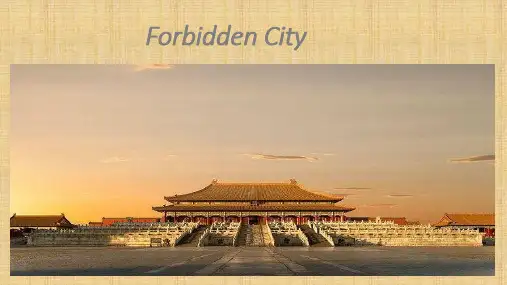
At each end of the hall of supreme harmony have beast of prey. There are many pictures in the part of tile build. Such as dragon and phoenix, lion and hippocampus. These pictures are symbol of good luck and majesty. Architects think that the Palace Museum is an incomparable masterpiece of architecture and design.
The colors of the forbidden city
Yellow and vermilion are the thematic colors
The bream color is blue and white
• The gold and red building, against the huge white marble terraces on which they stand, form a striking contrast in color.
Forbidden City
The common English name, "the Forbidden City", is a translation of the Chinese name Zi jin Cheng. The name "Zi jin Cheng" is a name with significance on many levels.
Thank you
故宫重要景点英文介绍-The-Forbidden-City
The Forbidden City(紫禁城)Size:The forbidden city is located in the centre of Beijing city, it used to be the imperial palace for the Ming and Qing 24 emperors to live and handle state affairs. It has a history of about 600 years.Name Source:In the feudal society, emperor was commonly considered the son of God, so he always had the supreme power and his residence was absolutely forbidden to the common people. What is the name source of Forbidden City. Of course, it is open to the public today, so you guys are very lucky!Room: The forbidden city is rectangular in shape with a total space of about 163,000 square meters. There was a popular saying that it had 9,999 and a half rooms in the Forbidden city. Accordingly, the number is only a half less to 10,000 because emperor on earth did not dare to compare himself with the God of Heaven. Well in fact, the forbidden city consists of 980 buildings with 8,700 rooms. It’s amazing, right? What shocked me most is that the appearance is never disordered with so many rooms. That is mainly because the forbidden city was built along the central north-south axis and show great symmetry.Path: Today our pathway is from south to the north, that is, we entered the forbidden city from Meridian Gate and exit from the Gate of Divine Prowess. The total journey inside is about 2 hours.1: The Meridian Gate(午门)Name source: the emperor believed that the meridian line went through the forbidden city and his imperial residence was the center of the whole universe. That is another explanation is that in the ancient times, “ meridian” means “South”.2:The gate of Supreme Harmony(太和门)Function: Emperor usually held his imperial audience, accepted documents from his ministers and made decisions here.The following three halls are the main buildings in the outer court, successively, they are The Hall of Supreme Harmony, the Hall of Middle Harmony and The Hall of Preserving Harmony.3: the Hall of Supreme Harmony:(太和殿)The emperor exercised his role (重大典礼)over the country here. It is a hall for grand ceremonies as well as important festival celebrations.4: The hall of Middle Harmony(中和殿)The name of Middle comes from the Confucius idea of “mean” and “impartial”. It is a place for the emperor to take a short rest. In Qing Dynasty, the emperor usually came here and examined the tools for ploughing(农耕)in spring time. Besides that, the emperor also held ceremony of presenting the genealogy revision and approval.5: the hall of Preserving Harmony(保和殿)It is a place for the emperor to have banquets to entertain the civil and military officials. Later in Qing Dynasty, emperor held the Imperial Palace examination here. Attention! There is no pillar in its front part.When you are walking through the Gate of Heavenly Purity(乾清门), you have entered the Inner Court.Resembling to the outer court, there are also three main buildings inside, the first one you are seeing is6:The palace of Heavenly Purity(乾清宫)In Ming and Early Qing Dynasty, emperors used to live here and handle the daily affairs. Later after emperor Yongzheng, it was changed to be an audience chamber for receiving foreign ambassadors and envoys form vassal states.8:the palace of Union and Peace(交泰殿)It is a place where the empress held the important ceremonies and her birthday celebration. in Qing Dynasty, the empress usually came here and examined the tools for picking mulberry in spring time.Name source: the name of this palace came from the book of Changes(ZHOU YI), which means the intercourse of heaven & earth, harmony of positive & negative, as well as the harmony between emperor & empress.7: The palace of Earthly Tranquility(坤宁宫)In Ming and Early Qing Dynasty, it was used as empress’s residence. Later ,the hall was completely reconstructed by imitating Qingning Palace(清宁宫) in Shenyang according to the Manchu’s custom.8:The Imperial Garden(御花园)it is about 12,000 square meters, containing more than 20 different types of buildings , pavilions, terraces etc. you can also see lots of pine trees, cypress trees and other botanies.Undoubtedly, the Imperial Garden is an ideal place for entertainment and relaxation.Ok, it is almost the end of our visit in the Forbidden city. You can have a 5 minutes short break here. The toilet is …….., please come back at…….The last spot is the Gate of Divine Prowess(神武门). Actually, the name of the gate was Xuanwumen at first, but when to Emperor Kangxi, as his name is Xuanye, the gate’s name had the same pronunciation with emperor’s name. You know, it was a serious taboo for mentioning the emperor’s name in ancient times. Hence the gate’s name was finally changed to “Shenwumen”.。
故宫博物馆英文介绍
WHOLE SCENE
THE ENSEMBLE (整体布局)
Traditionally, the Forbidden City is divided into two parts. The Outer Court and Inner Court. The Inner Court includes the northern sections, and was the residence of the Emperor and his family, and was used for day-today affairs of state. The Outer Court was where the emperor exercised his supreme power over the nation.
PALACE OF HEAVENLY PURITY
The palace of Heavenly Purity is the place for emperors of Ming and Qing Dynasties to live and deal with the daily affairs . “Qian" means "day“, while"Qing" means"thorough" .The name is the symbol of clear sky , national stability,and it also symbols emperors ‘doing are as the clear sky.
Because the emperor was supposedly the son of the heavenly gods, his central and dominant position would be further highlighted the use of the word purple in the name of his residence. In folklore, the term “an eastern purple cloud is drifting”became a metaphor(隐喻) for auspicious(吉祥的) events after a purple cloud was seen drifting eastward immediately before the arrival of an ancient philosopher, LaoZi, to the Hanghu Pass
故宫 介绍 英文
This is the palace museum; also know as the Purple Forbidden City. It is the largest and most well reserved imperial residence in China today. Beijing Forbidden City is the head of the world's top five palace. The Forbidden City was built begin in 1406 and it took 14 years to built it. The first ruler who actually lived here was Ming Emperor Zhudi. North to south is 961 meters, and 753 meters from east to west. And the area of about 725,000 square meters. The Imperial Palace has 8704 rooms.In 1987 the Forbidden City was recognized a world cultural legacy.[legəsi]这是故宫博物院,也被称为紫禁城。
它是北京现在最大、保存最完好的宫殿。
北京故宫是世界五大宫殿之首。
紫禁城建于1906年,历时14年建造完成。
第一个明朝统治者朱棣便住在这里。
故宫南北长961米,东西宽753米,建地面积725,000平方米。
宫殿共有8704个房间。
在1987年紫禁城成为世界文化遗产。
Forbidden City building Classified as "outside in" and "inner court" two parts. 太和palace 中和palace and保和palace are the center of the outside in, Where the emperor would hold meeting and exercise of power. 乾清palace、交泰palace、坤宁palace are center of Inner court . Feudal emperors and princess lived here.故宫的建筑分为“外朝”与“内廷”两大部分.外朝以太和殿、中和殿、保和殿三大殿为中心,是皇帝举行朝会和行使权力的地方。
介绍故宫英语作文10词
介绍故宫英语作文10词英文:The Forbidden City, also known as the Imperial Palace, is a symbol of ancient Chinese culture and history. It is located in the heart of Beijing and was the former palace for 24 emperors during the Ming and Qing dynasties. The architecture, the grandeur, and the historical significance of the Forbidden City make it a must-see attraction for anyone visiting China.The Forbidden City is a treasure trove of Chinese history and culture. As I walked through the massive complex, I was in awe of the intricate details of the buildings, the beautiful gardens, and the countlessartifacts on display. It felt like I was stepping back in time and experiencing the grandeur of the imperial court.One of the most memorable experiences for me wasvisiting the Hall of Supreme Harmony, the largest hall inthe Forbidden City. The sheer size and opulence of the hall left me speechless. I could almost imagine the grand ceremonies and important events that took place within its walls.Exploring the Forbidden City was like taking a journey through China's rich and storied past. It's a place that truly captures the essence of traditional Chinese architecture and design. I left with a deep appreciationfor the country's history and a desire to learn more about its fascinating culture.中文:紫禁城,又称故宫,是中国古代文化和历史的象征。
英语作文介绍北京故宫(22篇)
英语作文介绍北京故宫(22篇)英语作文介绍北京故宫篇1The Imperial Palace is located in downtown Beijing, formerly known as the forbidden city. In the Ming Dynasty Yongle built eighteen years, is the Ming, Qing two generations of the palace, inparable masterpieceof ancient architecture, the world's largest, most plete wooden structure of the ancient building group. The entire the Imperial Palace building from thefuture and imperial palace is posed of two parts, surrounded by a wall around. Four from now on. City four corner turret. Four each having a gate, South is the Meridian Gate, as the front gate of the Imperial Palace. The Imperial Palace is located in downtown Beijing, now into the Museum of the Imperial Palace . Lived here 24 emperors, is during the two dynasties palace, inparable masterpiece of ancient architecture, the world's largest, most plete wooden structure ofthe ancient building group. Now into the Museum of the Imperial Palace . Is the world's largest existingroyal garden.英语作文介绍北京故宫篇2Situated in the western outskirts of Haidian District, the Summer Palace is 15 kilometers (9.3 miles) from central Beijing. Having the largest royal park and being well preserved, it was designated, in 1960 by the State Council, as a Key Cultural RelicsProtection Site of China. Containing examples of the ancient arts, it also has graceful landscapes and magnificent constructions. The Summer Palace is the archetypal Chinese garden, and is ranked amongst the most noted and classical gardens of the world. In 1998, it was listed as one of the World Heritage Sites by UNESCO.Constructed in the Jin Dynasty (1115-1234), during the succeeding reign of feudal emperors; it was extended continuously. By the time of the Qing Dynasty (1644-1911), it had bee a luxurious royal garden providing royal families with rest and entertainment. Originally called 'Qingyi Garden' (Garden of Clear Ripples), it was know as one of the famous 'threehills and five gardens' (Longevity Hill, Jade Spring Mountain, and Fragrant Hill; Garden of Clear Ripples, Garden of Everlasting Spring, Garden of Perfection and Brightness, Garden of Tranquility and Brightness, and Garden of Tranquility and Pleasure). Like most of the gardens of Beijing, it could not elude the rampages of the Anglo-French allied force and was destroyed by fire. In 1888, Empress Dowager Cixi embezzled navy funds to reconstruct it for her own benefit, changing its name to Summer Palace (Yiheyuan). She spent mostof her later years there, dealing with state affairs and entertaining. In 1900, it suffered again, being ransacked by the Eight-Power Allied Force. After the success of the 1911 Revolution, it was opened to the public.Composed mainly of Longevity Hill and Kunming Lake, The Summer Palace occupies an area of 294 hectares (726.5 acres), three quarters of which is water. Guided by nature, artists designed the gardens exquisitely so that visitors would see marvelous views and be amazed by perfect examples of refined craftwork using the finest materials.Centered on the Tower of Buddhist Incense (Foxiangge) the Summer Palace consists of over 3,000 structures including pavilions, towers, bridges, and corridors. The Summer Palace can be divided into four parts: the court area, front-hill area, front-lake area, and rear-hill and back-lake area.Front-Hill Area: this area is the most magnificent area in the Summer Palace with the most constructions. Its layout is quite distinctive because of the central axis from the yard of Kunming Lake to the hilltop, on which important buildings are positioned including Gate of Dispelling Clouds, Hall of Dispelling Clouds, Hall of Moral Glory, Tower of Buddhist Incense, the Hall of the Sea of Wisdom, etc.Rear-Hill and Back-Lake Area: although the constructions are fewer here, it has a unique landscape, with dense green trees, and winding paths. Visitors can feel a rare tranquility, and elegance. This area includes scenic spots such as Kunming Lake and Back Lake , which presents a tranquil beauty, Garden of Harmonious Interest , built by imitating the layout of Southern China’s classical gardens, andSuzhou Market Street, endowed with a strong flavor of the water town Suzhou.Court Area: this is where Empress Dowager Cixi and Emperor Guangxu met officials, conducted state affairs and rested. Entering the East Palace Gate, visitors may see the main palace buildings: the Hall of Benevolence and Longevity served as the office of the Emperor, the Hall of Jade Ripples where Guangxu lived, the Hall of Joyful Longevity, Cixi's residence, the Garden of Virtue and Harmony where Cixi was entertained, Yiyun House , where once lived the Empress Longyu, and Long Gallery, which measures the longest in Chinese gardens.Front Lake Area: covering a larger part of the Summer Palace, opens up the vista of the lake. A breeze fluttering, waves gleam and willows kiss the ripples of the vast water. In this fortable area there are the Eastern Bank and Western Bank, Seventeen-Arch Bridge, Nanhu Island, the largest island in Summer Palace, Bronze Ox, an imposing statue beside the lake, and Marble Boat, built in western style with elaborate decorations . On the western bank float six distinct bridges amongst which the Jade-Belt Bridge is the pretty!英语作文介绍北京故宫篇3The imperial palace, also known as the Forbidden City, is the imperial palace of the Ming and qing dynasties, which is the largest and most plete ancientarchitectural plex in China. I especially want to know the architecture of ancient palaces and the living environment of ancient emperors.One weekend in the golden autumn, the sun is the shining and the autumn wind is crisp. My mother and I went to visit the Palace Museum in the center of the city. I was very happy.Enter the gate of the Forbidden City, "wow! It's so big here!" I couldn't help it. The mother said, "the most spectacular is still in the back!" We first visited the architectural model of the imperial palace and its construction. I know that the imperial palace covers an area of over 720,000 square meters, with more than 9,000 rooms, all wooden structures, and all the wooden structures have no nails. The palace is the blue and white stone base, the tall roof, the yellow glazed tile, the pattern of the dragon everywhere, and decorated with the brilliant color of the golden wall.I observed all the palaces, and found that the palaces were lined up along the north-south axis, and spread out to the sides, to the north and south, and to the right and left. I told mom, I found mother listen to nod a smile, said: "the central axis not only in the Forbidden City, and nanda YongDingMen, north to the drum tower, almost throughout the whole city. It's magnificent, well-planned and spectacular.We have been visiting the taihe temple from the imperial garden. What a breathtaking view! In the Forbidden City, the most striking is the "threehalls" : the hall of supreme harmony, the hall of harmony, the hall of protection and the temple. They are all built on the 8-meter-high base of the white jade, which looks like the qiong yuyu in the myth. The first hall of supreme harmony was the most magnificent building. People called it the "throne room". It was the place where the emperor held the grand ceremony.It is 28 meters high, 63 meters, 35 meters north and south, and a large pillar with a diameter of 1 meter. Among them, six large pillars, one meter in diameter around the throne, are flat dragon pillars of leached gold. The throne is located at the base of the two meters high in the temple, with the graceful crane and the top of the furnace, followed by a carefully carved screen. The whole hall is decorated with golden walls, which are both majestic and magnificent. The hall of neutralization was the place where the emperor went to the hall of supreme harmony to take a rest and exercise etiquette. Baohe and the temple are the place where the emperor gives banquet to the king of the foreign land every New Year. This is just the palace buildings, and house decoration is numerous, the rarities of the mother said: "these treasures is only part of it, when Chiang kai-shek fled to Taiwancarried away many treasure palace, there are some loss in a foreign country". I feel sorry for the loss of these treasures. When will these lost treasures return to the embrace of the motherland? I am looking forward to the reunion of Taiwan and mainland as soon as possible.The visit of the Forbidden City made me linger. The Palace Museum is an unparalleled masterpiece. It is a miracle. Our five thousand years of Chinese culture are profound and profound, and we should be proud and proud to have built such a magnificent palace for the ancients. At the same time, we also have the responsibility to protect these cultural relics from destruction, so that the five thousand years of splendid civilization of the motherland will be handed down.英语作文介绍北京故宫篇4Because the Palace Museum is a place of five thousand years of brilliance and ancient culture, so he has long been a tourist attraction in my heart, and this summer vacation I have finally made a dream e true.In the Beijing I will ride my father and mother went to the 天安门 square, across 天安门 square, the meridian gate of the world-famous greeted the hall of supreme harmony, the hall of supreme harmony majestic, magnificent, colorful glazed tile, such as a long arranged very neat. Curved corner with a monster, four up the eaves of the cock appear grand hall of supreme harmony, to the hall of supreme harmony, seventy-two large andalusite carved dragon painted chicken shows the architecture of the feudal monarchy. The golden roof reflects the majesty and status of the ancient Chinese emperors. The great hall looked solemn and solemn, but the beauty of the appearance was somonotonous and heavy that I was in vain. I don't know why I feel as if a group of puppets are standing respectfully on either side of the house. Incensesticks up in the incense burner, and the emperor sits high in the temple. The Palace Museum, a symbol of the ancient kingship, has been invaded by a brick and a brick. It is far from the palace of Buckingham Palace.In the afternoon, we in addition to the front door, look back at taihe light standing in 天安门 square,this magnificent buildings, so the layout of the orderly, so solemn, not amazing, hope this trip to the Forbidden City will bee my eternal memory.英语作文介绍北京故宫篇5Last month I went to Beijing to visit one of my friends, because we haven’t seen each other for about two years and I got a holiday meanwhile. It is myfirst time to visit Beijing, which is always the dream city for all the Chinese. All the information aboutthe city came from the books and TV, now I could see and get know of it by myself, how excited I am!上个月我去北京看望我的一个朋友,因为我们有将近两年没见,而我刚好有假期。