
外研版(三起)-英语-三年级上册-Module 3 Unit 2 Point to the desk 教案
Module 3 Unit 2 Point to the desk
一、教学目标
单词:window ,blackboard,door,desk ,chair
二、教学栏目
Listen and say. & Play the game.
三、教学重点
听懂并说出desk,chair 及句子Point to the …! 并能对别人发出指令和听懂并执行听到的指令。
四、教学步骤
Step 1 Warming up
1. Listen and sing a song.
Song: point to the window
One two three four five six seven eight nine ten. Stand up. Clap! Clap! Clap!
Point to the window. Point to the door. Point to the ceiling. Point to the floor.
One two three four five six seven eight nine ten. Stand up. Clap! Clap! Clap!
2. T: Boys and girls, let's have a match. Ok? (屏幕上出示了5个本课涉及到的图片,教师指向某幅图片的时候,全班同学齐声说:Point to,Point to,Point to the …。
全对的同学加分,并给予奖励。
)
Step 2 Practise
1. (在墙上粘上了林玲等四个小朋友的头饰)
T: You are very clever! Now please stop! Boys and girls, our friends Da Ming, Ling Ling, Amy and Sam are in my classroom. Where are they?
(学生找到后,教师向学生发出指令:Point to Da ming. Point to Ling ling. Point to Sam. Point to Amy. Point to the desk. Point to the chair.)
2. 教师询问一些同学的姓名,指向教室内的一些物品,而后发出指令并请同学执行指
令。
例如:T:What’s your name? (询问某位同学姓名)Ss: I’m xxx.
T: Point to xxx.
Ss: Point to xxx.
T: Point to the TV.
Ss: Point to the TV.
…
Step 3 Homework
在家中同家人做“I say you do or I do you say”的活动。
三年级上册英语教案-Module 3 Unit2 Point to the desk 外研版
Module 3 Unit2 Point to the desk. 教学设计【目标确定的依据】1.相关课程标准的陈述能根据教师的简单指令做游戏、做动作、做事情(如涂颜色、连线)。
能听懂课堂简短的指令并做出相应的反应。
2.教材分析本单元是《新标准英语》(三年级起点)第一册第3模块第2单元的内容,本单元是上一单元“发出指令和执行指令”这一题材的拓展单元,并提供若干任务型练习。
要求学生认读“desk, chair ”等词,继续学习发出指令和执行指令,本单元呈现的是语言扩展和语言练习,旨在学习发出指令和执行指令。
通过学习“Point to the desk/chair.”等指令,进一步巩固学生上节课所学的知识。
根据《小学英语新课程标准》提出的目标,其中一个非常重要的目标就是要激发学生学习英语的兴趣,培养他们学习英语的积极态度,使他们初步建立学习英语的自信心,使他们初步具备用英语进行简单日常交流的能力。
3.学情分析三年级的学生在二年级时已经简单接触了一些简短的指令性短语,例如:Stand up.Sit down.等,所以在学习过程中,对课文内容理解应该不难。
学生在单词的认读方面普遍存在一个问题,在纯单词的认读方面有迟钝,究其原因可能为含有色彩的图片对此年龄阶段的学生要大于纯文本的单词,更提醒我们在课堂教学中要强化纯文本单词的认读和识记。
【教学目标】1.通过跟读单词音频、自己试读和小老师领读,能正确认读单词desk, chair。
2.通过观看和跟读课文视频、自己练读,能正确朗读课文,做到发音清楚、语调达意。
3.通过设置情境化对话练习、角色扮演,能正确运用本模块重点句型“Point to……”“Sit down,please.”“Stand up,please.”。
【教学重难点】重点:学生能正确运用本模块重点句型“Point to……”“Sit down,please.”“Stand up,please.”发出指令,并可根据指令做出相应的动作。
外研版(一起)三年级上册《Module_3》小学英语-有答案-同步练习卷(4)
外研版(一起)三年级上册《Module 3 Unit 2 The ducks are playing in the rain》同步练习卷(4)一、写出单词或短语的中文意思)1. 写出单词或短语的中文意思noodles________2. 写出单词或短语的中文意思under the tree________3. 写出单词或短语的中文意思play hide﹣and﹣seek________二、根据汉语提示选择正确的单词)4. 根据汉语提示选择正确的单词A. These B. Those C. This D. That(1)________(这些) are green trees.(2)________(那些) are dragon boats.(3)________(这个) is Sam's photo.(4)________(那个) is Amy's car.三、判断下列句子与图片是否相符)5. 判断下列句子与图片是(T)否(F)相符They're playing hide﹣and﹣seek.________6. 判断下列句子与图片是(T)否(F)相符These are tigers.________7. 判断下列句子与图片是(T)否(F)相符They're cakes.________四、情景选择)8. 当你想问别人这些是什么东西时,你可以怎么表达?()A.What's this? B.What are these?9. 当你想问别人正在做什么时,你可以怎么表达?()A.What are you doing? B.What is it doing?10. 当你想问别人那些是什么东西时,你可以怎么表达?()A.What are those? B.What are these?四、单项选择)11. ﹣ What are those?﹣ ____ are flowers.()A.TheyB.hisC.It12. They are ____ under the flowers.()A.hiding B.hides参考答案与试题解析外研版(一起)三年级上册《Module 3 Unit 2 The ducks are playing in the rain》同步练习卷(4)一、写出单词或短语的中文意思1.【答案】面条【考点】单词、词组【解析】面条.【解答】该题考查单词翻译.noodles面条.故答案为:面条.2.【答案】在树下【考点】翻译能力【解析】在树下【解答】考查短语翻译.under在…下面;the tree数.故答案为:在树下3.【答案】玩捉迷藏【考点】翻译能力【解析】玩捉迷藏【解答】考查短语翻译.play hide﹣and﹣seek译为:玩捉迷藏.故答案为:玩捉迷藏二、根据汉语提示选择正确的单词4.【答案】A,B,C,D【考点】选词填空【解析】(1)这些是绿色的树木.(2)那些是龙舟.(3)这是山姆的照片.(4)那是艾米的车.【解答】(1)A.考查代词.句意"__是绿色的树木."根据提示"这些"可知,应该是These.故选:A.(2)B.考查代词.句意"__是龙舟."根据提示"那些"可知,应该是Those.故选:B.(3)C.考查代词.句意"__是山姆的照片."根据提示"这个"可知,应该是This.故选:C.(4)D.考查代词.句意"__是艾米的车."根据提示"那个"可知,应该是That.故选:D.三、判断下列句子与图片是否相符5.【答案】T【考点】看图完成句子【解析】他们在玩捉迷藏.【解答】该题考查看图完成句子.They're playing hide﹣and﹣seek他们在玩捉迷藏,图示中的人物在玩捉迷藏.故答案为:T.6.【答案】F【考点】看图完成句子【解析】These are tigers.这些是老虎.【解答】该题考查看图完成句子.These are tigers.这些是老虎,图示为松鼠,句子与图片不相符.故答案为:F.7.【答案】F【考点】看图完成句子【解析】They're cakes.它们是蛋糕.【解答】该题考查看图完成句子.They're cakes它们是蛋糕,图示为面条,句子与图片不相符.故答案为:F.四、情景选择8.【答案】本题考查情景询问.A.What's this?这是什么?B.What are these?这些是什么?;因此,你想问别人这些是什么东西时,你可以说:What are these?故选:B.【考点】情景交际【解析】What are these?这些是什么?【解答】本题考查情景询问.A.What's this?这是什么?B.What are these?这些是什么?;因此,你想问别人这些是什么东西时,你可以说:What are these?故选:B.9.【答案】本题考查情景询问.A.What are you doing?你正在做什么?B.What is it doing?它正在做什么?因此,当你想问别人正在做什么时,你可以说:What are you doing?故选:A.【考点】情景交际【解析】你正在做什么?【解答】本题考查情景询问.A.What are you doing?你正在做什么?B.What is it doing?它正在做什么?因此,当你想问别人正在做什么时,你可以说:What are you doing?故选:A.10.【答案】本题考查情景询问.A.What are those?那些是什么?B.What are these?这些是什么?;因此,当你想问别人那些是什么东西时,你可以说:What are those?故选:A.【考点】情景交际【解析】What are those?那些是什么?【解答】本题考查情景询问.A.What are those?那些是什么?B.What are these?这些是什么?;因此,当你想问别人那些是什么东西时,你可以说:What are those?故选:A.四、单项选择11.【答案】A【考点】人称代词【解析】那些是什么?它们是鲜花.【解答】本题考查人称代词.根据问句可知答语要用they代替those回答,his他的,it它.故选:A.12.【答案】本题考查现在分词.根据句意,可知句子要用现在进行时,用be+doing构成,hide的现在分词形式为hiding.故选:A.【考点】物主代词【解析】他们正在鲜花下面藏着.【解答】本题考查现在分词.根据句意,可知句子要用现在进行时,用be+doing构成,hide的现在分词形式为hiding.故选:A.。
外研版小学三年级英语上册 《Point to the door》PPT教学课件
Pointtothedoor.
Standup!
Sitdown!
Pointtothe window.
课堂练习
一、圈出不同类的一项。
1. A. upB. downC. the 2. A. windowB. doorC. point 3. A. sitB. theC. point 4. A. boyB. girlC. Ms
指一指窗户。
文本解读
Sitdown/Standup!
“坐下/起立”,也是 祈使句,sit和stand是 动词,互为反义词; up和down是副词,互
为反义词。
Roleplay
以小组为单位练习对话,并表演。 1. Readthedialogue. 合作朗读。 2. 2. Roleplaythedialogue. 3. (含有表情、语气、动作表演对话。)
Pointtothewindow.
window
窗户
Let’slearn.
Pointtotheblackboard. blackboard
黑板
Let’slearn.
Pointtothebird.
bird
鸟
Let’slearn.
Standup.
stand
站
up
向上
Let’sleinttothedoor. 1. Words: 2. pointtothedoorsitdownup 3. standwindowblackboardbird
2. Sentences: (1)Pointtothe… (2)Sitdown/Standup.
二、选择正确的答语。 1. --Sitdown, please!
2. --_______C_____
外研版(三起)三年级上册英语教案
外研版(三起)三年级上册英语教案Module 1第一课时 Unit1 I’m Sam.一、教学目标:1.基本能听懂会说:“Hello, Hi, Goodbye, bye-bye”2.学会运用句型“I’m…”进行自我介绍。
3.通过运用Hello, Hi, Goodbye, Bye-bye进行打招呼,并运用I’m…的句型进行自我介绍等情景让学生在感知、模仿、学习、体验的基础上逐步达到自然交流与真实运用语言的目的。
4.培养学生初学英语的兴趣。
通过大量的游戏活动让学生充分体会学习英语的乐趣所在。
同时教育学生要有礼貌的与人交际,主动与他人沟通,并逐渐建立深厚友谊。
二、教学重点:1.学会并运用Hello,Hi进行相互间问好打招呼。
2.引导学生使用I’m …句型进行自我介绍。
三、教学难点:1.要求学生注意I’m中m的发音,不要吞音,发音要到位。
2.强调Goodbye和Bye-bye的正确发音。
四、教学用具:英文名字卡片(教师自备),手偶,a toy五、教学过程:1、启动:(5分钟)(1)课前播放学生熟悉的英文儿歌Hello 或字母歌渲染课堂学习的活跃气氛。
(2)教师可以在课前收集一些常用的英文单词或缩略语如:WTO TV,CD,KFC,Best Food让学生了解一些身边的英语,同时也请同学们说一说他们所知道的生活中的英语,这样有助于强化他们亲身经历英语的真实感受。
2、导入:(3分钟)启发学生当他们在新学期初次见面的时候,他们是如何相互间有礼貌的打招呼问好的呢?当他们在彼此陌生的情况下,是如何相互作自我介绍,互相交流的呢?教师用语:新学期开始了,老师首先欢迎各位新同学的到来,虽然同学们都来自不同的地方,但现在我们就是一家人,那你愿意用自己最友好的方式相互问候和作自我介绍吗?3.呈现:(12分钟)(1)教师首先以自然的方式配以恰当的手势动作和不同的语调来向学生问好Hello , Hi。
同时也引导学生向教师说Hello , Hi 。
外研社(三年级起点)三年级上册课课练 练习题
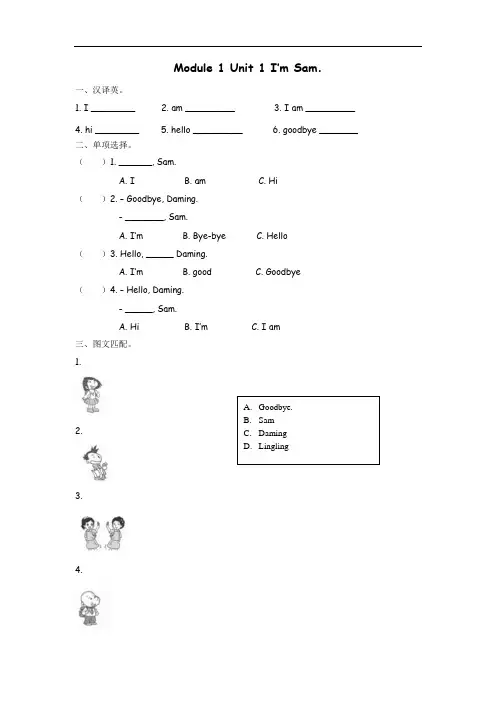
Module 1 Unit 1 I’m Sam.一、汉译英。
1. I ________2. am _________3. I am _________4. hi ________5. hello _________6. goodbye _______二、单项选择。
()1. ______, Sam.A. IB. amC. Hi()2. – Goodbye, Daming.- _______, Sam.A. I’mB. Bye-byeC. Hello ()3. Hello, _____ Daming.A. I’mB. goodC. Goodbye ()4. – Hello, Daming.- _____, Sam.A. HiB. I’mC. I am三、图文匹配。
1.2.3.4.A.Goodbye.B.SamC.DamingD.Lingling四、情景选择。
1. 放学了,你要回家了,你应该对老师和同学们说:A. Goodbye.B. Hi.2. 开学第一天,你向老师和同学们这样介绍自己:A. Hello, Amy.B. Hello, I’m Amy.3. 你在校门口看到了玲玲,你会说:A. Hi, Lingling.B. Hello, I’m Lingling.五、连词成句。
(只写序号)1. ①I ②Lingling ③am ④Hi ⑤, (.)_______________________________2. ①Daming ②Goodbye ③, (.)_______________________________参考答案一、1. 我 2. 是 3. 我是4. 你好5. 你好6. 再见二、1. C 2. B 3. A 4. A三、1. D 2. C 3. A 4. B四、1. A 2. B 3. A五、1. ④⑤①③②2. ②③①Module 1 Unit 2 How are you?一、将下列单词英汉连线。
三年级上册英语一课一练-Module 3 Unit 2|外研社(一起)(含答案)
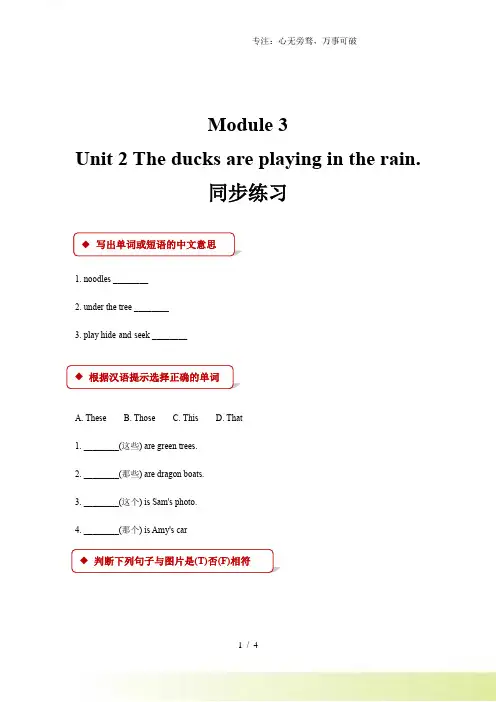
Module 3Unit 2 The ducks are playing in the rain.同步练习◆写出单词或短语的中文意思1. noodles ________2. under the tree ________3. play hide-and-seek ________◆根据汉语提示选择正确的单词A. TheseB. ThoseC. ThisD. That1. ________(这些) are green trees.2. ________(那些) are dragon boats.3. ________(这个) is Sam's photo.4. ________(那个) is Amy's car◆判断下列句子与图片是(T)否(F)相符( ) 1. They're playing hide-and-seek. A.( ) 2. These are tigers. B.( ) 3. They're cakes. C.◆情景选择( ) 1.当你想问别人这些是什么东西时,你可以怎么表达?A. What's this?B. What are these?( ) 2.当你想问别人正在做什么时,你可以怎么表达?A. What are you doing?B. What is it doing?( ) 3.当你想问别人那些是什么东西时,你可以怎么表达?A. What are those?1. - What are those?- ____ are flowers.A. TheyB. ThisC. It2. They are ____ under the flowers.A. hidingB. hideC. hides参考答案一、1.面条2.在树下3.玩捉迷藏二、1. A2. B3. C4. D三、1. T2. F3. F四、1. B2. A3. A 五、1.A2. A。
外研(三起)三上课件-M3 Unit 1 Point to the door
Module 3 Unit 1 Point to the door.
第一课时
第二课时
Revision.
pwnwyglbgaebhiohoirmaoaruaylsyltsertse’s
Good afternoon, …
— Your name, please? —…
— What’s your name? — I’m…
Game.
运气球
以组为单位,从每组选一位同学,这两位同学边 用手托气球走路边用“Point to …”句型造句,气 球掉下之前说的最多者为优胜者。
Listen and say.
Point to the door.
Point to the window.
听指令,做动作。
Practise.
A: Stand up, please. B (stands up) A: Sit down, please. B (sits down) A: Point to … B (points to …)
Good morning, boys and girls.
Good mornlease.
Please stand up, Lingling.
Point to the door.
Point to the window.
Point to the blackboard.
猜谜语 四四方方一间房, 只有桌椅没有床, 白天读书声朗朗, 夜里无人静悄悄。
classroom
Point to the door.
Point to the blackboard.
Point to the window.
Golden Finger
外研版(三起)英语三年级上册全册同步练习(20套)附答案
Module 1 Unit 1 I’m Sam.一、我会连。
(将人名与图片用线连起来)1. Daming2. Sam3. Amy4. LinglingA. B. C. D.二、小蜜蜂采花蜜。
(选择合适的标号填空)是你好再见我我是A. B. C. D. E.hello am I’m1. 2. 3.()()()goodbye I4. 5.()()三、选择与图片相对应的句子,在前面的括号内打“√”。
1. () A. I’m Amy.() B. I’m Lingling.2. () A. I am Daming.() B. I am Sam.3. () A. Hello, Lingling.() B. Byebye.4. () A. Goodbye.() B. I’m Amy.四、情景交际。
() 1. 当你遇到Lingling时,你应该说:________A. Hello, I’m Lingling.B. Hello, Lingling. () 2. 当Tom 向别人介绍自己时应说:________A. Hello, I am Tom.B. Hello, Tom. () 3. 放学时老师会对你说:________A. Hi.B. Bye-bye.() 4. 班内新转来的同学自我介绍叫Amy,你应该对她说:________A. Hello, Amy.B. Hello, I’m Amy.五、读一读,连一连。
1. A.2. B.3. C.4. D.答案:一、1. D 2. A 3. C 4. B二、1. B 2. A 3. E 4. C 5. D三、1. B 2. A 3. A 4. A四、1. B 2. A点拨:自我介绍时一般用I’m ...3. B4. A五、1. C点拨:Hello...的答语是Hello...或Hi...。
根据人名可知选C。
2. D3. A4. BModule 1 Unit 2 How are you?一、每组中有一只小猫排错了队,请你把它找出来。
三年级英语上册全册教案(外研版一起)
三年级英语上册全册教案(外研版一起)module 1the general aims of module one:language points:(1) the new words: chopsticks, a knife and fork, use, easy, hard and mess(2) the basic sentence pattern and the students could make dialogues according to the sentence patterns.do you want…do you use…(3) the new words: hamburgers, chips, fast food(4) the basic structure of processing tenseattitude aims:the students could make differences in food culture between the western countries and china.teaching important points:(1) do you use chopsticks in …?do you use a knife and fork in …?(2) the processing tenseteaching difficult points:(1) the pronunciation of some new words. for example, chopsticks(2) the changes of “be”activity for module one:in module one, the topic is mainly about the different customs in china and western countries. before the class, i require the students to prepare the pictures of food. in the process of teaching, i begin the class with talking about the differences in food and then some other topics are related. with the help of pictures, the students talk about the differences in group. several minutes later, one group is given two minutes to show the results of discussion. then the teacher takes out the chopsticks and fork and knife. the students can also talk about the other aspects. this activity class is designed in the form of dicussion. the students could speak freely according to their own vocabularies.unit 1 do you use chopsticks in england?teaching aims:(1)make students remember the new words:chopsticks, a knife and fork, use, easy, hard and mess(2) mastering the basic sentence pattern and the students could make dialogues according to the sentence patterns.do you want…do you use…attitude aims:the students could make differences in food culture between the western countries and china.teaching important points:do you use chopsticks in …?do you use a knife and fork in …?teaching difficult point:the pronunciation of some new words. for example, chopsticks preparation:word card, cd-romteaching process:warming up part:the teacher shows many pictures about food.(noodles,rice,hamburgers,cakes and so on). firstly, the teacher leads the students to get familiar with these food names and then on this basis the teacher can ask them to practice the sentence pattern.do you like noodles? yes, i do.\ no, i don’t.do you want …? yes, i do.\no,i don’t.step two: presentation and practicethe teacher makes use of the picture “noodles”and a new word “chopsticks”can be leaded out.共27页,当前第1页123456789101112131415161718192021222324252627t: i like noodles. i eat noodles with chopsticks.the teacher takes out the real chopsticks and then says the new word. at the same time, the teacher shows the picture of chopsticks.an activity can be made here. the title of the activity is saying words as quickly. the pronunciation of new word is a difficult point. so the teacher should ask students to practice more.step three:the new word “use”can be leaded out in the process of communication.t: can you use chopsticks?the word card of use should be shown.we use chopsticks in china. and the teacher writes the sentence on the blackboard.we use chopsticks.do you use chopsticks? yes, we do. no, we don’t.ask and answer in pairs.the teacher inquires the students if the english people usechopsticks and a knife and fork will be leaded out.t: we use chopsticks in china. do the english people use chopsticks?s: no, they don’t.english people use a knife and fork.do you use chopsticks / a knife and fork? yes, i do. no, i don’t.step four:(1)presentation of the text.amy and daming are in the park. they want to eat noodles. watch the cd-rom, then answer the questions: “does amy use chopsticks in england?”the students look at the co-rom and then answer questions.now amy is using chopsticks. watch again, then answer the next question: are the chopsticks “easy”or “hard”for her?easy –hardchopsticks are hard for amy.a knife and fork are easy for her.some other oposite words are shown here.big-smalllong-shortfat-thinhot-coldwhite-blackeasy-hardlisten again, then answer:are the chopsticks “easy”or “hard”for english people?t: if i say “big”. you should say “small”. please say the words as quickly as you can.chopsticks are hard for english people. so amy make the mess.?mess /e/then the students read the passage again.find the sentences, “do you …?”. then circle them.practice:(1)in china, we use __________. in england, people use ________. chopsticks are ________ for chinese people. they are _______ for english people.chant:do you use chopsticks? yes i do. yes, i do.we use chopsticks in china.they’re easy for us.do you use ___________? yes i do. yes, i do.we use ________ in england.they’re easy for us.homework:ask students to practice the sentence patterns that they have learned in this lesson.unit 2 i’m eating hamburgers and chipsteaching aims:(1)mastering the new words:hamburgers, chips, fast food(2)the basic structure of processing tense共27页,当前第2页123456789101112131415161718192021222324252627teaching important point:the processing tenseteaching difficult point:the changes of “be”preparation:word card, card for real things,cd-romteaching process:warming up part:review the content of unit one.we use chopsticks in china. english people use a knife and fork in england. listen to a poem, then say it.step one:presentation and practicea. the teacher does actions and ask questions.what am i doing?(running, playing, jumping, etc.)e.g. you’re running.b.do actions:look, i’m eating. i’m eating hamburgers and chips.and then the new words are be leaded out. hamburger, chip?it’s english fast food. here we can talk about the england food. steak, cheese, bread and butter, etc. what is chinese / english fast food? do you like …? do you want …?step two:asking students to listen to the tape and answer the questions.what is amy eating?listen, point and repeat the text.practice:here the teacher asks students to practice the processing tense.look at amy. she’s eating hamburgers and chips. she’s using her hand. what is daming doing ? he’s eating rice.what is he using? he’s using chopsticks.then the teacher asks students to talk about the pictures in the textbook. s: what is daming doing? s: he’s ---s: what is daming using? s: he’s ---step 3 consolidation and extension1. game: what am i eating?the teacher does actions and asks students to guess what he\she is doing.for example: are you eating a hamburger?2. guessing game: what am i doing? what is he / she doing?3. make a new dialogue.it’s time for _________. (breakfast/ lunch/ dinner)i like _______.look, i’m eating ________.i’m using ________.step 4 summarythe differences between chinese customs and english customschina englandwe use ___________. they use __________________ is chinese fast food. _____ and _____ are english fast foodstep 5 homeworkmake a summary about the differences in customs in different countries.reflection of module one:the topic of module one is talking about the different customs in different countries. at the first, i prepare many datas about the differences. i think that the students maybe know little about these differences. but i am surpised at students’aboundance in the knowledge. so i change my plans. i asks them discuss these differences in groups. then i ask them to stand up in a line in the front of the classroom to tell others about the differences. they tell a lot. i am very happy. in the future, i should make great efforts to find students’knowledge. we should really believe them and give tasks to them. they can achieve the tasks perfectly. 共27页,当前第3页123456789101112131415161718192021222324252627reading of module one:content of reading:an article about the different customspurpose of reading:broaden the cultural knowledge of students.preparation:multiplayerstep of reading:firstly, i ask students to discuss about the festivals. then they can talk freely about the festivals in china. talking as the topic, i lead students to talk about the festivals in western countries. in this lesson, i take christmas day as an example. the students are required to express more idea. they must speak in english. then i write down all the sentences on the blackboard. more than thirty sentences are learned in the class. in my opinion, it is a good way. it is not necessary to find all the reading materials in datas. our students are the good material resource. the sentences are spoken by students as following:it is very good.i like it.……..module 2the general aims of module one:language points:(1) the new words: make, cake, idea, instead, lovely.(2) the basic sentence pattern and the students could make dialogues according to the sentence patterns.what are you making?i’m…(3) the new words: good idea! be quiet!teaching important points:1. what are you making?i’m making…2. can use these by themselves.unit 1 we are making a cake.teaching aims:1. make students remember the new words:making a cake; good idea and so on.2.can listen and say: what are you doing? we’re making a cake.please be quiet! i’m working.teaching important and focal points:what are you doing? we’re making a cake.please be quiet! i’m working.teaching aids:1.tape-recorder2.some cardsteaching course:step one warming up1.say the poem of module 1.2.review: do you use chopsticks in england? no, we don’t.what are you doing? i’m eating.are you eating a hamburger? yes, i am.step two presentation and practice1.ask the child to act, and ask him: what are you doing?the child try to answer: i’m eating…2.ask ss to look at their books. elicit as much as i can.3.play the cassette. the children listen and follow it.4.play the cassette again. pause after each utterance for the children to point at the corresponding picture.5.play the cassette again. ask the children to find “we are making…”then explain.6.play the cassette again. ask the students to repeat.共27页,当前第4页123456789101112131415161718192021222324252627step three1.listen to the tape and say the sentence.2.explain and practice: read row by row.3.practice in pairs. then check it.step four1.point and say: cake, plane, kite, noodles2. practice in pairs.: what are you doing? we’re making a plane.3.check them.step five1.listen and write the missing words.2.now point and say.homework:read the text to your friend or your parents.thinking:this book is difficult for almost students. i spent more time to teach itabout module one. they are not happy to learn it. unit one: they couldn’t read it well. they couldn’t say, “chopsticks, knife, fork”and some sentences well.unit 2 i’m watching tv.teaching aims:1.can listen and repeat: i’m watching tv.2.can sing the song.3.play the game: point and say.teaching important and focal points:i’m watching tv.teaching aids:tape-recorderteaching course:step one wrming up1.listen to the tape of unit 1 and repeat.2.review: what are you doing? we’re making a cake.step two1.ask the children to look at the picture. listen to the tape.2.play the cassette again and explain.3.play the cassette again. the children follow it.4.practice the sentence: i’m watching tv.step three1.listen and say the words.2.teach the children the song line by line.3.listen and sing.step five1.play the game in groups.2.point and say: what is he doing? he’s sleeping.homework:finish activity three.thinking:this book is difficult for almost students. i spent more time to teach it about module one. they are not happy to learn it. unit two: it’s easier than unit one. almost students could read it well.reflection of module one:name: who is clever?purpose: remember the words in module oneteaching steps:step oneread the texts and the words in module one.step twogive the students ten minutes to remember these words: chopsticks, knife and fork.step threecheck them.step fourgive the students ten minutes to remember these words: use, people, hard and easy.step fivecheck them.step sixfind out who is the best one.thinking:the students could remember these words quickly to use this way. theydid this well that their group could get high points.reading:title: fox and grapescontent:this is a fox. he is very hungry. he sees some black grapes. the grapes are high from the ground. he wants to eat them very much. he jumps and jumps, but he still can’t reach the grapes.in the end, the fox gives up. he says to himself, “i don’t want to eat the grapes. they are not good to eat.”共27页,当前第5页123456789101112131415161718192021222324252627teaching steps:1. watch the flash about “fox and grapes”in chinese.2. teacher tells the students the story in english, and ask them to listen it carefully.3. give them the paper and ask them to read it by themselves.4. ask them to tell the story with their own words.5. make a book about this story.thinking:this is the first class about english reading. so i just ask them to listen the story and say some easy sentences. i want them to listen the story just like chinese story, so i do some actions. at last, some students from class one can recite the story with their own words. but the class two is not good.module 3the general aims of module three:teaching aims:(1) vocabulary: naughty, dragon boat, row, lake, feed, get outsentence structure:what are these/those?they’re…(2) vocabularies:wet, shortssentence structure: this is …’s …these are …’s …teaching important points:(1) mastering the sentence introducing the plural forms(2) the students could describe the processive form of some things in non-plural sentences.teaching difficult points:(1) the students could describe a situaton in which plural formsare used.(2) the students could use non-plural sentences correctly.ativity for module three:purpose of activity:having a systemic review of the important sentences and words that have been learned in module three. at the same time, the students’interests are aroused through the organization of activity.preparation of activity:pensil, pens, and many other things that students owns.process of activity:firstly, i let students to show the things that they have prepared. each one has a fixed place to stand up. and then we imitate the enviornment of supermarket. they can introduce their own things to other persons. they can persuade other persons to buy the things. the teacher guides the students to using the sentence:this is…these are …this is sam’s …the students are active because they all want to let others to know their things and exchange the things with other person. at the same time, they practice the sentence correctly and frequently.unit 1 these ducks are very naughty.teaching aims:vocabulary: naughty dragon boat, row, lake, feed, get outsentence structure:what are these/those?they’re…attitude aim:cultivating the emotion of loving life and natureteaching important point:共27页,当前第6页123456789101112131415161718192021222324252627mastering the sentence introducing the plural formsteaching difficult point:the students could describe a situaton in which plural formsare used.preparation:picutres, cards,cd-rom,teaching processes:step one: warming upthe students enjoy the song: row row row your boat. the teacher does actions andsings this song together with the students. the teacher writes these words on theblackboard and the students could learn these words from the song.row your/a boatstep 2: presentation and practicethe teacher asks students “do you want to row a boat?”according to the song. and further the teacher asks students “where can you row a boat?”then the teacher draws a picture of boat on the blackboard and teaches the new word lake. and the teacher says like this: “you can row a boat on a lake.”at this time, the teacher can show the picture of dragon boat. “look! this is a very big boat. it’s a dragon boat! the teacher asks questions such as what’s this/that ? it’s a …to practicethe new words and sentences. then the teacher can show more pictures about dragon boatand asks them. what are these? the students are leaded to speak out the sentence that they are dragon boats. the teacher draws some pictures of some ducks and practice the sentence pattern. the teacher says that“sam and his family are in the park now. let’s have a look. what’s happen?”after listening to the tape,some students perform different roles and read the new lesson. at the same time the teacher teaches the new words: these, those, feed the ducks. the students imitates the sound of ducks and teaches the word naughty. activities: read the text in rolesstep 4 summarythe teacher asks students to reinforce the new words:this, that, these, those.step 5 homeworkread the lesson for three times and write one timeunit 2 this is sam’s sweater.teaching aims:vocabulary: wet, shortsthe sentence structure: this is …’s …these are …’s …teaching important point:describing the processing of things using non-plural sentence.teaching difficult point:using the non-plural sentences correctly.preparation:cd-rom, pictures and word cardsteaching processes:step 1 warm upreview the song row row row your boat.at the same time, the teacher sings and does action to creat the situaiton for speaking english.the teacher takes out the rulers, pensils and so on. then the teacher leads the students to use the new sentenceis it ……’s….?yes, it is./ no, it isn’t.共27页,当前第7页123456789101112131415161718192021222324252627step 2 presentation and practicethe teacher draws sam’s clothes and amy’s clothes on the blackboard. the students are required to introduce the clothes.the teacher can write the sentence on the blackboard.this/that is …..’s….these/those are …..’s…….the teacher asks students to open the book and introduce like this: it’s raining now.what is happening to sam and amy? the teacher illustrates the new word wet.the trees are wet.the dog is wet.practice:the teacher asks students to practice the sentence pattern that they have learned.this/that is ….’s…these/those are …’s…then some dialogues are shown.sam:this is my red sweater. these are my blue shorts.the students are required to draw on the paper according to the content.step 3 summarythe teacher makes use of the picutre on the blackboard to practice the important sentence patterns.step 5 homeworkdraw a picture about your home and use the sentence to introducethis/that is ….’s…these/those are …’s…and also they should be able to write down at least foursentences.unit 2 this is sam’s sweater.teaching aims;language points:vocabularies:wet, shortssentence structure: this is …’s …these are …’s …emotion and attitude aim:create the english enviornment and the students could be enjoyable in the process of speaking english.teaching important point:the students could describe the processive form of some things in non-plural sentences.teaching difficult point:the students could use non-plural sentences correctly.preparation:cd-rom, pictures and word cardsteaching steps:step one:warming upreview the song: row row row your boat. the teacher can do actions with the students to arouse the students’interests.then we can take out the pensils, pens and so on. the students are guided to use the sentence as following.is it ……’s….? yes, it is./ no, it isn’t.through the guessing, the students finds the owner of these things.step two:presentation and practicethe teacher draws two different pictures and explains that this is sam’s clothes and amy’s clothes. the teacher write the following sentence onthe blackboard and asks students to practice according to the pictures. this/that is …..’s….these/those are …..’s…….the students are required to open the book and the teacher introduces that it is raining now. what has happened to sam and amy? the teacher asks students to listen to the tape and answer the questions. the teacher should explains the meaning of wet. here we can show a picture of raining and make students understand the word better. 共27页,当前第8页123456789101112131415161718192021222324252627the trees are wet.the dog is wet.the students are required to listen to the tape for three times and retell the story.in the next step we should guide students to practice the sentence pattern.this is my red sweater. these are my blue shorts.step three: summarythe teacher can use the pictures on the blackboard to review theimportant sentences.step four: homeworkasks the students to draw a picture of their own home and introduce the home using the sentence pattern that have been learned in the class. also at least four sentences are required to write down.this/that is ….’s…these/those are …’s…reading lesson:the reading class content:a flash: can i help him?purpose of reading:the students could review the content about the ducks and at the same time the story could arouse the students’emotion of protecting animals.the content of story:i find a turtle in the street, i want to keep him. “mom, can i keep him?”mom says, “no, it is not easy taking care of him. you have to feed him everyday. i find a cat in the street and i want to keep him. mom, can ikeep him?mom says, “no, it is not easy taking care of him. you have to feed him everyday. you have to wash him everyday.i find a dog in the street, i want to keep him. “mom, can i keep him?”mom says, “no, it is not easy taking care of him. you have to feed him everyday. you have to wash him everyday. you have to walk him everyday. process of reading:in the first period, i ask students to listen to the story and look at the flash. with teachers’guidance, the students listen to again and again. then the teacher know the situation if the students have mastered the main idea through asking questions. i do not require students to remember all the new words. the main idea is that the students could understand the idea and then they can get some ideas of protecting animals.reflection of module three:in module three, we mainly learn the processive forms of nouns. also through the learning of unit one, the students are active in the aspect of protecting animals. in the teaching of unit one, the students are veryinterested in the knowledge of protecting. therefore, i think that we should love nature and impart these good things to our students. our students are also volunteers in the proteching of our earth. in this method, the students learn quickly, efficiently.module 4the general aims of module four:language points:(1) the new words: can, jump, far, see, winner.(2) the basic sentence pattern and the students could make dialogues according to the sentence patterns.共27页,当前第9页123456789101112131415161718192021222324252627can you…?yes, i can. \ no, i can’t.(3) the new words: winner, far, jump.(4) the basic structure of processing tenseattitude aims:the students could use the important sentences to introduce themseleves.teaching important points:(1) can you…?(2) the processing tenseunit 1 can you run fast?teaching aims:1.知识目标:①could speak and usethe words: can, winner, jump, far, see puddle。
外研版(三起点)三年级上册Module3_Unit2_名师教案
Module3 Unit2教案【内容来源】外研版三起点(2012年审定)三上Module3 Unit2【主题】Point to the desk.【课时】此教学设计按单元写,教师可根据实际情况划分课时。
一、教学目标(Teaching aims)(1)学生能听懂,会说,会用词汇desk, chair.(2)学生能熟练掌握句型:Point to…并能准确指认身边事物。
(3)学生能够听懂、会说、会表演课文内容。
二、教学重难点(Teaching points and difficulties)(一)重点(Points)学习新单词desk, chair和复习Point to…指令性短语。
(二)难点(Difficulties)能够透彻理解Point to …指令性短语的意思,并灵活运用,指认身边的实物及图片。
三、教学准备(Teaching preparation)多媒体PPT课件。
教学过程采用任务型教学法、情景教学法、交际法。
四、教学过程Step 1: Warm-up & Lead in1. Greetings.老师用之前学过的问候语Hello或hi和学生打招呼。
2. Let’s chant.唱一唱,复习上节课的句子Point to…3. 头脑风暴看图片,说单词,复习单词:window, door, bird, blackboard, boy, girl.Step 2: Presentation1. 教材活动1:Listen, point and say.(1)出示幻灯片第4页,逐一呈现活动1的图片,请学生使用句型Point to the…看图说或读句子。
(2)Listen and circle “desk, chair”.听,圈出desk, chair。
播放活动1课文录音,学生跟读句子并模仿语音语调,圈出生词desk, chair。
2. Let’s learn.(1)打开幻灯片第6-7页,通过句型Point to…来学习本课新单词:desk, chair. (2)Match it. 通过此图连线,操练已学的物品名称。