
人教版八年级英语下册教案Unit 10 第1课时
Unit 10I’ve had this bike for three years. 单元目标
第一课时Section A(1a-2d) 课时目标
自主学习
根据句意及音标提示写出单词及其汉语意思。
1.The dessert is so sweet /swiːt/.甜的
2.Those things can always bring my good memory /’meməri/ back.记忆;回忆
3.The boy was a trouble maker /’meɪkə(r)/ before.生产者
4.Check /tʃek/ your homework before you hand in.检查
5.She takes away the wooden board /bɔː(r)d/.板;木板
教学过程
环节1新课导入
教师向学生展示下列图片并提出问题,学生思考并口头作答。
T:Do you know about yard sale?
S1:Yes,I heard about it from my uncle in the UK.
T:What things can you find in a yard sale?
S2:Maybe all kinds of things.
T:If you have something you don’t use anymore,will you sell them to others in low price?
Ss:Yes,/No...
设计意图:通过图片直观地展示本课时的主题——庭院拍卖会,激发学生的学习兴趣;通过师生之间的互动,活跃课堂气氛,顺利进入到本课时的学习。
环节2学习1a-1c
1.教师让学生先仔细观察1a中的图片,然后和同桌一起尽可能多地说出图中的物品,并谈谈自己是否也拥有其中一些物品及其拥有的时间。
2.教师让学生浏览1b的句子,理解句子意思,为听力练习做准备。
3.教师播放1b的录音,学生在听到的内容前打钩。
4.再次播放录音,让学生整体感知听力内容,并小声跟读,核对答案。
然后教师指导学生订正答案。
5.学生两人一组,参照1c方框中的对话示例,根据1a中的图片中的其他物品来编新的对话。
6.教师邀请两组学生当堂表演对话,并给予评价。
设计意图:通过1a的活动为后续练习作好铺垫;通过1b的听力练习,可以锻炼学生捕捉重要信息的能力;通过1c的对话练习,可以培养学生的口头表达能力和协作能力。
环节3学习2a-2d
1.让学生把握2a的题意并理解方框中给出的单词或词组的含义。
2.教师播放2a的录音,学生勾出埃米家要卖的物品和圈出要保留的物品。
教师核对答案。
3.让学生浏览2b 中的四个句子,然后教师播放2b的录音。
学生根据所听到的信息把句子补充完整。
4.教师请两名学生回答他们补充好的句子并说出其汉语意思,老师给出修改建议并给出参考答案。
5.教师再次播放2b的录音,学生进行跟读,注意模仿说话者的语音语调和停顿的地方。
学生读错或者读得不准确的地方教师要及时纠正。
6.让学生两人一组,按照2c的要求,编一则新的对话。
两人分角色表演对话。
教师请两组学生表演他们的对话,老师和其他学生进行点评。
7.让学生先浏览2d中的对话,勾画出生词、重要的短语和句子。
8.教师播放2d的录音,让学生边听录音边小声跟读,并把握对话的主要内容。
然后教师讲解知识点和学生勾画出的地方。
9.让学生大声朗读对话,然后和同桌分角色表演。
教师请两组学生表演对话,其他学生和教师一起进行点评。
10.要点点拨。
(1)Amy wants to keep her old things because they bring back sweet memories.
①keep v.保留,保存。
常用搭配:a.“keep+adj.”意为“保持……”。
b.“keep+sb./sth.+v.-ing sth.”意为“使某人或某物一直做某事”。
例:The boss kept his workers working without a rest.这个老板让工人一直工作不休息。
②bring back使记起;使恢复。
它是动副型短语,代词作其宾语时,代词只能放在bring 与back之间。
(2)You can also give old things away to people in need.
①give away赠送。
它也是动副型短语,代词作其宾语时,代词只能放在give与away 之间。
②in need在穷苦中;在危难中。
need在此作名词,意为“需要”。
11.学以致用。
(单项选择)
(B)(1)—________ has Hong Kong been back to our motherland?
—For 21 years.How time flies!
A.How soon B.How long
C.How often D.How many
(C)(2)Tom will never sell the car because it always brings ________ his sweet memories.
A.in B.out
C.back D.about
(D)(3)Our teachers have been with us for nearly three years ________ we came to junior high school.
A.before B.until
C.when D.since
(A)(4)My uncle has been fixing up some old bikes these days.He plans to ________ to charity(慈善机构).
A.give them away B.give away them
C.give them up D.take them away
设计意图:通过2a和2b的听力练习可以锻炼学生的听力能力;通过模仿标准的发音,提升学生的口语水平;通过分角色表演对话,可以锻炼学生的语言表达能力。
板书设计
练习设计
请完成本课对应训练!。
人教版八年级英语下册第十单元教案
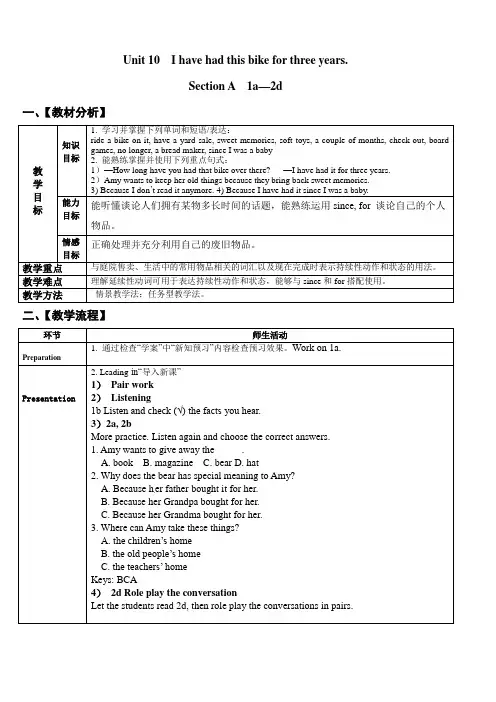
Unit 10 I have had this bike for three years.Section A 1a—2d一、【教材分析】教学目标知识目标1. 学习并掌握下列单词和短语/表达:ride a bike on it, have a yard sale, sweet memories, soft toys, a couple of months, check out, board games, no longer, a bread maker, since I was a baby2. 能熟练掌握并使用下列重点句式:1)—How long have you had that bike over there? —I have had it for three years.2)Amy wants to keep her old things because they bring back sweet memories.3) Because I don’t read it anymore. 4) Because I have had it since I was a baby.能力目标能听懂谈论人们拥有某物多长时间的话题,能熟练运用since, for 谈论自己的个人物品。
情感目标正确处理并充分利用自己的废旧物品。
教学重点与庭院售卖、生活中的常用物品相关的词汇以及现在完成时表示持续性动作和状态的用法。
教学难点理解延续性动词可用于表达持续性动作和状态,能够与since和for搭配使用。
教学方法情景教学法;任务型教学法。
二、【教学流程】环节师生活动Preparation1. 通过检查“学案”中“新知预习”内容检查预习效果。
Work on 1a.Presentation 2. Leading-in“导入新课”1)Pair work2)Listening1b Listen and check (√) the facts you hear.3)2a, 2bMore practice. Listen again and choose the correct answers.1. Amy wants to give away the _____.A. bookB. magazineC. bearD. hat2. Why does the bear has special meaning to Amy?A. Because h er father bought it for her.B. Because her Grandpa bought for her.C. Because her Grandma bought for her.3. Where can Amy take these things?A. the children’s homeB. the old people’s homeC. the teachers’ homeKeys: BCA4)2d Role play the conversationLet the students read 2d, then role play the conversations in pairs.三、【板书设计】四、【教后反思】Unit 10 I’ve had this bike for three years.The second period Section A (3a—3c) 一、【教材分析】教学目标知识目标1. 学习并掌握下列单词及其常用表达:seem to get smaller, part with certain toys, a train and railway set, do with the money,homemade,2. 能熟练掌握并使用下列重点句式:1)We have de cided to each sell five things we no longer use.2)As for me , I didn’t want to give up my football shirts, but, to be honest, I have not played for a while now.3) It has special meaning to me becau se Grandma gave it to me.能力目标通过阅读训练,能从阅读中获得个人物品的相关信息。
最新人教版八年级英语下册第十单元教案
最新人教版八年级英语下册第十单元教案Unit 10 I’ve had this bike for three years.教材解读本单元以庭院售卖为载体,让学生学习“谈论所有物”和目标结构“现在完成时表示持续性动作或状态”的用法,并且在此过程中,学生不仅能掌握重点单词、短语、句型,而且也提高了听说读写等综合能力。
Section B部分由谈论身边的物品转到谈论周围的环境变化,通过听说训练,学习如何描述所居住的城市或者家乡的特色建筑物的历史或者改变,此过程的学习,又进一步提高了学生的综合能力。
单元目标一、知识与技能1. 能谈论你拥有的物品和周围的事物。
2. 能正确使用现在完成时询问并表达持续性动作或状态。
3. 能掌握一些重点词汇和表达:yard,memory,cent,toy,bear,maker,scarf,board,bedroom,railway,while,hometown,crayon,shame…part with,as for,to be honest,close to,according to ,4.培养听、说、读、写各项基本技能。
二、过程与方法采用展示图片、表演对话、创设情境、小组合作与交流、听说读写四项基本技能相结合的方式来学习本单元的知识,培养各项能力。
三、情感态度与价值观了解国外的庭院售卖、慈善捐赠活动以及我国乡村生活的变迁。
教法导航采用直观教学法,遵循以学生为主体的原则。
学法导航采用独立思考与小组合作与交流相结合的方法,在老师的引领下相对独立地学习知识,培养能力。
课时支配第1课时:Section A1a-2d第2课时:Section A 3a-4c第3课时:Section B 1a-2d第4课时:Section B 3a-Self Check课时教案仅供学习与交流,如有侵权请联系网站删除谢谢1第1课时Section A 1a-2d教学目标一、知识与技能1.掌握本课单词和短语:yard sale,sweet,soft toy,bear maker,scarf,board game,check out.2. 能听懂谈论人们拥有某物多长时间的话题,能熟练运用since,for 谈论自己的个人物品。
八年级英语unit 10 i’m going to be a basketball player. 人教版(新目标)知识精讲
初二英语Unit 10 I ’m going to be a basketball player. 人教版(新目标)【本讲教育信息】一. 教学内容:Unit 10 I ’m going to be a basketball player.二. 具体过程:(一)语言目标:Talk about future intentions(二)目标语言:—What are you going to be when you grow up?—I’m going to be a basketball player.—How are you going to do that?—I ’m going to practice basketball every day.(三)重、难点诠释:1. I’m going to take acting lessons.(1)be going to +V 原是一般将来时态的表现形式之一,它表示说话者根据某迹象认为很可能将要发生的事或计划、打算要做的事。
be 的形式有am, is, are 三种。
ex.: Mary is going to leave China. (变否定句,疑问句并回答)→计划、打算要做某事。
soccer.play to going are y think the I rain. to going s It' Look!发生根据迹象判断某事即将→⎭⎬⎫ 常和be going to 结构连用的时间状语有tomorrow, next week, this evening, when you grow up 等。
(2)take acting lessons 上表演课,acting 是动名词作定语,限定lessons ,类似的短语有:running star, eating habit, reading room, skating champion, flying kites, English-speaking country 而且短语中的take 可以用have 替换。
八年级英语下册全册教案人教版新目标

Unit 1 Will people have robots ?单元教学目标:1、Words&phrases: robot, paper, less, fewer, simple, unpleasant, factory, seem, etc .2、will 构成的一般将来时态的陈述句、否定句、疑问句及回答.3、There be 句型的一般将来时.4、more , less , fewer 的用法.5、学习一般将来时态的相关知识,学会对未来进行预测.单元重难点:1、will构成一般将来时态的句式。
2、There be 句型的一般将来时态。
3、more , fewer , less 的用法。
4、How to make predictions .第一课时课前准备:教师:录音机、所学物品的图片。
学生:英语点金教练、练习本及相关的学习用具教学步骤:Step 1 Leading in(导入话题,激活背景知识)(导入话题,激活背景知识)1.Greetings: Welcome to school .What’s the date today ? Who’s o n duty today ?Do you enjoy your winter holiday ?(你喜欢你的寒假吗?)Do you finish your Homework(家庭作业)?(你完成你的假期作业了吗?)Do you want to live on the moon ?(你想去月球吗?)Can you guess what will happen in ten years ?(你能猜出十年后将会发生什么吗?)Collect the Ss’ answers and say somethi ng about their predictions .Step 2 Pre-task(任务前活动)SB Page 2 ,1a .1.Look at the picture :How will the world be different in the future ,100 years from now ?We’re going to talk about sth in 100 years .2.Read each predictions to the class .Explain the new vocabulary .3.Read the instructions .Make sure Ss know what they should do .4.Do it by themselves .5.Talk about the answers with the class .Explain :一般将来时态构成: will / be going to +动词原形=Step 3 While-task(任务中活动)SB Page 2 ,1b .1.Practise reading the six predictions .2.Read the instructions to Ss .Circle the things you hear on the recording .3.Play the tape twice .(放录音,两次)4.Play the tape a third time .At the same time ,check the answers .SB Page 2 , 1c .1、Pay attention to the dialogues .2、Read the dialogues fluently .3、Pairwork .Work in pairs to make predictions according to the sample .4、Ask several pairs to share their conversations to the class .SB Page 3 , 2a & 2b .1、Read the predictions .2、Read the instructions and point out the sample answer .3、Play the tape twice .Ss circle the word they hear in each sentences: more , less , fewer .4、Check the answers .学生探究: less , fewer 的区别。
人教版八年级英语下册教学课件《Unit-10-Section-B-1a-1d》
3. What is behind the science museum? What do people do there on weekends?
We lost the game although/though/even though we tried our best.
3) be full of = be filled with 充满,装满
瓶子里装满了水。 The bottle is filled with water. 满屋浓烟。 The room is filled with heavy smoke. 香槟酒有很多气泡。 Champagne (香槟酒) is full of bubbles (气泡).
他英语说的和你一样流利。
He speaks English as fluently as you. 这部字典不如你想象的那样有用。
This dictionary is not as useful as you think it is.
4. It’s been around for at least 20 years.
at least “至少”
我至少在十岁以前一直怕狗。 I was afraid of dogs until I was at least ten. 停电时我们至少可以使用蜡烛。 At least we can use candles if the electricity fails.
Exercises
Jenny’s hometown is really b__ea_u__ti_fu__l __. She __h_a_s__ __b_e_e_n_a_w__a_y______ for the past few years. It’s _f_u_ll_o_f__ interesting places to see & things to do. One of the oldest buildings in the town is the library. It’s been around for __h_u_n_d_r_e_d_s___of years. Next to the library is the new science museum. It’s only been there since _l_a_s_t _A_u_g_u_s_t_. There’s a big park __b_e_h_in__d___ the museum. Many families go there on weekends to let the kids _r_u_n__a_ro_u__n_d_ and climb the hills. There’s a restaurant down the street. It’s been around for a_s__lo_n_g__a_s_s_h_e__ca_n__r_e_m_e_m__b_e_r_. It serves the best food in town.
Module10Unit1Donttalkinthelibrary(教案含教学反思)
教学方法与手段
1.教学方法
(1)情境教学法:通过模拟公共场所的情境,让学生在实际环境中学习和运用英语。例如,教师可以组织学生进行角色扮演,模拟在图书馆、电影院等场所的对话。
- No talking in the cinema, please.
教学反思
在本节课的教学中,我采用了情境教学法、任务型教学法和互动式教学法,通过模拟公共场所的情境,设计任务活动和引导学生之间的互动,激发学生的学习兴趣和主动性。同时,我充分利用多媒体设备、在线教学平台和教学软件等现代化教学手段,提高教学效果和效率。
为了改进今后的教学,我需要更加关注学生的个体差异,采用更加灵活多样的教学方法,以满足不同学生的学习需求。同时,我需要更加注重激发学生的学习兴趣,通过引入更多与学生生活实际相关的话题,提高他们的参与度和学习积极性。
课后作业
1.用所学的词汇和短语描述公共场所的规则,例如图书馆、电影院等,并用英语表达出来。
2.引导与启发:在讨论过程中,我将作为一个引导者,帮助学生发现问题、分析问题并解决问题。我会提出一些开放性的问题来启发他们的思考,例如“你们认为在公共场所应该遵守哪些规则?为什么?”
3.成果分享:每个小组将选择一名代表来分享他们的讨论成果。这些成果将被记录在黑板上或投影仪上,以便全班都能看到。
五、总结回顾(用时5分钟)
-词汇和短语的学习与使用是理解和学习公共场所规则的基础。通过学习这些词汇和短语,学生能够更好地描述和表达公共场所的规则。
③句子和规则的逻辑关系:
人教版八年级下册英语教案(全册)
人教版八年级下册英语教案(全册)Unit1What’s the matter?Section A◆教材分析本单元的主题是有关于身体健康。
这个话题是关乎我们每天的日常生活,所以有必要让学生了解相关的知识。
学生将会学会如何谈论他们的健康问题以及如何给予他人建议。
◆教学目标【知识目标】描述健康问题以及如何根据别人的健康问题提建议【能力目标】1.听懂谈论健康问题的对话材料2.能根据别人的健康问题提建议3.能写出重点单词和重点句型4.能描述怎样对待健康问题。
【情感目标】通过本课的阅读,培养学生关心他人身体健康的品质,并培养学生处理紧急事件的基本能力,树立在紧急事件时互相帮助的精神.◆教学重难点◆【教学重点】1、词汇:have a stomachache,have a cold,lie down,take one's temperature,go to a doctor,get off;to one's surprise,2、句型:1.——What's the matter?——I have a stomachache.You shouldn't eat so much next time.2.——What's the matter with Ben?——He hurt himself.He has a sore back.——He should lie down and rest.【教学难点】掌握情态动词should shouldn't.的用法;学习have的用法◆课前准备◆Multimedia,group work,cooperative discussion.◆教学过程Step1.Warm up1.Look at the picture and learn the parts of the body.2.New words and phrases.Step2Presentation1.1aLook at the picture.Write the correct letter[a-m]for each part of the body.Then check the answers.2.1bFirst,lead Ss to read the five names.Then look at the picture.Number the names1-5.’sFinally, check the answers.3. 1cDivide two Ss into a pair to make conversations. Finally, invite several pairs to act outfor the class.Step 3 Practice1. 2aTell Ss there are five conversations. In each conversation the person says what goingon with them. Listen carefully and number the pictures.Play the tape. Then check the answers.2. 2bAsk Ss to listen to the recording again to match the problems with the advice.Play the recording again. Then check the answers.3. 2cAsk Ss to make conversations using the information in 2a and2b. Give them enoughtime to do this task. Later , invite several pairs to present their conversations to theclass.Step 4 Consolidation1. 2dFirst, ask Ss to have a fast reading of the conversation to get the main idea.Then, lead Ss to read the conversation sentence by sentence, explain some languagepoints.Finally, divide Ss into pairs to practice role-playing the conversation.2. 3aFirst, read the passage quickly and answer the question.Then,lead Ss to read the passage and analyse the key points.Finally,read together.3.3bRead the passage again and check the things that happened in the story3cDiscuss the questions with a partner.4.Grammar focusFirst,lead Ss to read the sentences.Then,prompt Ss to analyse the use of model verb should.After that,explain the grammar together.5.4aAsk Ss to fill in the blanks.Then,invite some Ss to present their answers.6.4bAsk Ss to circle the best advice for these health problems,then add their own advice.After that,invite some Ss to present their advice.7.4cOne student mimes a problem.The other students in your group guess the problem and give advice.Step5Language pointsStep6HomeworkMake a conversation about health problems and giving advice.Unit1What’s the matter?Section B◆教材分析本单元的主题是有关于身体健康。
【课时练】八年级下册英语人教版Unit 10 Section A 01(含答案解析)
答卷时应注意事项1、拿到试卷,要认真仔细的先填好自己的考生信息。
2、拿到试卷不要提笔就写,先大致的浏览一遍,有多少大题,每个大题里有几个小题,有什么题型,哪些容易,哪些难,做到心里有底;3、审题,每个题目都要多读几遍,不仅要读大题,还要读小题,不放过每一个字,遇到暂时弄不懂题意的题目,手指点读,多读几遍题目,就能理解题意了;容易混乱的地方也应该多读几遍,比如从小到大,从左到右这样的题;4、每个题目做完了以后,把自己的手从试卷上完全移开,好好的看看有没有被自己的手臂挡住而遗漏的题;试卷第1页和第2页上下衔接的地方一定要注意,仔细看看有没有遗漏的小题;5、中途遇到真的解决不了的难题,注意安排好时间,先把后面会做的做完,再来重新读答题;6、卷面要清洁,字迹要清工整,非常重要;7、做完的试卷要检查,这样可以发现刚才可能留下的错误或是可以检查是否有漏题,检查的时候,用手指点读题目,不要管自己的答案,重新分析题意,所有计算题重新计算,判断题重新判断,填空题重新填空,之后把检查的结果与先前做的结果进行对比分析。
亲爱的小朋友,你们好!经过两个月的学习,你们一定有不小的收获吧,用你的自信和智慧,认真答题,相信你一定会闯关成功。
相信你是最棒的!Unit10I've had this bike for three years.Period1(Section A1a-2d)一、词组翻译1.进行庭院销售________________________________________________________________________ 2.拥有……超过10年________________________________________________________________________ 3.带来甜蜜的回忆________________________________________________________________________ 4.把旧东西捐给需要的人________________________________________________________________________ 5.不再适合她________________________________________________________________________ 6.几个月________________________________________________________________________ 7.为孩子们查看这些布绒玩具和棋类游戏________________________________________________________________________ 8.不再……________________________________________________________________________二、完形填空Time is very important in our life.But it never had any importance in my life until I__1__a watch from my father.It__2__me the importance of time in my life.I got this gift on a gray-sky day.I had to get to the__3__at9:00a.m.to pick up my uncle Ali and take him to my father's house.However,I forgot it completely__4__I was playing with my ter on that day,around11:00a.m.,I__5__my uncle,but when I got to the airport, he had got off the plane and__6__a taxi to my father's house.I got to my father's house at2:00p.m.My father looked at me__7__.I said“hi”to him and my__8__uncle.My father asked me to sit__9__him and handed me this watch which was a giftfrom__10__.It weighed8oz and all of it was made of silver(银).Then he said,“Essa,did you have fun with your__11__?What you did today was not very__12__and you should be sorry for your action(行为).”I felt sorry and told my father that I wouldn't do that again.Then he said,“This watch will be a reminder(提醒物)for you.I hope__13__you have learned something important.”I learned a lesson from my father:to respect time and__14__be late.The watch is important to me,not because of its__15__,but because of the lesson that I learned from it.()1.A.bought B.borrowed C.got D.broke()2.A.told B.found C.sent D.turned()3.A.station B.school C.airport D.home()4.A.though B.so C.if D.because()5.A.remembered B.met C.saw D.visited()6.A.invited B.taken C.learned D.invented ()7.A.angrily B.happily C.slowly D.excitedly ()8.A.famous B.free C.tired D.wonderful ()9.A.far from B.under C.around D.next to()10.A.him B.you C.me D.us()11.A.brothers B.friends C.parents D.classmates ()12.A.important B.cold C.necessary D.nice()13.A.today B.tomorrow C.yesterday D.tonight()14.A.always B.usually C.often D.never()15.A.size B.weight C.price D.look三、阅读理解Feeling left out?A reader wrote in to say that she was feeling lonely at break because her best friend wasn't around.Here's our advice to her and to all kids who feel lonely sometimes.It's hard when a best friend isn't around,maybe because she moved to a different school or a different class.You may feel lonely at break or lunchtime.You want to have new friends,but how do you make them?Maybe it seems that everybody else already has their friends.But remember, there's always room for more friends.Start by looking around your classroom and think about which kids you'd like to play with at break.Look for chances to say hi to them,smile,and be friendly.Offer to share something or express your appreciation(欣赏)to them.Invite someone to play with you or say“Do you want to sit here?”in the lunchroom.When you're at break,walk over to kids you want to play with, act friendly,and say“Hi,can I play,too?”or just join in.If you have trouble doing this or if you're feeling shy,ask your teacher to help you make new friends.Teachers are usually pretty good at matching up friends.The best way to make friends is to be a friend.Be kind,be friendly,share,say nice things,offer to help and pretty soon,you'll have one,or two,or even more new friends.You might still miss that special best friend.But when you see each other,you can share something you didn't have before she left:You can introduce her to your new friends!()1.This text is written for________.A.teachers B.parents C.students D.visitors ()2.According to the writer,some kids feel lonely at break because they________.A.have trouble with their studies B.don't have their best friends aroundC.need their parents to be with them D.are too young to look after themselves ()3.The underlined word“this”in Paragraph4refers to(指的是)“________”.A.sharing your ideas B.talking before many peopleC.studying better at school D.developing new friendship ()4.Some kids need help from teachers to make friends because________.A.they miss their old friends a lotB.they have no time to stay with othersC.teachers know who wants a new friendD.they are shy or not good at making friends()5.The expression“feeling left out”means“________”in Chinese.A.受冷落B.被调侃C.挨批评D.遭攻击四、根据句意及汉语提示完成句子1.The children are playing in the________(院子).2.My father bought my little sister two________(玩具)last week.3.Mary bought two________(围巾).4.This wood is________(软的)than that stone.5.I bought some________games(棋类游戏)for younger kids.五、用方框中所给词或短语的适当形式填空sell ride cent in need check out1.Tom decided________his toy car.2.Amy gave old things away to people________.3.________the most interesting book in this bookstore.4.I don't know how________a bike on this road.5.—How much is this old magazine?—Fifty________.六、语法填空阅读下面短文,按照句子结构的语法性和上下文连贯的要求,在空格处填入一个适当的词或使用括号中词语的正确形式填空(每空不多于3个单词)。
八年级英语下册教案人教版核心素养unit 1英文版
八年级英语下册教案人教版核心素养unit 1英文版全文共3篇示例,供读者参考篇1Unit 1: My future jobPart 1: Teaching Objectives1. Knowledge and skills goals:- Students can understand and use vocabulary related to future jobs.- Students can talk about their dreams and aspirations.- Students can describe their future job and career aspirations.2. Process goals:- Students can participate in group discussions and share their ideas.- Students can practice listening, speaking, reading and writing skills.3. Emotion and values goals:- Students can develop a positive attitude towards planning for their future.- Students can appreciate the importance of setting goals and working towards achieving them.Part 2: Teaching Content1. Vocabulary: job titles (teacher, doctor, engineer, etc.), job responsibilities (teaching, healing, designing, etc.), job requirements (skills, education, experience, etc.).2. Grammar: Future tense (will/won't + base form of the verb).3. Speaking and Listening: discussing future goals and aspirations, describing future job aspirations.4. Reading and Writing: reading and writing about future job aspirations.Part 3: Teaching Procedures1. Warm-up: (10 minutes)- Show pictures of different job titles and ask students to guess the job titles.- Play a guessing game where students describe a job without using the job title and others have to guess the job.- Discuss the importance of setting goals and working towards achieving them.2. Presentation: (20 minutes)- Introduce vocabulary related to future jobs using flashcards or pictures.- Present and practice the future tense with examples.- Show a video or audio clip of people talking about their future career aspirations.3. Practice: (30 minutes)- Divide students into pairs or small groups to discuss their dreams and future job aspirations.- Have students write a short paragraph describing their future job aspirations.- Conduct a role play activity where students act out a job interview scenario.4. Production: (20 minutes)- Ask students to present their future job descriptions to the class.- Have students write a short essay about their dream job, including job title, responsibilities, requirements, and reasons for choosing that job.5. Review: (10 minutes)- Review vocabulary and grammar covered in the lesson.- Summarize key points and discuss the importance of setting goals for the future.Part 4: Assessment- Assessment can be done through written assignments, oral presentations, and class participation.- Encourage students to reflect on their learning and set goals for improving their English skills in the future.篇2Unit 1: Our worldLesson 1: We need to protect our worldObjectives:1. Students will be able to understand the importance of protecting our environment.2. Students will be able to discuss different ways to protect our world.3. Students will be able to use target vocabulary related to the environment.Warm-up: To start the lesson, the teacher can show pictures of environmental issues such as pollution, deforestation, and climate change. Students can discuss in pairs or small groups what they see in the pictures and why it is important to protect our world.Presentation: The teacher can introduce key vocabulary words related to the environment such as pollution, recycling, conservation, and sustainable. Students can repeat after the teacher to practice pronunciation.Practice: Students can work in pairs to discuss different ways to protect our environment. They can also brainstorm ideas on how they can make a difference in their daily lives to help the environment.Production: In groups, students can create a poster or a presentation about a specific environmental issue and how theycan make a positive impact in solving it. They can present their work to the class and engage in a discussion about each group's topic.Homework: Students can write a short paragraph about what they can do to protect our world. They can also research and find information about a specific environmental issue and write a summary of their findings.Assessment: The teacher can assess students based on their participation in class discussions, their creativity and teamwork during the group project, and the quality of their homework assignment.Overall, this lesson aims to raise awareness about the importance of protecting our environment and empower students to take action to make a difference in the world. By fostering a sense of responsibility and empathy towards the planet, students will be better equipped to contribute to a more sustainable and eco-friendly future.篇3Unit 1 Get ready for the futureTeaching Goals:1. Enable students to understand and use the target language in real-life situations2. Develop students' listening, speaking, reading, and writing skills3. Encourage students to think about their future plans and goalsTeaching Procedures:Part 1: Warm-up (10 minutes)- Start the lesson by asking students about their future plans and goals. This can be done in a whole-class discussion or in small groups.- Have students share their aspirations, such as what they want to be when they grow up or where they want to visit in the future.- Encourage students to think about why these goals are important to them and how they plan to achieve them.Part 2: Listening and Speaking (20 minutes)- Play a video or audio clip of people talking about their future plans and goals. Ask students to listen carefully and take notes.- After playing the clip, have students work in pairs or small groups to discuss what they heard and share their notes.- Encourage students to ask each other questions about their future plans and offer advice or support.Part 3: Reading (20 minutes)- Distribute a reading passage about different career options and their requirements. Have students read the passage silently and underline any unfamiliar vocabulary.- Divide students into pairs and have them discuss the different career options mentioned in the passage. Ask them to talk about the skills and qualifications needed for each career.- The teacher can then lead a whole-class discussion on the importance of education and training in achieving future goals.Part 4: Writing (20 minutes)- Ask students to write a short paragraph about their future plans and goals. They can include information about their desired career, education, hobbies, and aspirations.- Encourage students to use the target language learned in class and to be as descriptive as possible.- Once students have finished writing, have them share their paragraphs with a partner or with the whole class.Part 5: Assessment and Extension (10 minutes)- To assess students' understanding of the lesson material, give them a short quiz on the target language and key concepts covered in class.- For extension activities, ask students to research a specific career or field of interest and present their findings to the class.- Provide feedback on students' work and encourage them to continue thinking about their future plans and how they can achieve success.Homework:Assign students to write a reflection on their future goals and the steps they will take to achieve them. Encourage them to be specific and realistic in their planning.Overall, this lesson aims to inspire students to think about their future with optimism and determination. By developing their language skills and critical thinking abilities, students will bebetter prepared to face the challenges and opportunities that lie ahead.。
八年级英语下册全册电子版教案【名师版】
人教版新目标(新)八年级下册电子教案Unit 1What's the matter?第一课时Section A (1a-2d)1.重点单词:matter,back,sore,throat,stomachache,foot,neck,stomach,fever,lie,rest,cough,Xray,toothache,headache2.重点短语:have a sore throat,have a stomachache,have a cold,lie down,take one's temperature,have a fever,go to a doctor3.重点句式:—What's the matter?—She talked too much yesterday and didn't drink enough water.She has a very sore throat now.You should drink some hot tea with honey.It doesn't sound like you have a fever.You need to take breaks away from the computer.I think I sat in the same way for too long without moving.If your head and neck still hurt tomorrow,then go to a doctor.1.重点短语和句型2.询问对方身体状况的句型及答语询问对方身体状况的句型及答语一、预习课本P1-2新单词并背诵,完成下面的汉译英。
1.问题____________ 2.背部____________3.疼痛的____________ 4.嗓子____________5.胃痛____________ 6.脚____________7.脖子____________ 8.胃____________9.发烧____________ 10.平躺____________11.休息____________ 12.咳嗽____________13.X光____________ 14.牙疼____________15.头疼____________二、认真预习1a-2d找出下列短语和句型。