
《英美社会与文化》教学内容框架
《英美社会与文化》教学大纲
一、课程的任务和目的:
《英美社会与文化》是介绍英国社会和美国社会方方面面文化知识的一门课程。
开设本课的目的在于使学生通过学习,了解英美国家的历史、政治、地理、社会、经济、教育等方面的情况及其文化传统,内容庞杂、信息量大。
培养学生正确分析有关英美等国问题的能力,并能以正确的眼光看待世界上所发生的问题,提高学生对文化差异的敏感性和宽容性,培养学生跨文化交际能力。
培养学生成为热爱祖国、热爱社会主义、为国家繁荣发展而奋斗的人才。
同时,通过课文学习和各种实践,达到提高英语水平的目的。
通过学习英美文化和中外文化的比较,让学生切身感受到成功的交际仅有语言是远远不够的,文化方面的学习有时所起的作用远远大于语言本身,文化积累必将为英语学习者未来的学习和工作打下坚实的基础。
二、课程主要内容:
主要包括英美两国的政治体制、政府形式、教育制度、新闻媒体、体育运动、节日假日、社会问题、科技成果、著名景区、流行文化等内容,目的在于开阔学生的视野,扩大他们的知识面,并注意借鉴最新研究成果,合理吸收最新知识,进一步增强其实用性。
第四章:英国政府
教学要求:通过教学使学生了解英国君主政体的形成过程和基本特点,议会的形式和职责,首相和内阁的产生过程,当代英国政府的内部构成,宪法和议会的历史由来,英国王室的作用,上下议院各自的职能。
教学重点:君权神授、内战、大宪章、大议会、1689年《权利法案》、内阁、首相、宪法、议会的权利与职能、君主的角色、上议院、下议院。
第六章:英国教育制度
教学要求:通过教学使学生了解英国教育制度历史上的不同发展阶段,当代基础教育制度的特点,高等教育制度的基本情况。
教学重点:英国教育制度的目的、教育与社会阶层的关系、教会对学校的影响、1944年教育法案、综合制中学、语法学校、国家课程、公立学校、GCSE、GCE-A、GNVQs、开放大学。
第九章:英国媒体
教学要求:通过教学使学生了解英国媒体的作用和影响,几大主要报纸,全国性报纸和地方性报纸,大报和小报,英国广播公司的主要特征和各类节目,以及媒体对政治的影响。
教学重点:英国媒体的功能、大报、《观察家报》、《泰晤士报》、《卫报》、《每日电讯报》、《金融时报》、小报、电视和广播、英国广播公司、独立电视委员会。
第十章:英国的体育运动和节假日
教学要求:通过教学使学生了解英国民众体育运动休闲的主要方式,足球、网球和板球的历史发展和重要赛事的基本情况,高尔夫球、赛马、打猎和马术运动的基本情况,英国的主要宗教节日、国家节日以及四个地区的各自主要节日。
教学重点:足球、足球流氓、网球、温布尔登网球赛、板球、高尔夫球、赛马、打猎、马术运动、圣诞节、节礼日、复活节、万圣节、圣帕特里克节。
第四章:美国的政治制度
教学要求:通过教学使学生了解美国政治制度形成的过程,美国联邦条例的基本内容,美国宪法的基本内容,美国的立法机关、行政机关和司法机关各自的特征及三者的关系,政治的制约与平衡,权利法案的特点,两大政党的基本特征。
教学重点:美国联邦条例、美国宪法的形成、立法机关、行政机关、司法机关、权力制衡、权利法案、美国两大政党。
第八章:美国的教育制度
教学要求:通过教学使学生了解美国教育制度的现状,教育是属于各州当地的事务,美国各阶段教育所学习的内容,美国新国家教育的由来,美国学生成为世界公民的教育理念,美国高等教育的基本特征,美国学生如何选择大学和专业,以及美国的全民教育的趋势。
教学重点:美国全民教育、教育的几个阶段、课程设置、少数族裔平等接受教育的权利、高等教育体制、大学和学院、专业发展趋势、学位。
第十章:美国社会问题
教学要求:通过教学使学生了解美国种族矛盾冲突的历史根源、发展和现状,贫困人口的基本生活状况,毒品泛滥的情况,各类犯罪的情况,政府和公司权力滥用的情况。
教学重点:种族问题、对黑人的种族歧视、底层黑人群体、贫困、毒品泛滥、犯罪、罪犯档案、白领犯罪、政府权力滥用、公司权力滥用。
第十三章:美国科技发展
教学要求:通过教学使学生了解美国科学技术发展的几个基本阶段,19世纪早期和晚期的主要科技发明和发明者,20世纪早期、中期、晚期和今天的主要科技发明和发明者。
教学重点:伊莱·惠特尼、约翰·霍尔、托马斯·阿迪生、亨利·福特、弗雷德里克·泰勒、詹姆斯·麦克斯韦、计算机科学、互联网、核能、可再生能源技术。
第十五章:美国的体育运动和景点
教学要求:通过教学使学生了解最受美国人喜爱的橄榄球、棒球和篮球运动的历史和现状,赛狗、赛车、赛马等其他热门体育项目,科罗拉多大峡谷的形成,落基山脉,太平洋海岸,中西部地区,东南部地区,东北部地区,以及夏威夷等。
教学重点:美式橄榄、棒球、篮球、NBA、迈克尔·乔丹、杰克·鲁滨逊、大峡谷、黄石公园、迪斯尼乐园、国家纪念碑、尼亚加拉瀑布、夏威夷、阿拉斯加。
第十六章:美国流行文化:电影和音乐
教学要求:通过教学使学生了解流行文化一词的由来,20世纪初早期电影发展的历程和成就,好莱坞电影时代的崛起和发展,奥斯卡金像奖,1900年以来流行乐发展的各个阶段的特点、代表歌星及知名歌曲。
教学重点:美国早期电影、好莱坞时代、九十年代电影特效、美国电影全球化、爵士乐、乡村音乐、西部音乐、甲壳虫乐队、八十年代摇滚乐、鲍勃·迪伦。
四、参考资料:
本课程指定教材:
《英语国家社会与文化入门》朱永涛、王立礼主编,高等教育出版社,2011年。
其他同类教材或资料:
《英美概况》(上、下册)张奎武主编,吉林科学技术出版社,1994年。
《英美概况应试必读》何兆枢、刘鹤鸣主编,海洋出版社,1997年。
《英美概况》金谦廉、刘孝恒主编,辽宁大学出版社,1993年。
《英语国家概况》余志远主编,外语教学与研究出版社,1996年。
《英国风情录》吴延迪编著,东方出版中心城市,1998年。
《新编英美概况》周叔麟,北京大学出版社,2004年。
《美国文化阅读教程》宁洪主编,天津大学出版社,2004 年。
《欧洲文化入门》王佐良等主编,外语教学与研究出版社,2003年。
《英语专业八级人文知识》刘宝全等主编,大连理工大学出版社,2006 年。
五、教学方法:
本课程学习以教师课上讲授和学生课前准备、课上参与共同完成。
建议授课教师讲授十个单元中的任意四个。
其余四个单元由学生以小组为单位,在教师指导下,课前做好充分准备(相应的PPT,Word,图片,音频,视频等材料),课上由学生展示讲解,教师补充为辅的方式。
六、评测方式:
学生总评成绩取决于学生的平时成绩(出勤情况、课堂参与、课后作业)、听力课成绩、口语和背诵成绩,以及期末考试成绩。
考试采取正规闭卷考试的形式,考试范围为全部十个指定的学习单元,采用名词解释、填空、多项选择、判断对错、简答、阅读、写作、翻译等形式,考察学生对英美两个国家社会文化各方面的熟悉与掌握情况。
学生期末总评成绩比例构成:(暂定)
平时成绩(15%)
听力课成绩(15%)
口语和背诵(20%)
期末考试成绩(50%)
七、教学进度:
具体教学进度和讲授单元顺序由任课老师自己决定。
2014年2月20日。
英美社会与文化教案

英美社会与文化教案教案标题:探索英美社会与文化教学目标:1. 了解英美社会与文化的历史和发展2. 探讨英美社会与文化的特点和差异3. 分析英美社会与文化对世界的影响教学重点:1. 英美社会与文化的历史和发展2. 英美社会与文化的特点和差异3. 英美社会与文化对世界的影响教学内容及安排:1. 第一课时:英美社会与文化的概述- 介绍英美社会与文化的概念和范围- 分析英美社会与文化的历史渊源- 讨论英美社会与文化在全球化背景下的地位和影响2. 第二课时:英美社会与文化的特点和差异- 比较英美社会与文化的特点和差异,如语言、宗教、风俗习惯等 - 探讨英美社会与文化的多元性和包容性- 分析英美社会与文化对个体和群体的影响3. 第三课时:英美社会与文化对世界的影响- 分析英美社会与文化对世界政治、经济、文化等方面的影响- 探讨英美社会与文化在国际关系中的地位和作用- 思考如何更好地理解和尊重英美社会与文化,促进跨文化交流与合作教学方法:1. 多媒体教学:通过图片、视频等多媒体资料展示英美社会与文化的特点和差异2. 小组讨论:组织学生就英美社会与文化展开讨论,促进思想碰撞和交流3. 角色扮演:让学生扮演英美社会与文化中的代表人物,深入体验和理解其特点和影响4. 实地考察:组织学生进行英美社会与文化的实地考察,深化对其的认识和理解教学评估:1. 课堂表现:学生对英美社会与文化的讨论和参与情况2. 作业完成:学生完成相关阅读、写作和研究任务的质量和深度3. 课堂测试:对学生对英美社会与文化的理解和掌握程度进行测试教学反思:1. 教学内容是否贴近学生生活实际,能否引起学生的兴趣和思考2. 教学方法是否多样化,是否能够激发学生的学习热情和参与度3. 教学评估是否客观全面,是否能够准确反映学生的学习情况和水平通过以上教案的撰写和实施,希望能够引导学生深入了解英美社会与文化,促进跨文化交流与合作,培养学生的国际视野和跨文化交际能力。
英美文化教案

英美⽂化教案Unit OneIntroduction& Unit 1The Society and Culture of Major English-Speaking Countries课程名称:英语国家社会与⽂化本课内容:The Society and Culture of Major English-Speaking Countries授课时间:90分钟教学⽬的:通过本节课的教学,使学⽣了解英语国家社会与⽂化课程的主要内容与要求,了解⽂化的概念;同时对英国有⼀个总体上的了解。
教学意义:帮助学⽣了解主要英语国家的社会与⽂化概貌,如地理、历史、政治、经济、社会⽣活和⽂化传统等⽅⾯的基本知识。
教学重点:⽂化的概念;英国基本情况。
教学难点:英国概况教学⽅式:以电⼦课件为主,辅以少量板书的课堂讲授。
教学内容: (详见下页)1.什么是⽂化?2.英国国⼟与⼈民英国的不同名称及其区域3. 伦敦概况教学⽅法:采取教师教授为主,结合学⽣课堂讨论。
时间分配: What is culture? (10 分钟.);What’s th e relation between Culture and society? (10 分钟);Why should we learn culture (10 分钟);UK- a complicated country with a complicated name(40 分钟)A Brief Idea about London. (20 分钟)课堂板书:1. Culture-the foundation of communication2. The four parts of UK3. Main cities of EnglandLondonBirmingham-second largest city of England.Liverpool-second largest port of EnglandManchester- industrial and commercial centre.课后作业: Exercises in Unit 1Unit OnePart One1.What is culture?Culture-the foundation of communicationCulture is very abstract and complicated. Concretely speaking, it refers to all the aspects of social life, such as, the values, the practices of a society and social conventions, education, politics, art or literature,language,ideas,etc.⽂化即是⼈们所思,所⾔(⾔语和⾮⾔语),所为,所觉的总和.⽂化是⽆处不在的,具体说来,包括社会⽣活的⼀切⽅⾯,如:价值观念,⽣活⾏为⽅式,社会规范等,乃⾄艺术,政治,经济, 教育,修养,⽂学,语⾔,思想等.2. What’s the relation between Culture and society?1)Culture is a separate idea from society, although culture and society are interrelated andcannot exist without each other.2)Culture is a system of values (or beliefs) and norms (or behaviour). A society is a system ofinterrelationships which connect or bind individuals together.3. Why should we learn culture?1)Requirement of communication2) Language and culture are inseparable3)Culture acquisition is important for the study of literature.Part TwoUK- a complicated country with a complicated nameⅠStatus in the worldEffects of its Imperial Past--“an empire in which the sun never set”(⽇不落帝国):1.one of five permanent members of the UN Security Council, a founding member ofNATO, and of the Commonwealth,2. Member of European Union and the Group of seven3.The make-up of the British population (Immigration has produced a population of which 1in 20 are of non-European ethnicity.)II. The effects of its imperial past* The days of empire ended after World War II1. The effects were mainly encountered in the close relationships which exist with the 50 or more colonies of that empire, and which maintain links through Commonwealth of Nations. But more important international relation is its membership in the European Union since 1973.2. The makeup of the British population--- immigration from India, Pakistan, or Caribbean (西印度群岛与中南美洲海域) countries in the 1950s and1960s. 1/20 are non-European ethnicity.III.The features of British society:1.a multiracial societyRacial, gender, class, regional and economic differences in the societya multi-racial society: most are Christians and because of immigration, many are Muslims;gender difference: male and female live different livesclass difference: the class structure of UK society is relatively obvious (A white-collar worker’s lives are very different from a blue-collar worker’s.)economic and regional difference within each of the 4 countries:-- difference between highland and lowland Scots-- difference between north and south England (South is on average more wealthy than the north)2. a society with class-structure3. a society with difference of region difference: highland and lowland Scots,north and southEngland,the capital and provinces.Part ThreeMain cities of England1. London2. Birmingham-second largest city of England.3. Liverpool-second largest port of England4. Manchester- industrial and commercial centre.London--cultural,bussness,and financial centre1. One of the most famous cities of the world, London is England's capital and a favourite for tourists from all over the world who flock there in their millions. It has a history stretching back almost 2000 years, A population of 7.5 million people, and some of the most famous tourist attractions in the world.2.London Attractions:Big Ben and the Houses of Parliament.The Tower of London,Tower Bridge,St Paul's Cathedralthe River ThamesCountless fascinating museums, art galleries and famous theatres.The English Royal Family reside in London at Buckingham Palace whereyou can see the famous 'Changing of the Guard' and much more.3. A significant role of LondonWhen a man is tired of London, you are tired of life for there is in London all that life can afford.—Samuel Johnson London is dominant in UK in all sorts of ways.1)It is the largest city in the country with abo ut one seventh of the nation’s population.2)It is seat of government.3)It is the cultural centre.4)It is the business centre.5)It is the financial centre of the nation.6)London is a huge weight in Britain’s economic and cultural life, and to some exte nt the restof the country lives in its shadow.For reference英国历代国王与王后Geographical features1.Geographical positionThe United Kingdom of Great Britain and Northern Ireland (UK) is situated north-west of the European continent between the Atlantic Ocean and the North Sea. It has a total land area of 244,100 square kilometres, of which nearly 99% is land and the remainder inland water. From north to south it is about 1,000 kilometres long.(1) Northwest of Europe(2) North Atlantic Ocean(3) Separated from the rest of Europe by the English Channel2.Geographical features(1) An island country, surrounded by sea(2) Highlands in the north and west(3) Lowlands in the east and southeastA. Part of the great European PlainB. Level land and fertile soilC. farming(4) 3 natural zones in ScotlandA. the highlands in the northB. the central lowlandsC. the southern uplands. Rivers and LakesImportant role of rivers in the country’s economy1.Important Rivers(1)the Severn RiverA.the longest in the countryB.only 338 kilos long(2)the Thames RiverA.the 2nd longestB.the most important riverC.336 kilos longD.Oxford and London are on the river(3)River ClydeA.the most important in ScotlandB.important commercial waterway2.the Lake District(1)in northwest England and North Wales(2)popular tourist attractions(3)the home of the Lake PoetsA.William WordsworthB.Samuel Taylor ColeridgeC.Robert SoutheyClimate1.Typical feature of Britain’s climate“Other countries have a climate; in England we have weather.”The statement is often made by Englishmen to describe the peculiar meteorological conditions of their country.A maritime type of climate(1)rainy---abundant rainfallThe uncertainty about the weather tends to make the Englishmen cautious.“A foreigner may laugh when he sees the Englishman setting forth on a brilliantlysunny morning wearing a raincoat and carrying an umbrella, but he may well regret hislaughter later in the day!”(2)changeable and unpredictable, no clear cut of 4 seasons“In no country other than England, it has been said, can one experience four seasons in the course of a single day! Day may break as a balmy spring morning; an hour or solater black clouds may have appeared from nowhere and the rain may be pouring down.At midday conditions may be really wintry with the temperature down by about eightdegrees or more centigrade. And then, in the late afternoon the sky will clear, the sunwill begin to shine, and for an hour or two before darkness falls, it will be summer.”(3)Mild: no extremesIn England one can experience almost every kind of weather except the most extreme.temperature: 4-6℃ in winter, 12-17℃ in summer2.Factors influencing the climate(1)the surrounding waters(2)the prevailing south-west winds(3)the North Atlantic Drift (warm current)3.Rainfall(1) a steady reliable rainfall throughout the year(2)uneven distribution of rainA. a water surplus in the north and westB. a water deficit in the south and eastUnit TwoThe History of England课程名称:英语国家社会与⽂化本课内容:The Society and Culture of Major English-Speaking Countries授课时间:90分钟教学⽬的:通过本节课的教学,使学⽣了解英国历史,尤其是英格兰的历史;掌握主要历史事件及⼈物。
美国社会与文化课程教学大纲

美国社会与文化课程教学大纲【课程代码】【课程中文名称】美国社会与文化【课程英文名称】American Society and Culture【学分】1 学分【总学时】 28 学时【讲授学时】 28学时一、教学目标本课程教学目标为:了解美国社会与文化的基本特点;掌握美国概况的基础知识;理解中美文化差异和不同的文化价值观念;掌握相关社会历史背景知识;提高英语语言技能;培养跨文化言语交际和非言语交际意识。
二、课程描述本课程的主要内容包括:美国历史、社会、政治、经济、文化、教育、及社会等多层面内容的表象了解及内在原因的分析。
本课程以教材内容为主,补充电影报刊等媒体材料,旨在通过阅读英语文字材料和观看英文影象资料,对美国的社会历史、生活习俗和风土人情有一个直观的印象。
使学生在欣赏了解的同时,联系社会历史原因进行分析,培养兴趣,开拓视野,提高英语和跨文化学习水平。
三、课程性质及教学对象美国社会与文化是大学外语选修课程,本课程面向_____全校______学生开设。
开课1个学期,共28学时。
四、教材选用1.选用教材:《美国制度与文化》(中国人民大学出版社)2.学生使用教材说明: A 需要学生购买教材 B 教师根据教材内容发放活页材料3.参考书目:《美国文化背景》世界图书出版社《新编英美概况教程》北京大学出版社五、教学内容IntroductionChapter 1 General IntroductionSection 1 General Introduction1 Introduction and requirements about this course2 Basics of Culture3 Name the visible and invisible aspects of culture4 Question the students to check the knowledge of America as a nation of immigrants &understanding the American ethnic diversitySection 2 American geography: from Atlantic to Pacific1 the immense size of US2 location, rivers, mountains & climate3 the states and famous cities4 some major parts & population5 the national anthem and national flag【基本要求】1.学生课前预习2.充分理解课文,能就课文表述自己的观点3.掌握重要基础知识4.能参与小组口头讨论,应用所学知识,并联系现实。
美国社会与文化课程教学大纲
美国社会与文化课程教学大纲【课程代码】【课程中文名称】美国社会与文化【课程英文名称】American Society and Culture【学分】1 学分【总学时】 28 学时【讲授学时】 28学时一、教学目标本课程教学目标为:了解美国社会与文化的基本特点;掌握美国概况的基础知识;理解中美文化差异和不同的文化价值观念;掌握相关社会历史背景知识;提高英语语言技能;培养跨文化言语交际和非言语交际意识。
二、课程描述本课程的主要内容包括:美国历史、社会、政治、经济、文化、教育、及社会等多层面内容的表象了解及内在原因的分析。
本课程以教材内容为主,补充电影报刊等媒体材料,旨在通过阅读英语文字材料和观看英文影象资料,对美国的社会历史、生活习俗和风土人情有一个直观的印象。
使学生在欣赏了解的同时,联系社会历史原因进行分析,培养兴趣,开拓视野,提高英语和跨文化学习水平。
三、课程性质及教学对象美国社会与文化是大学外语选修课程,本课程面向_____全校______学生开设。
开课1个学期,共28学时。
四、教材选用1.选用教材:《美国制度与文化》(中国人民大学出版社)2.学生使用教材说明: A 需要学生购买教材 B 教师根据教材内容发放活页材料3.参考书目:《美国文化背景》世界图书出版社《新编英美概况教程》北京大学出版社五、教学内容IntroductionChapter 1 General IntroductionSection 1 General Introduction1 Introduction and requirements about this course2 Basics of Culture3 Name the visible and invisible aspects of culture4 Question the students to check the knowledge of America as a nation of immigrants &understanding the American ethnic diversitySection 2 American geography: from Atlantic to Pacific1 the immense size of US2 location, rivers, mountains & climate3 the states and famous cities4 some major parts & population5 the national anthem and national flag【基本要求】1.学生课前预习2.充分理解课文,能就课文表述自己的观点3.掌握重要基础知识4.能参与小组口头讨论,应用所学知识,并联系现实。
《英美文化》课程实施性教学大纲要点

13级《英美文化》课程实施性教学大纲制定人:日期:审核人:日期:批准人:日期:一、说明1.课程的性质和内容根据本课程的要求与特点,该课程基本以理论课为主,以教材为教学中心,附以与该课程有关的资料作为教学补充材料,扩展学生的视野。
教学内容包括:英国与美国的地理、社会生活、宗教、文化、教育与艺术。
2.课程的任务和要求通过教学,使学生了解英、美两国的国家地理、人文特征、宗教、社会、教育与文艺等基本情况,包括社会各层面的发展和特征表现以及传统的风俗习惯等等。
理解西方思想的根源,包括英、美两国社会的思想意识的根源与形成;理解英国历史发展对其现今社会、宗教与政治制度的影响,以及美国社会、文化结构多元化的历史渊源。
掌握英、美两国经济、文化和社会等方面的知识要点,以及用于分析国家社会现象的历史辨证方法。
此外还要求学生通过听讲、阅读、讨论等方式提高英语语言应用能力。
3.教学中应注意的问题(含教学建议)英美文化博览是一本理论性比较强的课程,目前对许多英语学习者来说,由于众多因素的影响,不可避免地出现对英美等国的政治,经济,文化,风俗、观念和衣食住行诸多方面知之甚少,或缺少切实地了解,甚至出现空缺,这显然不能同日益发展的世界政治,经济和文化想一致。
因此,新教学模式以现代信息技术为支撑,黑板教学与多媒体教学结合。
教师应根据教学内容制作教学课件,适当选择英美国家有关文化最新音像资料和影视资料,使学生对英美国家的政治、经济、地理、气候、文化风俗等知识有更感性的认识。
4.推荐教材及学时说明教材:《美英文化博览》,总课时36课时二、学时分配三、课程内容和要求第一章英国文化§1-1 英国文化背景教学要求:1.了解英国的名称,英国概况,英国地势,气候,人口。
2.英国的主要分区;教学内容:一、英国的名称二、英国概括三、英国地势四、英国气候五、英国人口六、英格兰七、苏格兰八、威尔士九、北爱尔兰教学建议:引导学生通过都市自学法了解英国概况,地势,及地理分区并且利用PPT及多媒体。
《英语国家社会与文化》课程教学大纲
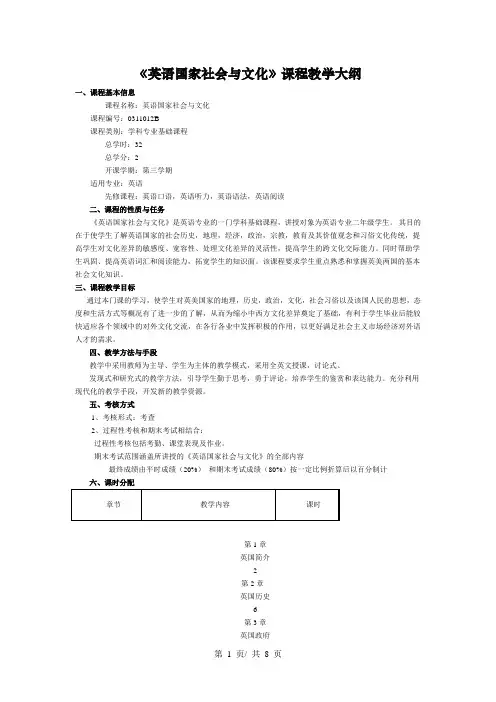
《英语国家社会与文化》课程教学大纲一、课程基本信息课程名称:英语国家社会与文化课程编号:0311012B课程类别:学科专业基础课程总学时:32总学分:2开课学期:第三学期适用专业:英语先修课程:英语口语,英语听力,英语语法,英语阅读二、课程的性质与任务《英语国家社会与文化》是英语专业的一门学科基础课程,讲授对象为英语专业二年级学生。
其目的在于使学生了解英语国家的社会历史,地理,经济,政治,宗教,教育及其价值观念和习俗文化传统,提高学生对文化差异的敏感度、宽容性、处理文化差异的灵活性,提高学生的跨文化交际能力。
同时帮助学生巩固、提高英语词汇和阅读能力,拓宽学生的知识面。
该课程要求学生重点熟悉和掌握英美两国的基本社会文化知识。
三、课程教学目标通过本门课的学习,使学生对英美国家的地理,历史,政治,文化,社会习俗以及该国人民的思想,态度和生活方式等概况有了进一步的了解,从而为缩小中西方文化差异奠定了基础,有利于学生毕业后能较快适应各个领域中的对外文化交流,在各行各业中发挥积极的作用,以更好满足社会主义市场经济对外语人才的需求。
四、教学方法与手段教学中采用教师为主导、学生为主体的教学模式,采用全英文授课,讨论式、发现式和研究式的教学方法,引导学生勤于思考,勇于评论,培养学生的鉴赏和表达能力。
充分利用现代化的教学手段,开发新的教学资源。
五、考核方式1、考核形式:考查2、过程性考核和期末考试相结合:过程性考核包括考勤、课堂表现及作业。
期末考试范围涵盖所讲授的《英语国家社会与文化》的全部内容最终成绩由平时成绩(20%)和期末考试成绩(80%)按一定比例折算后以百分制计六、课时分配第1章英国简介2第2章英国历史6第3章英国政府2第4章英国政治、阶级与种族2第5章英国经济2第6章英国教育与外交关系2第7章美国简介2第8章美国历史6第9章美国政治2第10章美国经济2第11章美国宗教2第12章美国的社会问题2七、教学内容第一章英国简介【教学目标】1.了解英国的名称、地理位置及组成部分2.理解英国国旗、国歌与国徽的含义3.掌握英国人口与社会等级以及民族价值观的特点【教学内容】1.英国名称、地理位置与组成部分2.英国国旗、国歌与国徽3.英国主要城市4.英国气候特征5.英国人口与社会等级6.英国民族价值观与特征【教学重点】1.英国名称、地理位置与组成部分2.英国人口与社会等级3.英国民族价值观与特征【教学难点】1.英国名称、地理位置与组成部分2.英国国旗、国歌与国徽3.英国民族价值观与特征【学时数】课堂讲述1学时、习题1学时第二章英国历史【教学目标】1.了解英国历史发展的主要阶段2.理解英国历史中的主要事件发生背景、意义与影响3.掌握英国历史中的重要历史事件【教学内容】1.民族的起源(5000BC-1066)2.民族的形成 (1066-1381)3.向现代的转变 (1455-1688)4.大英帝国的崛起与衰落(1688-1945)5.二战后的英国(1945至今)【教学重点】1.凯尔特民族、罗马入侵与盎格鲁-撒克逊民族2.诺曼征服与英国大宪章3.玫瑰战争4.资产阶级革命【教学难点】1.盎格鲁-撒克逊民族入侵2.玫瑰战争3.英国宗教改革4.资产阶级革命【学时数】课堂讲述3学时、课堂讨论1学时、习题2学时第三章英国政府【教学目标】1.了解英国政府的具体内容2.理解英国的宪法及其政治体制3.掌握英国主要政党的基本情况【教学内容】1.西方国家的政治体制2.英国的政治体制3.英国的君主4.英国的议会5.英国的司法部门6.英国三大主要政党【教学重点】1.英国的政治体制2.英国三个主要政党的不同之处与代表人物【教学难点】1.英国宪法的特点2.英国君主的职能3.英国议会的职能4.英国三大主要政党的不同之处【学时数】课堂讲述1学时、习题1学时第四章英国政治、阶级与种族【教学目标】1.了解英国大选的重要性2.理解英国政治发展趋势3.掌握英国社会等级与种族的具体内容【教学内容】1.英国大选2.英国三大主要政党3.英国政治发展趋势4.英国的社会等级5.英国的种族情况【教学重点】1.英国大选2.英国政治发展趋势3.英国社会等级的划分【教学难点】1.英国大选的过程2.英国政治发展趋势3.英国社会等级的划分【学时数】课堂讲述1学时、习题1学时第五章英国经济【教学目标】1.了解英国经济的组成部分2.理解英国经济发展历史与现状3.掌握英国经济不同发展阶段的特点【教学内容】1.英国经济的绝对衰落与相对衰落2.英国经济的现状【教学重点】1.英国经济的绝对衰落与相对衰落2.英国经济的三大产业【教学难点】1.英国经济相对衰落的原因2.英国经济三大产业的不同之处【学时数】课堂讲述1学时、习题1学时第六章英国教育与外交关系【教学目标】1.了解与掌握英国教育发展历史与体制与英国外交关系的发展历史2.理解英国的小学、中学与大学阶段的教育现状3.掌握英国外交政策的基础【教学内容】1.英国教育的目的2.英国教育与社会等级的关系3.宗教对英国教育的影响4.英国教育体制的重要转变5.英国教育的现状6.英国外交政策的基础7.英国外交政策的制定【教学重点】1.英国教育体制发展历史2.英国的高等教育3.英国外交关系发展的历史4.英国外交政策的基础与制定【教学难点】1.英国教育体制发展历史2.英国外交政策的基础与制定【学时数】课堂讲述1学时、习题1学时第七章美国简介【教学目标】1.了解美国的名称、地理位置与组成部分2.理解美国的主要象征,包括国旗、国歌与国徽3.掌握美国文化的基本元素【教学内容】1.美国官方名字2.美国地理位置、国土面积与人口3.美国的州4.美国英语5.美国国旗、国歌与国徽6.美元7.山川、河流与气候8.美国的五大象征【教学重点】1.美国全名、地理位置、五十个州与首都2.美国国旗、国歌与国徽3.美国的地理特征【教学难点】1.美国的地理位置与组成部分2.美国的国旗、国歌与国徽的含义【学时数】课堂讲述1学时、习题1学时第八章美国历史【教学目标】1. 了解美国历史发展的主要阶段2. 理解美国历史中重要历史事件发生的背景与影响3. 掌握美国历史发展中的主要人物与主要事件【教学内容】1.美国历史(1600-1900)2.美国历史(1900-1945)3.美国二战后的历史4.二十一世纪的美国【教学重点】1. 美国独立宣言2. 美国内战的原因与意义3. 美国冷战时期【教学难点】1.美国内战的原因与意义2.美苏争霸时期的主要事件【学时数】课堂讲述3学时、课堂讨论1学时、习题2学时第九章美国政治【教学目标和要求】1.了解邦联条例的不足之处2.理解三权分立原则3.掌握美国宪法的三大原则【教学内容】1.美国宪法2.美国行政机构3.美国立法机构4.美国司法机构5.美国两党制【教学重点】1.邦联条例2.美国宪法3.美国三权分立4.美国权利法案5.美国的两党制【教学难点】1.美国宪法制定的背景2.美国三权分立的特点3.美国两党制的特点【学时数】课堂讲述1学时、习题1学时第十章美国经济【教学目标】1.了解美国经济发展历史2.理解美国经济的现状3.掌握工业革命给美国经济带来的发展【教学内容】1.美国经济简介2.美国经济的发展历史3.美国经济的现状【教学重点】1.工业革命给美国经济带来的主要发展2.美国经济的现状【教学难点】1.工业革命对美国经济发展的主要影响2.美国经济发展的不同阶段【学时数】课堂讲述1学时、习题1学时第十一章美国宗教【教学目标】1.了解美国宗教自由与多样性2.理解美国三大宗教信仰3.掌握美国宗教特征【教学内容】1.基督教简介2.美国宗教的发展进程3.美国的三大信仰及其特点4.美国的宗教特征【教学重点】1.美国历史与宗教自由2.美国三大信仰3.美国宗教特征【教学难点】1.美国的三大信仰及其特点2.美国宗教的三大特征【学时数】课堂讲述1学时、习题1学时第十二章美国的社会问题【教学目标】1.了解美国的主要社会问题2.理解美国种族问题的起源、发展与现状3.掌握美国五大主要社会问题的起源、发展与现状【教学内容】1.美国种族问题2.美国贫穷问题3.美国毒品问题4.美国犯罪问题5.政府与社会机构滥用权力问题【教学重点】1.美国种族问题的起源、发展与现状2.美国贫穷问题的根源与解决方法3.美国毒品问题与犯罪与美国经济的关系【教学难点】1.美国种族问题的起源、发展与现状2.美国贫穷问题的不同内涵【学时数】课堂讲述1学时、习题1学时八、教材及主要参考书1、教材:朱永涛、王立礼. 英语国家社会与文化入门上册[M]. 北京: 高等教育出版社,2011第三版.2、主要参考书:1)陈治刚,张承谟,汪尧田,汪明. 英美概况(新编本)[M]. 上海:上海外语教育出版社,2002.2)来安方.新编英美概况(最新修订版)[M]. 河南:河南人民出版社,2003.3)刘炳善.英国文学简史[M]. 河南:河南人民出版社,1992.4)王佐良.欧洲文化入门[M]. 北京:外语教学与研究出版社,1993.5)吴伟仁.美国文学史及选读[M]. 北京:外语教学与研究出版社,2007.6) 肖惠云.当代英国概况[M]. 上海:上海外语教育出版社,1996.7)张奎武.英美概况[M].吉林:吉林科学技术出版社,2000.8)朱永涛.英美文化基础教程[M]. 北京:外语教学与研究出版社,2002.。
大学英语拓展课《美国社会与文化》教学大纲
大学英语拓展课《美国社会与文化》教学大纲课程名称:美国社会与文化课程代码:学分总学时:开课单位:外国语学院授课对象:非英语专业大二本科生一、课程的性质、任务和特色美国社会与文化是大学英语拓展课程,本课程面向二年级已经通过四级或六级的学生开设,旨在满足学生更高的学习需求。
已经过了四、六级的大学生,原有的教材和教学模式已经不能满足他们的需求。
大学英语拓展课程的开设已经成为必然,拓展课程包括英语国家社会与文化、奥斯卡影视欣赏、外贸口语、翻译、写作等等,美国社会与文化课程是整个拓展课程群的重要组成部分。
本课程的主要内容涵盖美国地理、历史、政治、经济、文化、教育等多层面内容,既有表面现象的了解,又有内在原因的分析。
本课程以教师自制教材为主,补充电影报刊及网络资源等多媒体材料,旨在通过阅读英语文字材料和观看英文影像资料,然后讨论并解决问题的方式让学生对美国的社会历史、生活习俗和风土人情有一个直观的印象。
使学生在欣赏了解的同时,联系社会历史原因进行分析,培养兴趣,开拓视野,提高英语和跨文化学习水平。
本课程教学任务为:了解美国社会与文化的基本特点;掌握美国概况的基础知识;理解中美文化差异和不同的文化价值观念;掌握相关社会历史背景知识;提高英语语言技能;培养跨文化言语交际和非言语交际意识。
本课程的特色:(1)拓展学生的英语知识。
本课程配合全新版大学英语三、四册使用,基于整个大学英语教学大纲和课程要求。
学生阅读英语文字书面及网络材料和观看英文影像资料,是一个资源输入的过程,通过讨论来解决问题,和中间及最后的考查和考试就是资源输出的过程。
前一个过程重点培养学生的英语阅读能力,而后一过程可帮助学生提高说、听、写和译的能力,这与大学英语整个课程要求不谋而合。
(2)拓展学生思维,培养学生跨文化交际意识,帮助学生更好适应全球一体化这一大形势。
文化是语言的来源和基础,没有文化背景的语言是没有生命的。
美国是全球最有影响力的国家之一,同时也是英语语言的主要载体国家。
英美国家社会与文化教程-教学设计-UNIT 3
056
Section 1
Resources/ Equipment: the textbook; slips of paper
Dos and Don’ts:
1. Students should read the passage within a limited time period.
board.
Resources/ Equipment: the textbook; old newspapers, magazines, glues,
and a performance board
Dos and Don’ts: The tutor should set the rules for the activity and make sure
PART C FOCUS ON THE US
Tasks / Activities: Fast Reading & Brief Conversation Production
1. Ask students to read the text briefly;
2. Ask students to transform the text into conversations;
and the bride and groom.
058
3. Six. They are best friends and they are attending their best friend’s wedding.
4. No, the way they prepared for the event revealed their different
students know the rules clearly and correctly beforehand.
《美国社会与文化》教学大纲
《美国社会与文化》教学大纲张立新编写英语专业课程教学大纲812 目录前言 (813)一、概述 (813)二、课程教学目的和基本要求 (813)三、教学基本内容及学时分配: (813)Chapter One Geography (816)Chapter Two History (818)Chapter Three The Government (821)四、教材及主要参考书 (822)美国社会与文化前言一、概述《美国社会与文化》课是英语专业(本科)的一门专业选修课。
通过本课程的学习,使学生了解美国的历史、地理、社会、经济、政治、教育、宗教、体育等方面的情况及其文化传统,使学生对这些国家有进一步的了解,培养学生分析问题的能力、独立思考的习惯和获取知识的途径和方法。
提高学生对文化差异的敏感性、宽容性和处理文化差异的灵活性,培养学生跨文化交际能力,扩大学生的文化知识面,促进英语语言的学习和应用。
二、课程教学目的和基本要求介绍美国的地理概貌、历史背景、政治制度、经济概况、科学技术、文化传统、体育娱乐、宗教信仰、风俗习惯及社会生活的基本生活等方面的基本知识,有助于学生了解美利坚民族的思维方式、价值观念及生活方式,掌握美国的地理特征、重大历史事件和政治经济制度;更好地掌握和运用英语语言,加深对语言和文化的理解,增强对文化差异的敏感性,提高分析和评价能力,达到扩大知识面、巩固和提高英语水平之目的。
能够运用图书馆、互联网和工具书查找教材上没有、不够详尽或当前发生的各种相关资料;熟练地运用英语表达所掌握的知识。
正确认识课程的性质、任务及其研究对象。
全面了解课程的体系、结构,对美国社会与文化有一个总体的把握。
对美国的历史和现状有一般性的了解;对美国的政治制度和教育制度有较好的认识;不断提高阅读能力,尤其提高社会科学英语书籍的阅读能力。
三、教学基本内容及学时分配:Chapter One Geography 7课时1.THE LAND2.THE CLIMATE3.THE VEGETATION4.THE SOILS5.THE REGIONAL CHARACTERISTICS1)NEW ENGLAND2)MIDDLE ATLANTIC3)THE SOUTH4)THE MIDWEST5)THE SOUTHWEST6)THE WEST6.THE FRONTIER SPIRITChapter Two History7课时1.NATIVE AMERICANS2.THE NEW SETTLEMENTS3.THE FOUNDING OF THE NATION4.THE WAR BETWEEN THE BROTHERS813英语专业课程教学大纲814 5.THE GILDED TIMES6.THE REFORM7.WORLD WAR ONE8.THE HARDEST TIMES9.WORLD WAR II10.THE COLD WAR11.THE ONLY POWERChapter Three The Government 7课时1.THE CONSTITUTION2.BILL OF RIGHTS3.LEGISLATIVE BRANCH4.EXECUTIVE BRANCH5.JUDICIAL BRANCH6.THE PRESIDENCY7.POLITICAL PARTIES AND ELECTIONSChapter Four Culture 10课时1.SPORTS1).BASEBALL2).BASKETBALL2. MOVIES3. MUSIC1).POP MUSIC2).JAZZ3).ROCK AND ROLL AND COUNTRY4.THE MEDIA1).NEWSPAPERS2).MAGAZINES3). RADIO4).TELEVISION5.Cities with the Largest Population 19946.National Flag and National Anthem7. ATTS1).The Globalization of Art2).What Is An American Artist?3).The Impact of Electronic Media4).The Changing Nature of Public Art5).The Expanded Role of the MuseumChapter Five Education5课时1.MANY CHOICESCATION, A LOCAL MATTER3.CHANGING STANDARDS4.LOCIAL ISSUES IN AMERICAN SCHOOLS美国社会与文化5.A SNAPSHOT OF AMERICAN HIGHER EDUCATION6.LIBERAL OR VOCATIONAL EDUCATION?共计 36课时具体内容;815英语专业课程教学大纲816Chapter One Geography1.THE LANDThe main land features of the United States tend to extend north-south across the country . Theinterior of the country is a vast lowland that stretches from the Gulf of Mexico to the Canadian border and then on to Alaska. It can be divided into three different regions--the Atlantic and Gulf coastal plains, the interior lowland and the Canadian Shield(地盾).The Atlantic and Gulf coastal plains reach north along the east coast of the United States as far as the southern New England. These low plains extend well out under the ocean surface to form a continental shelf, which in places extends as much as 400 kilometers beyond the shore.Northward is the interior lowland. This region is covered with a deep series of rocks, which are generally quite flat; mostly resulted from the local erosion or, in the North, of glacial debris of the Ice Age.2.THE CLIMATEClimatic patterns are a result of the interaction of three geographic controls. The first is latitude(纬度). The second control is based on the relationship between land and water. Land tends to heat and cool more rapidly than water,places far from large bodies of water experience greater seasonal extremes of temperature than do coastal communities. Parts of the northern Great Plains experience annual temperature ranges close to 65°C; annual differences of as much as 100°C (from 50°C to -50°C) have been recorded in some locations.The western coast of continents is in the mid-latitudes. These locations have smaller temperature ranges as a result of what is called a maritime(海上) influence. Summer and winter extremes are moderated (温和)by the movement onshore of westerly wind systems from the ocean. Horizontal and vertical(垂直)ocean currents minimize seasonal variations in the surface temperature of the water. The moderated water temperature serves to reduce temperature extremes in the air above the surface.3.THE VEGETATIONFor most of the inhabited portions of America today, The "natural" vegetation is seldom found now. In the Southeast, for example, the original mixed broadleaf and needleleaf forests were cut and replaced by the economically more important needleleaf forests. The grasses of the plains and prairies are mostly European imports. Their native American forests are gone either because they offered an inferior grass for farm animals or because they could not withstand the invading of modern humanity and its imported weeds. Most of what climax vegetation remains is in the West and North.4.THE SOILSMost soils of the major agricultural zones of the eastern United States are moderately to strongly acidic(酸性). Lime(石灰)must be added periodically to neutralize that acidity before these soils can be used to produce most row crops.The U.S. Department of Agriculture has developed a soil classification system that indicates the most important soil types for an area of the country. Aridisols,(旱成土)found mostly in the Southwest, gain their name from arid. These soils of dry climates are low in organic content and have little agricultural value. Spodosols(灰土)generally develop in cool, moist climates, although they are found in northern美国社会与文化Florida. They are quite acidic and low in nutrients(有营养的), and are of agricultural value only for acid-loving crops. Tundra soils, which also have little agricultural value, are associated with a cold, moist climate such as Alaska. The soil is shallow, and with a subsurface of frozen ground. Highland soils, found in West Virginia, Utah, and Alaska, are little developed and agriculturally worthless.5.THE REGIONAL CHARACTERISTICSNew England, made up of Maine, New Hampshire, Vermont, Massachusetts, Connecticut, and Rhode Island.The Middle Atlantic, comprising New York, New Jersey, Pennsylvania, Delaware, and Maryland.The South, which runs from Virginia south to Florida and west as far as central Texas. This region also includes West Virginia, Kentucky, Tennessee, North Carolina, South Carolina, Georgia, Alabama, Mississippi, Arkansas, Louisiana, and parts of Missouri and Oklahoma.The Midwest, a broad collection of states sweeping westward from Ohio to Nebraska and including Michigan, Indiana, Wisconsin, Illinois, Minnesota, Iowa, parts of Missouri, North Dakota, South Dakota, Kansas, and eastern Colorado.The Southwest, made up of western Texas, portions of Oklahoma, New Mexico, Arizona, Nevada, and the southern interior part of California.The West, comprising Colorado, Wyoming, Montana, Utah, California, Nevada, Idaho, Oregon, Washington, Alaska, and Hawaii.817英语专业课程教学大纲818Chapter Two History1.NATIVE AMERICANSThe first American immigrants, beginning more than 20,000 years ago, were hunters and theirfamilies following animal herds from Asia to North America, across a land bridge where the Bering Strait is today. When Spain's Christopher Columbus "discovered" the New World in 1492, about 1.5 million Native Americans lived in what is now the continental United States, although estimates of the number vary greatly. Mistaking the place where he landed -- San Salvador(圣萨尔瓦多)in the Bahamas -- for the Indies, Columbus called the Native Americans "Indians."2.THE NEW SETTLEMENTSThe first successful English colony was founded at Jamestown, Virginia, in 1607. A few years later, English Puritans came to America to escape religious persecution(迫害) for their opposition to the Church of England. In 1620, the Puritans founded Plymouth Colony in what later became Massachusetts. Plymouth was the second permanent British settlement in North America and the first in New England.3.THE FOUNDING OF THE NATIONIn essence, the Constitution showed Americans' fear of excessive central power by dividing government into three branches -- legislative (Congress), executive (the president and the federal agencies), and judicial (the federal courts) -- and by including 10 amendments(补充) known as the Bill of Rights to safeguard individual liberties. Continued uneasiness about the accumulation of power manifested itself in the differing political philosophies of two towering figures from the Revolutionary period. George Washington, the war's military hero and the first U.S. president, headed a party favoring a strong president and central government; Thomas Jefferson, the principal author of the Declaration of Independence, headed a party preferring to give more power to the states, on the theory that they would be more accountable to the people.4.THE WAR BETWEEN THE BROTHERSIn the first quarter of the 19th century, the frontier of settlement moved west to the Mississippi River and beyond. In 1828 Andrew Jackson became the first "outsider" elected president: a man from the frontier state of Tennessee, born into a poor family and outside the cultural traditions of the Atlantic seaboard.Although on the surface the Jacksonian Era was one of optimism and energy, the young nation was entangled(卷入)in a contradiction. The ringing words of the Declaration of Independence, "all men are created equal," were meaningless for 1.5 million slaves. In 1820 southern and northern politicians debated the question of whether slavery would be legal in the western territories. Congress reached a compromise: Slavery was permitted in the new state of Missouri and the Arkansas Territory but barred everywhere west and north of Missouri. The outcome of the Mexican War of 1846-48 brought more territory into American hands -- and with it the issue of whether to extend slavery. Another compromise, in 1850, admitted California as a free state, with the citizens of Utah and New Mexico being allowed to decide whether they wanted slavery within their borders or not (they did not).5.THE GILDED TIMESAbraham Lincoln was assassinated in 1865, depriving America of a leader uniquely qualified by background and temperament to heal the wounds left by the Civil War. His successor, Andrew Johnson,美国社会与文化was a southerner who had remained loyal to the Union during the war. Northern members of Johnson's own party (Republican) set in motion a process to remove him from office for his weakness toward former Confederates. Johnson's removeal was an important victory for the principle of separation of powers: A president should not be removed from office because Congress disagrees with his policies, but only if he has committed, in the words of the Constitution, "treason, bribery, or other high crimes and misdemeanors(行为不规)."6.THE REFORMWhile Americans were venturing(冒险) abroad, they were also taking a fresh look at social problems at home. Despite the signs of prosperity, up to half of all industrial workers still lived in poverty. New York, Boston, Chicago, and San Francisco could be proud of their museums, universities, and public libraries -- and ashamed of their slums. The prevailing economic dogma(教义) had been laissez faire(自由竞争): let the government interfere with commerce as little as possible. About 1900 the Progressive Movement arose to reform society and individuals through government action. The movement's supporters were primarily economists, sociologists, technicians, and civil servants who sought scientific, cost-effective solutions to political problems.7.WORLD WAR ONEWhen World War I erupted in Europe in 1914, President Woodrow Wilson urged a policy of strict American neutrality(中立). Germany's declaration of unrestricted submarine warfare against all ships bound for Allied ports undermined(削弱) that position. When Congress declared war on Germany in 1917, the American army was a force of only 200,000 soldiers. Millions of men had to be drafted, trained, and shipped across the submarine-infested(充满) Atlantic. A full year passed before the U.S. Army was ready to make a significant contribution to the war effort.By the fall of 1918, Germany's position had become hopeless. Its armies were retreating in the face of a relentless American buildup. In October Germany asked for peace, and an armistice(停火) was declared on November 11. In 1919 Wilson himself went to Versailles(凡尔塞) to help draft the peace treaty. Although he was cheered by crowds in the Allied capitals, at home his international outlook was less popular. His idea of a League of Nations was included in the Treaty of Versailles, but the U.S. Senate did not ratify(支持) the treaty, and the United States did not participate in the league.8.THE HARDEST TIMESBy 1932 thousands of American banks and over 100,000 businesses had failed. Industrial production was cut in half, wages had decreased 60 percent, and one out of every four workers was unemployed. That year Franklin D. Roosevelt was elected president on the platform of "a New Deal for the American people."9.WORLD WAR IIAgain neutrality was the initial American response to the outbreak of war in Europe in 1939. But the bombing of Pearl Harbor naval base in Hawaii by the Japanese in December 1941 brought the United States into the war, first against Japan and then against its allies, Germany and Italy.American, British, and Soviet war planners agreed to concentrate on defeating Germany first. British and American forces landed in North Africa in November 1942, proceeded to Sicily and the Italian mainland in 1943, and liberated Rome on June 4, 1944. Two days later -- D-Day -- Allied forces landed in Normandy. Paris was liberated on August 24, and by September American units had crossed the German border. The Germans finally surrendered on May 5, 1945.819英语专业课程教学大纲820 10.THE COLD WARA new international congress, the United Nations, came into being after the war, and this time theUnited States joined. Soon tensions developed between the United States and its wartime ally the Soviet Union. Although Soviet leader Joseph Stalin had promised to support free elections in all the liberated nations of Europe, Soviet forces imposed Communist governments in eastern Europe. Germany became a divided country, with a western zone under joint British, French, and American occupation and an eastern zone under Soviet occupation. In the spring of 1948 the Soviets sealed off (围困)West Berlin in an attempt to starve the isolated city into submission. The western powers responded with a massive airlift of food and fuel until the Soviets lifted the blockade in May 1949. A month earlier the United States had allied with Belgium, Canada, Denmark, France, Iceland, Italy, Luxembourg, the Netherlands, Norway, Portugal, and the United Kingdom to form the North Atlantic Treaty Organization (NATO)(北约).11.THE ONLY POWERAfter World War II the presidency had alternated between Democrats and Republicans, but, for the most part, Democrats had held majorities in the Congress -- in both the House of Representatives and the Senate. A string of 26 consecutive years of Democratic control was broken in 1980, when the Republicans gained a majority in the Senate; at the same time, Republican Ronald Reagan was elected president. This change marked the onset of a volatility(挥发性) that has characterized American voting patterns ever since.美国社会与文化 Chapter Three The Government1.THE CONSTITUTIONThe Articles of Confederation failed as a governing document for the United States because the states did not cooperate as expected. When it came time to pay wages to the national army or the war debt to France, some states refused to contribute. To cure this weakness, the congress asked each state to send a delegate to a convention. The so-called Constitutional Convention met in Philadelphia in May of 1787, with George Washington presiding.2.BILL OF RIGHTSThe Constitution written in Philadelphia in 1787 could not go into effect until it was ratified by a majority of citizens in at least 9 of the then 13 U.S. states. During this ratification process, misgivings arose. Many citizens felt uneasy because the document failed to explicitly guarantee the rights of individuals. The desired language was added in 10 amendments to the Constitution, collectively known as the Bill of Rights.3.LEGISLATIVE BRANCHThe legislative branch -- the Congress -- is made up of elected representatives from each of the 50 states. It is the only branch of U.S. government that can make federal laws, levy federal taxes, declare war, and put foreign treaties into effect.Members of the House of Representatives are elected to two-year terms. Each member represents a district in his or her home state. The number of districts is determined by a census, which is conducted every 10 years. The most populous states are allowed more representatives than the smaller ones, some of which have only one. In all, there are 435 representatives in the House.Senators are elected to six-year terms. Each state has two senators, regardless of population. Senators' terms are staggered, so that one-third of the Senate stands for election every two years. There are 100 senators.4.EXECUTIVE BRANCHThe chief executive of the United States is the president, who together with the vice president is elected to a four-year term. As a result of a constitutional amendment that went into effect in 1951, a president may be elected to only two terms. Other than succeeding a president who dies or is disabled, the vice president's only official duty is presiding over the Senate. The vice president may vote in the Senate only to break a tie.5.JUDICIAL BRANCHThe judicial branch is headed by the U.S. Supreme Court, which is the only court specifically created by the Constitution. In addition, Congress has established 13 federal courts of appeals and, below them, about 95 federal district courts. The Supreme Court meets in Washington, D.C., and the other federal courts are located in cities throughout the United States. Federal judges are appointed for life or until they retire voluntarily; they can be removed from office only via a laborious process of impeachment and trial in the Congress.6.THE PRESIDENCY7.POLITICAL PARTIES AND ELECTIONSAmericans regularly exercise their democratic rights by voting in elections and by participating in821英语专业课程教学大纲political parties and election campaigns. Today, there are two major political parties in the United States, the Democratic and the Republican. The Democratic Party evolved from the party of Thomas Jefferson, formed before 1800. The Republican Party was established in the 1850s by Abraham Lincoln and others who opposed the expansion of slavery into new states then being admitted to the Union.Chapter Four Culture1.SPORTS2. MOVIES3. MUSIC4.THE MEDIA5.Cities with the Largest Population 19946.National Flag and National Anthem7. ATTSChapter Five Education1.MANY CHOICESCATION, A LOCAL MATTER3.CHANGING STANDARDS4.LOCIAL ISSUES IN AMERICAN SCHOOLS5.A SNAPSHOT OF AMERICAN HIGHER EDUCATION6.LIBERAL OR VOCATIONAL EDUCATION?四、教材及主要参考书[1] 张奎武. 英美概况. 吉林:吉林科学技术出版社.2000年3月[2] 王恩铭. 美国社会与文化. 上海:上海外语教育出版.2003年6月[3] 周宝娣. 主要英语国家概况. 重庆:重庆大学出版社.2004年8月[4] Ethel Tiersky ad Martin, Tiersky,The U.S.A.Customs and InstitutionsNew Jersey, Prentice Hall Regent, 1990822。
《英美社会与文化》教学内容框架
《英美社会与文化》教学大纲一、课程的任务和目的:《英美社会与文化》是介绍英国社会和美国社会方方面面文化知识的一门课程。
开设本课的目的在于使学生通过学习,了解英美国家的历史、政治、地理、社会、经济、教育等方面的情况及其文化传统,内容庞杂、信息量大。
培养学生正确分析有关英美等国问题的能力,并能以正确的眼光看待世界上所发生的问题,提高学生对文化差异的敏感性和宽容性,培养学生跨文化交际能力。
培养学生成为热爱祖国、热爱社会主义、为国家繁荣发展而奋斗的人才。
同时,通过课文学习和各种实践,达到提高英语水平的目的。
通过学习英美文化和中外文化的比较,让学生切身感受到成功的交际仅有语言是远远不够的,文化方面的学习有时所起的作用远远大于语言本身,文化积累必将为英语学习者未来的学习和工作打下坚实的基础。
二、课程主要内容:主要包括英美两国的政治体制、政府形式、教育制度、新闻媒体、体育运动、节日假日、社会问题、科技成果、著名景区、流行文化等内容,目的在于开阔学生的视野,扩大他们的知识面,并注意借鉴最新研究成果,合理吸收最新知识,进一步增强其实用性。
第四章:英国政府教学要求:通过教学使学生了解英国君主政体的形成过程和基本特点,议会的形式和职责,首相和内阁的产生过程,当代英国政府的内部构成,宪法和议会的历史由来,英国王室的作用,上下议院各自的职能。
教学重点:君权神授、内战、大宪章、大议会、1689年《权利法案》、内阁、首相、宪法、议会的权利与职能、君主的角色、上议院、下议院。
第六章:英国教育制度教学要求:通过教学使学生了解英国教育制度历史上的不同发展阶段,当代基础教育制度的特点,高等教育制度的基本情况。
教学重点:英国教育制度的目的、教育与社会阶层的关系、教会对学校的影响、1944年教育法案、综合制中学、语法学校、国家课程、公立学校、GCSE、GCE-A、GNVQs、开放大学。
第九章:英国媒体教学要求:通过教学使学生了解英国媒体的作用和影响,几大主要报纸,全国性报纸和地方性报纸,大报和小报,英国广播公司的主要特征和各类节目,以及媒体对政治的影响。