
外研版(三起)-英语-四年级下册-Module 4 Unit 2 Will it be hot in Haikou 教案
Module 4 Unit 2 Will it be hot in Haikou?教案
教学目标:
1.能力目标:使学生能听、说、认识、口头运用单词:cloudy, weather, because, so…能理解并口头运用:Will it be hot in…
2.情感目标:
通过本课的学习,激发学生学习兴趣和动力。
教学重点:
1、认识新单词三会(会说、会听、会读):
cloudy 多云的weather天气because 因为
so 所以
2、掌握新句子:两会(会听、会说):
Will it be hot in…
______会不会很热?
教学难点:
理解并口头运用:Will it be hot in…知道如何做简要的介绍。
教学流程:
Class opening
1、Greeting: Hello!/Hi!
New Concepts
利用图片引出对话,并对其进行介绍:Will it be hot in…? (说出图片),接着介绍Will it be cloudy in…,教师可以重复这句话,使学生理解它,如果学生不能明白,教师就多举几个例子,例如:
在学生理解句子的含义后教师试着让学生造句:Will it be hot in…? Will it be cold in…? 反复进行几组后就要放手让学生自己来练习了。
教授单词和句子同上述方法。
设计意图:根据年龄特点,用创设情景的方法,直观的将所学内容展示给学生,生动活泼,使学生容易接受新知。
激发学生的学习兴趣。
2、Listen to the tape, and read after it.
设计意图:让学生在模仿练习进一步熟练课文内容,并同时进行听力训练。
3、Play a game.
Memory name。
游戏规则:让几名自告奋勇的学生面对全班站在教室的前面,教师站在这一排学生得一端拿着卡片提问。
第一个人说:Will it be hot in…?
第二个人说:Will it be cold in…?
第三个人说:Will it be cloudy in…?
设计意图:通过游戏使学生能有亲身体验,并激发他们的学习兴趣,在游戏中轻松愉悦地获得新知。
4、Make a dialogue in groups.
设计意图:使学生在活动中发散思维,并培养他们的合作创新精神,能够运用所学知识进行简单的口语交流,培养自主学习能力。
家庭作业:
根据课文所学内容编对话并熟读课文和单词。
外研版(三起)五年级下册英语第四模块第二单元教案M4 Unit 2 We can find information from books and CDs

Module 4Unit 2We can find information from books and CDs. 【教学目标】1、掌握单词:information,e-book,project,guide,film,as well,way,on,topic2、掌握句型:We can find information from books and CDs.3、感知”pie”与”lie”中”ie”的读音,”light”与”night”中”igh”的读音,”girl”与“skirt”中”ir”的读音。
4、提高学生自主获取信息的能力,培养关心、帮助他人的美好情感。
【学情分析】该课内容主要涉及学生对信息收集来源的表达。
对于用where提问学生也有了一定的基础。
【教学重难点】1、掌握单词:information,e-book,project,guide,film,as well,way,on,topic2、掌握句型:We can find information from books and CDs.【课前准备】1.单词卡片/时间展示图;2.教学光盘或其他录音机设备;3.教学课件。
【教学过程】Step 1:Warmup1. Sing a song: Where did you go?【设计意图】利用歌曲帮助学生复习所学内容,并以此激发学生的学习兴趣,活跃课堂气氛。
2. Revision课件出示贴有Shelf A,Shelf B,Shelf C,Shelf D,Shelf E的书架,书架从上到下分别摆有玩具(toys)、光盘(CD-ROMs)、苹果(apples)、书(books)、钢笔(pens)。
利用书架上摆放的物品,复习上节课所学句型“Where are the…,please? They are on…”。
For example: 老师对学生说:“Where are the apples, please?” 学生回答:“They are on Shelf C.”……【设计意图】上课伊始, 用前一单元学过的内容和学生交谈,既复习了旧知识,又为本节课知识的拓展埋下了伏笔,起到了很好的过渡作用。
2014版外研版(三年级起)英语四年级下册课文
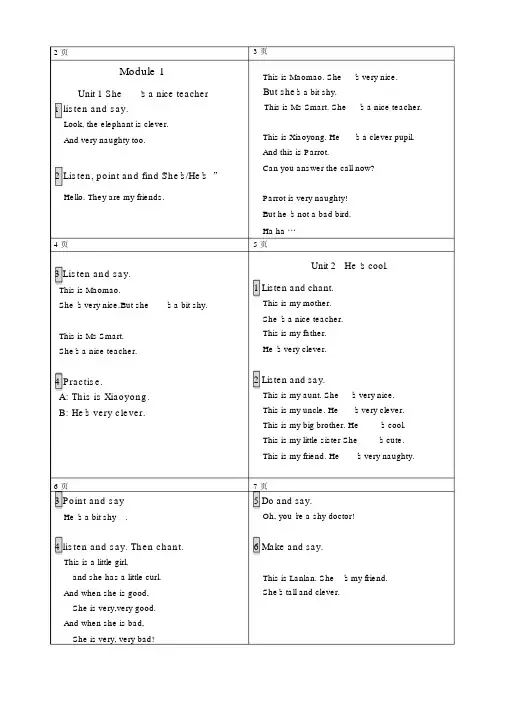
2页Module 1Unit 1 She’s a nice teacher1listen and say.Look, the elephant is clever.And very naughty too.2Listen, point and find“She’s/He’s”Hello. They are my friends.4页3 Listen and say.This is Maomao.She ’s very nice.But she’s a bit shy.This is Ms Smart.She’s a nice teacher.4Practise.A:This is Xiaoyong.B:He’s very clever.6页3 Point and sayHe ’s a bit shy.4 listen and say. Then chant.This is a little girl,and she has a little curl.And when she is good,She is very,very good.And when she is bad,She is very, very bad!3 页This is Maomao. She’s very nice.But she’s a bit shy.This is Ms Smart. She’s a nice teacher.This is Xiaoyong. He’s a clever pupil.And this is Parrot.Can you answer the call now?Parrot is very naughty!But he ’s not a bad bird.Ha ha ⋯5页Unit 2 He ’s cool.1 Listen and chant.This is my mother.She ’s a nice teacher.This is my father.He ’s very clever.2 Listen and say.This is my aunt. She’s very nice.This is my uncle. He’s very clever.This is my big brother. He’s cool.This is my little sister She’s cute.This is my friend. He’s very naughty.7页5 Do and say.Oh, you ’re a shy doctor!6 Make and say.This is Lanlan. She’s my friend.She’s tall and clever.8页9页Module 2Unit 1 London is a big city.1 listen , point and say.This panda is short, but that one is tall. This ship is big, but that one is smallOoh!What ’s this?It ’s Buckingham Palace.It ’s very big and very beautiful. Yes, it is!2 Listen, point and find “big, beautiful,small ”.Is it your house? No, it isn ’t.It ’s very nice!Whose house is it?What ’s this?It ’s the Queen ’s house.It ’s a book about London.Oh, London is a big city. This is my house! It’s small.But it ’s very beautiful too.Yes! Very big!And it ’s close to the Queen ’s house.10 页11 页3 Listen and say.London is a big city. My house is very small, but it ’s beautiful.4 Practise .A: This is a book about London.B: It ’s very nice.12 页Unit 2 It ’s very old .1 Listen, point and say.This is my home. It ’s old.This is my home.It’s very famous.2 Listen and say.This is Big Ben. It ’s very old. And it ’s very tall. This is Hyde Park. It ’s very beautiful.And this is Tower Bridge.It ’s very famous.And it ’s very beautiful too.13 页3 Listen and Point .5 Think, ask and answer.A:It ’s very old . What is it?A: It ’s a big city. What is it? B:It ’s the desk. The desk is very old.B: It ’s London. ① London4 listen and say. Then sing.London Bridge is a falling down, fallingdown, falling down. London Bridge is falling6 Do and say.down, my fair lady.②Buckingham Palace③Big Ben⑤ Tower Bridge⋯14页 15页It ’s big and beautifulThis is Chengdu. ④ Hyde parkModule 3Unit 1 Robots will do everything.1listen and chant.Sam can ride a bike.He can ride his bike.Amy can fly a kite.She can fly her kite.2 Listen, point and find“will”What ’s that, Daming? It’s a robot. Wow! It can walk! Yes, it can.And it can talk! Hello! Wow!16页3Listen and say.One day, robots will do everything.They will do the housework.4Practise.Robots will make cakes.18页3 Point , ask and answer.A: What will you do on sunday? B:I ’ll play football.Sunday Monday Tuesday WednesdayThursday Friday Saturday4 listen and say. Then sing and clap. Monday, thusday Wednesday,school! Thursday, Friday, lots of rules!On Saturday and Sunday, we can play! Let ’s start again and sing the days!One day, robots will do everything. Everything?Yes. They will do the housework.And they will help children learn.Oh, they will do our homework too!No,they won’t。
外研版(三起)-英语-四年级下册--Moudle4 Unit 1教材同步讲解

【新课堂】Moudle4 Unit 1教材同步讲解同学们,Saturday就要到了,让我们去picnic吧,都要带上什么呢?take your kite还要take your ball。
对了,去picnic还要关注weather,现在就去准备吧。
语法索引Unit l(第一单元)1.fly的用法 (66)2.一般将来时的一般疑问句及回答 (66)3.great的用法 (69)4.Why not?与because的用法 (69)5.so的用法 (70)Unit 2(第二单元)6.形容词构词法及在某一城市的表达 (72)7.it的用法 (73)模块目标预览学前必备一、语音能够了解并掌握音标/ei/,/ai/,/au/,/e/,/ ð /,/w/等的发音特点及发音规律。
二、单词take(带,拿),fly(飞),why(为什么),cloudy(多云的),weather(天气),picnic (野餐),because(因为),so(所以)三、短语take your kite(带着你的风筝),take your ball(带着你的球),on Saturday(在周六),have a picnic(野餐)四、句型1.询问对方是否将要做某事的句型及回答:--Will you...?你将……吗?--Yes,I will.是的。
/No,I won't.不,我不会。
2.介绍将来天气的句型:It will be... in...在……天气将……3.On Saturday we're going to have a picnic.在周六我们将去野餐。
4.Because tomorrow is Friday.因为明天是星期五。
3.So I will take my kite and my ball on Saturday.所以我将在周六带着我的风筝和球。
能力目标1.能够运用一般将来时进行日常的交流。
英语外研新标准(三起)四年级下册-Module 4 Unit 1 Will you take you
英语外研新标准(三起)四年级下册-Module 4 Unit 1 Will youtake your kite说课稿一、背景Module 4 Unit 1 是英语外研新标准(三起)四年级下册的一个模块。
本单元主要是介绍如何用英语表达风筝飞行的话题。
二、教学目标1.了解如何用英语表达天气现象。
2.学会用英语表达风筝飞行相关的词汇。
3.学会用英语表达和询问风筝飞行的话题。
三、教学内容与步骤1. 词汇学习教师在黑板上写出与风筝相关的词汇:kite, fly, string, wind, sun, cloud等。
让学生逐个读音,并跟读,牢记每个单词的音标和意义。
2. 听说训练让学生听一段描述天气的对话:A: Will you fly your kite today? B: I hope so. But I hope the wind will blow later. A: Yes. We need a windy day. B: Look at the clouds in the sky. It may rain soon.然后在黑板上画一个天空,让学生模拟对话,利用已学到的词汇描述天气和风筝飞行:A: Will you take your kite today? B: I hope so. But I hope the wind will blow later. A: Yes. We need a windy day. B: Look at the clouds in the sky. It may rain soon.让学生在对话中运用所学的词汇,进行语言训练。
教师要逐个点评学生对话的语言表达是否准确。
3. 读写练习教师发放练习册,让学生完成练习册上的相关练习。
这些练习涵盖了关于天气和风筝飞行的问答练习、图片配对练习、根据描述填空的练习等。
4. 语音练习在黑板上画出单词fly的发音,让学生模仿教师的发音,注意每个音的发声。
外研版四年级下册英语课件PPT:Module 4 Unit 2 Will it be hot in Haikou

A. 下雨的
B. 多风的
(4)It will be cloudy in Qingdao.
A. 高的
B. 多云的
3. 读句子,选择合适的图片。
(C)1. It will be sunny in Guangzhou. (B)2. It will be cloudy in Sichuan. (D)3. It will rain in Suzhou. (A)4. It will snow in Shenyang.
I can see …
What will the weather be in Beijing and London?
(1)It will be __s_u_n_n_y_ in Beijing.
(2)It will be __c_lo__u_d_y_ in London.
weather cloudy
will引导的一般疑问句的回答有两种: 肯定回答是:Yes, it will. 否定回答是:No, it won’t。如:
— Will it be windy in Beijing? 北京明天将会是多风的吗? — Yes, it will. 是的,它将会是(多风的)。 — No, it won’t. 不,它将不会是(多风的)。
A. snowy
B. windy
Will it be hot in Haikou?
外研版三起四年级下册教案

外研版三起四年级下册教案一、Module 1。
(一)Unit 1。
1. 教学目标。
- 语言知识目标。
- 学生能听、说、认读单词“nice, clever, naughty”等描述人物特征的形容词。
- 能理解并运用句型“This is my... He/She is...”介绍人物及其特征。
- 语言技能目标。
- 听:能听懂关于介绍人物特征的简单对话。
- 说:能够用所学单词和句型简单介绍自己的家人或朋友。
- 读:能正确朗读课文,理解课文大意。
- 写:能正确书写新学单词。
- 情感态度目标。
- 通过介绍家人和朋友,增进学生对家人和朋友的了解和热爱之情。
2. 教学重难点。
- 重点。
- 掌握新单词和句型的正确发音和用法。
- 能够正确介绍人物及其特征。
- 难点。
- 形容词在句子中的正确使用,如“a nice teacher”和“nice teachers”中“a”的用法区别。
3. 教学方法。
- 情景教学法:创设介绍家人和朋友的情景,让学生在情景中学习和运用语言。
- 任务驱动法:布置任务,如让学生介绍自己的家人,促使学生积极参与学习。
- 游戏教学法:通过游戏巩固新学单词和句型,提高学生学习兴趣。
4. 教学过程。
- 导入(5分钟)- 展示一些名人或卡通人物的图片,如周杰伦、哆啦A梦等,问学生是否认识他们,然后简单描述这些人物的特征,如“Jay Chou is very cool. He can sing very well.”引出本节课要学习的描述人物特征的话题。
- 新授(20分钟)- 单词学习。
- 利用图片或实物展示新单词,如展示一个聪明的孩子的图片,教授“clever”这个单词,教师领读,学生跟读,注意纠正发音。
- 采用开火车读、小组读等方式让学生练习读新单词,加强记忆。
- 句型学习。
- 教师先介绍自己的家人,如“This is my father. He is very nice.”同时板书句型,让学生观察并理解。
外研版英语四年级下册教案备课(三年级起点)
pupils' ability of
saying .
They can improve the ability of hearing.
They can improve
the ability of
hesring .
According to the
explanation ,the
pupils can
understand the
tsxt better.
The pupils can
know more each
other .
课后反思
This lesson is so easy .I teach them read only some times ,the students can say it well.
It's very beautiful.
2. Be able to describe places or things.
教学重难点
Be able to describe places or things.
准备
Pictures
a recorder
教学过程
教师活动
学生活动
设计意图
I.Warmer
1. Revise abjectives
2. Be able to do according to the teacher’s order .
教学重难点
Be able to describe a city or a place.
准备
a recorder
教学过程
教师活动
学生活动
设计意图
I.Warmer
1.Move around the cla
小学英语外研版(三起)四年级下册Module4__Unit2__will_it_be_hot_in_Haikou
Read
It will be hot in Haikou tomorrow. On Friday I will fly my kite.
Will it rain in Beijing? Yes, it will.
Homework:
1 Read the passage. 2 听天气预报并用英文写至少3个城 市的天气预报。如:It will be ___ in ____.
Choose.
1 Will it
(sunny\be sunny) next (will be\will) cold tomorrow.
week? 2 It
3 Will it (rain\snowy) on Sunday. 4 Will it be hot tomorrow? No, it (will\won’t). 5 I will (fly\flying) my kite.
Yes, it will.
Yinchuan
It will be cold in Yinchuan.
No, it won’t.
Will it snow in Hangzhou?
Hangzhou
It will rain in hangzhou.
Will it rain in Shenyang?
Shenyang
4. Saturday, I’ll go to the park. A. On B. At
5. It will snow, tomorrow I will make a snow man. A. So B. Because 6. It will on Sunday. A. sunny B. rain
Match.
1.
A.---Will it be cold tomorrow?
英语外研新标准(三起)四年级下册- Module 4 Unit 1 Will you take yo
英语外研新标准(三起)四年级下册- Module 4 Unit 1 Willyou take your kite教案教学目标1.了解问询他人是否有做某事的用语:“Will you take…?”2.听、说、读、写句型:“Will you take your kite?”3.学生能够在实际生活中运用所学知识询问他人是否准备带上某物。
教学重点1.学会用“Will you take…?”来询问他人是否准备带上某物。
2.阅读、写作技能的培养。
教学难点1.学生能否熟练运用所学知识询问他人。
2.较为复杂的阅读技能的培养。
教学准备1.多媒体课件。
2.板书工具。
教学过程导入(5分钟)1.教师与学生互相问好,营造良好的课堂氛围。
2.教师为学生介绍本节课的主要内容。
热身(10分钟)1.教师向学生展示一个名为“Flying Kite”的视频短片,并问学生是否喜欢放风筝。
2.向学生讲述自己童年时放风筝的有趣经历,并要求学生与教师分享自己的风筝故事和经历。
正文(25分钟)1. 学习会话1.向学生展示“Will you take your kite?”这个句子的用法和意义,并要求学生用此句子询问自己的同桌是否准备带风筝。
2.让学生进行互动交流,帮助他们更好地掌握询问方式。
2. 阅读理解1.教师出示一张名为“Famous Kites”的图片,并引导学生进行阅读。
2.教师向学生提出一些问题,帮助学生更深入、更全面地理解文章。
3. 巩固练习1.让学生以小组为单位进行练习,询问对方是否准备带上指定的物品。
2.鼓励学生进行课堂展示,并向同班同学询问是否准备带上指定的物品。
小结(5分钟)1.教师总结本节课上学习的重点内容。
2.向学生提出一些问题,帮助他们回顾本节课的重要信息。
课堂作业(5分钟)让学生在家将“Will you take your kite?”这个句子运用到实际生活中,询问他人是否准备带风筝或其他物品。
总结在本节课中,学生通过学习“Will you take…?”这一句型,掌握了询问他人是否准备带上某物的方法。
外研版英语(三起点)四年级下册全册教案(教学设计)
外研版英语四年级下册全册教案学校:____________教师:____________2020年3月Module 1Unit 1 She’s a nice teacher.知识目标:a) 能听、说、认读下列单词:nice、clever、shy、naughtyb) 能听懂、会说下列句型:He’s / She’s a bit/ very …c) 初步了解转折的表达方式:She’s very nice. But she’s a bit sh y. 能力目标: 能简单描述周围人的性格特征、个性特点。
情感目标:能用英语向他人介绍某人的性格特征、个性特点,培养学生认真观察、善于观察的好习惯,进一步通过活动使学生热爱英语,培养学生团结友爱、互帮互助的良好习惯。
教学重点:描述性格的形容词汇与句型的学习和运用。
教学难点:描述周围人的性格特征、个性特点。
教具:学图片、单词卡片、单词陀螺、课件。
每人一张人物个性特点调查表。
教学过程Ⅰ热身复习. (3’)①问候:T——S②听唱歌曲《The more we get together.》(学生一边拍手一边唱)Ⅱ呈现新授(20’)通过歌曲引出本课的话题T:This is a song about friends. Today we will talk about our friends. let’ssee who can describe his\her friends best. And let’s see which group is the best in this class.T: Now the first, let’s recognize Panpan’s fr iends. 课件出示Panpan’s的四位朋友Do you want to know how does Pan-pan appraise his friends?播放录音,让学生们回答下列问题(1)What are their friends names?(2)What is each person’s temperament?让学生尽可能用英语回答问题.(1)课件出示毛毛的图片T: Who is she? (Maomao)What’s she like? (nice \a bit shy)S: She’s nice.T: Yes. And she’s nice. But a bit shy(课件出示单词、教读、拼读单词)nice. a bit shy(板贴图片、板书单词)S: Practise in groups.(因为以前曾经接触过,所以由学生来当小老师进行检查)T: Who is nice in our class?(学生通过观察,根据实际情况回答问题,对单词和句子有更深刻的理解)(2)教师用同的方法出示小勇的图片新授单词clever(3)教师用同的方法出示鹦鹉的图片新授单词naughtyⅢ课文学习(5’)1、教师播放录音,学生边听边用手指出相应的图片。