
8a unit4 reading 1教案
Unit 4 Wild animals Reading 1
一教学目标
1.知识目标
1).To learn some key words to read the passage skillfully.
2) To understand and master pandas’ growth, problems and actions to protect
2.能力目标
1)To guess the meaning of some words from the context in the passage
2)To know the structure of the article by reading.
3.情感目标
To realize we should be kind to pandas, they are our friends and we should protect them by learning some information about pandas.
二、教学重难点
1. To learn some important facts about giant pandas.
2. To skim and scan the text to learn its structure and necessary information.
3. To talk about facts and express their own opinions.
三.学情分析
学生有什么
They have learnt something about animals. And they are familiar with giant pandas. It can make teaching and learning easier. Most of them have the ability to do the reading. 学生缺什么
They need skills to help them find details from the material. They lack the vocabulary and abilities to conclude from a number of facts.
助学方案
1. To have students do a mini-test before reading. This can make them more interested in
what they need to learn, and the test itself can offer further information as well.
2. To use PPT, making abstract information visualized and intuitive.
3. To use note-making, helping students sum up what they have learnt.
4. To ask and answer questions orally, in order to help students improve their reading
skills and understand what they have learnt better.
四、教学流程
Step 1 Revision
(1).Describe some wild animals and students guess what they are
(2).talk about students’favourite animal and give some reasons
Step 2 Lead-in/Warm-up
Show 2 photos of a giant panda at different ages. talk something about them. lead in some new words
Step 3. Presentation
Task 1: Find the answer
Read quickly and answer a question
What ’s the story about? It is about a giant panda called Xi Wang.
Task 2: Match the main idea to each part.
Task 3: Scanning the growth of a giant panda for answering the QS
1. How old was the baby panda when the writer first saw her?
2. What did she look like?
3. How much did Xi Wang weigh at birth?
4. When did she start to eat bamboo shoots and leaves?
5. Why did she have to look after herself when she was 20 months old?
Task 4: Scanning for more information about the growth of Xi Wang. Read the lines from 1 to 14.
(A)The weight of Xi Wang
(B)Things she eats
(C)The activity of Xi Wang
(D)Go through the whole process of the growth Do part C on P61 on the textbook Task 5: Find out the problems Xi Wang may have
Read the lines from 15 to 22. Hunters Farmers People Task 6: Actions we can take to protect a giant panda
Read the lines from 23 to the last to talk about actions.
Step4. Practicing
Read the whole text after the teacher, then fill in the blanks on the slide.
Step 5. Have a free talk to make a summary The growth of Xi Wang
The problems giant pandas have The actions we can take Part One (Line 1- Line 14) Part Two (Line 15- Line 22) Part Three (Line 23- Line 30)
Today we learned some about a giant panda called Xi Wang. We now know the growth of a giant panda , some problems they are facing to and some actions we can take. Go through the problems and actions again. What other actions can we take?
Ss’ own answer.
Eg,stop the hunters who kill pandas.
grow more bamboos
encourage farmers to live in other areas
...
Step 6.homework
A.巩固练习
1. To read the material at least three times.
2. To finish off the exercises on the Workbook.
3. Try retelling the material if possible.
B.预习设计
To mark the difficult and important sentences in the text.
Discuss: what other actions we should take to protect giant pandas and other wild animal.
板书设计
Unit4 Reading 1
The story of Xi Wang
1. The growth of Xi Wang
2. the problems Xi Wang may have
3. actions to protect giant pandas
Weather bamboo s bamboo shoots leaves
grow into hunter
farmer。
任务型阅读教学案例的设计、分析与反思——以“牛津英语”8A Unit 4“Wild Animals”(Reading1)课堂

板 书 出 来 , 带 领 学 生 朗 读 , 接 下 来 的 阅读 教 学 做 铺 垫 。 ) 并 为 2读 前 准备 。 . S p3 T a ok 把 学 生 进行 分组 实 行 合 作 学 习 ) t :emw r( e 任务 设计 : 在正 式 阅读 文 章 前 , 学 生 分 组 布 置 任 务 . 求 前 后 四名 给 要 学 生 为一 组 共 同讨 论 , 现 团 队合 作 精 神 。 设 计 目的 : 组 讨 体 ( 小 论 、 商 , 仅 给 学 生 提 供 了大 量 的 口头 练 习 机会 , 且 是 一 协 不 而 个 取 长 补 短 、 思 广 益 、 相 学 习 的 过 程 , 助 于培 养 学 生 分 集 互 有 析 问题 和解 决 问题 的能 力从 而发 展 他 们 的 个 性 。 ) 3课 文展 现 与 分 析 。 .
tl ueo le: el Tr rFas
1I r t a eb b a d h n s ewa n h l . F) .f s w t a yp n aw e h s mo t s d ( i s h 4 o
2Wh n i n a b r ,h e h d ut 0 0ga s( ) . e g s o se i e s 10 m . X Wa w n w g j r F
生动物。 2教 学 目标 设 计 。 . 1 基 本 知 识 目标 : 习 和 掌 握 阅读 部 分 所 涉 及 的 新 单 词 ) 学 和 词 组 、 惯 用语 和 固定 搭 配 。2 能 力智 力 目标 : 一 步 训 练 习 ) 进 自我 阅读 能 力 , 求 速 读 后 领 会 主 要 句 子 的意 思 。 ) 育 情 感 要 3德 目标 : 白野 生 动物 是 人 类 的 朋 友 。 明 3教 学重 点 与 难 点 . 1 有关 重 要 词 汇 、 语 ; ) 读 理 解 能 力 、 取 具 体 信 息 ) 短 2听 获 的 能 力 ; ) 速 阅读 的 能 力 、 读 对 写作 的迁 移 能 力 。 3快 阅 4教 学 方 法 和教 学 工具 . 任 务 教 学 法 ( ak Bae n u g e c ig | s— sdL g a eT a hn ) r a 多 媒 体 教 学 ( l— daC m ue S s m) A Mu ime i o p tr y t t e 5教 学 时 间 。 . 课 时 教学 ( 5 钟 ) 共4 分 三 、 堂 教 学 程 序 的设 计 课 1教 学 导入 . Se : r n p 热 身 ) 务设 计 t 1 Wa p mig ( u 任 1 P aigg me T UU o r ao f ea i lnE gih ) ) lyn a s( e Sy u v u t nma n l . f i i s
牛津英语8A Unit4 第一课时教案

1.go through the table in part B onP59
Fill in the form by them selves.
2.practice a dialogue
-which animal do you like best?
-I like…best.
If Eddie dies, what will happen?
–If hobo doesn’t have food, he will die
If Eddie dies, no one will look after hobo.
Step 2 Listen and repeat
1.Play the tape and repeat after it
3. Where do people usually see wild animals?
What wild animals can we see there?
Step 4 presentation:
1.present picture 1 onP59
-what can you see in the picture?
If I die, no one will look after you
If I don’t eat food, I will die
三、教学步骤
Step 1 presentation:
1.sometimes, we need to share limited resources with others, It is not easy to decide whether to stay alive together sharing what you have, or whether you should keep all the resources for yourself
译林牛津版8A unit 4 Reading I 公开课教学课件PPT 8AU4
23.n. 供电中断;停电 24.n.管子,水管 25.vt.使充满 26.用…填充…
23.power cut 24.pipe 25.fill 26.fill… with 27.not only … but also…
27.不仅…而且…; .…和2…8.都ceiling
28.n.天花板
29.shelf/ shelves
2.最好/最好不要做had better do/ had better not do
3.这儿有…
Here is/ are…
4.它/它们在这儿
Here it is / they are.
5.没问题
No problem.
6.给你。
Here you are.
7.上面写着
It says…
8.一些DIY工具
some tools for DIY
51.correct-incollect 52.finished
53.adj.确定的
53.certain-uncertain
54.adj.积极的,活跃的54.active-inactive
55.adj.可能的
55.possible-impossible 56.tidy/ untidy
56.vi. & vt. 收拾,整理57.tidy up
put up a picture on the wall
23.敲裂水管
hit a pipe
24.把房间灌满了水 fill the room with water
25.把房子刷成蓝色 paint the house blue
26.不仅…而且…
not only...but also
27.建议某人(不要)做某事
牛津译林版英语8AUnit4全套教案

Step 4 Homework.1. Read the article fluently, memorize the vocabulary, phrases and senten ces.2. More able students to recite the text.3. Finish the relative exercise.教学反思sentence. Pay attention to your pronunciation and inton ati on. Play the tape. Show some key words and phrases in each paragraph. 3. Prese nt all the key words and phrases. T: Close your books, please. Use these key words and useful phrases to retell the article. Paragraph 1: be crazy about, repair, decorate, look terrible Paragraph 2: a brighter light, make a mistake, power cut, put up a picture, hit a pipe, fill …with …Paragraph 3: living room, boring, paint …blue,ceiling, floor, cat Paragraph 4: a shelf, above, spend five hours, not stay, much higher Paragraph 5: buy, advise, make him an gry, atte nd less ons, know much more 4. T: Can you retell Suzy ' s story about her cous in in your own words? Praise ss who can organize their Ianguage well and retell the article flue ntly. phrases. Retell the paragraph paragraph. Retell the article.article bywhole 总课时 第3课时总课题 Unit 4 Do it yourself总课时8 第5课时 课题Grammar B课型New教学目标1. To master the new words.2. To use should/had better to give advice.3. To use should/had better to give advice in correct con text. 教学重点 1. To use should/had better to give advice.2. To use should/had better to give advice in correct con text.教学难点 As above.教学准备 Computer Pictures Notebook课前预习Go through the part and try to lear n some new words by heart.教学过程教师活 动学生活动备课札记教学反思 Want to broke n pipe ) Don / t know cut ) We (建议(修理坏掉的水管 ). how to deal with (停电 )you (修一门课程repair the(a power in DIY .(advise , take a course ) You can ( 上课 )every weekend . ( attend lessons )Call us on 88221546 .Step 4. ActivitiesEnjoy DIY :Ask Ss to work in groups ,according to the teacher / s in struct ions to do their DIY jobs A : Having a discussion in groups Group 1 : making a lovely en velope Group 2 : making a birthday card Group 3 :pa in ti ng the paper B: Group prese ntati onStep5 ExerciseFinish the relative exercise. Homework 1、 To recite the text . 2、 Write a passage about how to do your DIY jobs (such as painting a room , fixing a bicycle , making cakes, repairi ng computers ) 3、 P review GrammarListe n and pay much attention to the main poi nts.Try to finish some exercise.Sandy and her mum are talking about what to eat for lunch. 2. Play the tape.Are san dwiches quick and easy to make ? What do they put on the bread?Do they just n eed one piece of bread?3. Play the tape and ask ss to repeat after the tape.4. Work in pairs: Work in pairs. It ' s your turn to make similar dialogues. Talk about what you can make for lunch. You can use Sandy and her mother ' s con versati on as a model. Homework1. Memorize words, phrases and sentences.2. Recite Speak up.3. Preview Study skills.总课题 Unit 4 Do it yourself总课时8 第7课时 课题Study skills课型New教学目标 1. To add un-,i n-and im- to form a new word.2. To use adjectives with un-,i n-and im- to express n egative meanin gs.教学重点 1. To add un-,i n-and im- to form a new word.2. To use adjectives with un-.i n-and im- to express n egative meanin gs.教学难点 As above.教学准备Computer Pictures Notebook教学反思Fin ish the exercise.课前预习Go through the part and try to lear n some new words by heart.教学过程教师沽动学生沽动备课札记Step 1 Lead in1. T: We' ve learnt a lot about Suzy ' s cousin. He loves DIY very much. What happens every time he does DIY?2. P rese nt more questi ons,(1) What happen to the cat when Suzy' s finished painting the whole living room blue?(2) C ould Suzy put the books on the shelf made by her cous in?(3) W hy did Suzy' s cousin feel unhappy when Suzy advised him to take a course in DIY?⑷ Is Suzy also weak at DIY?3. T: We know Suzy is good at DIY. Her mother' s birthday is coming. Do you know what he decided to give her mother? Did she do some DIY?En courage ss to guess the possibility.Step 2 Reading1. T: Suzy made a birthday card at the weeke nd. Liste n to her diary entry carefully and find the answers to these questi ons.(1) Why didn ' t Suzy make the card at home?(Because she wan ted to keep it secret.)(2) Did Sandy help?(Yes. Sandy helped her with the draw in g.)(3) How long did Suzy and Sandy spe nd making it?(They spe nt two hours making it.)(4) What mistakes did Suzy keep making whe n work ing onit?(She kept spelling the words wrong because she was too excited.)(5) What colour did she use for the roses?(She coloured them red, blue and pin k.)(6) Did they make a mess in the house?(Yes. There was paint on everyth in g.)2. Play the tape.T: Open your books and turn to page 52, please. Let ' s repeat after the tape sentence by sentence.3. Ask ss to read the article paragraph by paragraph and think over the content of each paragraph.4. Make ss un dersta nd the content of a diary.Para 1: The reas on why Suzy made a birthday card.Para 2: How she made the card.Para 3: What happe ned in the end.Para 3: Suzy' s hope.Step 3 Writing1. Ask ss to turn to page 53, part B.T: Write your own diary entry about one of the DIY jobs you did. Use the diary entry in Part A as a model and use the useful expressions on page 52 to help you 1 ook atS:Something terrible happe n.S: It was also pain ted blue.S: No, the books couldn ' t stay there because one end was much higher and higher.An swer.An swerthes equestio ns.Liste n and repeat. Read and think over.。
新译林版英语八年级上册第四单元8AUnit4Reading1
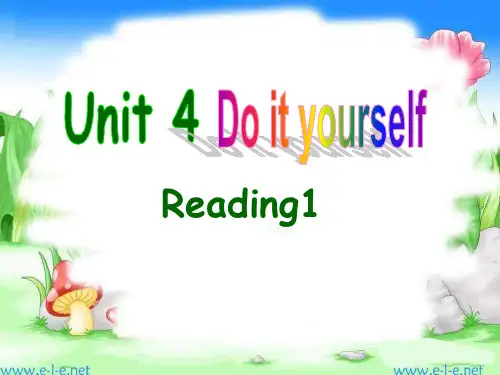
Benefits(好处) of DIY
save money make anything we like train our hands-on ability(动手能力) be creative(有创意的) be cleverer relax ourselves protect the environment(保护环境) have fun enjoy life
terrible
be crazy about
My daughter _is__c_ra_z_y__a_b_ou_t DIY. She thinks
it is_n_o_t_o_n_ly_interesting_b_u_t_a_l_s_o meaningful.
However, she always__f_ill_s_her room_w_i_th_hair
Fast reading:
Suzy’s advice. Introduction of Andrew. Andrew’s DIY jobs and problems.
Part1( Para.1 ) Part2(Para.2-4) Part3( Para.5 )
Careful reading:
Part1 Introduction of Andrew
know more
be crazy about, decorate ……
buy…for… advise…to… attend ……
(Group work)
If you want to decorate your room, would you like to do it yourself or pay others to do it ?
to me.Now, she _a_tt_e_n_d_s the course every
8A Unit4 Reading 1课件ppt

she weighed about 10 kilograms . Eight months later,
She weighed 35 kilograms .
Things she eats
At the very beginning, Xi Wang drank her mother’s milk for up to 14 hours a day.
A riddle(谜语)
We are beautiful black and white animals .We look like bears. We live only in China . Our favourite food is bamboo shoots and leaves . our greatest hope is to take a colour photo. Who are we?
giant panda
The growth of Xiwang
the weight of Xi Wang
the things she eats
The weight of Xi Wang
When she was born, she weighed just 100 grams . At four months,
Unit4 wild animals
by Zhu Ling
bear
fox
wolf
tortoise
monkey
lion
tiger
kangaroo
dolphin
squirrel
Polar bear
eaffe
zebra
words
• • • • • • • • Bear Fox Wolf Tortoise Monkey Lion Tiger kangaroo • • • • • • • Dolphin Squirrel Polar bear Elephant Camel Giraffe zebra
牛津译林版英语8A Unit4 Reading 1课件
shelf
crazy be crazy about
crazy about football. Most boys are ________
mistake make a mistake He was unhappy because he made a mistake _______.
terrible
power cut pipe fill fill … with … not only … but (also) ceiling
n. 供电中断;停电 n. 管子,水管 vt. 使充满 用……填充…… 不仅……而且……; ……和…….都 n. 天花板
shelf whoops advise course already instead attend
Introduction of Andrew Part 1: ( para 1)
Part 2: ( para 2-4) Part 3: ( para 5)
Andrew’s DIY jobs NhomakorabeaAdvice from Suzy
Task 2: Scanning
Read the article quickly and answer these questions:
Putting in a brighter light Putting up a picture Painting the living room Putting up a shelf
7. 喜欢制作一些新东 西 8. 付钱给某人 9. 修理和装修东西
10. 代替做某事
enjoy making something new pay sb. repair and decorate things instead of doing sth.
8A unit4 wild animals Reading教案
8A unit4 wild animalsTeaching aims:1.to develop the ability to guess the general meaning from the context.2.to get to know the problems that the giant pandas are facing and then start tothink of ways to protect the pandas.Teaching main and different points: 1.to use if-clause correctly2.to discuss the ways to protect wild animals in English Teaching aids: teaching cards radioTeaching ProceduresStep1.Talking about the animalsGet the students to talk about the animals. Play the guessing game again.Guess:1.They are large and heavy. They like eating sweet food and fish. If they are hungry,theyalso eat man.2.They are lovely and clever animals in the sea. They like swimming in groups, They arevery friendly to people.3.They come from Australia. They jump with their babies in their special pockets.4.They have yellow fur with black strips. They are the king of the forest.5.They are the biggest animals on land. They eat grass.6.They are small animals with big tails. They like climbing tress and eating nuts.Step2. Presentation1.show the students the following pictures which show how the baby grows into a giantpanda. Ask the students to put them into the right order.2.according to the pictures,ask them to find out:Step3. Listening to the first pare of the passageTell the students:”Millie has found a report about giant pandas. Let us read it and learn more about the animals. But first let us listen to the first part of the passage and answer the following questions.”Step4: Filling in the following tableSay “so it is really amazing that the baby panda is so small. Do you want to kow how it grows into a giant panda? Let us open our books and read the passage”.Get the students to read the passage and fill in the following table.Ask; What did Xi Wang do at different times? Get the students to read and find out the answers. Step5; Finishing PartCGet the students to finish partC: the growth of Xi Wang. Look at the pictures and get the students to read the sentences here loudly. This will once again consolidate the students’understanding of Xi Wang’growth.Step6: Reading and finding out the problemSay:Are pandas lovely? Howere,they are now in danger. It is hard for them to survive in the wild.( write the sentences on the blackboard.) They are facing a lot of problems.Can you find themStep7; Finish Part DHunters, farmers and some people did something bad to the giant pandas. Get the students say something to them.Hunters, you should n′t kill giant pandas for their fur.Farmers, you should n′t cut down trees and forests any more.Get the students to finish partD, on page62. Then check the answers.Step8:DiscussionDiscuss; As a middle school student, can you think of some good ideas to protect pandas?Step9:HomeworkRead the passage and finish off the exercises in the books.。
牛津译林版八年级上英语Unit4集体备课表格式教案
牛津译林版八年级上英语Unit4集体备课表格式教案璇?棰?8A Unit 4 Welcome to this unit璇惧瀷New鏁?甯?鍐?瀹??璇?棰?8A Unit 4 Reading (1) 璇惧瀷NewTo learn about vocabulary about DIY.To understand the article and finish relative exercise. To cultivate the sense of DIY.鏁?甯?鍐?瀹??璇?棰?8A Unit 4 Reading (2)璇惧瀷New鏁?甯?鍐?瀹??璇?棰?8A Unit 4 Grammar A 璇惧瀷New鏁?甯?鍐?瀹?? 璇?棰?8A Unit 4 Grammar B璇惧瀷New鏁?甯?鍐?瀹?Step 1 Presentation1. Review Reading to introduce the usage of 鈥渟hould鈥?T: Suzy doesn鈥檛think her cousin knows much about DIY either. What did she advise him to do?T: What do you think she said to him about this?Write this sentence on Bb and mark the word should in red.2. T锛欴o you think we can use had better instead of should in this sentence?Write 鈥淵ou had better take a course in DIY.鈥?Ask ss to think and understand the meaning of the two sentences.3. Present more sentences, encourage ss to sum up the rule: Here are some more sentences. Can you work out when to use should and had better?锛?锛塗o keep fit, you should /had better have a healthy diet.锛?锛塝ou should not /had better not leave litter.锛?锛塈t鈥檚going to rain. You should/had better take an umbrella.4.Work out the rule with ss: We use should and had better when giving advice and telling people what we think is the best or right thing to do. The tone of had better is strong than should.5. Please open your books and turn to page 48. Let鈥檚read the sentencestogether.Step 2 Practice1. T: Suzy is giving DIY advice to her classmates. Can you help her make sentences with should(not) and had better(not)?Have ss do exercise on page 48, and then read and check answers together.2. T: You鈥檙e giving advice to your friends. Rewrite the following sentences using should(not) and had better(not):(1) It鈥檚time for class. Put your comic books away.(You should/had better put your comic books away.)(2锛塝our English is not good enough. Read more to improve it.(You should/had better read more to improve it)(3)Turn your mobile phone off in class.(You should/had better turn your mobile phone off in class.)(4) Don鈥檛make the mistake again.(You should/had better not make the mistake again.)3.T: Boys and girls ,you have learnt how to give advice. I have a problem and I need your help. I can鈥檛sleep well at night and I feel tired during the day. Can you give me some advice?Encourage ss to give advice:You should drink a glass of milk before going to bed./ You should not watch TV just before going to sleep./You had better do some reading before you go to sleep./鈥?4.T: Work in pairs. Talk about your problems and try to give useful advice.Homework1.Preview Grammar2.Finish the relative exercise.?璇?棰?8A Unit 4 Integrated skills 璇惧瀷New鏁?甯?鍐?瀹?A .How to make a fruit saladStep 1 Presentation1. Communicate with ss to lead in new lessons: What did you have forbreakfast/lunch today? What food do you like best? Do you have a healthy diet? Can you cook dinner on your own?2. Present the picture of salad and ask: Look at the picture .This is my favorite food. What is it? Yes, it鈥檚a salad.Write salad on Bb and teach the new words.T: Salad is healthy. Do you like it? Do you think it鈥檚easy to make a salad? Can you make a salad?3. T: What do you need when making a salad?Write spoon and cream on Bb, teach the new words and explain.Step 2 Listening1. T: Open your books and turn to page 49. Look at the pictures in Part A1.T: When we make a salad, we need some tools and we can add anything we like. Canyou name the things in the pictures锛?Write grape and strawberry.2. T: Any and Suzy are making a fruit salad. They鈥檙e talking about what they need. Listen to their conversation and tick the things they need.Play the tape.3. T: Any volunteers? Have a try. The rest of you can check the answers together.If they can鈥檛obtain correct information, play the tape again, pause if necessary.4. T: Amy is making some notes of how to make a fruit salad. Read her notes and put the sentences in the correct order.Play the tape again, ask ss to finish Part A2 on page 49.5. Ask ss to read together and check answers.Step 3 Listening1. T: Amy wants to make a fruit salad. She鈥檚asking Suzy for some tips. Please listen to their conversation and help Amy complete her notes in Part A3 on page 50.2. Ask ss to read together and check answers.B.Speak upStep 4 Activities1. Have a free talk.What do you often have for lunch?Do you like sandwiches for lunch?Sandy and her mum are talking about what to eat for lunch.2. Play the tape.Are sandwiches quick and easy to make ?What do they put on the bread?Do they just need one piece of bread?3. Play the tape and ask ss to repeat after the tape.4. Work in pairs: Work in pairs. It鈥檚your turn to make similar dialogues. Talk about what you can make for lunch. You can use Sandy and her mother鈥檚conversation as a model.Homework1. Memorize words, phrases and sentences.2. Recite Speak up.3. Preview Study skills.?璇?棰?8A Unit 4 Study skills璇惧瀷New鏁?甯?鍐?瀹?Step 1 Presentation1.Show some words on the blackboard old-young easy-hard tall-shortrude/impolite-polite happy-unhappy kind-unkindNow锛寃e know they are prefixes.2.PresentationSay: With some adjectives, we can change the meaning by adding a prefix. Adding the prefixes 鈥渄is鈥? 鈥渋m鈥?鈥渋n鈥?or 鈥渦n鈥?to an adjective will express the opposite meaning of the word. These prefixes mean 鈥渘ot鈥?or 鈥渢he opposite of鈥?e.g. Trainers are comfortable to wear.But small ones are uncomfortable.If someone shows good manners to others, he is a polite person.If someone does not show good manners to others, he is impolite.Step 2 Practice1.Tell the students that 鈥渦n-鈥漣s not the only prefix. There are more prefixes like this. Invite the students to open their book and ask them to match the words on the left with their opposites on the right.1.certain鈥晆ncertain2.important鈥晆nimportant 鈥?2. Show some sentences and fill in the blanks with prefixes.Zhalong is a protected area. It isn鈥檛allowed to hunt or fish there. It is incorrect to kill wild animals. (correct)These trainers are comfortable to wear. But those are uncomfortable. (not comfortable).If someone shows good manners to others, he is a polite person. If someone doesn鈥檛show good manners to others, he is impolite. (not polite )3.Try to pronounce the underlined words銆?1.The boy in this picture is Jake .He often plays with his cat after school.2.Tennis is Lily鈥檚favorite sport .She likes playing tennis with her father.3.What does she look like?She looks slim.4.The girl has a lot of bags in her hand.She is shopping.5.I am a student .I go to school by bus every day.Step 3 Group work鐢ㄥ惁瀹氬墠缂€鐨勫舰瀹硅瘝閫犲彞銆?(1)Water is very important to us.(2) This chair is too small.锛?锛塈have never seen such heavy snow here.锛?锛塗he restaurant is quite near here.锛?锛塈don鈥檛like him because he is rude.Step 4 ExerciseTry to finish the exercises on Page51 and check the answers. usual-unusual possible-impossiblecertain-uncertain tidy-untidy鍐欏嚭涓嬪垪璇嶇殑鍙嶄箟璇?necessary--_________important--_________happy--_________comfortable--_________ friendly--__________ common--_________welcome--__________able--_________ well--__________popular--__________ true--__________ tidy--__________?璇?棰?8A Unit 4 Task璇惧瀷New鏁?甯?鍐?瀹?Step 1 Lead in1.T: We鈥檝e learnt a lot about Suzy鈥檚cousin. He loves DIY very much. What happens every time he does DIY?2.Present more questions,(1) What happen to the cat when Suzy鈥檚finished painting the whole living room blue?(2) Could Suzy put the books on the shelf made by her cousin?(3) Why did Suzy鈥檚cousin feel unhappy when Suzy advised him to take a course in DIY?(4) Is Suzy also weak at DIY?3. T: We know Suzy is good at DIY. Her mother鈥檚birthday is coming. Do you know what he decided to give her mother? Did she do some DIY?Encourage ss to guess the possibility.Step 2 Reading1. T: Suzy made a birthday card at the weekend. Listen to her diary entry carefully and find the answers to these questions.(1) Why didn鈥檛Suzy make the card at home?(Because she wanted to keep it secret.)(2) Did Sandy help?(Yes. Sandy helped her with the drawing.)(3) How long did Suzy and Sandy spend making it?(They spent two hours making it.)(4) What mistakes did Suzy keep making when working on it?(She kept spelling the words wrong because she was too excited.)(5) What colour did she use for the roses?(She coloured them red, blue and pink.)(6) Did they make a mess in the house?(Yes. There was paint on everything.)2. Play the tape.T: Open your books and turn to page 52, please. Let鈥檚repeat after the tape sentence by sentence.3. Ask ss to read the article paragraph by paragraph and think over the content of each paragraph.4. Make ss understand the content of a diary.Para 1: The reason why Suzy made a birthday card.Para 2: How she made the card.Para 3: What happened in the end.Para 3: Suzy鈥檚hope.Step 3 Writing1. Ask ss to turn to page 53, part B.T: Write your own diary entry about one of the DIY jobs you did. Use the diary entry in Part A as a model and use the useful expressions on page 52 to help you. Look at the ideas in Part B. You can choose to write about one of them or use your own ideas.2. Check the composition.Comment on two of their articles.3. Read the sample together.Homework1. Memorize words, phrases and sentences.2. Read and recite the sample writing.精品教案设计资料3. Finish relative exercises.?。
第三届全国“教学中的互联网搜索”8A unit 4 reading
8A Unit 4 Wild Animals Reading I 教学设计江苏省宜兴高塍中学周敏芳教学课题牛津英语 8A Unit 4 Wild Animals Reading I教学对象八年级学生,摆脱了刚进初一的活泼好动,自我认知能力不断提升,希望学到知识的同时,又希望能得到老师的认同,有很强的求知欲,但又处在叛逆期,对自我的约束力不强,因此学习缺乏主动性,因此需要老师在课堂上的不断引导。
教材分析动物是人类的朋友,我们有责任和义务去保护它们。
但随着现代工业的发展,环境污染严重,加上人类对森林资源的乱砍乱伐,一些野生生物的生存环境受到了破坏,有些动物甚至到了灭绝的地步。
大熊猫是中国的国宝,目前,它们也处于困境中,全世界大概还幸存2000多只大熊猫,所以保护野生动物,保护大熊猫是全世界的呼声,还野生动物一个自然生存的环境,给大熊猫一个安静、舒适的家刻不容缓。
教学背景本课要求学生阅读一篇介绍大熊猫幼仔的早期生活以及它的成长过程的文章。
动物是我们人类的朋友,但由于人类对大自然环境的破坏,导致了它面临灭绝的困境。
通过文章的学习,教育学生要保护自然生态环境,不要随意猎杀野生动物,并要努力采取措施保护大熊猫,并由此引出生态环境对不仅对动物,对人更为重要,倡仪学生行动起来,保护我们的环境。
教学目标1.to know the meanings of the new words2.to know the growth of pandas, their problems and actions to protect them3.to encourage students to take more actions to protect wild animals教学策略1.通过多媒体课件,设计多种方式如视频、图片等,吸引学生的注意力,并把他们带入愉快的学习气氛。
2.培养学生各种读的技能,如泛读,快读,精读等等。
3.为学生创设更多的语言环境,激发学生主动参与的欲望。