
2016年最新英语六级模拟试卷含答案
2016年六级6月份模拟考试真解析
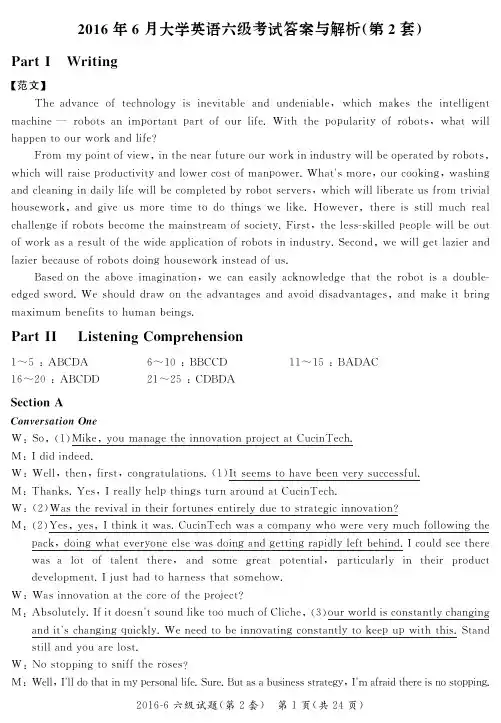
P a r t I I L i s t e n i n o m r e h e n s i o n gC p
1~5 : A B C D A 1 6~2 0: A B C D D 6~1 0: B B C C D 2 1~2 5: C D B D A 1 1~1 5: B A D A C
S e c t i o nA
, , M:W e l l I ������ l l d o t h a t i nm e r s o n a l l i f e . S u r e . B u t a s a b u s i n e s s s t r a t e I ������ ma f r a i d t h e r e i s n o s t o i n . y p g y p p g 第 2 套) 第 1 页( 共2 2 0 1 6 6 六级试题 ( 4 页)
a c k, d o i n h a t e v e r o n ee l s ew a sd o i n n dg e t t i n a i d l l e f tb e h i n d . I c o u l ds e e t h e r e p gw y ga gr p y , , w a sa l o to ft a l e n tt h e r e a n ds o m eg r e a tp o t e n t i a l p a r t i c u l a r l nt h e i rp r o d u c t yi
? M:Wh a t e x a c t l i ss t r a t e i c i n n o v a t i o nt h e n y g , W: S t r a t e i c i n n o v a t i o n i s t h ep r o c e s so fm a n a i n i n n o v a t i o n o fm a k i n u r e i t t a k e sp l a c ea t g g g gs , M:S o i n s t e a do fi n n o v a t i o nf o ri n n o v a t i o n ������ ss a k ea n dn e wp r o d u c t sb e i n r e a t e ds i m l gc p y , b e c a u s e t h e t e c h n o l o st h e r e t h ec o m a n u l t u r em u s ts w i t c hf r o mt h e s ep o i n t i n g yi p yc gM: Is o o nb e c a m ea w a r et h a tc a m a i n i n su s e l e s s . P e o l et a k en on o t i c e . S i m l tc a m e p g gi p p yi b e s tw a ow o r k. yt : ? W D o e s i n n o v a t i o no nt h es k i l l r e a l l i v eac o m e t i t i v ea d v a n t a e yg p g , , ( M: I a mc e r t a i no f i t a b s o l u t e l e s e c i a l l f i t ������ sd i f f i c u l t f o rac o m e t i t o rt oc o . 4) T h e y p yi p p y M: P r e c i s e l . y W: T h a n k s f o r t a l k i n ou s . gt 答案 1. M: S u r e . A r i s k i so f c o u r s e t h a t i n n o v a t i o nm a r e u e n t l l e a dt o i m i t a t i o n . yf q y W: B u tn o t i f i t ������ ss t r a t e i c . g a b o u t t h r o u hg o o dp r a c t i c e t r i c k l i n o w n . T h i sb u i l t c o n s e n t . P e o l ec o u l ds e e i tw a s t h e g gd p t i m e i n n o v a t i o n s t oc o n t i n u o u sp i e l i n eo f i n n o v a t i o n s f r o me v e r w h e r ea n de v e r o n e . p y y ? W:H o wd i dy o ua l i ns t r a t e i e s t h r o u h o u t t h ec o m a n g g g p y , a l l l e v e l so f t h ec o m a n a n dt h a t i s r e l a t e dt ot h ec o m a n ������ so v e r a l l s t r a t e . p y p y g y W: I s e e .
2016年6月英语六级参考答案(第一、二、三套)
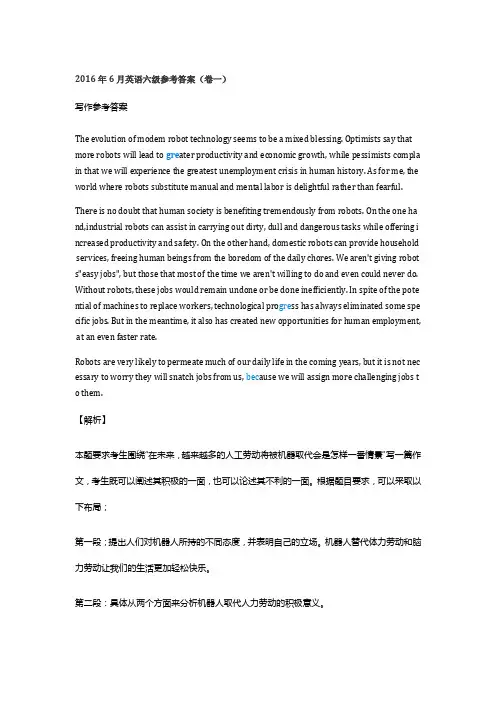
2016年6月英语六级参考答案(卷一)写作参考答案The evolution of modem robot technology seems to be a mixed blessing. Optimists say that more robots will lead to gre ater productivity and economic growth, while pessimists compla in that we will experience the greatest unemployment crisis in human history. As for me, the world where robots substitute manual and mental labor is delightful rather than fearful.There is no doubt that human society is benefiting tremendously from robots. On the one ha nd,industrial robots can assist in carrying out dirty, dull and dangerous tasks while offering i ncreased productivity and safety. On the other hand, domestic robots can provide household services, freeing human beings from the boredom of the daily chores. We aren't giving robot s"easy jobs", but those that most of the time we aren't willing to do and even could never do. Without robots, these jobs would remain undone or be done inefficiently. In spite of the pote ntial of machines to replace workers, technological pro gre ss has always eliminated some spe cific jobs. But in the meantime, it also has created new opportunities for human employment, at an even faster rate.Robots are very likely to permeate much of our daily life in the coming years, but it is not nec essary to worry they will snatch jobs from us, bec ause we will assign more challenging jobs t o them.【解析】本题要求考生围绕“在未来,越来越多的人工劳动将被机器取代会是怎样一番情景”写一篇作文,考生既可以阐述其积极的一面,也可以论述其不利的一面。
2016年12月大学英语六级考试真题答案(全三套))
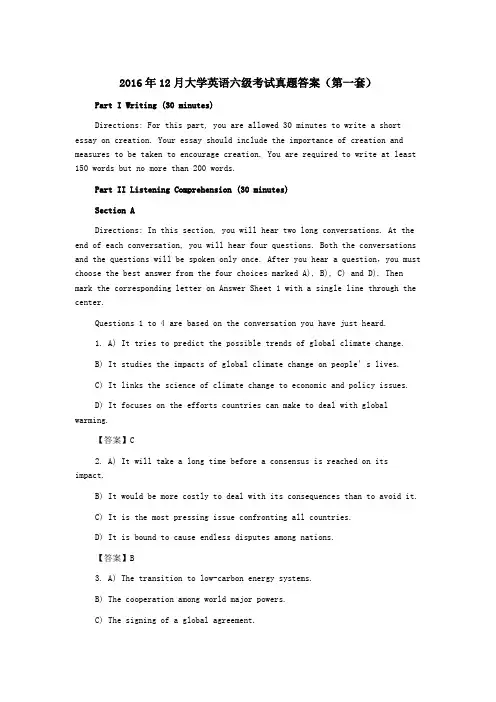
2016年12月大学英语六级考试真题答案(第一套)Part I Writing (30 minutes)Directions: For this part, you are allowed 30 minutes to write a short essay on creation. Your essay should include the importance of creation and measures to be taken to encourage creation. You are required to write at least 150 words but no more than 200 words.Part II Listening Comprehension (30 minutes)Section ADirections: In this section, you will hear two long conversations. At the end of each conversation, you will hear four questions. Both the conversations and the questions will be spoken only once. After you hear a question,you must choose the best answer from the four choices marked A), B), C) and D). Then mark the corresponding letter on Answer Sheet 1 with a single line through the center.Questions 1 to 4 are based on the conversation you have just heard.1. A) It tries to predict the possible trends of global climate change.B) It studies the impacts of global climate change on people’s lives.C) It links the science of climate change to economic and policy issues.D) It focuses on the efforts countries can make to deal with global warming.【答案】C2. A) It will take a long time before a consensus is reached on its impact.B) It would be more costly to deal with its consequences than to avoid it.C) It is the most pressing issue confronting all countries.D) It is bound to cause endless disputes among nations.【答案】B3. A) The transition to low-carbon energy systems.B) The cooperation among world major powers.C) The signing of a global agreement.D) The raising of people’s awareness.【答案】A4. A) Carry out more research on it.B) Cut down energy consumption.C) Plan well in advance.D) Adopt new technology.【答案】CQuestions 5 to 8 are based on the conversation you have just heard.5. A) When luck plays a role.B) What determines successC) Whether practice makes perfect.D) How important natural talent is【答案】B6. A) It knocks at your door only once in a while.B) It is something that no one can possibly create.C) It comes naturally out of one’s self-confidence.D) It means being good at seizing opportunities.【答案】D7. A) Luck rarely contributes to a person’s success.B) One must have natural talent to be successful.C) One should always be ready to seize opportunities.D) Practice is essential to becoming good at something.【答案】D8. A) Putting time and effort into fun things is profitable.B) People who love what they do care little about money.C) Being passionate about work can make one wealthy.D) People in need of money work hard automatically.【答案】CSection BDirections: In this section, you will hear two passages. At the end of each passage, you will hear three or four questions. Both the passage and the questions will be spoken only once. After you hear a question, you must choose the best answer from the four choices marked A), B), C) and D). Then mark the corresponding letter on Answer Sheet 1 with a single line through the center.Questions 9 to 12 are based on the passage you have just heard.9. A) The stump of a giant tree.B) A huge piece of rock.C) The peak of a mountain.D) A tall chimney.【答案】A10. A) Human activity.B) Wind and water.C) Chemical processes.D) Fire and fury.【答案】B11. A) It is a historical monument.B) It was built in ancient times.C) It is Indians’ sacred place for worship.D) It was created by supernatural powers.【答案】D12. A) By sheltering them in a cave.B) By killing the attacking bears.C) By lifting them well above the ground.D) By taking them to the top of a mountain.【答案】CQuestions 13 to 15 are based on the passage you have just heard.13. A) They will buy something from the convenience stores.B) They will take advantage of the time to rest a while.C) They will have their vehicles washed or serviced.D) They will pick up some souvenirs or gift items.【答案】A14. A) They can bring only temporary pleasures.B) They are meant for the extremely wealthy.C) They should be done away with altogether.D) They may eventually drive one to bankruptcy.【答案】A15. A) A good way to socialize is to have daily lunch with one’s colleagues.B) Retirement savings should come first in one’s family budgeting.C) A vacation will be affordable if one saves 20 dollars a week.D) Small daily savings can make a difference in one’s life【答案】DSection CDirections: In this section, you will hear three recordings of lectures or talks followed by three or four questions.The recordings will be played only once. After you hear a question, you must choose the best answer from the four choices marked A), B),C) and D). Then mark the corresponding letter on Answer 1.Questions 16 to 18 are based on the recording you have just heard.16. A) They should be done away with.B) They are necessary in our lives.C) They enrich our experience.D) They are harmful to health.【答案】B17. A) They feel stressed out even without any challenges in life.B) They feel too overwhelmed to deal with life’s problems.C) They are anxious to free themselves from life’s troubles.D) They are exhausted even without doing any heavy work.【答案】B18. A) They expand our mind.B) They prolong our lives.C) They narrow our focus.D) They lessen our burdens.【答案】AQuestions 19 to 22 are based on the recording you have just heard.19. A) It is not easily breakable.B) It came from a 3D printer.C) It represents the latest style.D) It was made by a fashion designer.【答案】B20. A) When she had just graduated from her college.B) When she attended a conference in New YorkC) When she was studying at a fashion design school.D) When she attended a fashion show nine months ago.D) They can’t be solved without government support.【答案】C21. A) It was difficult to print.B) It was hard to come by.C) It was hard and breakable.D) It was extremely expensive.【答案】C22. A) It is the latest model of a 3D printer.B) It is a plastic widely used in 3D printing.C) It gives fashion designers room for imagination.D) It marks a breakthrough in printing material.【答案】DQuestions 23 to 25 are based on the recording you have just heard.23. A) They arise from the advances in technology.B) They have not been examined in detail so far.C) They are easy to solve with modem technology.D) They can’t be solved without government support.【答案】A24. A) It is attractive to entrepreneurs.B) It demands huge investmentC) It focuses on new products.D) It is intensely competitive【答案】D25. A) Cooperation with big companies.B) It demands huge investment.C)In-service training of TV personnelD) Sharing of costs with each other.【答案】DPart III Reading Comprehension (40 minutes)Section ADirections: In this section here is a passage with ten blanks. You are required to select one word for each blank from a list of choices given in a word bank following the passage. Read the passage through carefully before making your choices. Each choice in the bank is identified by a letter. Please mark the corresponding letter for each item on Answer Sheet 2 with a singleline through the center. You may not use any of the words in the bank more than once.It is important that scientists be seen as normal people asking and answering important questions. Good, sound science depends on -26 -experiments and reasoned methodologies. It requires a willingness to ask new questions and try new approaches. It requires one to take risks and experience failures. Butgood science also requires -27 -understanding, clear explanation and concise presentation.26._______ 27. _______A) arena B) contextual C) convincing D) devoted E) digitsF) hasten G) hypotheses H) impairing) incorporate J) indefiniteK) indulge L) inertia M) pride N) reaping O) warrant【答案】26.G 27.BOur country needs more scientists who are willing to step out in thepublic -28- and offer their opinions on important matters. We need more scientists who can explain what they are doing in language that is -29 -and understandable to the public. Those of us who are not scientists should also be prepared to support public engagement by scientists, and to -30 -scientific knowledge into our public communications.28._______ 29. _______ 30._______A) arena B) contextual C) convincing D) devoted E) digitsF) hasten G) hypotheses H) impairing) incorporate J) indefiniteK) indulge L) inertia M) pride N) reaping O) warrant【答案】28.A 29.C 30.IToo many people in this country, including some among our elected leadership, still do not understand how science works or why robust, long-range investments in research vitally matter. In the 1960s, the United States -31- nearly 17% of discretionary (可酌情支配的)spending to research and development, -32--decades of economic growth. By 2008,the figure had fallen into the single -33-. This occurs at a time when other nations have made significant gains in their own research capabilities.31._______ 32. _______ 33._______A) arena B) contextual C) convincing D) devoted E) digitsF) hasten G) hypotheses H) impairing) incorporate J) indefiniteK) indulge L) inertia M) pride N) reaping O) warrant【答案】31.D 32. N 33.EAt the University of California (UC), we -34- ourselves not only on the quality of our research, but also on its contribution to improving our world.To -35 -the development of science from the lab bench to the market place, UC is investing our own money in our own good ideas.34._______ 35. _______A) arena B) contextual C) convincing D) devoted E) digitsF) hasten G) hypotheses H) impairing) incorporate J) indefiniteK) indulge L) inertia M) pride N) reaping O) warrant【答案】34.M 35.FSection BDirections: In this section, you are going to read a passage with ten statements attached to it. Each statement contains information given in one of the paragraphs. Identify the paragraph from which the information is derived. You may choose a paragraph more than once. Each paragraph is marked with a letter. Answer the questions by marking the corresponding letter on Answer Sheet 2.Are we in an Innovation Lull?[A]Scan the highlights of the year’s Consumer Electronics Show (CES), and you may get a slight feeling of having seen them before. Many of the coolest gadgets this year are the same as the coolest gadgets last year ---or the year before, even. The booths are still exciting, and the demos are still just as crazy. It is still easy to be dazzled by the display of drones (无人机), 3D printers, virtual reality goggles (眼镜)and more “smart” devices than you could ever hope to catalog. Upon reflection, however, it is equally easy tofeel like you have seen it all before. And it is hard not to think: Are we in an innovation lull (间歇期)?[B] In some ways, the answer is yes. For years, Smartphones, televisions, tablets, laptops and desktops have made up a huge part of the market and driven innovation. But now these segments are looking at slower growth curves--- or shrinking markets in some cases—as consumers are not as eager to spend money on new gadgets. Meanwhile, emerging technologies---the drones, 3D printers and smart-home devices of the world--now seem a bit too old to be called “the next big thing”[C] Basically the tech industry seems to be in an awkward period now. “There is not any one-hit wonder, and there will not be one for years to come,” said Gary Shapiro, president and chief executive of the Consumer Technology Association (CTA). In his eyes, however, that doesn’t necessarilymean that innovation has stopped. It has just grown up a little. “Many industries are going out of infancy and becoming adolescents,” Shapiro said.[D] For instance, new technologies that are building upon existing technology have not found their footing well enough to appeal to a mass audience, because, in many cases, they need to work effectively with other devices to realize their full appeal. Take the evolution of the smart home, for example. Companies are pushing it hard but make it almost overwhelming even to dip a toe in the water for the average consumer, because there are so many compatibility issues to think about. No average person wants to figure out whether their favorite calendar software works with their fridge or whether their washing machine and tablet get along. Having to install a different app for each smart appliance in your home is annoying; it would be nicer if you could manage everything together. And while you may forgive your smartphone an occasional fault, you probably have less patience for error messages from your door lock.[E] Companies are promoting their own standards, and the market has not had time to choose a winner yet as this is still very new. Companies that have long focused on hardware now have to think of ecosystems instead to give consumers practical solutions to their everyday problems. “The dialogue is changing from what is technologically possible to what is technologically meaningful, said economist Shawn DuBravac. DuBravac works for CTA— which puts on the show each year---and said that this shift to a search for solutions has been noticeable as he researched his predictions for 2016.[F] “So much of what CES has been about is the cool. It is about the flashiness and the gadgets,” said John Curran, managing director of research at Accenture. “But over the last couple of years, and in this one in particular, we are starting to see companies shift from what is the largest screen size, the smallest form factor or the shiniest object and more into what all of these devices do that is practical in a consumer’s life.” Even the technology press conferences, which have been high-pro the past and reached a level of drama and theatrics fitting for a Las Vegas stage, have a different bent to them. Rather than just dazzling with a high cool factor, there is a focus on the practical. Fitbit, for example, released its first smartwatch Monday, selling with a clear purpose---to improve your fitness—and promoting it as a “tool, not a toy.” Not only that, it supports a number of platforms: Apple’s iOS, Google’s Android and Microsoft’s Windows phone.[G]That seems to be what consumers are demanding, after all. Consumers are becoming increasingly bored with what companies have to offer: A survey of28,000 consumers in 28 countries released by Accenture found consumers are not as excited about technology as they once were. For example, when asked whether they would buy a new smartphone this year, only 48 percent said yes—a six-point drop from 2015.[H] And when it comes to the hyper-connected super-smart world that technology firms are painting for us, it seems that consumers are growing more uneasy about handing over the massive amounts of consumer data needed to provide the personalized, customized solutions that companies need to improve their services. That could be another explanation for why companies seem to be strengthening their talk of the practicality of their devices.[I] Companies have already won part of the battle, having driven tech into every part of our lives, tracking our steps and our very heartbeats. Yet the persistent question of “Why do I need that?”~or, perhaps more tellingly, “Why do you need to know that?”dogs the steps of many new ventures. Only 13 percent of respondents said that they were interested in buying a smartwatch in 2016, for example—an increase of just one percent from the previous year despite a year of high-pro. That is bad news for any firm that may hope that smartwatches can make up ground for maturing smartphone and tablet markets. And the survey found flat demand for fitness monitors, smart thermostats (恒温器)and connected home cameras, as well.[J] According to the survey, that lack of enthusiasm could stem from concerns about privacy and security. Even among people who have bought connected devices of some kind, 37 percent said that they are going to be more cautious about using these devices and services in the future. A full 18 percent have even returned devices until they feel they can get safer guarantees against having their sensitive information hacked.[K] That, too, explains the heavy Washington presence at this year’s show, as these new technologies intrude upon heavily regulated areas. In addition to many senior officials from the Federal Trade and Federal Communications commissions, this year’s list of policy makers also includes appearances from Transportation Secretary Anthony Foxx, to talk about smart cities, and Federal Aviation Administration Administrator Michael Huerta, to talk about drones.[L] Curran, the Accenture analyst, said that increased government interest in the show makes sense as technology becomes a larger part of our lives. “There is an incompatibility in the rate at which these are advancing relative to the way we,re digesting it,” he said. “Technology is becoming bigger and more aspirational,and penetrating almost every aspect of our lives. We have tounderstand and think about the implications, and balance these great innovations with the potential downsides they naturally carry with them.”36. Consumers are often hesitant to try smart-home devices because they are worried about compatibility problems.【答案】D37. This year’s electronics show featured the presence of many officials from the federal government.【答案】K38. The market demand for electronic devices is now either declining or not growing as fast as before.【答案】B39. One analyst suggests it is necessary to accept both the positive and negative aspects of innovative products.【答案】L40. The Consumer Electronics Show in recent years has begun to focus more on the practical value than the showiness of electronic devices.【答案】F41. Fewer innovative products were found at this year’s electronic products show.【答案】A42. Consumers are becoming more worried about giving personal information to tech companies to get customized products and services.【答案】H43. The Consumer Technology Association is the sponsor of the annual Consumer Electronics Show.【答案】E44. Many consumers wonder about the necessity of having their fitness monitored.【答案】I45. The electronic industry is maturing even though no wonder products hit the market.【答案】CSection CDirections: There are two passages in this section. Each passage is followed by some questions or unfinished statements. For each of them there are four choices marked A), B), C) and D). You should decide on the best choice and mark the corresponding letter on Answer Sheet 2 with a single line through the center.Passage OneQuestions 46 to 50 are based on the following passage.The Paris climate agreement finalised in December last year heralded a new era for climate action. For the first time, the world’s nations agreed to keep global warming well below 2℃.This is vital for climate-vulnerable nations. Fewer than 4% of countries are responsible for more than half of the world’s greenhouse gas emissions. In a study published in Nature Scientific Reports, we reveal just how deep this injustice runs.Developed nations such as Australia, the United States, Canada, and European countries are essentially climate “free-riders,” causing themajority of the problems through high greenhouse gas emissions, while incurring few of the costs such as climate change’s impact on food and water. In other words, a few countries are benefiting enormously from the consumption of fossil fuels, while at the same time contributing disproportionately to the global burden of climate change.On the flip side, there are many “forced riders,” who are suffering from the climate change impacts despite having scarcely contributed to the problem. Many of the world’s most climate-vulnerable countries, the majority of which are African or small island states, produce a very small quantity of emissions. This is much like a non-smoker getting cancer from second-hand smoke, while the heavy smoker is fortunate enough to smoke in good health.The Pairs agreement has been widely hailed as a positive step forward in addressing climate change for all, although the details on addressing “climate justice” can be best described as sketchy.The goal of keeping global temperature rise “well below” 2℃ is commendable but the emissions-reduction pledges submitted by countries leading up to the Pairs talks are very unlikely to deliver on this.More than $100 billion in funding has been put on the table for supporting developing nations to reduce emissions. However, the agreement specifies that there is no formal distinction between developed and developing nations in will provide the funds or, importantly, who is responsible for their provision. Securing these funds, and establishing who is responsible for raising them will also be vital for the future of climate-vulnerable countries.The most climate-vulnerable countries in the world have contributed very little to creating the global disease from which they now suffer the most. There must urgently be a meaningful mobilisation of the policies outlined in the agreement if we are to achieve national emissions reductions while helping the most vulnerable countries adapt to climate change.And it is clearly up to the current generation of leaders from high-emitting nations to decide whether they want to be remembered as climate change tyrants or pioneers.46. The author is critical of the Paris climate agreement because .A) it is unfair to those climate-vulnerable nationsB) it aims to keep temperature rise below 2^ onlyC) it is beneficial to only fewer than 4% of countriesD) it burdens developed countries with the sole responsibility【答案】A47. Why does the author call some developed countries climate “free-riders”?A) They needn’t worry about the food and water they consume.B) They are better able to cope with the global climate change.C) They hardly pay anything for the problems they have caused.D) They are free from the greenhouse effects affecting “forced riders.”【答案】C48. Why does the author compare the “forced riders” to second-hand smokers?A) They have little responsibility for public health problems.B) They are vulnerable to unhealthy environmental conditions.C) They have to bear consequences they are not responsible for.D) They are unaware of the potential risks they are confronting.【答案】C49. What does the author say about the $ 100 billion funding?A) It will motivate all nations to reduce carbon emissions.B) There is no final agreement on where it will come from.C) There is no clarification of how the money will be spent.D) It will effectively reduce greenhouse emissions worldwide.【答案】B50. What urgent action must be taken to realise the Paris climate agreement?A) Encouraging high-emitting nations to take the initiative.B) Calling on all the nations concerned to make joint efforts.C) Pushing the current world leaders to come to a consensus.D) Putting in effect the policies in the agreement at once.Questions 51 to 55 are based on the following passage【答案】DPassage TwoQuestions 51 to 55 are based on the following passage.Teenagers at risk of depression, anxiety and suicide often wear their troubles like a neon (霓虹灯) sign. Their risky behaviors---drinking too much alcohol, using illegal drugs, smoking cigarettes and skipping school---can alert parents and teachers that serious problems are brewing.But a new study finds that there’s another group of adolescents who are in nearly as much danger of experiencing the same psychiatric symptoms: teens who use tons of media, don’t get enough sleep and have a sedentary (不爱活动的)lifestyle.Of course, that may sound like a description of every teenager on the planet. But the study warns that it is teenagers who engage in all three of these practices in the extreme who are truly in jeopardy. Because their behaviors are not usually seen as a red flag, these young people have been dubbed the “invisible risk” group by the study’s authors. “In some ways they’re at greater risk of falling through the cracks,” say researcherVladimir Carli. “While most parents, teachers and clinicians would react to an adolescent using drugs or getting drunk, they may easily overlook teenagers who are engaging in inconspicuous behaviors.”The study’s authors surveyed 12,395 students and analyzed nine risk behaviors, including excessive alcohol use, illegal drug use, heavy smoking, high media use and truancy (逃学).Their aim was to determine the relationship between these risk behaviors and mental health issues in teenagers.About 58% of the students demonstrated none or few of the risk behaviors. Some 13% scored high on all nine of the risk behaviors. And 29%, the“invisible risk” group, scored high on three in particular: They spent five hours a day or more on electronic devices. They slept six hours a night or less. And they neglected “other healthy activities.” The group that scored high on all nine of the risk behaviors was most likely to show symptoms of depression; in all, nearly 15% of this group reported being depressed, compared with just 4% of the low-risk group. But the invisible group wasn’t far behind the high-risk set, with more than 13% of them exhibiting depression.The findings caught Carli off guard. “We were very surprised,” he says, “The high-risk group and low-risk group are obvious. But this third group was not only unexpected, it was so distinct and so large---nearly one third of our sample---that is became a key finding of the study.”Carli says that one of the most significant things about his study is that it provides new early-warning signs for parents, teachers and mental health-care providers. And early identification, support and treatment for mental health issues, he says, are the best ways to keep them from turning into full-blown disorders.51. What does the author mean by saying “Teenagers at risk of depression, anxiety and suicide often wear their troubles like a neon sign” (Line 1—2, Para 1)?A) Mental problems can now be found in large numbers of teenagers.B) Teenagers’ mental problems are getting more and more attention.C) Teenagers,mental problems are often too conspicuous not to be observed.D) Depression and anxiety are the most common symptoms of mental problems.【答案】C52. What is the finding of the new study?A) Teenagers5 lifestyles have changed greatly in recent yearsB) Many teenagers resort to drugs or alcohol for mental relief.C) Teenagers experiencing psychological problems tend to use a lot of media.D) Many hitherto unobserved youngsters may have psychological problems.【答案】D53. Why do the researchers refer to teens who use tons of media, don’t get enough sleep and have a sedentary lifestyle as the “invisible risk”group?A) Their behaviors can be an invisible threat to society.B) Their behaviors do not constitute a warning signal.C) Their behaviors do not tend towards mental problems.D) Their behaviors can be found in almost all teenagers on earth.【答案】B54. What does the new study find about the invisible group?A) They are almost as liable to depression as the high-risk group.B) They suffer from depression without showing any symptoms.C) They do not often demonstrate risky behaviors as their peers.D) They do not attract the media attention the high-risk group does.【答案】A55. What is the significance of Vladimir Carli’s study?A) It offers a new treatment for psychological problems among teenagers.B) It provides new early-warning signals for identifying teens in trouble.C) It may have found an ideal way to handle teenagers with behavioral problems.D) It sheds new light on how unhealthy behaviors trigger mental health problems.【答案】BPart IV Translation (30 minutes)。
2016年12月大学英语六级真题及答案(完整版))
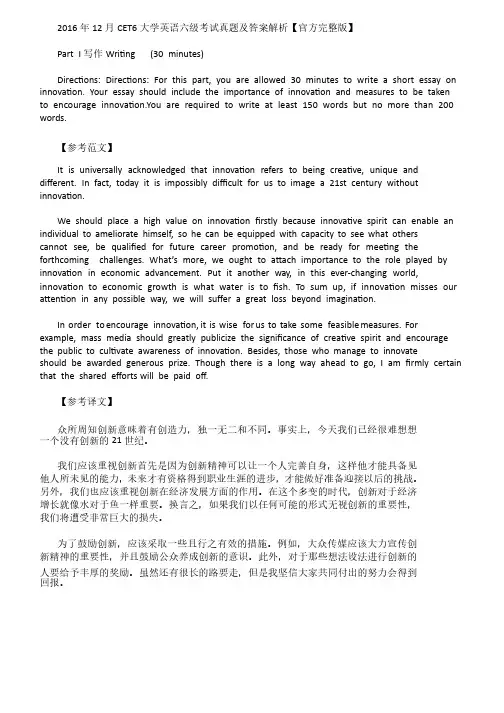
It is universally acknowledged that innova on refers to being crea ve, unique and different. In fact, today it is impossibly difficult for us to image a 21st century without innova on.
And for this to happen, we may need ac on on a global scale from a poli cal perspec ve. We need to understand the terms on which major countries like China and the USA might sign up to a global agreement because at the moment we don't have that consensus.
【参考译文】
众所周知创新意味着有创造力,独一无二和不同。事实上,今天我们已经很难想想 一个没有创新的 21 世纪。
我们应该重视创新首先是因为创新精神可以让一个人完善自身,这样他才能具备见 他人所未见的能力,未来才有资格得到职业生涯的进步,才能做好准备迎接以后的挑战。 另外,我们也应该重视创新在经济发展方面的作用。在这个多变的时代,创新对于经济 增长就像水对于鱼一样重要。换言之,如果我们以任何可能的形式无视创新的重要性, 我们将遭受非常巨大的损失。
B Cut down energy consump on.
C Plan well in advance.
D Adopt new technology.
2016年12月英语六级考试模拟题及答案解析(4)

Part Ⅱ Reading Comprehension (35 minutes) Directions: There are four passages in this part. Each passage is followed by some questions or unfinished statements. For each of them there are four choices marked A), B), C) and D). You should decide on the best choice and mark the corresponding letter on the Answer Sheet with a single line through the centre. Questions 21 to 25 are based on the following passage: There are two methods of fighting, the one by law, the other by force; the first method is that of men, the second of beasts; but as the first method is often insufficient, one must have recourse to the second. It is, therefore, necessary for a prince to know well how to use both the beast and the man. This was covertly taught to rulers by ancient writers, who related how Achilles and many others of those ancient princes were given to Chiron the centaur to be brought up and educated under his discipline. The parable of this semi animal, semi human teacher is meant to indicate that a prince must know how to use both natures, and that the one without the other is not durable. A prince, being thus obliged to know well how to act as a beast, must imitate the fox, and the lion, for the lion cannot protect himself from traps, and the fox annot defend himself from wolves. Those that wish to be only lions do not understand this. Therefore, a prudent ruler ought not to keep faith when by doing so it would be against his interest, and when the reasons which made him bind himself no longer exist. If men were all good, this precept would not be good ; but as they are bad, and would not observe their faith with you, so you are not bound to keep faith with them. Nor have legitimate grounds ever failed a prince who wished to show colorable excuse for the nonfulfilment of his promise. Of this one could furnish an infinite number of examples, and show how many times peace has been broken, and how many promises rendered worthless, by the faithlessness of princes, and those that have best been able to imitate the fox have succeeded best. But it is necessary to be able to disguise this character well, and to be a great feigner and dissembler, and men are so simple and so ready to obey present necessities, that the one who deceives will always find those who allow themselves to be deceived. 21.The author of the passage does not believe that ____. A) people can protect themselves B) the truth makes men free C) leaders have to be consistent D) princes are human 22.The lion represents those who are ____. A) too trusting B) strong and careful C) reliant on force D) lacking in intelligence 23.The fox, in this passage, is ____. A) admired for his trickery B) no match for the lion C) pitied for his trick D) considered worthless 24.The writer suggests that a successful leader must ____. A) be prudent and faithful B) cheat and lie C) have principle to guide his actions D) tell the people the truth about his opponent 25.The writer would approve an unsuccessful political candidate ____. A) gave up all his opportunities B) promised to try again next time C) overthrew the government by force D) told the people the truth about his opponent Questions 26 to 30 are based on the following passage: The forest from which Man takes his timber is the tallest and most impressive plant community on Earth. In terms of Man's brief life it appears permanent and unchanging, save for the seasonal growth and fall of the leaves, but to forester it represents the climax of a long succession of events. No wooded landscape we see today has been forest for all time. Plants have minimum requirements of temperature and moisture and, in ages past, virtually every part of Earth's surface has at some time been either too dry or too cold for plants to survive. However, as soon as climatic conditions change in favour of plant life, a fascinating sequence of changes occurs, called a primary succession.。
2016年6月英语六级真题(全三套+详细答案)
2016年6月英语六级真题第一套Part I Writing (30 minutes)Directions:For this part, you are allowed 30 minutes to write a short essay on the use of robots. Try to imagine what will happen when more and more robots take the place of human beings in industry as well as people's daily lives. You are requried to write at least 150 words but no more than 200 words.Part II Listening Comprehension (30 minutes)Section ADirections:In this section, you will hear two long conversations. At the end of each conversation, you will hear four questions. Both the conversation and the questions will be spoken only once. After you hear a question, you must choose the best answer from the four choices marked A),B),C)and D). Then mark the corresponding letter on Answer Sheet 1 with a single line through the centre.Questions 1 to 4 are based on the conversation you have just heard.1. A)Project organizerB)Public relations officer.C)Marketing manager.D)Market research consultant.2.A)Quantitative advertising research.B)Questionnaire design.C)Research methodology.D)Interviewer training.3.A)They are intensive studies of people’s spending habits.B)They examine relations between producers and customers.C)They look for new and effective ways to promote products.D)They study trends or customer satisfaction over a long period.4.A)The lack of promotion opportunity.B)Checking charts and tables.C)Designing questionnaires.D)The persistent intensity.Questions 5 to 8 are based on the conversation you have just heard.5.A)His view on Canadian universities.B)His understanding of higher education.C)His suggestions for improvements in higher education.D)His complaint about bureaucracy in American universities.6.A)It is well designed.B)It is rather inflexible.C)It varies among universities.D)It has undergone great changes.7.A)The United States and Canada can learn from each other.B)Public universities are often superior to private universities.C)Everyone should be given equal access to higher education.D)Private schools work more efficiently than public institutions.8.A) University systems vary from country to country.B)Efficiency is essential to university management.C) It is hard to say which is better, a public university or a private one.D) Many private university in the U.S. Are actually large bureaucracies.Section BDirections: In this section, you will hear two passages. At the end of each passage, you will hear three or four questions. Both the passage and the questions will be spoken only once. After you hear a question, you must choose the best answer from the four choices marked A), B), C) and D). Then mark the corresponding letter on Answer Sheet 1 with a single line through the centre.Questions 9 to 11 are based on the passage you have just heard.9.A) Government’s role in resolving an economic crisis.B) The worsening real wage situation around the worldC) Indications of economic recovery in the United States.D) The impact of the current economic crisis on people’s life.10.A)They will feel less pressure to raise employees’wages.B) They will feel free to choose the most suitable employees.C) They will feel inclined to expand their business operations.D) They will feel more confident in competing with their rivals.11.A) Employees and companies cooperate to pull through the economic crisis.B) Government and companies join hands to create hobs for the unemployed.C) Employees work shorter hours to avoid layoffs.D) Team work will be encouraged in companies.Questions 12 to 15 are based on the passage you have just heard.12.A) Whether memory supplements work.B) Whether herbal medicine works wonders.C) Whether exercise enhances one’s memory.D) Whether a magic memory promises success.13.A) They help the elderly more than the young.B) They are beneficial in one way or another.C) They generally do not have side effects.D) They are not based on real science.14.A)They are available at most country fairs.B)They are taken in relatively high dosage.C)They are collected or grown by farmers.D)They are prescribed by trained practitioners.15.A)They have often proved to be as helpful as doing mental exercise.B)Taking them with other medications might entail unnecessary risks.C)Their effect lasts only a short time.D)Many have benefited from them.Section CDirections:In this section, you will hear three recordings of lectures or talks followed by three or four questions. The recordings will be played only once. After you hear a question, you must choose the best answer from the four choices marked A),B),C) and D). Then mark the corresponding letter on Answer Sheet 1 with a single line through the centre.Questions 16 to 18 are based on the recording you have just heard.16.A)How catastrophic natural disasters turn out to be to developing nations.B)How the World Meteorological Organization studies natural disasters.C)How powerless humans appear to be in face of natural disasters.D)How the negative impacts of natural disasters can be reduced.17.A)By training rescue teams for emergencies.B)By taking steps to prepare people for them.C)By changing people’s views of nature.D)By relocating people to safer places.18.A)How preventive action can reduce the loss of life.B)How courageous Cubans are in face of disasters.C)How Cubans suffer from tropical storms.D)How destructive tropical storms can be.Questions 19 to 22 are based on the recording you have just heard.19.A)Pay back their loans to the American government.B)Provide loans to those in severe financial difficulty.C)Contribute more to the goal of a wider recovery.D)Speed up their recovery from the housing bubble.20.A)Some banks may have to merge with others.B)Many smaller regional banks are going to fail.C)It will be hard for banks to provide more loans.D)Many banks will have to lay off some employees.21.A)It will work closely with the government.B)It will endeavor to write off bad loans.C)It will try to lower the interest rate.D)It will try to provide more loans.22.A)It won’t help the American economy to turn around.B)It won’t do any good to the major commercial banks.C)It will win the approval of the Obama administration.D)It will be necessary if the economy starts to shrink again.Questions 23 to 25 are based on the recording you have just heard.23.A)Being unable to learn new things.B)Being rather slow to make changes.C)Losing temper more and more often.D)Losing the ability to get on with others.24.A)Cognitive stimulation.B)Community activity.C)Balanced diet.D)Fresh air.25.A)Ignoring the signs and symptoms of aging.B)Adopting an optimistic attitude towards life.C)Endeavoring to give up unhealthy lifestyles.D)Seeking advice from doctors from time to time.Part III Reading Comprehension (40 minutes)Section ADirections:In this section,there is a passage with ten blanks.You are required to select one word for each blank from a list of choices given in a word bank following the passage.Read the passage through carefully before making your choices.Each choice in the bank is identified by a letter.Please mark the corresponding letter for eachitem on Answer Sheet 2with a single line through the centre.You may not use any of the words in the bank more than once.Pursuing a career is an essential part of adolescent development.“The adolescent becomes an adult when he_26_a real job.”To cognitive researchers likePiaget,adulthood meant the beginning of an_27_.Piaget argued that once adolescents enter the world of work,their newly acquired ability to form hypotheses allows them to create representations that are too ideal.The_28_of such ideals,without the tempering of the reality of a job or profession,rapidly leads adolescents to become _29_ of the non-idealistic world and to press for reform in a characteristically adolescent way.Piaget said:“True adaptation to society comes_30_when the adolescent reformer attempts to put his ideas to work.”Of course,youthful idealism is often courageous,and no one likes to give up dreams.Perhaps,taken_31_out of context,Piaget’s statement seems harsh.What he was_32_,however,is the way reality can modify idealistic views.Some people refer to such modification as maturity.Piaget argued that attaining and accepting a vocation is one of the best ways to modify idealized views and to mature.As careers and vocations become less available during times of _33_,adolescents may be especially hard hit.Such difficult economic times may leave many adolescents_34_about their roles in society.For this reason,community interventions and government job programs that offer summer and vacation work are not only economically_35_but also help to stimulate the adolescent’s sense of worth.A)automaticallyB)beneficialC)capturingD)confusedE)emphasizingF)entranceG)excitedH)existenceI)incidentallyJ)intolerantK)occupationL)promisesM)recessionN)slightlyO)undertakesSection BDirections:In this section,you are going to read a passage with ten statements attached to it.Each statement contains information given in one of the paragraphs.Identify the paragraph from which the information is derived.You may choose a paragraph more than once.Each paragraph is marked with a letter.Answer the questions by marking the corresponding letter on Answer Sheet 2.Can societies be rich and green?[A]“If our economies are to flourish,if global poverty is to be eliminated and if the well-being of the world’s people enhanced—not just in this generation but in succeeding generations—we must make sure we take care of the natural environment and resources on which our economic activity depends.”That statement comes not,as you might imagine,from a stereotypicaltree-hugging,save-the-world greenie(环保主义者),but from Gordon Brown,a politician with a reputation for rigour,thoroughness and above all,caution.[B]A surprising thing for the man who runs one of the world’s most powerful economies to say?Perhaps;though in the run-up to the five-year review of the Millennium(千年的)Goals,he is far from alone.The roots of his speech,given in March at the roundtable meeting of environment and energy ministers from the G20 group of nations,stretch back to 1972,and the United Nations Conference on the Human Environment in Stockholm.[C]“The protection and improvement of the human environment is a major issue which affects the well-being of peoples and economic development throughout the world,”read the final declaration from this gathering,the first of a sequence which would lead to the Rio de Janeiro Earth Summit in 1992 and the World Development Summit in Johannesburg three years ago.[D]Hunt through the reports prepared by UN agencies and development groups —many for conferences such as this year’s Millennium Goals review—and you will find that the linkage between environmental protection and economic progress is a common thread.[E]Managing ecosystems sustainably is more profitable than exploitingthem,according to the Millennium Ecosystem Assessment.But finding hard evidence to support the thesis is not so easy.Thoughts turn first to some sort of global statistic,some indicator which would rate the wealth of nations in both economic and environmental terms and show a relationship between the two.[F]If such an indicator exists,it is well hidden.And on reflection,this is not surprising;the single word“environment”has so many dimensions,and there are so many other factors affecting wealth—such as the oil deposits—that teasing out a simple economy-environment relationship would be almost impossible.[G]The Millennium Ecosystem Assessment,a vast four-year global study which reported its initial conclusions earlier this year,found reasons to believe that managing ecosystems sustainably—working with nature rather than against it—might be less profitable in the short term,but certainly brings long-term rewards.[H]And the World Resources Institute(WRI)in its World Resources 2005report,issued at the end of August,produced several such examples from Africa and Asia;it also demonstrated that environmental degradation affects the poor more than the rich,as poorer people derive a much higher proportion of their income directly from the natural resources around them.[I]But there are also many examples of growing wealth by trashing the environment,in rich and poor parts of the world alike,whether through unregulated mineral extraction,drastic water use for agriculture,slash-and-burn farming,orfossil-fuel-guzzling(大量消耗)transport.Of course,such growth may not persist in the long term—which is what Mr.Brown and the Stockholm declaration were both attempting to point out.Perhaps the best example of boom growth and bust decline is the Grand Banks fishery.For almost five centuries a very large supply of cod(鳕鱼)provided abundant raw material for an industry which at its peak employed about 40,000 people,sustaining entire communities in Newfoundland.Then,abruptly,the cod population collapsed.There were no longer enough fish in the sea for the stock to maintain itself,let alone an industry.More than a decade later,there was no sign of the ecosystem re-building itself.It had,apparently,been fished out of existence;and the once mighty Newfoundland fleet now gropes about frantically for crab on the sea floor.[J]There is a view that modern humans are inevitably sowing the seed of a global Grand Banks-style disaster.The idea is that we are taking more out of what you might call the planet’s environmental bank balance than it can sustain;we are living beyond our ecological means.One recent study attempted to calculate the extent of this“ecological overshoot of the human economy”,and found that we are using 1.2 Earth’s-worth of environmental goods and services—the implication being that at some point the debt will be called in,and all those services—the things which the planet does for us for free—will grind to a halt.[K]Whether this is right,and if so where and when the ecological axe will fall,is hard to determine with any precision—which is why governments and financial institutions are only beginning to bring such risks into their economic calculations.It is also the reason why development agencies are not united in their view of environmental issues;while some,like the WRI,maintain that environmental progress needs to go hand-in-hand with economic development,others argue that the priority is to build a thriving economy,and then use the wealth created to tackle environmental degradation.[L]This view assumes that rich societies will invest in environmental care.But is this right?Do things get better or worse as we get richer? Here the Stockholmdeclaration is ambiguous.“In the developing countries,”it says,“most of the environmental problems are caused by under-development.”So it is saying that economic development should make for a cleaner world?Not necessarily;“In the industralised countries,environmental problems are generally related to industrialisation and technological development,”it continues.In other words,poor and rich both over-exploit the natural world,but for different reasons.It’s simply not true that economic growth will surely make our world cleaner.[M]Clearly,richer societies are able to provide environmental improvements which lie well beyond the reach of poorer communities.Citizens of wealthy nations demand national parks,clean rivers,clean air and poison-free food.Theyalso,however,use far more natural resources-fuel,water(all those baths and golf courses)and building materials.[N]A case can be made that rich nations export environmental problems,the most graphic example being climate change.As a country’s wealth grows,so do its greenhouse gas emissions.The figures available will not be completelyaccurate.Measuring emissions is not a precise science, particularly when it comes to issues surrounding land use;not all nations have re-leased up-to-date data,and in any case,emissions from some sectors such as aviation are not included in national statistics.But the data is exact enough for a clear trend to be easily discernible.As countries become richer,they produce more greenhouse gases;and the impact of those gases will fall primarily in poor parts of the world.[O]Wealth is not,of course,the only factor involved.The average Norwegian is better off than the average US citizen,but contributes about half as much to climate change.But could Norway keep its standard of living and yet cut its emissions to Moroccan or even Ethiopian levels?That question,repeated across a dozen environmental issues and across our diverse planet,is what will ultimately determine whether the human race is living beyond its ecological means as it pursues economic revival.36.Examples show that both rich and poor countries exploited the environmentfor economic progress.37.Environmental protection and improvement benefit people all over the world.38.It is not necessarily true that economic growth will make our world cleaner.39.The common theme of the UN reports is the relation between environmental protection and economic growth.40.Development agencies disagree regarding how to tackle environment issues while ensuring economic progress.41.It is difficult to find solid evidence to prove environmental friendliness generates more profits than exploiting the natural environment.42.Sustainable management of ecosystems will prove rewarding in the long run.43.A politician noted for being cautious asserts that sustainable human development depends on the natural environment.44.Poor countries will have to bear the cost for rich nations’economic development.45.One recent study warns us of the danger of the exhaustion of natural resources on Earth.Section CDirections:There are 2 passages in this section. Each passage is followed by some questions or unfinished statements. For each of them there are four choices marked A),B),C)and D).You should decide on the best choice and mark the corresponding letter on Answer Sheet 2 with a single line through the centre.Passage OneQuestions 46 to 50 are based on the following passage.Interactive television advertising, which allows viewers to use their remote controls to click on advertisements, has been pushed for years. Nearly a decade ago it was predicted that viewers of “Friends”, a popular situation comedy, would soon be able to purchase a sweater like Jennifer Aniston’s with a few taps on their remotecontrol.“It’s been the year of interactive television advertising for the last ten or twelve years,”says Colin Dixon of a digital-media consultancy.So the news that Cablevision, and American cable company, was rolling out interactive advertisements to all its customers on October 6th was greeted with some skepticism. During commercials, an overlay will appear at the bottom of the screen, prompting viewers to press a button to request a free sample or order a catalogue. Cablevision hopes to allow customers to buy things with their remote controls early next year.Television advertising could do with a boost. Spending fell by 10% in the first half of the year. The popularization of digital video recorders has caused advertisers to worry that their commercials will be skipped. Some are turning to the Internet, which is cheaper and offers concrete measurements like click-through rates—especially important at a time when marketing budgets are tight. With the launch of interactive advertising,“many of the dollars that went to the Internet will come back to the TV,”says David Kline of Cablevision. Or so the industry hopes.In theory, interactive advertising can engage viewers in a way that 30-second spots do not. Unilever recently ran an interactive campaign for its Axe deodorant(除臭剂),which kept viewers engaged for more than three minutes on average.The amount spent on interactive advertising on television is still small. Magna, an advertising agency, reckons it will be worth about $138 million this year. That falls far short of the billions of dollars people once expected it to generate. But DirecTV, Comcast and Time Warner Cable have all invested in it. A new effort led by Canoe Ventures, a coalition of leading cable providers, aims to make interactive advertising available across America later this year. BrightLine iTV, Which designs and sells interactive ads, says interest has surged: it expects its revenues almost to triple this year. BSkyB, Britain’s biggest satellite-television service, already provides 9 million customers with interactive ads.Yet there are doubts whether people watching television, a“lean back”medium, crave interaction. Click-through rates have been high so far(around 3-4%, compared with less than 0.3% online), but that may be a result of the novelty. Interactive adsand viewers might not go well together.46.What does Colin Dixon mean by saying“It’s been the year of interactive television advertising for the last ten or twelve years”(Lines 4-5, Para.1)?A)Interactive television advertising will become popular in 10-12 years.B)Interactive television advertising has been under debate for the last decade or so.C)Interactive television advertising is successful when incorporated into situation comedies.D)Interactive television advertising has not achieved the anticipated results.47.What is the public’s response to Cablevision’s planned interactive TV advertising program?A)Pretty positive.B)Totally indifferent.C)Somewhat doubtful.D)Rather critical.48.What is the impact of the wide use of digital video recorders on TV advertising?A)It has made TV advertising easily accessible to viewers.B)It helps advertisers to measure the click-through rates.C)It has placed TV advertising at a great disadvantage.D)It enables viewers to check the sales items with ease.49.What do we learn about Unilever’s interactive campaign?A)It proves the advantage of TV advertising.B)It has done well in engaging the viewers.C)It helps attract investments in the company.D)it has boosted the TV advertising industry.50.How does the author view the hitherto high click-through rates?A)They may be due to the novel way of advertising.B)They signify the popularity of interactive advertising.C)They point to the growing curiosity ofTV viewers.D)They indicate the future direction of media reform.Passage TwoQuestions 51 to 55 are based on the following passage.What can be done about mass unemployment? All the wise heads agree: there’re no quick or easy answers. There’s work to be done, but workers aren’t ready to do it—they’re in the wrong places, or they have the wrong skills, Our problems are “structural,”and will take many years to solve.But don’t bother asking for evidence that justifies this bleak view. There isn’t any. On the contrary, all the facts suggest that high unemployment in America is the result of inadequate demand. saying that there’re no easy answers sounds wise. But it’s actually foolish: our unemployment crisis could be cured very quickly if we had the intellectual clarity and political will to act. In other words, structural unemployment is a fake problem, which mainly serves as an excuse for not pursing real solutions.The fact is job openings have plunged in every major sector, while the number of workers forced into part-time employment in almost all industries has soared. Unemployment has surged in every major occupational category. Only three states. With a combined population not much larger than that of Brooklyn, have unemployment rates below 5%. So the evidence contradicts the claim that we’re mainly suffering from structural unemployment. Why, then, has this claim become so popular?Part of the answer is that this is what always happens during periods of high unemployment—in part because experts and analysts believe that declaring the problem deeply rooted, with no easy answers, makes them sound serious.I’ve been looking at what self-proclaimed experts were saying about unemployment during the Great Depression; it was almost identical to what Very Serious People are saying now. Unemployment cannot be brought down rapidly,declared one 1935 analysis, because the workforce is“unadaptable and untrained. It cannot respond to the opportunities which industry may offer.”A few years later, a large defense buildup finally provided a fiscal stimulus adequate to the economy’s needs—and suddenly industry was eager to employ those“unadaptable and untrained”workers.But now, as then, powerful forces are ideologically opposed to the whole idea of government action on a sufficient scale to jump-start the economy. And that, fundamentally, is why claims that we face huge structural problems have been multiplying: they offer a reason to do nothing about the mass unemployment that is crippling out economy and our society.So what you need to know is that there’s no evidence whatsoever to back these claims. We aren’t suffering from a shortage of needed skills, We’re suffering from a lack of policy resolve. As I said, structural unemployment isn’t a real problem, it’s an excuse—a reason not to act on America’s problems at a time when action is desperately needed.51.What does the author think is the root cause of mass unemployment in America?A)Corporate mismanagement.B)Insufficient demand.C)Technological advances.D)Workers’slow adaptation.52.What does the author think of the experts’claim concerning unemployment?A)Self-evident.B)Thought-provoking.C)Irrational.D)Groundless.53.What does the author say helped bring down unemployment during the Great Depression?A)The booming defense industry.B)The wise heads’benefit package.C)Nationwide training of workers.D)Thorough restructuring of industries.54.What has caused claims of huge structural problems to multiply?A)Powerful opposition to government’s stimulus efforts.B)Very Serious People’s attempt to cripple the economy.C)Evidence gathered from many sectors of the industries.D)Economists’failure to detect the problems in time.55.What is the author’s purpose in writing the passage?A)To testify to the experts’analysis of America’s problems.B)To offer a feasible solution to the structural unemployment.C)To show the urgent need for the government to take action.D)To alert American workers to the urgency for adaptation.Part IV Translation (30minutes)Directions: For this part, you are allowed 30 minutes to translate a passage from Chinese into English. You should write your answer on Answer Sheet 2.中国的创新正以前所未有的速度蓬勃发展。
2016年12月英语六级cet6模拟试题及答案(2)
2016年12月英语六级cet6模拟试题及答案(2)阅读理解二:Every once in a while the reasons for discouragement about the human prospect pile up so high that it becomes difficult to see the way ahead。
and it is then a.great blessing to have one conspicuous and undeniable good thing to think about ourselves,something solid enough to step onto and look beyond the pile.language is often useful for this,and music.A particular painting,if you have the right receptors,can lift the spirits and hold them high enough to see a whole future for the race.The sound of laughter in the distance in the dark can be a marvelous encouragement.But these are uncertain stimuli,ready,to work only if you happen to be ready to receive them,which takes a bit of luck.I have been reading magazine stories about the technology of lie detection lately,and it occurs to me that this may be the thing I've been looking for,an encouragement supported by genuine,hard scientific data.It is promising enough that I’ve decided to take as given what the articles say.uncritically,and to look no further.As I understand it,a human being cannot tell a lie,even a small one.without setting off a kind of smoke alarm Somewhere deep in a dark recess of the brain,resulting in the sudden discharge 9f nerve impulses,or the sudden outpouring of neurohormones(神经激素)of some sort,or both.The outcome,recorded by the lie—detector device is similar to the responses to various kinds of stress.Lying,then is stressful,even when we do it for protection,or relief,or escape,or profit,or just for the pure pleasure oflying and getting away with it.It is a strain.distressing enough to cause the emission of signals to and from the central nervous system warning that something has gone wron9.It is,in a pure physiological sense,an unnatural act.Now I regard this as a piece of extraordinarily good news,meaning,that we are compelled to be a moral species at least in the limited sense that we are biologically designed to be truthful to each other.It seems a petty thing to have this information,but perhaps it tells us to look again,and look deeper.We are indeed a social species,more dependent on each other than the celebrated social insects,we can no more live a solitary life than can a bee,we ale obliged,as a species。
2016年6月六级模考题答案
恩波英语模考答案-·凡团购恩波图书,可于考前一个月免费获得恩波模考和作文预测服务。
大学英语六级考试参考答案Part ⅠWritingAs for life, it is how you react to it rather than what happens to you that counts. This can be best echoed by the saying “life is 10% of what happens to you and 90% of how you react to it.” Indeed, it is more than that you are defeated by yourself than by your life.We are living in an everchanging world and we may encounter some unexpected situations, including natural disasters and personal hardship. We ve heard about many cases that some miners miraculously survived several days after being trapped underground due to worksite accidents. It is their strong will to live that has supported them to hold on until the rescuers come to help them. By contrast, there are some people who are not brave enough to face the failures or difficulties in their life. Whenever they meet with a setback, they just shrink back. Therefore, it is often impossible for those people to get over the difficulties and learn.Generally speaking, life treats everyone fairly. You may lose something at a time and then you will gain something else at another time. No matter what life changes happen to you, what you should do is just to react to it in a positive way.Part ⅡListening ComprehensionSection ●AConversation One1. B2. C3. C4. AConversation Two5. A6. B7. D8. CSection ●BPassage One9. D10. A11. C12. CPassage Two13. D14. D15. ASection ●CLecture/Talk One16. C17. D18. D19. ALecture/Talk Two20. C21. C22. ALecture/Talk Three23. A24. B25. APart ⅢReading ComprehensionSection ●A26. M27. G28. I29. L30. O31. A32. K33. D34. B35. FSection ●B36. H37. D38. O39. B40. J41. K42. E43. N44. B45. MSection ●CPassage One46. D47. B48. A49. C50. DPassage Two51. B52. A53. D54. C55. BPart ⅣTranslation参考答案:Westerners have long linked China with porcelain, because the technique of manufacturing porcelain originated from China. Porcelain was developed on the basis of pottery. China s porcelain has a history of about 3,000 years since the Shang Dynasty when the primitive porcelain was first produced. The techniques of manufacturing porcelain have developed rapidly since the Eastern Han Dynasty, Famous kilns producing porcelain products with unique features and new porcelain varieties constantly came forth in subsequent dynasties. China s porcelain wares are not only daily necessities, but also precious arts and crafts. From the Han and Tang Dynasties on, China s porcelain wares and their manufacturing techniques gradually spread all over the world.听力原文Section ●AConversation OneW: Good morning and welcome to today s program. Have you always wanted to invest, but didn t know where to get started?Today s show will help you with this problem. Very happily, we have Mr. Brown as our guest. Welcome to our program, Mr. Brown.M: It s a pleasure to be here.W: Now, Mr. Brown. Can you give us some suggestions on how to invest wisely?M: Well, I think there are three basic guidelines to smart investment.W: What are they?M: Number one is to have clear goals. Decide how many years you will invest for, and what your needs will be in the future.W: I see. First, we should have a clear goal. That s definitely important. Then what is the second guideline?M: Number two is to understand the range of possibilities. You ll want diversified investments: one with a mix of stocks, mutual funds, bonds, and cash. It s a jungle out there. Each of these products has different risks associated with them and also different potential rewards. Understand them before you buy, so there won t be any big surprises later.W: That sounds quite reasonable. Well, what about the third guideline?M: Finally, number three is to have realistic expectations. Keep this in mind: he who wishes to be rich in a day will be hanged in a year. You should invest for the long term since the stock market has both up and down years.W: That s quite true. For example, over the past several years, New York stocks have averaged 30% annual returns, but this may not continue for long. Well, that s today s show. Thank you, Mr. Brown, for joining us.M: My pleasure.Questions 1 to 4 are based on the conversation you have just heard.1. What are the two speakers mainly talking about?2. What is the first guideline to investment?3. According to Mr. Brown, what is the second guideline?4. What do we learn about the stock market from the conversation?Conversation TwoM: Have you ever noticed that one of the most common questions we ask about people s behavior is “why...?”W: Yes. We always ask “Why she says this?”“Why he does that?”M: Exactly. Sometimes the reason is obvious. For example, a man is driving down the street, when the light turns red, he stops, why?W: Because he has to, legally, I mean.M: Sure! In this case the reason is obvious, so we usually don t question it. But when the reason is not so obvious and especially when the behavior could have negative consequences, we ll be more likely to feel a need to explain the causes of the behavior.W: Most people are curious.M: Yes, I know one theory suggests, there s a pattern in the way we go about attributing causes to people s behavior. According to this theory, there are two categories of reasons: internal factors and external factors.W: Sounds a bit abstract. How about an example?M: Again, Lisa, say you re driving down the road and all of a sudden some guy turns into the lane right in front of you, and you have to slam on your brake to avoid an accident. How do you react?W: I ll probably get very angry. You know, he s not paying attention; he s a bad driver. M: So you automatically attribute the driver s behavior to an internal factor. He himself is to blame because he is careless.W: So if I said it was because of heavy traffic or something, I d be attributing his behavior to an external factor, something beyond his control.M: Good. Now how do you usually explain your own negative behavior?W: We blame external factors.M: That s right.Questions 5 to 8 are based on the conversation you have just heard.5. What are the two speakers mainly talking about?6. On what occasion do we usually want to know the causes of behavior more?7. Why will Lisa get angry at the driver s mistakes?8. How do we usually explain our own negative behavior?Section ●BPassage OneTeachers say the digital age has had a good influence—and a not so good influence—on this generation of American teenagers. More than 2,000 middle and high school teachers took an online survey. Researchers also spoke with teachers in focus groups. Three quarters of the teachers said the Internet and digital search tools have had a positive effect on their students research habits and skills. But 87 percent agreed that these technologies are creating an “easily distracted generation with short attention s pans.” And 64 percent said the technologies “do more to distract students than to help them academically.” Many students think “doing research” now means just doing a quick search on Google.Judy Buchanan is deputy director of the National Writing Project and a co author of the report. She says, “Teachers really like these tools because they are ways to make some of learning exciting and engaging. Young people love these tools which can help them become creators ofcontent, and not just sort of consumers.”But one problem the survey found is that many students are lacking in digital literacy. In other words, they trust too much of the information they find on the Internet. Judy Buchanan says these students have not developed the skills they need to judge the quality of online information. Another problem is blamed on something that might not seem like a problem at all: being able to quickly find information online. Teachers say the result is a reduction of the desire and ability of their students to work hard to find answers. They say students are overly dependent on search engines and do not make enough use of printed books or research librarians.Many teachers are also concerned that the Internet makes it easy for students to copy work done by others instead of using their own abilities.Questions 9 to 12 are based on the passage you have just heard.9. How do three quarters of the teachers think about the Internet and digital search tools?10. According to Judy Buchanan, why do young people like the Internet tools?11. According to the survey, what ability do many students lack when facing the Internet?12. According to the passage, what is the problem of finding information online quickly?Passage TwoWe check e mail as soon as we reach home, and sneak a peek at our inboxes along the way. We respond to calls, texts, and messages even while on vacation. Companies often allow employees to work from home for one or two days a week; some let them live in remote locations.This has all become the norm. A decade ago, we could not have imagined being always on, always connected, with work following us wherever we go.For our grandparents, “work” was almost always in a factory or on a farm. Today, the farm and factory jobs are performed by a shrinking minority. There are still many jobs in the services sector that require physical work. But increasingly our workforce is performing tasks that are done with the mind—that require knowledge and skill. These knowledge jobs can be assisted by technology. This is all exciting—and terrifying enough. But what worries me is the intrusion that companies will increasingly make into our lives and the burnout we will suffer from always being at the beck and call of our employers. I know from personal experience how hard it is to turn off e mail and disconnect from social media. This will only get worse for all of us as we become more connected.And then there will be demands by our employers for us to better manage our lifestyles—so that they can reduce their health bills and get more out of us. The new generation of sensor based devices will continually gather data about our movement, heart rate, weight, sleep, and other health related matters and upload these to the cloud. Before giving you more sick leaves, employers will probably demand that you improve your lifestyle and habits.Questions 13 to 15 are based on the passage you have just heard.13. According to the speaker, what do we know about our grandparents?14. What may be the negative side of the work style in the future?15. Why are the employers concerned about the employees lifestyles?Section ●CLecture/Talk OneGood morning. Welcome to this talk on Space Management. And today I m going to lookparticularly at space management in the supermarket.Now since the time supermarkets began, marketing consultants have been gathering information about customers shopping habits.To date, various research methods have been used to help promote the sales of supermarket products. There is, for example, the simple and direct questionnaire which provides information from customers about their views on displays and products and then helps retailers make decisions about what to put where.Another method to help managers understand just how shoppers go around their stores are the hidden television cameras that film us as we shop and monitor our physical movement around the supermarket aisles: where do we start, what do we buy last, what attracts us, etc.More sophisticated techniques now include video surveillance and such devices as the eye movement recorder. This is a device which shoppers volunteer to wear taped into a headband, and which traces their eye movements as they walk round the shop recording the most eye catching areas of shelves and aisles.But with today s technology, Space Management is now a highly sophisticated method of manipulating the way we shop to ensure maximum profit. Supermarkets are able to invest millions of pounds in powerful computers which tell them what sells best and where.Now, an example of this is Spaceman which is a computer program that helps the retailer to decide which particular product sells best in which part of the store. Now Spaceman works by receiving information from the electronic checkouts, where customers pay, on how well a product is selling in a particular position. Spaceman then suggests the most profitable combination of an article and its position in the store.So, let s have a look at what we know about supermarkets and the way people behave when they walk down the aisles and take the articles they think they need from the shelves.Now imagine one supermarket with an aisle and two rows of shelves.Products placed at the beginning of aisles don t sell well. In tests, secret fixed cameras have filmed shoppers movements around a store over a seven day period. When the film is speeded up, it clearly shows that we walk straight past these areas on our way to the centre of an aisle. Items placed here just don t attract people.When we finally stop at the centre of an aisle, we pause and take stock, casting our eyes along the length of it. Now products displayed here sell well and do even better if they are placed at eye level so that the customer s eyes hit upon them instantly. Products here are snapped up and manufacturers pay a lot for these shelf areas which are known in the trade as hot spots. Naturally everyone wants their products to be in a hot spot.But the prime positions in the store are the ends of aisles, otherwise known as Gondola ends. Now these stand out and grab our attention. For this reason new products are launched in these positions and manufacturers are charged widely varying prices for this privileged spot. Also, the end of an aisle may be used for promoting special offers which are frequently found waiting for us as we turn the corner of an aisle.Well, now, eventually of course, we have to pay. Any spot where a supermarket can be sure we are going to stand still and concentrate for more than a few seconds is good for sales. That s why the shelves at the checkout have long been a favorite for manufacturers of chocolates—perhaps the mo st surefire “impulse” food of all.16. Which of the following is NOT mentioned as a research method used to help promote thesales of supermarket product?17. Which of the following products sell best?18. Where are special offers often found?19. Which of the following statements is NOT true?Lecture/Talk TwoStress is very common in all walks of life and in all occupations. There are different kinds of stress, such as acute, episodic and chronic. Each one has its own list of symptoms and triggers that set it off.Chronic stress is the most dangerous one because it can affect a person s health and lead to depression if he or she cannot develop methods of stress relief. It can be related to work, an unhappy marriage, money problems or other things that cause people to become very unhappy with their lives. People who suffer from this condition often cannot see anything good about their lives. It can lead to suicide, heart attacks and as research has shown, cancer.We may also have heard about post traumatic stress disorder from men and women who return from war and stressful situations. However, there are many things that can cause this disorder, such as abuse in childhood, rape or any other experience that may have been traumatic. People who are suffering from post traumatic stress disorder usually exhibit different types of symptoms, like flashbacks and arousal.Other stress symptoms can include not being able to sleep, constantly worrying about things beyond your control and even aches and pains in your body. These symptoms of stress can eventually lead to more serious diseases such as heart problems. You do need to talk to someone who can help, such as your doctor.Teen stress is one of the leading causes of suicide among teenagers who are unable to cope with all the pressures that seem to come at them from all sides. Feeling left out of popular groups or being constantly teased at school is one of the leading causes of teen depression. Even a child as young as two or three years of age can feel stressed when he or she is trying to live up to the parents expectations of being a good boy or girl. School age children have pressures on them from all sides: schoolwork, parents and friends.As stresses have so much impact on human beings, then what can help to suffer less from these stresses?Using exercise as a form of stress relief has many benefits. New research suggests that exercising as a way of stress management helps people to improve their minds as well as their bodies because they become fit, giving them a whole new feeling about themselves. Another aspect of stress management involves making changes in your life to help you reduce the events that trigger your episodes. In some cases this may be a simple matter of getting out more often or it can mean changing jobs or careers.Stress ball is another way that people have used as stress management techniques. The stress balls are small round balls filled with beads or other squeezable material that you can squeeze. The method may sound silly but many people swear by these stress balls because the squeezing motion affects not only your hand, but your whole arm and seems to provide an outlet for the stress inside your body.20. Why is chronic stress the most dangerous kind of stress?21. Which of the following is not mentioned as a way of releasing stress?22. Which of the following statements is Not true?Lecture/Talk ThreeResearch in Britain has shown that “green consumers”continue to flourish as a significant group amongst shoppers. This suggests that politicians who claim environmentalism is yesterday s issue may be seriously misjudging the public mood.A report from Mintel, the market research organization, says that despite recession and financial pressures, more people than ever want to buy environmentally friendly products and a “green wave”has swept through consumerism, taking in people previously untouched by environmental concerns. The recently published report also predicts that the process will repeat itself with “ethical” concerns, involving issues such as fair trade with the Third World and the social record of businesses. Companies will have to be more honest and open in response to this mood.Mintel s survey, based on nearly 1,000 consumers, found that the proportion who look for green products and are prepared to pay more for them has climbed from 53 percent in 1990 to around 60 percent in 1994. On average, they will pay 13 percent more for such products, although this percentage is higher among women, managerial and professional groups and those aged 35 to 44.Between 1990 and 1994 the proportion of consumers claiming to be unaware of or unconcerned about green issues fell from 18 to 10 percent but the number of green spenders among older people and manual workers has risen substantially. Regions such as Scotland have also caught up with the south of England in their environmental concerns. According to Mintel, the image of green consumerism as associated in the past with the more eccentric members of society has virtually disappeared. The consumer research manager for Mintel, Angela Hughes, said it had become firmly established as a mainstream market. She explained that as far as the average person is concerned environmentalism has not “gone off the boil”. In fact, it has spread across a much wider range of consumer groups, ages and occupations.Mintel s 1994 survey found that 13 percent of consumers are “very dark green”, nearly always buying environmentally friendly products, 28 percent are “dark green”, trying “as far as possible”to buy such products, and 21 percent are “pale green”, tending to buy green products if they see them. Another 26 percent are “armchair greens”; they said they care about environmental issues but their concern does not affect their spending habits. Only 10 percent say they do not care about green issues.Among green consumers, animal testing is the top issue—48 percent said they would be deterred from buying a product if it had been tested on animals, followed by concerns regarding irresponsible selling, the ozone layer, river and sea pollution, forest destruction, recycling and factory farming. However, concern for specific issues is lower than in 1990, suggesting that many consumers feel that Government and business have taken on the environmental agenda.23. What percentage of customers nearly always buy environmentally friendly products?24. Which issue concerns green consumers most?25. Which of the following statements is NOT true according to the passage?。
2016年6月英语六级考试真题试卷附答案和解析
2016年6月英语六级考试真题试卷附答案和解析(第1套) Directions: There are 2 passages in this section. Each passage is followed by some questions or unfinished statements. For each of them there are four choices marked A. , B. , C. and D.. You should decide on the best choice and mark the corresponding letter on Answer sheet with a single line through the centre.Passage OneQuestions 46 to 50 are based on the following passage.Manufacturers of products that claim to be environmentally friendly will face tighter rules on how they are advertised to consumers under changes proposed by the Federal Trade Commission.The commission's revised "Green Guides" warn marketers against using labels that make broad claims, like "eco-friendly". Marketers must qualify their claims on the product packaging and limit them to a specific benefit, such as how much of the product is recycled."This is really about trying to cut through the confusion that consumers have when they are buying a product and that businesses have when they are selling a product," said Jon Leibowitz, chairman of the commission.The revisions come at a time when green marketing is on the rise. According to a new study, the number of advertisements with green messages in mainstream magazines has risen since 1987, and peaked in 2008 at 10.4%. In 2009, the number dropped to 9%.But while the number of advertisements may have dipped, there has been a rapid spread of ecolabeling. There are both good and bad players in the eco-labeling game.In the last five years or so, there has been an explosion of green claims and environmental claims. It is clear that consumers don't always know what they are getting.A handful of lawsuits have been filed in recent years against companies accused of using misleading environmental labels. In 2008 and 2009, class-action lawsuits (集体诉讼) were filed against SC Johnson for using "Greenlist" labels on its cleaning products. The lawsuits said that the label was misleading because it gave the impression that the products had been certified by a third party when the certification was the company's own."We are very proud of our accomplishments under the Greenlist system and we believe that we will prevail in these cases," Christopher Beard, director of public affairs for SC Johnson, said, while acknowledging that "this has been an area that is difficult to navigate."Companies have also taken it upon themselves to contest each other's green claims.David Mallen, associate director of the Council of Better Business Bureau, said inthe last two years the organization had seen an increase in the number of claims companies were bringing against each other for false or misleading environmental product claims."About once a week, I have a client that will bring up a new certification I've never even heard of and I'm in this industry, said Kevin Wilhelm, chief executive officer of Sustainable Business Consulting. "It's kind of a Wild West, anybody can claim themselves to be green." Mr. Wilhelm said the excess of labels made it difficult for businesses and consumers to know which labels they should pay attention to.46. What do the revised "Green Guides" require businesses to do?A) Manufacture as many green products as possible.B) Indicate whether their products are recyclable.C) Specify in what way their products are green.D) Attach green labels to all of their products.47. What does the author say about consumers facing an explosion of green claims?A) They can easily see through the businesses' tricks.B) They have to spend lots of time choosing products.C) They have doubt about current green certification.D) They are not clear which products are truly green.48. What was SC Johnson accused of in the class-action lawsuits?A) It gave consumers the impression that all its products were truly green.B) It gave a third party the authority to label its products as environmentally friendly.C) It misled consumers to believe that its products had been certified by a third party.D) It sold cleaning products that were not included in the official "Greenlist".49. How did Christopher Beard defend his company's labeling practice?A) There were no clear guidelines concerning green labeling.B) His company's products had been well received by the public.C) It was in conformity to the prevailing practice in the market.D) No law required the involvement of a third party in certification.50. What does Kevin Wilhelm imply by saying "It's kind of a Wild West" (Line 3,Para. 11)?A) Businesses compete to produce green products.B) Each business acts its own way in green labeling.C) Consumers grow wild with products labeled green.D) Anything produced in the West can be labeled green.Passage TwoQuestions 51 to 55 are based on the following passage.America's education system has become less a ladder of opportunity than a structure to transmit inequality from one generation to the next.That's why school reform is so critical. This is an issue of equality, opportunity and national conscience. It's not just about education, but about poverty and justice.It's true that the main reason inner-city schools do poorly isn't teachers' unions, but poverty. Southern states without strong teachers' ,unions have schools at least as awful as those in union states. Some Chicago teachers seem to think that they shouldn't be held accountable until poverty is solved. There're steps we can take that would make some difference, and Mayor Rahm Emanuel is trying some of them—yet the union is resisting.I'd be sympathetic if the union focused solely on higher compensation. Teachers need to be much better paid to attract the best college graduates to the nation's worst schools. But, instead, the Chicago union seems to be using its political capital primarily to protect weak performers.There's solid evidence that there are huge differences in the effectiveness of teachers. The gold standard study by Harvard and Columbia University scholars found that even in high-poverty schools, teachers consistently had a huge positive or negative impact.Get a bottom 1% teacher, and the effect is the same as if a child misses 40% of the school year. Get a teacher from the top 20%, and it's as if a child has gone to school for an extra month or two.The study found that strong teachers in the fourth through eighth grades raised the skills of their students in ways that would last for decades. Just having a strong teacher for one elementary year left pupils a bit less likely to become mothers as teenagers, a bit more likely to go to college and earning more money at age 28.How does one figure out who is a weak teacher? Yes, that's a challenge. But researchers are improving systems to measure a teacher's performance throughout the year, and, with three years of data, ifs usually possible to tell which teachers are failing.Unfortunately, the union in Chicago is insisting that teachers who are laid off—often for being ineffective—should get priority in new hiring. That's an insult to students.Teaching is so important that it should be like other professions, with high pay and good working conditions but few job protections for bottom performers. This isn't a battle between garment workers and greedy bosses. The central figures in the Chicago schools strike are neither strikers nor managers but 350,000 children. Protecting the union demand sacrifices those students, in effect turning a blind eye to the injustice in the education system.51. What do we learn about America's education system?A) It provides a ladder of opportunity for the wealthy.B) It contributes little to the elimination of inequality.C) It has remained basically unchanged for generations.D) It has brought up generations of responsible citizens.52. What is chiefly responsible for the undesirable performance of inner-city schools?A) Unqualified teachers. C) Unfavorable learning environment.B) Lack of financial resources. D) Subconscious racial discrimination.53. What does the author think the union should do to win popular support?A) Assist the city government in reforming schools. C) Demand higher pay for teachers.B) Give constructive advice to inner-city schools. D) Help teachers improve teaching.54. What is the finding of the gold standard study by Harvard and Columbia University scholars?A) Many inner-city school teachers are not equal to their jobs.B) A large proportion of inner-city children often miss classes.C) Many students are dissatisfied with their teachers.D) Student performance has a lot to do with teachers.55. Why does the author say the Chicago unions demand is an insult to students?A) It protects incompetent teachers at the expense of students.B) It underestimates students, ability to tell good teachers from poor ones.C) It makes students feel that they are discriminated against in many ways.D) It totally ignores students,initiative in the learning process.答案:46 [C]【定位】根据题干中的the revised “Green Guides”定位至第2 段。
12月大学英语六级模拟试卷及答案
12月大学英语六级模拟试卷及答案2016年12月大学英语六级模拟试卷及答案2016年下半年的英语六级考试还有一个多月就要到了,为了帮助同学们更好地备考六级考试,下面是yjbys网店铺提供给大家关于大学英语六级模拟试卷及答案,希望对大家的备考有所帮助。
Part I Writing.Directions: For this part, you are allowed 30 minutes to write a short essay entitled The Civil Servant Test Craze. Your essay should start with a brief description of the picture. You should write at least 150 words but no more than 200 words.1.如今数字化产品得到越来越广泛的使用,例如……2.数字化产品的使用对人们的工作、学习、生活产生的影响。
36、根据下列短文,回答36-46题。
Women in 2011 made no significant gains in winning more top US business jobs, according to a study, but the head of the study said women are poised to make 36 in the year ahead.The number of women who were board directors, corporate officers or top earners at Fortune 500 companies remained 37 unchanged, said the study by Catalyst, a nonprofit group that 38 opportunities for women in business.The percentage of companies with women on the board of directors was 15.1 percent this year, compared with 14.8 percent in 2010, Catalyst said.Also, the percentage of corporate officer positions 39 by women was 15.7 percent in 2011 and 15.4 percent in 2010, it said. The percentage of top earners in 2011 who were women was 6.2 percent, compared to 6.7 percent in 2010, it said.The research on the Fortune 500 companies was 40 on data as of March 31, 2011. The slight changes in the numbers are notconsidered 41 significant, Catalyst said.Nevertheless, given the changes in U.S. politics, the future for women in business looks more 42 , said Ilene Lang, president and chief executive 43 of Catalyst."Overall we're 44 to see change next year," Lang said. "When we look at shareholders, decision makers, the general public, they're looking for change. ""What they're basically saying is, ' Don't give us 45 of the status quo (现状). Get new ideas in there, get some fresh faces,'" she said.A. officerB. changesC. basedD. positionsE. moreF. promisingG. businesslikeH. surveyingI. essentiallyJ. stridesK. promotesL. statisticallyM. confusedN. heldO. expectingSection BDirections: In this section, you are going to read a passage with ten statements attached to it. Each statement contains information given in one of the paragraphs. Identify the paragraph from which the information is derived.You may choose a paragraph more than once. Each paragraph is marked with a letter. Answer the questions by marking the corresponding letter on Answer Sheet 2.根据下列短文,回答46-56题。