
人教版七下unit 2 Section B (2a-2c)
二、根据汉语意思完成英语句子,每空一词 1. 明天是校庆日,你应该早点起床。 get _____ up Tomorrow is School Day. You should _____ early _____. 2. 或者汤姆或者杰克将和你一起去骑共享单车。 Either or _______Tom ________Jack will ride shared bikes with you. 3. 这个男孩没有多少时间进行体育运动。 much _________ time ________ for The boy doesn’t have_______
2) many与可数名词复数形式连用。 e.g. There are many apples in the basket. 篮子里有许多苹果。 3) much表数量时,只能修饰不可数名词。 e.g. We don’t have much milk. 我没有很多牛奶了。
6. She knows it’s not good for her, but it
当either…or…连接两个名词作主语时, 谓语动词的时态和数应与最近的一个 相匹配(就近一致) 。 is right. e.g. Either you or he ___ He is good at ________ either singing or ________ dancing.(要么...要么) either You needn’t go to the shop ________. (也)
tastes good!
1) be good for …“对……有益;对……有好处”
be bad for…“对……有害;对……有坏处” e.g. It’s good for our health to go to bed early and get up early.早睡早起对我们的健康有好处。 Don’t read in the dark. It’s bad for your eyes. 不要在暗处看书,这对你的眼睛有害。
2. After school, I sometimes play basketball
for half an hour.
sometimes 用作副词,表示频率,意为“有时”
,用how often 提问。
eg: Sometimes my parents use WeChat Pay. 有时我的父母使用微信支付。 He sometimes takes a walk with his mom. (对画线部 分提问) _____ How ______ often ______ does he take a walk with his mom?
5. …she eats lots of fruit and vegetables for lunch. lots of与many, much的用法 都有“许多;大量”之意,但用法不同。 1) lots of=a lot of 后面可以跟可数名词也可 以跟不可数名词。 e.g. He doesn’t have lots of (=many) books. We have lots of (=much) work to do.
very sour. (宁波)
A. tastes B. looks C. feels D. sounds
B 3. I have ________ work to do every day.
A. a lot
B. lots of
C. a lots of
D. many
4. His grandfather often ________after dinner. B
4. In the evening, I either watch TV or play computer games. either conj. 或者 adv. 也(用在否定词 组后) either… or… “或者……或者……;要 么…….要么……; 不是……就是…… ” 连接两个独立的词、短语或句子成份。
watches TV or plays computer games in the evening ______________________________ At ten thirty brushes teeth and goes to bed
Time
At six thirty ook“看起来”; sound“听起来”;smell“闻起来;有……的气味”; feel“摸起来”。
Translation. 1. 步行 __________ take a walk 2. 做作业 do _____________ homework clean the room 3. 打扫房间 ______________ 4. 吃得快 ____________ eat quickly 5. 去睡觉 ___________ go to bed either…or 6. 或者……或者…… _________ 7. 许多、大量 __________ lots of
get up early have breakfast slowly eat fruit and vegetables
Mary
Don’t eat icecream after dinner
1. …so I usually eat very quickly. quickly adv. “很快地”,修饰动词,反义 词slowly。
Mary’s Activities
takes a shower and eats a good breakfast At eight thirty goes to school ____________ eat lots of fruit and vegetables At twelve __________________________ volleyball ______________ After lunch plays eats ice-cream ______________ her homework, swims or takes in the evening does _________________________________ a walk ________ At nine thirty goes to bed
一、单项选择 C 1. I usually go to school by bike, but ________ by bus. A. always C. sometimes B. never D. often
A 2. This kind of peach looks really nice, but it ________
2) taste v.有……的味道;品尝 n.味道,滋味
系动词(后接形 It tastes sweet.它尝起来是甜的。 容词作表语)
Tom smelled the moon cake and then 实义动词(后接 tasted it.汤姆闻了闻月饼,然后尝了 名词或代词) 它。 名词 Sugar has a sweet taste.糖有甜味。
A. take a walk C. go a walk Don't forget it. B. takes a walk D. goes a walk
A 5. —Either you or she ________ on duty today.
—OK. I won't.
A. is B. am C. are D. be
e.g. Don’t eat quickly. It’s not a good habit. 别吃得太快,这不是个好习惯。
quick adj. “快的;迅速的”,修饰名词。
e.g. Tom eats a quick breakfast, then goes to school. 汤姆快速吃完早饭,然后就去上学了。
after dinner every day.
Write down the activities you
think are healthy and unhealthy.
sports.
4. 喝牛奶对健康有好处。 is good for Drinking milk ________ ________ ________ health.
5. 我和我弟弟每天晚饭后做家庭作业。
do our __________ homework My brother and I ________ _______
3. When I get home, I always do my homework first.
get v. 到达 get to +地点名词; get +地点副词 get to school 到校 get home 到家
eg. I get home early every day.
我每天到家很早。
2c
Write down the unhealthy habits of each person. Then think of healthy activities for them.
Unhealthy habits Healthy activities
Tony
get up late have breakfast quickly usually eat hamburgers eat ice-cream after dinner
exercise
2b Scan the passage and answer the question. Who is healthier? Mary. Tony Mary
Read the passage carefully and fill in the blanks.
Time At eight Tony’s Activities gets up ________
人教版七下课时练习Unit2SectionB2a-2c
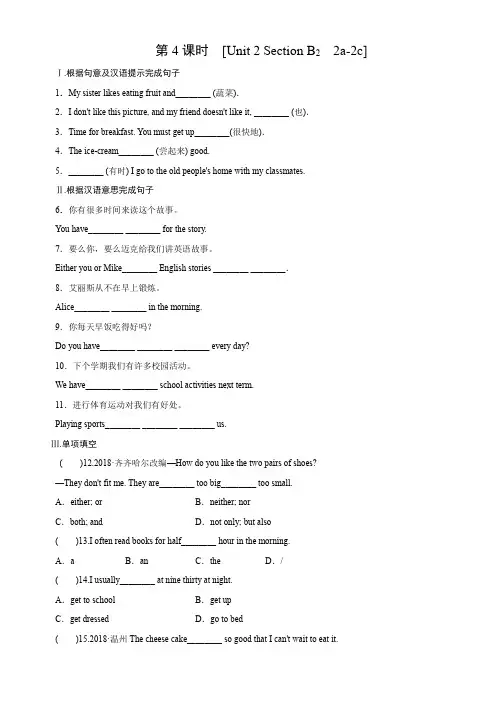
第4课时[Unit 2 Section B22a2c]Ⅰ.根据句意及汉语提示完成句子1.My sister likes eating fruit and________ (蔬菜).2.I don't like this picture, and my friend doesn't like it, ________ (也).3.Time for breakfast. You must get up________(很快地).4.The icecream________ (尝起来) good.5.________ (有时) I go to the old people's home with my classmates.Ⅱ.根据汉语意思完成句子6.你有很多时间来读这个故事。
You have________ ________ for the story.7.要么你,要么迈克给我们讲英语故事。
Either you or Mike________ English stories ________ ________.8.艾丽斯从不在早上锻炼。
Alice________ ________ in the morning.9.你每天早饭吃得好吗?Do you have________ ________ ________ every day?10.下个学期我们有许多校园活动。
We have________ ________ school activities next term.11.进行体育运动对我们有好处。
Playing sports________ ________ ________ us.Ⅲ.单项填空()12.2018·齐齐哈尔改编—How do you like the two pairs of shoes?—They don't fit me. They are________ too big________ too small.A.either; or B.neither; norC.both; and D.not only; but also()13.I often read books for half________ hour in the morning.A.a B.an C.the D./()14.I usually________ at nine thirty at night.A.get to school B.get upC.get dressed D.go to bed()15.2018·温州The cheese cake________ so good that I can't wait to eat it.A.tastes B.smellsC.sounds D.feels()16.For lunch, Tina always eats________ vegetables like carrots and tomatoes.A.much B.allC.no D.lots of()17.His brother gets up very ________ so he doesn't have breakfast and goes to school ________.A.early; quickly B.late; quicklyC.quickly; early D.quickly; late()18.Alan and his sister need to________ their rooms on weekends.A.clean B.brushC.find D.playⅣ.2019·武汉黄陂区期中完形填空Rose is a schoolgirl. She is very busy every day. Let me tell you__19__ about her school day. Her school is far__20__ her home. So she gets up very__21__ in the morning. She usually goes to school by__22__. It__23__ her about half an hour to get there every day. She has__24__ time to have breakfast at home. She often has some bread for breakfast on her way to school. She doesn't want to__25__ late for morning exercises. She has lunch at school. Usually she__26__ soccer with her friends after school. Then she takes the bus and goes __27__ at about 6:00. Then she starts to do her homework. After that she reads English and__28__ music for half an hour. At 9:00 she takes a shower and goes to bed.()19.A.something B.anything C.everything D.nothing()20.A.at B.to C.from D.in()te B.early C.quickly D.fast()22.A.her bike B.bus C.foot D.bikes()23.A.needs B.spends C.pays D.takes()24.A.not B.never C.no D.some()25.A.be B.goes C.comes D./()26.A.brings B.gets C.finds D.plays()27.A.to school B.to work C.home D.to home()28.A.listens to B.hears C.listens D.watchesⅤ.阅读理解ADong Yi lives in Beijing. Read and learn about her day.7:10 a.m.My father takes me to school. It takes 30 minutes.8:00 a.m.I start to have classes. I have four classes in the morning. Each class is 45 minutes long.10:00 a.m.We get a 20minute exercise between classes. We all go to the playground to do morning exercises.11:50 a.m.It's lunchtime! I have lunch in the classroom with my classmates.5:10 p.m.My father takes me home. I have some icecream and then do my homework.After that I listen to English.7:00 p.m.It is time for dinner. After dinner, I play chess with my father and then watch TV.10:00 p.m.I go to bed.()29.Who takes Dong Yi to school?A.Her mother. B.Her uncle.C.Her father. D.Her sister.()30.What does Dong Yi do at 10:00 a.m.?A.She plays chess. B.She does her homework.C.She does morning exercises. D.She has classes.()31.When does Dong Yi have dinner?A.At 5:10 p.m. B.At 7:00 p.m.C.At 7:10 p.m. D.At 10:00 p.m.BAs we all know, labour skill education(劳动技能教育) is an important part of quality education in middle schools in China. We should learn not only our subjects but also some living skills(技能). I think Tom sets a good example(例子) for us.Like any other student, Tom goes to school, does his homework, meets his friends and enjoys doing sports. But between 5:30 p.m. and 6:30 p.m. from Monday to Friday, Tom does something different. He cooks dinner for all the family: Mom, Dad, younger brother Joe and elder sister Emma.“I think it's important for students to learn how to cook. Math and English are important, but they also need otherskills to help them in today's world. First, I taught Tom how to cook easy meals like pizza, eggs and chips. Then, he started to use the recipes(食谱) in some books. Yesterday he made vegetable soup. It was very good!”says Tom's mother.“I love cooking and I think I'm really good at it.My friends can't cook. I don't know why. It isn't difficult and it's great fun!” says Tom.()32.What activity(活动) of Tom isn't mentioned(提到) according to the passage?A.Going to school. B.Doing his homework.C.Cooking at school.D.Exercising.()33.The underlined word “they” refers to(指的是) ________.A.math and English B.some skillsC.students D.Tom's parents()34.How does Tom learn to cook?A.His father teaches him.B.He learns it by using recipes from some books.C.He learns it at school.D.His friends teach him.()35.Which of the following is TRUE according to the passage?A.Tom is the only person who eats the food he cooks.B.Tom's vegetable soup was not delicious.C.Tom's friends also like cooking now.D.Tom's mom thinks learning to cook is good for students.()36.The passage may come from ________.A.a shopping websiteB.a science magazineC.a storybookD.a school newspaperⅥ.短文填词阅读短文,在没有汉语提示的空格处,根据首字母、音标或语境的提示填入1个适当的单词;在有汉语提示的空格处,填入适当的短语,使短文语意连贯,意思完整。
人教版七年级英语下册课后达标训练:Unit2SectionB(2a_2c)
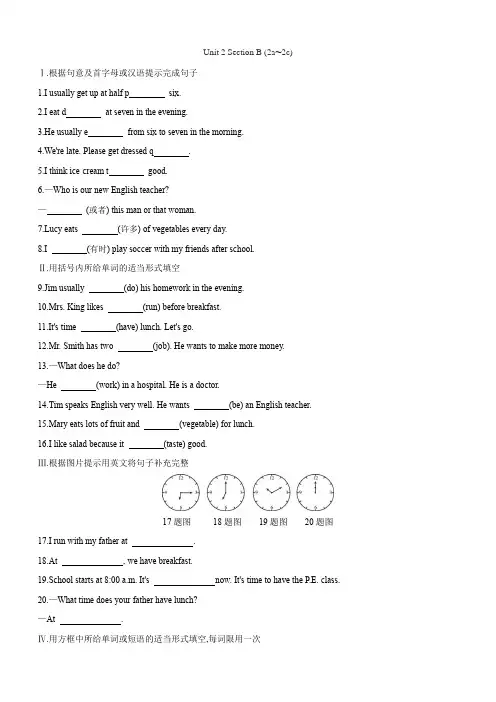
Unit 2 Section B (2a~2c)Ⅰ.根据句意及首字母或汉语提示完成句子1.I usually get up at half p six.2.I eat d at seven in the evening.3.He usually e from six to seven in the morning.4.We're late. Please get dressed q.5.I think ice-cream t good.6.—Who is our new English teacher?—(或者) this man or that woman.7.Lucy eats (许多) of vegetables every day.8.I (有时) play soccer with my friends after school.Ⅱ.用括号内所给单词的适当形式填空9.Jim usually (do) his homework in the evening.10.Mrs. King likes (run) before breakfast.11.It's time (have) lunch. Let's go.12.Mr. Smith has two (job). He wants to make more money.13.—What does he do?—He (work) in a hospital. He is a doctor.14.Tim speaks English very well. He wants (be) an English teacher.15.Mary eats lots of fruit and (vegetable) for lunch.16.I like salad because it (taste) good.Ⅲ.根据图片提示用英文将句子补充完整17题图18题图19题图20题图17.I run with my father at .18.At , we have breakfast.19.School starts at 8:00 a.m. It's now. It's time to have the P.E. class.20.—What time does your father have lunch?—At .Ⅳ.用方框中所给单词或短语的适当形式填空,每词限用一次21.Children need to sleep ten hours every night.22.I can't play computer games now.I have to do my homework .23.I like fruit and vegetables but I like meat.24.Tony and Mary are in China and they have friends here.25.I want to stay healthy, I exercise every day.26.Today is Saturday.You don't need to eat so .27.She usually her teeth before she goes to bed.28.I have breakfast, I go to school.Ⅴ.按要求完成下列各题29.They often go home at 5:15.(对画线部分提问)do they often go home?30.Jim's father often has lunch in his office.(改为一般疑问句)Jim's father often lunch in his office?31.It's time for school.(改为同义句)It's time school.32.She eats lots of fruit for lunch.(对画线部分提问)she for lunch?33.I usually go to bed at 9:00.(用Lucy代替主语改写句子)Lucy usually at 9:00.Ⅵ.完形填空Hello, my name is Linda. Kate is my mother. She is always 34every day.Every morning, she 35at six and makes breakfast. She is very good 36it. Then she wakes(叫醒) my father and me up at six thirty. After we get dressed and brush teeth, we have 37. At seven, my mother goes to 38.She is a Chinese teacher. She has her first class at eight. She 39has two classes in the morning and two classes in the afternoon. She is very nice to her students, 40they all love her very much.Classes 41at five in the afternoon. After that my mother buys some food in the market(市场). She usually gets home at five thirty. Then she makes dinner for us. It always 42good. After dinner, she does some housework(家务). She always makes our house 43and tidy.My mother is really busy. She does a lot for our family and her students.()34.A.funny B.busy C.healthy D.tidy()35.A.gets up B.goes home C.plays chess D.plays sports()36.A.for B.on C.at D.in()37.A.drinks B.dinner C.lunch D.breakfast()38.A.house B.bed C.work D.game()39.A.never ually C.quickly D.very()40.A.but B.because C.so D.or()41.A.finish B.teach C.make D.show()42.A.sounds B.gets C.looks D.tastes()43.A.clean B.big C.small D.sameⅦ.阅读理解Dear Yang Jun,How are you? You ask me about my favorite subject. I think math and geography are my favorites. They are interesting and helpful. Our last class finishes at half past three. Do you think it's late or early? We have lots of after-school activities. For me I like going to the sports club with my classmates. At about a quarter to five I go home. On school days I never watch TV because I'm busy. I usually do my homework first after getting home. It usually takes me about an hour.Then I have dinner with my parents at about six o'clock. I always take a shower and go to bed at half past eight. But I'm always free on weekends. So I can either go to the library or clean the rooms with my parents. Sometimes we play tennis on Saturday. I have a happy life. What about you?Yours,Karl ()44.What does Karl think of math?A.Easy and interesting.B.Easy but boring.eful but difficult.D.Interesting and helpful.()45.What time is Karl's last class over?A.At 3:00.B.At 3:30.C.At 4:20.D.At 4:30.()46.It usually takes Karl about to finish his homework.A.half an hourB.an hourC.two hoursD.one and a half hours()47.Karl usually does all the following things on weekends EXCEPT(除了) .A.going to the libraryB.cleaning the roomsC.playing tennisD.playing computer games()48.We can know that.A.Karl only watches TV at nightB.Karl joins the sports clubC.Karl is always busy on weekendsD.Karl usually has lunch at homeⅧ.单词拼写根据短文内容和括号内所给汉语意思,写出空白处各单词的正确形式(每空一词)。
英语人教新目标七年级下册Unit2Section B (2a – 2c)

Advice(建议):
get up early/on time have breakfast slowly eat fruit and vegetables
Mary eat ice-cream after dinner
Don’t eat ice-cream after dinner
精致卓越 大气开放 品质绵外 担当未来
(4)eats hamburgers for lunch
(5)plays basketballfor half an hour
does homework
(6)
first
(7)either watches o games
(8)at 10:30 _b_ru_s_h_e_s_t_e_et_h_ (9)then__g_o_e_s_t_o_b_e_d______
Teaching aims
Preparation
1.Master key words and Text book Page 11
phrases.
Notebook
2.Talk about healthy and Pen
unhealthy habits.
3. Improve reading skills.
Retell
Tony's Daily Routine
at 8:00
goes _t_o___s__c_h__o__o__l_____
at noon
plays basketball for half an___h__o_u__r______
in the brushes teeth and goesevening to bed________________
After school
人教版英语七年级下册课时练 Unit 2 第四课时 Section B(2a-2c)
人教版英语七年级下册课时练 Unit 2第四课时Section B (2a-2c)Ⅰ. 根据句意及汉语提示完成单词1. The fish tastes(品尝) very good. Enjoy it, please.2. Mary sometimes(有时) goes to the park with her parents.3. The old doctor saves many people's lives(生命) every year.4. Bill always eats breakfast quickly(很快地) because he doesn't want to be late for school.5. You can either(要么) eat now or after the show.Ⅱ. 用括号内所给单词的适当形式填空1. He usually eats lots(lot) of fruit and vegetables, because they're good for his health.2. The little girl usually cleans(clean) her room on Sundays.3. I always brush my teeth first(one) after I get up in the morning.4. I like eating ice-cream. I know it's not good for my health, but it really tastes good(well).5. Mary usually does her(she) homework at 7 p.m.Ⅲ. 单项选择(C) 1. We usually play basketball ________ an hour after school.A. atB. inC. forD. on(D) 2. For breakfast, I usually have milk and eggs, but________ I eat noodles.A. alwaysB. oftenC. neverD. sometimes(D) 3. Lingling likes apples because they________ good.A. getB. lookC. soundD. taste(C) 4. —What do you usually do in the evening?—Well, I either watch TV ________ play games with my sister.A. andB. butC. orD. so(C) 5. He usually gets up ________ half past six ________ the morning.A. at; atB. in; inC. at; inD. in; atⅣ. 根据汉语意思完成句子,每空一词1. 你可以今天或明天来。
人教版七年级下册Unit 2 Section B 2a-2c
goes to bed early.
典型错误 • 句子写着写着没有主语了 比如: He gets up at half past five. He runs at six. Eat breakfast at seven. Goes to
In the evening, I either watch TV or play computer games. At ten thirty, I brush my teeth and then I go to bed.
Mary is my sister. She usually gets up at six thirty. Then she always takes a shower and eats a good breakfast. After that, she goes to school at eight thirty.
At twelve, she eats lots of fruit and vegetables for lunch. After lunch, she sometimes plays volleyball. She always eats ice-cream after dinner. She knows it’s not good for her, but it tastes good! In the evening, she does her homework and usually swims or takes a walk. At nine thirty, she goes to bed.
eat breakfast
七年级-人教版-英语-下册-[学习任务单]Section-B-(2a-2c)
![七年级-人教版-英语-下册-[学习任务单]Section-B-(2a-2c)](https://360docs-1393072327.cos.ap-beijing.myqcloud.com/d8315158e97101f69e3143323968011ca300f785.webp)
Unit 12 What did you do last weekend? (Period 4)Section B (2a-2c)班级_________ 姓名_________学习目标学完这一课,你能够掌握:1.词汇:high、high school、ago、India、tent、put up、moon、each other、surprise、get a surprise、snake、scared、move、shout to ...、start、jump、up and down、wake、wake ... up、into、forest、ear;2.能力:根据标题和插图预测文章的主旨大意的能力;用一般过去时讲述过去发生的事情;3.交际功能:使用“Last weekend was interesting but scary.”“We went camping in a small village in India.”“When we looked out of our tent, we saw a big snake sleeping near the fire.”“This was a very useful lesson for me.”等句型谈论周末发生的事情。
课前学习任务【学习任务】词汇检测1.adj. & adv.高的(地)__________2.中学;高中__________3.adv.以前__________4.n.印度__________5.n.帐篷__________6.搭起;举起__________7.n.月亮__________8.互相;彼此__________9.n.惊奇;惊讶v.使吃惊__________10.吃惊__________11.n.蛇__________12.adj.惊慌的;吓坏了的__________13.v.移动__________14.对……大声喊叫__________15.v.开始;着手__________16.v.跳;跃__________17.上上下下;起伏__________18.v.弄醒;醒__________19.把……弄醒__________20.prep.到……里面;进入__________21.n.森林__________22.n.耳朵__________课堂学习任务【学习任务一】1.What kinds of animals are people sometimes afraid of? Why? Make a list.Animals people are sometimes afraid of Why【学习任务二】1.快速阅读2b的短文,选出每段的主旨大意。
人教版英语七年级上册教案:Unit2 SectionB(2a-2c)
Unit2 SectionB(2a-2c)教案【教材版本与册数】新目标人教版七年级上册【单元名称】Unit 2 This is my sister.【课时】Section B 2a-2c (第5课时)【课型】Reading(阅读课)教材分析【本单元话题】本单元围绕“家庭成员”这一主题展开听、说、读、写等多种教学活动,使学生学会询问家庭成员的称呼,掌握家庭成员的关系。
【本单元重点掌握目标】主要学习用英语介绍家人和朋友,通过本单元的学习学生应该掌握对家庭成员的称呼;通过谈论“家庭”的话题,使学生学会并掌握“介绍人物、识别人物”的基本句型,进一步体会一般疑问句的用法,学会运用指示代词介绍人物,学会运用人称代词询问人物。
【教材内容拆分分析】Section B能够用英语向朋友介绍自己的家人,从而让他们了解自己的家庭。
【通过本单元的学习学生需掌握哪些综合技能】通过本单元的学习使学生学会谈论自己喜好的学科或自己喜好的其它事情并给出理由;学会说出一周的七天;学会合理地安排自己的作息时间。
教学目标 1. 语言知识目标:1) 能掌握对家庭成员称呼的词汇:son, daughter, cousin, grandpa, grandma, mom, dad, aunt, uncle, 以及here, of, photo, next, picture,girl, dog等。
2)能正确理解家庭成员之间的关系,对家庭成员能正确称呼。
3)进一步学习一些英语名字,并能分辨出名字的不同性别。
1 / 6第 1 页4)通过听、说、读的训练,提高学生们综合运用英语的能力,培养学生们学习英语的兴趣,并在学习中体会到学习英语的乐趣。
2. 情感态度价值观目标:通过学习对自己的家庭成员会有更清晰的印象,学会与家庭成员和睦相处,从而激发起他们对家人的热爱。
教学重难点 1. 教学重点:①阅读有关家庭成员的小短文,能正确理不同性别,以及人物之间的关系。
人教版英语七年级下册Unit 2 Section B 2a-2c 课件
go to bed early__ √ eat ice-cream __
eat quickly __
play sports __√ eat vegetables __ √ take a walk __ √
Circle the healthy activities
2b 判断正(T)误(F)
( F)1.Tony likes to get up early. ( T)2.Tony goes to school at half past eight. ( F)3.Mary usually gets up at six. ( F)4.Mary never eats ice-cream after dinner. ( F)5.Tony and Mary go to bed at 10:00.
3. A: When does Jim do__(h_i_s_)_h_o_m__e_w_o_r_k?
B: He usuallyd_o_es__ his h__o_m_e_w__o_rk_ at __ _a__q_u_a_rt_e_retioght in the __e_v_e_n_in_g.
4. A: When does Eric _t_a_k_e_a w__a_lk_?
2. I either watch TV or play computer games.
Revision
Ask and answer.
A: Can you say the time in the three ways? B: Yes/No. A: What time is it? B: It’s ...
学习目标
重点单词: quickly, either, lot, sometimes, taste. 重点短语: either…or…,be good for, lots of. 重点句式: 1.I don’t have much time for breakfast, so I usually eat very quickly.
新目标(人教)七年级下册英语教学课件 Unit 2 Section B(2a-2c)
breakfast, so I usually eat very quickly. For lunch, I usually eat
半小时
hamburgers. After school, I sometimes play basketball for half an hour.
to bed early; eat quickly; play sports; unhealthy; think of.
➢Key sentences:
1. I don't have much time for breakfast, so I usually eat very quickly.
2. After school, I sometimes play basketball for half an hour.
2b
Tony and Mary are brother and sister. They have healthy and unhealthy habits. Who is healthier?
Circle the healthy activities.
Hi! I’m Tony. I don’t like to get up early. In the morning, I get up at eight. Then I go to school at eight thirty. I don’t have much time for breakfast, so I usually eat very quickly. For lunch, I usually eat hamburgers. After school, I sometimes play basketball for half an hour. When I get home, I always do my homework first. In the evening, I either watch TV or play computer games. At ten thirty, I brush my teeth and then I go to bed.
新版(人教版)七年级(下)英语Unit2课文详解
Unit 2 What time do you go to school?Section A 1a — 1c (P7)* 教师寄语:No man can do two things at once. 一心不可二用。
【学习目标】:1. 熟练掌握本课单词和短语.2. 学会谈论自己及他人的日常生活及日常作息习惯,并能合理安排.3. 初步掌握时间表达法.【学习重点】:谈论自己及他人的日常生活及日常作息习惯.【体验学习】:1. go to school 去上学(school 前不用冠词)2. tooth (复数)3.eat breakfast = have breakfast 吃早饭4.take a shower = have a shower 洗澡,淋浴【课堂导学】:学习任务一:会读写新单词及短语。
1、个人自读、记忆本课单词。
2、小组互相检查单词读的情况。
3、小组内竞赛,看谁记得快、准,并展示(默写)单词:时间______________ 几点,什么时候___________...点钟______________ 短语:通常______________ 去上学_________________ 起床_______________ 淋浴;洗澡__________ 吃早饭_________________ 刷牙______________4、认真观察1a的图画,将词语与图片搭配,并核对答案。
学习任务二:利用时间表达法,自由的表达时间.1、个人读出下列时间.5:00 -- five o'clock 6:00 -- six o'clock7:00 -- seven o'clock 8:00 -- eight o'clock9:02 -- nine two 10:20 -- ten twenty11:35 -- eleven thirty-five2、小组为单位,读出1a中的时间.3、听录音,完成活动1b学习任务三:完成1c.运用句型What time 谈论Rick的日常生活及Rick一家的淋浴时间.1、熟读1a中的对话, 理解并复述.2、两人合作, 谈论Rick的日常生活(分别扮演Rick和采访者).3、熟读1b中的对话,理解并复述.4、小组为单位,两人合作, 谈论Rick一家的淋浴时间.【自主检测】:I、精挑细选1.Do you often _______ TV?A. seeB. watchC. look2. ______ do you get up in the morning?A. WhereB. What timeC. How3. When ______ Tom take a shower?A. doesB. doC. has4. What time does Ann ______ every day?A. go schoolB. go to the schoolC. go to school5. -----What time is it ?------It’s ______ 7:00. We often have breakfast ____7:00A. at, atB. /, atC. at, /II、按要求改写句子.1. Alicia takes a shower at 9:00.(提问划线部分)______________________________________?2. Mary takes a shower at 8:00.(变一般疑问句)_________ Mary ________ a shower at 8:00?3. I usually go to bed at 10:00.(变否定句)I _______ usually _______to bed at 10:00.4. She often runs in the morning.(对划线部分提问)________ _________ she often _________?5.I usually get up at five o’clock every day. (对划线部分提问)________ _________ ________ you get up every day?Unit 2 What time do you go to school?Section A 2a— 2d(P8)* 教师寄语:No man can do two things at once. 一心不可二用。