
人教版英语必修一 Unit2 Grammar
1. “Don’t play with fire, little boy,” his grandfather said. →________________________________ His grandfather told the little boy not _______________. to play with fire
3. She said to Tom, “Can you help me?”
→ She asked Tom if/whether he could
help her.
1. 陈述句的间接引语—连接词用that, 在 口语中可省略。引述动词用said, told, 等。例如: He said, “I’ve left my book in my room.” → He told me that he had left his book in his room.
“Let me help you,” she said.
→She offered to give me some help me.
“Let me give you a lift home,” David said.
→ David offered to give me a lift home.
what 或 5. 引述感叹句时,常以________
4. My sister said, “You’d better tidy your room by yourself.” → My sister advised me to tidy my room by myself.
5. Li Ming said to me, “Will you keep the secret for me?” → Li Ming asked me to keep the secret for him.
The officer commanded his men to fire. He commanded that the students (should) cross the river. command v. 吩咐,命令 常用于以下结构: ______________________ command sb. to do sth. ; command + that从句(从句谓语用 “should +动词原形”,should可以省 略)。
1. He said, “I’ve left my pen in my room.”
→ He told me that he had left his pen in
his room. 2. She said, “He will be busy.” → She said that he would be busy.
2) 直接引语中有具体的过去某年、某月、 某日作状语,变为间接引语时, 时态 不变。 Xiao Wang said, “I was born on April 2l, 1989.” → Xiao Wang said he was born on April 20, 1989.
3) 直接引语中被引述的部分是反复出现 的, 习惯性的动作或说话时情况仍然存 在的, 变间接引语时, 时态保持不变。 The boy said to us, “I usually get up at six every day.”
但要注意在以下几种情况下。在直接引 语变为间接引语时,时态一般不变化。 1) 直接引语是客观真理。 “The earth moves around the sun and the moon moves around the earth”, the teacher told me. → The teacher told me the earth moves around the sun and the moon moves around the earth.
request n. 要求,请求 make a request for 要求/请求……; at sb.’s request / at the request of sb. 依照某人的要求; on / upon request 一经要求 e.g. They made a request for further help.
Tom’s father said to him, “Don’t drive
too fast.” → Tom’s father told him not to drive
too fast.
4. 引述表示“建议,提议”的祈使句时, 动词-ing形式 可以采用“suggest + ______________” 或 that “suggest +_________” ,也可以采用 “offer +不定式” 等结构。
一般过去时 过去完成时 过去进行时 过去将来时 过去完成时 过去完成进行时
不变
间 接 引 语
如: 1) She said, “I have lost a pen.” → She said she had lost a pen. 2) She said, “We hope so.” → She said they hoped so. 3) She said, “He will go to see his friend.” → She said he would go to see his friend.
• “Come next week,” Bob suggested. • → Bob suggested my coming / that I (should) come the following week. • “Read the sentence again,” the teacher suggested. • →The teacher suggested my reading / that I (should) read the sentence again.
8. “Happy weekend to you!” my teacher said to us. → My teacher wished us a happy weekend.
Can you find the following command and request from Reading? command n. 命令;掌握 have a ... command od of the family, his wish was a command. Mary has a good command of Chinese.
6. My teacher always said, “What an interesting and challenging job teaching is!” My teacher always said what an →_______________________________ interesting and challenging job _______________________________ teaching was _____________.
根据括号内的提示补全下列句子。 1. He’s studied in the US and _____________________________ has a good command of English (精 通英语). 2. You must obey ____________________ the teacher’s commands (老师的命令). you to start at once / 3. I command ____________________ __________________________ that you (should) start at once (你立即 动身).
→ The boy told us he usually gets up at
six every day.
4) 若直接引语中含有when, since, while等
引导的表示过去的时间状语从句, 变间
接引语时, 从句时态不变。
She said, “I went there when I was six
2. 疑问句的间接引语。一般疑问句后连接 词用if或whether,而引述选择疑问句时 只能用whether,引述动词用asked,没 有间接引语的可以加一个间接宾语me, him等。 例如: She said to Tom, “Can you help me?” → She asked Tom if /whether he could help her.
→ She said we should help each other.
Command and request
How to change them into indirect
speech. “Look at this example,” the teacher said to us.
→ The teacher told us to look at that example.
3. 特殊疑问句用原句中的疑问词作连接 词,改为陈述语序。例如:
The teacher asked, “How did you repair it?” →
The teacher asked me how I had repaired it.
主句为过去时时,从句时态变化规 则如下:
直 接 引 语
一般现在时 现在完成时 现在进行时 一般将来时 一般过去时 过去进行时 过去完成时
2. Kate said, “Let’s discuss the problem tomorrow.” → Kate suggested our discussing/that we (should) discuss the problem the next day
高中英语新课标(人教版)必修I Unit2 Grammar1

(例: this 改为that), 如: 例 改为 He said, "These books are mine." →He said those books were his.
指示代词、时间状语、 指示代词、时间状语、地点状语的变 化: this→ that; these→ those ; now→ then; yesterday→ the day before; today→ that day; tomorrow→ the next day; next week (month, year)→ the next week (month, year); ago→ before; here→ there. .
9.The boy said, “May I go along with you?” The boy asked me ___. A. if I might go along with you B. if he might go along with you C. if he might go along with me D. if he might go along with the boy
2.疑问句的间接引语。一般疑问句后连接 疑问句的间接引语。 疑问句的间接引语 词用if或 词用 或whether,而引述选择疑问句时 , 只能用whether,引述动词用asked,没 ,引述动词用 只能用 , 有间接引语的可以加一个间接宾语me, 有间接引语的可以加一个间接宾语 him等。 例如: 等 例如: She said to Tom, “Can you help me?” → She asked Tom if /whether he could help her.
7. “You’ve already got well, haven’t you?” she asked. →She asked ________. A. if I have already got well, hadn’t you B. whether I had already got well C. have I already got well D. had I already got well.
人教版高中英语必修一 第二单元 教学设计

课时安排:(初步计划,因这是学生进入高中以来的第一个新课单元,可能会随课程进展的实际情况相应变动)
Period IThe first part of the new words and Ex 1-3 on P.11
Period IIThe second part of the new words and Ex 1-2 on P49
Finish the Exx individually or in groups
本节课中的重点与中心环节,希望通过本节的设置,能让学生在实际运用中较为有效的识记单词,体会语用的功效。
min
Step 6
Checking
If time permits,Check the answers
Check the answers and correct their own.Try to be clear why they are right or wrong.
教学
重点
1 Pronounce the new words and expressions correctly. 2 Grasp the use of some key words.
3 Learn at least one way to memorize new words and expressions
学情
分析
Ss have poor vocabulary, and the worse is that they still don’t have an essential way to enrich their vocabulary.So, this period will help them to realize how to memorize words in practical using.
人教版英语九年级全册-Unit 2 Section A (Grammar Focus)教案
Unit 2 I think that mooncakes are
delicious!
Section A (Grammar Focus)
一、教学目标
1. 能够正确使用由that, if/whether引导的宾语从句表达自己的想法或做出回应。
2. 能够正确运用感叹句表达自己强烈的情感。
3. 能够认识到文化不同,习俗不同,做到入乡随俗。
二、教学重点及难点
重点:
1. 能够正确使用由that, if/whether引导的宾语从句表达自己的想法或做出回应。
2. 能够正确运用感叹句表达自己强烈的情感。
难点:
能够正确使用由that, if/whether引导的宾语从句表达自己的想法或做出回应。
三、教学过程
四、板书设计
Unit 2I think that mooncakes are delicious!
第3课时Section A (Grammar Focus)
Grammar:
1. I heard that it is becoming more and more popul ar to celebrate Mother’s Day and Father’s Day in China.
2. I wonder if children over there also give similar gifts to their parents.
3. I believe that there are many ways to show our love.。
2019人教版高中英语必修一Unit2 Listening and Speaking 课件
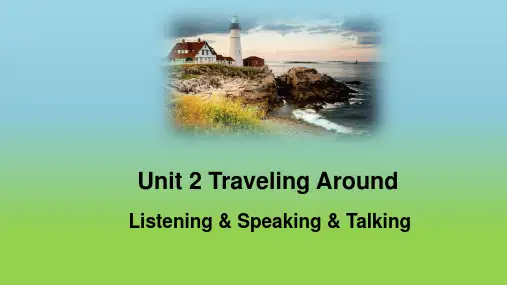
Get ready to travel Activity2: Discuss with your partners 1.If you have the chance to travel anywhere in the world, where will you go ?
(pick one in the following pictures)
the Eiffel Tower, France Lijiang, China
Tianshan, China
Neuschwanstein Castle, Germany n.城堡
Get ready to travel
Activity2: Discuss with your partners
2.What do you need to do to prepare for the trip?
C. the scenery.
2. What will Meilin do for the holiday?
A. having classes
B. going shopping
C. traveling
Activity4:
(2) Listen to the Conversation1 again to choose the correct answers.
You can collect information by answering the following questions:
• Where will you go? • Why is it famous? • Why do you like to go there? • When is the best time to go there?
Unit2GrammarFocus课件人教版英语九年级全册(完整版)2

1. 和or not连用
2.不定式前 I can’t decide whether to buy this book. I can’t decide whether to buy the blue one or the red one.
3.做discuss(讨论),consider(考虑)的宾语。 We discussed whether we should buy a car. 4.介词之后 I’m thinking of whether we should go fishing. We are worried about whether it will rain tomorrow.
8. He asks me when my birthday is
(be) .
He asked me when my birthday was
(be) .
当堂检测2
宾语从句:用__一__个__句__子____ 来充当宾语。
_t_h_a_t____(陈述句), 无__词__义__,可__省__略__ _引__导__词_ _i_f/_w__h_e_t_h_e_r_(一般疑问句), “_是__否__”
当堂检测2
4 . The teacher told us the sun rises
(rise) in the east .
5. Can you tell me what he did (do)yesterday .
6. We are sure that he will go
(go) to school
多么好的天气呀!
I believe that the Water Festival is the most fun. I wonder if the mooncakes are delicious.
高二英语人教版(2019)选择性必修第一册 课件 unit2 Grammar
1. Go over what we have learnt. 2. Finish the Ex.1-3 on workbook P69.
Thanks
4.星期五你可以在我的办公室开会。那会儿我不用它。 You can have a meeting in my office on Friday . I won't be using it. 5.明天上午你做什么? What will you be doing tomorrow morning? 6.不久我们就要造一部新计算器进行更高级的运算。 It won't be long before that we will be making a new computer for more advanced calculation. 7.今晚我不能参加聚会了。我要给一位朋友送行。 I can't go to the party tonight . I'll be seeing off a friend.
汉译英 1.我们在校门口见面。 We shall be meeting at the school gate. 2.接下来我们干什么? What shall we be doing next? 3.你如果不这样做就会面临很大的困难。 If you don't do so, you will be facing great difficulties.
一般将来时
将来进行时 5.Smart toilets will be keeping constant track of your health as well. 6.Your lights will come on the instant you enter the door along with your favorite music or TV programmes, and you will find your dinner already prepared for you. 一般将来时
高中英语Unit2EnglisharoundtheworldSectionⅢGrammar教案新人教版必修1
Section Ⅲ Grammar —直接引语和间接引语(Ⅱ)语法图解探究发现1.He said to Ann, “Tell me your problem.”→He told Ann to tell him her problem.2.David said to me, “Leave the room quietly.”→David ordered me to leave the room quietly.3.“Could you please arrive by 8:00?” she asked.→She asked me to arrive by 8:00.4.“Be careful with the dog, boys,” she said.→She warned the boy s to be careful with the dog.5.“Don't work in bed, Tom,” she said.→She told Tom not to work in bed.[我的发现]如果直接引语为祈使句,变为间接引语时,通常采用“动词+宾语+不定式”结构。
常见的引述动词有tell, order, ask, warn,如句1~4。
如果转述的祈使句为否定式,则在不定式前加not,如句5。
一、祈使句变间接引语如果直接引语是表示命令、建议或提议、请求、警告或提醒的祈使句,变为间接引语时通常要将祈使句的动词原形变成带to的不定式,并在不定式前根据句意以及说话者当时的语气或态度加上ask, tell, order, suggest, advise, beg, warn, remind, invite, request, command, encourage等动词。
1.表示命令的祈使句引述表示命令的祈使句,变间接引语时常采用ask/tell/order sb. to do sth.的形式。
高中英语 新人教版必修一Unit 2 Travelling Around: Grammar+Writing 课件
(Ⅱ)Preparation for writing—Words and phrases
①_t_a_k_e_a_d_v_a_n_t_a_g_e_o_f_ 利用 ③____ta_k_e_a__to_u_r_____ 游览 发 a seven-day trip
ቤተ መጻሕፍቲ ባይዱ
②___a_s__fo_l_lo_w_s______ 如下 s④et_o_u_t_/o_f_f __________ 出
Ⅱ. While-writing 假设你是王明,寒假即将来临,你打算和家人去上海玩。请你给你的
好友李华写一封e-mail, 分享你的出行计划。 要点:1.元月21日下午2点左右从醴陵坐高铁去上海,到上海后入住
预订酒店,休息一晚。 2.第二天进上海迪士尼乐园游玩,体验各种游乐设施,购买纪念品。 3.第三天上午参观上海科技馆,下午登东方之珠,欣赏上海全貌。 4.元月24日乘坐高铁返回。
• 语言能力:
主题: 旅行
• 词汇: castle, apply, rent, pack, amazing, arrangement…
• 语法: 理解并正确运用现在进行时表示将来的计划。
• 学习能力:通过浏览文本的标题,图片辨别文本类型,培养阅读策略。
• 文化意识:了解中国和秘鲁等国家的著名景点和文化特色,培养爱国情怀;
Learning more 知识拓展
• There is not a person in the world who is given the advantage of travel who does not return changed.
• There are no foreign lands. • It is the traveller only who is foreign.
新人教版必修一 Unit 2 English around the world全单元[教案]
Teaching planTeaching aims:1. Get the students to learn different reading skills.2. Get the students to learn about the English language.Teaching important points:1. Develop the students reading ability and let them learn to use some reading strategies such as skimming, scanning, and so on.2.Enable the students to learn about English language and know different kinds of English so as to communicate with people from different countries.Teaching difficult points:Develop the students’ readi ng ability.Teaching methods :Task-based teaching and learningUnit 2English around the world知识目标:本单元需要学习的重点单词为:include role international native elevator flat apartment rubber petrol gas modern culture AD actually present(adj. )rule(v. ) vocabulary usage identity government Singapore Malaysia rapidly phrase candy lorry command request retell polite boss standard Midwestern southern Spanish eastern southeastern northwestern recognize accent lightning direction ma’am subway block本单元需要学习的重点词组为:play a role in because of come up such as play a part(in) 本单元需要学习的重点句型为:1. World English comes from those countries, where English plays an important role as a first or second language, either because of foreign rule or because of its special role as an international language. (the Attributive Clause; either. . . or. . . )2. Native English speakers can understand each other even if they don’t speak the same kind of English. (even if. . . )3. It became less like German, and more like French because those who ruled England at that time spoke French. (those who. . . )4. Today the number of people learning English in China is increasing rapidly. (the number of+ n. 作主语时,谓语动词用单数形式)5. Believe it or not, there is no such a thing as standard English. (Believe it or not, . . . )6. The US is a large country in which many different dialects are spoken. (the Attributive Clause)7. In fact, an English dictionary like the kind you use today wasn’t made until the time of the Qing Dynasty. (the Attributive Clause; not. . . until. . . )8. These men spent nearly all of their lives trying to collect words for their dictionaries. (spend. . . in doing sth. )9. At the age of fourteen, he left his village school in Scotland and taught himself while working ina bank. (while doing. . . )10. We know that languages develop and change over time and that is why we have new dictionaries from time to time. (that is why. . . )本单元需要掌握的交际功能用语为:语言交际困难(Difficulties in language communication) Pardon?I beg your pardon?I don’t understand.Could you say that again please?Sorry, I can’t follow you.Could you repeat that, please?Could you speak more slowly, please?How do you spell it, please?本单元需要掌握的语法为:祈使句及其间接引语(the imperative sentence and its indirect speech)1. 要求或命令(demands or orders)“Open the door, ” told he.→He told/ordered me to open the door.2. 请求(requests)He said, “Please open the door. /Would you please open the door? ”→He asked me to open the door.能力目标:1. 能运用所学语言知识谈论有关“世界英语”方面的话题。
2019统编人教版高中英语必修第一册unit 2《Travelling around》全单元教案教学设计
【2019统编版】人教版高中英语必修第一册Unit 2全单元备课教案教学设计Period 1 Listening Speaking&Talking教学目标与核心素养:1. Instruct students to get main facts by listening and motivate them to talk about the topics about how to prepare for the trip and make reservations by listening and ultimately can make travel arrangements and reservations.2. Develop students’ sense of cooperativ e learning and individual thinking capability.3. Develop students’ different listening skills to solve different listening comprehensive problems.4. Help students to understand how to use the structures “the present continuous tense (be doing) is used to express future plans.教学重难点:1. Teach students how to focus on key words, not on single words or grammar.2. Prompt Ss to talk about the related topics, such as how to prepare for the trip and make a travel plan.教学过程:Part 1: Listening and SpeakingLead inThe teacher is advised to talk with their students about the places that they want to travel most both at home and abroad: boys and girls, if you have a chance to travel around the world, where will you go? After their small talk, the teacher can move on by finishing the following listening task:Before travelling, what do we need to prepare for the trip?After finishing the task above, the teacher is expected to play conversation 1 which is about Paul and Meilin’s conversation about coming holiday and after finishing listening for the first time, the studentsneed to solve the following task.1.Circle the two places Meilin is going to for holiday.A. Germany. B. England. C. Iceland. D. France.2. How is she going to get there?A. By sea.B. By air. C .By train.3 How is she planning to get around after she arrives?A .By car. B. By train. C. On foot.Listening tip:After finishing the task above, the teacher is expected to play conversation 2 which is about where and why Paul is visiting with his family and after finishing listening, the students need to solve the following task.Listen to Conversation 2. Then answer the following questions:1.Where is Paul's family going over the holiday?2. Why are they going there?After finishing the task above, the teacher is expected to play conversation 3 which contains the whole conversation and solve the following task.Fill in the table below:Finally, after finishing the task above, the teacher is expected to instruct students to work in groups to finish the following project: Speaking ProjectWork In pairs. Choose a travel destination and discuss how to prepare for the tripPart 2: Listening and Talking:The teacher is advised to talk with their new students about the related topic: Boys and girls, do you know how to make reservations for a trip? Let’s listen and find out:Play the listening and answer the following questions:1.What are the two speakers talking about?2.What is the relationship between the two speakers?2 Listen again and complete the table with the words you hear.Making reservationsOpening:Talking about timeTalking about what you prefer:Other informationPaymentTalking projectWork in groups.Imagine you are making plans for the holiday. Choose one of the situations below and role-play a phone call with a partner.Booking air tickets Booking a hotel room Booking a table for dinnerPeriod 2 Reading and Thinking教学目标与核心素养:1. Enable students to acquire the basic usage of the new words and expressions concerning the topic of traveling and learn to use them flexibly.2. Enable students to sum up some details related to Peru.3. Develop students’ sense of cooperative learning and individual thinking capability.4. Develop students’ different learning skills to solve different reading comprehensive problems, such as skimming, scanning and inferring.教学重难点:1. Develop students’ reading ability such as skimming, scanning and summarizing.2. Let students talk about their travel plans and topics about travelling.教学过程:1. Before readingStep 1 warming upHave a free talk with students. Ask them the following question:How much do you know about Peru? Let’s have a quiz. Show the quiz on the screen.Step2 Pre-readingPrediction:1. What types of text is the passage?2. Let students guess what the text will be mainly about before reading by looking at the picture and the title.Step3: Reading1. Fast readingAsk students to skim the reading passage to find out some main details about Peru as quickly as possible by doing the multiple choice test.1. Peru lies on the _________ coast of South America.A. PacificB. AtlanticC. ArcticD. India2. How many years did Spain control Peru about?_________A.1400.B.1500.C.300.D.100.3. How will you get the center of forest if you visit Amazon Rainforest?A. By air.B. By seaC. On foot.D. By car.4. If you want to enjoy stone buildings, which tour should you take?A. Amazon Rainforest TourB. Machu Picchu TourC. Cusco Tour D Lake Titicaca Tour5. Where is your accommodation while visiting Lake Titicaca?A. Local hotel.B. Visitor center.C. Stone building.D. Local home.2. Intensive readingAllow students to read the passage more carefully this time to sum up the features of each scenic spot.Step 4: Further Reading and discussionRead the text the third time and work in pairs to do the following task.Suppose you are a travel agent, and the following people want a package trip to Peru and ask for your advice. Please recommend them the destination according to their interest.Good expressions that students can choose to use: help the travelers choose which tour to take1. Mike, a well -paid photographer, who has great interest in adventuring and exploration. He hopes to have an active holiday and shoot some pictures of different kinds of animals. He doesn’t need first class accommodation.2. Bill is a reporter, who not only enjoys learning about the culture and lifestyle of the country, but also likes admiring beautiful scenery. He needs to make a report about the local people’s life of this country.3. Tom, a hiking lover, hopes to spend some days hiking while enjoying the beautiful natural scenery.4. Mary, a designer, is planning to make a trip to a place, where she can enjoy the different architecture of this country and some excellent food. She also likes going shopping.1.In my opinion, you could/might choose…, because you prefer to…2.Could be a perfect choice for you, for…3.As far as I am concerned, you would enjoy…, for…4.Would probably suit you, because you enjoys/ love/hate doing…Step 5: Passage ConsolidationLanguage appreciation:• 1. You can then spend three days exploring the rainforest with a local guide and enjoying the plants and animals unique to the rainforest.•[句式分析] 本句主体结构为spend some time doing sth.•exploring the rainforest 与_____________________为并列结构;____________作方式状语; unique to the rainforest为形容词短语作定语修饰____________•[尝试翻译]在接下来的三天里,您可以在当地导游的陪同下,深人雨林进行探索,欣赏雨林特有的动植物。