
初中英语外研版七年级下册Module4 Life in the future单元练习
初中英语外研版七年级下册Module4 Life in the future单元练习一、听力(听力)(共20小题;共20分)听力选择(共20小题,计20分)(一)录音中有五个句子,每个句子听一遍,然后从每小题A、B、C中选出适合每个句子的答语。
1. A. If you do, you'll be sorry. B. You're lucky.C. Thanks a lot.2. A. My teacher will be happy.B. My mother will be angry.C. At 9:00 p.m.3. A. She was cooking. B. She goes shopping. C. She is going to swim.4. A. It's a good idea. B. No, I didn't. C. Sure, I'd love to.5. A. Why not? B. Sorry, I won't. C. Of course.(二)录音中有五组对话,每组对话听一遍,然后从每小题A、B、C中选出能回答每个问题的正确答案。
6. When does Betty want to have a party?A. This afternoon.B. This evening.C. Tomorrow morning.7. How does the girl want to go to the movies?A. By bus.B. By bike.C. By taxi.8. What does John think of Kate's jeans?A. Beautiful.B. Ugly.C. Dirty.9. Who will Mr. Green call?A. Lucy.B. Lucy's parents.C. Mrs. Green.10. What will Lily bring here tomorrow?A. Some drinks.B. Some snacks.C. Some flowers.(三)录音中有一段对话,听对话两遍,然后从每小题A、B、C中选出能回答每个问题的正确答案。
11. What does Ben like?A. Skating.B. Swimming.C. Fishing.12. Where is Today Beach?A. Near Ben's house.B. Near Kate's house.C. Near Tim's house.13. When did Kate go to Today Beach?A. Last spring.B. Last summer.C. Last autumn.14. Who is Linda?A. Ben's sister.B. Kate's sister.C. Tim's cousin.15. How many people will go to Today Beach this summer?A. Two.B. Three.C. Four.(四)录音中有一篇短文,听短文两遍,然后从每小题A、B、C中选出能回答每个问题的正确答案。
16. Where does Bob live?A. In a small village.B. In a big city.C. In a small city.17. What time does Bob get up every morning?A. At 5:30.B. At 6:00.C. At 6:30.18. Where does Bob eat breakfast?A. In the bus.B. In the train.C. In his company.19. How long does Bob stay in the train on his way to work?A. Half an hour.B. An hour.C. One and a half hours.20. How does Bob go to his company from the train station?A. By bicycle.B. By taxi.C. On foot.二、单项选择(共10小题;共10分)( ) 21. —Will there be schools in the future?—_______ But they will be quite different from ones today.A. Yes, there is.B. Yes, there will.C. No, there won’t.D. No, there isn’t. ( ) 22. The students will ______ their homework to the teachers by email.A. sendB. sendsC. writeD. writes( ) 23. Many writers don’t write ______ pens. They often use computers.A. onB. useC. withD. by( ) 24. —Who uses calculators in your class? —No one _______ it in our class.A. useB. will useC. usingD. uses ( ) 25. Martin likes rain, and he likes sunny weather .A. in peaceB. as wellC. in the endD. from now on( ) 26. The radio says that there will be ______ winds and ______ rain next week.A. strong; heavyB. small; heavyC. heavy; largeD. strong; large( ) 27. —_______ will the students go to school in the future? —Three days a week.A. How manyB. How longC. How oftenD. How much ( ) 28. In the future, everyone will have a car, _______ we will go to work by car.A. orB. soC. butD. because ( ) 29. What do you think the weather _______ in 100 years?A. will likeB. likeC. likesD. will be like( ) 30. We can use the sun energy (能量) ______ the machines ________.A. make; workB. to make; workC. make; to workD. to make; to work.31 Ben goes to work and his sister gets to work .A. by car; on her bikeB. by a car; on her bikeC. by cars; by bikesD. by his car; by bike32 Take it easy. I am sure you work it out soon.A. will canB. will be able to三、单词拼写(单句首字母填空)(共10小题;共10分)31. I didn't have much money, so I decided to buy a c one.32. The washing m seems to have broken down again, so I have to wash the clothes by hand.33. The box is so h that I can't carry it.34. --- Oh, Vera, you are late again.--- I'm sorry. But the t is very busy this morning.35. My friend is David, I often call him Dave for s .36. Students n to study hard.37. Today I am busy. But tomorrow I will be f .38. We have looked for Jim e , but we can't find him anywhere.39. It's e for me to answer the question.40. We need two more students to help me c these heavy bags.Ⅱ. 完形填空。
(每小题1分,共10分)I’d like to tell you about my dream classroom. In the future, my classroom will be very 31 , so we can do lots of activities in the classroom. In summer, it will be 32 and in winter it will be warm, so it will be 33 . There 34 a beautiful garden in front of it. We can see many trees and flowers in it. There will be a cable TV in our classroom and we can 35 it at noon. Everyone will have a 36 on the desk, so we can download information 37 the Internet. The lessons will be interesting. We 38 use pens or pencils. We will use computers 39 our homework. The teachers won’t use 40 to write on the blackboard. They will teach the lessons with the help of the computer.( ) 31. A. big B. long C. small D. short( ) 32. A. cold B. warm C. hot D. cool( ) 33. A. dull B. comfortable C. boring D. uncomfortable( ) 34. A. will be B. will have C. is going to have D. are going to be( ) 35. A. see B. watch C. look D. look at( ) 36. A. radio B. phone C. calculator D. computer( ) 37. A. in B. near C. at D. from( ) 38. A. will B. can C. won’t D. don’t( ) 39. A. to do B. do C. doing D. does( ) 40. A. pens B. chalks C. pencils D. computers七、阅读理解(共20小题;共40分)AThe future is coming! All over the world there are new ideas(想法) for new places to live and work in. Some of them will be in the sea! They will be very big and lots of people will live and work in them. The Americans are planning to build a town called Atlantis City. It will be in the sea, about five miles away from the land. But the most exciting idea comes from Japan. It is called Aeropolis. Aeropolis will be a huge sea city, with parks, schools, a hospital and an airport… and it will move! It will travel slowly around the world. There are just two problems. Aeropolis will cost(花费) a lot of money to make. And for people who get seasick( 晕船), it won't be much fun.66. Which country will plan to build a town in the sea?A. USAB. EnglandC. China67. What's the name of Japanese Sea city?A. AtlantisB. AeropolisC. Tokyo68. What does the underlined word “huge” mea n?A. very smallB. very longC. very big69. “Aeropolis will cost a lot of money to make” means .A. Aeropolis will be very cheap to buildB. People will spend much money to build “Aeropolis”C. It will take little money to build “Aeropolis”70. Which of the following is true?A. Sea cities will be holiday townsB. Sea cities will be very bigC. There are already two sea citiesBIn England, people often talk about the weather because they can experience four seasons in one day. In the morning the weather is warm just like in spring. An hour later black clouds come and then it rains hard. The weather gets a little cold. In the late afternoon, the sky will be clear, the sun will begin to shine, and it will be sunny at this time of the day.In England, people can also have summer in winter, or have winter in summer. So in winter they can swim sometimes, and in summer sometimes they should take warm clothes.When you go to England, you will see that some English people usually take an umbrella(伞) or a raincoat with them in the sunny morning, but you should not laugh at them. If you don't take an umbrella or a raincoat, you will regret(后悔) later in the day.71. The best title(标题) for this passage is .A. Bad SeasonsB. Summer or WinterC. The Weather in EnglandD. Strange English People72. From the story we know that when come, there is a heavy rain.A. sunshine and snowB. black cloudsC. summer and winteD. spring and autumn73. "People can also have summer in winter." means "It is sometimes too in winter."A. warmB. coolC. coldD. rainy74. What do English people often take?A. A stick.B. A raincoat.C. Clothes.D. A cooker.75. Why do people in England often talk about the weather?A. Because they like the weather.B. Because they may experience four seasons in one day.C. Because they often need rainy weather.D. Because they want to be weather worker.COne day a lawyer's wife fell ill. The lawyer went to get a doctor. The doctor knew that the lawyer was famous for not paying bills. So he said to the lawyer before he entered the house, "If I do cure your wife, I am afraid you may not pay me.""Sir," replied the lawyer, "here is $500. Whether you cure(治愈) my wife or you kill her, I will give you all this."The doctor believed him and went into the house. When he reached the woman's bedside, it soon became clear to him that he could do little. She was seriously(严重) ill. Though he gave her some medicine, she soon died.He told the lawyer he was very sorry, and he asked for the money which he had been promised(答应)."Did you kill my wife?" asked the lawyer."Of course I didn't." said the doctor."Well, then," said the lawyer, "since you neither killed her nor cured her, I have nothing to pay you."76. Before entering the house, the doctor .A. was afraid he couldn't cure the lawyer's wifeB. asked the lawyer for 500 dollarsC. didn't know if the lawyer would keep his wordsD. was reassured(使消除疑虑) by the lawyer77. Because the lawyer's wife was badly ill, the doctor .A. did nothing for herB. spent a lot of timeC. found it impossible to cure herD. didn't examine her at all78. After the lawyer's wife died, the doctor got .A. his pay as the lawyer had promisedB. nothing but the money for medicineC. $500D. no money at all79. If the doctor had cured the lawyer's wife, he would have got .A. more than $50B. nothingC. the paymentD. a little money80. The best little of the passage is .A. The Lawyer and His WifeB. A Good Doctor and a Poor LawyerC. The Lawyer's TrickD. A Serious Illness答案一、听力(听力)1. A2. B3. C4. C5. B6. B7. B8. A9. B 10. C11. B 12. A 13. B 14. B 15. C16. C 17. A 18. B 19. B 20. C听力原文一、听力选择(一)录音中有五个句子,每个句子听一遍,然后从每小题A、B、C中选出适合每个句子的答语。
初一七年级英语下册外研版Module 4 Life in the future 教案
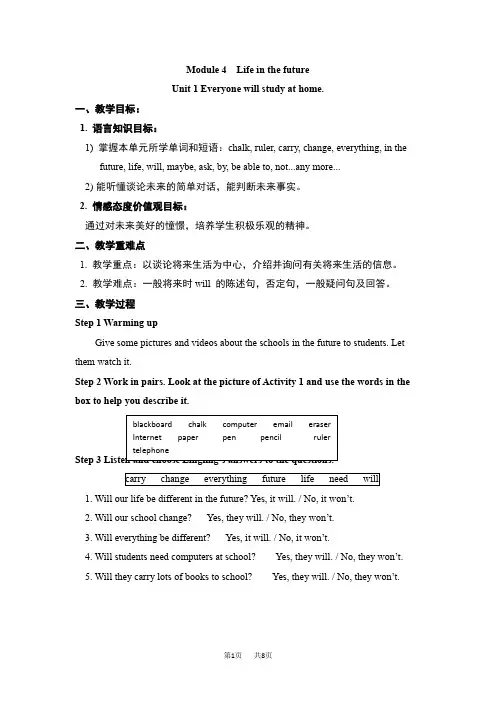
Module 4 Life in the futureUnit 1 Everyone will study at home.一、教学目标:1. 语言知识目标:1) 掌握本单元所学单词和短语:chalk, ruler, carry, change, everything, in thefuture, life, will, maybe, ask, by, be able to, not...any more...2)能听懂谈论未来的简单对话,能判断未来事实。
2. 情感态度价值观目标:通过对未来美好的憧憬,培养学生积极乐观的精神。
二、教学重难点1. 教学重点:以谈论将来生活为中心,介绍并询问有关将来生活的信息。
2. 教学难点:一般将来时will 的陈述句,否定句,一般疑问句及回答。
三、教学过程Step 1 Warming upGive some pictures and videos about the schools in the future to students. Let them watch it.Step 2 Work in pairs. Look at the picture of Activity 1 and use the words in the box to help you describe it.1. Will our life be different in the future? Yes, it will. / No, it won’t.2. Will our school change? Yes, they will. / No, they won’t.3. Will everything be different? Yes, it will. / No, it won’t.4. Will students need computers at school? Yes, they will. / No, they won’t.5. Will they carry lots of books to school? Yes, they will. / No, they won’t.Step 4 Listen and read. Then let the students do Activity 3.Step5 Complete the passage of the Activity 4Betty: We’ll always (1) _____ teachers because computers will never be (2) _____ to check the students’ (3) ______ and answer their (4) _____ by (5) _____orInternet. Will students need to go to school (6) _____? Yes, (7) _____they will, because school is good fun, but everyone will have lots of(8) ______ time.Step6 Work in pairs. Ask and answer the questions.1. Will schools be different in the future?2. Will students use books in the future?Step7 Work in pairs. Talk about what your school will be like in ten years.— We will study at home and only go to school for sports and games.— Well, this is good, but I’ll miss my teachers and friends.Step8 Language Points1. In 20 year’s time, maybe there won’t be any schools.句中的“in +一段时间” 表示“一段时间之后”,常用于将来时。
外研版初中英语七年级下册教案:Module4 Life in the future
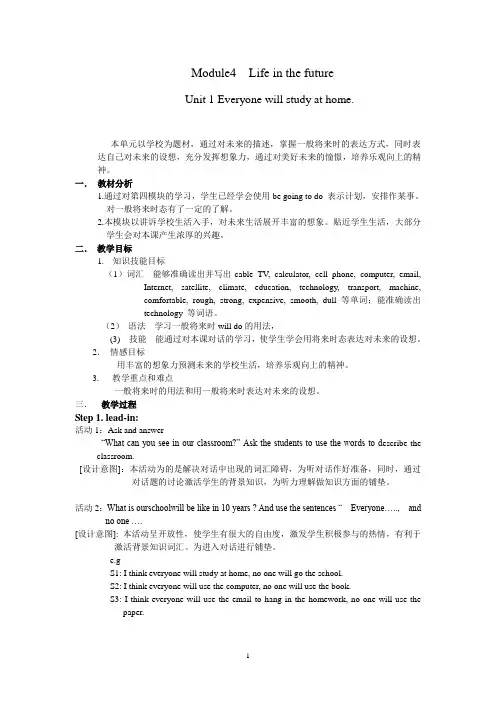
Module4 Life in the futureUnit 1 Everyone will study at home.本单元以学校为题材,通过对未来的描述,掌握一般将来时的表达方式,同时表达自己对未来的设想,充分发挥想象力,通过对美好未来的憧憬,培养乐观向上的精神。
一.教材分析1.通过对第四模块的学习,学生已经学会使用be going to do 表示计划,安排作某事。
对一般将来时态有了一定的了解。
2.本模块以讲诉学校生活入手,对未来生活展开丰富的想象。
贴近学生生活,大部分学生会对本课产生浓厚的兴趣。
二.教学目标1.知识技能目标(1)词汇能够准确读出并写出cable TV, calculator, cell phone, computer, email, Internet, satellite, climate, education, technology, transport, machine,comfortable, rough, strong, expensive, smooth, dull 等单词;能准确读出technology 等词语。
(2)语法学习一般将来时will do的用法,(3) 技能能通过对本课对话的学习,使学生学会用将来时态表达对未来的设想。
2.情感目标用丰富的想象力预测未来的学校生活,培养乐观向上的精神。
3. 教学重点和难点一般将来时的用法和用一般将来时表达对未来的设想。
三.教学过程Step 1. lead-in:活动1:Ask and answer“What can you see in our classroom?” Ask the students to use the words to d escribe the classroom.[设计意图]:本活动为的是解决对话中出现的词汇障碍,为听对话作好准备,同时,通过对话题的讨论激活学生的背景知识,为听力理解做知识方面的铺垫。
外研版七年级下册 Unit 4 Life in the future PPT课件
语法讲解: 一般将来时 will+动词原形
思考如何翻译?
将来每个桌子上都会有一台电脑。
There will be a computer on every desk in the future.
将来每个桌子上不会有一台电脑。
There will not be a computer on every desk in the future.
A. is
B. is going to have
C. will have D. is going to be
5. ---Mom, when can I go out to play football?
---Finish your homework first, or I ___C_____let you go out.
D. is going to be
(2). Look at the dark clouds. It _________D_______ rain.
A. will
B. is going to be C. will be D. is going to
14
语法讲解: 一般将来时 will +动词原形
4. be going to+动词原形和 will+动词原形的辨析: (1). 纯粹的将来的客观事实,不表明计划打算,用will+动词原形。 (2). 有迹象表明将会发生某事,用be going to+动词原形。
20
词汇讲解 need: v. 需要 need sth: 需要某物 e.g. I need some money to buy snacks. need to do sth: 需要做某事 e.g. I need do my homework right now.
外研版英语七年级(下) Module 4 .Life in the future
外研版英语七年级(下)Module 4 .Life in the future一.重点短语句型归纳。
1.in the future 将来in future 从今以后2.study at home 在家学习3. on the Internet 在网络上4.be able to 能、会5 .free time 空闲时间 6.as well 也﹙肯定句句末,前面无逗号﹚e true 实现8. all year﹙around﹚整年9.by email 通过电子邮件10.ask a question 问问题11.the change of weather天气的变化12.do light and easy work 做轻松简单的工作13、chalk、paper为不可数名词 a piece of+ chalk/paper 一支粉笔/一张纸14、in twenty years’time= in twenty years 在二十年后in +段时间,句子用一般将来时,用How soon提问15、use ... to do sth 使用...做某事use computer to get information16、get information on the Internet 从网上获得信息17. on the Internet 在网上18、by Internet 通过网络by telephone 通过电话方式by +交通工具单数乘坐by bus 乘公共汽车19、be able to do=can 能够做…20、not ...any more=no...more 不再...21、answer one’s question 回答某人的问题the answer to the question 问题的答案22、need to do sth 需要做某事need sth 需要…此时need是实义动词,有形式变need 做情态动词用时,后接动词原形,无形式变化。
2019-2020年七年级英语下册 Module 4 Life in the future全模块教案 外研版
2019-2020年七年级英语下册 Module 4 Life in the future全模块教案外研版一、教学内容分析本模块以未来的教室及学习为切入点,谈论将来我们生活的各个方面,学生较为有兴趣,便于展开活动。
Unit1的主要内容是涉及一些有关于教室和科学方面的名词,一篇出现了将来时的听力、一段有关未来教室的对话以及相关的几个训练活动,在这个过程中学习和掌握一般将来时WILL+动词原形的陈述,一般疑问句及问答,及否定句。
二、学生情况分析本模块以学生心目中的未来教室为话题,这与学生的现实生活密切相关,他们有话可说,乐于参与课堂活动,而涉及的语法项目是一般将来时will 的陈述句,否定句,一般疑问句及回答,动词不用任何的变化,学生应该较为容易掌握。
三、教学目标1.能够正确理解有关未来学校的对话。
2.能够听懂有关未来生活的简单对话。
3.能够用一般疑问句正确问答有关将来的信息。
四、教学重点和难点1.词汇的正确运用。
2.一般将来时will 的陈述句,否定句,一般疑问句及回答五、教学策略任务型教学、自主学习、合作学习六、教学手段磁带,图片七、教学过程Step 1 . Everyday EnglishWhat day is it today?What do you do today?What are you going to do tomorrow?……Step2.Warm-upT: What will you do at this weekend?S: I will do my homework at this weekend..T: Will you play the piano this afternoon?S: Yes, I will /No, I will not.………Like this, ask the students to work in pairs to review the future tense.Step2. PresentationT: What will you do at this weekend?Help the students answer: I will play games at this weekend.(用be going to+do引出will+do,使同学们在很自然的复习语境中导入到新课)Ask the students to work in pairs to practice will+do.Step3.Vocabulary(1) Use the pictures to teach the new words :cable, , cell phone, , paper, ruler, satellite TV.(2)guessing games :What do you use to learn math and science ? calculatorWhat do I use to teach English? chalk(3)Let students repeat the words loudly.(创设情景教单词,使学生自然地掌握了单词的读音和用法。
外研社英语七年级下第四模块课文内容

Module4 Life in the futureUnit1 Everyone will study at home。
Ms Li:Will schools be different in the future, Daming?Daming:Yes,they will!In twenty years’ time, maybe there won’t be any schools!Ms Li:How will students learn then?Daming:Everyone will study at home. Students will use computers and get information on the Internet。
They can ask their teachers questions by Internet, telephone or email.Betty:Well, I’m not sure。
Yes, students will use computers, but school is good fun, and you can make friends there。
And teachers can check the students' level and will help them.Computers won’t be able to do that.Tony:Yes,teachers won't use chalk on a blackboard and students won’t use pens and paper, or erasers any more.Lingling: Great!Will students have a lot of homework to do?Tony: No, they won’t。
They'll have a lot of free time.Lingling: That’ll be great!Questions:1。
外研版新版七年级下Module-4-Life-in-the-future词汇语法课-
面孔二: will do 1. 根据计划或安排要做某事。
Will you see a film tomorrow evening? 明晚你打算看场电影吗? 2. 表示不以人的意志为转移的客观规 律,即注定要发生的事情。 Tomorrow will be my birthday. 明天是我的生日。
3. 表示不以人的意志为转移的客观规律, 也 可用一般现在时代替一般将来时。 Next Sunday is Women’s Day. 下周日是三八妇女节。
面孔四: 现在进行时代替一般将来时 come, go, leave, arrive, start 等动词 也可用现在进行时代替一般将来时。
He is coming here next Sunday. 下周日他将来这儿。 When are you leaving? 你什么时候动身?
3. Everyone will have a small car. (对划线部分提问) _W__h_o_w__il_l have a small car?
4. Flying in planes will be cheap. (用expensive改为选择疑问句) _W__il_l flying in planes be cheap _o_r_e_x_p_e_n_s_iv_e__?
面孔三: 一般现在时代替一般将来时 1. hope, wish, want等表“想要,希望”
的词汇无一般将来时,应用一般现 在时代替一般将来时。 I hope to see you again. 我希望再次见到你。 I want to get your help. 我想得到你的帮助。
外研版七年级英语下册Module 4 Life in the future精品课件
2. –________ you ____D____ free tomorrow?
– No. I ________ free the day after tomorrow.
A. Are; going to; will B. Are; going to be; will
C. Are; going to; will be D. Are; going to be; will be
一般将来时的构成
一般将来时表示将来发生的动作或存在的状态 助动 词will + 动词原形
肯定式: 主语+will+动词原形+其他组卷网
否定式: 主语+will+not+动词原形+其他. 疑问式: Will+主语+动词原形+其他 简略回答: (肯) Yes,主语+will .
(否) No,主语+will+not .
▪ 11、一个好的教师,是一个懂得心理学和教育学的人。2021/7/292021/7/292021/7/29Jul-2129-Jul-21
▪ 12、要记住,你不仅是教课的教师,也是学生的教育者,生活的导师和道德的引路人。2021/7/292021/7/292021/7/29Thursday, July 29, 2021
Module 4 Life in the future
Unit 1 Everyone will study at home.
一般将来时 will
详见课本P94----95学组卷网
科网
(Simple Future Tense )
一般将来时表示将来某一时刻的动作或状态, 或将来某一段时间内经常的动作或状态。
外研版七年级英语下册 精品课件 Module 4 Life in the future(共110张PPT)
Tony writes a passage about the life in the future. Listen and answer these two questions. 1.What will the clothes be like in the future? 2.Who will do all the heavy and difficult jobs in the future?
句中的 “in + 一段时间”表示“一段时间 之后”,常用于将来时。可以用 how soon 来提问。例如: — How soon will you be back? 你多久回来? — In a week. 一个月之后。
They can ask their teachers questions by Internet, telephone or email. 他们可以通过互联网、电话或电子邮件 向老师提问。 句中的 “by”表示方式,意 思是“用……,靠……,通 过……”。 例如: Send it by air mail. 用航空邮件寄吧。 They want to travel by train. 他们想坐火车旅行。
重难点讲解
¤ Well, I’m not sure. 喔,我不确定。 ¤ That’ll be great! 那太棒了!
more 是形容词 many 和 much “多的” 的比较级。意为“更多的”,即: many — more 多的 更多的
much — more 多的 更多的
如: many books — more books much milk — more milk
Now Tony and his kids are talking about the future in class too. Listen and answer these two questions. 1.Where will students study in the future? 2.Will students have a lot of homework to do in the future?
外研版七年级英语下册 Module 4 Life in the+future专题讲解(有答案)
外研版英语七年级下册Module4 Life in the future专题讲解Name:__________________本单元提纲1. 主题功能:能够谈论未来的生活2. 重点单词:change, ask, traffic, cheap, heavy, hour 等。
3. 重点短语:in the future, not...any more, on the internet, come true, heavy rain 等。
4. 核心句型:Will school be different in the future?Everyone will study at home.等。
语法结构:will结构的一般将来时重难点精讲Will school be different in the future?将来学校会不一样吗?本句是一般将来时的一般疑问句,结构为“will+主语+动词原形+其它?”。
该句式的答语有两种形式:肯定回答Yes,主语+will否定回答No,主语+won’t一般将来时表示的是未来的事情或者是对将来的预测,will没有人称和数的变化。
如果表示将来不会,就要用will not或者缩写成won’t。
题一:翻译:那边将会有一个大型的公园。
将来每张桌子上都会有一台电脑。
我想人人都将用电脑学习。
他们将不用课本。
学校里会有电脑吗?In the future意为“将来,未来”。
in the future 意为“将来”in future 意为“今后,以后”,相当于from now onIn twenty years’ time, maybe there won’t be any schools.在20年后,也许将不会有任何学校。
in twenty years’ time意为“在20年后”,其中years’是名词所有格结构。
在一般将来时中,“in+时间段”表示“在一段时间之后”。
题二:翻译:谁知道将来会发生什么事情?今后多注意你的拼写。