
PEP三年级英语上册 第四单元(含听力材料)
PEP小学三年级上册英语单元作业(四)
Listening Part(听力部分)
I. Listen and number.(根据你听到的内容给下面的图片排列顺序)
( ) ( ) ( ) ( )
( ) ( ) ( ) ( )
II. Listen and tick.(根据听到的内容,判断与图片所表达的意思是否一致)
( ) ( ) ( )
( ) ( ) ( ) ( )
III. Listen and tick.(根据你听到的内容,选出恰当的图片,在图片下面的括号里划对号)
1. 2.
()()( ) ( )
3. 4.
()()( ) ( )
5. 6.
()()( ) ( )
7. 8.
()()( ) ( )
9. 10.
()()( ) ( ) IV. Listen and circle.(听音,圈出单词的首字母。
)
1. 2.
g j l n
3. 4.
k c n m
5. 6.
l n d m
V. Listen and circle.(听音,圈出你所听到的字母或单词)
1. KFC ABC CEO
2. CBA BBC CMC
3. JAN GEB KBC
4. HAB MAN NBA
5. monkey bird elephant
6. cat pig dog
7. bird duck pig
8. bear bird tiger
9. tiger bear panda
10. duck cat tiger
Writing Part (笔试部分)
I. Read and number.(读单词,给图片排列顺序)
1. duck
2. pig
3. cat
4. bear
5. dog
6. elephant
7. monkey
8. bird
9. tiger 10. panda
( ) ( ) ( ) ( ) ( )
( ) ( ) ( ) ( ) ( ) II. Read and write.(读一读。
写出下列字母的大写或小写形式。
)
A D F
b c e g
H I K M N
j l
III. Read and choose.(读一读,选出每组中不同类的单词)
( ) 1. A. pig B. dog C. bag
( ) 2. A. cat B. duck C. book
( ) 3. A. blue B. bear C. bird
( ) 4. A. monkey B. nose C. mouth
( ) 5. A. elephant B. orange C. tiger
( ) 6. A. panda B. bear C. pencil
( ) 7. A. leg B. bag C. book
( ) 8. A. foot B. face C. bird
附:听力材料
I. Listen and number.(根据你听到的内容给下面的图片排列顺序)
1.—What’s this?
--It’s a dog.
2. --What’s that?
--It’s a bear.
3. --What’s this?
-- It’s a bird.
4. --It’s a panda. I like it.
--Thanks.
5. –what’s that?
--It’s an elephant.
--Cool! I like it.
6.Look! I have a monkey.
7. –What’s this?
-- It’s a pig.
8.-- What’s that?
-- Oh! It’s Zoom.
II. Listen and tick.(根据听到的内容,判断与图片所表达的意思是否一致)
1.Act like a pig.
2. Act like a bird.
3. Act like a tiger.
4. Act like a dog.
5. Act like a panda.
6. I have a elephant.
7. I have a monkey.
III. Listen and tick.(根据你听到的内容,选出恰当的图片,在图片下面的括号里划对号)
1. --What’s this? --It’s a pig.
2. – Look! A tiger.
3. I have a duck.
4. This is a cat.
5. --What’s that? --It’s a bear.
6. –What’s this? --It’s a monkey.
7. I have a panda.
8. Look! This is a cat.
9. --What’s that? --It’s a tiger.
10. Oh! It’s a bird. I like it.
IV. Listen and circle.(听音,圈出单词的首字母。
)
1. jeep
2. leg
3. kite
4. milk
5. nose
6. monkey
V. Listen and circle.(听音,圈出你所听到的字母或单词)
1. KFC
2. BBC
3. KBC
4. NBA
5. monkey
6. pig
7. duck
8. bear
9. panda 10. cat。
新版PEP三年级英语上册第四单元测试题(附听力材料)

新PEP小学英语三年级上册单元测试题Unit 4 We love animals学校姓名班级评分Listening Part听力部分(60分)一Listen and choose.(听录音,圈出你所听到的单词)(10分)2. 3.1.A B A B A B4. 5.A B A B二Listen and write the number.(听音,给下列图标上正确的序号。
)(10分)()()()()()()三Listen and choose.(听音,选出你所听到的句子的最佳答句)(10分)( ) 1. A. Good morning. B. Good afternoon. C. Hello. ( ) 2. A. How are you? B. I’m Sarah. C. Fine, thanks. ( ) 3. A.It’s a cat. B. Nice to meet you, too. C. Hi!( ) 4. A. Thank you. B. Bye! C. How are you? ( ) 5. A. Good morning. B. Goodbye. C. Very well,thanks.四Listen and choose.(听录音,将你所听到的单词填入圆圈。
)(10分)五Listen, tick or cross.(听录音,与录音内容相符的打“√”,不相符的打“×”。
)(10分)( )1. Act like an elephant.( )2. What’s this?( )3. Cool! I like the monkey!( )4. Nice to meet you, too!( )5. Dad, this is Jack.六.Listen and choose.(听音,选出你所听到的单词。
)(10 分)()1.A. monkey B. pig C. dog()2. A. red B. blue C. bear()3. A. ruler B. hand C. leg()4. A. jeep B. jump C. milk()5. A. noodles B. nose C. kiteWriting Part笔试部分(40分)一.Read and circle.圈出不同类的单词。
人教PEP版英语三年级上册第四单元(含听力材料)

PEP小学三年级上册英语单元作业(四)Listening Part(听力部分)I. Listen and number.(根据你听到的内容给下面的图片排列顺序)( ) ( ) ( ) ( )( ) ( ) ( ) ( )II. Listen and tick.(根据听到的内容,判断与图片所表达的意思是否一致)( ) ( ) ( )( ) ( ) ( ) ( )III. Listen and tick.(根据你听到的内容,选出恰当的图片,在图片下面的括号里划对号)1. 2.()()( ) ( )3. 4.()()( ) ( )5. 6.()()( ) ( )7. 8.()()( ) ( )9. 10.()()( ) ( ) IV. Listen and circle.(听音,圈出单词的首字母。
)1. 2.g j l n3. 4.k c n m5. 6.l n d mV. Listen and circle.(听音,圈出你所听到的字母或单词)1. KFC ABC CEO2. CBA BBC CMC3. JAN GEB KBC4. HAB MAN NBA5. monkey bird elephant6. cat pig dog7. bird duck pig8. bear bird tiger9. tiger bear panda10. duck cat tigerWriting Part (笔试部分)I. Read and number.(读单词,给图片排列顺序)1. duck2. pig3. cat4. bear5. dog6. elephant7. monkey8. bird9. tiger 10. panda( ) ( ) ( ) ( ) ( )( ) ( ) ( ) ( ) ( ) II. Read and write.(读一读。
写出下列字母的大写或小写形式。
)A D Fb c e gH I K M Nj lIII. Read and choose.(读一读,选出每组中不同类的单词)( ) 1. A. pig B. dog C. bag( ) 2. A. cat B. duck C. book( ) 3. A. blue B. bear C. bird( ) 4. A. monkey B. nose C. mouth( ) 5. A. elephant B. orange C. tiger( ) 6. A. panda B. bear C. pencil( ) 7. A. leg B. bag C. book( ) 8. A. foot B. face C. bird附:听力材料I. Listen and number.(根据你听到的内容给下面的图片排列顺序)1.—What’s this?--It’s a dog.2. --What’s that?--It’s a bear.3. --What’s this?-- It’s a bird.4. --It’s a panda. I like it.--Thanks.5. –what’s that?--It’s an elephant.--Cool! I like it.6.Look! I have a monkey.7. –What’s this?-- It’s a pig.8.-- What’s that?-- Oh! It’s Zoom.II. Listen and tick.(根据听到的内容,判断与图片所表达的意思是否一致)1.Act like a pig.2. Act like a bird.3. Act like a tiger.4. Act like a dog.5. Act like a panda.6. I have a elephant.7. I have a monkey.III. Listen and tick.(根据你听到的内容,选出恰当的图片,在图片下面的括号里划对号)1. --What’s this? --It’s a pig.2. – Look! A tiger.3. I have a duck.4. This is a cat.5. --What’s that? --It’s a bear.6. –What’s this? --It’s a monkey.7. I have a panda.8. Look! This is a cat.9. --What’s that? --It’s a tiger.10. Oh! It’s a bird. I like it.IV. Listen and circle.(听音,圈出单词的首字母。
人教pep版三年级上册英语第四单元Unit4《We love animals》单元测试卷(含答案)
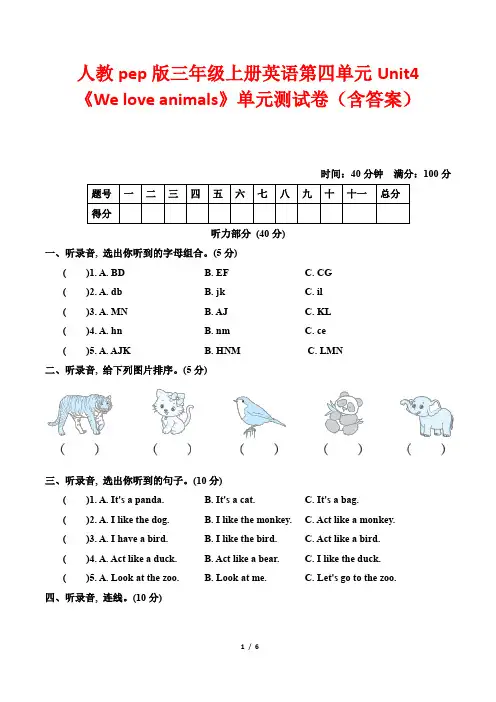
人教pep版三年级上册英语第四单元Unit4《We love animals》单元测试卷(含答案)时间:40分钟满分:100分听力部分(40分)一、听录音, 选出你听到的字母组合。
(5分)()1. A. BD B. EF C. CG()2. A. db B. jk C. il()3. A. MN B. AJ C. KL()4. A. hn B. nm C. ce()5. A. AJK B. HNM C. LMN二、听录音, 给下列图片排序。
(5分)三、听录音, 选出你听到的句子。
(10分)()1. A. It's a panda. B. It's a cat. C. It's a bag.()2. A. I like the dog. B. I like the monkey. C. Act like a monkey.()3. A. I have a bird. B. I like the bird. C. Act like a bird.()4. A. Act like a duck. B. Act like a bear. C. I like the duck.()5. A. Look at the zoo. B. Look at me. C. Let's go to the zoo.四、听录音, 连线。
(10分)五、听录音, 选择正确的应答语。
(10分)()1. A. It's a bird. B. It's black. C. This is a bird.()2. A. Thanks. B. Me too. C. Good idea.()3. A. Cool! l like it. B. What's that? C. Very well, thanks.()4. A. OK. B. Guess! C. Act like a tiger.()5. A. Follow Pig. B. Hello, Duck. C. Follow Monkey.笔试部分(60分)六、写出下列字母的左邻右舍。
三年级上册人教版英语第四单元听力
三年级上册人教版英语第四单元听力全文共3篇示例,供读者参考篇1Unit 4 Listening: A Student's PerspectiveWow, Unit 4 Listening was quite a journey! As a third-grader, I've come to anticipate the excitement and challenges that each new unit brings. This time around, we delved into the world of animals and their habitats, and let me tell you, it was an adventure like no other!Right from the start, our teacher introduced us to a lively and engaging set of listening exercises. We kicked things off with a warm-up activity where we had to identify different animal sounds. It was like a game of "Guess Who's Calling," but with a zoological twist. I'll never forget the look of sheer delight on my classmates' faces as we tried to imitate the roars, chirps, and howls of various creatures.But the real fun began when we moved on to the main listening exercises. Our teacher played a series of short dialogues and passages, each one brimming with fascinating facts about animals and their habitats. I remember feeling a sense of awe as Ilearned about the majestic elephants roaming the African savannas, the playful dolphins gliding through the vast oceans, and the elusive pandas munching on bamboo shoots in the misty mountains of China.What struck me the most was how vividly the listening materials brought these animals to life. It was as if we were transported to their natural environments, witnessing their behaviors and exploring their homes firsthand. The narrators' engaging voices and the background sounds added an extra layer of authenticity, making the experience truly immersive.Of course, with every listening exercise came a set of comprehension questions. At first, I'll admit, I found them a bit challenging. Trying to remember specific details while keeping up with the audio was no easy feat. But with each exercise, I became more adept at active listening, honing my skills in picking up on key information and making connections between different parts of the passages.One particular exercise that stands out in my mind was the one about animal adaptations. We learned how certain animals have evolved unique features and behaviors to survive in their environments. Hearing about the remarkable camouflageabilities of the chameleon or the incredible migration patterns of the Arctic tern left me in awe of the natural world's wonders.But it wasn't just about absorbing information; our teacher also encouraged us to think critically and discuss what we had learned. We had lively debates about the importance of conservation efforts and the impact of human activities on animal habitats. These discussions not only deepened our understanding but also fostered a sense of responsibility towards the environment and its inhabitants.As we progressed through the unit, I noticed a significant improvement in my listening comprehension skills. I could follow the dialogues and passages with greater ease, and my ability to answer questions accurately increased. It was a testament to the effectiveness of the listening exercises and the engaging way they were presented.One of the highlights of the unit was when our teacher organized a "Nature Walk" activity, where we ventured into a nearby park and tried to spot and identify different animals and their habitats. It was a perfect opportunity to apply what we had learned in a real-world setting. The excitement of spotting a squirrel scurrying up a tree or a bird building its nest waspalpable, and it reinforced the importance of preserving these natural wonders.As we neared the end of Unit 4, I couldn't help but feel a sense of accomplishment and gratitude. Not only had I gained a wealth of knowledge about the animal kingdom, but I had also developed valuable listening skills that would serve me well in my academic journey and beyond.Looking back, I can say with certainty that Unit 4 Listening was a transformative experience. It ignited my curiosity about the natural world and instilled in me a deep appreciation for the incredible diversity of life on our planet. And who knows? Maybe one day, I'll become a zoologist or a wildlife conservationist, inspired by the captivating stories and sounds that resonated within these classroom walls.篇2Unit 4 Listening - A Student's PerspectiveListening exercises are always the hardest part of learning English for me. In our PEP English textbook, Unit 4 was all about listening to conversations and stories. I had to really pay close attention!The first exercise was listening to a conversation between two kids, Peter and Annie, talking about their pets. I heard the names of different animals like dogs, cats, rabbits and hamsters. Peter said he had a dog named Spotty that was big and loved chasing balls in the park. Annie said she had two cats called Fuzzy and Snowy that liked napping in the sun.After listening to their conversation, I had to circle the pictures of the pets they were describing. I got most of them right, but I accidentally circled a picture of a parrot instead of a rabbit when Annie mentioned her friend's pet rabbit. Those animal names can be so tricky sometimes!The next listening was a story called "The Greedy Monkey." It was about a monkey who really loved bananas. One day he reached his hand into a jar to grab a bunch of bananas. But when he made a fist around the bananas, his hand got stuck in the jar's narrow neck! No matter how hard he pulled, his hand wouldn't come out because he refused to let go of the bananas.After the story, I had to number some pictures in the correct order of what happened. I mixed up the order of the last two pictures at first, but I listened again carefully and fixed my mistake. The story taught me it's better to be satisfied with what you have instead of being too greedy.My favorite part was the next exercise where we listened to a funny story song called "One Trillion Trillion Sandwiches." It was about a boy who kept asking his mom to make him more and more sandwiches until the numbers got ridiculously huge! One trillion, one quintillion, one sextillion sandwiches - the lyrics just kept going up and up. We all cracked up laughing at how silly and impossible that many sandwiches would be.Then we had to fill in the missing numbers and words we heard in the lyrics. I have to admit, I didn't know what some of those crazy big number names like "quintillion" meant at first. But repeating them over and over while filling in the blanks helped me remember. English number names can be really fun!The last story was called "Tom's Camping Adventure" and it was about a boy who went camping in the woods with his family. We heard all about the things he did like pitching a tent, gathering firewood, roasting marshmallows, and looking at the stars. But then a growling noise scared Tom at night and he got afraid there was a bear outside!For this one, we circled true or false sentences about what happened in the story. I got stuck on one question asking if Tom heard a strange noise at night. I couldn't remember if the story specifically said the noise was strange or not. I listened again andrealized the noise was just described as a "growling" sound, so I marked that sentence as true.Overall, the listening exercises in Unit 4 helped me practice following conversations and stories in English. The different tasks like circling pictures, numbering events, filling blanks, and marking true/false really made me tune in closely. Some parts were pretty challenging, but listening over and over made it easier to catch the details.I'm slowly getting better at listening comprehension, but it takes a lot of concentration and repetition for me. Luckily doing these kinds of exercises lets me hear the same things multiple times until it sticks in my brain. With more listening practice like this, one day I'll be a totally fluent English speaker!篇3Unit 4: At the BookstoreHi there! I'm a third grader and I want to tell you all about Unit 4 in our English textbook. This unit was super fun and interesting because it was all about books and bookstores. As a kid who loves reading, I was really excited to learn more vocabulary and phrases related to this topic.The unit starts off by introducing us to some key words like "bookstore", "borrow", "buy", and different genres of books like mysteries, comics, and fairy tales. Our teacher had us practice saying and spelling these words. Then we learned the sentence pattern "There is/are..." to talk about things that exist. Like "There are many books at the bookstore."Next up was the listening practice. I really enjoyed this part because the recordings were so lively and engaging. One dialogue was between a kid and a bookstore clerk. The kid was looking for a comic book. Another one had a mom and daughter discussing what books to borrow from the library. Listening to these convos helped me pick up vocabulary in context.Then we moved on to the reading section. We read a short story called "Lisa's Saturday" about a girl who goes to the bookstore with her dad. It described all the sections like fantasy, non-fiction, and children's books. There were questions about the key details to check our comprehension. My favorite part was the beautiful illustrations!The writing section for this unit had us describing our favorite books and bookstores. We practiced using descriptive language and vocabulary from the unit. I wrote about my lovefor the magic treehouse book series and how I enjoy browsing the aisles at my local Barnes & Noble.We also learned some fun rhymes and songs related to books and reading. One was called "Reading is Fun" and had a catchy melody. Another one was about the different genres with rhyming couplets like "Mysteries, oh mysteries, what will happen next?" Singing really helps cement the words in my mind.Towards the end of the unit, we did a fun project making our own tiny bookstores out of shoeboxes. We could decorate the sections for different genres and make little books out of construction paper to put on the shelves. It was a creative way to get hands-on practice with the vocabulary.Overall, I'd say Unit 4 was one of my favorites so far. I feel like I expanded my English knowledge about the bookstore theme while getting to combine it with my personal love of reading. The activities and practice opportunities were engaging for different learning styles too. Listening, speaking, reading, writing - we covered it all!Now I can go to any English bookstore and feel confident browsing the shelves, asking about books, and discussing my reading preferences. Maybe I'll even work at a bookstore when I'm older! For now, I'm excited to move on to the next unit andsee what other fun English adventures await. Thanks for reading my recap!。
PEP人教版三年级英语上册第四单元单元检测及答案
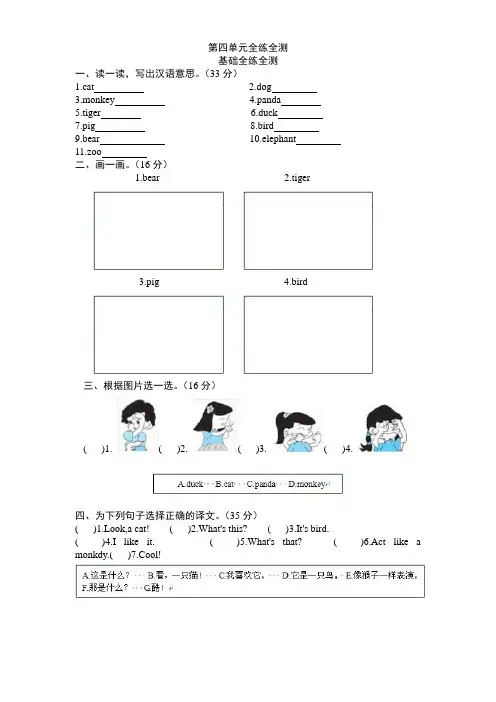
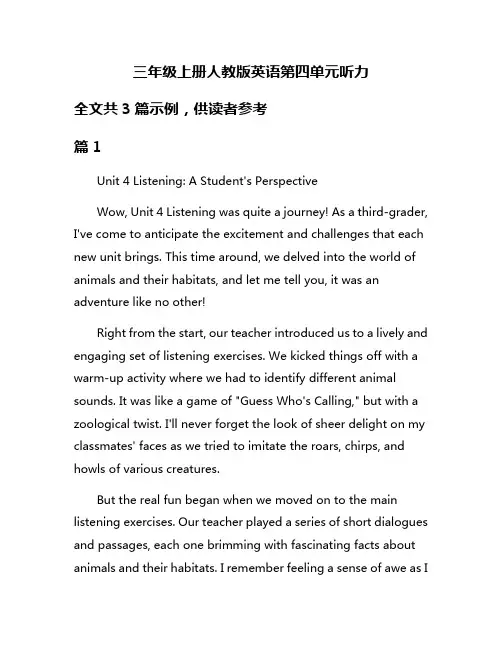
第四单元全练全测基础全练全测一、读一读,写出汉语意思。
(33分)1.cat2.dog3.monkey4.panda5.tiger6.duck7.pig 8.bird9.bear 10.elephant11.zoo二、画一画。
(16分)1.bear2.tiger3.pig4.bird三、根据图片选一选。
(16分)( )1. ( )2. ( )3. ( )4.四、为下列句子选择正确的译文。
(35分)( )1.Look,a cat! ( )2.What's this? ( )3.It's bird.( )4.I like it. ( )5.What's that? ( )6.Act like a monkdy.( )7.Cool!答案详解一、1.猫 2.狗 3.猴子 4.熊猫 5.老虎 6.鸭子 7.猪 8.鸟 9.熊 10.大象11.动物园二、1.熊 2.老虎 3.猪 4.鸟 三、1.D 2.A 3.B 4.C四、1.B 2.A 3.D 4.C 5.F 6.E 7.G六年级英语期末检测题1乡镇__________________ 学校_____________________ 班级____________ 姓名____________ 座号__________ ……………………密………………………………….封……………………….线…………………………………………………………………………..题次一二三四五六七八九十十一十二总评记分A. 听力部分(30分)一、听录音,选出正确的单词,把答案序号填入括号里。
(5分)()1 .A read newspapers B empty the trash C sweep the floor()2. A potato B tomato C carrot()3. A purple B paper C picture()4. A washed clothes B watched TV C took pictures()5 .A skate B skirt C shirt二、听句子,选择最佳答语,将其编号写在括号里。
PEP人教小学英语三年级上册unit4where is my car单元测试题含答案(共3套)
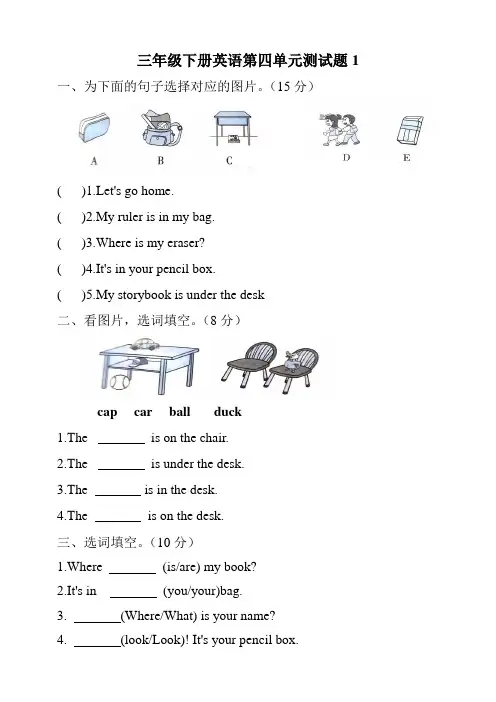
三年级下册英语第四单元测试题1 一、为下面的句子选择对应的图片。
(15分)( )1.Let's go home.( )2.My ruler is in my bag.( )3.Where is my eraser?( )4.It's in your pencil box.( )5.My storybook is under the desk二、看图片,选词填空。
(8分)cap car ball duck1.The is on the chair.2.The is under the desk.3.The is in the desk.4.The is on the desk.三、选词填空。
(10分)1.Where (is/are) my book?2.It's in (you/your)bag.3. (Where/What) is your name?4. (look/Look)! It's your pencil box.5.My crayons (is/are) in my bag.四、选择正确的答案,将序号填入括号里。
(12分)( )1.--Where is the bird?--It's in the .A. boxB. body( )2.-- Look! It's an .--No, it's an apple.A. orangeB. pear( )3. --Act like a--Meow, meow!A. catB. dog( )4.-- is the toy car?--It's on the chair.A. WhatB. Where( )5.-- under the toy box?--No, it isn't.A. Is itB. It is( )6.--Is it on the map?--Yes, .A. is itB. it is五、情景选择。
人教PEP版英语三年级上册Unit3-Unit4单元测试卷含答案
小学英语三年级上册三、四单元测试卷 听力部分 一、Listen and number. (听录音,按照录音顺序标号。
) ( ) ( ) ( ) ( ) ( ) 二、Listen and tick.(听录音,选出你听到的图片,在图片下打“√”。
) 1. 2. ( ) ( ) ( ) ( ) 3. 4. ( ) ( ) ( ) ( ) 5.( ) ( )三、Listen and choose. (听句子,选出句子中你所听到的单词。
)( ) 1. A. nose B. red C. leg( ) 2. A. elephant B. face C. green( ) 3. A. dog B. foot C. hand( ) 4. A. eye B. ear C. arm( ) 5. A. bear B. body C. zoo 同学们,咱们一起来做听力闯关,相信你们一定能闯关成功! 学校: 班级: 姓名:四、Listen and choose. (听录音,选择相应答句。
)( )1. A. I’m fine, thanks. B. Nice to meet you.( )2. A. Good morning. B. Good afternoon.( )3. A. It’s a monkey B. Hello, bird.( )4. A. Great! B. Guess.( )5. A. OK! B. No. It’s a dog.笔试部分同学们,愉快的听力结束了,下面让我们开动脑筋,仔细答题,做一个“神笔高手”吧!一、Order and write. (将下列字母按正确顺序排列,用书写体抄写在四线格里。
)Gg Ff Mm Hh Ii Kk Jj Ll二、Read and choose. (选出下列每组中与其它两个不同类的单词。
)( ) 1. A. ear B. eye C. red( ) 2. A. face B. nose C. pencil( ) 3. A. leg B. cat C. foot( ) 4 A. bird B. arm C. hand( ) 5. A. tiger B. mouth C. monkey( ) 6. A. arm B. eraser C. head三、Read and choose.(读问题选择正确答语。
人教PEP版三年级英语上册Unit 4 过关检测卷(1)(含听力材料和答案)
Unit 4 达标检测卷时间:40分钟满分:100分听力部分(40分)一、听录音,选出你所听到的选项。
(10分)()1. A. Mm B. Nn C. Ll()2. A. Gg B. Jj C. Kk()3. A. bird B. bag C. blue()4. A. mouth B. monkey C. mum()5. A. egg B. elephant C. leg二、听录音,给下列图片排序。
(10分)() () () () () 三、听录音,选出你所听到的句子。
(10分)()1. A. Look at my bear! B. Look at my ear!()2. A. It's a pig. B. It's big.()3. A. I have a duck. B. I like the duck.()4. A. What's that? B. What's this?()5. A. Act like a dog. B. Act like a duck.四、听录音,判断答语与所听内容是(T)否(F)对应。
(10分)()1. It's a monkey.()2. No, it's a panda.()3. OK!()4. How are you?()5. Me, too.笔试部分(60分)五、写出下列字母相邻字母的大写或小写形式。
(15分)1. 2. 3. 4.5. 6. 7. 8.六、选出与画线单词同类的选项,将序号写在括号中。
(5分) ()1. What's this?A. thatB. anC. long ()2. It's a pig.A. legB. milkC. duck ()3. Look at the jeep.A. coolB. inC. dog ()4. Act like a bird.A. legB. noseC. make ()5. It is big.A. fatB. kiteC. noodles七、看图,根据句意、字母及图片提示补全单词。
人教PEP三年级英语上册Unit4_单元达标卷
Unit4 单元达标卷建议时间:40分钟满分:100分Listening Part(40分)一、听录音,圈出你所听到的单词的首字母。
(12分)1. 2. 3.g j n l m n4. 5. 6.c k n l m l二、听录音,选择你所听到的选项,将序号填入题前括号里。
(10分)( ) 1. A. m k l B. i n g C. j f h( ) 2. A. elephant B. egg C. green( ) 3. A. cat B. crayon C. pig( ) 4. A. panda B. bird C. zoo( ) 5. A. cool B. this C. that( ) 6. A. Act like a cat. B. Act like a dog. C. Act like a bear. ( ) 7. A. I see a monkey. B. I see a panda. C. I see a rabbit. ( ) 8. A. This is a duck. B. This is a bear. C. This is a dog. ( ) 9. A. I have a pig. B. I have a bird. C. I have a cat.( ) 10. A. Look at the tiger. B. Look at the elephant. C. Look at the duck.三、听录音,用数字给下列图片排序。
(8分)( ) ( ) ( )( )四、听录音,判断下列图片与你所听到的内容是否相符,相符的打“√”,不相符的打“×”。
(5分)1. 2. 3.( ) ( ) ( )4. 5.( ) ( )五、听录音,选择正确的单词,将序号填在横线上。
(有两项多余) (5分)Look! This is my zoo. It’s 1. ________. I have a 2. ________ duck, a black cat, a brown 3. ________, a black 4. ________, a brown monkey and 5. ________ orange dog. I love my zoo.Writing Part(60分)六、读一读下面的单词,找出每组单词中所含有的相同字母,写出它们的大小写,注意字母的书写格式哟。
“PEP”2024年10版小学三年级上册第15次英语第四单元综合卷
“PEP”2024年10版小学三年级上册英语第四单元综合卷考试时间:60分钟(总分:110)考试人:_________题号一二三总分得分评级介绍:本次试卷涵盖第四单元的核心知识,难度适中,重点在于词汇运用和简单句型的理解,旨在巩固学生的英语基础,提升综合语言能力。
一、(选择题)总分:50分(1分/题)1、Which plant is known for its vibrant colors?哪种植物以其鲜艳的颜色而闻名?A, TulipB, OakC, PineD, Grass2、Which type of plant grows in dry places?哪种植物生长在干燥的地方?A, FernB, CactusC, MossD, Water lily3、What do you call the first meal of the day?A, LunchB, DinnerC, Breakfast4、What color is the sky on a clear day?A, GreenB, BlueC, YellowD, Red5、What does "植物科学技术推广" mean in English?A, Plant science and technology promotionB, Agricultural promotionC, Environmental promotionD, Ecological promotion6、What is a common dairy product used on cereal?A, MilkB, JuiceC, WaterD, Soda7、What do we call a plant that produces seeds in a cone?我们称在锥形果实中产生种子的植物为?A, ConiferB, DeciduousC, TropicalD, Aquatic8、What color is an emerald?A, RedB, BlueC, GreenD, Yellow9、What is the English translation of "椅子"?A, TableB, ChairC, SofaD, Bed10、Which word describes a loud sound?A, QuietB, NoisyC, SoftD, Silent11、What do we call a story that is told to teach a lesson?A, FableB, FictionC, HistoryD, Biography12、Which part of the plant can be colorful and attract insects?中文解释:植物的哪个部分可能是多彩的并吸引昆虫?A, FlowersB, LeavesC, Roots13、What is the English translation of "蒸腾作用"?A, TranspirationB, EvaporationC, CondensationD, Photosynthesis14、Which part of the plant is often colorful and attracts insects?中文解释:植物的哪个部分通常很有色彩并吸引昆虫?A, RootsB, FlowersC, Stems15、What is the English translation of "植物实习"?A, Plant internshipB, Agricultural internshipC, Environmental internshipD, Ecological internship16、What is the English word for "苹果"?A, AppleB, BananaC, OrangeD, Grape17、What do we call a plant that grows in rocky areas?中文解释:我们称生长在岩石地区的植物为?A, LithophyteB, Aquatic plantC, Herbaceous plant18、Which of these is a type of dance?A, BalletB, PaintingC, DrawingD, Reading19、What is the season after winter?中文解释:冬天之后是什么季节?A, SpringB, FallC, Summer20、Which one is a mode of communication?A, TVB, RadioC, PhoneD, All of the above二、(听力题)总分:30分(1分/题)1、听力填空题:I ___ (wake) up early every day.2、听力填空题:We ___ (go) to the movies every Friday.3、听力填空题:She ___ (not/attenD, the meeting yesterday.4、What instrument has 88 keys?A, GuitarB, ViolinC, PianoD, Flute5、听力填空题:The ______ is a place where you can see animals in their natural habitat.6、Which one is a mode of transportation?A, TableB, BicycleC, ChairD, Sofa7、听力填空题:We ___ (not/visit) the museum.8、What is the name of the invisible gas we breathe?A, SmokeB, OxygenC, CarbonD, Nitrogen9、听力填空题:She ___ (make) a salad for lunch.10、Which animal is known as the "King of the Jungle"?A, ElephantB, TigerC, LionD, Bear11、What do you call a person who writes stories?A, ArtistB, AuthorC, ActorD, Musician12、What do you call a large area covered with trees?A, DesertB, ForestC, CityD, Town13、听力填空题:We ___ (visit) the science fair this weekend.14、听力填空题:The sun ___ (shine) brightly.15、What is the first month of the year?A, JuneB, JanuaryC, MarchD, April16、What do you call a sports competition held every four years? A, Olympic GamesB, World CupC, Super BowlD, Championships17、What time do we eat breakfast?A, MorningB, AfternoonC, EveningD, Midnight18、What do you call a story that isn’t true?A, FactB, FictionC, HistoryD, Science19、听力填空题:He ___ (not/drink) soda.20、听力填空题:She ___ (make) a cake for her birthday.三、(填空题\连线题)总分:50分(2分/题)1、填空题:A ______ (植物特征数据库) aids in identification.2、填空题:A ________ (黑豹) is a stealthy predator.3、填空题:The ________ (驴) is known for its strength and stubbornness.4、They are ______ to the zoo.A, goingB, goC, goneD, went5、The rabbit is _____ than the turtle.A, fastB, fasterC, fastestD, more fast6、I _____ my homework yesterday.A, finishB, finishedC, finishingD, to finish7、选择正确的单词填空:What is your _____ hobby? A, favoriteB, favoritesC, favoring8、We ___ breakfast together every Sunday.A, haveB, hasC, hadD, having9、关于"人物"沟通用语填空题:The _____ builds and repairs roads and bridges. (civil engineer)10、关于"人物"沟通用语填空题:An _____ provides support for individuals seeking career development opportunities. (career counselor)。