
五下英语Lesson 12 A Visit to the Great Wall完美版
三千年读史,不外功名利禄;九万里悟道,终归诗酒田园。 这是一个最好的时代,这是一个最坏的时代这是一个智慧的年代,这是一个愚蠢的年代;这是一个光明 的季节,这是一个黑暗的季节;这是希望之春,这是失望之冬;人们面前应有尽有,人们面前一无所有;人们正踏上天堂之路,人们正走向地狱之门。 我有所感事, 结在深深肠。 你一定要“离开”才能开展你自己。所谓父母,就是那不断对着背影既欣喜又悲伤,想追回拥抱又不敢声张的人。 心之所向 素履以往 生如逆旅 一 个人的行走范围,就是他的世界。因为爱过,所以慈悲;因为懂得,所以宽容。 刻意去找的东西,往往是找不到的。天下万物的来和去,都有他的时间。 与善人 居,如入芝兰之室,久而自芳也;与恶人居,如入鲍鱼之肆,久而自臭也。 曾经沧海难为水,除却巫山不是云。 回首向来萧瑟处,归去,也无风雨也无晴。 半生 闯荡,带来家业丰厚,儿孙满堂,行走一生的脚步,起点,终点,归根到底,都是家所在的地方,这是中国人秉持千年的信仰,朴素,但有力量。风吹不倒有根的 树我能承受多少磨难,就可以问老天要多少人生。心,若没有栖息的地方,到哪里都是流浪...如果有来生,要做一只鸟,飞越永恒,没有迷途的苦恼。东方有火红 的希望,南方有温暖的巢床,向西逐退残阳,向北唤醒芬芳。如果有来生,希望每次相遇,都能化为永恒。不乱于心,不困于情。不畏将来,不念过往。如此,安 好。 笑,全世界便与你同声笑,哭,你便独自哭。 一辈子,不说后悔,不诉离伤。上帝作证,我是真的想忘记,但上帝也知道,我是真的忘不了 如果其中一半是 百分百的话那就不是选择了而是正确答案了,一半一半,选哪一半都很困难,所以这才是选择。跟着你,在哪里,做什么,都好。眠。我倾尽一生,囚你无期。择 一人深爱,等一人终老。痴一人情深,留一世繁华。断一根琴弦,歌一曲离别。我背弃一切,共度朝夕。 人总是在接近幸福时倍感幸福,在幸福进行时却患得患失。 路过的已经路过,留下的且当珍惜 我相信,真正在乎我的人是不会被别人抢走的,无论是友情,还是爱情。我还是相信,星星会说话,石头会开花,穿过夏天的木 栅栏和冬天的风雪之后,你终会抵达! 每一个不曾起舞的日子,都是对生命的辜负。 每个清晨都像一记响亮的耳光,提醒我,若不学会遗忘,就背负绝望。 那一 年夏天的雨,像天上的星星一样多,给我美丽的晴空,我们都有小小的伤口,把年轻的爱缝缝又补补,我会一直站在你左右,陪你到最后的最后。 如果一开始就知道是这样 的结局,我不知道自己是不是会那样的奋不顾身。 黄昏是一天最美丽的时刻,愿每一颗流浪的心,在一盏灯光下,得到永远的归宿。 因为有了因为,所以有了所
※How old is the oldest part of the Great Wall?
The oldest part is more than 2000 years old.
※How can we keep the Great Wall
clean and beautiful?
Don't draw or write on the Great Wall.
冀教版 五年级下册
Lesson 12
A Visit to the Great Wall
★Listen carefully and answer:
1. Who are they? 2. Where are they going? 3. How do they go there?
★Read it in a group and answer:
风,没有衣裳;时间,没有居所;它们是拥有全世界的两个穷人生活不只眼前的苟且,还有诗和远方的田野。你赤手空拳来到人世间,为了心中的那片海不顾一切。 运动太多和太少,同样的损伤体力;饮食过多与过少,同样的损伤健康;唯有适度可以产生、增进、保持体力和健康。 秋水无痕聆听落叶的情愫红尘往事呢喃起涟
漪无数心口无语奢望灿烂的孤独明月黄昏遍遍不再少年路岁月极美,在于它必然的流逝。
春花、秋月、夏日、冬雪。 你必汗流满面才得糊口,直到你归了土;因为你是从土而出的。你本是尘土,仍要归于尘土。 我始终相信,开始在内心生活得更严肃 的人,也会在外表上开始生活得更朴素。在一个奢华浪费的年代,我希望能向世界表明,人类真正需要的的东西是非常之微少的。世界上的事情,最忌讳的就是个 十全十美,你看那天上的月亮,一旦圆满了,马上就要亏厌;树上的果子,一旦熟透了,马上就要坠落。凡事总要稍留欠缺,才能持恒。 只有经历过地狱般的磨砺, 才能练就创造天堂的力量;只有流过血的手指,才能弹出世间的绝响。时光只顾催人老,不解多情,长恨离亭,滴泪春衫酒易醒。梧桐昨夜西风急,淡月朦胧,好 梦频惊,何处高楼雁一声? 如果你长时间盯着深渊,深渊也会盯着你。 所有的结局都已写好 所有的泪水也都已启程 却忽然忘了是怎么样的一个开始 在那个古老 的不再回来的夏日 无论我如何地去追索 年轻的你只如云影掠过 而你微笑的面容极浅极淡 逐渐隐没在日落后的群岚 遂翻开那发黄的扉页 命运将它装订得极为拙劣 含着泪 我一读再读 却不得不承认青春是一本太仓促的书 记忆是无花的蔷薇,永远不会败落。 我也要求你读书用功,不是因为我要你跟别人比成就,而是因为,我
Gll the Great Wall “The _T_e_n-_T_h_ou_s_a_nd_s_-__ Great Wall”. The Great Wall isLi__o_ld__,__lo_n_g_,_b_e_a_ut_if_u.lIn China, people say “He who does not go to __t_he__ __G_r_e_at_ __W_a_ll__ is not a ___tr_u_e ___m_a_n”. We don’t _d_ra_w__ or _w_r_it_e _ on the Great Wall. Let’s keep it ____ andcl_ea_n____. beautiful
冀教版五年级下册英语-Unit2Lesson12AVisittotheGreatWall

教案:冀教版五年级下册英语——Unit 2 Lesson 12 A Visit tothe Great Wall一、教学目标1. 知识目标:(1)能够听懂、会说、会读本课的生词和句子。
(2)能够用英语简单描述参观长城的经历。
(3)能够理解并运用本课的核心句型 "—What did you do? —I went to " 进行交流。
2. 能力目标:(1)能够运用所学的词汇和句型,进行简单的口语交流。
(2)能够根据图片或情景,运用所学知识进行创造性表达。
3. 情感目标:(1)培养学生对祖国大好河山的热爱之情。
(2)培养学生的团队协作精神,增强集体荣誉感。
二、教学内容本课主要讲述了一群学生在老师的带领下,去参观长城的经历。
通过本课的学习,学生能够掌握有关参观活动的词汇和句型,并用英语进行简单的口语交流。
三、教学重点与难点1. 重点:(1)生词的学习:wall, China, group, teacher, summer vacation, take pictures, exciting。
(2)核心句型的运用:"—What did you do? —I went to "。
2. 难点:(1)正确理解并运用情态动词 "have" 的过去式 "had" 。
(2)能够根据情景,运用所学知识进行创造性表达。
四、教具与学具准备1. 教具:多媒体课件、黑板、粉笔。
2. 学具:课本、练习册、单词卡片。
五、教学过程1. 热身(5分钟)(1)教师与学生用英语进行简单的日常交流。
(2)学生自由发挥,用英语讲述自己在上个周末的所见所闻。
2. 导入(10分钟)(1)教师出示长城的图片,引导学生说出 "Great Wall" 。
(2)教师提问:"Have you ever been to the Great Wall?" ,引导学生用英语回答。
五年级下册英语课件-Lesson12《AvisittotheGreat Wall》|冀教版三起 共27张PPT

Okay, Li Ming, _____.
No,______! Don’t _________________! Let’s ____________________________.
What a _________________ to visit! We are __________________.
Fill in the blanks. 1.Mrs. Li, Jenny, Danny and Li Ming are going to the Great Wall ___b_y_b_u_s_. 2.The Great Wall is very __lo_n_g__ and very __o_l_d__. 3.Danny wants to __w_r_it_e__his name on the Great Wall. Li Ming stops him. 4.The Great Wall is a very special place. Let’s keep it __cl_e_a_n__ and __b_ea_u_t_if_u_l .
除了照片什么也别带走, 除了脚印什么也别留下
Does Jenny like the Great Wall? How do you know it?
Mrs. Li, ______, ______ and _______ are going to the ________ by_______.
Wow, __________!
How can we keep the Great Wall clean and beautiful? Don’t _________________.
destroy (破坏) throw the things(扔东西) move the bricks (挪动墙砖) hit (撞击)
五年级英语下册Lesson 12 A Visit to the Great Wall冀教版

Can or Can’t
To be a civilized tourist! 做文明游客!
Group work: Make a sign (做指示牌)
Be a vonlunteer and make a sign for scenic spots(景区).
(write or draw, English or Chinese)
( )3.The Great Wall is very old and very long. ( )4.We can't draw or write on the Great Wall. ( )5.We are lucky to see the Great Wall.
1.The Ten Thousand-Li Great Wall 2.the oldest part 3.more than 4.true man 5.interesting things 6.keep …clean and beautiful
Homework
1.Talk about the Great Wall with your friends. 2.Read the recommended book about the Great Wall. 3.Make a postcard about the Great Wall.
keep …clean and beautiful
say to Danny?
1.Today,_M__rs_._L_i_,J_e_n_n__y,_D_a_n_n_y and Li Ming are going to _t_h_e_G__re_a_t_W__a_l_l __ by bus.
2.In China, we call the Great Wall “The __T_e_n_-T_h_o__u_s_a_n_d_-L__i __ Great Wall.”
冀教版五年级英语下册Lesson12 A Visit to the Great Wall
Okay,LiMing. Sorry.
李明说.好的,李明,对不起.
“Great!So now I am true man!
太好了!现在我是一个真是男人了!
Let me write my name on the Great Wall,”
says Danny.
让我把我得名字写在长城上吧,丹妮说.
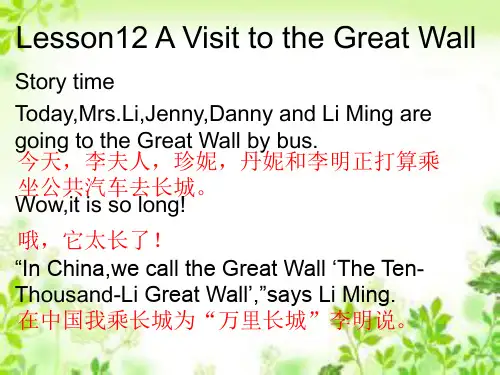
Lesson12 A Visit to the Great Wall
Story time
Today,Mrs.Li,Jenny,Danny and Li Ming are going to the Great Wall by bus. 今天,李夫人,珍妮,丹妮和李明正打算乘 坐公共汽车去长城。 Wow,it is so long!
“No,Danny!Don’t draw or write on the Great Wall!
不丹妮!不要在长城上画和写!
Let’s keep it clean and beautiful,” says LiMing.
让我们让他保持保持干净和漂亮,李明说。
“What a wonderful place to visit!”says Jenny.
• The oldest part is more than 2000 years old,”LiMing goes on.
最古老的部分超过2000年了,李明接着说。
• Danny and Jenny want to know more about the Great Wall.
丹妮和珍妮想知道更多关于长城的事。
多么值得参观的美丽地方!珍妮说。
“We are lucky to see it.”
冀教三起英语五下《Lesson 12 A Visit to the Great Wall》
Lesson 12 A Visit to the Great Wall教材分析本课是在学习了LiMing、Mrs.Li 、Jenny and Danny一起游览北京的天安门广场、故宫、长城和到王府井大街购物这几篇课文的基础上学习的,有助于学生了解更多的有关长城的知识,帮助学生理解并掌握外出游玩和观赏时常用的英语表达方式。
本课的内容接近学生生活实际,学生乐于了解,学习兴趣深厚,老师应结合本课重点内容,为学生创设游览和介绍长城这一情境,通过本课重点问题导入引导学生一起进入本课的学习。
学情分析本课的学习对象是五年级的小学生,大部分学生能用一些简单的英语谈论一些简单的问题,而且本课是本单元的故事课,是在学生了解了北京一些著名的地方后开展的,是本单元前几课的一个总结和延伸。
作为故事课,为了提高学的学习兴趣,教学过程中采用多媒体课件、图片呈现教学内容,创设情境,让学生在情境中掌握知识,并能积极运用所学英语进行表达和交流。
教学目标1、知识与技能(1)能在老师的帮助下听懂并读懂故事。
(2)能朗读故事并在老师的帮助下表演故事。
2、学习策略目标:(1)在学习中集中注意力,尝试各种阅读策略:寻读、略读、根据上下文猜测词义等。
(2)对所学内容能主动练习和实践。
(3)积极运用所学英语进行表达和交流。
3、情感态度目标:(1)学生有兴趣听、读英语故事、积极参与各项活动等。
(2)通过学习故事增强学生对历史文物的尊重和保护意识,提倡学生文明旅行。
教学重点:能够在老师的帮助下表演故事教学难点:能够复述故事教学准备:多媒体课件教学步骤:Step1、创设情境,导入新课 1.Free talk 出示天安门、故宫、长城和王府井大街的图片,然后提问:Where do you want to go? Why? Do you know where do I want to go?What do you know about the Great Wall? 设计思路:这一环节通过对北京名胜古迹图片的回顾激活学生的原有知识,给学生营造了一个轻松愉悦的学习氛围,调动学生的旅游兴趣,激发学生参与课堂活动的热情。
五年级下英语教案-Lesson12AVisittotheGreatWall-冀教版
教案:五年级下英语教案 Lesson 12 A Visit to the GreatWall 冀教版一、教学目标1. 知识目标:(1)能够听懂、会说、会读本课的生词和重点句子。
(2)能够运用所学知识描述一次参观长城的经历。
2. 能力目标:(1)能够通过图片和文字资料,了解长城的历史和文化。
(2)能够用英语简单描述参观长城的所见所闻。
3. 情感目标:激发学生对祖国历史文化的自豪感,培养他们的爱国情怀。
二、教学内容1. 教材内容:本课主要介绍长城的历史和文化,以及一次参观长城的经历。
通过学习,让学生了解长城的壮丽景色和雄伟气势,培养他们的爱国情怀。
2. 拓展内容:通过图片和文字资料,让学生了解长城的历史和文化,提高他们的文化素养。
三、教学重点与难点1. 重点:(1)能够听懂、会说、会读本课的生词和重点句子。
(2)能够运用所学知识描述一次参观长城的经历。
2. 难点:(1)生词和短语的理解和运用。
(2)描述参观长城的经历。
四、教具与学具准备1. 教具:(1)课件:包括本课的生词和重点句子,以及与长城相关的图片和文字资料。
(2)黑板和粉笔。
2. 学具:(1)课本。
(2)练习本。
五、教学过程1. 导入:通过课件展示长城的图片,引导学生谈论长城的美丽景色,激发他们的学习兴趣。
2. 新课呈现:(1)教师引导学生学习本课的生词和短语,并通过例句展示它们的用法。
(2)教师播放课文录音,让学生跟读并模仿语音语调。
3. 课堂练习:(1)学生分组进行角色扮演,模拟一次参观长城的经历。
(2)学生用英语描述自己所见所闻,并尽量使用本课所学词汇和句型。
4. 拓展活动:学生通过查找资料,了解长城的历史和文化,并在课堂上进行分享。
六、板书设计板书设计如下:课题:A Visit to the Great Wall生词和短语:The Great WallancientChinesehistoryculturetouristattractionmagnificentclimbview句子:1. The Great Wall is an ancient Chinese tourist attraction.2. It has a long history and rich culture.3. We climbed the Great Wall and had a magnificent view.七、作业设计1. 抄写本课生词和短语,每个写5遍。
冀教版英语五年级下册Lesson12 A Visit to the Great Wall优秀教案
冀教版小学英语Book6 Lesson12:A Visit to the Great Wall一、教学分析:1、学习者分析:五年级学生以经学过两年多英语,已经积累了一定的词汇和语法知识,在课堂活动中能够应尽量调动起她们的用英语来表达的积极性。
2、学习内容分析:本课很多词句学生都已学过,生词不多,理解起来较容易,谚语是学生初次接触,感觉很新鲜。
而且很多孩子都去过长城,所以这个故事很容易能引起共鸣。
二、教学目标:知识、技能目标:1、能听懂并读懂故事。
2、能朗读故事并在老师的帮助下表演故事。
学习策略目标:1、在学习中集中注意力,初步尝试各种阅读策略:寻读,略读,速读,等。
2、对所学内容能主动练习和实践。
3、积极运用所学英语进行表达和交流。
情感态度目标:1、学生有兴趣听故事,读故事,积极参与各项活动。
2、提倡学生文明旅行,爱护文明古迹。
文化意识目标:1、了解、体会中西文化的异同。
三、教学重难点:1本课重点:听懂并读懂故事。
2本课难点:表演故事。
四、教学准备:课件,本课人物头像,句子条幅,导游帽子和旗子等。
五、教学过程:Class Opening:1 greetings:T: Good morning, boys and girls.Ss: Good morning, Miss Liu.2 Talk:T: Spring is coming. Do you want to go outside to play? To travel?Ss: Yes.T: Where do you want to go?Ss:(设计意图:简单的问候后,与学生进行free talk,拉近师生的关系,为接下来的复习环节做铺垫)3 Review:1)Guessing GameT: First, let’s play a guessing game. Look, let’readtogether.Ss:It’s very big. There are many people on it. Some people like to fly kites here. Some people like to take pictures here.T: Where is it?S1:It’s Tian'anmen Square.T: Good. Go on. This time, all the boys read together. Boys: It’ s red and yellow. It’s about six hundred years old. There are many houses in it.T: Where is it?S2:It’s the Palace Museum.The same way:It’s Wangfujing Street. It’s the Great Wall. 2)Talk about these placesT: Let’s talk about these places. What do you know about Tian'anmen Square? / the Palace Museum?/Wangfujing Street?/ the Great Wall?S1:S2:(设计意图:猜地名,并对北京的四个地点进行语言知识的汇总,既是本单元前几课复习的同时,也是引出新授的开端。
五年级下册英语课件- Lesson 12《A visit to the Great Wall》|冀教版(三起)
Let’s keep it …
Write about the Great Wall in English.
NOTICE (温馨提示) No smoking! ___________ _____________ _____________ _____________
Introduction of the Great Wall (长城简介)
_______________________ ________________________ ________________________ ________________________ ________________________
开头大写和末尾标点得1星; 正确运用时态得2星; 书写工整得1星。
最古老的部分 超过 继续
more than
万里长城
600 10,000 2000 13,000
more 更多的
interesting things
What’s the Chinese saying about the Great Wall?
中国谚语
People say “__H_e_w__h_o_d_o_e_s__n_o_t __g_o__to__th_e__G_r_e_a_t _W_a_l_l _is_n_o_t___
___a__tr_u_e_m__a_n_.”
1. How can we keep (保持) the Great Wall clean and beautiful? Don’t draw or write on the Great Wall! 2. How does Jenny feel? Jenny feels _l_u_c_k_y_ to see the Great Wall.
冀教版(三起)-英语-五下-Unit 2 Lesson 12 A Visit to the Great Wall教案
Unit 2Lesson12 A Visit to the Great Wall通过本节课Story time 学习,使学生能够表述自己在日常生活中去旅行的事迹。
【知识目标】 1. 学生能听懂和理解这个简单的故事。
2. 学生能就故事内容进行问答。
3. 学生能向同学复述故事。
【能力目标】通过本节课Story time 学习,使学生能够表述自己在日常生活中去旅行的事迹。
【情感目标】培养学生热爱文物及保护文物的情感意识。
【教学重点】通过本节课的学习,学生能够简要复述课文大致内容。
【教学难点】学生能够简要复述Story time 课文内容。
Tape recorder, MultimediaStep 1.Warm-up1 GreetingsSay hello to students: Hello everybody. Welcome boys and girls.Whe n the students sit well, let them recall as much as possible about the landscape of ◆ 教材分析◆ 教学目标◆ 教学重难点◆ ◆ 课前准备◆◆ 教学过程Beijing. Ask:What do you know about Tian 'anmen Square?What did you learn about the Great Wall?Would you like to see the Palace Museum?2. text introductionLet the students turn to the thirtieth page of the textbook. Tell them to read a story that can provide more information about the Great Wall.Step 2.PresentationStory time: A Visit to the Great Wall1. pre reading activitiesLook at the pictures and discuss what you see in each picture, and record the contents of the students' answers on the blackboard. Use the problem to help students understand.How do Mrs. Li, Jenny, Danny and Li Ming go to the.What do we call the Great Wall in China?Are Danny and Jenny interested in the Great Wall?Do you know the Chinese saying about the Great Wall?Why can 't Danny draw or write on the Great Wall?2. reading activitiesTalk about picturesFigure 1What do you see in this picture?Everyone is sitting in the bus and going to visit the Great Wall.Figure 2Where are they now?They arrived at the the Great Wall. How happy it is to see the children! They know that the the Great Wall in China called the Great Wall".Li Ming told Danny and Jenny about the knowledge of the Great Wall.Figure 3In this picture, they are lucky to be on the the Great Wall. What are they getting toknow now? They know that the Great Wall is very old. Some parts have the history of 2000. How old it is! A s time goes on, more walls have been built, and this is the the Great Wall that we see today.Figure 4Now, they stop to talk about more about the Great Wall. Li Ming tells an interesting thing about the Great Wall and China and the country. People say that if you want to know that you are "a good man", you have to visit the Great Wall.Figure 5Danny felt that he was a real "man" and wrote the word on the Great Wall. Li Ming is not happy. He told Danny not to scribble on the the Great Wall scribble. Why? Because it is the responsibility of everyone to protect the cleanness and beauty of the Great Wall. Do you agree with this point of view? You'll certainly agree.Figure 6The children are going to leave. Jenny was very impressed. She was heartily pleased. She felt lucky to be able to visit the Great Wall.Listen to the storyPlay story recordings. The students listened quietly. Listen again and repeat all the students. Now, let the volunteered students take turns reading the story. Let a student stood up and he / she said: "Let s read this part of the story. points to the frame, to help students to read aloud. Continue to let the different students read aloud until all the contents are read.Step 3.PracticeAfter 1. reading activitiesMake a signIt is important to explain to the students why it is important to protect the historic sites like the Great Wall. Because they are part of our historical heritage and culture, they should be respected and protected whenever they are. So we can not scribble on the the Great Wall by not throw garbage in the scenic spots. Divide the students into groups. The students decided to make a sign on the the Great Wall to protect the beauty and c leanliness of the Great Wall. Give them some time to make it. Afterfi nishing, let the volunteered students read the signs of the sign. Then, put the signs in the classroom.2. read and discussLet the students look at the bottom of the thirty-first page. Help students understand what they need to do. The teacher read the three questions aloud to ensure that the students knew what to do. Divide the class into groups, talk about the story, and what they know after reading. The groups should first read the story together again. Then, ask questions and answers on the questions given.What 's the Chinese saying about the Great Wall?How can we keep the Great W all clean and beautiful?Talk about the Great Wall with your friends.Talk about the playStudents should be able to answer these two questions easily. Q: Who is going to Beijing? Wait to answer. And then ask: What happens to Danny?The class was divided into three groups, with one girl and two boys in each group. Each group should practice the story and perform it for the whole class.1. Danny2. Jenny3. Li MingExplain their task to the students. The first thing to do is to decide your role. Then read the story together and decide how to perform. Let a few groups perform in Chinese, and the other groups perform in English.Step 4.ConsolidationI'm a little speaker: group the whole class to perform and retell the text story. The teacher has chosen the best team to win and gives the students the appropriate reward. Step 5. SummaryRetell the Story time text story.Step 6. HomeworkRead and retell the Story time text story.◆教学反思略。
五年级下册英语教案-Unit2Lesson12AvisittotheGreatWall(冀教版)
教案:五年级下册英语教案 Unit 2 Lesson 12 A visit to theGreat Wall(冀教版)一、教学目标1. 知识目标(1)能够听懂、会说、会读本课的生词和重点句子。
(2)能够运用所学知识描述一次参观长城的经历。
2. 能力目标(1)能够正确使用一般过去时描述过去的事件。
(2)能够通过图片和文字资料,了解长城的历史和特点,提高阅读理解能力。
3. 情感目标培养学生的民族自豪感,激发学生对祖国历史文化的热爱。
二、教学内容本课主要讲述了一次参观长城的经历,通过图片和文字资料,让学生了解长城的历史和特点。
重点句子为:“We visited the Great Wall last weekend.”和“It was built over 2,000 years ago.”,以及本课的生词和短语。
三、教学重点与难点1. 教学重点:能够听懂、会说、会读本课的生词和重点句子,能够运用所学知识描述一次参观长城的经历。
2. 教学难点:一般过去时的运用,以及如何准确描述参观长城的经历。
四、教具与学具准备1. 教具:多媒体课件、图片、地图、录音机、磁带等。
2. 学具:课本、练习册、笔记本、彩色笔等。
五、教学过程1. 导入(1)复习上一课的内容,提问学生:“What did you learnlast class?”(2)引导学生谈论一次参观长城的经历,激发学生对本课的兴趣。
2. 新课呈现(1)向学生展示图片,引导学生说出:“We visited the Great Wall last weekend.”(2)引导学生读课文,理解课文内容,让学生找出课文中提到的长城的特点和历史。
3. 课堂练习(1)让学生听录音,跟读课文,注意语音语调的准确性。
(2)让学生模仿课文,自己创作一段关于参观长城的经历的对话。
4. 巩固练习(1)让学生完成课后的练习题,检查学生对课文内容的理解。
(2)让学生在小组内进行角色扮演,模拟参观长城的场景。