
Unit 3 Where did you go part A 第1课时
drank tea
Pair work
A: What did you do the day before yesterday/yesterday/last weekend/? had a cold slept
B: I ... washed my clothes cleaned my room
watched TV
状元成才路
Meimei
状元成才路
3. What did Mr Guo do yesterday? went fishing He __________________ rode horses And _________________.
状元成才路 状元成才路
Mr Guo
Summary
Look at the blackboard. Help John fill in the blank.
Hello, I’m _________________. Last weekend I went to ____________. I ________________________there. I was happy. How about you?
Summary
⒈询问某人在过去时间去了哪儿。 句型: Where did you go last Saturday? 疑问词where+助动词did+主语+动词原形+其他?
回答: I rode a horse.
状元成才路
主语+动词过去式+名词.
状元成才路
Exercise
1. _____ did you go last Wednesday? —— I went to the bookstore. A. Where B. What C. How
2. ——What did she do? —— ________. A. She rode a horse. B. She likes riding a horse. C. Yes, she did.
rode a bike
cooked food
Interview
• Talking 2: Talk about your weekend with your partners.
A: B: A: B: A: B: A: How was your weekend/holiday/…? It was good/bad/so so… Where did you/he go? I … What did you/he do? Interview and I … make a report. Sounds great!
状元成才路
回答: I went to a forest park.
状元成才路 状元成才路 状元成才路
(主语+动词过去式+)地点名词.
Summary
2.询问某人在过去时间做了什么。 句型: What did you do there? 疑问词what+助动词did+主语+动词原形+其他?
状元成才路 状元成才路
Consolidation & Extension
• Talking 1: Help them talk their weekend again.
the park the mountain went camping Lubao the lake went fishing
A: Where did you go last weekend? B: I went to a forest park. A: What did you do? B: I rode a horse.
野营
去钓鱼
Summary
shopping drinking
dancing swimming
went go
状元成才路
fishing
skating
状元成才路
hiking
状元成才路
go与表示活动、消遣等方面的动词ing形式连 用,意为“去……”。
状元成才路
camping
rode a horse went fishing rode a bike
Unit 3 Where did you go ?
Part A Let’s learn & Listen, answer and write
Learning aims
1.能够正确掌握单词和词组:rode,hurt,went,camping, went fishing,并注意总结动词过去式。 2.能够正确运用句型:Where did you go last Saturday?What did you do there? 3.能够听懂、会说let's learn的内容,并根据实际情况运用本 课时重点句型询问周末去过哪里和做过什么。 4.能够提高口语表达能力和语言组织能力,并且进行积极的 思考和大胆的创新,提高自主学习能力。
状元成才路
Carl
状元成才路
hurt his foot and _________________.
状元成才路 状元成才路
2. What did Meimei do yesterday?
got a new bike and rode She ____________________ it for the whole day ____________________.
went camping
hurt my foot
hurt my leg
• Read the following words.
rode fishing horse hurt camping e the past forms of verbs in this lesson. rode go ________ went hurt________ hurt ride _______ did read _______ read see _______ saw do ________
状元成才路
3、There are fifty-three fishes in the lake.这个湖里有53种鱼。
状元成才路
camp
野营
状元成才路
v:钓鱼;捕鱼 n:鱼,鱼肉,鱼类
fish
状元成才路
went went camping
went fishing
状元成才路 状元成才路 状元成才路 状元成才路
状元成才路 状元成才路 状元成才路 状元成才路
An example
Amy's weekend was good. She went to a forest park. She rode a bike there. Mike's weekend was happy. He went to the bookstore. He bought some books there.
状元成才路 状元成才路 状元成才路 状元成才路
Homework
Recite the phrases and the dialogue
of Let’s learn.
Let’s play a game : Catch the helicopter(直升机)
What did you do?
washed my clothes
watched TV saw a film
cleaned my room
went boating
had a cold
read a book
stayed at home slept
状元成才路 状元成才路 状元成才路 状元成才路
Listen, answer and write
What did they do yesterday?
1. What did Carl do yesterday?
camping yesterday He went ___________________
went camping
hurt my foot
New words
go
过去式
went
去
状元成才路 状元成才路
hurt
状元成才路
过去式
状元成才路
hurt
(使)受伤
状元成才路 状元成才路
ride
状元成才路
rode
状元成才路
骑(马;自行车)
Tips: ① fish作为鱼肉解释,是不可数的; ②作为鱼解释,是可数的,但单数和复数同形,three fish,三条鱼; ③作为“一种鱼”解释,也是可数的,并且复数形式是fishes。 eg: 1、I catch three fish.我抓到了三条鱼。 2、I had fish for lunch.我午餐吃的鱼。
drank tea
saw a film
Where did John go last Saturday? What did John do ?
状元成才路 状元成才路 状元成才路 状元成才路
…went to the forest park. rode a bike went fishing rode a horse
人教版(PEP)六年级英语下册Unit 3《Where did you go》PPT课件

Was it good? NO! It was so bad.
What happened?
I fell off the horse.
fell (fall)
And, I hurt my foot.
hurt my foot (hurt— hurt)
I fell off the horse.So I couldn't ride a horse.
Practice
Pair work
• A: Where did you go last Saturday? • B: I went to ______. • A: What did you do there? • B: I ______.
Exercise
连词成句。
st,you,Where, go,did, Saturday ? ___W__h_e_re__d_id__y_o_u_g_o__la_s_t_S_a_t_u_rd_a_y_?_______
或点击此处播放视频
点 击 图 片 , 播 放 视 频
Practice
rrooddee
ቤተ መጻሕፍቲ ባይዱ
fishing
wweenntt
my foot
hhuurrtt
aa hhorrssee
连一连!
Listen,answer and write
What did they do yesterday?
Carl
Meimei
Check the answers.
1.He rode a horse in Hailar. 2.She visited a museum. 3.She hurt her foot yesterday. 4.He took many photos.
Unit 3 Where did you go (说课稿) 英语六年级下册
授课内容:Unit 3 Where did you go?( PB Let’s talk)Unit 3 Where did you go ?( Part B Let’s talk) 说课一、教学内容分析教材的地位与作用:本节课选自PEP小学六年级下册第三单元Part B第二课时对话课。
本课时共包括两个部分,Let’s try和Let’s talk,本单元以“假期”为话题中心,主要通过讨论寒假活动来学习what ,where ,how, when ,who引导的特殊疑问的运用,进一步学习特殊疑问句。
本单元承接上一单元过去时态(周末)的学习,连接下一单元(购物话题)的学习,起着承上启下的作用。
该单元话题贴近生活,具有较强的实际交流意义,基于内容的生活化课上将通过一系列的活动用英语把身边的事物联系起来,使学生保持积极的学习态度,在大量的语言实践中形成语感,养成良好学习习惯。
二、学生分析六年级的学生已经学了近四年的英语,有了一定的基础。
多数在11-12岁之间,有了一定的生活经验,并能对他们所经历的事情进行阐述。
同时在本册书第二单元中,学生已初步学习了一般过去时的相关短语并能对句型:What did you do last weekend? How was your weekend?做出相应的回答;学生在本单元第一课时初步学习了如何询问并回答有关假期去过的地方及做过的事情的句型:Where did you go?为本节课的学习打下了基础。
三、教学目标及教学重难点基于新课程标准的要求以及学生自身的水平特点,我制定了本节课的教学目标:1、知识与能力1. 能完成Let’s try中的听力任务,根据听力内容完成问题答案的选择。
2. 能够在图片和教师的帮助下理解对话大意,并回答问题。
3. 能够按照正确的语音、语调及意群朗读对话,并能进行角色表演。
4. 能够在情景中运用句型Where did you go…? How did you go there? What did you do? 谈论假期活动。
Unit 3 Where did you go? (单元解读)六年级英语下册(人教PEP版)
六年级下册Unit 3 Where did you go?单元解读一、单元内容体现的课标理念本单元的教学主题谈论过去的去了什么地方。
本单元要求学生通过学习,能够在情境中运用本单元重点句型询问并回答有关过去某个时间活动的安排;学生能够正确使用本单元单词、短语和句型谈论过去的活动以及过去去了什么地方。
本单元,学生继续学习一般过去时态,通过学习能够理解一般过去时态的用法及动词过去式的规则变化和不规则变化,并运用一般过去时态叙述自己的假期。
二、单元信息三、单元内容分析本单元的话题是“Where did you go?”本单元通过不同的场景,提供了表达过去的时间、去了哪里,乘坐什么交通工具的句型结构。
共三个版块A 部分,B部分和C 部分。
在课堂教学中,教师首先整体把握本单元的教学内容,理清与第二单元之间的联系,了解学生的基本学情,确立教学重点和教学难点,然后围绕本单元主题Where did you go?”,展开教学设计。
本单元的教学内容和学生的生活实际相关,在组织语言教学时要注重生活化,充分利用教材设定的情境开展活动,运用情境教学法、合作探究法等多种教学方法,帮助学生正确的表达所学语言。
鼓励学生大胆说英语、编对话巩固所学知识。
同时还要帮助学生自己巩固和归纳不规则动词的变化形式,培养学生的思维能力和记忆能力。
本单元所需要掌握的词组went fishing, went swimming, took pictures, bought gifts, ate fresh food这些动词过去式的原形,在五、六年级的教材中已经学过。
本单元所需要掌握的句型在前面的教材中没有集中涉及到,但是询问对方曾经做过哪些事情的句型What did you do ? I…在第二单元已经学过,这个句型的表达问本单元的教学打下了坚实的基础。
四、单元教学目标1.语言能力:①能够听、说、读、写词组:rode a horse, rode a bike, went camping, went fishing, hurt my foot, took pictures, went swimming, ate fresh food, bought gifts.。
六年级下册Unit 3 Where did you go- 第一课时教学设计及反思
六年级下册Unit 3 Where did you go? 第一课时教学设计及反思[教学目标]1. 能够听、说、读、写以下动词短语:rode a horse, rode a bike, hurt my foot, went camping ,went fishing.2. 能够询问别人在假期里所做的事情并做答。
[教学重点和难点]1. 本课时的教学重点是掌握五个动词短语的过去式形式。
2. 本课时的教学难点是以下五个单词的拼读和拼写:rode, hurt,went,camp,horse.教师要多示范,通过有针对性地反复操练直到学生熟练掌握。
[教学准备]本课时的动词短语卡片;、一首歌曲,一张照片;本课时的单词卡片。
[教学过程](一)Warm-up1.教师放五年级下册的歌谣“Let’s go on a field trip...”学生边唱歌边跟教师做相应的动作。
2.教师放Let’s chant的录音,学生跟着录音说。
(二)Preview1. “猜一猜”游戏:教师呈现学生小时候的照片问:Who’s he/she? 引导学生回答。
然后教师拿出自己小时候的照片让学生猜。
学生猜出后,教师指着照片说:Yes, it’s me. I was ... years old then. 教师依次拿出几张风景照,问:Guess. What place is it? 引导学生回答。
2. Let’s start教师展示本部分的挂图问:Do you like holidays? What do you usually do on your holiday? Do you go on trip? What do you usually do during your trips? 引导学生根据提示图回答。
(三)Presentation and PracticeLet’s learn1. 教师问一名学生:What’s your hobby? 引导学生回答。
人教PEP版六年下英语Unit3《Where-did-you-go》第1课教案
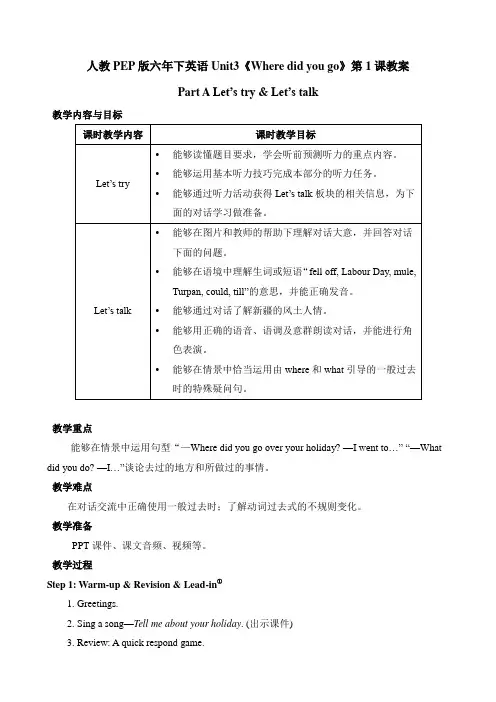
人教PEP版六年下英语Unit3《Where did you go》第1课教案Part A Let’s try & Let’s talk教学内容与目标教学重点能够在情景中运用句型“—Where did you go over your holiday? —I went to…” “—What did you do? —I…”谈论去过的地方和所做过的事情。
教学难点在对话交流中正确使用一般过去时;了解动词过去式的不规则变化。
教学准备PPT课件、课文音频、视频等。
教学过程Step 1: Warm-up & Revision & Lead-in①1. Greetings.2. Sing a song—Tell me about your holiday. (出示课件)3. Review: A quick respond game.The teacher shows some verbs on the PPT. Students try to say their past or original forms as soon as possible. The fastest one can get a reward.4. Lead-in.The teacher shows a calendar on the screen. (出示课件)T: What’s the date?Ss: It’s May 1st. It’s the Labour Day holiday.T: Where did you go last Labour Day holiday?Ss: I went to…◆Teaching purpose①歌曲可以激发学生的学习兴趣,引入假期这个话题。
以师生互动游戏的方式简单复习动词原形与其过去式的转换,回顾上个单元的重点知识。
通过引导学生观察并讨论图片,自然地引出短语“the Labour Day holiday”,并通过问答的方式引出本课讨论话题。
PEP人教版六年级英语下册第三单元课课练(附答案)
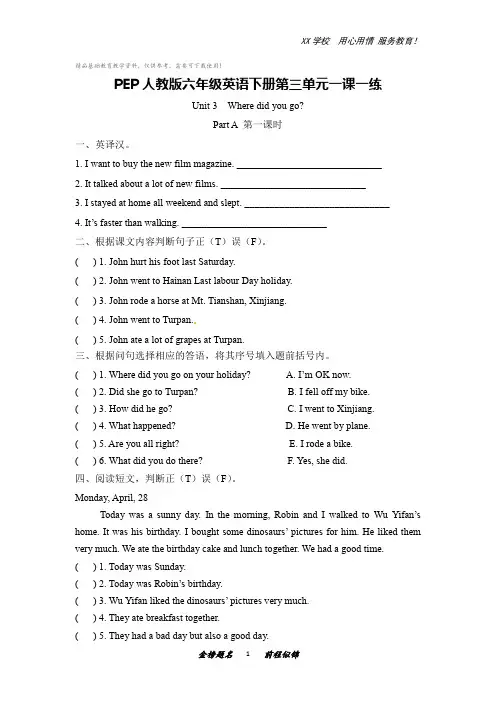
精品基础教育教学资料,仅供参考,需要可下载使用!PEP人教版六年级英语下册第三单元一课一练Unit 3 Where did you go?Part A 第一课时一、英译汉。
1. I want to buy the new film magazine. _____________________________2. It talked about a lot of new films. _____________________________3. I stayed at home all weekend and slept. _____________________________4. It’s faster than walking. _____________________________二、根据课文内容判断句子正(T)误(F)。
( ) 1. John hurt his foot last Saturday.( ) 2. John went to Hainan Last labour Day holiday.( ) 3. John rode a horse at Mt. Tianshan, Xinjiang.( ) 4. John went to Turpan.( ) 5. John ate a lot of grapes at Turpan.三、根据问句选择相应的答语,将其序号填入题前括号内。
( ) 1. Where did you go on your holiday? A. I’m OK now.( ) 2. Did she go to Turpan? B. I fell off my bike.( ) 3. How did he go? C. I went to Xinjiang.( ) 4. What happened? D. He went by plane.( ) 5. Are you all right? E. I rode a bike.( ) 6. What did you do there? F. Yes, she did.四、阅读短文,判断正(T)误(F)。
Unit 3 Where did you go? Part A Let's talk(教案)-202
Unit 3 Where did you go? Part A Let’s TalkOverviewThis lesson is part of the English curriculum for the 2022-2023 academic year for sixth-grade students. The lesson will focus on learning new vocabulary and using simple past tense to describe past experiences. The goal of this lesson is for students to be able to communicate about their past experiences in English.ObjectivesBy the end of this lesson, students will be able to:•Identify new vocabulary related to places and transportation•Use simple past tense to describe past experiences•Ask and answer questions about past experiencesMaterialsThe following materials will be needed for this lesson:•Whiteboard or blackboard•Markers/chalk•Flashcards with pictures of places and modes of transportation•Handouts with conversation questionsProcedureWarm-up (5 minutes)Ask students where they have been recently. Ask follow-up questions such as:•When did you go there?•How did you get there?•Did you enjoy it?Vocabulary (10 minutes)Introduce new vocabulary related to places and modes of transportation. Use flashcards with pictures to help students understandthe new words. Encourage students to repeat the words after you and ask questions if they’re uncertain.Some of the vocabulary words include:•museum•park•cinema•bus•train•bicycleConversation practice (20 minutes)Distribute handouts with conversation questions to students. The questions should be related to past experiences and can be as follows:•Where did you go on your last holiday?•How did you get there?•What did you do there?Encourage students to use the new vocabulary in their answers. Have students pair up and take turns asking and answering the questions. Walk around the class to monitor and help students if needed.Grammar lesson (10 minutes)Introduce simple past tense to students. Explain that it is used to talk about past actions or events that have already happened. Formulate simple past tense sentences using the new vocabulary and write them on the board.For example:•I went to the park yesterday.•We took a bus to the museum.•She rode her bicycle to the cinema.Sentence building (20 minutes)In pairs, have students create their own sentences about past experiences using the new vocabulary and simple past tense. Encourage them to be creative and use descriptive language in their sentences.Closure (5 minutes)Ask students to share their sentences with the class. Give feedback and correct any errors if necessary. Ask students to reflect on what they learned and how they can use the new vocabulary and simple past tense in their everyday conversations.HomeworkFor homework, students will write a short paragraph about a recent trip or experience they had using the new vocabulary and simple past tense.ConclusionBy the end of this lesson, students should be comfortable using simple past tense to describe past experiences using the new vocabulary. This lesson will help students communicate better in English and encourage them to use more descriptive language.。
人教PEP六年级英语下册Unit3 Where did you go?教案教学设计(含教学反思)
Unit 3 Where did you go?Part A 第一课时 (1)Part A 第二课时 (4)Part A 第一课时Let’s try & Let’s talk教学目标1.能听、说、认读fell,off,mule,could,till,Labour Day,Turpan等词汇。
2.能听懂Let’s try的内容,并完成对应的训练题。
3.能理解Let’s talk的内容,并能熟练朗读对话。
教学重点1.听、说、认读句子:What happened?Are you all right?I’m OK now.Where did you go?Did you go to Turpan?Yes,we did.2.理解重点句型,并能运用过去式谈论假期活动。
教学难点运用句型“Where did you go?What did you do?”询问并回答有关假期去过的地方及做过的事情。
教学准备1.单词卡片2.录音机及录音带或教学光盘3.多媒体课件教学过程Step 1:Warm-up1.师生相互问候。
2.播放英语歌“Tell me about your holiday”,让学生跟着录音学唱。
3.“打擂台”游戏。
规则:请五名学生到教室前面,教师任意抽取一张短语卡片,让五名学生根据卡片上的内容造句,如:I watched TV last weekend.不能正确造句的学生即被淘汰出局。
然后教师出示另一张卡片,留在台上的学生继续比赛。
最后留在台上的学生成为擂主。
Step 2:Presentation1.Let’s try.(1)教师通过问候对话谈论的关于假期的话题,引导学生猜猜看John的假期过得怎么样。
(2)教师播放录音,学生完成题目。
(3)教师追问学生:Why was John at home?引导学生进行猜测。
教师再次放录音,学生根据录音回答问题。
2.Let’s talk.(1)教师播放本部分动画,学生带着问题观看动画,看后回答问题:①What happened to John last Saturday?②What did they talk about later?(2)教师利用图片帮助学生理解短语fell off;教师结合日历,让学生理解Labour Day holiday的概念。
六年级英语下册第三单元unit3 Where did you go基于标准的教学设计
六年级英语下册第三单元unit3 Where did you go?基于标准的教学设计教材来源:教育部审定2013义务教育教科书内容来源:小学英语六年级下册Unit3A Let’s try& Let’s talk.教学主题:Where did you go?课时:共6课时,第1课时授课对象:六年级学生目标确定的依据:1.课程标准相关要求(1)基于语言技能能借助图片、图像、手势听懂简单的话语或录音材料;能听懂课堂活动中简单的提问;能听懂常用指令和要求并做出适当的反应;能在口头表达中做到发音清楚、语调达意。
(2)基于情感态度能按要求用简单的英语做游戏,能体会到英语学习的乐趣;在学习中集中注意力;敢于开口,表达中不怕出错误。
(3)基于学习策略积极参与各种课堂学习活动,积极与他人合作,共同完成学习任务。
2.教材分析本课时先在Let’s try部分通过John应答Amy和张鹏的电话、说明自己没有上课的原因这一情景,来呈现新句型。
Let’s talk部分通过Amy去John家探望受伤的John,并通过照片分享John在五一假期活动的情景,来呈现核心句型Where did you go …? What did you do? 学生在第二单元对过去时已有基本的了解,本课时可以将新旧知识相结合,以旧引新,充分调动学生的生活记忆,体现教学的衔接性。
3.学情分析通过前7册的英语学习,六年级学生具备一定的听、说、读、写、演能力。
如:能用正确的语音、语调朗读对话。
能够根据要求进行角色表演。
六年级学生思维活跃,逐步学会独立进行逻辑论证,语言学习大多仍以经验感知型为主,而本学段学生随着知识的积累和对事物体验的深化,内心世界比较丰富,教学可从学生的已有的生活体验作为切入点。
教学目标:1. 能够用正确的语音、语调朗读对话,并能进行角色表演。
2. 能在情景中恰当运用由Where和What引导的特殊疑问句(一般过去时)进行沟通和交流。
Unit 3 Where did you go?Part A教案设计-人教版(三起)英语六年级下册
活动设计意图:通过观看视频和图片能充分调动学生的整体感观,提高参与度,并且游戏教学能够寓教于乐,激发了学生的学习兴趣,让他们对此记忆深刻,在学习知识的同时形成了积极的学习态度,又很好地巩固所学知识。
4)听录音朗读单词和句型
5)复述约翰的周六故事
请几位学生扮演约翰的一家人演周六的活动
Step3. Consolidation
1) Make a survey
提示:要求用句型Where did you go last summer/winter holiday?和What did you do ?来提问班上的同学。
Name
Where?
What?
Wu Yifan
媒介运用:PPT、调查表
媒介运用:图片、PPT、视频
活动设计意图:通过教师的暑假活动带出John的周六假期活动,观看视频引出约翰去了一个森林公园。并通过图片训练Where did you go ? I went to ….句型。视频的设置目的是把五个新单词串成一个简短的故事,情境中教学单词,以便学生记忆单词。
Step2. Presentation and practice
to Zhaoqing . He ate good
food…
4.Summing
Summing up
1. Words:
rode a horse, rode a bike, went camping, went fishing, hurt my foot.
2.Sentences:
Where did you go last Saturday? I went to a forest park. What did you do there? I rode a bike.