
Volume 2.8 轨道交通车辆发车前检查推荐规范
8. Recommended Practice for Rail Transit Vehicle Pre-Departure InspectionApproved October 21, 2002APTA Rail Transit Standards Vehicle Inspection and Maintenance CommitteeApproved May 23, 2003APTA Rail Transit Standards Task ForceAuthorized September 28, 2003APTA Rail Transit Standards Executive CommitteeAbstract: This recommended practice provides guidance for the pre-departure inspection of systems and components on rail transit vehicles. The recommended practice covers a pre-departure vehicle exterior inspection, interior inspection and brake system tests.Keywords: rail transit system, rail transit vehicle, vehicle inspection and maintenance, pre-departure inspectionCopyright © 2004 by The American Public Transportation Association1666 K Street, NW, Washington, DC, 20006-1215, USANo part of this publication may be reproduced in any form, in an electronic retrieval system or otherwise, without the prior written permission of The American Public Transportation Association.Introduction(This introduction is not a part of APTA RT-RP-VIM-008-03, Recommended Practice for Rail Transit Vehicle Pre-Departure Inspection.)This Recommended Practice for Rail Transit Vehicle Pre-Departure Inspection represents a common viewpoint of those parties concerned with its provisions, namely, transit operating/planning agencies, manufacturers, consultants, engineers and general interest groups. The application of any standards, practices or guidelines contained herein is voluntary. In some cases, federal and/or state regulations govern portions of a rail transit system’s operations. In those cases, the government regulations take precedence over these recommended practices. APTA recognizes that for certain applications, the standards or practices, as implemented by individual rail transit systems, may be either more or less restrictive than those given in this document.This document describes the basic pre-departure inspection requirements for rail transit vehicles. APTA recommends the use of this standard by:–Individuals or organizations who perform rail transit vehicle pre-departure inspections;–Individuals or organizations that contract with others for the performance of the pre-departure inspection of rail transit vehicles; and–Individuals or organizations who influence how pre-departure inspections of rail transit vehicles are performed.ParticipantsThe American Public Transportation Association greatly appreciates the contributions of the following individual(s), who provided the primary effort in the drafting of the Recommended Practice for Rail Transit Vehicle Pre-Departure Inspection:Hannie L. Woodson, Jr. Jayendra N. Shah Dave BarberJohn D. SadoraBrian Whately Clive ThornesJoe MarieJim O’ KellyPhil EberlBrian LeyDave BarberDavid BlizzardTom PeacockAt the time that this recommended practice was completed, the VIM Committee included the following members:Jayendra Shah, ChairBen Antonio, Vice ChairDave Barber Richard Berk David Blizzard Stephen Bonina Joseph Brattelli Gordon Campbell Dhiren Chakraborty Lisa CobbJohn Condrasky Phil EberlChris EichinKevin JohnsonPaul KovacsBrian LeyBill McCoyLemuel ProctorThomas PeacockDavid PhelpsJames PlominJohn SadorraMario SequeiraJohn SheaClive ThornesBrian WhatelyHannie WoodsonAPTA Rail Transit Standards Vehicle Inspection and Maintenance Committee project consultant:Gordon S. Campbell, LDK EngineeringAPTA Rail Transit Standards project team:Gabrielle Bayme, Standards Development Program Specialist and Project EditorSaahir Brewington, Administrative Assistant and Project EditorAntoinette Hankins, Program AssistantThomas Peacock, Director-Operations & Technical ServicesDavid Phelps, Senior Project Manager - Rail ProgramsContents1. Overview................................................................................................................................................8.1 1.1 Scope....................................................................................................................................................8.1 1.2 Purpose.................................................................................................................................................8.12. References..............................................................................................................................................8.13. Definitions, abbreviations, and acronyms..............................................................................................8.1 3.1 Definitions............................................................................................................................................8.1 3.2 Abbreviations and acronyms................................................................................................................8.24. Background............................................................................................................................................8.25. Requirements..........................................................................................................................................8.3 5.1 Safety....................................................................................................................................................8.3 5.2 General requirements...........................................................................................................................8.36. Vehicle inspections................................................................................................................................8.4 6.1 Operating cab inspection......................................................................................................................8.4 6.2 Vehicle pre-departure exterior inspection............................................................................................8.5 6.3 Vehicle pre-departure interior inspection............................................................................................8.66.4 Brake system functional check.............................................................................................................8.77. Correction of deficiencies......................................................................................................................8.78. Supervisory oversight.............................................................................................................................8.7 Annex A (informative) Bibliography........................................................................................................8.8Recommend Practice for Rail Transit VehiclePre-Departure Inspection1. OverviewThis recommended practice provides guidance for the development of pre-departure inspections of rail transit vehicles. Individual rail transit systems should tailor these recommended practices to accommodate their specific equipment and mode of operation.1.1 ScopeThis recommended practice applies to rail transit systems that operate light rail, heavy rail or rail subway systems. This recommended practice does not apply to rail transit systems regulated by the Federal Railroad Administration. This document should be used by rail transit systems that operate under Federal Transit Administration state safety oversight jurisdiction.1.2 PurposeThis recommended practice provides recommendations for pre-departure inspections of rail transit vehicles to confirm the fitness for service of these vehicles. This recommended practice includes a pre-departure operator’s cab check, vehicle exterior inspection, vehicle interior inspection and brake system functional check.As resources and operating tempo permit, some rail transit systems may be able to perform an expanded pre-departure inspection that incorporates inspection of items and systems related to comfort, quality, and reliability.2. ReferencesSpecific rail transit system’s (RTS) standard operating procedures and/or policies for conducting vehicle pre-departure inspections.3. Definitions, abbreviations, and acronyms3.1 DefinitionsFor the purposes of this standard, the following terms and definitions apply:3.1.1 contractor: a person under contract with the RTS or an employee of a person under contract with the RTS to perform inspection and/or maintenance of rail transit vehicles.3.1.2 deadman control: a pressure or activity actuated device that detects inattention or disability of a train operator.3.1.3 heavy rail system: a railway with the capacity for a “heavy volume” of traffic and characterized by exclusive rights-of-way, multi-car trains, high speed and rapid acceleration, sophisticated signaling and high platform passenger loading. Also known as “rapid rail”, “subway” or “elevated railway”.3.1.4 light rail system: a railway that may use shared or exclusive rights-of-way. Light rail systems may run trains intermingled with street traffic. Light rail systems frequently operate with low platform loading and single car trains. Also known as “street car”, “trolley car” or “tram”. 3.1.5 pre-departure inspection: a visual and/or functional check of rail transit vehicle components or systems, performed prior to placing a vehicle or train into revenue service, conducted in accordance with local RTS procedures by a person trained to have the necessary skills and knowledge to effectively perform these tasks.3.2 Abbreviations and acronymsADA Americans with Disabilities ActCCTV Closed Circuit TelevisionOEM Original Equipment ManufacturerRTS Rail Transit System\4. BackgroundDue to the many differences in vehicle design, system size and operating tempo among rail transit systems, the committee determined that a standard set of inspection criteria to be used across the industry is not workable. Specifically what to and how to inspect needs to be determined individually by each RTS based on their specific equipment design(s) and operating environment.The committee set the following guiding principles to develop the pre-departure inspection:–The inspection should not require the vehicle to be placed over a pit;–The inspection should not require coupling or uncoupling of vehicles;–The inspection could be performed by either operating or maintenance personnel, but anyone doing the inspection must be adequately trained to do so;–The inspection should be a walk around and walk through visual examination looking for obvious defects; and–The recommended practice should provide flexibility for rail transit systems to inspect some items on a less frequent than pre-departure basis based on past safe operating history.Rail transit systems should develop local policies and procedures that implement the recommended practice. The local policies and procedures should be based on manufacturers’ recommendations and operating experience with the equipment covered. Since the purpose of the pre-departure inspection is to ensure safety, local policies and procedures must provide clear guidance and criteria for removing vehicles from or not placing vehicles in revenue service when safety critical defects are identified.5. Requirements5.1 SafetyEstablished RTS safety practices, rules and procedures must be followed at all times in the performance of these inspections.5.2 General requirementsEach RTS should determine which vehicle systems or components must be inspected on a pre-departure basis.Each RTS should identify those vehicle systems or components, which (based on extensive past operating experience) do not require a pre-departure inspection but can be inspected at greater intervals. Each RTS shall develop and conduct a periodic inspection and maintenance program with required inspection frequencies for these systems or components.Each RTS should perform a pre-departure inspection of the systems or components, identified in accordance with Section 6 of this recommended practice, on each rail transit vehicle prior to placing that vehicle in revenue service. That pre-departure inspection should consist of:- an operator’s cab check;- an external vehicle inspection;- an internal vehicle inspection; and- a brake system functional check.Each RTS should develop specific written policies and procedures that take into account specific equipment designs and local operating conditions to implement the vehicle pre-departure inspections recommended by this recommended practice. These policies and procedures should give inspectors clear guidance and criteria for reporting equipment that should be removed from or not placed into revenue service.Each RTS should ensure that employees and/or contractors responsible for the performance of vehicle inspections have the skills and knowledge required to effectively perform the inspections assigned to them. Refer to APTA RT-RP-VIM-011, Recommended Practice for Rail Transit Vehicle Inspection Training and Qualifications, for guidance on training for inspecting rail transit vehicles.6. Vehicle inspectionsThe vehicle inspections and tests recommended by sections 6.1 through 6.4 should be conducted prior to placing the vehicle into revenue service or operations (i.e. work train service, testing, plowing, etc.).NOTE: Light rail and heavy rail vehicle designs differ. Light rail vehicles are often designed for street running and are equipped with additional street running safety features. If a vehicle is not equipped with a listed component or system, the corresponding pre-departure inspection of the component/system may be omitted. Also, all repairs and adjustments are to be made in accordance with the RTS policies and procedures.6.1 Operating cab inspectionInspect and/or test all the cab components or systems identified by the RTS. Rail transit systems should consider including the following in the operator’s cab pre-departure inspection:a)Presence of restrictive operating tags or devices;b)Train configuration settings;c)Train control settings;d)Cab signal equipment;e)Electrical circuit breakers;f)Windshield Wipers and Washers;g)Windshield and side glazing;h)Horns, Gongs and Bells;i)Radio, Public Address and Intercom Systems;j)Side View Cameras;k)Interior/Exterior Mirrors;l)Closed Circuit Television (CCTV) Interior Surveillance;m)Equipment Panel’s Covers and Guards: secured;n)Cab Lights, Gauges, and Indicators;o)Emergency Equipment/Tools;p)Annunciator Panel Indicators (normally equipped with a test feature to ensure indicator lights are functional);q)All Doors Closed (and locked if applicable) indication;r)All doors locked per RTS Policy; ands)Train Operator Display (TOD).6.2 Vehicle pre-departure exterior inspectionWhen possible, and in accordance with RTS yard and track safety rules and procedures, conduct a full walk around visual inspection of the vehicle for obvious defects. If the rail yard configuration does not allow full walk around inspections to be safely done, only one side of the vehicle may be inspected. As much as possible without uncoupling or going under the vehicle, inspect all systems or components identified by the RTS for visual defects, presence, and function. Rail transit systems should consider including the following components or systems as part of the pre-departure inspection:a)Train make-up;b)Presence of restrictive operating tags;c)Coupler assembly and draft gear (as can be inspected without uncoupling);d)Pilot/Snow Plow;e)Track brake;f)Parking brake/handbrake;g)Headlights;h)Tail lights;i)Brake lights;j)Marker Lights;k)Equipment provided for the disadvantaged;l)Directional Turn Signals;m)Sander;n)Wheels and Wheel Bearings where visibleo)Friction Brake Components where visiblep)Steps, Stairs, threshold plates and anti-climbers;q)Handholds;r)Windows and Window Gaskets and Seals;s)Exterior Emergency Signaget)Status of Exterior Emergency Indicators;u)Electrical cables, jumpers and connectors (as can be inspected without disconnecting or uncoupling);v)Pantographs, Current Collectors or Fuel Level;w)Buffers, Springs, Chains, and/or diaphragms between cars;x)Automatic Train Control (ATC), Automatic Train Operation (ATO), and Automatic Train Protection (ATP) components;y)Transponders;z)Trip Switches or Trip Cocks;aa)Air Suspension System Levelers;bb)Brake Cutouts; andcc)Carbody damage, dragging equipment or fouling debris that would interfere with safe train movement.6.3 Vehicle pre-departure interior inspectionWhile performing an interior walk through, inspect all components or systems identified by the RTS for obvious visual defects, presence, and function. Rail transit systems should consider including the following as part of the vehicle interior pre-departure inspection:a)Floors, Passages and Aisle Ways;b)Interior Lighting;c)Emergency Lighting;d)Emergency Tools and Equipment;e)Emergency Signs/Decals;f)Emergency Window Exits;g)Emergency Brake Handles;h)Seats;i)Luggage Racks;j)ADA Equipment;k)Heating, Ventilating and Air Conditioning;l)Side Passenger and Emergency Doors;m)Circuit Breakers; andn)All doors locked per RTS Policy.6.4 Brake system functional checkA functional check of the friction brake system shall be made in accordance with the RTS’s policies and procedures. Rail transit systems should consider checking the following:a)Deadman or alerter feature;b)Train operator’s emergency brake application actuation device;c)Friction brake apply and release, normal function and indications; andd) A low speed brake application.7. Correction of deficienciesAny deficiencies uncovered during the inspections in Sections 6.1, 6.2, 6.3 or 6.4 should be corrected in accordance with established RTS policies and Original Equipment Manufacturer (OEM) recommendations.8. Supervisory oversightSupervisors of RTS employees or contractors assigned vehicle inspection and maintenance tasks should conduct spot checks or use other techniques to ensure that the assigned tasks, including pre-departure inspections, are performed in accordance with the RTS’s policies and procedures.Annex A (informative)Bibliography[B1]Bay Area Rapid Transit (BART), Procedure 405, Train Dispatch[B2]Bay Area Rapid Transit (BART), Procedure 503, Friction Brake Test[B3]Bay Area Rapid Transit (BART), Procedure 504, Movement on Yard Tracks[B4]Bay Area Rapid Transit (BART), Procedure 507, Revenue Ready Train[B5]Chicago Transit Authority, Duties and Responsibilities of the Rapid Transit Operator, Publication Number 8149, 3/8/99.[B6]Chicago Transit Authority, Yard Inspection of Rail Revenue Vehicle (exterior) Daily, Bulletin 1-003A, 7/31/01.[B7]Chicago Transit Authority, Yard Inspection of Rail Revenue Vehicle (interior) Daily, Bulletin 1-002A, 7/31/01.[B8]Chicago Transit Authority, Rail System Rule Book, August 1, 2000.[B9]Southeastern Pennsylvania Transportation Authority, Train Make-Up Procedures Training Bulletin, 3/31/00.[B10]Niagara Frontier Transit Metro System Inc., Standard Operating Procedure for Pre-Trip Vehicle Inspection, Publication Number 105.7, 6/1/98[B11]GO Transit, Trip Inspection Coach, Inspection Item, C.2.2.[B12]GO Transit, Trip Inspection Locomotive, Inspection Item, C.2.1。
地铁车务站运营前检查作业标准
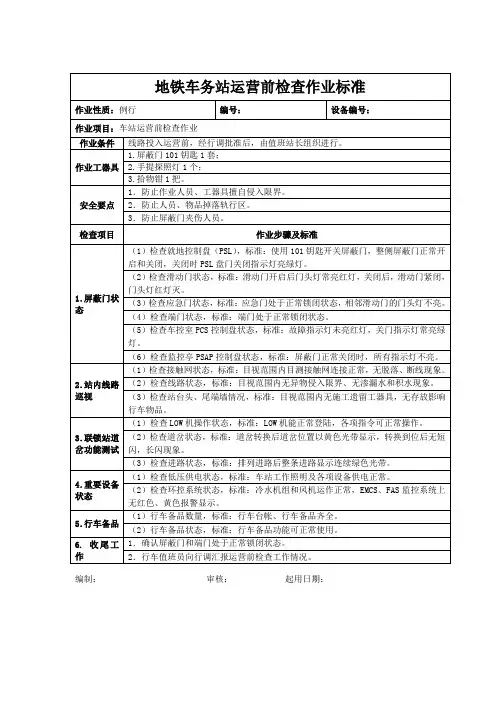
(5)检查车控室PCS控制盘状态,标准:故障指示灯未亮红灯,关门指示灯常亮绿灯。
(6)检查监控亭PSAP控制盘状态,标准:屏蔽门正常关闭时,所有指示灯不亮。
2.站内线路巡视
(1)检查接触网状态,标准:目视范围内目测接触网连接正常,无脱落、断线现象。
(2)检查线路状态,标准:目视范围内无异物侵入限界、无渗漏水和积水现象。
1.确认屏蔽门和端门处于正常锁闭状态。
2.行车值班员向行调汇报运营前检查工作情况。
编制:审核:起用日期:
检查项目
作业步骤及标准
1.屏蔽门状态
(1)检查就地控制盘(PSL),标准:使用101钥匙开关屏蔽门,整侧屏蔽门正常开启和关闭,关闭时PSL盘门关闭指示灯亮绿灯。
(2)检查滑动门状态,标准:滑动门开启后门头灯常亮红灯,关闭后,滑动门紧闭,门头灯红灯灭。
(3)检查应急门状态,标准:应急门处于正常锁闭状态,相邻滑动门的门头灯不亮。
4.重要设备状态
(1)检查低压供电状态,标准:车站工作照明及各项设备供电正常。
(2)检查环控系统状态,标准:冷水机组和风机运作正常,EMCS、FAS监控系统上无红色、黄色报警显示。
5.行车备品
(1)行车备品数量,标准:行车台帐、行车备品齐全。
(2)行车备品状态,标准:行车备品功能可正常使用。
6.收尾工作
(3)检查站台头、尾端墙情况,标准:目视范围内无施工遗留工器具,无存放影响行车物品。
3.联锁站道岔功能测试
(1)检查LOW机操作状态,标准:LOW机能正常登陆,各项指令可正常操作。
(2)检查道岔状态,标准:道岔转换后道岔位置以黄色光带显示,转换到位后无短闪,长闪现象。
城市轨道交通安全检查操作规范
城市轨道交通安全检查操作规范一、前言城市轨道交通是现代城市快速交通的重要组成部分,其线路经过城市中心区域及居民区域。
因此,保障城市轨道交通运营安全至关重要。
本文旨在制定城市轨道交通安全检查操作规范,规范城市轨道交通安全检查的工作流程,确保城市轨道交通的运营安全。
二、检查对象城市轨道交通安全检查的对象主要包括如下几个部分:1. 列车检查列车的安全设施和电气系统是否正常,列车外部以及内部是否有明显损坏或者异味;列车内部是否符合清洁卫生要求,铁路线路是否平整、整洁无损。
2. 轨道检查铁路轨道的状态是否良好,轨道是否平整、鲜明标线、接缝是否紧密,轨道钢轨的焊接是否密实。
3. 信号设备检查信号设备是否完好,信号灯是否明亮、信号标志是否清晰、信号机是否正常,安全门是否灵活、开闭正常。
4. 线路设备检查线路设备是否完好,例如电源设备、通讯设备、监控系统的设备是否正常等。
5. 车站检查车站的设施是否完善,警示标志是否醒目,站台和车站出入口的洁净度和卫生情况是否符合要求。
三、操作规范1. 前期准备对于城市轨道交通安全检查工作,必须提前做好必要的准备,例如:(1)检查人员必须配备必要的工具和仪器设备,例如检测仪、检测仪器等。
(2)检查人员必须穿着合适的工作服和工作鞋,在进入检查区域之前必须进行安全教育,确保做好安全防护工作。
(3)检查工作必须严格按照检查时间表进行,尽量在铁路停运时间进行检查,保证检查对铁路运营的影响最小化。
2. 检查方式在检查城市轨道交通安全问题的时候,可以采用如下几种方式:(1)目视检查固定在指定位置巡视,目视检查是否存在安全隐患,例如列车底部是否存在异物,安全门是否灵活通畅。
(2)手动检查用手工操作设备或关注设备状态的变化,检查信号设备、列车动力系统等方面的安全问题。
(3)仪器检查采用仪器设备检测电气设备、线路或轨道的状态变化情况,并保持记录以备后查。
(4)样本检测采用抽样检测的方法,检测信号设备、列车底部、轨道等方面的安全情况,并针对检测结果做出调整和改进。
城市轨道交通安全检查操作规范

城市轨道交通安全检查操作规范城市轨道交通安全检查操作规范一、前言城市轨道交通作为大型公共交通系统,在人们的出行中扮演着非常重要的角色。
为了确保城市轨道交通的安全运行,保障乘客出行安全,研究制定了本操作规范,旨在规范安全检查操作流程,提高工作效率,保障城市轨道交通的安全运行。
二、适用范围本操作规范适用于城市轨道交通线路、车站及车辆的安全检查工作。
三、检查前准备1.检查人员应熟悉城市轨道交通安全规章制度和专业知识。
2.检查前应对工作内容、范围和方法进行清晰明确的交流和沟通。
3.检查前应进行必要的安全防护措施,包括佩戴安全帽、手套等个人防护装备,进行危险区域封锁等。
4.检查前应检查检测设备的运行状况,确保设备正常。
5.检查前应对检测设备进行校准和测试,确保检测数据准确无误。
四、检查流程1.轨道线路检查流程(1)检查隧道内是否有摆放杂物,人员是否入内,是否存在嶙峋的岩石、可燃物等物品。
(2)检查隧道牢固性和排水情况,发现问题及时报告。
(3)检查道岔、轨道、轨枕和钢轨的连接情况,有异常情况及时发现和处理。
(4)检查轨道的水平和竖直度,确保列车行驶的平稳。
(5)检查信号系统是否正常,信号设备是否完好,发现问题及时处理。
2.车站检查流程(1)检查站厅安全设施是否完好,如防护门、防护栏等情况。
(2)检查站内洗手间、自动扶梯、电梯、照明设备等设施是否正常运转。
(3)检查站台的平整程度和照明情况,最大限度确保乘客的安全。
(4)检查安检设备是否正常,防盗设备是否启用。
(5)检查站内广播系统是否正常,清晰明了。
3.车辆检查流程(1)检查车辆整体结构是否完整,车体、车轮等部件是否存在危险因素。
(2)检查制动系统及其防护装置,确保制动系统的可靠性。
(3)检查行驶系统的工作状况,如百叶窗、电动门等是否正常。
(4)检查零部件的密封性能及连接情况,如连轴器、管道等。
(5)检查乘客空间的布局是否能保障乘客的安全,如扶手是否牢固,座椅多高等。
车辆发车前例检制度范本

车辆发车前例检制度范本一、目的和范围本制度的目的是规范车辆发车前的例检工作,确保车辆在发车前处于良好的工作状态,保障乘客的安全出行。
本制度适用于公司所有车辆的每次发车前例检。
二、车辆发车前例检的内容和要求1. 车辆外观检查a. 检查车辆整体外观是否整洁,车身是否有明显的刮擦或破损。
b. 检查车辆玻璃是否完好,无裂痕或破损。
c. 检查车辆灯光是否正常,包括前大灯、示廓灯、转向灯等。
d. 检查车辆轮胎是否充气正常,胎面是否有磨损或异物卡入。
2. 车辆内部检查a. 检查车辆座椅是否完好,无破损或松动。
b. 检查车辆安全带是否正常运作,无卡滞或损坏。
c. 检查车辆空调系统是否正常运作,温度和风力是否正常。
d. 检查车辆音响系统是否正常运作,能否播放音乐或广播。
3. 车辆机械部件检查a. 检查车辆刹车系统是否正常,踏板是否有松动或卡滞现象。
b. 检查车辆悬挂系统是否正常,有无异常的杂音或过度震动。
c. 检查车辆发动机运转状态,能否平稳启动,有无异常响声。
d. 检查车辆转向系统是否正常,转向灵活,无卡滞或异常现象。
4. 其他检查事项a. 检查车辆安全设备是否齐全,包括灭火器等。
b. 检查车辆驾驶员证照是否齐全,包括驾驶证和从业资格证。
三、责任和流程1. 车辆发车前例检责任a. 车辆驾驶员负责进行车辆发车前的例检,并记录检查结果。
b. 相关部门负责对车辆发车前例检结果进行审核和跟踪。
2. 车辆发车前例检流程a. 每个发车交接班时,驾驶员需要对自己负责车辆进行发车前例检。
b. 驾驶员按照预设的例检内容进行检查,发现问题及时记录,并报告相关部门。
c. 相关部门会对例检结果进行审核,并记录结果,核实问题处理情况。
四、记录和处理1. 例检结果记录a. 驾驶员需要将例检结果记录在统一的例检表中,包括检查的日期、车辆信息、例检内容以及结果。
b. 驾驶员需要将例检表上报给相关部门,由相关部门进行审核。
2. 问题处理a. 驾驶员发现问题后,需立即报告相关部门,等待相关部门的处理指示。
轨道运输现场检查标准
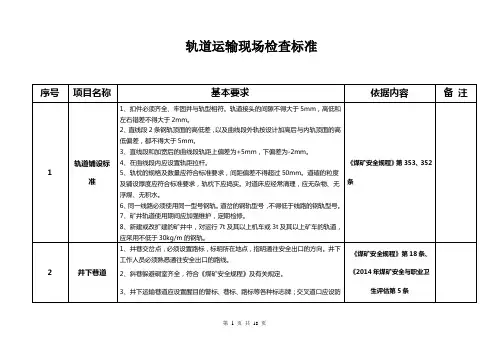
轨道运输现场检查标准序号项目名称基本要求依据内容备注1 轨道铺设标准1、扣件必须齐全、牢固并与轨型相符。
轨道接头的间隙不得大于5mm,高低和左右错差不得大于2mm。
2、直线段2条钢轨顶面的高低差,以及曲线段外轨按设计加高后与内轨顶面的高低偏差,都不得大于5mm。
3、直线段和加宽后的曲线段轨距上偏差为+5mm,下偏差为-2mm。
4、在曲线段内应设臵轨距拉杆。
5、轨枕的规格及数量应符合标准要求,间距偏差不得超过50mm。
道碴的粒度及铺设厚度应符合标准要求,轨枕下应捣实。
对道床应经常清理,应无杂物、无浮煤、无积水。
6、同一线路必须使用同一型号钢轨。
道岔的钢轨型号,不得低于线路的钢轨型号。
7、矿井轨道使用期间应加强维护,定期检修。
8、新建或改扩建的矿井中,对运行7t及其以上机车或3t及其以上矿车的轨道,应采用不低于30kg/m的钢轨。
《煤矿安全规程》第353、352条2 井下巷道1、井巷交岔点,必须设臵路标,标明所在地点,指明通往安全出口的方向。
井下工作人员必须熟悉通往安全出口的路线。
2、斜巷躲避硐室齐全,符合《煤矿安全规程》及有关规定。
3、井下运输巷道应设臵醒目的警标、巷标、路标等各种标志牌;交叉道口应设防止侧面冲撞的装臵,主要交叉点及弯道处应设道岔指示器或预警灯。
《煤矿安全规程》第18条、《2014年煤矿安全与职业卫生评估第5条4、斜巷信号硐室、运输绞车车房、候车室、充电硐室、井下运输车辆检修硐室应符合《煤矿安全规程》及有关规定要求。
5、车场、车房、硐室、巷道弯道半径、巷道连接方式、运输方式应设计合理。
3 轨道系统1、运行7t及以上机车、3t及以上设备时线路轨型不低于30kg/m。
2、主要运输线路(主要运输大巷和主要运输石门、井底车场、主要斜巷车道,地面运煤、运矸石线路和集中运载站车场的轨道)及行驶人车的轨道线路质量应达到优良。
3、其他轨道线路质量达到合格,不得有杂拌道(异型轨道长度小于50m为杂拌道).。
轨道车出库前的准备检查作业指导书
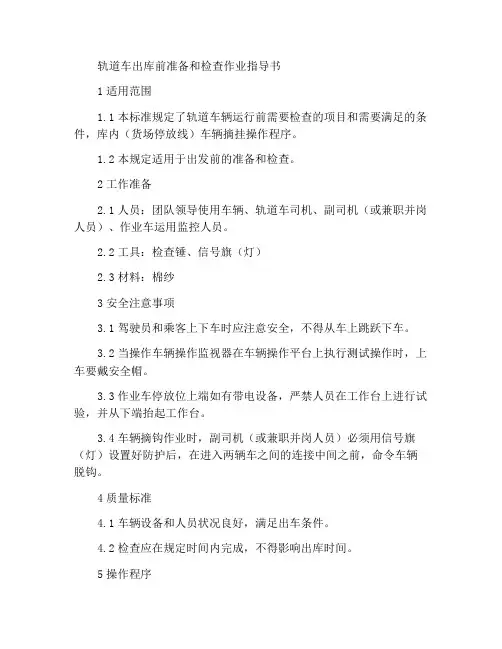
轨道车出库前准备和检查作业指导书1适用范围1.1本标准规定了轨道车辆运行前需要检查的项目和需要满足的条件,库内(货场停放线)车辆摘挂操作程序。
1.2本规定适用于出发前的准备和检查。
2工作准备2.1人员:团队领导使用车辆、轨道车司机、副司机(或兼职并岗人员)、作业车运用监控人员。
2.2工具:检查锤、信号旗(灯)2.3材料:棉纱3安全注意事项3.1驾驶员和乘客上下车时应注意安全,不得从车上跳跃下车。
3.2当操作车辆操作监视器在车辆操作平台上执行测试操作时,上车要戴安全帽。
3.3作业车停放位上端如有带电设备,严禁人员在工作台上进行试验,并从下端抬起工作台。
3.4车辆摘钩作业时,副司机(或兼职并岗人员)必须用信号旗(灯)设置好防护后,在进入两辆车之间的连接中间之前,命令车辆脱钩。
4质量标准4.1车辆设备和人员状况良好,满足出车条件。
4.2检查应在规定时间内完成,不得影响出库时间。
5操作程序5.1操作前的配合和准备程序5.1.1接触网工区使用轨道车施工时,当天的工作负责人必须被任命为车辆运行监督员。
5.1.2接触网工区使用轨道车作业时,应在用车的前日22第二天的工作负责人应在出发前将第二天的调度单提交给轨道车司机。
派车单必须填写出车的时间范围、司机姓名、车辆的往返地点、停车地点、时间要求、车号、派车人、监护人的姓名。
日期应填写填发日期,“时间要求”栏填写使用日期及时间。
任务栏内详细说明当天的工作内容,根据不同的施工地段,制定相应的安全措施(在安全措施栏填写监护人姓名)。
5.1.3车间、车队应合理安排其余司机和乘客,确保司乘人员精神状态良好。
5.1.4值班驾驶员必须参加当天在工作区域内的分工会议。
车辆远离工区停放时,有一名司乘人员参加,另一人看车。
5.1.5大型施工多车编组时,分工会期间出现车站通知调车作业,司乘人员不能参加分工会,指导司机(或车管干部)必须参加分工会。
指导司机(或车管干部)参加分部会议后,应将分部要求及时传达给每位驾驶员和乘客。
城市轨道交通安全检查操作规范
城市轨道交通安全检查操作规范城市轨道交通作为一种重要的交通工具,在保障城市交通畅通和方便市民出行的同时,也需要高度重视安全问题。
为了确保城市轨道交通的安全运营,各城市轨道交通管理部门和运营单位应制定相应的安全检查操作规范,以下是一份参考模板:一、安全检查操作规范的基本要求1.安全检查是城市轨道交通运营安全的重要手段,应按照相关法律法规和标准要求进行操作,确保安全可靠。
2.安全检查操作应具有科学性、有效性和实用性,确保能够全面、细致地排查隐患。
3.安全检查操作应针对不同设备、场所和环境等因素进行有针对性的规定,以确保安全检查的全面性和专业性。
4.安全检查操作应做到目的明确、程序规范、操作严谨、验收准确、记录完整,为安全运营提供可靠依据。
二、安全检查操作规范的具体内容1.安全检查的程序要求(1)确定安全检查的参与人员和责任分工,并进行相关培训和考核。
(2)明确安全检查的时间、频次和对象,并编制相应的计划安排。
(3)制定安全检查的流程和操作指南,明确检查的各个环节和要点。
2.安全检查的内容要求(1)轨道线路:检查线路的平顺度、车辆通行区域的无碍程度、信号系统的运行状态等。
(2)车辆设备:检查车辆的车体、轮对、车门、报警系统、消防系统等设备的完好性和正常运行。
(3)车站设施:检查候车区域的安全性、售票设备的良好运行、站台的平整度和安全设施的完善程度。
(4)人员素质:检查运营人员的工作纪律、作业规范、技能水平等,确保人员不足以导致安全事故。
3.安全检查的方法要求(1)采用综合性的检查方法,包括目测、测量、试验、抽样等多种手段。
(2)严格按照规范要求进行检查,包括检查仪器设备的状态、精度和合法性等。
(3)对发现的问题进行科学分析、判断和评估,确定处理措施,并制定相应的整改计划。
4.检查结果的处理要求(1)对检查结果进行详细记录,包括问题的发现、原因分析、处理措施等,确保记录准确、完整。
(2)根据检查结果,及时采取相应的整改措施,确保问题的及时消除和安全运营的恢复。
城市轨道交通安全检查操作规范
城市轨道交通安全检查操作规范1. 引言城市轨道交通作为现代城市交通体系的重要组成部分,其安全运营对保障市民出行和城市发展至关重要。
为了确保城市轨道交通的安全运营,制定一套完善的安全检查操作规范,对于规范检查流程、提高安全意识、预防事故发生具有重要意义。
本文档旨在提供一套详细的城市轨道交通安全检查操作规范,以指导相关人员进行安全检查工作。
本规范适用于城市轨道交通运营公司及其下属各级单位的安全检查工作。
2. 安全检查流程2.1 前期准备在进行安全检查之前,需要进行充分的前期准备工作,包括但不限于以下内容:•制定安全检查计划,明确检查目标和内容;•组织检查人员,确定检查小组,并明确各自的职责;•准备检查所需的工具、设备和资料;•了解当前的安全运营情况,掌握最新的安全规定和操作流程。
2.2 安全检查程序安全检查程序分为以下几个环节:2.2.1 安全检查准备•检查小组集合,进行必要的安全教育和培训;•分配工作任务,明确检查重点和重要区域;•检查工具和设备是否完好并准备就绪;•确认检查时间、地点和路线。
2.2.2 安全检查实施•按照检查计划和路线,对轨道交通线路、车辆、设备和相关设施进行全面检查;•严格按照规定的检查要求和程序进行操作;•发现问题或隐患时,及时记录并采取相应的措施,确保问题得到解决。
2.2.3 安全检查总结•检查小组汇总检查结果,编制检查报告;•对发现的问题和隐患进行分析和评估,并提出整改意见;•将检查报告和整改意见及时上报给相关部门和领导。
2.3 安全检查要点以下是城市轨道交通安全检查的主要要点:•轨道线路:检查线路的平整度、道岔的工作状态、轨道的磨损程度等;•车辆设备:检查车辆的制动系统、通信设备、电气设备等是否正常运行;•车站设施:检查站台的安全设施、照明、通风系统等是否正常运行和维护;•安全管理制度:检查运营公司的安全管理制度是否完善,员工的安全培训和意识是否到位;•应急救援措施:检查应急救援设备的配备和使用情况,是否能够及时响应突发事件。
轨道车全面检查
一次性出乘作业标准之轨道车全面检查轨道车检查作业顺序及路线1、局部检查顺序:轨道车局部检查顺序原则应由上而下,由内而外,以检查部位为基本点,由左向右,使应检查的部位包括在检查顺序中。
从而做到熟练掌握轨道车检查作业顺序,且检查全面不漏检。
2、绕车全面检查顺序:前端检查→走行部左侧检查→后端检查→走行部右侧检查→上部检查轨道车全面检查及整备检查作业程序前端检查内容1:上大灯、雨刮器、档风玻璃完整,下大灯、标志灯、百叶窗完整。
2:扶手、脚踏安装牢固,脚踏无开焊。
外接电源插头无烧蚀。
3:排障器、排石器安装牢固状态良好、高度符合规定。
排障器低面距轨面高度为90-130mm,排障器橡胶板下缘距轨面25 mm。
4:车钩:钩提杆无弯曲变形,防提销其全有效,车钩体无裂纹、钩舌无弯曲裂纹、油润良好,钩舌销、大钩销、开口销齐全角度符合规定,车钩开关灵活,车钩三态符合标准。
车钩三态即指:开锁位、闭锁位、全开位,闭锁位基本尺寸为110-130mm全开位基本尺寸为220-250mm。
大钩中心线距轨面高度880+-10mm。
5:制动软管:制动软管无裂纹、水压试验未过期水压试验应不超过 6 个月,管卡无松动接口垫完好,联接器无裂纹,折角塞门及制动软管安装牢固、角度正确、无泄漏,防尘堵及安全链齐全有效。
走行部左侧检查内容1:车体外观:车体应平整、油漆无脱落,车身无倾斜局、段标记、车号完整。
2:前端裙板内侧:排障器安装牢固、螺丝无松动,机车信号传感器及托架牢固、可靠。
3:空压机:风泵吊架螺栓紧固无松动(锤检)、吊架无裂纹、开焊、变形,底座螺丝无松动,风扇叶片无裂纹,油位符合规定,加油口完好放油堵完好。
中继阀安装牢固,各管路无漏风截断塞门位置正确,空压机支架、张紧轮牢固无开焊黄油嘴其全油润良好调整螺丝紧固,同一皮带轮上皮带松紧度一致且皮带无划伤和龟裂。
用30-50N力下压挠度20-30mm。
4:发动机左下部:散热器安装牢固、各水管、放水开关无滴漏,发动机各螺栓紧固可靠,发动机无漏油、漏水现象。
车辆检查作业标准
附件6车辆检查作业标准一、轨道车单机检查顺序示意图始点二、检查顺序详图三、轨道车附挂平车检查顺序示意图说明:轨道车附挂平车检查顺序示意图。
为检查起点(顺序以挂平车前进方向右侧),为检查终点。
发动机机油 水箱水、风扇、皮带 发电机、皮带及各电线路 车轮 轴箱、侧档及 弹簧 基础制动 及 闸瓦 检查 制动 管路车钩 软管及折角塞门 进车底检查水泵及发动机底检查空压机及皮带 检查固定轴、传动轴 检查换向箱、变速箱、车轴齿轮箱是否渗检查安全托架、各销垫 检查 离合器 检查人力制动机 检查各仪表 起动发动机检查 检查换向 检查变速 制动机试验 变换操纵端检查各仪表、离合器、变速箱各档、换向箱检查风 笛、雨刮 随机吊检查试验 油水管路及各连接部行车安全装备检查外观检查,开启监控装置四、检查内容(一)司机、学习司机检查内容1、检脱查油箱柴油充足。
2、检查行车安全装备状态及各部接线,开启监控装置。
3、检查发动机的油、水充足:①水箱内冷却水距水箱顶面10~20mm;各水管接头牢固,无渗漏。
②检查发动机油底壳机油在静满、动满线之间;4、检查风扇不松旷,不摇头。
5、检查风扇、发电机皮带的张紧度标准:10~20mm(压力30~50N);6、检查车轮无擦伤、剥离、碾堆,车轮与车轴压装无移位。
7、侧档磨耗板润滑良好,无松旷、偏磨,轴箱两侧档间隙之和为4~6mm。
8、检查传动轴、固定轴各部连接正常、不缺油、不松旷,螺栓紧固,锁紧装置齐全可靠。
9、安全托架、悬挂装置各部件、螺栓、开口销、销子等安装牢固,焊波无裂纹,弹簧无折损10、检查制动管路无泄漏,闸瓦无偏磨,制动缸鞲鞴行程符合标准JY360-2为85~135mm,PC40车型为120~170mm),闸瓦极限厚度17mm、间隙5~10mm、同一制动梁上闸瓦偏差不大于20mm。
11、检查车钩连接状态稳固良好,大钩中心距轨面高度845~980mm,且同一车辆两车钩中心水平线高差不大于10 mm,车钩开度220~250mm,关度110~130mm,排障器距轨面高度90~130mm。