
人教版新目标七年级英语上册Unit 6集体备课教案设计
(2)have sth. for breakfast/lunch/dinner早/午/晚/餐吃……
3.可数名词和不可数名词的修饰词
教
学
反
思
集体备课教案
首备人
七年级组
复备人
课型
课时
授课人
授课时间
授课班级
备课组
课题
Unit 6Do you like bananas?
(3)What does Cindy like for dinner?
(2)Whose(谁)birthday is next week?
(3)What will(将)they have?
12.教师根据学生理解情况,讲解对话中的重难点。
【语法提要】
1.询问某人的喜好,常用句型:Do/Does +主语+ like + …?意思是“某人喜欢……吗?”其肯定回答用:Yes,主语+ do/does;否定回答用:No,主语+ don’t/doesn’t.。
Section B第4课时(3a~Self Check)
二次备课
学习
目标
1;重点单词;.banana(n.).salad(n.).strawberry(n.).pear(n.).milk(n.)
.bread(n.)birthday(n.).dinner(n.)food(n.).week(n.)
2;能用like谈论自己喜欢或不喜欢的东西
.bread(n.)birthday(n.).dinner(n.)food(n.).week(n.)
2;能用like谈论自己喜欢或不喜欢的东西
重点
难点
Like 的一般现在时态
教法
学法
导学、独学、互学、小展示
教
学
过
程
教
学
过
程
Step 1情景导入
【完成教材1a~1e的教学任务】
1.教学1a。学生读1a中的单词,最好能默写。
(2)不可数名词:bread, milk, rice
(3)既可数又不可数的名词:food, fruit, ice-cream, salad
3.学生独立完成3a任务,复习like的肯定形式及否定形式;like的第三人称单数形式及非单三形式。
4.快速完成3b任务,教师核对答案。
5.行为动词的一般现在时结构
集体备课教案
首备人
七年级组
复备人
课型
课时
授课人
授课时间
授课班级
备课组
课题
Unit 6Do you like bananas?
Section A第1课时(1a~2d)
二次备课
学习
目标
1;重点单词;.banana(n.).salad(n.).strawberry(n.).pear(n.).milk(n.)
Step 2完成教材1a~1c的任务
完成教材1a~2d的教学任务】
1.教学1a。教师让学生读1a中的单词,注意学生的发音,如有错误及时纠正。
2.让学生看图,然后将单词与图中的物品配对。(最好能使用多媒体课件,这样效果更好。)
3.读记单词。
4.教学1b。听1b录音,为对话编号。
5.放1b录音,让学生跟读对话。
2. like是及物动词,意为“喜欢”。like + sb./sth. /doing sth. /to do sth.意为“喜欢某人/某物/做某事”。后可以接very much, a lot, a little, not…at all等表程度的词。Meimei doesn’t like junk food atall.梅梅一点都不喜欢垃圾食品。3.think about意为“考虑;思考”,think为不及物动词,常与介词about连用,其后可接名词、代词或动词-ing形式。
例句: Let’s have some ice-cream.让我们吃一些冰激凌。
Please give me two ice-creams.请给我两份冰激凌。
2. breakfast, lunch和dinner
breakfast意为“早餐”,lunch意为“午餐”,dinner意为“晚餐,正餐”。
常ቤተ መጻሕፍቲ ባይዱ短语:
规则变化口诀
单数名词变复数,多数直接加s;s,x,ch,sh来结尾,直接加上-es;
词尾若是f或fe,变成v加-es;辅音+y在词尾,y改i加-es;
词尾字母若是o,常用三个已足够,英雄土豆西红柿(hero,potato,tomato),要加es请记好。
C)1.—___________?
—Yes, she does.
I like soccer and volleyball a little.我有点喜欢足球和排球。
Meimei doesn’t like junk food at all.梅梅一点都不喜欢垃圾食品。
3.think about意为“考虑;思考”,think为不及物动词,常与介词about连用,其后可接名词、代词或动词-ing形式。
T: You don’t eat well. So you are not healthy.
S: But I like hamburgers.(1)若强调这种物质,为不可数名词,意为“沙拉”。
(2)若指“一份沙拉”或“一盘沙拉”,则为可数名词。
例句: I have salad/a salad.我吃沙拉/一份沙拉。
教
学
反
思
集体备课教案
首备人
七年级组
复备人
课型
课时
授课人
授课时间
授课班级
备课组
课题
Unit 6Do you like bananas?
Section B第3课时(1a~2c)
二次备课
学习
目标
1;重点单词;.banana(n.).salad(n.).strawberry(n.).pear(n.).milk(n.)
教法
学法
导学、独学、互学、小展示
教
学
过
程
教
学
过
程
Step 1情景导入
【完成教材Grammar Focus~3c的教学任务】
1.学生大声朗读Grammar Focus中的句子。
2.小结训练。把所学的表示食物名称的单词分类,能写多少写多少。
(1)可数名词的复数:apples, pears, bananas, carrots
breakfast意为“早餐”,lunch意为“午餐”,dinner意为“晚餐,正餐”。
常用短语:
(1)have breakfast/lunch/dinner吃早/午/晚餐
(2)have sth. for breakfast/lunch/dinner早/午/晚/餐吃……
3.可数名词和不可数名词的修饰词
9.教师展示食物图片让学生两人一组进行对话。
参考案例
A: What’s that?
B: It’s an egg.
A: Do you like it?
B: Yes, I do. /No, I don’t.
A: Do you have it for breakfast?
B: Yes, I do. /No, I don’t.
8.学生读2d的对话,回答下列问题:
(1)What does John like?
(2)Whose(谁)birthday is next week?
(3)What will(将)they have?
9.教师根据学生理解情况,讲解对话中的重难点。
1.询问某人的喜好,常用句型:Do/Does +主语+ like + …?意思是“某人喜欢……吗?”其肯定回答用:Yes,主语+ do/does;否定回答用:No,主语+ don’t/doesn’t.。
6..教学1b。听1b录音,为对话编号。
3.放1b录音,让学生跟读对话。
4.教学1c。学生根据1a中的物品模仿1b中的对话,编造新的对话并表演。
5.教学2a。听2a录音,在表中圈出所听到的食物。
6.教学2b。再听录音,填写2b中的空缺。
7..教学2c。学生分小组练习2b中的对话,并谈谈自己真实的学习情况。
例句:Let's think about the next week's trip.咱们考虑一下下周的旅行。(接名词)
教
学
反
思
集体备课教案
首备人
七年级组
复备人
课型
课时
授课人
授课时间
授课班级
备课组
课题
Unit 6Do you like bananas?
Section A第2课时(Grammar Focus-3a~1c)
10.教学1e。根据萨莉和汤姆喜欢与不喜欢的食物与同伴进行问答。
【语法提要】
1. salad的用法
(1)若强调这种物质,为不可数名词,意为“沙拉”。
(2)若指“一份沙拉”或“一盘沙拉”,则为可数名词。
例句: I have salad/a salad.我吃沙拉/一份沙拉。
【拓展】ice-cream用法与其类似,若强调该物质,则为不可数名词;若指数量,则为可数名词。
2.将1a中的单词编号写在对应的食物旁边。
3.教学1b。让学生将所学食物的单词分成水果和蔬菜两类。
4.教学1c。听1c录音,在1a中圈出所听到的食物。
5.教学1d。再听一遍录音,填1d中的表格。
6.听录音并跟读。
7.让学生根据1d表中的信息进行问答。
8.学生根据自己的实际情况问答,并表演自己的对话。
新目标七年级英语上册六单元教案

Unit 6 教学设计一、课题:Do you like bananas ?二、教学目标(知识目标、能力目标、德育目标)知识目标:掌握询问对方喜欢与不喜欢食物的几种典型的句型。
学习常见食物的名称。
能力目标:通过对食物名称和询问句型的学习,学会谈论自己与他人早、中、晚餐喜爱吃的食物。
通过对食物的学习了解,学会配制营养餐。
德育目标:通过对不同食物的学习,让学生了解哪些是有益于健康的食品,哪些是不益于健康的食品,从而使学生学会均衡饮食,不偏食。
通过对食物喜好的提问,能增强同学之间的相互了解和友谊。
三、教学设计的思路及教学建议第六单元的主题是“询问对方喜欢与不喜欢的食物”,这些食物都是学生比较熟悉的生活食品。
在教学时老师能够使用实物进行教学,增强学生的学习兴趣和学习效果。
在传授新知识时,为了为学生创设真实的,贴近生活的情境,可以设计一些游戏,即根据不同人对食物的不同喜好,自配营养餐和填写购物清单等,这样不但激发了学生学习的热情,也达到了练习重点句型的目的。
五、主题词表六、主题思维及任务型活动七、教学重点及难点1.教学重点:词汇:有关食物名称的单词。
句型:Do you like … ? Yes, I do. / No, I don’t.2.教学难点:创设语言交际情景,操练句型。
八、具体教案设计Unit 6 Do you like bananas ?课时安排:四课时第一课时:P31—P32 第二课时:P33—P34 第三课时:P35 第四课时:P36第一课时:P31—P32Step 1 讲授1A中的新单词1.通过用“What’s this in English ?” 句型询问一些具体的食物或图片,如:apple, orange, meat, rice 等,让学生通过直观回忆以前所学过的食物名称。
2.呈现新的食物或食物幻灯片,激发学生的求知欲,从而引出本课的新单词。
3.朗读P31—1a 中的新单词。
(先全班,再小组,然后到个人,层层检查、补漏。
人教版新目标七年级英语初一上册Unit6单元教案设计含教学反思
1b Listen and number the conversations.
After listening, show the dialogue on the screen and get the students to practice the
conversations, and then make their own conversations.
人教版义务教育教科书◎英语七年级上册
Unit 6 Do you like bananas?
教材解读 本单元主要讨论各种食物以及喜欢或不喜欢某种食物;
询问某人是否喜欢某种食物
及回答;会描述一日三餐,会合理搭配一日三餐。
like 的一般现在时、一般疑问句及肯、否定回答;肯定句和否定句。 通过本单元的学习,认识到在平日饮食中要做到不挑食、不偏食、合理饮食。
二、过程与方法 通过听说读写等任务型活动,熟练应用所学单词和动词词组,掌握描述过程。
七年级英语上册(人教版)Unit6单元整体教学设计

1.词汇量有限,对一些描述个人兴趣和日常生活的词汇掌握不足,需要通过本单元的学习进行拓展。
2.时态运用不够熟练,对一般现在时和现在进行时的运用容易混淆,需要通过实例和练习加强巩固。
5.实践活动:
-加入学校的英语角或参加线上英语交流活动,与真实的外国朋友进行交流,体验交笔友的乐趣。
-尝试与班级内的同学建立笔友关系,定期用英语写信交流,分享生活和学习心得。
-根据课堂学习,尝试独立撰写一篇介绍自己和一个好朋友的书信,要求格式正确,内容丰富,不少于50词。
-收集并整理本单元所学的词汇和短语,制作成词汇卡片,方便日常复习。
2.口语作业:
-与同学结成对子,模拟交笔友的场景,用英语进行自我介绍和相互了解,录制一段对话视频。
-尝试用英语向家人介绍本单元学习的主题,分享自己与笔友交流的趣事。
2.使学生掌握一般现在时和现在进行时的用法,并能运用这两种时态描述自己的日常生活。
3.培养学生运用英语进行自我介绍、描述兴趣爱好、谈论日常生活等交际能力。
4.提高学生的阅读理解能力,能够理解并获取文章中的关键信息。
5.培养学生的写作能力,能够独立完成一篇关于介绍自己和朋友的书信。
(二)过程与方法
1.通过小组合作、讨论、分享等方式,激发学生的学习兴趣,培养合作意识和团队精神。
2.强调本单元的重点和难点,提醒学生在课后加强巩固。
3.鼓励学生积极参与英语学习,保持对英语的热情,并期待在下一节课中继续探讨交笔友的乐趣。
4.最后,布置课后作业,让学生练习书写英文书信,巩固所学知识。
五、作业布置
七年级英语上册Unit 6教案1人教新目标版
精品基础教育教学资料,请参考使用,祝你取得好成绩!unit6 Do you like bananas?一、教材分析本单元主要内容是以围绕“Food”教学活动,学习动词like的一般现在时的用法。
在已学习用“Do you have a soccer ball?”来确认物品所属及对各项运动的看法和感受的基础上,进一步以“Food”为话题谈论个人的喜好问题, 引导学生养成良好的饮食习惯,了解健康食品的概念。
所以本单元是继续学习巩固上一单元开始涉及的一般现在时态,拓展生活中饮食方面的词汇,让学生学会善于表达喜欢和不喜欢的情感。
本课是第一课时,涉及到不同种类的食物以及学生通过句型的学习学会相互询问对食品的喜恶,其中图片与词语的匹配,听力以及结对活动的设置使难度层层递进,更有梯度。
二、教学目标(一)语言技能目标1. 能够询问对方或他人的饮食爱好。
2. 学会用两种不同方式回答和表达个人喜恶.( 二) 语言知识目标1.掌握并正确运用常见的食物名称及其他词汇:hamburgers(汉堡包), tomatoes(番茄), French fries(薯条), pears(梨子), oranges(橙子), ice cream(冰淇凌), salad (色拉), bananas(香蕉), strawberries(草莓),have(吃)。
2.了解并掌握可数名词以及不可数名词的用法。
3. 掌握并运用目标句型:--Do you like bananas? --Yes, I do.No,Idon’t.--Does he like salad? --Yes,he does.No, he doesn’t.(三) 情感态度目标1.通过对食物喜好的提问,能增强同学之间的相互了解和培养合作精神。
2.学生对周围的事物要用心地观察,做个生活的有心人。
三.教学重难点(一)教学重点:1.掌握重点词汇:记住常吃的食物名称,包括水果和蔬菜等。
2.重点句型 like 的一般现在时的用法(肯定句、疑问句及否定回答)能用“Do you like…? ” “Yes, I do. I like…. / No, I don’t. I don’t like…” “Does he like…” “Yes, he does. He likes……/ No, he doesn’t. He doesn’t like……”目标句型询问他人对某事物的喜欢与不喜欢的情感态度。
新目标英语七年级上Unit 6教案3
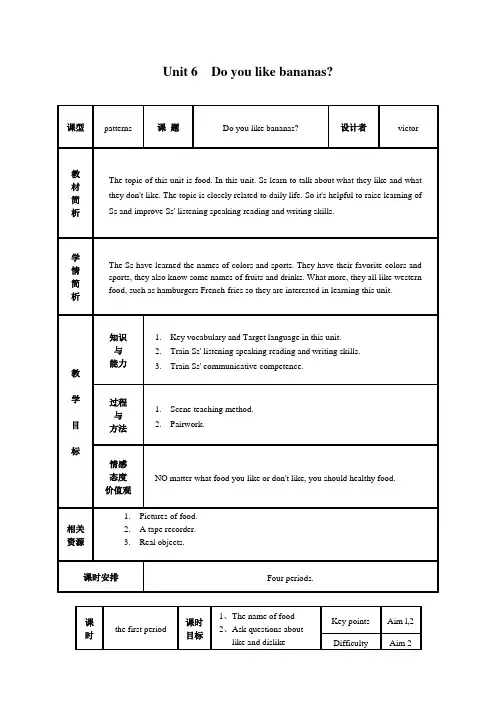
Unit 6 Do you like bananas?课时the first period课时目标1、The name of food2、Ask questions aboutlike and dislikeKey points Aim l,2Difficulty Aim 2课型patterns 课题Do you like bananas? 设计者victor教材简析The topic of this unit is food. In this unit. Ss learn to talk about what they like and what they don't like. The topic is closely related to daily life. So it's helpful to raise learning of Ss and improve Ss' listening speaking reading and writing skills.学情简析The Ss have learned the names of colors and sports. They have their favorite colors and sports, they also know some names of fruits and drinks. What more, they all like western food, such as hamburgers French-fries so they are interested in learning this unit.教学目标知识与能力1. Key vocabulary and Target language in this unit.2. Train Ss' listening speaking reading and writing skills.3. Train Ss' communicative competence.过程与方法1. Scene teaching method.2. Pairwork.情感态度价值观NO matter what food you like or don't like, you should healthy food.相关资源1. Pictures of food.2. A tape recorder.3. Real objects.课时安排Four periods.自学提示1、Prepare the new words of this period.Underline the words you can't read.2、Draw pictures about your favorite food.3、Practice reading.教与学活动设计教师活动设计学生活动设计Step I presentation the class:Greet with the class as usualStep II RevisionDo you have……?Yes, I do. No, I don't.Does she/he have……?Yes, she/he does, No, she/he doesn't.Step III Lead-in1、Show a real apple and ask the students " Do youhave an apple ? "Then the teacher eats it and says: Ilike apples.2、Show more real objects or pictures, such as bananasoranges tomatoes…3、Show a projector on the screen. Tell the students:This is a supermarket. There are many things in it.Do you know the games of these things?Step IV1、The teacher points to the Picture again and says: Ilike…… Then ask them "what do you like”?2、Point to one picture and say I like…,Do you like…?3、Write down the conversation and teach it . 1、The students make a conversation in pairs. Use the language in step II. 2、The students read after you.3、The students read the new words by themselves.4、Match the words with the pictures such as Picture, hamburgers.5、Check the answers. And let them read the words again.6、Help the Ss to say: I like…I don't like…7、Help them answers “Yes,I do. No, I don't” by nodding or shaking your head.8、The Ss read it loudly.9、Practice in pairs.教师活动设计学生活动设计4、In the same way to lead in:She /He likes…She/He doesn't like…Does she/he like…?Yes, she/he does.No, she/he doesn't.Step V Summarywe're learned the names of food and practiced asking and answering questions about like and dislikeStep VI HomeworkMake more conversations with his/her partner and record their conversations. 10、The Ss speak and practice11、Talk about the member of their family likes and dislikes. Using "Does she/he like…?"学习效果测评1、Listen to the tape. Do 1b 2a 2b. to check new words.2、Make a conversation with the target language .拓展性学习1、Draw your favorite food .2、Write down the sentences about you your father or mother your best friendlikes and dislikes板书设想Unit 6 Do you like bananas?1、Key vocabulary2、Target language hamburgers tomatoes Do you like…? broccoli French fries Yes , I do. /No, I don’t. oranges ice cream Does she/he like …? salad bananas Yes, she/he does. Strawberries No, she/he doesn't.教学反思Improve the Ss' speaking and writing skills by practicing.。
((人教版))[[初一英语教案]]新目标七年级英语第一学期Unit_6教学设计
![((人教版))[[初一英语教案]]新目标七年级英语第一学期Unit_6教学设计](https://360docs-1393072327.cos.ap-beijing.myqcloud.com/5e86b09e84868762cbaed513.webp)
Stages / timing
Students’
Teacher’s
Warming-up
(3 mins)
1. Greeting.
2. Free talking: Discuss what we should do for the earthquake in Sichuan and what people in Wenchuan need now.
Another teaching difficulty is the differences between countable nouns and uncountable nouns.
Teaching aids: PPT, a survey form that students can use to discuss what their desk mates like and dislike. Some real fruit if it’s necessary or easy to get ready.
a). students get to know the new words of food.
b). students learn to discuss what they like and dislike.
c). students get the information about their classmates’ favorite food or other things.
Do they like…?
Yes, I do. / No, I don’t.
Yes, he / she does. / No, he / she doesn’t.
人教版新目标七年级英语上册Unit 6集体备课教案设计
2;能用like谈论自己喜欢或不喜欢的东西
重点
难点
Like 的一般现在时态
教法
学法
导学、独学、互学、小展示
教
学
过
程
教
学
过
程
Step 1情景导入
【完成教材1a~1e的教学任务】
1.教学1a。学生读1a中的单词,最好能默写。
2. like是及物动词,意为“喜欢”。like + sb./sth. /doing sth. /to do sth.意为“喜欢某人/某物/做某事”。后可以接very much, a lot, a little, not…at all等表程度的词。
例句:Jerry likes Chinese food very much.杰里非常喜欢中国的食物。
(2)Whose(谁)birthday is next week?
(3)What will(将)they have?
12.教师根据学生理解情况,讲解对话中的重难点。
【语法提要】
1.询问某人的喜好,常用句型:Do/Does +主语+ like + …?意思是“某人喜欢……吗?”其肯定回答用:Yes,主语+ do/does;否定回答用:No,主语+ don’t/doesn’t.。
(2)不可数名词:bread, milk, rice
(3)既可数又不可数的名词:food, fruit, ice-cream, salad
3.学生独立完成3a任务,复习like的肯定形式及否定形式;like的第三人称单数形式及非单三形式。
4.快速完成3b任务,教师核对答案。
七年级英语上册(人教版)Unit6单元整体优秀教学案例
(一)情景创设
1.利用多媒体展示各种食物图片,让学生在直观的视觉感受中认识本课所学词汇。
2.设计有趣的食物品尝活动,让学生在实际操作中了解食物,提高他们的实践能力。
3.创设购物场景,让学生模拟购买食物,运用本课所学句型进行交流,提高他们的语言运用能力。
(二)问题导向
1.教师提出问题,引导学生思考和探讨食物的重要性,激发他们的学习兴趣。
四、教学内容与过程
(一)导入新课
1.利用多媒体展示各种食物图片,引导学生关注本节课的主题。
2.向学生提问:“你们最喜欢的食物是什么?”让学生发表自己的观点,激发他们的学习兴趣。
3.介绍本节课的学习目标,让学生明确学习任务,提高他们的学习动力。
(二)讲授新知
1.教授一般现在时的疑问句和陈述句的构成及用法,让学生掌握询问和表达喜好的句子结构。
3.通过小组讨论等活动,培养学生合作意识、团队精神,提高人际交往能力。
4.教师以耐心、关爱、尊重的态度对待每一个学生,营造和谐、融洽的课堂氛围,使学生在轻松愉快的环境中学习。
作为一名特级教师,我深知教学目标的重要性。在制定教学目标时,我注重将知识与技能、过程与方法、情感态度与价值观三者紧密结合,以全面提高学生的英语素养。在实际教学过程中,我将紧紧围绕教学目标,采用多种教学方法和手段,努力实现教学目标,为学生的全面发展奠定基础。
二、教学目标
(一)知识与技能
1.学生能够掌握一般现在时的用法,能够用英语询问并介绍自己和他人的喜好食物。
2.学生能够听懂、说出一般现在时的疑问句和陈述句,并能正确回答。
3.学生能够运用本单元所学词汇和句型,进行简单的日常交流,提高语言运用能力。
(二)过程与方法
1.通过展示各种食物图片,激发学生的学习兴趣,让他们在轻松愉快的氛围中进入本课的学习。
人教新目标英语七年级上册Unit 6 教案(共计17页)
精品"正版〞资料系列,由本公司独创 .旨在将"人教版〞、〞苏教版"、〞北师大版"、〞华师大版"等涵盖几乎所有版本的教材教案、课件、导学案及同步练习和检测题分享给需要的朋友 .本资源创作于2021年8月,是当前最|新版本的教材资源 .包含本课对应内容,是您备课、上课、课后练习以及寒暑假预习的最|正确选择 .Unit6Doyoulikebananas?一、单元教材分析本单元的核心工程是"喜欢和不喜欢(like and dislike )〞.围绕着这一中|心工程,课文中设计了各种食物及水果的插图和不同形式的表格,让学生进行听、说、读、写等各种学习活动.通过本单元的教学,使学生学会询问对方与了解别人喜欢与不喜欢的食物,学会谈论自己与他人早、中、晚餐喜爱吃的食物,为其今后能在交际中恰当地表达自己的情感、灵活运用已经学过的常用功能工程、进一步学习并掌握新的语言功能奠定坚实的根底.本单元的重点内容仍然是行为动词在一般现在时句子中的使用,应该是上一个单元内容的延伸,通过本单元的教学,学生应初步掌握行为动词一般现在时的肯定句、否认句、特殊疑问句、一般疑问句的构成以及简单的答复.二、单元学情分析本单元的主题是使用动词like询问对方对食物的喜好;谈论自己与他人喜欢吃的食物,学习并掌握行为动词的一般现在时的使用.通过前一单元的学习,学生已经初步了解了行为动词一般现在时的构成及其使用,再通过本单元学生比较感兴趣的话题的操练,一定会使学生有更深刻的印象;同时教师要善于总结、比较以帮助学生了解构成规律,正确把握所学内容.三、单元教学建议采用自主学习、小组合作探究、Different opinions和Classifying的学习策略,利用实物、教学图片等来展开课堂pairwork问答式或groupwork讨论式的口语交际活动,使用like询问对方对食物的喜好和谈论自己、他人喜欢吃的食物.本单元的教学法建议:语音教学- -让学生进行模仿操练;词汇教学- -采取演示讲解的方式进行教学,让学生进行情景操练、反复使用;口语教学- -采取pairwork问答式和groupwork讨论式的口语交际活动互相操练练习;阅读教学- -让学生学会抓住主要词汇和句型;听力教学- -采取图文配对和对话选择的方式;写作教学- -以填空、造句为主;语法教学- -比较不同、总结规律、模仿操练. 四、单元课时分配本单元可用4课时完成教学任务:Section A (1a -2d) 用1课时Section A (Grammar Focus-3c) 用1课时Section B (1a-2c) 用1课时Section B (3a -Self Check) 用1课时Period 1 Section A (1a -2d)一、教学目标:1. 语言知识目标:1) 能掌握以下词汇:banana, hamburger, tomato, ice -cream, salad, strawberry, pear, milk, bread, birthday, dinner, food, week, sure, How about …?, burger, vegetable, fruit, right, then2) 能掌握以下句型:①- Do you like salad? - Yes, I do. / No, I don ,t.②- Does she/he like …? - Yes, she/he does./ No, she/he doesn ,t.③- I like … /I don ,t like …④- He/She likes … / He/She doesn ,t like …3) 能通过介绍食物学会询问对方喜欢与不喜欢的食物.2. 情感态度价值观目标:该局部学习内容贴近学生的生活,谈论的主题涉及学生的饮食习惯和偏爱,对学生养成健康的饮食习惯很有帮助,能引起学生的特别关注,极易于激发学生学习英语的欲望和兴趣,使他们乐于参与各种英语实践活动.通过学习西方食品文化,促使学生了解西方生活方式与文化,培养跨文化交际的意识.二、教学重难点1. 教学重点:1) 学习并积累一些食物的词汇.2) 名词复数的使用.3 )动词like一般现在时的各种句式及一般疑问句的肯定、否认答复;2. 教学难点:1) 行为动词like的一般现在时的用法;2) 使用do和does引导的一般疑问句的构成和使用 .三、教学过程Ⅰ. Warming -up and revision1. Greeting the Ss. Check the homework.2. Ask some Ss questions:T: Do you have volleyball?S1: Yes, I do.T: Do you like volleyball?S1: (Help S1 answer) Yes, I do.3. We have learned about sports equipment. Now let ,s have a revision about sports equipment.S2: basketball, soccer ball, tennis ball, baseball …Then let some other Ss add other words.S3: baseball bat, ping -pong bat …Ⅱ. Presentation1. (Show a banana on the screen.)T: What ,s this?Ss: It ,s a banana.T: Do you like bananas?Ss: Yes, I do. / No, I don ,t.(Show other pictures of food on the screen and learn the new words.)(banana, hamburger, tomato, ice -cream, salad, strawberry, pear, milk, bread, birthday, food, burger, vegetable, fruit)2. Let Ss read and try to remember the new words.3. T: Let ,s look at the picture in 1a. Match the words with the things in the picture. Then check the answers.Ⅲ. ListeningT: Let ,s work on 1b. Listen and number the conversations [1 -3].Ss listen to the tape and number the conversations.Ⅳ. Pair work1. Read the conversations in 1b. Have Ss read after the teacher.2. Now let ,s act out the conversations 1 -3.(Ss work with their partner and act out the conversation 1 -3.)3. Look at the picture and make more conversations using the words in 1a.4. Let some pairs act out their conversations.Ⅴ. Listening1. Point to and read each word aloud, Ss only listen. Then let some Ss read the words by themselves. Check that Ss understand the meaning of the each word.2. Play the recording for the first time, Ss only listen.3. Then play the recording again Ss circle the words they hear. Play the recording again. Check the answers.4. A girl and a boy want to have something in the restaurant. Do they like hamburgers? Does the boy like milk? Does the boy like ice -cream? Now let ,s listen to the recording.For the first time, Ss only listen.For the second time, Ss listen and fill in the blanks.Play the recording for the third time, Check the answers.Ⅵ. Pair work1. Read the conversation in speech bubbles in 2b. Ask Ss to read after the teacher.2. Ss practice the conversations in pairs.3. Let some pairs act out the conversations.4. Ss give answers that are true for them. Then practice their conversations.5. Ask some pairs act out their conversations.Ⅶ. Role -play1. Read the dialogue with your partner. Then fill in the blanks below.① It ,s _______ birthday dinner next week.② For food, John likes ___________.③ For vegetables, John likes __________.④ For fruit, John likes ________.2. Ss read the conversation and fill in the blanks.3. Practice the conversation with your partner.4. Let some pairs role -play the conversation in front of the class.5. 评价:(让学生们对自己的表现及语言表达能力进行自我评价,在小组内评价,然后进行评出最|优秀的小组.并鼓励学生们下一次争取做最|优秀的小组及个人. )Homework:1. Review the words we learn today.2. Fill in the chart after class.Period 2 Section A (Grammar Focus-3c)一、教学目标:1. 语言知识目标:1) 继续学习描述自己或他人喜欢或不喜欢的食物,能够用but来表达简单的句子.2 )总结动词like一般现在时的肯定句式、否认句式及一般疑问句的肯定、否认答复.3) 总结复习可数名词复数的知识.4 )理解英语可数名词与不可数名词的概念,并对所学过的局部词汇按此分类进行归纳总结.2. 情感态度价值观目标:通过任务型活动,使学生学会在实际生活中均衡饮食,合理配餐;通过开展小组活动,指导学生积极与他人合作,培养他们的合作精神.二、教学重难点1. 教学重点:1 )总结动词like一般现在时的肯定句式、否认句式及一般疑问句的肯定、否认答复.2 )理解英语可数名词与不可数名词的概念,并对所学过的局部词汇按此分类进行归纳总结.2. 教学难点:理解英语可数名词与不可数名词的概念,并对所学过的局部词汇按此分类进行归纳总结. 三、教学过程Ⅰ. Warming - up and revision1. Greeting the Ss. Check the homework.2. Review the new words about food, fruit and vegetables. (Ss may look at the picture in 1a).3. Ask and answer.(Ss work in groups. Ask and answer about the questions according to the picture in 1a.)S1: Do you like bananas?S2: Yes, I do.S3: Does he like bananas?S4: Yes, he does.S1: Do you like ice -cream?S2: No, I don ,t.S3: Does he like ice -cream?S4: No, he doesn ,t.(Exchanging the roles ask and answer questions.)Ⅱ. Grammar Focus(此局部指导内容通过多媒体辅助教学以提高学习效率)一、单元句式结构阅读指导:1. 行为动词like的各种句式的构成肯定句:①第|一人称/第二人称/第三人称复数+ like + 其他②第三人称单数及其他单数名词+ likes + 其他否认句:①第|一人称/第二人称/第三人称复数+ don ,t + like + 其他②第三人称单数及其他单数名词+ don ,t + likes + 其他一般疑问句:① Do + 第|一人称/第二人称/第三人称复数+ like +其他?答复:Yes, I/we/you/they do. No, I/we/you/they don ,t.② Does + 第三人称单数及其他单数名词+ like + 其他?答复:Yes, he/she/it does. No, he/she/it doesn ,t.2. Read the sentences in Grammar Focus and complete the sentences below.①你喜欢色拉吗?____ you_____ salad?②是的.___, I ____. 不,不喜欢._____, I ______.③他们喜欢梨吗? ____ _____ like pears?④是的.____, they ____. 不喜欢.___, they ___.⑤她喜欢西红柿吗? ____ she _____ a tennis?⑥是的.___, she ____. 不喜欢.___, she ______.⑦我们喜欢米饭.我们不喜欢汉堡.We _____ _____. We _____ ______ hamburgers?⑧她喜欢冰淇淋.她不喜欢蔬菜.She ____ ________. She ____ ______ vegetables.3. Check the answers with the class.二、可数名词与不可数名词学习指导:1. 可数名词与不可数名词的含义与特点2. 可数名词复数的构成Ⅲ. Practice1. Let ,s work on 3a. Here are some sentences. Please underline the correct words in the brackets.2. Ss read the sentences and underline the correct words. They can discuss with their partners.3. Check the answers and let some Ss say the grammar rules.(根据句子主语的人称和数来确定谓语动词或助动词的数)Ⅴ. Practice1. Look at the sentences in 3b. Number the sentences [1 -4] to make a conversation.2. Check the answers and let Ss practice the conversation.Ⅵ. Survey1. T: Our likes and dislikes of food are different. Some Ss like these food and other Ss like other food. Let ,s make a survey of our likes and dislikes about food.First, look at the chart below and write down the names of the food.Second, ask your classmates about the food in the chart. e.g.You: Do you like ice -cream, Liu Li?Liu Li: Yes, I do.You: What about rice?Liu Li: No, I don ,t.…You: Do you like ice -cream, Zhao Jun?Zhao Jun: No, I don ,t.Zhao Jun: What about rice?Zhao Jun: Yes. I like rice.2. Fill in the chart with the names of your classmates.3. Report the result of your survey likes this:Liu Li likes ice -cream, but she doesn ,t like rice. Zhao Jun doesn ,t like ice -cream but he likes rice. …Homework1. Review the Grammar Focus.2. Write the report of your survey result on your workbook.Period 3 Section B 1a-2c一、教学目标:1. 语言知识目标:1) 继续学习有关膳食名词:breakfast ,lunch ,dinner ,egg ,apple ,chicken ,fruit ,vegetables;并能按食品、水果和蔬菜进行分类总结.2 )理解可数名词与不可数名词的概念,并能对所学的词汇进行分辨.3 )就食物的话题开展听、说、读、写技能的训练,促进学生语言运用能力的提高.2. 情感态度价值观目标:该局部学习内容涉及学生的饮食习惯和偏爱,对培养学生健康的饮食习惯有很强的指导性,能引起学生的特别关注;同时通过互相询问和谈论,培养对家人和同学、朋友的关心和友爱之情.二、教学重难点1. 教学重点:1 )继续学习运用有关食物的词汇并能按食品、水果和蔬菜进行分类总结.2 )就食物的话题开展听、说、读、写技能的训练,促进学生语言运用能力的提高.2. 教学难点:阅读有关饮食方面的材料,并能获得相关信息,提高综合运用英语的能力.三、教学过程Ⅰ. Warming - up and revision1. Greet the Ss. Then check the homework. (Let some Ss report their survey result)2. Review the words on food. And list them into countable nouns, uncountable nouns, countable and uncountable nouns.Countable nouns: hamburgers, eggs, oranges, bananas, apples, pear, carrots, vegetables, strawberries Uncountable nouns: milk, bread, riceUncountable and countable nouns: food, fruit, ice -cream, salad, chicken3. Ss read and try to remember the new words.4. Review the plural forms of countable nouns.(让学生说出规那么及例词)Ⅱ. Presentation1. T: How many meals do you have every day?Ss: Three.T: What are they? (The students can answer them in Chinese.)Ss: They are "早餐、中餐和晚餐〞.T: Oh, yes. In English "早餐〞we can say "breakfast〞.(Show a picture of the breakfast)Read after me, "breakfast〞.B -R -E -A -K -F -A -S -T, breakfast.Ss: B -R -E -A -K -F -A -S -T, breakfast.T: Do you have your breakfast every day?S1: No, sometimes I get up late. I have no time to eat.T: I think it ,s not good for your health.(Teach the other two words lunch, dinner in the same way.)2. Ss read and try to remember the new words.Ⅲ. Writing1. T: Look at 1a, read the words in the box, then write the number in the box next to the correct food. (The students finish off 1a.)T: Look at 1b. How many other food words can you add to the chart?Try to write them down in the chart.(The students write them down as soon as possible and then read them. See who will add most.)Ⅳ. Listening1. T: Look! There are so many foods. Maybe they are very delicious. Which food do you like? Do you like tomatoes? (Show the picture.)S1: …T: How about chicken? Do you like it?S1: …T: Can you guess what food I like?S1: Do you like …?T: No, I don ,t.S2: Do you like …?S3: Do you like …?T: Yes, you are right. I think you are very lucky. But I have two friends. They are Sally and Tom. Do you know what food they like? Now, let ,s listen and circle the food you hear in 1a.(Play the recording 1c in Section B. The students find out each food mentioned in the conversation on the recording. Then check the answers.)2. T: Now open your books and listen again. Fill in the chart.(Play the recording the first time. Students listen to the conversation and write in the answers on their charts. Play the recording the second time and then the students can check their answers to be sure they are correct.)Ⅴ. Pair work1. T: Does Tom like tomatoes?Ss: Yes, he does.T: Ask and answer about the chart in pairs.2. Let some Ss act out their conversation.Ⅵ. Discussing1. T: There is much food around us. Some food is healthy, but others are not so healthy.I think fruit like apples, bananas, strawberries, oranges are very healthy. I think hamburgers are not so healthy. Maybe, chicken, eggs are healthy, too.Which food do you think is healthy? Check (√) Yes, Maybe or No.2. First, Ss make a list of food on their workbook. Then discuss with their partners. Check (√) Yes, Maybe or No behind the food on the workbook.S1: I think fruit is healthy.S2: I also think fruit is healthy.S1: I think …3. Make a report, then read the report to their partner.Ⅶ. Presentation1. T: We have breakfast, lunch and dinner every day. Let ,s see what do you usually eat for breakfast, lunch, and dinner?T: What do you like for breakfast, S1?S1: I like milk and bread.T: What do you like for lunch?S1: I like chicken and vegetables.T: What do you like for dinner?S1: I like rice and vegetables.T: Great! You have healthy eating habits(Write "eating habits〞and " - What do you like for breakfast/lunch/dinner? - I like…〞on the blackboard. )2. OK. Now ask your partners questions to see if they have healthy habits.3. T: Many boys and girls like ice -cream. Do you like it?Ss: Yes, I do. / No, I don ,t.T: Do you eat ice -cream, S1?S1: Yes, I do.T: Do you eat ice -cream, S2?S2: No, I don ,t.Ⅷ. Reading1. T: Well, let ,s see some sports star ,s eating habits. Cindy Smith is a volleyball star. What does she like for breakfast, lunch and dinner? Does she eat ice -cream? Now let ,s read the magazine article about Cindy Smith. First, read the article and circle the food words.(Ss read the article and circle the food words quickly.)2. Read the article carefully again and answer the questions:① Does Cindy like bananas?② Does Cindy like salad?③ Does Cindy like hamburgers for dinner?④ What does Cindy like for dinner?⑤ Does Cindy eat ice -cream after dinner?⑥ Are Cindy ,s eating habits healthy?(Ss read the article and answer the questions. Then check the answers.)3. We know Cindy has healthy eating habits. What food does she like? What food doesn ,t she like? Read the article and write five sentences about Cindy ,s eating habits. e.g.Cindy likes fruit for breakfast.(注意运用句型:Cindy likes … for … 或Cindy doesn ,t like/eat … for … )4. Let some Ss read their sentences to the class.Homework1. Review the word on food.2. Make a survey about "What do your parents like for three meals?〞after class.Period 4 Section B 3a -Self Check一、教学目标:1. 语言知识目标:1 )复习所学习有关食物的词汇,并在实践活动中能熟练运用.2 )复习用行为动词like一般现在时的肯定句、否认句和一般疑问句来询问、谈论对方或自己一日三餐所喜欢的食物并学会营养配餐;3 )由询问所喜欢的食物再拓展到所喜欢的运动和颜色来进一步复习运用所学习的句型结构.4 )通过写作练习来到达提高学生们的综合表达能力 .2. 情感态度价值观目标:通过谈论自己与他人早、中、晚餐喜欢吃的食物,养成良好的饮食习惯;通过互相询问和谈论饮食习惯,培养对家人和同学、朋友的关心和友爱之情并学会营养配餐 .二、教学重难点1. 教学重点:1 )复习关于各种食物的词汇、运动类的词汇及颜色类的词汇并就对方的喜欢进行问答.2 )复习名词复数的构成.3 )就喜欢与不喜欢什么食物的话题进行写作训练,培养提高学生们的英语综合运用能力. 2. 教学难点:就喜欢与不喜欢什么食物的话题进行写作训练,培养提高学生们的英语综合运用能力.三、教学过程Ⅰ. Warming - up and revision1. Review all the food we learned. Let Ss say the words quickly.S1: fruit: apples, bananas, pears, strawberries …S2: vegetables: tomatoes, potatoes, salad, carrots …S3: food: bread, milk, ice -cream, hamburger (burger) …2. T: I like eggs and milk for breakfast. What do you like eating for breakfast? (Point to a student.) Sa: I like apples and bread.T: What about you? (Point to another student.)Sa: I like hamburgers and bananas. (Ask two more students to answer his/her questions for lunch and dinner.)T: Who can ask and answer like this?S1: What do you like to eat for lunch?S2: I like …S1: What do you like to eat for dinner?S2: I like …(Then ask the students to work in pairs one by one.)Ⅱ. Survey1. Now let ,s make a survey what food you and your partner like for breakfast, lunch or dinner.Ask and answer with your partners and write down the results in the chart in 3a.S1: What do you like for breakfast?S2: I like eggs and milk.S1: What do you like for lunch?S2: I like hamburger and salad.S1: What do you like for dinner?S2: I like chicken and fruit.S1: I think your eating habits are healthy.(Exchange the roles)2. Ss fill in the chart. If you forget what your partner likes. You may ask him or her a second time.You: Oh, do you like eggs for breakfast?Your partner: No, I don ,t. I like oranges.Ⅲ. Writing1. Can you introduce yourself for three meals according to the survey result just now? Maybe many friends want to know you. Now let ,s write about what you and your partner like and don ,t like for breakfast, lunch and dinner. You can look at the chart above. You should use these sentence structures:For breakfast/lunch/dinner, I like …, but I don ,t like …For breakfast/lunch/dinner, my partner likes …, but he/she doesn ,t like …(T goes round the classroom and offer helps if it ,s necessary.)2. The students write about themselves as quickly as they can. When they are ready, ask them to introduce.Ⅳ. Self Check 11. T: Your friends also want to know what food/sports/colors you like. First, let ,s talk about sports. What sports do you like? What sports do you dislike?T: I like basketball, volleyball, ping -pong, soccer. I don ,t like soccer, baseball. What about you?S1: I like …, but I don ,t like …S2: …2. Now, let ,s talk about colors. I like red, blue, white and green. I don ,t like black, brown, purple or yellow. What about you?S3: I like …, but I don ,t like …S4: ….3. OK. Now first think and write about what sports/color you like and dislike. Then tell your partner about it.(Ss work with their partners. T goes around the classroom and offers any helps. )Ⅴ. Self Check 21. Do you know the plurals of these words? Put them in the correct columns.2. Ss work with their partners and put the words in the correct columns. Then check the answers with the class.3. 规那么总结:学生表达名词复数构成的规那么,并说出几个例词.S1: 一般在词性加-s ,apples, bananasS2: 以"辅音字母+y〞结尾,变y为i, 再加-es .families, strawberriesS3: 以s. x. sh. ch结尾的加-es .boxes, watchesS4: 以"f或fe〞结尾,变f或fe为v, 再加-es .knivesS5: 以字母"o〞结尾的有生命词,加-es;以字母"o〞结尾的无生命词,加-s .tomatoes, photos4. 在屏幕上展示可数名词复数的构成规那么,学生强化记忆.Ⅵ. Self Check 31. T: Can you remember what color/sports your partner likes and dislikes. Write a short report about what color/sports your partner likes and dislikes. If you have forgotten what your partner likes and dislikes. Ask him/her again. (Or you can check his/her report.)- What color do you like?- I like …- What sport do you like?- I like …2. Ss write about what his/her partner likes and dislikes. Then report to the class.Homework1. Review the rules of plural forms.2. What food, sports and colors do you parents like and dislikes? Write a short article about them.板书设计:当我们在日常办公时,经常会遇到一些不太好编辑和制作的资料 .这些资料因为用的比较少,所以在全网范围内,都不易被找到.您看到的资料,制作于2021年,是根据最|新版课本编辑而成.我们集合了衡中、洋思、毛毯厂等知名学校的多位名师,进行集体创作,将日常教学中的一些珍贵资料,融合以后进行再制作,形成了本套作品.本套作品是集合了多位教学大咖的创作经验,经过创作、审核、优化、发布等环节,最|终形成了本作品.本作品为珍贵资源,如果您现在不用,请您收藏一下吧.因为下次再搜索到我的时机不多哦!本资源的初衷,是希望通过网络分享,能够为广阔读者提供更好的效劳,为您水平的提高提供坚强的动力和保证 .内容由一线名师原创,立意新,图片精,是非常强的一手资料 .。
人教新目标英语七年级上册Unit6SectionB(2a2c)课时教学设计
1.回顾本节课所学内容:引导学生回顾一般过去时态的用法、动词过去式的变化规则以及如何运用一般过去时态进行对话。
2.归纳重点:总结本节课的教学重点,提醒学生注意动词过去式的变化规则和一般过去时态的运用。
3.鼓励学生:鼓励学生在课后多进行英语口语练习,运用所学知识描述过去的事情,提高英语实际应用能力。
4.学生能够运用所学词汇和语法知识,进行简单的句子编写和对话交流。
(二)过程与方法
在本节课中,我们将采用以下过程与方法,使学生达到教学目标:
1.利用图片、实物等直观教具,引导学生观察、思考、描述,激发学生的学习兴趣和积极性。
2.采用任务型教学法,设计丰富的课堂活动,如小组讨论、角色扮演等,让学生在互动中掌握语法知识。
2.学生能够运用一般过去时态来描述过去某个时间点的动作或状态,如:“I went to the park yesterday.”、“She played with her friends last week.”等。
3.学生能够通过听力练习,提高获取、处理和运用信息的能力,如:听懂并记录下关于过去活动的关键信息。
4.布置作业:布置与本节课相关的作业,如完成练习册上的习题,预习下一课的内容等。
五、作业布置
为了巩固本节课所学的人教新目标英语七年级上册Unit 6 Section B (2a-2c)关于一般过去时态的知识,特此布置以下作业:
1.完成练习册中与本节课相关的一般过去时态练习题,包括填空、选择题和句型转换等,旨在帮助学生巩固动词过去式的变化规则及句型结构。
3.教师点评:对每个小组的讨论成果进行点评,指出语法错误并给予指导。
(四)课堂练习
1.听力练习:播放一段关于过去活动的对话,要求学生听懂并完成相关练习,如填空、判断正误等。