
优化方案2017高中英语 unit 5 nelson mandela a modern hero
Unit 5 Nelson Mandela a modern hero Section Ⅲ Learning aboutLanguage & Using LanguageⅠ品句填词1.The ____________(总统) of the country is facing a hard time.答案:president2.Her friends and ____________(亲戚) attended the wedding.答案:relatives3.She put a soft ____________(毛毯) over the little child.答案:blanket4.A $100 ____________ (奖赏) has been offered for the return of the necklace.答案:reward5.The ____________(残忍) of his words cut her like a knife.答案:cruelty6.He was involved in a bank robbery and was ____________(判处) to six years in prison.答案:sentenced7.He never ____________ (恳求) me to forgive him even when he made mistakes.答案:begged8.Charlie is very polite to everybody, so he must be an ____________ (受过教育的) person.答案:educated9.When the earthquake happened, the teacher chose to protect her students instead of ____________(逃跑) first.答案:escaping10.In my ____________ (见解),watching TV is a waste of time.答案:opinionⅡ单句改错1.The young said that he shouldn’t be stopped studying for his degree.stopped 后加from2.What my parents say often makes me feeling good about myself.feeling→feel 3.I thought her a teacher for the first time I met her.去掉for4.I won’t leave the office until the manager will come.will_come→comes5.The young man, who was sentenced for ten years in prison for his acts of violence, lost all hope for his future.第一个for→to6.A notice set up in order to remind the students of the changed lecture time.set前加wasⅢ完成句子1.这位车手在他第一次骑自行车受伤时,简直吓坏了。
The cyclist just ________________________ he was riding a bicycle and got injured.答案:felt frightened the first time2.地震时一些矿工被困在矿井中,没有救援他们不能逃脱。
During the earthquake some miners were trapped in the mine, and they ________________________.答案:couldn’t escape without rescue3.依靠军队力量获得政权的革命家通常背后有大的罪行。
Revolutionaries who ________________________ arms usually have crimes in their background.答案:come to power by force of4.威廉恳求他的父亲给他买部新手机,但遭到了拒绝。
William ________________________ a new cellphone for him, but got refused.答案:begged his father to buy5.那个人因杀了自己的一个朋友而被判处死刑。
That man ________________________ for killing one of his friends.答案:was sentenced to death6.他把本来应该用在学习上的时间花在了玩电脑游戏上,所以他没通过考试。
He spent the time he ________________________ in studying in playing computer games, so he didn’t pass the exam.答案:should have spentⅠ单句语法填空1.We are busy with our work, so we intend to get a ____________(relation) to look after the children.答案:relative2.In a democracy (民主国家), ____________(powerful) must be divided.答案:power3.She is a highly ____________(education) woman,so she is well received by the students.答案:educated4.The first time I ____________ (visit) that land, I decided to settle there.答案:visited5.It is the fifth time that the students in Trinity College ____________ (visit) our school.答案:have visited6.—John is always working hard.—So he is. I believe all his efforts will ____________ (reward) at last.答案:be rewarded7.The driver narrowly escaped ____________(kill) in the traffic accident.答案:being killed8.Though he has met with many difficulties over the past two years, he is still____________ (hope).答案:hopeful9.Most of the students in our class are ____________ (will) to spend their money and time on books and other useful things.答案:willing10.When a person is ____________ trouble, talking with others often helps him feel better.答案:inⅡ阅读理解ANavarathri, which is celebrated throughout India, falls in September or October.On the first three days, people pray(祈祷) to the goddess Durga, the protector who destroys all evil(邪恶).The next three days they pray to Lakshmi, the goddess of wealth.Then, also for three days, they look to Saraswathi, the goddess of wisdom and knowledge. The tenth and final day of the festival is for the goddess Durga.On this day many years ago, Durga killed the evil buffaloheaded monster(怪物), Mahishasura.My daughter and I took out the models of the gods and goddesses that we had stored away last year.Soon the room was littered with all kinds of dolls.We usually buy at least one new doll every year.On the tenth day, the dolls are carefully put away.If a doll is too damaged to be shown, it is never thrown away.Instead, it is put deep into the seas.In our hallway six long wooden steps are set up.First, we spread a thick white cloth (布) over the steps.Now it’s time to put the dolls on the steps carefully.Every year, the_gollu is different.Sometimes—as the collection grows—there is no space to fit all of the dolls on the steps.Smaller dolls can also be placed on the floor.Every night there are prayers, music, dancing, and a large meal for many people.In northern India, the children sing songs while doing the dandiya raas, a traditional dance.Every dancer also has two wooden sticks—called dandiya—that he or she uses to make a sound in time to the lovely music.Dancing the dandiya raashelps people think of the true meaning of Navarathri—togetherness, laughter, and fun!【解题导语】本文是记叙文。
人教版高中英语必修一 教案: unit 5 Nelson Mandela--a modern hero Reading
必修一Unit 5 Nelson Mandela—a modern heroReading一.Type 教学课型:Reading 阅读课本文以Elias 的口吻,讲述了南非黑人所受到的不公正待遇以及他们争取种族平等的斗争历史。
同时还提到了他与Nelson Mandela的一段交往,从侧面向学生展示Nelson Mandela的高贵品质。
教材设计的目的是在训练学生阅读技能的基础上,让他们认识到南非黑人争取自由和平等权利而付出的艰辛努力。
文章的主题有利于培养学生坚强的意志,树立正确的人生观与世界观。
二.Analysis of the textbook 教材分析教材借穷苦的黑人工人伊莱雅斯之口,叙述发生在他身边的纳尔逊曼德拉的故事,时间是从1952年到1963年。
伊莱雅斯初遇曼德拉时还是一个年仅12岁的黑人少年,正处于人生的一个非常困难时期。
当时曼德拉开办了专为黑人服务的侓师事务所,帮助黑人解决问题。
伊莱雅斯正是在曼德拉的帮助下获得了在约翰内斯堡工作的合法权利,在曼德拉的教育下,伊莱雅斯开始体会到人生的快乐和希望。
曼德拉亲切和蔼的态度、宽容博大的襟怀让他深深感到,永生难忘。
因此,伊莱雅斯第一时间加入了曼德拉领导的非洲人国民大会青年联盟,聆听曼德拉的演讲,积极参加他组织的反政府活动,为争取获得与白人平等的权利而斗争。
这样的写法有别于惯常所采用的平铺直叙,虽然只反映出曼德拉的一个侧面,但读起来却更加亲切感人,引人入胜,还留给了学生更多的思考空间。
在本单元的Warming up &pre-reading部分,学生通过图片了解了一个伟人应具备怎样的品质。
为熟悉本课的内容作了铺垫。
虽然学生对一些伟人已经有一点的背景知识,但是对Nelson Mandela 并非完全了解。
本节课的目的是让学生通过阅读,从语言材料中获取相关信息,并通过对信息的加工和处理,提高他们的语言运用能力。
1. Teaching Aims教学目标1)Knowledge objectivesa.Students will be able to learn the useful new words and expressions in this part:Hero,quality,republic,principle,nationalism,livelihood,fight,youth,peaceful,prison,legal,equal,law,advise,continue,gold,passbook,ANC,league,stage,vote,position,accept,violence,devote,vote, guidance, blow up, in troubleb. Enable the students to read Elias’ storyc. Guide the students to know the qualities of Nelson Mandela as a great leader2) Ability objectivesa.Develop the students ’reading skills, such as fast reading ,careful reading and summarizingb.Improve the students’ comprehension ability3) Emotion objectivesa,Understand the qualities great person have in common and learn the fine qualities from themb.Develop the students’ moral quality2.Teaching important points教学重点a.Enable the students to read Elias’ story and Learn to grasp the main idea of the text.b.Enable students to talk about the fine qualities of great people,especially Nelson Mandelac.Improve the students’ reading ability3.Teaching difficult points 教学难点a.How to grasp the main idea of the text.b.How to help develop students’ reading abilityc.How to help students learn from Nelson Mandela4.Teaching methods 教学方法a.Student-centeredb.Task-based teaching method(任务型教学)c.Discussion5.Learning methods 学习方法Individual or pair work and group work6.Teaching Aids 教具准备The multimedia三.教学设计1. 总体思路本堂课的主要内容分为四大部分,Pre-reading(阅读前活动) ,while –reading(阅读中活动),post-reading(阅读后活动)以及discussion(讨论) and role play 。
优化方案2017高中英语 unit 5 nelson mandela a modern hero
Unit 5 Nelson Mandela a modern hero Section Ⅱ Warming Up &Reading Language PointsⅠ品句填词1.Activities all take place under the ____________(指导) of a famous expert.答案:guidance2.We must follow the ____________(原则) that education should be fair to everyone.答案:principle3.It was ____________ (大方的) of him to pay for us both.答案:generous4.As a student, John is very ____________(活跃的,积极的) in class.答案:active5.As a matter of fact,I am ____________(乐意的) to discuss the problem.答案:willing6.You must try to improve the ____________(质量) of all your goods.答案:quality7.—Do you know when the People’s Republic of China was ____________ (成立)?—On October 1, 1949.答案:founded8.All people are ____________(平等的), having the same rights as a citizen.答案:equal9.I was a fairly good football player in my ____________ (青年时期).答案:youth10.China is playing an important role on the international political ____________ (舞台).答案:stageⅡ单句改错1.The girl is hardworking and she is always the first student coming every ing→to_come2.The old man was kind to me, to which I was grateful.第二个to→for3.The river saw some great improvement in the last twenty years.saw→has_seen 4.I have been dreaming of seen the famous pilot one day.seen→seeing5.Only in this way we can finish the work ahead of schedule.we_can→can_we 6.You should do as you are told or you will in trouble.will后加beⅢ课文语法填空Elias, a poor black worker in South Africa, said that the time 1.when hefirst met Nelson Mandela was a very difficult period of his life.Nelson Mandela helped him a lot,for 2.which Elias was very grateful.Elias had little education,3.because his family couldn’t afford the school fees and the bus fare.After 4.trying/having_tried (try) many times, he succeeded getting a job.Not 5.having(have) a passbook, he wasn’t allowed6.to_live(live) in Johannesburg, and he worried about whether he7.would_become (become) out of work.Later he joined the ANC Youth League anized(organize) by Mandela.At that time the blacks 9.were_treated(treat) badly until they came to a stage 10.where they had no rights at all.Elias was sure that only by answering violence with violence could they achieve their dreams.Ⅰ单句语法填空1.The black fought peacefully so as to be treated ____________ (equal) withthe white.答案:equally2.Under his ____________(guide), we finished the work smoothly.答案:guidance3.If some athletes use drugs,it is ____________(fair) for the others.答案:unfair4.He studied hard at law and became a good ____________(law) after graduation.答案:lawyer5.He is popular with his friends because he is too ____________(will) to help them when they are in trouble.答案:willing6.Nowadays many school children devote too much time to ____________(play) computer games.答案:playing7.Our hometown ____________(see) a lot of changes in recent years.答案:has seen8.____________(found) in last century, the church has a history of about 90 years.答案:Founded9.Amy had great trouble ____________(make) up her mind to send her daughter to go abroad.答案:making10.He got himself into dangerous situation ____________he is likely to lose control over the plane.答案:whereⅡ阅读理解George Bizos,Mr Mandela’s lawyer,said he believed he still wanted to live, despite his poor health.The former leader of South Africa was sent to hospital on Wednesday night because of suffering from a recurring lung infection(反复肺部感染).Mr Mandela has been in hospital four times in just over two years and three times have been in the past four months.Mr Bizos defended(辩护) Mr Mandela during his 1960s trial (审判) fighting white minority rule,and now remains a famous human rights lawyer.And he recently represented families of striking miners killed when the police opened fire on themoutside a mine in Marikana last August.He said that Mr Mandela was stronger than his appearance might suggest.“Of course I have been saying to people,‘you should remember Mandela is no longer that young.’Even if he goes for checkups every now and then,I don’t think people should be worried about him,”Zuma,South Africa’s President told the BBC.“Let us slow down the worries.He is responding very well and he is in good hands of very good doctors.All of the above will bring comfort to all of us.I would like to really say the country must not panic.”On Thursday Barack Obama, the US President, said he was deeply concerned about th e state of Mr Mandela’s health.Mr Obama said he believed Mr Mandela was as strong as he had been in character and in leadership over so many years.President Obama said it was inevitable that people should be concerned about news about Mr Mandela.After Mr Mandela was released from prison, he became the first black President of South Africa.“We are deeply concerned about Nelson Mandela’s health —he is a hero, I think, to all of us,”he said on Thursday as he met four leaders from subSaharan Africa.【解题导语】曼德拉的一生充满了传奇,步入晚年的他像其他老年人一样受到疾病的困扰,而他同样再次选择了坚强面对病魔。
最新人教版高中英语必修一unit5《nelsonmandela》全单元教案.doc
Unit 5 Nelson Mandelaa modern heroContents 目录一、单元教学目标和要求(Teaching aims and demands)二、教材内容分析 (Analysis of the teaching materials三、教学安NF (Teaching arrangements)四、单元预习任务(Pre-unit Activities: Preview Task)五、教学步骤(Teaching procedures)六、背景参考资料(Background knowledge)七、评价与反思(Assessment and reflection)、教学目标和要求(Teaching aims and demands)根据课程标准实验教材(英语必修)关于总目标的具体描述,结合高一学生实际和教材内容,我们将教学目标分为语言知识、语言技能、学习策略、情感态度和价值观四个方面。
1.语言知识(Knowledge)词汇(Vocabulary ):能理解、内化、运用以下生词---- hero, quality, willing, active, republic, fight, peaceful, prison, prisoner, period, law, advise, continue, fee, gold league , stage , vote , position , accept , violence , equal , blanket , degree, guard , educated , terror , fear , cruelty , reward , right (n. ), criminal , leader , president , sentence (v. ), sincerely短语(Phrases and expressions) : lose heart, in trouble ,worry about, out of work, Youth League, as a matter of fact, blow up, put ... in prison, come to power , setup , be sentenced to功能(Functions):学习掌握一些用于发表意见与评论的结构句式,如:1. 发表意见(Giving opinions )Why do you think so? What do you think of …? What's you opinion?agree / don't agree. I think / don't think .... I prefer .... In myopinion ....I'm afraid ....2.评论(Making comments)Good idea! That's an excellent idea .语法(Grammar):定语从句(II )(由where, when, why, 介词+ which, 介词+ whom引导的定语从句)The school where I studied only two years was three kilometres awayThis was a time when you had got to have a passbook to live in JohannesburgThe reason why I got a job was because of my hard work .•••we were put in a position in which we had either to accept we were less important, or fight the Government .The person to whomyou should be grateful for a peaceful South Africa is Nelson Mandela.扩展词汇:negative(消极的),heroine(女主角,女主人公),unwilling(不情愿的),nation(国家,民族),sacrifice(牺牲),realize (认识到),give up (放弃),riches (财富),Bible (圣经),revolution (革命),career (职业),equality (平等),fairness(公平),conflict (冲突),biography (自传),beliefs (信仰),Christianity (基督教),religion (宗教),priests (牧师),version (翻译),readable (易读的),adventure (冒险),scholar (学者),sympathy (同情),,campaign (从事活动),communist (共产主义者),injustice (不公平),oppose (反对),pilot(飞行员) , boycott (联合抵制)2.语言技能(Skills)听:在本单元的课文及练习册听力教学中,能听懂人物和事件以及它们的关系,能抓住所听语段中的关键词,正确理解话语间的逻辑关系。
新教材高中英语必修一Unit 5 Nelson Mandela—a modern hero
新教材高中英语必修一Unit 5Nelson Mandela—a modern hero一、语基必备知识(一)重点词汇——分类记忆Ⅰ.阅读词汇——知其意1.mean adj.吝啬的;自私的;卑鄙的2.generous adj. 慷慨的;大方的3.easygoing adj. 随和的;温和宽容的4.invader n. 侵略者5.republic n. 共和国;共和政体6.principle n. 法则;原则;原理7.relative n. 亲戚;亲属8.mankind n. 人类9.lawyer n. 律师10.fee n. 费(会费、学费等);酬金11.quote n. 引用语;语录12.release v t. 释放;发行13.blanket n. 毛毯;毯子14.terror n. 恐怖;可怕的人;恐怖时期;恐怖活动15.principle n. 法则;原则;原理16.league n. 同盟;联盟;联合会Ⅱ.核心词汇——写其形1.quality n. 质量;品质;性质2.beg v i. 请求;乞求3.stage n. 舞台;阶段;时期4.opinion n. 意见;看法;主张5.reward n. 报酬;奖金v t. 酬劳;奖赏6.found v t. 建立;建设7.attack v t. 进攻;攻击;抨击8.escape v i.& v t. 逃脱;逃走;避开9.vote v t.& v i. 投票;选举n. 投票;选票;表决10.youth n. 青年;青年时期11.sentence v t. 判决;宣判12.__president n. 总统;会长;校长;行长Ⅲ.拓展词汇——通其变1.guide v t.指导→guidance n.指导;领导2.violent adj.暴力的;猛烈的→violence n.暴力;暴行3.cruel adj.残忍的;残酷的→cruelty n.残忍;残酷4.equal adj.相等的;平等的→equally ad v.平等地→equality n.平等5.active adj.积极的;活跃的→actively ad v.积极地;活跃地→activity n.活动6.devote v t.(与to连用)献身;专心于→devotion n.奉献;献身;忠诚→devoted adj.忠实的;深爱的7.educate v t.教育;训练→educated adj.受过教育的;有教养的→education n.教育→educator n.教育者8.peace n.和平;平静;和睦→peaceful adj.和平的;平静的;安宁的→peacefully ad v.和平地;平静地9.self n.自我;自身→selfish adj.自私的→selfless adj.无私的;忘我的→selflessly ad v.无私地;忘我地10.legal adj.法律的;依照法律的→illegal adj.(反义词)非法的,违法的11.fair adj.公正的;公平的→unfair adj.(反义词)不公正的;不公平的12.willing adj.乐意的;自愿的→unwilling adj.(反义词)不情愿的;不乐意的13.hope v.希望;期待n.希望;期望→hopeless adj.绝望的→hopeful adj.怀有希望的;有希望的→hopefully ad v.有希望地;有前途地1.表示“人物特点”的形容词全扫描①generous慷慨的②mean 吝啬的③devoted 忠实的④easygoing 随和的⑤warmhearted 热心肠的⑥enthusiastic 充满热情的2.“n.+-ful→adj.”荟萃①peace→peaceful和平的②pain→painful 痛苦的③harm→harmful 有害的④power→powerful 强大的⑤meaning→meaningful 有意义的⑥cheer→cheerful 欢乐的3.百年大计,“教育”为本①educate v t.教育;训练②education n. 教育③instruct v t. 指导;教授④drill v. 训练;练习⑤train v t. 训练;培养⑥bring up 养育;教育(二)重点短语——记牢用活1.out__of__work失业2.as__a__matter__of__fact 事实上3.blow__up 使充气;爆炸4.in__trouble 在危险、受罚、痛苦、忧虑等的处境中5.turn__to 求助于;致力于6.lose__heart 丧失勇气或信心7.come__to__power 当权;上台8.set__up 设立;建立9.be__sentenced__to 被判处……(徒刑) 10.be__willing__to__do__sth. 愿意做某事11.fight__for 为……而战12.in__one’s__opinion/view 在某人看来1.“out of +n.”短语集锦①out of work失业②out of control 失控③out of mind 心不在焉④out of order 有毛病;出故障⑤out of sight 看不见2.“in+n.”短语面面观①in trouble在危险、受罚等处境中②in danger 处于危险中③in return 作为回报④in vain 徒劳地⑤in order 井然有序⑥in place 在适当的位置(三)重点句式——背熟巧用Ⅰ.语境填词——根据提示写出该词的适当形式1.Glad to learn that you are coming to China for a visit, I am willing(乐意的) to recommend some historic sites that may interest you.2.(2019·江苏卷)At some time in the past Yellowstone must have blown up with a violence(暴力) far beyond the scale of anything known to humans.3.(2018·全国卷Ⅱ)The government encourages farmers to grow corn instead of rice to improve water quality(质量).4.Thanks to your generous(慷慨的) help, I do believe that I will have a better understanding of your country and culture.5.(2019·全国卷Ⅱ书面表达)We are confident that we can win this competition.But we sincerely hope you will give us your guidance(guide) and encouragement.6.In terms of this matter,I’d like to listen to other different opinions(opinion).Ⅱ.语境品词——写出加黑词汇在语境中的意义1.(2019·北京卷七选五)Stars apparently do not follow this basic principle of sportsmanship.原则2.(2019·全国卷Ⅰ阅读D)I was the queen of the playground.Then came my tweens and teens, and mean girls and cool kids.刻薄的3.(2019·江苏卷任务型阅读)The bone structure of our ancestors developed for millions of years to support a creature that walked on all fours and had a relatively small head.相对地4.(安徽卷阅读D)Behaving in this selfless and devoted manner, these little creatures have survived on Earth for more than 140 million years, far longer than dinosaurs.无私的Ⅲ.派生词练习——用所给词的适当形式填空1.The old teacher devoted all his life to educating his devoted students and he was admired for his devotion to the education cause.(devote)2.All men are born equal,__so everyone hopes to be treated equally because equality is the basic demand.(equal)3.On the whole, people who are well educated can find jobs easier than those without a good education.(educate)4.As far as I’m concerned, it does serious harm to children’s character that too much violence is shown on television.What’s worse, violence on TV makes people behave violently.(violent)5.Everyone likes to live in peace,__but it seems that the world is always not peaceful.(peace)Ⅳ.选词成篇1.devoted__his__life__tocolors should be equal. He worked as an educated lawyer to offer legal guidance to the poor black people 2.in__trouble or out of work. He 3.set__up a law office to offer guidance to poor black people on their legal problems. He believed that all people are born equal and should be treated equally, so every one shouldn’t 4.lose__heart. One day, one of his supporters helped him 5.blow__up the government buildings to 6.fight__for their rights. In 1962, he7.was__sentenced__to prison for life on Robben Island until 1990.With his continuous efforts he8.came__to__power__as president in 1994. Also he was rewarded with the Nobel Peace Prize.Ⅴ.完成句子1.我们到了这样一个阶段:为了挽救我们自己,我们必须采取有效措施来保护环境。
优化方案2017高中英语Module5ALessoninaLabSectionⅡIntroduction
Module 5 A Lesson in a Lab Section Ⅱ Introduction & Reading and Vocabulary-Language Points[学生用书P58]Ⅰ品句填词1. As i s known, metals expand (膨胀)with heat and contract(收缩) as they cool.2. Why does it cost so much? I think it’s just an ordinary(普通的)camera.3. In conclusion(结论), walking is a cheap, safe and enjoyable form of exercise.4. The company has just brought in a piece of advanced equipment(设备), which will boost its business.5. The conference marked an important stage(阶段) in the t wo countries’ relationship.6. There is a kind of harmful substance(物质) in the water, so please stay away from it.7. “What is his reaction(反应)to our plan?” he asked after the meeting.Ⅱ单句改错1.Please close the windows to keep flies out the room.out后加of2. These newlybuilt gardens added up to the beauty of the city.去掉up3. It is impossible of him to sleep on such a small bed.of→for4.I’m not sure how she will react on the decision.on→to5.About a quarter of the wall are painted blue.are→isⅢ课文语法填空Metals are very important in 1.the world.Different metals have different es(use).For example, steel 3.is_used(use) in cars, and iron in4.electrical(electricity) equipment.When we use metals, it is important5.to_know(know) how they react6.with different substances, for example, water and oxygen.The7.reaction(react) of metals with these substances can8.be_put(put) in order.Potassium, sodium, calcium, magnesium, aluminum and zinc react most,9.and iron and copper react 10.least(little).[学生用书单独成册]Ⅰ单句语法填空1.—Mum, the soup is a little salty.—Try adding_(add)some water to it.2.It’s wise of you to_think_(think) twice before you make the final decisio n.3.—Have you got in touch with Tom?—Oh, sorry.I couldn’t think of his phone numb er at the moment.4.It was difficult to guess what his reaction (react) to the news would be.5.We have been working on it for several hours but we haven’t reached any conclusion(conclude) that was practical.6.They will start their project aiming_(aim) at helping the poor children to be educated in China’s west.7.Please observe the mixture(mix)and write down what you will have seen.8.After the experiment, everything is put in order in the cupboard.9.Threefifths of the students in our class are(be) girls.10.China Daily has nine websites in three languages and three mobile platforms, forming (form) Asia’s biggest network of Englishlanguage news and information.Ⅱ阅读理解Are you interested in doing scientific experiments? If you are, follow the following instructions and do an experiment in your home.NAME: Candle time and room temperatureMATERIALS: 15 mediumsize wax candles, air conditioning, a space heater, a nail or a fork, and three thermometersINSTRUCTIONS:1.Come up with your hypothesis (假设)—do you think that candles will burn faster in warm or cold environments?2.Measure your candles.They should all be brandnew, so all of them should have the same length.3.Run the airconditioner in one room, space heater in another, and leave another room at a mild temperature.Leave a thermometer in each room and wait for the temperature to adjust (one hour or so).4.Write down the temperature in each room.5.Place 5 candles in each of the rooms and light them.Return every 15 minutes to measure all of the candles.Keep a separate data sheet for each room, and track the time, temperature, and length of all 5 candles in each.6.When all 15 candles have burned out, plot your results on a graph with time on the xaxis (horizon tal) and average length in each room on the yaxis.At the end, you should have a graph with three lines on it, all sloping down.Do they slope down at different rates? Are the results the same as your hypothesis?TIP: These science projects for kids can also be done without air conditioning or a heater: simply place one candle in the refrigerator (preferably without anything else in it, since the smoke will make for an unpleasant taste), and one under a 40watt bulb.Make sure to place thermometers next to the candles.1.In the experiment, what is the use of the thermometers?A.To measure candles.B.To measure temperature.C.To record the results.D.To help fix the wax candles.B解析:推理判断题。
高中英语Unit 5 Nelson Mandela教案 新课标 人教版 必修1 教案
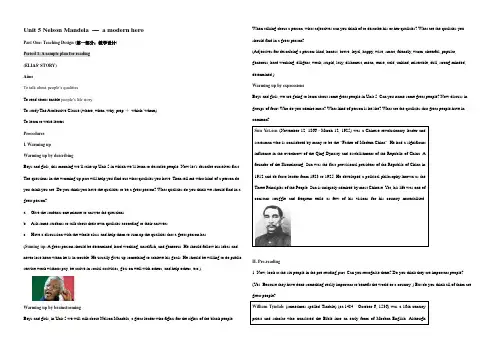
Unit 5 Nelson Mandela —a modern heroPart One: Teaching Design (第一部分:教学设计)Period 1: A sample plan for reading(ELIAS’ STORY)AimsTo talk about people’s qualitiesTo read about enable people’s life storyTo study The Attributive Clause (where, when, why, prep.+which/ whom)To learn to write lettersProceduresI. Warming upWarming up by describingBoys and girls, this morning we’ll take up Unit 5 in which we’ll learn to describe people. Now let’s describe ourselves first. The questions in the warming up part will help you find out what qualities you have. Then tell me what kind of a person do you think you are. Do you think you have the qualities to be a great person? What qualities do you think we should find in a great person?a.Give the students one minute to answer the questions.b.Ask some students to talk about their own qualities according to their answers.c.Have a discussion with the whole class and help them to sum up the qualities that a great person has.(Suming up: A great person should be determined, hard-working, unselfish, and generous. He should follow his ideas and never lose heart when he is in trouble. He usually gives up something to achieve his goals. He should be willing to do public service work without pay, be active in social activities, gets on well with others, and help others, etc.)Warming up by brainstormingBoys and girls, in Unit 5 we will talk about Nelson Mandela, a great leader who fights for the rights of the black people. When talking about a person, what adjectives can you think of to describe his or her qualities? What are the qualities you should find in a great person?(Adjectives for describing a person: kind, honest, brave, loyal, happy, wise, smart, friendly, warm, cheerful, popular, generous, hard-working, diligent, weak, stupid, lazy, dishonest, mean, tense, cold, unkind, miserable, dull, strong-minded, determined,)Warming up by expressionsBoys and girls, we are going to learn about some great people in Unit 5. Can you name some great people? Now discuss in groups of four: Who do you admire most? What kind of person is he/she? What are the qualities that great people have in common?Sun Yat-sen(November 12, 1866–March 12, 1925) was a Chinese revolutionary leader andstatesman who is considered by many to be the “Father of Modern China”. He had a significantinfluence in the overthrow of the Qing Dynasty and establishment of the Republic of China. Afounder of the Kuomintang, Sun was the first provisional president of the Republic of China in1912 and de facto leader from 1923 to 1925. He developed a political philosophy known as theThree Principles of the People. Sun is uniquely admired by most Chinese. Yet, his life was one ofconstant struggle and frequent exile as few of his visions for his country materialized.II. Pre-reading1. Now, look at the six people in the pre-reading part. Can you recognize them? Do you think they are important people? (Yes. Because they have done something really important to benefit the world or a country. ) But do you think all of them are great people?William Tyndale(sometimes spelled Tindale) (ca.1484 - October 6, 1536) was a 16th centurypriest and scholar who translated the Bible into an early form of Modern English. Although2.Speaking task: Students read the information of each of the six persons and discuss in pairs to find out whether he is a great person or not according to the criteria they worked out in the previous step.Remind the students to use the following expressions for giving and asking for opinions:A sample dialogue:A: Do you think William Tidal is a great person?B: Yes. I think so. He had a strong belief that all people should be able to read the Bible for themselves. So he translated and printed it into English although he was not allowed to do so. And later he died for his work.A: Yes. I agree. William Tyndale went through a lot of struggles and difficulties and even sacrificed his life to realize his dream. He is a great person that everybody who picks up the Bible must think of. Now, let’s come to Norman Bethune. What do you think of him?B:….III. Reading1. Skimming for general ideaSo far we have talked a lot about great people. Do you want to know more about them and learn from them? Well, this morning we are going to read about Nelson Mandela, who was considered as a modern hero. Now open your books to page 34 and read the title of the text. What kind of writing is the text, can you guess? … Yes. A story is usually a piece of narrative writing. Now skim the text to get the general idea: What does Elias tell about in his story? (He tells about his life, how Mandela helped him and how he supported Mandela.) 2.Listening and scanning for detail informationa. Listen to the text again and do Comprehending Ex.... 1.True: 2, 4 False: 1, 3, 5, 6, 7, 8b. Scan the text and do Comprehending Ex. 2.3.Questions for further understandingDiscuss the following questions in groups of four:a.How did the white people stop the black people from being treated fairly?b.Why did Elias support Mandela?c.Why did he support violence when he did not agree with it?IV. Closing downClosing down by discussinga.What do you learn about Nelson Mandela from ELIAS’ STORY?b.Do you like the way Elias tells his story? Give a reason.Closing down by retellingRetell the story according to the following clues:introduction of Elias’ problem; Mandela’s help; Elia s’ supportClosing down by an interviewAsk the student to do an interview in pairs. A journalist is interviewing Elias with the following questions: When did you first meet Mandela?Can you tell me more about how he helped you?Can you tell me about the problems that the black people are facing?How do you like his idea of peaceful fighting?What do you think of him?What will you do to support him in the future?Period 2: A sample plan for Learning about Language(The Attributive Clause: where, when, why, prep.+which/ whom)AimsTo help students learn about attributive clause introduced by when, where, why, and prep.+ which/ whom To help students discover and learn to use some useful words and expressionsTo help students discover and learn to use some useful structures ProceduresI. Warming upWarming up by discovering useful words and expressionsTurn to page 35 and do exercises No. 1 and 2. Check your answers against your classmates’.II. Learning about grammar1.Reading and thinkingTurn to page 34. Read the text of ELISA’ STORY and find out all the attributive clauses.Think over this question: On what circumstance do we use when/ where/ why to introduced an attributive clause? (“Where”is used when the antecedent refers to a place, and “when” is used for time. “Why “ is used when the antecedent is “why”.)paring and discoveringTurn to page 36. Do Ex. 1. Then compare the following sentences and find out why we use different words to introduce the attributive clauses while the antecedents are the same.a.The government building where we voted was very grand.b.The government building which/ that we paid a visit to yesterday was very grand.c.The government building in which we voted was very grand.In sentence a), a relative adverb “where” is used because it refers to “in the government building” which serves as the adverbial in the attributive clause. “in which” can also be used as in sentence c) because it also means “in the government building” in the attributive clause. While in sentence b), a relative pronoun “which” is used as it refers to “the governmentbuilding” which serves as the object of the predicate “visited” in the attributive clause.Compare another three sentences:a.The date when I arrived was the 5th August.b.The date which/ that he told me was the 5th August.c.The date on which I arrived was the 5th August.In sentence a), a relative adverb “when” is used because it refers to “on that date” which serves as the adverbial in the attributive clause. “in which” can also be used as in sentence c) because it also means “on that date” in the attributive clause. While in sentence b), a relative pronoun “which” is used as it refers to “the date” serving as the object of the predicate “told” in the attributive clause.Read the following sentence and find outa.The reason why I got a job was because of my hard work.b.The reason that/ which he gave for getting the job was because of his hard work.c.The reason for which I got a job was because of my hard work.In sentence a), a relative adverb “why” is used because it refers to “for this reason” which serves as the adverbial in the attributive clause. “for which” can also be used as in sentence c) because it also means “for this reason” in the attributive clause. While in sentence b), a relative pronoun “which/that” is used as it refers to “the reason” serving as the object of the predicate “gave” in the attributive clause.III. Ready used materials for attributive clauseDefinitions: Attributive clause: An attributive clause is a clause modifying a noun or pronoun in a compound sentence. Antecedent: The word being modified by an attributive clause is called the antecedent.Relative: The word that is used to introduce an attributive clause is called a relative. There are two kinds of relatives, i.e. relative pronouns including which, that, who, whom, whose, as, etc. and relative adverbs including where, when and why, etc.Note: Relatives plays three important roles in an attributive clause, i.e. introducing an attributive clause, replacing the antecedent in meaning, and functioning as a sentence element in the attributive clause.e.g.: The girl who is talking to Mr. Li over there is my sister. In the sentence, The girl is the antecedent and who is used to introduce the attributive clause as the antecedent is a person. It (who) refers to the girl and functions as the subject in the attributive clause.The choice of the relatives is the most difficult in learning the attributive clause. However, there are some rules that can help us choose the correct relatives. Usually, which relative to choose depends on what the antecedent is and what sentence element the relative functions in the attributive clause as shown in the following chart:Note: relatives can be omitted if they serves as the objects in the attributive clauses.If a relative functions as the object of a preposition in the attributive clause, the preposition can usually be placed before the relative. In this situation, we use “which” for things and “whom” for people, and they can never be omitted. However, if the preposition and a verb form a set phrase in the attributive clause, they should not be separated:The school (which/ that) he once studied in is very famous.The school in which he once studied is very famous.This is the girl (who/ whom) I went to the Great Wall with.This is the girl with whom I went to the Great Wall.The sentence “This is the watch (which/ that ) you are looking for.” can not be changed into “This is the watch for which you are looking.” because “look for ” is a set phrase.Now turn to page 36 and let’s do Ex.2 and 3.IV. Closing down by doing a quizTo end the period you are going to take a quiz on attributive clause.Choose the best answer:1.The weather turned out to be very good, ____ was more than we could expect.A. whatB. whichC. thatD. it2.After living in Pairs for fifty years he returned to the small town ____ he grew up as a child.A. whichB. whereC. thatD. when3.The house ______ we live is not large.A. whichB. in whichC. on whichD. at which4.Recently I bought an ancient Chinese vase, _____ was very reasonable.A. which price C. the price of which C. its price D. the price of whose5.He lived in London for 3 months, during ____ time he learned some English.A. thisB. whichC. at whichD. some6.I will never forget the day _____ he came to see me.A. thatB. whichC. at whichD. when7.The visitor asked the guide to take his picture _____ stands the famous tower.A that B. where C. which D. there8.The students ____ department Ms King worked ten years ago look down upon women.A. in whichB. in thatC. in whoseD. whose9. I don’t like _____ you speak to her.A. the wayB. the way in thatC. the way whichD. the way of which10. I had neither a raincoat nor an umbrella. _______ I got wet through .A. It’s the reasonB. That’s whyC. There’s whyD. It’s howPeriod 3: A sample lesson plan for Using Language(T HE REST OF ELIAS’ STORY)AimsTo help students read the passage THE REST OF ELIAS’ STORYTo help students to use the language by reading, listening, speaking and writing ProceduresI. Warming up and listeningSo far we have read a story about Elias. Do you remember why it was difficult for him to get a job? (because he hadn’t a passbook) what is a passbook? Why is it important? Let’s listen to a short passage and find out.Turn to page 37. Read the questions and choose the best answer after listening.Discuss the questions in Ex. 2.II. Guided reading1. Reading and answering questionsAs we know, in order to support Mandela, Elias helped him blow up some government buildings. Can you imagine what would happen to him if he was caught? Actually, he was caught and put into a prison on Robben Island. However, he was lucky enough to get help from Mandela even when he was in prison.Turn to Page 38, read the passage quickly and find out:How did Mandela helped Elias when he was on Robben IslandHow did Mandela help Elias after he came to power?2. Reading and doing exercisesRead the passage again and do the exercise on Page 38.3. Task (a text dialogue)Now we have finished the story about Elias. Next we are going to do a group activity. We will do it in groups of four. Suppose one of you is Elias and works as a tour guide on Robben Island. The other three of you are tourists who are very interested in the island and Mandela’s life and asking the tour guide the following questions. Elias must answer them.III. Guided writing1. Preparation for writingImagine now Mr Mandela is in prison. You are going to write a letter to the President of South Africa asking him to free Nelson Mandela. Do you remember the format of a letter? What should be the main content of this letter? (The reasons for freeing Mandela) How would you try to persuade the president? (You must make your reasons persuasive.)2. Writing a letterRead the information about Mandela. Discuss with your partner and collect ideas for the letterWriter down the ideas and put them into a good and logical order.Write the letter. IV. Further applying1. Finding informationGo to the library to read or get online to search for more information on Nelson Mandela. Take notes of your finding and do an oral presentation next period.2. Writing a descriptionWrite a description of Nelson Mandela using the information you have found.V. Closing down by sharingShare your letter with your partners and make necessary changes.Share your letter with the class by reading it aloud.Part 2: Teaching resources(第二部分:教学资源)Section 1: A text structure analysis of ELIAS’ STORYI. Type of writing and summary of the ideaall.Topic sentence of 5th paragraph We first broke the law in a way which was peaceful;when this was not allowed … only then did we decideto answer violence with violence.II. A tree diagram(with key words of each paragraph placed in each box)III. A retold passage of the textElias is a black worker in South Africa. His family was so poor that he had to drop out of school at the age of eight. Later on, he was able to work as a gold miner in Johannesburg. But as he hadn’t got a passbook which was required if one wanted to live in Johannesburg. He was worried about being dismissed. However, he was lucky enough to get some help from Nelson Mandela and managed to get the correct papers. After that, he began to know more Mandela and his political ideas. He agreed with Mandela’s views on the unfair laws against the black people and his idea about peaceful fighting. He also knew that all Mandela wanted to do was to fight for equal rights for the black people. So he supported him heart and soul.Section 2: Background information on Nelson Mandela and othersI. Nelson MandelaNelson Rolihlahla Mandela, (born 18 July 1918), before becoming President of South Africa, was one of its chiefanti-apartheid activists, and was also an anti-apartheid saboteur. He is now almost universally considered to be a heroic freedom fighter. He spent his childhood in the Thembu chiefdom before embarking on a career in law.The name Madiba is an honorary title adopted by older male members of Mandela's clan; however, in South Africa the title is synonymous with Nelson Mandela.II. Courtroom quotes by Nelson Mandela“I have fought against white domination and I have fought against black domination. I havecherished the ideal of a democratic and free society in which all persons live together in harmonyand with equal opportunities. It is an ideal which I hope to live for and to achieve. But if needs be,it is an ideal for which I am prepared to die.”“Why is it that in this courtroom I am facing a white magistrate, confronted by a white prosecutor,escorted by white orderlies? Can anybody honestly and seriously suggest that in this type ofatmosphere the scales of justice are evenly balanced? Why is it that no African in the history ofthis country has ever had the honor of being tried by his own kind, by his own flesh and blood? (I)am a black man i n a white man’s court. This should not be.”(Finlayson 84).“Out of the experience of an extraordinary human disaster that lasted too long, must be born asociety of which all humanity will be proud... We have, at last, achieved our politicalemancipation. We pledge ourselves to liberate all our people from the continuing bondage ofpoverty, deprivation, suffering, gender, and other discrimination. Never, never, and never againshall it be that this beautiful land will again experience the oppression of one by another... The sunshall never set on so glorious a human achievement.”Elias’life before Elias’life after information Elia s’s problemElias’ storyMandela’s helpblack people’ssupport to Mandela black workerdifficult periodsix leave not pay gold mine passbooktell help correctno rights votelive job poorestposition acceptfight peacefully blow upIII. ANC and ANC Youth LeagueThe ANC is a national liberation movement. It was formed in 1912 to unite the African people and spearhead the struggle for fundamental political, social and economic change. For nine decades the ANC has led the struggle against racism and oppression, organising mass students resistance, mobilising the international community and taking up the armed struggle against apartheid. Membership of the ANC is open to all South Africans above the age of 18 years, irrespective of race, colour and creed, who accept its principles, policies and programmes.The ANC Youth League was founded in 1944. The league propagated “Africanism” and its motto was “Africa’s cause must triumph.” It was radical and militant. The members of it rejected the idea of “foreign” leadership and argued that black Africans must provide their own leadership and rely upon themselves.Section 3: Words and expressionsI. Words for warming upqualityn. something typical of a person or material: Kindness is his best quality. She shows qualities of leadership.willingadj. ready (to do sth.): Are you willing to help?activeadj. able or ready to take action: Although he is over 70; he is still active. An active member of the club is sure to attend every meeting. lose heart灰心,丧失信心I used to work in the garden every week. But I lost heart when all the plants died. Don’t lose heart; you still have more chances.lose one’s heart爱上,喜欢上She lost her heart to him as soon as she saw the handsome soldier.trouble n.麻烦:in trouble 有麻烦,处于困境中;get into trouble 陷入困境;make trouble 制造麻烦;ask for trouble 自找麻烦;have trouble (in) doing sth. 做某事有困难II. Words for Readingadvisev. to tell what one thinks should be done:advise sth.; advise doing sth.; advise sb. to do sth.; advise that sb. (should) do sth.; I advise waiting until the teacher comes. The doctor advised a week’s rest/ taking a week’s rest. I advised (him) that he should take a rest. I advised him not to drive/ against driving. What do you advise me to do?advicen. opinion given by one person to another on how that other should behave or act: give some advice to sb.; five sb. some advice; follow sb’s advicecontinuevi & vt. go on: continue to do sth/ doing sth; continue (with)sth.; go on doing sth. / with sth. / to do sth. The sports meet continued for 3 days. He continued to study/ studying as if nothing had happened. We must continue our journey until we find water.worryn. & v. to be or make anxious:worry sb.,worry about…; bbe worried about…; You don’t have to worry about your health if you keep a balanced diet. Our parents must be worrying because we are coming back late. Her sick students worried me. What he said added to her worries.stagen. a period a in a course of events; the raised floor on which plays are performed in a theater: stage direction; stage director; put sb. on the stage; at an early stage in our historyvotev. & n. to express one’s choice officially from among the possibilities offered ; an act of making a choice or decision on a matter by means of voting: vote for/ against sb. Most students voted for Jim as they thought him capable and honest. Mostpeople voted against the former leader because of rumor about him. I gave my vote to Li Gao. The new leader was elected through a secret vote.positionn. the place where someone or something is or should be; a particular place or rank in a group: What I know about him was that he is in a high position in the company. Can you tell me the position of your city on the map?acceptv. to take something offered willinglyreceivev. to get: I received some roses from Jack on Valentines’ Day but I didn’t accept them. Have you accepted the job they offered you? He received many presents on his birthday.violencen. use if bodily force to hurt or harm; very great force in action or feelingviolentadj. Violence in the media has influenced teenagers a lot.as a matter of fact: in fact; actually: As a matter of fact, he discover the truth quite by accident. As a matter of fact, I felt extremely nervous when I was giving the speech.blowv. blow up: blow up the building/ bridge/ dam; blow up the tire; blow off; blow outprisonn. a place where criminals are kept locked up as a punishmentprisonern. a person kept in a prison for some crime or while waiting to be tired.put in prison: If you continue doing those kinds of things, you will end up in prison. They were put in prison for blowing up the government building.equaladj. the same in size; number; value; rank; etc.; having enough strength; ability; etc.: All men were born equal. Cut the cakes into three equal pieces. Women demand equal pay for equal work. Bill is equal to the job of running the office. n. person who is equal ( to another or to oneself): The teacher is popular because he treats the children as his equals.III. Words for Using Languageimaginev. to form (a picture or idea) in mind: imagine sth.; imagine doing sth.; imagine sb. doing sth.; imagine that …; Can you imagine life without electricity? I cannot imagine Lily cooking dinner for twenty people? You cannot imagine what life was like on Robben Island.powern. political power; super power; come to/ into power; in powerterrorn.( terrible adj. terrorist n. terrorism n.) She trembled with terror when the thief pointed a knife at her. She screamed with terror on hearing the explosion. The murder case was a terror to everybody in the small town.fearn.& v the feeling that one has when danger is near; to be afraid: fear sth; fear to do sth; fear that…; for fear that…; for fear of escapev.& n. find a way out; get out; the act of escaping: a narrow escape; fire escape; escape death punishment/ being punished; escape from prison / reality; escape out of a burning building. The bird has escaped from the cage. The bird has escaped being shot.degreen. He passed the exam and finally got his Master’s degree. The temperature today is two degrees hotter than yesterday. rewardn. (sth. given or gained as) return for work or service: The police are offering a reward for information about the robbery. v. to give a reward to: He rewarded the boy for bring back the dog.sentencen. a punishment for a criminal found guilty in court: The sentence was ten years in prison. a heavy sentence; a life sentence; under the sentence of death; serve one’s sentence v. to give a punishment to: He was sentenced to three years in prison. be sentenced to death; be sentenced for thief。
优化方案2017高中英语Unit5NelsonMandelaamodernher语篇阅读提能新人教版必修1
语篇阅读提能(建议用时:30分钟)Ⅰ阅读理解A(2016·辽宁师大附中高一上期末)If you have ever been discouraged because of failure, please read on. Usually, achieving what you set out to do is not the important thing. Let me explain.Two brothers decided to dig a deep hole behind their house. As they were working, a couple of older boys stopped by to watch.“What are you doing?” asked one of the visitors.“We plan to dig a hole all the way through the earth!”one of the brothers answered excitedly.The older boys began to laugh, telling the younger ones that digging a hole all the way through the earth was impossible. After a long silence, one of the diggers picked up a jar full of s piders, worms and a lot of insects. He removed the lid and showed the wonderful contents to the visitors who were laughing at them. Then he said quietly and confidently,“Even if we don’t dig all the way through the earth, look what we f ound along the way!”Their goal was far too difficult, but it made them dig. And that is what a goal is for—to make us move in the direction we have chosen. In other words, it sets us to digging!But not every goal will be fully achieved.Not every job will end successfully. Not every hope will come to pass. Not every love will last. But when you fall short of your aim, perhaps you can say,“Yes, but look at what I found along the way! Look at the wonderful things which have come into my life because I tried to do something!” And I believe it is the joy in the journey, in the end, that truly matters.【解题导语】在本文中,作者通过举例子说明了生活的乐趣是在于过程,而不是最终实现了目标才会让人快乐。
人教版高中英语必修一教案Unit 5 Nelson Mandela (含答案)
Unit 5 Nelson Mandela—a modern hero I.单元教学目标II.目标语言III. 教材分析和教材重组I. 教材分析本单元以Nelson Mandela —— a modern hero 为话题,目的在于使学生了解一个伟大的人应具备怎样的品质,学会表达自己的观点,并用所学的句型来描写一个伟人。
1.1 Warming Up列出一些形容词让学生判断一下哪些可以用来描述伟大的人,一个伟大的人应具备怎样的品质。
1.2 Pre-reading给学生提供了六个名人的图片,要求利用图片下面标注的人物的重要事迹以及学生对他们的了解,来判断这六个人谁是伟人,谁是重要的人但不是伟人。
1.3 Reading介绍Elias的生平,向学生展示Nelson Mandela是一个怎样的人。
这是一篇记叙文,让学生学会利用时间顺序描述一个人一生的主要活动。
1.4 Comprehending练习1和3帮助学生利用判断正误和时间顺序来整体理解课文。
练习2和4要求学生进一步了解课文细节。
1.5 Learning about Language分词汇和语法两部分。
其中Discovery useful words and expressions是根据课文语境在运用中掌握词汇,Grammar是有关关系副词where, when, why以及“介词+关系代词”引导定语从句的用法,并通过练习加以巩固。
1.6 Using Language分为三部分,一是Listening,练习听力可配合P72的Listening Task进行。
二是Reading,这也是一篇精读文章,更详细地了解曼德拉。
三是Writing,要求利用时间顺序简要地描述一个人。
2. 教材重组2.1 因本教材重点强调的是阅读能力,故将Reading, Comprehending,Using Language 中的Reading合在一起设计成一节“阅读课”(一)(精读课)。
高中英语 Unit 5 Nelson Mandela — a modern hero Section
Unit 5 Nelson Mandela — a modern hero曼德拉——南非首位黑人总统,被尊称为南非国父。
曼德拉不仅仅是一位伟人,更是人们敬仰的英雄。
Nelson Mandela, the first black president of South Africa who was a symbol (象征) of social justice (公正), passed away on Dec. 5, 2013. His death is a great loss to the whole world, since this modern hero, who used to fight for the black people, helped the black people get the same rights as white people, and began a school to help those who had little learning even during the time when he was put into prison. He was the one who always gave priority to (优先考虑) his nation.Nelson was a great man, but he was more than a great man. He was, is, and always will be a hero. In my view, being a hero means more than making great achievements. In fact, heroes are extraordinary (非凡的), because their hearts are filled with love for people. It is this love that makes them heroes, rather than great men.So this is the difference between great men and heroes. What makes a hero is not only one's achievements, but also his selfless (无私的) love. With great achievements and selfless love, the person can bee a true hero, just like Nelson Mandela.短文注释:1.pass away 去世2.a great loss一个巨大的损失3.used to do 过去常常4.fight for... 为……而奋斗5.put... into prison将……投入监狱6.in my view 在我看来7.make great achievements取得巨大成就8.be filled with 充满9.not only... but also...不但……而且……Section ⅠWarming Up & Reading —Prereading重点单词写作词汇1.quality n.质量;品质;性质2.mean adj. 吝啬的;自私的;卑鄙的3.generous adj. 慷慨的;大方的4.found vt. 建立;建设5.principle n. 法则;原则6.stage n. 舞台;阶段;时期7.vote vt.&vi. 投票;选举n. 投票;选票;表决8.attack vt. 进攻;攻击;抨击拓展词汇1.active adj.积极的;活跃的→actively adv.积极地→activity n.活动2.devote vt.(与to连用)献身;专心于→devoted adj.忠实的;深爱的→devotion n.热爱;献身;奉献3.peaceful adj.和平的;平静的;安宁的→peacefully adv.和平地→peacen.和平;平静;和睦①peace→peaceful和平的②pain→painful 痛苦的③harm→harmful 有害的④power→powerful 强大的⑤meaning→meaningful 有意义的⑥cheer→cheerful 欢乐的后缀ance高频名词全接触①guidance 指导;领导②importance 重要;重要性③ignorance 无知;愚昧④signifi cance 意义;重要性⑤appearance 出现⑥tolerance 宽容;容忍self反身代词①myself 我自己②yourself 你自己③himself 他自己④herself 她自己⑤itself 它自己⑥ourselves 我们自己⑦yourselves 你们自己⑧themselves 他们自己“out of+n.”短语集锦①out of work失业②out of control 失控③out of mind 心不在焉④out of order 有毛病;出故障⑤out of sight 看不见“in+n.”短语面面观①in trouble 在困境中②in danger 处于危险中③in return 作为回报④in vain 徒劳地⑤in order 井然有序⑥in place 在适当的位置Step One:Warming upA famous person may not be a great person, but a great person must be a famous person.1.Who do you think are great persons in the following pictures?答案:A,B and E2.What do you know about Nelson Mandela?He_devotes_his_life_to_helping_his_people_get_the_same_rights_as_white_peop le_in_his_country./He_is_a_national_leader_who_has_been_fighting_for_making_bla ck_and_white_people_equal./Nelson_Mandela_is_regarded_as_one_of_the_greatest_sp iritual_and_political_leaders_of_our_time.Step Two:Fast readingSkim the text and choose the best answers.1.What's the main idea of the text?A.The life of black workers.B.The fight between Mandela and the white people.C.The stories between Mandela and Elias.D.The education of Elias.答案:C2.Match the main idea of each part.Paras.1~2(B) A.The change of Elias' life after he met Nelson Mandela and what Mandela didParas.3~7(A) B.The life of Elias before he met Nelson MandelaStep Three:Careful readingRead the reading passage carefully and choose the best answers according to the text.1.Why did Elias have to leave school?A.He didn't have a passbook.B.His home was far from the school.C.His family couldn't afford the school fees.D.He couldn't read or write.答案:C2.Nelson Mandela opened a black law firm in order to ________.A.make moneyB.help the poor black people with their problemsC.make himself famousD.study law答案:B3.How did Nelson Mandela help Elias keep his job?A.He talked with Elias' boss.B.He helped him get the correct papers.C.He lent him some money.D.He asked him to go to court.答案:B4.What dream did Nelson Mandela have?A.To bee the president of South Africa.B.To win the Nobel Peace Prize.C.To make black and white people equal.D.To blow up some government buildings.答案:CStep Four:Explain difficult sentences1.The time when I first met Nelson Mandela was a very difficult period of my life.[句式分析][尝试翻译]第一次见到纳尔逊·曼德拉的时候,是我一生中非常艰难的时期。
优秀教案(Unit-5-Nelson-Mandela—a-modern-hero-Period-7-
Module1 Unit 5Nelson Mandela-a modern heroPeriod 6Writing and Writing Task(Summing up and Learning tip)整体设计从容说课This is the last teaching period of this unit, so the emphasis should be placed on going over and summarizing what has been learned in this unit. It mainly includes three parts:Summing up, Learning tip and consolidation exercises.Summing up summarizes the whole contents of this unit from the aspects of topics, vocabulary and grammar. The teacher can first use this part to let the students to sum up what they have learned and then explain what the students couldn’t understand very well in this unit. An experienced teacher should design some exercises for the students to do in order that they can learn to use and grasp all the contents.Learning tip encourages students to choose a famous person and try to find out as much as possible about his or her life. Read what he or she did and what people remember about him or her. Find some people who like him or her and some who do not. Try to find out for what reason they like this person or not. If the students are doing this, they will be teaching themselves a useful way of learning. It is very good for their further study. So, make sure the students have a try.In this period, the teacher can also add more practices to consolidate what the students have learned in this unit. Finally, ask the students to finish Checking yourself on Page 75 in the workbook. This part aims at encouraging students to make a self-assessment after they finish learning this unit. It is very important to improve their learning.教学重点Get the students to review and consolidate what they have learned in this unit.教学难点Get the students to turn what they have learned into their ability.教学方法Summarizing, discussing and practicing教具准备A projector and other normal teaching tools三维目标Knowledge aims:1. Get the students to go over useful new words and expressions.2. Have the students review the grammar:the Attributive Clause introduced by relative adverbs and preposition+which/whom.Ability aims:1. Develop the students’ ability to use the important language points.2. Enable the students to learn to use relative adverbs and preposition+which/whom correctly.Emotional aims:1. Encourage the students to learn from famous persons and great persons.2. Strengthen the students’ sense of group cooperation.教学过程→Step 1 Revision1. Check the homework exercises.2. Dictate some useful new words and expressions in this unit.→Step 2 Lead-inTell the students: Up to now, we have finished Unit 5. Have you learned and grasped all in this unit? Turn to Page 40. You can check yourself by filling in the blanks in the part Summing Up.→Step 3 Summing UpFive minutes for the students to sum up by themselves. Then check and explain something where necessary.Suggested answers:Write down what you have learned about Nelson Mandela.We have learned many noble qualities about Nelson Mandela, such as intelligent, determined, generous, kind, unselfish, hard-working, brave, confident, and so on.From this unit you have also learneduseful verbs:fight, advise, continue, vote, accept, fear, reward, sentenceuseful nouns:hero, quality, republic, principle, fight, prison, prisoner, period, law, fee, gold, youth, league, stage, vote, position, violence, blanket, degree, guard, terror, fear, cruelty, reward, right, criminal, leader, presidentuseful adjectives:willing, active, peaceful, gold, equal, educated, anti-blackuseful expressions:lose heart, in trouble, worry about, out of work, Youth League, as a matter of fact, blow up, put. . . in prison, come to power, set up, be sentenced tonew grammar item:the Attributive Clause introduced by relative adverbs and preposition+which/whom→Step 4 Word and expression exercisesShow the exercises on the screen or give out exercise papers.1. Fill in the blanks with the missing words according to the first letter or Chinese meaning given.1)Nelson Mandela was regarded as one of the best l of the black people.2)I think you must solve your problem in a p way. F ighting can’t solve any problem.3)The full name of our great motherland is the People’s R of China.4)I don’t think ten years is a long p of time.5)You must try to improve the q of all your products.6)Nobody forced me to do it; I was w to do it.7)At present, women hold an important______________ (地位)in our country.8)A middle-aged woman killed her husband, which showed her______________ (残忍).9)You must be______________ (积极的)in all kinds of sports to keep healthy.10)I______________ (劝说)her to give up that idea, but she didn’t listen to me.11)I like all the______________ (男主角)of this play, because they are so kind.12)Don’t you think fighting is a serious act of______________ (暴力)?13)Since he was better______________ (受过教育的), he got a job in an office.14)The actress in poor health and has to leave______________ (舞台)soon.15)I guess this film will______________ (持续)for another fifteen minutes.2. Fill in each of the blanks with the proper phrase given. Change the form where necessary.1〕The sudden heavy snow______________ them______________ getting home as early as expected.2〕His glasses fell down to the ground and____________ _______________ _______________ .3〕Don’t____________ ____________her health; I think she will take good care of herself.4〕I just can’t understand why she is___________ _____________ ___________ again.5〕You can’t___________ ___________in face of any difficulty.6〕Boys and girls, let’s do our best to help those______________ ______________ .7〕It is reported that the new president will__________ ________________ ________________ next month.8〕It is said that a new factory will be_____________ _______________ in my hometown.9〕The murderer will___________ _____________ ________________ _______________for killing a few girls.10〕The thief will____________ ______________ _______________ _____________for stealing quite a few expensive cars.First get the students to do the exercises. Then the answers are given. The teacher can give them explanations when necessary.Suggested answers:1. 1)leaders2)peaceful3)Republic4)period5)quality6)willing7)position 8)cruelty9)active10)advised11)heroes12)violence13)educated14)stage 15)continue2. 1)stopped; from2)broke into pieces3)worry about4)out of work5)lose heart 6)in trouble7)come to power8)set up9)be sentenced to death10)be put in prison→Step 5 Grammar exerc isesShow the exercises on the screen or give out exercise papers.1. Complete the following sentences with “preposition+which/whom”.1)This is the rock______________ the boy fell down into the sea.2)Yesterday we had a meeting,______________ we discussed a lot of questions.3)The film star______________ we talked a lot will give us a speech tomorrow.4)Nothing can grow on the moon______________ there is neither water nor air.5)The West Lake______________ Hangzhou is famous in the world will be more beautiful.6)The newspaper______________ he often writes articles is China Daily.7)The stories about the Long March are well written,______________ this is one example.8)The subject______________ Xiao Wang is good is physics.9)The professor______________ Mr. Smith shook hands yesterday has made new discoveries in science.10)At last I met the writer______________ I had heard long before.2. Fill in the blanks with proper relative pronouns or relative adverbs.1)The city______________ I was born has a lot of parks.2)I don’t like cities______________ have a lot of factories.3)New Year’s Eve is a time______________ I am always looking forward to.4)My birthday is a day______________ I think about my future.5)He is the cleverest boy______________ I have ever seen.6)I saw a house the windows of______________ are broken.7)I saw a house______________ windows are broken.8〕I will never forget the days______________ I worked together you on the farm.9〕He has got himself into a dangerous place______________ he is likely to lose his way.10〕We expressed the hope______________ they had expressed.First get the students to do the exercises. Then the answers are given. The teacher can give them explanations where necessary.Suggested answers:1. 1〕from which2〕at which3〕about whom4〕on which5〕for which6〕for which7〕of which8〕at which9〕with whom10)of whom2. 1)where2)which/that3)(which/that)4)when5)(that)6)which7)whose 8)when9)where10)(which/that)→Step 6 Learning tipAsk the students to turn to Page 40. Read through the passage and make sure they understand it. Encourage them to do as the passage tells to because if they are doing so they will be teaching themselves a useful way of learning.→Step 7 Assessment1. Checking yourself (on Page 75 in the Workbook)First get the students to think about these questions individually. Then they can discuss in groups sharing their experience. The teacher can join in and give them advice and suggestions where necessary.2. Testing assessmentShow the exercises on the screen or give out test papers.1)Choose the best answers.(1)Dorothy always spoke highly of her role in the play,______________, of course, made the others unhappy.A. whoB. whichC. thisD. what(2)I shall never forget the days______________ I lived in the country with my parents.A. thatB. whichC. whenD. at which(3)The factory______________ his brother works lies in the south of the city.A. thatB. whichC. on whichD. where(4)My family climbed up the hills,______________ we had a picnic.A. on the top of whichB. on its topC. on the top of thatD. on the top of it(5)We were next-door neighbors for three years, during______________ we met only twice.A. whichB. thisC. thatD. the(6)All______________ is needed is some oil.A. the thingB. thatC. whatD. which(7)I, who______________ your friend, will go all out to help you.A. isB. areC. amD. be(8)They took care of the old man______________ son lost his life in the fire.A. whoB. thatC. whichD. whose(9)The scientist,______________ my father worked, went abroad last year.A. by whomB. with whomC. whoD. whom(10)Can you tell me the name of the company______________ you visited last week?A. /B. whereC. whatD. to which2)ClozeRead the following passage, get the main idea and fill in the blanks according to the first letters given to complete the passage.Nelson Mandela, b on July 18, 1918, is the first black president of South Africa. He studied l after he entered university. In 1944 he f the ANC Youth League. Then in 1952 he set up a law o to help poor black people. Because of his fight a the government and anti-black laws, he was s to five years hard labor. Fighters from ANC began to b up buildings in 1963 and he was sentenced to life imprisonment on Robben Island. Twenty-seven years later, he was f by the white government. In 1993 he was m president of South Africa and the government by and for black people was finally set up.Nelson Mandela is a g man.First get the students to do the following exercises. Then the answers are given. The teacher can give them explanations where necessary.Suggested answers:1)(1)B(2)C(3)D(4)A(5)A (6)B(7)C(8)D(9)B(10)A2)born; law; formed; office; against; sentenced; blow; freed; made; great→Step 8 Homework1. Finish off the Workbook exercises.2. Review and summarize what you have learned in Unit 5.活动与探究Choose a famous person and go to the library or get online to try to find out as much information as you can about his or her life. Write a report on your research and share it with your classmates. You report should include the following:1. What this person did.2. What people remember about this person.3. Who like this person and who do not.4. Why they like this person or not.。