
unit6+Do+you+like+bananas第一课时
tomatoes
strawberries
oranges
ice-cream
salad
bananas
2b Listen again. Fill in the blanks.
tomatoes
ice-creaቤተ መጻሕፍቲ ባይዱ ice-cream
tomatoes
2c Practice the conversations above.
2d Role-play the conversation.
Jack: Hey, John’s birthday dinner is next week. Let’s think about the food. Tom: Sure. How about burgers, vegetable salad, and some fruit? Bill: Sounds good. John likes hamburgers. Jack: Oh, I don’t like salad. Bill: But John likes salad, and it’s his birthday. Jack: Yes, you’re right. What about the fruit? Tom: I think John likes strawberries and apples. Bill: OK. Let’s have strawberries and apples then.
families dictionaries
boys keys tomatoes potatoes photos radios
可数名词和不可数名词 不可数名词 (1) 定义:是指表示不能计数的事物的名词。 不可数名词前不可以用 a , an 限定。 (2) 不可数名词前不可以用 one, two , three …等 (3) 限定。 (4)不可数名词没有复数形式。
不可数名词 (uncountable noun)
food
milk chicken
bread, rice , salad
ice cream , fruit
1a Match the words with the things in the picture.
1. hamburgers ___ d 2. tomatoes ____ i 3. oranges ___ f 4. ice cream ___ h 5. salad ___ b g 6. bananas ___ c 7. strawberries ___ 8. pears___ j 9. milk ___ e 10. bread ___ a
-es读[iz] -ves读[vz] boxes watches
以-s, -x, -sh, -ch 结尾的
加-es
以f 或 fe 结尾的
改f或fe为 v 再加-es
knives wives
可数名词复数形式的构成 2
名词特点 词尾加法 词尾读音方法 以辅音字母 改y为i 加y结尾的 再加-es 以元音字母 加-s 加y结尾的 有生命的 以o 结尾 事物加-es 的 无生命的 事物加-s -ies读[iz] -s读[z] -es读[z] -s读[z] 例词
1b Listen and number the conversations.
2 1 3 A: Do you like salad? B: No, I don’t. A: Do you like bananas? B: Yes, I do. A: Do you like oranges? B: Yes, I do.
Unit 6 Do you like bananas?
Section A Period 1 (1a-2d)
What’s in the fridge?
banana
中学学科网
bananas
pear
pears
strawberry
zxxkw
strawberries
apple
apples
orange
可数名词和不可数名词 既可数又不可数的名词
定义:在某些情况下能计数,在某些情况下不能计数 的名词。
e.g. (1)a chicken 一只鸡 chicken 鸡肉 (2)an ice-cream 一个冰淇淋 ice-cream 冰淇淋(指成份) (3)a salad 一碟沙拉 salad 沙拉(指成份)
food, fruit, ice-cream, salad, chicken
1. Don’t take the fruit to Alice. I need it ______ (it). 2._____ Those (That) are my ________ friends (friend). They (It) are nice. ______ 3.There are some ______ photos (photo) on the wall. They are very beautiful. 4.I have much homework _________(homework) to do.
oranges
tomato
组卷网
tomatoes
hamburger
hamburgers
ice-cream ice-cream
salad
salad
milk
milk
bread bread
可数名词 (countable noun) apple pear hamburger banana orange strawberry tomato — — — — — — — apples pears hamburgers bananas oranges strawberries tomatoes
1c Practice the conversations above with your partner. Then make your own conversations.
Do you like …? Yes, I do. No, I don’t.
A: Do you like hamburgers?
Countable nouns:
hamburgers, eggs, oranges, bananas, apples, pears, carrots, vegetables, tomatoes, strawberries
Uncountable nouns:
milk, bread, rice
Countable and uncountable nouns:
B: Yes, I do. / No, I don’t. A: Do you like salad? B: Yes, I do. / No, I don’t.
I like
I don’t like
2a Listen and circle the food you hear.
hamburgers
pears
Make an interview to your family about the food and fruit. Find out about what they like and don’t like. Then write a letter.
可数名词和不可数名词 可数名词 (1)定义:是可以计数的名词。 可数名词前可以用 a , an 限定,表一个。 (2)
可数名词前可以用 one, two, three …等限定。 (3)
可数名词有复数形式。 (4)
可数名词复数形式的构成1
名词特点 词尾加法 词尾读音方法 例词
一般情况 下
加-s
1. -s在清辅音后读[s] desks 2. -s在浊辅音后读[z] apples 3. -s在元音后读[z] trees 4. 以音素[ s , z , ʒ] ] oranges 结尾的,读[iz]
人教新目标英语七上Unit6Doyoulikebananas教案4
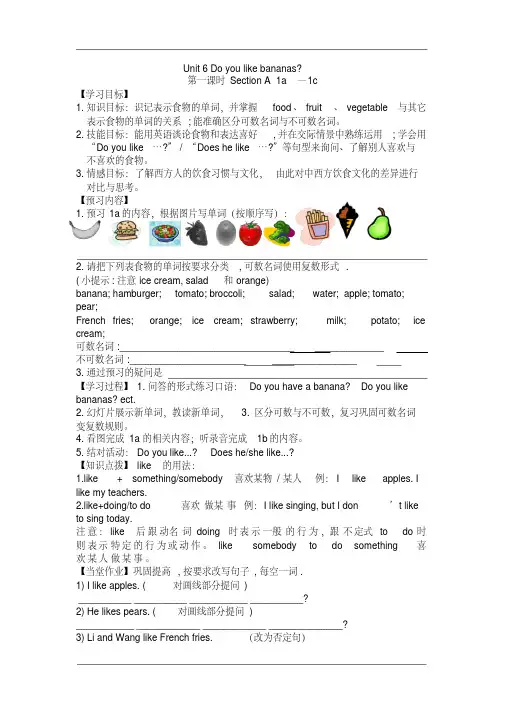
Unit 6 Do you like bananas?第一课时Section A 1a—1c【学习目标】1.知识目标:识记表示食物的单词,并掌握food、 fruit、 vegetable与其它表示食物的单词的关系;能准确区分可数名词与不可数名词。
2.技能目标:能用英语谈论食物和表达喜好,并在交际情景中熟练运用;学会用“Do you like…?” /“Does he like…?”等句型来询问、了解别人喜欢与不喜欢的食物。
3.情感目标:了解西方人的饮食习惯与文化,由此对中西方饮食文化的差异进行对比与思考。
【预习内容】1.预习1a的内容,根据图片写单词(按顺序写):2.请把下列表食物的单词按要求分类,可数名词使用复数形式.(小提示:注意ice cream, salad和orange)banana; hamburger; tomato; broccoli; salad; water; apple; tomato; pear;French fries; orange; ice cream; strawberry; milk; potato; ice cream;可数名词:_________________________________ _____________不可数名词:______________________ ________________3.通过预习的疑问是【学习过程】1.问答的形式练习口语:Do you have a banana? Do you like bananas? ect.2.幻灯片展示新单词,教读新单词,3.区分可数与不可数,复习巩固可数名词变复数规则。
4.看图完成1a的相关内容;听录音完成1b的内容。
5.结对活动:Do you like...? Does he/she like...?【知识点拨】like 的用法:1.like + something/somebody 喜欢某物/某人例:I like apples. I like my teachers.2.like+doing/to do喜欢做某事例:I like singing, but I don’t like to sing today.注意:like后跟动名词doing时表示一般的行为,跟不定式to do时则表示特定的行为或动作。
新人教英语七年级上Unit6第一课时 Section A1a-2d
I know a boy. His name is John. John’s birthday is next (中午或晚上吃的)正餐
week. So his friends are preparing for his birthday dinner. But they don’t want John to know it. 生日
Read the conversation in 2d and answer the question: What do they want to eat?
Jack: Hey, John’s birthday dinner is next week. Let’s think about the food. Tom: Sure. How about burgers, vegetable salad, and some fruit? Bill: Sounds good. John likes hamburgers. Jack: Oh, I don’t like salad. Bill: But John likes salad, and it’s his birthday. Jack: Yes, you’re right. What about the fruit?
2c Practice the conversations in 2b. Give answers that are true for you. Do a survey in groups of four and give a report.
I like tomatoes. Do you like tomatoes?
A: Do you like salad? B: No, I don’t. A: Do you like bananas? B: Yes, I do. A: Do you like oranges? B: Yes, I do.
英语七年级上册Unit 6 Do you like bananas 第一课时公开课教学设计
新版英语七年级上册Unit 6 Do you like bananas 第—课时公开课教学设计课型:Listening and speaking时间:45minutes教材内容:Section A教学要求:Target language 目标言语1. Words 生词banana; hamburger; tomato; ice-cream; salad; strawberry; pear; bread; food; burger; vegetable; fruit; apple; egg2. Key sentences 重点句子Do you like ... Yes, I do. / No, I don't.I like ...I don't like ...Language goals 言语技能目标Enable students to talk about likes and dislikes.Strategy goals 学习策略目标1. With the help of different forms of contexts and tasks, enable students to understand new words and classify countable and uncountable nouns.2. Enable students to communicate with partners by using target languages.Emotional and attitude goals 感情态度目标Enable students to communicate with others about likes and dislikes and learn to care for the people around more.Teaching important / difficult points 教学重难点1. The names of different food.2. How to talk about likes and dislikes.Teaching aids 教具打算A computer, blackboard, cards and fruits.Teaching procedures and methods 教学过程与方法Step 1ead-inAims: To attract students’ attention to the topic.Teachers' activities: Talk about the food the teacher has in the fridge in order to help teach students to learn the words.Students' activities: Guess what the teacher has in the fridge.Step 2: PresentationAims: To get students familiar with the new words of food and help students gain some input of countable nouns and uncountable nouns.Teachers' activities: Show students different kinds of food and teach them new words of food, and write on the blackboard.Students' activities: Try to guess what the teacher has in her fridge and learn those words to gain input. Step 3: PresentationAims: To help students get familiar with the key sentences of 〞I like ...〞and 〞I don’t like ...〞 with the help of context.Teachers' activities: During guessing, the teacher talks about likes and dislikes and asks them whether they like or not by using key sentences. And write key sentences on the blackboard.Students' activities: Know about the food the teacher likes and dislikes to gain input. Step 4: PracticeAims: To help students consolidate the words they learnt.Teachers' activities: Attract students' attention to the picture, and tell them about thecontext, and then show students the picture and ask them to finish 1a.Students' activities: Finish 1a. Step 5: ListeningAims: To get students familiar with the ways of asking and answering about likes.Teachers' activities: Play records and listen carefully in order to help students check the answers.Students' activities: Listen to the record carefully and get the correct order. Step 6: PairworkAims: To help students command the ways of talking about the food they like.Teachers' activities: Give instructions and make a sample dialogue for help.Students' activities: Ask and answer about the food they like by using target language. Step 7: Game: What’s missingAims: To help students command key words and get ready for the next listening task.Teachers' activities: Give instructions and help smooth the game when necessary.Students' activities: Students have to remember the food shown on PPT and then find out what’s missing in the next few pages and spell the word. Step 8: Listening ⅠAims: To make sure students can gain correct information by understanding conversations.Teachers' activities: Help students to predict the content, play records and listen carefully to help check the answers.Students' activities: Predict the content and listen carefully to get the correct answers. Step 9: Listening ⅠAims: To help students deal with more detailed information in the conversations.Teachers' activities: Play records and listen carefully to help check the answers.Students' activities: Listen carefully and get more detailed information. Step 10: Listening ⅠAims: To help students get familiar of the ways to talk about the third person's likes and dislikes.Teachers' activities: Play records, listencarefully to help check the answers and lead students to check the answers by using target language.Students' activities: Listen carefully and gain some input of talking about the third person’s likes. Check the answers by using target language. Step 11: ReadingAims: To help students understand the whole dialogue and gain detailed information about it.Teachers' activities: Show students the questions they have to deal with and ask them to read carefully.Students' activities: Read carefully and answer the questions. Step 12: ShadowingAims: To help students imitated the intonation of the dialogue and get more familiar with the dialogue by doing this task.Teachers' activities: Play records and ask students to do shadowing.Students' activities: Listen carefully and read after the tape to imitated the intonation. Step 13: Group workAims: Provide opportunities to students to practice the dialogue.Teachers' activities: Ask students to read the dialogue together and then read in different kinds of groups.Students' activities: Read the dialogue together and then read in different kinds of groups. Step 14: Group workAims: To provide more chances to students to practice their oral English.Teachers' activities: Invite some students to role play the dialogue.Students' activities: Role play the dialogue and add something more if they can. Step 15: HomeworkAims: To consolidate the contents learnt in the period and calculate students’ability to make a summary of things they learn.Teachers' activities: Try to make a summary of different words learnt today.Students' activities: Try to make a summary of different words learnt today by finishing the chart and make sentences.。
Unit 6Do you like bananas
Unit 6Do you like bananas?第一课时Section A(1a~1c)Ⅱ.根据句意及汉语提示填写单词。
6.My sister (喜欢) this photo.7.What about having (面包) this morning?8.Here is some (牛奶) for you,Mike.9.Do you like (沙拉)?10.Where is your (冰激凌)?Ⅲ.单项选择。
( )11.David has ________ apple and Mike has ________ pear.A.a;a B.an;a C.a;an D.an;an( )12.We often have some ________ after lunch(午餐).A.apple B.chickensC.egg D.ice-cream( )13.The milk ________ on the table and the oranges ________ in the box. A.is;is B.are;areC.are;is D.is;are( )14.Maria likes pears ________ bananas,________ she doesn't like strawberries. A.and;and B.and;butC.but;but D.but;and( )15.Kate and Linda ________ English.A.likes B.is likeC.don't like D.doesn't likeⅣ.按要求完成下列句子,每空一词。
16.My sister likes oranges.(改为否定句)My sister oranges.17.They like Chinese__food.(对画线部分提问)they ?18.She likes salad.(改为一般疑问句并做肯定回答)—she salad?—Yes,.19.We like vegetables.(改为否定句) We vegetables.20.My father likes strawberries.(对画线部分提问)your father ?第二课时Section A(2a~2d)Ⅰ.根据句意及汉语提示填写单词。
七年级人教版英语上册Unit6Doyoulikebananas?全单元教案

Unit 6Do you like bananas?Period 1(Section A 1a-1c)Teaching aims1. Learn words and be able to say, read and write them:orange(s), banana(s), strawberry, strawberries, pear(s), apple(s),tomato(es), carrot(s), vegetable(s), hamburger(s), egg(s), ice-cream(s),salad(s), bread, chicken2. Be able to talk about likes and dislikes by using:I/We/They like oranges. He/She likes oranges.I /We/They don’t likebananas. He/She doesn’t like hamburgers.Do you like salad? Yes, I do./No, I don’t.Does he/she like tomatoes? Yes, he/she does. / No, he/she doesn’t.3.Understand the difference between countable nouns and uncountable nouns.Teaching key and difficult points:1.Learn these words and be able to say, read and write them:2.Be able to talk about likes and dislikes by using:I/We/They like oranges. He/She likes oranges.I /We/They don’t likebananas. He/She doesn’t like hamburgers.Do you like salad? Yes, I do./No, I don’t.Does he/she like tomatoes? Yes, he/she does. / No, he/she doesn’t. Moral objects(1)To call students ’ attention to otherserests and’ei n ablet themto care more about classmates.(2)To improve Sts ’communicating skills and enable them to keeptheir health.教学设计备注Step 1. Warm-up and revision(1)Daily greeting to the students(2)Revision: What ’s this/that in English ? What coloris it?T:What ’s this in English? (show a picture of andorange)T:What color is it?Step 2. Presentation –New words.(1)Go on asking: What ’s this/that in English ? Whatcolor is it?T:What ’s this in English? (show a picture of anapple and if the student don’t know it, show thephonetic symbol of the word.)T: Spell it, please.S: A-P-P-L-E.T: What color is it?S: It ’s red.(Present the other three words as above: pear,strawberry, banana )T:We can call all of these things fruit . (Teach the newword “fruit ”.)Show pictures and ask the Ss “What arethese/those? ”and ask the SS to spell the pluralforms of these words: oranges, apples, pears,strawberries, bananas.(2)Repeat step (1) to present: carrot, carrots,tomato, tomatoes and vegetable, vegetables.(3)Present some more words by showing pictures. Get theSs to make an effort to pro nounce and spell the new words.Bread, hamburger ,hamburgers, milk, ice-cream,ice-creams, salad, chicken ,an egg, eggsWe can call all of these things food:食物3.Memory Challenge: Who has the best eyes?(1)Show the pictures, and say the plural forms of the nouns andsome uncountable noun.(2)Summarize. 可数名词有复数形式 , 不可数名词一般没有复数形式Step 3Presentation Target language 11. Show the pictures and say:I like tomatoes, but I don’ t like bread.2.Let students say:I like, but I don’t like ....3. Show the pictures and say:She likes bread, but she doesn’t like milk.He likes chicken, but he doesn’t like eggs.4.Let students say: He/She likes , but he/she doesn’tlike ....According Ss’answers and say:5. Sing a chant:Bananas, bananas, I like bananas! Salad, salad, I like salad!Strawberries, strawberries,I don ’t like strawberries!Pears, pears, he likes pears!Milk , milk, he likes milk!Tomatoes, tomatoes,He doesn ’t like tomatoes! Step 4 Work 1a .1. Read the words.2.T: Look at the pictures and fill in the chart .Fruit Food Vegetable3.Match the words with the things in the picture.4.Check the answers .Step 5 Present the new language 1 .1. T: Oh, we have lots of delicious fruits . I like apples best.Do you like apples ?S1 :Yes , I do. I like apples.S2: No, I don't . I like salad.T: Do you like salad ? S3: Yes , I do. I like salad./ No, I don't . I don’tlike salad.Step 6 Pairwork .1. T: Work in pairs .Ask and answer with your partners .(Before class the students have draw some pictures of the food )2. Get the Ss to ask and answer in pairs, using the sentences:’t.A: Do you like ?B: Yes, I do./ No, I don 3. When you ask andanswer, please fill in the chart. Name Like DislikeStep 7 Present the new language 2 .1.Show pictures and ask and answer questionsDoes she/he like ?Yes, she/he does. She/He likes/ No, she/he doesn ’t. She/He doesn ’tlike .Step 8 Pairwork .1. T: Work in pairs .Ask and answer with your partners .2.Get the Ss to ask and answer in pairs, using the sentences:Does she/he like ?Yes, she/he does. She/He likes/ No, she/he doesn ’t. She/He doesn ’tlike .3.According Ss’answers and ask “Do they like ? Yes, they do./ No, they don’t.”Step 9 Work on 1b.1.T: 1b. List en and number the conversations.2.Listen.3.Check the answers.4.Read after the tape.Step 10 work on 1c.1.First, practice the conversations in 1b.Then, make a survey and fill in the chart below.2. Report: I like milk and tomatoes, but I don’t like ice-cream. Mary likes oranges, but she doesn’liket milk orice-cream. Tom likes tomatoes and strawberries, but hedoesn ’ t like bread.Step 11 . HomeworkWrite down the report.Blackboard design:New Words Unit 6 Do you like bananas?Do you like?Yes , I do. I likeNo ,I don ’t. I don ’tlikeDoes she/he like ?Yes, she/he does. She/He likes/No, she/he doesn ’t. She/He doesn ’tlike.Period 2(Section A 2a-2d)Teaching aims:1. Words & expressionsBirthday, dinner, week, think about, food, sure, how/whatabout ? Burger, vegetable, fruit, apple, then2. Target languageI like strawberries, they’re delicious. Let’s have them.--Yes, I like them ,too./ No, I don’tlike them.I like salad, it ’s delicious. Do you like it?-- Yes, I do./No, I don’t but I likeice cream.Let ’ s have Let ’s think about the food.Ability goalsEnable students to talk about likes and dislikes.Learning ability goalsHelp students learn how to talk about likes and dislikes.2. Listening and speaking skills.Moral object:Learn to keep healthy.Teaching important / difficult pointsHow to talk about likes and dislikes with the target language.教学设计备注Step1 Warm up and revision.1.Everyday greeting.2.Review.Show the pictures and say the singularforms and the plural forms of the countable nouns.3.Show some pictures of the uncountable nouns.4.Summarize.(1).当可数名词复数再次出现时,用“They( 主语)或 them(宾语)”替代。
七年级英语上册Unit6 SectionB第一课时导学案

Unit6 Do you like bananas? SectionB第一课时导学案学习目标:1.能够区分蔬菜与水果,并用like 和don’t like表达自己的喜好。
2.学会简单叙述一日三餐。
学习提示:预习课本P34的单词和听力材料,单词和材料都要熟读,在自主学习和小组合作学习的基础上才能更好的学习本节课。
学习过程:一、自主预习在预习的基础上给学过的食物分类。
Fruits:_______________________________________________________Vegetables:_____________________________________________________二、完成下列内容。
1.根据1a图片,补全句子。
For breakfast, I like _______________________________.For lunch, I like __________________________________.For dinner, I like _________________________________.2. 模仿上面句子完成下列内容。
For breakfast, my mother _______________________________(喜欢冰激凌).For lunch, she __________________________________(喜欢沙拉).For dinner, they _________________________________(喜欢鸡肉).3.听听力完成课本2a、2b,同伴对话并熟读听力内容。
三、小结:1.介词________后跟三餐,意为______________,放在句首表强调。
2. ①.Do you like apples? 你喜欢苹果吗?②. We like him very much. 我们非常喜欢他。
人教版七年级上册英语第六单元第一课时教案设计
Unit6 Do you like bananas?SectionA period oneTeaching aims:1.knowledge objects(1)Function:Let the Ss know how to talk about their likes and dislikes. Learn somenew words ab o ut food。
(2)Keyvocabulary:hamburgers,tomatoes,oranges,ice-cream,salad,bananas strawberries,pears,milk,bread(3)Target language:①-I like bananas。
Do you like bananas?—Yes,I do./No,I don’t。
②-I don’t like salad。
Do you like salad?—Yes,I do./No,I don’t.③—Does he/she like hamburgers?—Yes,he/she does.He/She likes…No,he/she doesn’t。
He/She doesn’t like(4)Structure:The countable nouns and uncountable nouns.2。
Ability objects:To learn to talk about likes and dislikes.3.Moral objects:Learn to care about others。
Teaching key points:new words;sentence patternsTeaching difficult points:To talk about the countable nouns and uncountable nouns. Teachingmethods:Pairwork;Groupwork;Free talk;Listening Teaching aids:ppt; some real objectsTeaching procedures:Step1:Lead in(1)Show a ping—pong ball。
人教版七年级英语上册教案(RJ) Unit 6 Do you like bananas
Unit 6Do you like bananas?第一课时Section A(1a-1c)1.重点单词:banana,hamburger,tomato,icecream,salad,strawberry,pear,milk,bread2.重点句式:—Do you like bananas?—Yes,I do.—Do you like salad?—No,I don't.1.用like来谈论喜好2.可数名词的单复数1.用like来谈论喜好2.可数名词的单复数一、预习课本P31新单词并背诵,完成下面的汉译英。
1.香蕉____________ 2.汉堡____________3.西红柿____________ 4.冰激凌__________5.沙拉____________ 6.草莓____________7.梨____________ 8.牛奶____________9.面包____________二、认真预习1a,1b,1c,找出下列句型。
1.—你喜欢香蕉吗?—是的,我喜欢。
________________________________________________________________________ 2.—你喜欢沙拉吗?—不,我不喜欢。
________________________________________________________________________Step 1情景导入Teacher:There are many different kinds of fruits and vegetables in the world,and different people like different food.Everyone has its own taste.What kind of food do you like?What kind of food do you dislike?Today let's talk about the food we like and we dislike in Unit 6.环节说明:由学生感兴趣的话题导入新课,简洁明了,激起学生的学习兴趣。
七年级英语上册Unit6Doyoulikebananas第1课时教案
Unit6 Do you like bananas章节(课题)名称Unit6 Do you likebananas、学时7-1总课时52三维目标知识技能Master the new words.过程方法Reading, listening, writing, practicing情感态度与价值观Expand the students' vocabulary to cultivatestudents' interest in learning English.项目内容解决措施教学重点Master the newwords. Reading, listening, writing, practicing教学难点Master the new wordsReading, listening, writing,p racticing教学过程设计教学内容及问题情境学生活动设计意图教学札记Step1:GreetingStep2 study the new words.1. try to read the new words by yourself.Strawberry tomato like banana Hamburger salad food rice2.read the new words by teacher. Greetingtry toread thenew wordsbyyourself.增强口语交际能力。
3.listen and re ad the new words.atch the words with the foods in the picture.Rice banana apple noodleSalad tomato5.listen and check the food in you hear.Step3根据汉语写出下列英语单词并展示喜欢___________香蕉_____________汉堡包_______西红柿_________花椰菜_______薯条_____________奶油__________ 冰淇淋_________沙拉___________ 草莓_________梨__________Step4 have a summaryS listenand readthe newwords.listenandcheck thefood inyou hear.writingMaster thenew wordsExpand thestudents'vocabulary,to cultivatestu dents'interest inlear ningenglish.Read and write the new words.个性化教学为学有余力学生所做的调整根据汉语写出下列英语单词并展示喜欢___________香蕉_____________汉堡包_______ 西红柿______花椰菜_______ 薯条_____________奶油__________ 冰淇淋_________沙拉__________ 草莓_________梨__________为需要帮助的学生所做调整Read the new words板书设计Unit6 Do you like bananas? Strawberry tomato like banana Hamburger salad food rice教学反思。
Unit 6 Do you like bananas? 第一课时
2d
Read the dialogue and answer the questions.
1.Does John like hamburgers?
Yes, he does. 2.Does John like salad? Yes, he does. 3.What fruit does John like? He likes strawberries and apples. 4.What do they want to eat for John’s birthday dinner? They want to eat hamburgers, vegetable salad, and fruit for John’s birthday.
Let’s read aloud together. Jack: Hey, John’s birthday dinner is next week. Let’s think about the food. Tom: Sure. How about burgers, vegetable salad, and some fruit? Bill: Sounds good. John likes hamburgers. Jack: Oh, I don’t like salad. Bill: But John likes salad, and it’s his birthday. Jack: Yes, you’re right. What about the fruit? Tom: I think John likes strawberries and apples. Bill: OK. Let’s have strawberries and apples.
doesn’t like