
最新仁爱版英语九年级上册Unit 1 Topic 1 Section A公开课课件
Mount Huang Cuba
Australia Africa
the Great Wall Hangzhou
London America
中考链接:
( )1.—Where are Maria and Kangkang? They _____ England. A.have been to B. are away C.have gone to D .had been in ( )2.I _____ Hong Kong twice with my father. A. have been to B. have been in C. have gone to D.has gone to in
九年级英语上册(仁爱版) Unit 1 The Changing World
Topic 1 Our country has developed rapidly
Section A
Welcome back to school How was your summer holiday?
A: Where have you been? B: I have been to...
过去分词 ––––––– ––––––– ––––––– ––––––– –––––––
短语辨析
1. so that 引导目的状语从句,表示“以 便; 为了” 2. so + 形容词或副词+ that…引导结果状 语从句,意思是 “如此…以至于…” 3.such + 形容词或副词+ 名词+ that…引 导结果状语从句,意思是 “如此…以至 于…” • 中考链接(so / such) The boy is _ young that he can’t look after himself.
Preview
1. I haven’t found him yet . He has probably gone home. 2. I haven’t seen him these days. She has lived here for three days. • Question : What’s the same structure of these sentences?
Rita
Jane
Kangkang
Maria
and she will be back tomorrow ___________
Read 1a and finish the tasks
1.Find the sentences with Present Perfect Tense 2.Fill in the blanks 过去式 come take become be go ––––––– ––––––– ––––––– ––––––– –––––––
He has made __ great progress that the teachers are pleased with him. 注:如果复数名词前有few, many等形容词,不可数 名词前有little, much等形容词, 只能用so, 不能用 such. 中考链接: There were __ many people in the street __ I can hardly move ahead to find my friend. A. so ; that B. such ; that C. too; to
•
助动词 have /has + 动词的 过去分词(现在完成时)
1b Listen to 1a and complete the table.
places near many _______ India the home in ______ Mount ________ Huang has been to with her _________ parents summer an English _______ school Cuba to be a ______ has gone to volunteer hometown has become her __________ beautiful more and more __________ it is beautiful but there were people too many ________ improve his English to _________
A: Where has Mr. Brown gone?
I can’t find him. B: Hee has Jane gone? I can’t find her. B: She has gone to the
library.
A: Where have you been?
B: I have been to the park.
A: Where have you been?
B: I have been to Sydney.
A: Where have you been? B: I have been to the bank.
A: Where have Maria and her
mother gone? I can’t find them. B: They have gone to the
shop.
have/has been to … 曾经去过某地现在已经回来
2b Work in groups and find out the differences between have/has been to and have/has gone to.
have/has gone to … 去了某地现在还没有回来
3 Look at the pictures and make conversations with your partner with have/has been/gone to. Example: A: Where have you been? B: I have been to Mount Huang. How about Maria? A: She has gone to Cuba. She is still there and will be back tomorrow.
最新仁爱版九年级英语上册Unit1 Topic1 SectionA知识点

Unit1Topic1SectionA知识点1.高兴做某事be happy/glad to do sth.2.现在完成时:①定义:强调已经发生或完成的动作对现在造成的影响或结果。
②构成:助动词have/has+动词的过去分词③八大时态:三“一”:一般现在时,一般过去时,一般将来时两“现”:现在进行时,现在完成时三“过”:过去进行时,过去完成时,过去将来时3.回来come back=be back=return4.发生:take place(表示有计划地发生)happen(偶然发生)①What happened to you?②happen to do sth.碰巧做某事(注意:发生没有被动语态)5.越来越美more and more beautiful越来越热hotter and hotter6.去过某地(已回来)have/has been to···去了某地(没回来,强调不在说话现场)have/has gone to···7.如此······以致于①so+形容词+that结果状语从句②such+名词+that结果状语从句(注意:当句中有many,much,few,little表示数量时,只能用so)8.拍照take photos=take pictures9.顺便问一下by the way在去······的路上on the way to···挡道,妨碍in the way用这种方式in this way10.铃响了.There goes the bell.=That’s the bell.=The bell is ringing.11.来come--came--come变成become--became--become去go--went--gone带走take--took--taken是be--was/were--been。
仁爱版九年级英语上册Unit1 Topic1 SectionA 教案设计
Unit1 Topic1 Section A 优质课教案(河南省)一、教学目标1. Knowledge aims:Lead the students to learn and master(掌握)New words and phrases(新词和短语)Africa,bell,take place,volunteerNew sentence patterns(新句型):Where have you been?I have been to Mount Huang with my parents.Great changes have taken place there.She has gone to Cuba to be a volunteer.There goes the bell.2. Ability aim(能力目标):Lead the students to learn to use the structure(ta)of have been to and have gone to properly.3.Emotional aim(情感目标):Lead the students to learn to love others and help others.二、学情分析学生基础不太好三、重点难点Key points:have been to and have gone toThere goes the bellWhere have you been?Difficult point:The difference between have been to and have gone to.inverted sentence(倒装句).四、教学过程4.1教学过程4.1.1教学过程Step1 Leading-in操作通过问候、图片进行交谈,交流关于暑期的事情,对话间使用Where have you been?have been to.,让学生自然提前感知这些重要句型,借助图片已经创设的情境体会和理解句型的含义以及使用。
Unit1 Topic1 sectionA 教案仁爱版九年级英语上册
九年级上册Unit 1 Topic 1 Our country has developed rapidly.Section A【教学构思】一、教材分析:本课属于课标话题人与社会——“节假日活动(Festivals,holidays and celebrations)”中节日与假日(Festivals and holidays)项目,主要谈论Kangkang,Jane,Rita和Maria的暑期活动。
主要教学活动为1a和2a,通过Kangkang,Jane和Rita的对话,学习Present Perfect,引出本课的话题“谈论暑期活动”,了解他们每个人的暑期活动,初步接触现在完成时,学习have/has been to和have/has gone to的区别,并在2a Michael和Maria的对话中进一步巩固have/has been to和have/has gone to的学习。
本课是开学第一课,暑期刚结束,话题内容恰逢时机,教师可以结合学生实际,让学生充分运用所学谈论自己的假期生活,学以致用。
二、设计说明:根据学情和本课的语法及话题,本节课的教学设计将听与说相结合,以两组听力材料为载体,立足话题,聚焦语法,通过听说练习内化知识;在语言生成阶段,循序渐进,帮助学生学以致用,并通过同伴合作完成学习任务。
本课在重、难点突破的方法上有所创新,教师通过导入新课时的对话表演引导学生先感知本课重点句型,接着通过课本对话听力,重现重点句型,让学生在语篇对话中感受并根据上下文猜测意思。
【教学目标】1.通过听力活动和朗读对话,掌握对话大意和细节,培养“听”与“读”的语言能力;2.在对话和语篇中学习现在完成时,准确理解现在完成时的意义并用于表达;3. 使用表格复述文本,夯实语言知识,提升“说”的语言能力;4. 独立思考与小组合作相结合,在分析、批判、评价等思维活动中,发展思维品质、自主学习能力和团队协作意识。
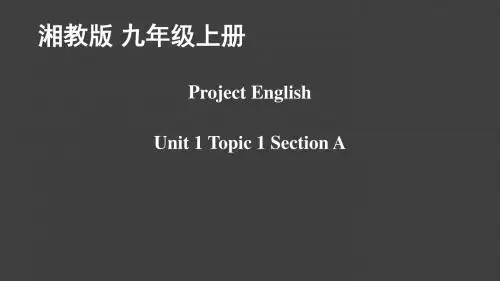
仁爱英语九年级上册第一单元Topic 1SectionA(共30张PPT)
Jane
Kangkang
an English summer school
Maria
Place
India
Mount Huang
Cuba
Name
Rita
Jane Mount Huang
Kangkang
Maria
Plcae
India
an English summer school
Cuba
Maria has gone to Cuba. Kangkang been an to English summer Rita Jane hasto been been to Mount India. Huang. school. Example: has
hometown has become her _________ more and more _________ beautiful it is beautiful but there were people too many _______ to improve _______ his English and she will be back tomorrow ________
Jane
Kangkang
Maria
Cuba to be a _____ volunteer
1. What did Rita do in her hometown? 2. How does she feel about her hometown? 3. Why couldn't Jane take photos in Mount
Maria:
Have you seen her this morning?
Michael: Oh, she _________ has gone to the library. Maria: I will go and find her. By the way, where is Kangkang? Michael: He _________ has gone to the library, too. Let’s go and find them.
仁爱英语九年级上册Unit1Topic1详细解读(共26张PPT)

“公共汽车来了。” (完全倒装) _H__e_re__h_e_c_o_m__e_s. “他来了。” (局部倒装)
3. Though I had no time to travel, I still felt very happy. 意思是“尽管我没时间去旅游,但我仍然感到很
Section B 1. 从……当中学习___l_e_a_rn_…__f_r_o_m_…____________ 2. 没有时间做某事___h_a_v_e_n_o__t_im__e_t_o_d_o__st_h_.____ 3. 表演有趣的节目_p_u_t _o_n_f_u_n_n_y_/i_n_t_er_e_s_ti_n_g_s_h_o_w__s 4. 一群老年人 _______a_g_r_o_u_p_o_f_o_l_d_p_e_o_p_l_e______ 5. 一些有意义的事___s_o_m__et_h_i_n_g_m__ea_n_i_n_g_f_u_l ____ 6. 上网聊天 _________c_h_a_t _o_n_li_n_e______________ 7. 跳绳 _____________ju_m__p_r_o_p_e_______________
Section D 1. (在……)发挥重要作用
____p_l_a_y_a_n__im__p_o_r_ta_n_t_p_a_r_t/_ro_l_e_(_i_n_.._.)___ 2. 下棋___________p_l_a_y_c_h_e_s_s___________ 3. 在某人空闲时间__in__o_n_e’_s_s_p_a_r_e/_f_re_e__ti_m_e_ 4. ……和……都___b_o_t_h__…__an_d_…__________ 5. 近几年_________i_n__re_c_e_n_t_y_e_a_rs________ 6. 出国旅游_______m__a_k_e_a__to_u_r_a_b_r_o_a_d____
仁爱英语九年级上册Unit1 Topic 1 SectionA
▪ Rita: I went to many places near my home in India. In one place I saw children working for a cruel boss. I felt sorry for them. Where have you been, Jane?
3. I felt sorry for them. 我同情他们。 Be/ feel sorry for sb. 怜悯(同情)…… 如:
He decided to help Jane as he felt sorry for her.
他同情简的遭遇,决定帮助她。
〔拓展〕feel sorry for oneself 感觉不幸,自我怜悯 如:
我和我的父母去过黄山。”两句话中含有
的have/ has gone to some place与have/ has been to some place该如何区别?
▪ 这是一个很重要的问题。Have/ has gone to some place表示去了某地,有可能就在某地或者是 在去某地的路上,总之不在说话的现场。如:
Stop feeling sorry for yourself and think about other people for a change.
别老觉得自己委屈了,也替别人想一想吧。
4. By the way, where’s Maria? 顺便问一问,玛丽亚在哪儿?
▪ by the way 顺便说 如: ▪ By the way, I have good news to tell you. ▪ 顺便说一声,我有好消息要告诉你。 ▪ 〔拓展〕(1)the way to…去……的路 如: ▪ I know the way to the hospital. 我知道去
仁爱英语九年级上册第一单元教案 Topic 1 section A教案
Unit 1 The Developing WorldTopic 1 Our country has developed rapidlysection A作者:李惠平单位:灵宝市实验中学学校审验人:郭亚琴教学目标功能和话题1.谈论假期发生的事情。
2.谈论社会环境发生的变化。
3.谈论人口问题。
4.谈论社会服务问题。
5.谈论城乡生活的区别。
6.谈论有关社会问题的话题。
7.谈论北京2008年奥运会。
8.谈论童工和希望工程的话题。
Topic 1Section A预习提示一、Pre—reading questions1、 Could you tell me what you did and where you went2、 Where have you been3、 Have you ever cleaned a room4、 Were you happy in summer holidayThe main activities are 1a, 1c and 2a. 本课重点活动是1a, 1c和2a。
Ⅰ.Teaching aims and demands 教学目标1.Master some new words and useful expressions:training, bell, whole, learn…from,2.Master the present perfect:(1)You have just come back from your hometown.(2)Where have you been(3)I have been to...(4) Have you ever...3. ?Talk about what they did and what they have done in their summer holidays.Ⅱ.Teaching aids教具录音机/多媒体课件或风景图片/印度童工图片/小黑板Ⅲ.Five-finger Teaching Plan五指教学方案Step 1 Review 第一步复习(时间:8分钟)(以谈论学生暑假生活的形式复习一般过去时,引出现在完成时。
最新仁爱版英语九年级上册Unit1 Topic1 SectionA知识点
Unit1 Topic1 SectionA1.语法:含有be going to +V原的一般将来时(P126)2.你将要去做什么?我将要去打篮球.What are you going to do ? I'm going to play basketball.3.喜欢做某事like doing sth(经常性地)4.see的过去式saw看见某人经常做某事see sb do sth / 看到做这件事的全过程看见某人正在做某事see sb doing sth 看到正在做,强调动作的正在进行5.在暑假期间during the summer holiday6.举办一场对抗3班的篮球赛have a basketball game against Class Three7. 在星期天on Sunday时间介词in, on, at 的用法:年月季节早晚in, at午夜时与分,具体某日上下午,星期日期全用on.8.我希望我们的队伍将会赢。
I hope our team will win.我也是. Me, too.9.你愿意来为我们加油吗?Would you like to come and cheer us on?当然,我愿意Sure,I'd love to.cheer sb on ( sb用的是人称的宾格, 因为跟在动词后)10. 你更喜欢哪一种运动,A or B ?Which sport do you prefer,A or B?11. prefer的用法(1) prefer + 名词= like +名词+ better如:I prefer apples = I like apples better(2) prefer A to B (和B比起来更喜欢A )(3) prefer doing sth 更喜欢做某事(4) prefer doing sth to doing sth和做某事比起来,更喜欢做某事(更喜欢前面的,即prefer 后紧跟的动作)(5) prefer to do sth rather than do sth和做某事比起来,更喜欢做某事(更喜欢前面的,即prefer 后紧跟的动作)12. 你划船多吗? 是的,非常多/ 不,很少。
Unit1+Topic+3+课文详解课件2023-2024学年仁爱版九年级英语上册
Section B
• Maria: What are you reading, Jane? be动词+V.ing (现在进行时)
• Jane: I’m reading a newspaper from Canada. Martin showed me an interesting article.
街区
事实上=in fact
wonderful place to live. Near our block, there are beautiful parks, good schools,
famous museums and excellent restaurants. And you can go to plays, concerts and
Lesson Three
Topic3 A-B
Words and passages
单词认读
背诵词汇
背诵词汇
词汇 1. with the money 2. so that 3. so...that... 4. in fact/as a matter of fact 5. come for a visit 6. in need 7. decide on sth. 8. provide sth. for sb./provide sb. with sth. 9. feel good about... 10. lend sth. to sb/lend sb. sth.
It is about a program that helps homeless people. show sb.sth.= show sth. to sb.
定语从句:从句充当形容词,修饰前面的program
给某人展示某物
仁爱版英语九年级上册Unit1Topic1SectionA教学设计
四、教学内容与过程
(一)导入新课
1.教师通过播放一段关于成长的短视频,引导学生关注个人成长过程中的重要时刻和感悟。
2.学生观看视频后,教师提出以下问题进行课堂讨论:
- What are the important moments in your growth?
4.创设真实的语境,鼓励学生大胆开口说英语,增强他们的自信心和自主学习能力。
(三)情感态度与价值观
在本章节的学习中,教师将关注学生的情感态度与价值观培养,帮助他们:
1.树立正确的自我认知,认识到自己的优点和不足,学会取长补短,努力提升自己。
2.培养积极向上的心态,相信自己可以通过努力实现成长目标,增强自信心。
-学生可以撰写学习心得,反思自己在课堂上的表现和收获。
-教师关注学生的反思情况,了解学生的学习需求,调整教学方法。
五、作业布置
为了巩固本节课所学知识,提高学生的英语实际运用能力,特布置以下作业:
1.写作任务:请运用本节课所学的核心词汇和语法知识,结合自己的成长经历,写一篇关于“An Important Moment in My Growth”的短文。要求不少于100词,内容真实,情感真挚。
-提交短文时,注意检查单词拼写、语法和句子结构的正确性。
-对小组合作成果给予及时反馈,引导学生互帮互助,共同进步。
5.注重语法知识点的讲解与练习。
-通过生动的例句和实际情境,帮助学生理解并掌握目标语法知识点。
-设计丰富多样的练习,巩固所学语法知识,提高学生的语法应用能力。
6.情感态度与价值观的培养。
-在教学过程中,关注学生的情感需求,引导他们树立正确的自我认知和价值观。