
最新九年级仁爱版英语上册U1T2SC
7 6 5 4 3 2 1 0 the population the world Asia
Almost half of the people in the world live in Asia.
3 billion÷ 6.5 billion≈1/2
(half)
50 percent (50%)
7 6 5 4 3 2 1 0 the population the world China
larger and is growing ____ (slower / faster) *The population problem is ____ (more serious / less
serious) in developing countries.
Asia had a population of more _______________ than 3 billion half of the world’s in 2005. That’s to say, ______ population live in Asia.
What problems does a large population cause?
•Because of the large population, there is______ (more\ less) living space. •Because of the large population, it’s ______ (difficult\ easy) for many people to find jobs. •Because of the large population, we are short of _______ and _______ . •Because of the large population, the cities are _______ _______ than before. •Because of the large population, the traffic is ______ _______.
Because of the large population, there is less living space.
Because of the large population, it’s difficult for many people to find jobs.
Because of the large population, we are short of energy and water.
8,888,888,888
88,888,888,888 888,888,888,888
*What’s the population of the world /China/ …?
*Which country has the largest population?
developing *The population in ____ (develop) countries is
Because of the large population, the cities are more crowded than before.
Because of the large population, the traffic is much heavier.
• What’s the topic sentence of paragraph three?
can’t offer the children good education
The population is increasing by 80 million every year. And it is growing faster and faster.
So far, our government has taken many measures to control the population.
• What has China done to control the
population?
One-child policy.
• Say something about China’s one-child
more
poor living condition
low average per capita income
not enough food
Topic:
the disadvantages of
China’s large population
environment problem
not well developed
One fifth of the people in the world live in China.
1.3 billion÷6.5 billion≈1 / 5mΒιβλιοθήκη re(one fifth)
20 percent (20%)
1 6
one sixth
5 five sixths 6 2 9 two ninths
1 9
one ninth
7 seven twentieths 1 one twentieth 20 20
1 2 1 4 3 4 1 3 2
one (a) half
a quarter
three quarters
three and a half
so far
past now
So far ,I have read five English masterpieces(名著).
policy.
• What is the author’s attitude towards
the population problem?
One-child policy has worked well in controlling China’s population.
Listen and read 1a
最新仁爱版九年级英语上册
Unit 1 Topic 2 Section C
warming up:
sing a song together. “ If You're Happy
8 88 888 8,888 88,888 888,888 8,888,888 88,888,888 888,888,888
最新仁爱版英语九年级上册U2T1SC课件
Discuss these phrases, check which is pollution and talk about what kind of pollution it is.
Producing electricity by wind, talking loudly after class laughing loudly at the cinema, smoking in public
· be harmful to = do harm to
· harm v. & n. 危害,伤害,损害
· do great harm to…对……有着极大的损害
E.g. It not only disturbs others but also does great harm to hearing.
it is reported that … 据报道…… no better than 同……一样(坏)
According to 1a, tell which one is false.
· In the U.S.A., many teenagers can hear no better than 65-year-old people do. · Not all people work in noisy conditions. · Making too much noise in the classroom during the break is a kind of pollution. · Noise can’t make people sick. · Nowadays, few countries are trying to solve all sorts of pollution problems.
仁爱版九年级英语上册U2T1SC优质教案
SectionCⅠ.Materialanalysis本课是第二单元第一话题的第三课时,主活动是1a和4。
学生通过阅读1a,了解噪音污染是如何产生的,是怎样影响人们健康的。
1b则训练学生通过语境,推断词义,选出与该词匹配的英文解释。
1c先让学生找出主旨句,再通过找出细节来论证段落的中心思想,以及通过语境判断重点词汇和句子的意思。
2继续谈论噪音污染,通过选词填空的方式辨析单词的用法。
3让学生模仿1a来讨论其它的污染。
为了让学生顺利地完成讨论任务,还给出了可能涉及到的讨论内容,很有指导性。
4是在2和3的基础之上进行的写作练习,让学生学习运用中心句来组织文章。
通过了解噪音污染,让学生进一步了解各种污染的现状。
引导学生关注环境问题,关注各种污染,树立正确的环保意识。
Ⅱ.Teachingaims1.Knowledgeaims:掌握本课的重点词汇和短语,初步感知定语从句。
了解与噪音污染有关的常识。
区别不同词性的单词的用法。
2.Skillaims:能读懂有关环境污染的文章。
能看懂和听懂简单的英文解释。
能够理解段落中各个句子间的逻辑关系。
能用合适的英语对环境污染问题进行口头和书面语表达。
3.Emotionalaims:(optional)通过学习,加深对环境问题的认知,树立环保意识。
4.Cultureawareness:(optional)了解各种不同种类的污染,关注全球的环境现状。
Ⅲ.Thekeypointsanddifficultpoints1.Keypoints:Wordsandphrases:deaf,print,recently,sentence,meaning,hearing,loss,disturb,uncomfortabl e,unpleasant,sort,environmental,including,ontogodeaf,doharmto/beharmfulto,loseone’shearing/havehearingloss,innoisycondition/toomuch noise,nobetterthannotonly…butalso…,causesb.todosth.,allsortsofenvironmentalproblems,includingnoiseprob lemsSentences:(1)…noiseisalsoakindofpollutionandisharmfultohumans’health.(2)Peoplewhoworkandliveinnoisyconditionsgodeafeasily.(3)…manyteenagersinAmericacanhearnobetterthan65-year-oldpeopledo…Grammar:Simplepast,presentperfect.2.Difficultpoints:能根据所学内容,表达与污染相关的话题。
仁爱英语多媒体教学初中九年级上册课件 U2 T1 U2 T1 SC
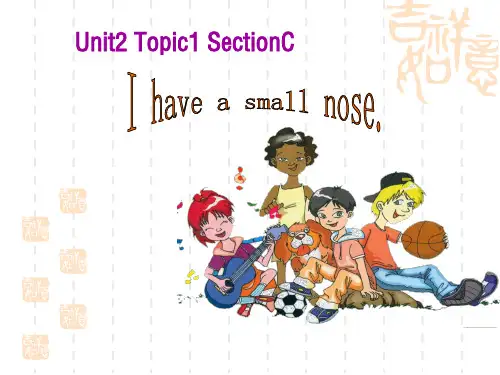
3b. Work in groups.
Example 1:
A: Do you have ...? B: Yes, I do. / No, I don’t. A: Does B have ...? C: Yes, he/she does. / No, he/she doesn’t.
I am a boy. I’mt_h_ir_t_e_e_n__years old. I come from England. I’m a student. I havea__ro__u_n_d__fa__c_e and_s_m__a_l_l _e_y_e_s. My nose is b__ig__, and mym__o_u_t_h_ is _s_m__a_ll_. I have a sister. Her name is Amy. She is twelve. She is a student, too. She has
他是个好学生。 He is a good student. 我们是蔡老师的学生。 We are Mr. Cai’s students.
different 不同的
The two apples are different.
We are in different schools. = We are not in the same school.
short legs
Do they have long legs? No,they don’t. They have short legs.
big hands
Does she have small hands? No, she doesn’t. She has big hands.
9上仁爱英语教学案例设计 教案 U1T2SC

Section CⅠ. Material analysis本课是九年级第一单元第二话题的第三课时,主活动是1a和3b。
1a具体了分析中国人口现状的严峻形势和政府采取的措施及成效。
这篇阅读文章较长,在阅读练习的时候,建议教师先解决部分生词,扫清单词障碍,1b主要是培养学生找出段落的主旨句的能力。
而1c则是要学生学习找到论据。
2可以看作是语法巩固训练,但内容仍然紧扣主题。
3a和3b是训练说和写的技能的。
通过本篇文章的学习,要求学生掌握一定的阅读策略和写作技巧,能够模仿作者恰当运用主旨句的写作方式,排篇布局。
引导学生关注社会问题,关注国家政策,培养学生树立良好的人口观念和正确的世界观。
Ⅱ.Teaching aims1.Knowledge aims:掌握本课的重点词汇和短语,继续学习现在完成时。
2.Skill aims:能基本读懂课文材料,掌握一定的阅读技巧和方法。
能正确模仿本课课文,有条理地写出有关解决人口问题的措施的文章。
3.Emotional aims: (optional)引导学生关注社会现象,培养学生树立正确的人口观念和社会意识。
4.Culture awareness: (optional)通过中国人口严峻形势的分析,了解计划生育政策,引导学生关注社会问题的意识。
第1页共11页Ⅲ. The key points and difficult points1. Key points:Words and phrases: social, natural, worse, government, offer, supply, paragraph, opportunity, newborn, percent,one fifth of, because of/thanks to, take measures to do sth., work well in (doing) sth.Grammar: Present Perfect2. Difficult points:如何通过语境和构词法,猜测生词、短语大意,并感知其用法。
仁爱英语九年级上册Unit1 Topic 2 Section C
3 Written work
Search for more information about the
population problem in China, and then
write something about it. The following
questions may help you.
F( ) 2.Indian has a larger population than China. (F ) 3.China has 25 percent of the world’s
poas tried to control the population.
Topic 2 What has happened to the
population?
Go on studying the present perfect.
Talk about the problem of overpopulation.
New words difficulty, energy, human being, and phrases trouble, less, offer
1.What’s the population of China? 2.How many people live in the countryside? 3.Some parents in less developed areas prefer boys
to girls, don’t they? 4.Call all Chinese families offer their children a
good education? 5.What is a comfortable life like? How can we
仁爱英语9年级上册Unit1Topic2学科讲义(有答案)

【基础知识巩固】U1T2SA1 get lost走失,迷路。
其中lost为形容词,其近义词有missing和gone。
e、g、I found mybike missing。
我发现我的自行车丢了。
My penis lost、我的笔丢了。
2call up给……打电话,名词作宾语时能够放在up后面或两词之间;宾语是代词时,必须放在两词之间。
e、g、IcalledTom up yesterday, but he didn't answer it、昨天我给汤姆打电话,但他没有接。
I’llcallyou up as soon as I e back。
我一回来就给您打电话。
同义词组:ring up, make atelephone call。
3already常用于肯定句中,指动作差不多发生,或比期望发生的要早,一般用在句子中间或句末;yet用于疑问句和否定句中,谈论尚未发生但估计发生的事,通常位于句末。
e。
g、—Have you hadyourlunchyet?您吃过午饭了不?—Yes, I’ve alreadyhad it、是的,我差不多吃过了。
U1T2SB1population意为“人口",“居民”,常用形容词large或small来表示人口的多少。
e。
g、China has the largestpopulation in the world、中国拥有世界上最多的人口。
注:常用句式:What’s the population of、。
、?意为“……人口是多少?”have apupulation of、、。
意为“有……人口”e。
g、China has a pupulation of 1。
3billion。
中国有13亿人口、2increase v。
(使)增加,(使)增大,增多、increase by+倍数或百分数,表示“增加了……倍或百分之……”。
e、g、paredwith last year, our pay hasincreasedbythree t imes。
仁爱英语九年级上册Unit1Topic2SectionC
Complex senses
Longer, more detailed senses are used to develop arguments and provide examples or evidence to support the main idea
Active voice
The active voice is preferred in most cases, as it is more direct and engaging, helping to maintain the reader's interest and understanding
01
Introduction
Theme Introduction
The theme of this section is "Famous Landmarks" It introduces students to fame landmarks around the world, including the Eiffel Tower, the Great Wall, and the Status of Liberty
feelings, and information between individuals
Sentence Analysis
Simple intentions
The article uses simple intentions to communicate basic ideas and information, advancing clear and decision statements
Passive voice
The passive voice is occasionally used to focus on the subject being acted up compared to the actor, specifically when discussing broader social trends or patterns
仁爱英语九上unit1topic2sectionC
• ( )10.—I have never visited a paper factory.
• •
—AC.S_o__h_a_ve I.
B.So I have.
• C.Neither have I.
D.I haven’t now.
• 1 What problems do you think China’s large population has caused?
• 你觉得中国的庞大的人口数目引起了什么 问题?
• 此句中do you think是插入语,what problems 作cause的宾语,所以do you think之 后接陈述句语序。
• —It’s_____yuan.
• A.one thousand, six hundred,eighty-eight
• B.one thousand six hundred eighty-eight
• C.one thousand, six hundred and eighty-eight
• D.one thousand and six hundred and eighty-eight
1 one / a half 2
1 a quarter 4
3 three quarters 4
3 1 three and a half 2
so far
past
now
So far, I have read five English novels .
• •
(—BN)7o.—, I Hhaavveeny’ot.u found your lost book_____?
• e.g. one seventh two sevenths
九年级上册英语仁爱版u1t2教案
九年级上册英语仁爱版u1t2教案教案标题:九年级上册英语仁爱版U1T2教案教学目标:1. 语言目标:学生能够掌握并正确运用本课时的词汇和短语,包括单词:hobby, collect, stamp, coin, postcard, keychain, watch, comic book, action figure, cartoon, poster, album;短语:collect stamps/coins/postcards/keychains, watch cartoons, read comic books, listen to music, play sports。
2. 沟通目标:学生能够运用所学的词汇和短语描述自己的爱好和兴趣,并与他人进行简单的交流。
3. 学习策略目标:学生能够通过听、说、读、写等多种方式进行学习,提高自主学习和合作学习的能力。
教学重点:1. 掌握本课时的词汇和短语。
2. 运用所学的词汇和短语描述自己的爱好和兴趣。
教学难点:1. 运用所学的词汇和短语进行简单的交流。
2. 提高学生的学习策略能力。
教学准备:1. 教材:九年级上册英语仁爱版教材。
2. 多媒体设备:电脑、投影仪等。
3. 教学辅助工具:图片、实物等。
教学过程:Step 1: 导入新课 (5分钟)1. 利用图片或实物引导学生讨论自己的爱好和兴趣,并提问学生是否了解一些与兴趣爱好相关的单词和短语。
Step 2: 新知呈现 (10分钟)1. 利用多媒体设备呈现本课时的词汇和短语,并进行读音和意义的讲解。
2. 通过图片和实物示范,帮助学生理解和记忆新词汇和短语。
Step 3: 听说训练 (15分钟)1. 播放录音材料,让学生跟读和模仿录音,培养学生的听力和口语表达能力。
2. 分组活动:将学生分成小组,让他们在小组内进行讨论,用所学的词汇和短语描述自己的爱好和兴趣,并进行简单的交流。
Step 4: 阅读训练 (10分钟)1. 学生阅读教材中与本课时主题相关的短文,并回答相关问题,提高学生的阅读理解能力。
仁爱英语九年级上册Unit1Topic2课文翻译-教学文档
仁爱英语九年级上册Unit1Topic2课文翻译-教学文档Unit 1 The changing world变化中的世界Topic 2The population in developing countries is growing faster.发展中国家的人口增长更快。
Section A1a:Hello, Michael. I have just called you, but you weren’t in. where have you been?你好,迈克尔。
我刚刚给你打了电话,但你不在,你去哪里了?I have just been to a shopping center with Kangkang. I’ve never been there before, but I don’t want to go there any more.刚才我和康康去购物中心了,我以前从未去过那儿,但我再也不想去那儿了。
Why?为什么呢?Because there were too many people. We got lost and couldn’t find each other.因为那儿人太多。
我们走散了,找不到对方。
Bad luck! Have you found him yet? 真倒霉!你已经找到他了吗?No, he has probably gone home. Let’s call him up now. I really hate go ing to a place like that. 没有,他可能已经回家了,我们现在给他打个电话吧。
我真的讨厌去那样的地方。
So do I. 我也一样。
Section B(Kangkang is reading a report on population in the newspaper.)(康康正在看报纸上一篇关于人口报道。
)Wow! What a large population! 哇!多么庞大的人口啊!What? 什么?Look, it says the world has a population of 6.8 billion. And it is increasing by 80 million every year.看!报纸上说世界人口已经达到68亿了,并且正以每年8000万的速度增长。