
仁爱版英语九年级上册Unit1 Topic1复习课课件
(二)重点语法
现在完成时:
用法一: 表示过去已经发生或已经完成的某一动作对现在造成的影响或结果 即“过去的动作 + 现在的结果”, 强调结果。
栗子: I have bought a new bike. (= I bought a new bike, and I have a new bike now.) 我已经买了一辆新的自行车。(强调我现在有了一辆新车。)
10. with the development of… 11. used to do sth. 12. make progress 13. thanks to 14. with the help of…
15. see sth. oneself
随着……的发展 过去常做某事 取得进步 多亏; 幸亏;由于 在……的帮助下 亲眼所见
2.Our government gives support to poor families.我们的政府能为贫困家庭提供帮助。 give support to sb.= give sb. support 为某人提供帮助/ 支持 support作动词时表“供养;支持;支撑”,如: She had to support her family at the age of ten. 她十岁时就得养家。
(三)重要句型:
1.Parents couldn’t afford education for their children. 父母供不起孩子上学。 afford 常与can, could 或 be able to 连用,尤其用于否定句或疑问句,表 “负担得起(做)某事;抽得出(时间)” “(can’t/ couldn’t) afford (to do) sth.” 如: We can’t afford (to buy ) this house because we don’t have enough money. 我们买不这房了,因为我们没有足够的钱。 He felt he couldn’t afford any time to play football. 他觉得自己没有时间踢球了。
仁爱版九年级英语Unit1Topic1 归纳复习
(Revision)
(一) 重点短语
1. have a good summer holiday 2. come back from… 3. work for … 4. learn…from 5. have a hard/ happy life 6. in the past/ future 7. have no chance to do sth. 8. afford ( to do) sth 9. get a good education 过一个愉快的暑假 从……回来 为……工作 从……当中学习 过着艰苦的/ 幸福的生活 在过去/ 在将来 没有机会做某事 担负得起(做)某事 获得良好的教育
thanks to /thanks for
thanks to 多亏,由于 thanks for 为····而感谢
沙场点兵
(1) ( )inviting us to your birthday party, we had a wonderful evening. (2) ---It is a great success. ---( )a lot of hard work.
His parents supported him in his decision.他的父母支持他的决定。
Fill in the blanks. made great progress 1. Li Ming has ________________ (取得很大进步) in English, because he studies hard. 2. China has succeeded in (获得成功) sending ______ (send) Shenzhou VII into space. already 3. I have _______( 已经) had lunch. I am full.
have/ has been to + 某地, 曾经去过某地(可以和次数连用) have /has gone to + 某地, 已经去了某地(不和一段时间或次数连用) have /has been in 与一段时间连用,表示呆在某地多长时间 栗子: (1)I have been to Xiamen twice. 我去过厦门两次。 (2)--- Where is Jim? 吉姆在哪儿? --- He has gone to the library? 他去图书馆了。 (3)JAY has been in FZ for 4 years.
一般疑问句: Has he finished the task? 回答:
Yes, he has. 是的,他完成了。 No, he hasn’t. 不,他没有完成。 What has he finished? 他完成了什么?
特殊疑问句:
火眼金睛
have/ has been to与 have/ has gone to和have/has been in
用法二: 过去已经开始,持续到现在的动作或者状态 I have studied English for five years.
构成形式: 助动词have / has + 动词的过去分词
1, 肯定句: 否定句: 回答: I have seen the film. I haven’t seen the film. Yes, I have. 我已经看过这部电影。 我没看过这部电影。 你看过这部电影了吗? 你已经做了什么? 他已经完成了任务。 他还没有完成任务。 他已经完成任务了吗?
一般疑问句: Have you seen the film?
是的,我看过了。 No, I haven’t. 不,我没看过。
特殊疑问句:
2. 肯定句: 否定句:
What the task. He hasn’t finished the task.
because/because of
because引导原因状语从句 because of 后面只能接名词(短语),代词或者动名词 沙场点兵: (1) we had to put off the sports meeting ( )the weather.
(2) --why didn't Jane go to school yesterday? --( )she was ill.
仁爱版九年级上册英语Unit 1 Topic 1 知识点总结
Unit 1 Topic 1※短语集锦1.have a good summer holiday 暑假过得好2.take place 发生3. have / has been to 去过某地(去而已归)have / has gone to 去了某地(去而未归)4. so many / few + 可数名词复数+ that… 如此多…以至于…So much / little +不可数名词+ that…如此少的…以至于…5. a proper place to take photos / pictures一个适合拍照的地方6. by the way 顺便问一下7. There goes the bell = The bell is ringing = That’s the bell 铃声响了8. take part in = join in = be in +某项活动join + sb / club / team /组织9. tell a story to sb 给某人讲故事10. feed the disabled children 喂残疾儿童11. What a wonder experience! 多么精彩的一次经历啊!12. learn a lot from … 从…中学习到很多13. have no time to do sth 没有时间做某事14. chat on line 上网聊天15. around the world = all over the world 全世界16. have a hard life = live a hard life 过着艰苦的生活Life is hard for sb 对某人来说生活是艰难的17. in detail 详细地18. in the past 在过去at present 现在in the future 将来19. Is that so? = Really? 真的吗?真是那样吗?20. in order to = so that = in order that 为的是;以便于in order to 后+动词短语so that / in order that后+ 句子21. support a family 供养一个家庭give support to 给…提供帮助22. day and night 日日夜夜23. What about you? = How about you? 你呢24. Now our country has developed rapidly.现在我们国家发展迅速developed:发达的developing:发展中的development:发展eg:1)China is a developing country.2) Japan is the only developed country in Asia.3) With the development of China, people’s living conditions become better andbetter.25. get / have / receive a good education 接受良好的教育26. have a balanced diet 均衡膳食27. more than = over 超过; 多余28. see … oneself 亲自看到29. in the 1968s 在二十世纪六十年代30. the living conditions 生活条件31. have a chance to do 有机会做某事32. keep in touch with 与某人保持联系get in touch with 与某人取得联系33. by letter or telegram 靠信件或电报34. things to choose from 供挑选的东西35. sorts of = kinds of 多种36. not only … but also … 不但….而且…37. Wha t’s more 而且38. make progress 取得进步make rapid progress 取得快速的进步make great progress 取得巨大的进步39. succeed in doing sth = be successfulin doing sth 成功做某事eg: Beijing succeeded in hosting the 29thOlympic Games in 2008. (同义句)= Beijing was successful in hosting the 29thOlympic Games.40. It’s important for sb to do sth 做…对某人是重要的41. dream about / of doing sth 梦想做某事42. watch a movie in the open air 看露天电影43. with the help of = with one’s help 在某人的帮助下44. draw up 拟定;起草45. thanks to … = because of 多亏;由于46.check over = look over 检查※精讲精析Section A1.have / has been to 去过某地(去而已归)与ever, never, before及次数等连用have / has gone to 去了某地(去而未归)have / has been in 表示在…已经多久了eg:用been, gone, in填空1)_ Where have you ?_ I have to a shopping center.2)_ Where is Maria?_ She has to Cuba.3)_ Has your mother ever there?_ No, she has never there.4)She has to England. She will come back in ten days.5)He has to Xian many times.6)He has been China for two years.7)How long have you been in this city?2. so ... that ... / such ... that ...都可意为如此...以至于...区别如下:1)so +形容词+ a / an + 单数名词= such + a / an + 形容词+ 单数名词eg:1) It is so moving a movie that all of us can’t help crying.(同义句)= It is such a moving movie that all of us can't help crying.2) It is so interesting a book that I read it again and again. (同义句)2) 如果名词是可数名词复数或不可数名词时这时只能用such , 不能用so3) 如果名词前有many , much , little, few时只能用so,不能用such.练习:用so / such 填空1) The boy is young that he can’t go to school.2) She told us a funny story that we all laughed.3) He has few books to read that he has to borrow some from the school library.4) It is a tall building that I can’t see its top.5) The old man is ill that he can’t get up.6) It was fine weather that we went swimming last weekend.7) They are small children that they can’t go to school.8) She speaks English well that the teacher praises(表扬)her.9) There is little bread that it is not enough for many people.10) It is delicious food that we all like it very much.3. There goes the bell.(同义句)= The bell is ringing.= That’s the bell.4.I want to work hard to make my English better.(同义句)= I want to work hard to improve myEnglish.注意:so ... that 句型的否定可与too ... to 句型和not enough ... to do 句型进行转换eg:1) Tom is so young that ha can’t go to school. (同义句)= Tom is too young to go to school.= Tom isn’t old enough to go to school.2)The desk is so heavy that I can’t move it. (同义句)= The desk is too heavy for me to move.= The desk isn’t light enough for me to move.3)The apple tree is so tall that we can’t reach it.(同义句)= The apple tree is too tall for us to reach.= The apple tree isn’t short enough for us to reac h.5.1) I have been to Beijing.(提问)Where have you been?2) Lily has been to Cuba.(提问)Where has lily been?3) My sister has gone to the gym.(提问)Where has your sister gone?4) They have gone to Shanghai.(提问)Where have they gone?Section B1.in a disabled children’s home在残疾儿童之家2.experience 在此处意为经历What a wonderful experience!一次多么棒的经历啊!experience还可意为经验讲,作经验讲时它是一个不可数名词eg: The teacher has a lot of teaching experience.这个老师有许多教学经验。
仁爱英语九年级上册第一单元Topic 1SectionA(共30张PPT)
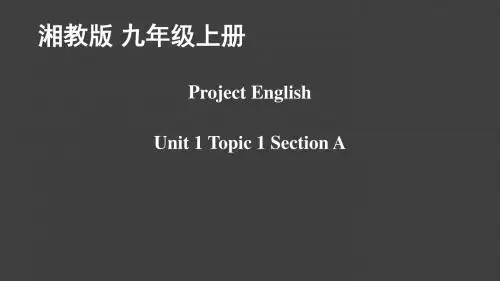
Jane
Kangkang
an English summer school
Maria
Place
India
Mount Huang
Cuba
Name
Rita
Jane Mount Huang
Kangkang
Maria
Plcae
India
an English summer school
Cuba
Maria has gone to Cuba. Kangkang been an to English summer Rita Jane hasto been been to Mount India. Huang. school. Example: has
hometown has become her _________ more and more _________ beautiful it is beautiful but there were people too many _______ to improve _______ his English and she will be back tomorrow ________
Jane
Kangkang
Maria
Cuba to be a _____ volunteer
1. What did Rita do in her hometown? 2. How does she feel about her hometown? 3. Why couldn't Jane take photos in Mount
Maria:
Have you seen her this morning?
Michael: Oh, she _________ has gone to the library. Maria: I will go and find her. By the way, where is Kangkang? Michael: He _________ has gone to the library, too. Let’s go and find them.
九年级英语上册 仁爱版.ppt课件
1.--Have you found him yet ? --Yes ,he has already gone home. yet, already 是副词,表示“已经,仍然, 还 ”。 already 多用于现在完成时态的肯定 句,可放在句中,也可放在句末。 yet常用在 现在完成时态的否定句和疑问句, 常放在句 末。 【链接】never 多用于否定陈述句,ever 多用 于疑问句,问初次经历,just 位于谓语动词 以后,before 一般放在句末。
Read 3a again and then mark (T) forTrue of (F) for False. (T )1.Kangkang thinks that China developed slowly in the past. (T ) 2.China has a larger population than any other country in the world. ( F) 3.China is developing more slowly than before because of China’s one-child policy. (T ) 4.Maria thinks it’s bad to be a “Little Emperor”. ( F) 5.It’s possible that Kangkang’s father was the only child in his family.
just already yet ever never
A: Have you ever been to France ? B: No, I have never been to any European . But Michael has just come back from France. He likes it very much. He says he has neverseen such a beautiful country before. A: Have you seen himyet ? B: Yes, I have already seen him.
仁爱版英语九年级上册Unit1 Topic 1 单元语法课件
b.表示过去已经开始、持续到现在(也 许还会继续进行下去)动作或状态,常 和表示一段时间状语,如:today, these days, since…,for…,this month, now等连 用。
根据下列情景填写句子, 请注意语境和时态。
A:Hello,Steve. _W_h_e_r_e_h_a_e_y_o_u_b_e_e_n_t_h_es_e_d_a_y_s? B:Hello, Ben. I've been to Xiamen for vacation. A:How was your trip? B:Wonderful!I_l_ik_e_t_h_e_e_n_v_ir_o_n_m_e_n_t _th_e_r_e_b_e_s_t.___It's really a clean and tidy city. You can see grass, trees and flowers everywhere.
Unit1 Topic1
现在完成时 (1)构成:现在完成时 “have/has+ 动词的过去分词”构成。
(2)现在完成时的用法:
1. have/has been to 2.have/has gone to 3.have/has been in/at …… 4.There goes the bell.
D
C
11
THANK YOU!
(2)用法
a.表示过去发生或已经完成的某一动作对现在造成的 影响或结果。例如:
I have opened the window.我已经把窗户打开了。(窗 户是开着的)
The concert has started.音乐会已经开始(音乐会现在 在进行)
They have gone to Shanghai.他们已去上海了(他们不 在这里)
仁爱英语九年级上册Unit1Topic1详细解读(共26张PPT)

“公共汽车来了。” (完全倒装) _H__e_re__h_e_c_o_m__e_s. “他来了。” (局部倒装)
3. Though I had no time to travel, I still felt very happy. 意思是“尽管我没时间去旅游,但我仍然感到很
Section B 1. 从……当中学习___l_e_a_rn_…__f_r_o_m_…____________ 2. 没有时间做某事___h_a_v_e_n_o__t_im__e_t_o_d_o__st_h_.____ 3. 表演有趣的节目_p_u_t _o_n_f_u_n_n_y_/i_n_t_er_e_s_ti_n_g_s_h_o_w__s 4. 一群老年人 _______a_g_r_o_u_p_o_f_o_l_d_p_e_o_p_l_e______ 5. 一些有意义的事___s_o_m__et_h_i_n_g_m__ea_n_i_n_g_f_u_l ____ 6. 上网聊天 _________c_h_a_t _o_n_li_n_e______________ 7. 跳绳 _____________ju_m__p_r_o_p_e_______________
Section D 1. (在……)发挥重要作用
____p_l_a_y_a_n__im__p_o_r_ta_n_t_p_a_r_t/_ro_l_e_(_i_n_.._.)___ 2. 下棋___________p_l_a_y_c_h_e_s_s___________ 3. 在某人空闲时间__in__o_n_e’_s_s_p_a_r_e/_f_re_e__ti_m_e_ 4. ……和……都___b_o_t_h__…__an_d_…__________ 5. 近几年_________i_n__re_c_e_n_t_y_e_a_rs________ 6. 出国旅游_______m__a_k_e_a__to_u_r_a_b_r_o_a_d____
2024年中考英语仁爱版一轮复习+九年级上册Unit+1+Topic+1+课件
have
( B )4. (2022·海南)We
each other since we met in the last
summer camp.
A. won’t see
B. haven’t seen
C. didn’t see ( A )5.(2022·重庆A卷改编)They have been good
C
③ What do you like doing in your spare time?
A
考点精练1 ( C )1. (2023·扬州)I
China for three months and this is the
first time I’ve tried on hanfu.
A. have gone to
考点精讲1 have been to 去过
I have been to Mount Huang with my parents.
我和父母去过黄山。 (教材P1 Section A 1a)
词汇
用法
have been to
意为“去过……”,强调经历,已经返回,常与just, ever, never或表示次数的单词或短语连用。
1. hide A. v. 躲藏
B. v. 藏
C. n. 隐藏处;藏身处
D. n. 皮;皮毛
① The man hid the letter under the rock.
B
② The cat hid behind the door.
A
③ Don’t buy coats made of animal hide.
1. since意为“自……以来”,后接表示时间点的单词、短语或从 句,是现在完成时的标志。 We have studied here since 2021. 自从2021年以来,我们就在这里学习。 We have studied here since I was 12. 自从我12岁以来,我们就在这里学习。 We have lived here since 2 years ago. 自从两年前以来,我们就住在这里。
仁爱版英语九年级上册Unit 1 Topic 1. 《Our country has develop
仁爱版英语九年级上册Unit 1 Topic 1. 《Our country has developed rapidly》教学设计一. 教材分析本课选自仁爱版英语九年级上册Unit 1 Topic 1.《Our country has developed rapidly》。
本课主要讨论了中国的快速发展以及人们的生活变化。
内容包括中国的经济发展、科技进步、城市建设、教育和文化等方面的变化。
通过本课的学习,学生可以提高自己的英语听说读写能力,了解中国的快速发展以及人们的生活变化。
二. 学情分析九年级的学生已经具备了一定的英语基础,能够听懂并运用一些基本的英语句型进行交流。
但是,对于一些复杂的英语句型和词汇,学生可能还有一定的困难。
因此,在教学过程中,需要结合学生的实际情况,采用适当的教学方法,帮助学生理解和运用所学知识。
三. 教学目标1.知识目标:学生能够听懂、会说、会读本课的生词和句子,了解中国的快速发展以及人们的生活变化。
2.能力目标:学生能够运用所学的知识进行简单的交流,提高自己的英语听说读写能力。
3.情感目标:学生能够认识到中国的快速发展,增强自己的民族自豪感。
四. 教学重难点1.重点:学生能够听懂、会说、会读本课的生词和句子,了解中国的快速发展以及人们的生活变化。
2.难点:学生能够运用所学的知识进行简单的交流,提高自己的英语听说读写能力。
五. 教学方法1.任务型教学法:通过设置各种任务,让学生在完成任务的过程中,提高自己的英语听说读写能力。
2.情境教学法:通过创设各种情境,让学生在真实的环境中,运用所学的知识进行交流。
3.小组合作学习:通过小组合作,让学生互相学习,共同进步。
六. 教学准备1.教材:仁爱版英语九年级上册2.多媒体教学设备:电脑、投影仪、音响等3.教学课件:根据教学内容,制作相应的教学课件4.教学资源:相关的图片、视频等七. 教学过程1.导入(5分钟)通过展示一些中国的快速发展相关的图片,如高楼大厦、高速公路、高铁等,引导学生谈论中国的快速发展。
仁爱版九年级英语 unit1 topic1知识点
九年级英语上册笔记Unit1 topic1 SectionA1.复习时态1).进行时(2种): be(are/am/is/was/were)+doing sth. 2). 一般将来时:will/shall+do sth. /be going to do sth. (won’t)3).一般现在时:主语+动词(v+s/es)+宾语(don’t/doesn’t)4).一般过去时:主语+动词(v+ed)+宾语(wasn’t/weren’t/didn’t)5).现在完成时:助动词have/has+过去分词(v+ed)(haven’t/hasn’t)定义:表示动作已经完成,对现在产生影响。
没有过去时间,一般与副词already(已经)、ever(曾经)、never (从不)、just(刚刚)、before (以前)、yet(还)、once/twice/three times(一次/两次/三次)、for(为多久)、since(自从)等连用。
2.h ave/has been to…曾经去过,人已回来。
Have/has gone to…人去了,还没回。
3.b e happy to do sth. 开心做某事4.c ome back from…从。
返回5.t ake place 发生6.m ore and more 越来越…(可接名词或多音节形容词)7.s o…that…/such…that…/so that…如此…以至于…/因此注意:so+形容词/副词such+名词短语特殊情况:名词前如果出现many/much/little/few时要用so. Eg: so many people/apples so much food/money8.t ake photos 照相9.i mprove your English 提高英语水平10.by the way 顺便说一下on the way to在…去的路上in the way 挡路out of the way 偏远的11.There goes the bell. 倒装句铃声响了。
仁爱版九年级英语上册 Unit 1 Topic 1 Section C 课件(共21张PPT)
2. China has succeeded in _s_e_n_d_in_g_
(send) Shenzhou Ⅹ into space.
3. I have _a_lr_e_a_d_y_(已经) had lunch. I am full.
Translate the words and phrases.
3. What will … be like in the future?
It is important to write a topic sentence for each paragraph to help organize your thoughts.
3 Write a short passage on the topic Changes in… You should write its situation in the past and at present based on 2.
Homework
1. Read 1a aloud.
2. Finish Section C in your workbook.
3. Write a passage on the topic Changes in… according to Part 3.
4. Preview Section D.
THANK YOU!
确使用所学的现在完成时。
Have you ever been to Beijing?
Do you know about Beijing?
Look at the pictures of Beijing in the past and at present. Then guess the meaning of each word and the main idea of the text.
仁爱版九年级上册英语Unit 1 Topic 1 知识点
Unit 1 Topic 1※短语集锦1.have a good summer holiday 暑假过得好2.take place 发生3. have / has been to 去过某地(去而已归)have / has gone to 去了某地(去而未归)4. so many / few + 可数名词复数+ that… 如此多…以至于…So much / little +不可数名词+ that…如此少的…以至于…5. a proper place to take photos / pictures一个适合拍照的地方6. by the way 顺便问一下7. There goes the bell = The bell is ringing = That’s the bell 铃声响了8. take part in = join in = be in +某项活动join + sb / club / team /组织9. tell a story to sb 给某人讲故事10. feed the disabled children 喂残疾儿童11. What a wonder experience! 多么精彩的一次经历啊!12. learn a lot from … 从…中学习到很多13. have no time to do sth 没有时间做某事14. chat on line 上网聊天15. around the world = all over the world 全世界16. have a hard life = live a hard life 过着艰苦的生活Life is hard for sb 对某人来说生活是艰难的17. in detail 详细地18. in the past 在过去at present 现在in the future 将来19. Is that so? = Really? 真的吗?真是那样吗?20. in order to = so that = in order that 为的是;以便于in order to 后+动词短语so that / in order that后+ 句子21. support a family 供养一个家庭give support to 给…提供帮助22. day and night 日日夜夜23. What about you? = How about you? 你呢24. Now our country has developed rapidly.现在我们国家发展迅速developed:发达的developing:发展中的development:发展eg:1)China is a developing country.2) Japan is the only developed country in Asia.3) With the development of China, people’s living conditions become better andbetter.25. get / have / receive a good education 接受良好的教育26. have a balanced diet 均衡膳食27. more than = over 超过; 多余28. see … oneself 亲自看到29. in the 1968s 在二十世纪六十年代30. the living conditions 生活条件31. have a chance to do 有机会做某事32. keep in touch with 与某人保持联系get in touch with 与某人取得联系33. by letter or telegram 靠信件或电报34. things to choose from 供挑选的东西35. sorts of = kinds of 多种36. not only … but also … 不但….而且…37. Wha t’s more 而且38. make progress 取得进步make rapid progress 取得快速的进步make great progress 取得巨大的进步39. succeed in doing sth = be successfulin doing sth 成功做某事eg: Beijing succeeded in hosting the 29thOlympic Games in 2008. (同义句)= Beijing was successful in hosting the 29thOlympic Games.40. It’s important for sb to do sth 做…对某人是重要的41. dream about / of doing sth 梦想做某事42. watch a movie in the open air 看露天电影43. with the help of = with one’s help 在某人的帮助下44. draw up 拟定;起草45. thanks to … = because of 多亏;由于46.check over = look over 检查※精讲精析Section A1.have / has been to 去过某地(去而已归)与ever, never, before及次数等连用have / has gone to 去了某地(去而未归)have / has been in 表示在…已经多久了eg:用been, gone, in填空1)_ Where have you ?_ I have to a shopping center.2)_ Where is Maria?_ She has to Cuba.3)_ Has your mother ever there?_ No, she has never there.4)She has to England. She will come back in ten days.5)He has to Xian many times.6)He has been China for two years.7)How long have you been in this city?2. so ... that ... / such ... that ...都可意为如此...以至于...区别如下:1)so +形容词+ a / an + 单数名词= such + a / an + 形容词+ 单数名词eg:1) It is so moving a movie that all of us can’t help crying.(同义句)= It is such a moving movie that all of us can't help crying.2) It is so interesting a book that I read it again and again. (同义句)2) 如果名词是可数名词复数或不可数名词时这时只能用such , 不能用so3) 如果名词前有many , much , little, few时只能用so,不能用such.练习:用so / such 填空1) The boy is young that he can’t go to school.2) She told us a funny story that we all laughed.3) He has few books to read that he has to borrow some from the school library.4) It is a tall building that I can’t see its top.5) The old man is ill that he can’t get up.6) It was fine weather that we went swimming last weekend.7) They are small children that they can’t go to school.8) She speaks English well that the teacher praises(表扬)her.9) There is little bread that it is not enough for many people.10) It is delicious food that we all like it very much.3. There goes the bell.(同义句)= The bell is ringing.= That’s the bell.4.I want to work hard to make my English better.(同义句)= I want to work hard to improve myEnglish.注意:so ... that 句型的否定可与too ... to 句型和not enough ... to do 句型进行转换eg:1) Tom is so young that ha can’t go to school. (同义句)= Tom is too young to go to school.= Tom isn’t old enough to go to school.2)The desk is so heavy that I can’t move it. (同义句)= The desk is too heavy for me to move.= The desk isn’t light enough for me to move.3)The apple tree is so tall that we can’t reach it.(同义句)= The apple tree is too tall for us to reach.= The apple tree isn’t short enough for us to reac h.5.1) I have been to Beijing.(提问)Where have you been?2) Lily has been to Cuba.(提问)Where has lily been?3) My sister has gone to the gym.(提问)Where has your sister gone?4) They have gone to Shanghai.(提问)Where have they gone?Section B1.in a disabled children’s home在残疾儿童之家2.experience 在此处意为经历What a wonderful experience!一次多么棒的经历啊!experience还可意为经验讲,作经验讲时它是一个不可数名词eg: The teacher has a lot of teaching experience.这个老师有许多教学经验。