
冀教版七年级英语下册unit 3教案
Unit 3 School Life教案Functions:●Talking about school●Expressing care and concernGrammar:●Adverbs: always, often, usually, sometimes, never Structures:●How is your school life going?●I often take part in the long jump.●You will do a great job!Teaching aids:computer, video, recorderTeaching periods:●Period 1: Lesson 13●Period 2: Lesson 14●Period 3: Lesson 15●Period 4: Lesson 16●Period 5: Lesson 17●Period 6: Lesson 18Lesson 13 How is school going?【教学目标】掌握单词、短语及重要句型。
【教学重点】频度副词:always, often, usually, sometimes, never 【教学难点】一频度副词:always, often, usually, sometimes, never 【教学过程】一、词汇学习1. My school ______ (生活)is nice and interesting.2. I climb hills ______ (两次)a year. What about you?3. This is a ______ (社会的)problem. I can’t solve it.4. Lin Hong’s favourite ______ (科目)is English.5. How many ______ (课)do you have every day?二、听力训练课本P35 Let’s Do It. Part 1.三、任务阅读课本P35 Let’s Do It. Part 2.四、课文讲解1. 【原句再现】We always have a big sports meet twice a year.【解析】twice a year意为“一年两次”,表示频度可用“次数+时间段”。
如:I write to my family once a month.我每个月给我的家人写一封信。
对频度提问用疑问词how often。
How often do you take exercise? 你每隔多长时间进行一次锻炼?Once a day. 每天一次。
2. 【原句再现】I often take part in the long jump.【解析】句式take part in意为“参加”,表示参加某种活动。
如:Many people took part in this meeting.很多人参加了这次会议。
3. 【原句再现】You’re good at the long jump.【解析】句式be good at意为“擅长……,……做得好”,后加名词、代词或动名词作介词宾语。
如:Danny is good at making donuts.丹尼擅长做面包圈。
表示这一含义还可用句式do well in。
Linda is good at English, she doesn’t do well in science.琳达英语学得好,但科学学得不好。
五、短语汇总六、课文诵读1、听读课文;2、诵读课文。
七、处理Let’s Do It 练习。
八、笔头操练【作业】1、预习下一课;2、复习本课。
Lesson 14 Jenny’s school life【教学目标】掌握单词、短语及重要句型。
【教学重点】频度副词:always, often, usually, sometimes, never【教学难点】一频度副词:always, often, usually, sometimes, never【教学过程】一、词汇学习1. Danny sits in the ______ (中间)of the classroom.2. Wang Hong, what ______ (年级)are you in this year?3. The workers are ______ (印刷)textbooks for the students.4. My brother enjoys playing the ______ (吉他)and the violin.5. Is there a gardening ______ (展览会)here next month?二、听力训练课本P37 Let’s Do It. Part 1.三、任务阅读课本P37 Let’s Do It. Part 2.四、课文讲解1. 【原句再现】Once, we made a bird house from wood.【解析】句式make ... from ... 意为“用……做……”。
如:Li Ming, can you make a box from paper.李明,你能用纸做一个盒子吗?2. 【原句再现】We usually play songs as a class.【解析】介词as加上名词或代词在句中作状语,意为“当做……”。
如:Wang Jie often looks on us as his good friends.王杰经常把我们当做他的好朋友。
五、短语汇总六、课文诵读1、听读课文;2、诵读课文。
七、处理Let’s Do It 练习。
八、笔头操练【作业】1、预习下一课;2、复习本课。
Lesson 15 Making a difference教学目标】掌握单词、短语及重要句型。
【教学重点】频度副词:always, often, usually, sometimes, never【教学难点】一频度副词:always, often, usually, sometimes, never【教学过程】一、词汇学习1. How many ______ (different) are there between the two pictures?2. Mr. Zhang wants his son to get good______ (educate) at school.3. Li Ming, you can make a good life for______ (you).4. My key is ______ (miss). Can you help me find it?5. What’s the ______ (mean) of this new word?二、听力训练课本P39 Let’s Do It. Part 1.三、任务阅读课本P39 Let’s Do It. Part 2.四、课文讲解【原句再现】Last year, I wanted to give up my studies.【解析】句式give up意为“放弃”,后加名词、代词、动名词作宾语。
如:She gave up her factory last year.去年她放弃了她的工厂。
Why did you give up learning English?你为什么要放弃学英语?give up是“动词+ 副词”短语,这类短语用名词作宾语时,名词可用在副词前,也可用在副词后;但用代词作宾语时,代词必须用在副词前。
This problem is too hard. I want to give it up.这个问题太难了。
我想放弃它。
五、短语汇总六、课文诵读1、听读课文;2、诵读课文。
七、处理Let’s Do It 练习。
八、笔头操练【作业】1、预习下一课;2、复习本课。
Lesson 16 We are with you教学目标】掌握单词、短语及重要句型。
【教学重点】频度副词:always, often, usually, sometimes, never【教学难点】一频度副词:always, often, usually, sometimes, never【教学过程】一、词汇学习1. The things are getting ______ (非常糟糕). What should we do?2. A strange thing ______ (发生)to her last night.3. They ______ (失败)the last game and this time they won.4. We tried our best to put out the ______ (火).5. These clothes are on ______ (出售)today.二、听力训练课本P41 Let’s Do It. Part 1.三、任务阅读课本P41 Let’s Do It. Part 2.四、课文讲解1. 【原句再现】On the first day of school, something terrible happened.【解析】形容词修饰以thing, one, body结尾的不定代词时,形容词用在这些不定代词之后。
There is nothing important in today’s newspaper.今天的报纸上没有什么重要的消息。
2. 【原句再现】Jason, don’t be afraid. We are with you.【解析】句式be afraid意为“害怕”,后加名词或代词作宾语时用句式be afraid of。
Many people are afraid of snakes.很多人害怕蛇。
句式be afraid to do something 意为“害怕做某事”。
Her little sister is afraid to go out at night.她的小妹妹害怕晚上出来。
3. 【原句再现】So they came up with a plan.【解析】短语come up with 意为“想出……”,后加名词或代词作宾语。
She thought hard and came up with a good idea.她使劲想,想出了一个好主意。
五、短语汇总六、课文诵读1、听读课文;2、诵读课文。
七、处理Let’s Do It 练习。
八、笔头操练【作业】1、预习下一课;2、复习本课。
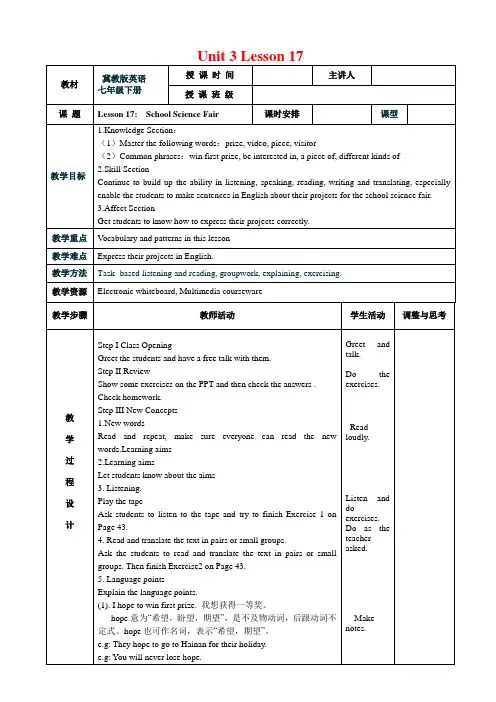
Lesson 17 School science fair教学目标:1.words: silk worm2.phrases: be ready for, do a great job, be interested in, a piece of, different kinds of 【教学过程】一、词汇学习1. They got a lot of ______ (奖品)in the race.2. Look! The children are watching ______ (录像)at home.3. I had four ______ (片)of bread and a cup of coffee.4. Now I understand I am welcome as a______ (参观者).5. They had two science ______ (展览会)last year二、听力训练课本P43 Let’s Do It. Part 1.三、任务阅读课本P43 Let’s Do It. Part 2.四、课文讲解1. 【原句再现】I am really interested in this subject.【解析】句式be interested in意为“对……感兴趣”,后加名词、代词、动名词作宾语。
七年级英语下册unit3教案课堂教学设计
本文将分享一份关于七年级英语下册Unit 3的课堂教学设计。
这一单元的主题是“Excuse me, where’s the post office?”,旨在帮助学生学会寻问和指示方向。
一、教学目标1.学生能够利用“Excuse me, where’s…?”和“Go straight / Turn left /Turn right / Do a U-turn…”等相关表达方式寻问和指示方向。
2.学生能够掌握交通工具和要素的相关单词和短语,如bus stop, subway, trainstation, etc.3.学生能够在交流中理解和使用地图和城市布局相关的词汇。
二、教学准备1.PowerPoint演示文稿2.学习用的绘画和游戏材料3.相关练习题和课堂活动材料三、教学步骤1.导入引入问题:幻灯片上展示一张城市地图,要求学生根据已知的地标(如学校、体育场、购物中心等)找出周围的其他地方。
2.学习交通工具和要素教师通过幻灯片展示不同的交通工具和点。
继续讨论如何利用不同的交通工具到达一个点,例如,利用地铁从学校到达电影院:Excuse me, how do I get to the movie theater?Take the subway.Where's the subway?Turn right and go straight. The station is on your left.3.教学寻问和指示方向教师在幻灯片上展示不同地理位置的照片和地图,提示学生开始学习如何问路和指路。
教师向学生展示如何使用“Excuse me, where’s…?”句型,以及“Go straight / Turn left / Turn right / Do a U-turn…”等表达方式来指示方向。
教师可以与学生分组进行角色扮演,以加强他们的语言进程和提高他们的口语表达能力。
4.练习方向、地图和城市布局相关的词汇通过游戏、图片和绘画等多种形式收集和展示不同的地图和城市布局相关的单词和短语,例如:Bus stop / Subway / Train stationNorth / South / East / WestOn the left / On the right / Across the street / Next to5.面向现实场景的实践通过现实场景的练习加强学生的学习效果。
冀教版英语七年级下册Unit 3 第1课时教案与反思
Unit 3 School Life 物以类聚,人以群分。
《易经》如海学校陈泽学单元目标第一课时Lesson 13 How Is School Going? 课时目标自主学习一、根据句意及汉语提示写出单词。
1.How do you like the life(生活)in America? 2.Do you like social(社会的)studies? 3.Finally,I finish(完成)cleaning my room. 4.They go there twice (两次)a year.5.I will do the work all by myself(我自己).二、写出下列画线短语的汉语意思。
1.We will have a sports meet tomorrow afternoon.运动会2.He went to visit his grandparents twice a year.一年两次3.I am sure I can finish the work by myself.我自己4.I'm not good at singing,but Mary is.擅长教学过程环节1 新课导入教师用PPT快速呈现与学科相关的图片,如英语、数学、历史等,让学生抢答说出图片中指代的是什么学科,并让学生试着造句。
设计意图:通过复习与学科相关的内容自然引出本课时的话题,为接下来的学习做好铺垫。
环节2 新课学习1.教师让学生快速阅读教材第34页的对话,阅读后邀请一名学生说出该对话谈论的主题。
2.教师邀请两名学生分角色朗读对话内容,教师注意纠正学生的发音。
3.教师让学生听对话,并提醒学生注意听其中的学科名词,完成活动1的练习,然后教师核对答案。
4.教师让学生浏览活动2中的五个问题,然后精读对话,完成练习,同时标记出对话中的重要词汇和句型。
教师抽几名学生分享答案,教师点评并核对答案。
5.教师对学生标记出的重要知识点和其他重难点进行讲解(教师可邀请学生试着翻译一些句式较为复杂的句子)。
2012新冀教版七年级英语Unit3全章教案
Unit 3 Lessons 13---18 Body parts and FeelingsLesson 13 Body partsLearning Content:Master the following:body, head, eye, nose, mouth, hair, ear, face, short, long, Linda, blondlong hair, short hair, big ears, small earsLearning Aims:To know the body partsLearning Important Points:To know and be able to point out a certain body partLearning Difficult Points:She/He has…Learning Preparation:Prepare some funny toys and other things that make students feel interesting. Learning Aids:a recorder, audiotapes, flashcards, projector, and some real objectsType of Lesson:New LessonStep 1.Revision Let some students draw body drawings on the blackboard. Then write the body parts that they have known.Step 2.Presentation Learn more new words about your body and write them on the blackboard, too.Step 3.Listen and repeat Listen to the tape and read after it. Because some words are hard, we listen and repeat for several times until we can read the words correctly. Step 4.Practice Point to parts of your body as you and the class say the words.Step 5.Practice for a while. When the students are practicing, the teacher must walk around and find the mistakes that they make.Step 6.A game Ask volunteers to stand in front of the class and point to parts of their bodies as they say the words.Step 7.Sing a song Play the tape and sing after it. Then sing with it again and do the actions when they are singing.Step 8.Acting Divide the class into several groups. Let them act in front of the class. Then choose the best one.Step 9.Activity book Come to the activity book.当堂训练:课后反思(Teaching reflection):Lesson 14: Colours and feelingsLearning Content:1.To master these words:happy, sad, nose, mouth, eye, ear,To understand the following:very, tired, ouch2. some useful patterns:How do you feel? I feel happy! I’m NOT fine, thanks. Are you tired? No, I’m not.I just feel sad.Learning Aims:1.To learn how to express the feeling of hot and cold2.To learn more about the body parts3.To use what was learned in the daily lifeLearning Important Points:How do you feel? I feel happy! I’m NOT fine, thanks. Are you tired? No, I’m not.I just feel sad.Learning Aids:A computer, a recorder, audiotapes, flashcards, dolls, fans and some other real objects.Type of Lesson:New lessonLearning Procedure:Step 1.Ask the students questions in the life. You give a student a present and ask his feeling now. Then lead the words: happy, sad.Step 2.Use your own body and the doll to say the words about body. From the top to the bottom, using the gesture language, teach the words. For example, step your foot and say “foot” loudly.Step 3.Now let’s listen to the tape and read after it. Pay attention to the words that they read must correct.Step 4.Some students come to the front, pointing their parts of body; the others say the names that they are pointing.Step 5.Give the presents that you prepared to the students that do well. Then ask “How do you feel?” Explain it in Chinese when it is necessary. Help them answer “I’m happy.” Then take their presents away and ask “How do you feel now?” Help them answer “I’m sad”Step 6.Listen to the tape and read after it. Then let some students read in roles. The best one will get a present.Step 7.Begin “happy, sad” game in pairs, using the presents that we prepared before the class. The best one will get a present.Step 8.Let’s sing a song together. Listen to the tape and sing happily after it. Encourage students to sing loudly because what we need is a happy feeling. The students can stand up and do according to the text.Step 9.Finish the activity book.当堂训练:课后反思(Teaching reflection):Lesson 15: Tall or shortLearning Content:Master these new words and expressions: in, out, left, rightLearning Aims:1.To be able to use these : left( 左边的), right(右边的); in(在里面), out(在外面)2.To learn something about foreign countriesLearning Important Points:1.Some classroom english2.Dance while the students sing the english song.Learning Difficult Points:To follow the teacher’s instructions. To perform actions.Learning Preparation:To show in out, left and right.Learning Aids:A recorder and some real objectsType of Lesson New LessonLearning Procedure:Step1.RevisionReview the words of the body. The students do what the teacher saysStep2.PresentationUse the gesture language to learn the new words. Guess the meanings of them. Step3.Perform actionsUse the objects to show the directionsStep4.Listen and readListen to the tape and follow it with the gestures in order to check if they can grasp the words.Step5.Listen and singListen to the tape and sing the song with it. Because the song is too hard for them, the teacher can make a example.Step6.Group work Let’s do with it together.Step7.Activity book Finish the activity book.当堂训练:课后反思(Teaching reflection):Learning Content:Learning Content:1.Master these new words: tall2.To understand these words: metre, stand, on3.The instructures : How tall are you? I’m 3.1 metres tall.Learning Aims:1.To be able to ask about one’s hight;2.Ask the students to do active practiceLearning Important Points:1.How to say one’s height in english2.To be able to read the text in the correct tones with the perfect pronunciationLearning Difficult Points:How to read out “3.1 metres , 1.6 metres”Learning Preparation:A ruler or some other things whice can be used to measure the length, the height, and so on.Learning Aids:A recorder, audiotapes, flashcards, and some measuring tools like rulersType of Lesson:New lessonLearning Procedure:Step1.Review:Ask students to describe one’s hair and eyes,Ask questions like this:What colour are your eyes and hair?Is your hair long or short?What colour are her eyes and hair?Is her hair long or short?Step2 listen and read .Listen to the tape and read after it until the students can read the text fluently. Step3.Practise telling one heightAsk the students :1. How tall are you?2. How tall is she?3. How tall is your teacher?4. How tall is your friend?Step4.Talk about the partner about the subject. Then ask volunteers to come to the front to act the dialogue out.Step5.Come to Part2. Listen to the tape and read after it. Then let some students read the text loudly. Choose the best one and give him present.Step6.Practice the dialogue again. Let some students act it out.Step7.Practice: How tall is she?How tall is Mr. Wood?Step8.Finish the activity book.当堂训练:课后反思(Teaching reflection):Lesson 17: Seeing a Doctor. Learning Content:1.Master these new words:hair, has2.Learn and understand these words:different, blondUseful instructions :She has long hair. My eyes are brown.Learning Aims:1.Learn to describethe looking of oneself and other students.2.To be able to read the text fluently3.To write a short passage in english, describe oneself or other people Learning Important Points:1.How to describe one’s hair, including the length and the colour2.How to describe one’s eyes, including the size and colourLearning Difficult Points:The subject-verb agreement,when the subject is in the third person, the verb should be in a special form, such is and hasLearning Preparation:Get some markers of all colours and fausle hair of different lengthsLearning Aids:A recorder, audiotapes, flashcards, films, markers and wigsType of Teaching:New lessonLearning Procedure:Step1. warming upReview: Express the feelings of yourself. You can say like this: I’m happy. Are you happy, too? Are you hot or cold? Let some students answer and ask questions like this.Step2. Presentation though gestures teach students how to say I have ….T : I have long hair.S1: I have short hair.S2: I have long hair.S3: I have short, black hair. …Learn the drill: She has…S4: She has long hair.S5: He has short hair.S6: She has long, blond hair. …Step3.Practise Change the hair, practice the dialogue again. When they make mistakes, the teacher must correct them immediately.Step4.Listen and read Listen to the tape and read after it until they can read it fluently. Let students read the text one by one in order to see who make the greatest progress. Give him a present.Step5.Practise.Talk about your partners each other. Remember to use right words.Step6.Practise.Ask volunteers come to the front. The others begin to describe them.Step7.Come to the activity book.当堂训练:课后反思(Teaching reflection):Lesson 18: We All Look Different.Learning Content:Master these new words and expressions: these, those, little, long, shortto under the followng: shoulder, stomach, elbow, knee, toe, fingerbig ears, little feet, long legs, short armsLearning Aims:1.Listen and tell whether it is right or wrong2.To say the body parts in englishLearning Important Points:1.Be able to undertand the instructions and do the right reactions, pointing out body parts2.In simple english , describe one’s own looking and others’Learning Difficult Points:How to describe oneself and other peopleLearning Preparation:Prepare some picturesLearning Aids:A recorder, audiotapes, dolls and some flashcardsType of Lesson:New lessonLearning Procedure:Step1.RevisionLet some students draw body drawings on the blackboard. Then write the body parts that they have known.Step2.PresentationLearn more new words about your body and write them on the blackboard, too. Step3.Listen and repeatListen to the tape and read after it. Because some words are hard, we listen and repeat for several times until we can read the words correctly.Step4.PracticePoint to parts of your body as you and the class say the words.Step5.Practice for a while.When the students are practicing, the teacher must walk around and find the mistakes that they make.Step6.A game Ask volunteers to stand in front of the class and point to parts of their bodies as they say the words.Step7.Sing a song Play the tape and sing after it. Then sing with it again and do the actions when they are singing.Step8.Acting Divide the class into several groups. Let them act in front of the class. Then choose the best one.Step9.Activity book Come to the activity book.当堂训练:课后反思(Teaching reflection):。
冀教版英语七年级下册unit3第五课时教案

第五课时Lesson 17:School Science Fair教学目标1.掌握单词:prize, video, piece, visitor短语:win first prize, be interested in…, a piece of, different kinds of, etc.2.掌握和运用关于学校科学展览的句型:Are you ready for the big science fair next week?I hope to win first prize.You will do a good job!What is your project about?I am really interested in this subject.I made a video about silk worms.I have a small piece of old silk.Silk worms are interesting.I will make ten different kinds of donuts.And people can taste them all.3.掌握一般现在时、一般过去时、一般将来时和系动词的用法。
4.了解学校科学展览。
5.了解丝绸的来历以及蚕的养殖情况。
6.了解世界上的各个国家的美食。
教学过程StepⅠ.Lead inLeading in 【情景1】Warm up.Pair work:Teacher shows pictures of Jenny’s and Danny’s projects.Teacher asks the students to work in pairs and talk about the pictures.Ask questions like this:S1:What are they?S2:They are silk worms.S1:What can they do?S2:We can use them to make silk.S1:Do they eat much food every day?S2:Yes, they do.S1:Can you teach me how to keep them?S2:Sure.…S3:What are they?S4:They are donuts.S3:Did you taste them?S4:Yes.S3:How did they taste?S4:They tasted delicious.S3:Can you make donuts on your own?S4:Sorry,I can’t.But I can learn to make them on the Internet.…After a few minutes, ask some pairs to act their dialogues out in front of the class.[设计意图]利用詹妮和丹尼的学校科学展览的课题,呈现相应的图片,让同学们谈论相关的话题,提前熟悉课文内容,为学习课文里的对话打下基础。
冀教版七年级下册英语精品教学课件 Unit 3 School Life Lesson 16
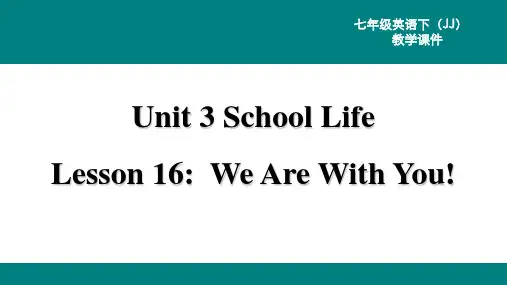
fire n. 意为“火, 火灾”。当其表示“火灾”时, 是可数名词; 表示 “火”时, 是不可数名词。 fire的常用短语有: be on fire / catch fire 着火 play with fire 玩火 start a fire 引起火灾, 生起一堆火 put out a fire 灭火
【拓展】 表示一天中的早、午、晚要用in; 黎明、午夜、点与分要用at; 年、月、季节、周要用in。 【例句】 People go skating in winter. 人们冬天去滑冰。 I usually take a nap at noon. 我通常会在中午小睡一下。
happen es heard the bad news. They stood up and said, “Jason, don’t be afraid. We are with you.” The class wanted to help Jason and his family. So they came up with a plan. The next day, many students brought clothes and food from their homes. The school had a car wash and a cookie sale. In just three days, the school raised $1 200.
3. When did it happen?
On the first day of school. 4. Who helped Jason and his family? Jason’s classmates. 5. How did they help Jason and his family? Many students brought clothes and food from their homes and the school raised $1200 for Jason’s family by having a car wash and a cookie sale.
初中英语冀教版七年级下册Unit 3 Lesson 17 School Science Fair教案 教学设计
(2). be interested in意为“对……感兴趣”interested表示“感兴趣的”,interesting表示“有趣的,引起兴趣的”。
e.g: We are all interested in English.
e.g: English is so interesting.
Ask students to listen to the tape and try to finish Exercise 1 on Page 43.
4. Read and translate the text in pairs or small groups.
Ask the students to read and translate the text in pairs or small groups. Then finish Exercise2 on Page 43.
(3)I have a small piece of old silk.
a piece of一片/张
e.g: He cut a piece of bread from the loaf.
e.g: She came in carrying a piece of paper.
e.g: She cut her finger on a piece of broken glass.
(4)I will make ten different kinds of donuts.
different kinds of不同种类的
e.g: Like me, she enjoys different kinds of music.
e.g: They planted different kinds of flowers in their garden.
冀教版英语七年级下册Unit 3:Lesson 18 Teaching in China. 教案设计
Lesson 18 Teaching in China一,教学目标1.知识目标(1)学会单词:teach, quite, nervous, comfortable, relaxed, helpful(2)会用短语: be happy to do sth / move from…to / the Great Wallbe friendly to / write…..to s b / arrive in(3)会用句子:She is writing an e-mail to her family and friends back home.I feel quire comfortable and relaxed.I am so happy to be in China.2.能力目标会写电子邮件,谈论中西方的文化差异。
3.情感目标激发学生的学生兴趣;;提高自信心和意志力;培养学生合作精神;并在不断了解异国文化的过程中增强爱国意识。
二,学情分析七年级学生思维活跃,活泼好动,表现欲强,希望得到老师的表扬和同学的认可。
vz本课话题即是有关学生日常生活的。
故有90%的学生可以参加讨论。
但是大多数学生倾向于直观的听力输入和口语活动。
学生们在整个英语学习过程中都需要扎实的基本功。
三,重点难点1.掌握单词和短语,能够谈论中西方的文化差异。
2.熟练运用频度副词always, usually, ofter, sometimes, never.四,教学过程活动1【导入】自主预习1. 从…移动到…____________2. 努力工作______________3. 与…友好___________4. 给某人写信______________5. 到达__________________6. 做得好_____________7. 教某人某事______________ 8. 长城____________________9.很高兴做某事____________活动2【活动】听录音感知课文Listen to the tape and write true (T) or false (F)1. Jane arrived in China last week. ( )2. Everyone is friendly and nice to Jane. ( )3. Canadian students don’t move to different classroom for their classes.( )4. Jane’s students teach her about her culture. ( )5. Jane didn’t visit the Great Wall last month.( )活动3【活动】学生朗读课文Read the text aloud together.活动4【活动】学生探究下列知识点学习任务一She is teaching English in China.她在中国教英语。
七年级英语下册Unit3SchoolLifeLesson16WeArewithYou教案(新版)冀教版
Unit 3 School Life Lesson 16 We Are with YouTeaching Analysis1. Teaching AimsKnowledge Section:(1)Master the following words:terrible, , lost, fire, raise(2)Common phrases:come up with, car wash, cookie sale,(1)Skill Section(2)Continue to build up the ability in listening, speaking, reading, writing andtranslating, especially enable the students to make sentences in English about Get students to know what they should do if their friends meet problems.2.Teaching FocusVocabulary and patterns in this lesson3. Difficult pointsExpress their thoughts about the PPT.Students do the exercises and check the answers together.Step III New Concepts (22 minutes)1.New wordsRead and recite.2.Learning aimsLet students know about the aims3.Lead-inFree talk:T: Work in groups. Imagine you work for a company that . What will you do for them? How will you .Ss: Show their plans....(The teacher presents some ideas to answer the questions in exercise 1 on page 41.Ask the students to find the phrase on PPT.3. Language pointsT: After reading, let’s study the language points in this lesson.(1). something terrible 可怕的事情。
冀教版英语七年级下册教案全册
教学内容
Lesson 1 : A trip to China
第几课时
1
共几
课时
1
知
识
目
标
1. New words and phrases
2. understand the meaning of text
3. Structures:May I ask.....? May I go with you ......?
思
课时教案
教学内容
Lesson 2:Meet you in Beijing
第几课时
2
共几
课时
1
知
识
目
标
1. Words and phrases:exciting,along,kilometer,special,culture,arrive,leave,How far is it from.....to.....?
This term ,what we will learn?
In unit one,we will learn the history of China and culture of China-the Silk Road.
Step 2. Lead in.
Explain the Silk Road in Chinese first,what about the Silk Road,talking about the history of China and culture of China.then we learn the new words.
教学
重点
Asking for permission:May I ask.....? May I go with you ......?
七年级下册英语教案-Unit3-Lesson13HowIsSchoolGoing(冀教版)
七年级下册英语教案-Unit3-Lesson13HowIsSchoolGoing(冀教版)(冀教版英语七年级下册) Lesson 13 How Is School Going? 课题How Is School Going? 课时 1 课型new 教学内容分析本教学设计选自英语冀教版七年级下册第三单元第十三课。
本课的教学重难点是词组How is ......going? be good at、take part in、by oneself,频度副词及其用法。
所以本课的授课将采取讲练结合的方式帮助学生攻破难点。
教学目标设计本课教学中渗透了“知识与技能,过程与方法,情感与态度”三种目标。
首先,教给学生基本的知识内容,如什么频度副词。
然后通过对比和相关习题帮助学生掌握对这一知识点的运用。
学生情况分析七年级学生好动、好奇、好表现,应采用形象生动、形式多样的教学方法和学生广泛、积极主动参与的学习方式去激发学生学习的兴趣。
生理上,学生好动,注意力易分散,爱发表见解,希望得到老师的表扬,所以在教学中应抓住学生这一特点,发挥学生的积极性。
设计教学活动时关注整体,层次分明。
教1.Knowledge Goal:① Grasp the new words: life, term, start, finish,twice, win,social, myself②Master the usage of phrases:学目标How is ......going? be good at、take part in、by oneselfMake students be able to distinguish andmake use of the frequency adverbs.2.Ability Goal: By the method of Task-based Language Teachingand pair-work, students get to know the main ideaof the text and use the frequency adverbs fluently.3.Moral Goal: Make students be interested in studying and learnto cooperate with others.重点the new phrases and the frequency adverbs难点Distinguish the five adverbs: always, often, usually, sometimes,never教法Task- based Language Teaching, pair-work教具audiotape, PPT, some pictures for competition教学过程教学步骤教师活动学生活动设计意图新课导入Step I Warming up:(1 minute)Teacher plays the happy songand sing it with students.Step II Leading in: (1 minute)Teacher says: I feel happy. Howdo you feel today?Students sing thehappy song and dothe actions with theteacher.Students answer thequestion voluntarily.It aims tomake theclass activeand lead inthe newlesson.新课教学Step III New words:(5 minutes) life, term, start,finish,twice, win,social, myself Teacher says: Most of us arehappy at school, because there are many subjects we like. Nowplease look at the board and seewhat subjects we have. Teacherplays the PPT.Then teacher shows the newword “shop”Next T shows each new word withthe help of the phonetics. Then teacher check students pronunciation and lead them toread the new words.Game: Teacher shows the newwords on the PPT and asksstudents to have a competition toread the words and get scores fortheir groups.Exercises:(1)We ____ our class at 8 a.m.and _______it at 5 p.m. Today.(2)This year, we ____ thebasketball game and we were Students competeto read the words.Students are notsure if it’s a subject and ask some questions about it. Students read the words by themselves according to the phonetics. Students read the words as soon as possible. And the better group get scores.Students do the exercises according to what they have learnt. Motivatestudents totake part inthe activityand developtheir senseofcooperation. Students findthe questionand ask.Checkstudents’pronunciationand learn thenew words.Help studentsremember thewords.Consolidation新课教学proud of it.(3)______ do _____ homeworkby _______ every day. (I)Step IV Listening (2 minutes) Practice students’listening ability.T shows a picture by PPT to the students and play the audio tape. Step V Reading (5 minutes) Teacher asks the students to read the lesson and answer the questions. Teacher shows the questions by PPT.(1)How is Jenny’s school life going?(2)How many classes does Wang Mei have every day?(3)What is Wang Mei’s favourite subject?(4)What is Jenny’s favourite subject?(5)What did Jenny make in shop class last week?Then teacher checks their answers. (3 minutes)Step VI Text (20 minutes) Explain the whole text, especially the new phrases and the frequency adverbs.(1)New phrases:① How is ___ going?(......怎么样?)Teacher makes use of the sentence in the text to explain the Students listen to itquietly and writedown what subjectsthey have.Students read thetext and answer thequestions on theirown. They can have abrief understanding ofthe text at the sametime.Students listen tothe teacher carefully.Students answer thequestion andunderstand themeaning of thePracticestudents’listeningability andfinish the task.Practicestudents’readingability.Teach thecontentdirectly andmakestudents paymoreattention toit.新课教学phrase.“How is your school life going?”② be good at ......Teacher explains the phrase directly and show the phrase “do well in”for students. And the teacher shows some pictures for students to make sentences on their own.③ take part in④ by oneself(Teach the phrases in the same way.)(2)Frequency adverbs: always, often, usually, sometimes, neverTeacher explains the wordsdirectly with the help of some examples.(Skill: 位置记忆口诀-主谓之间,系表之间,sometimes要除外)①You’re late again. You are always late for school.(埋怨)② They often\ usually go on a trip on holidays.③On weekends, I visit my grandparents sometimes.④ Jenny tries her best to study, so she never fails in her exam.Step VII Consolidation(2 minutes)Fill in the blanks with the correct forms of the words or phrases in the box.life finish subject take part inbe good at(1)I ___ singing. I want to be a singer in the future.(2)I start school at 8 a.m. and phrase.Students listencarefully and makesentences with thenew phrase.Students distinguishthe usage of thefrequency adverbsaccording to teacher’sexplanation.Students do theexercises according tothe knowledge they’velearned on their own.Then, they compete toanswer the question andget scores for theirgroups.To improvestudents’ability ofmaking useof thephrases.Helpstudentsunderstandthedifferencesamong thefrequencyadverbs.Consolidatewhat wehavelearned.___ at 5 p.m.(3)I often ___ the long jump at the sports meet.(4)A: What ___ do you have?B: I have Chinese, English, math and some others.(5)A: How is your school ___ going?B: Well, it’s a little busy.Step VIII Activity (7 minutes)Teacher asks students to have a pair work and have a dialogue practice.A: What subjects do you have? B: ......A: How many classes do you have?B: ......A: When does the first\second... class start?B: ......Step IX Conclusion(1 minute) Teacher leads students to review the knowledge.Step X. Homework(1 minute)①. Recite the new words,phrases and frequency adverbs in Lesson13. (all the students)②. Recite Paragraph 5 .(students after No. 30)③. Retell the content of the text.(Students before No. 30 including No. 30)Students work in pairsand write down theirclass timetable. Then useit to make up a dialogue.Time SubjectStudents say what theyhave learned.Make theatmosphereactive andpracticestudentsspokenEnglish.It’s time forstudents toretell whatthey havelearned.板书设计Lesson 13 How Is School Going?New words: Phrases: Frequency adverbs: life /la?f/ How is ... Going? alwaysterm /t?:m/ be good at oftenstart /stɑ:t/ take part in usuallyfinish /fInI?/ by oneself sometimesnever课堂小结1.回忆本课的主要内容。