
2016-2017学年山东省聊城市高一下学期期末考试英语试题+听力
2016-2017学年山东省聊城市高一下学期期末考试英语试题+听力第I卷(共80分)第一部分:听力(共两节,满分20分)该部分分为第一、第二两节。
注意:做题时,先将答案划在试卷上。
录音内容结束后,你将有两分钟的时间将试卷上的答案转涂到答题卡上。
第一节(共5小题;每小题1分,满分5分)听下面5段对话。
每段对话后有一个小题,从题中所给的A、B、C三个选项中选出最佳选项,并标在试卷的相应位置。
听完每段对话后,你都有10秒钟的时间来回答有关小题和阅读下一小题。
每段对话仅读一遍。
1. What does the woman want the man to do?A. Shut the window.B. Turn down the heat.C. Bring her a blanket.2. What time is it now?A. 8:00 a. m.B. 7:45 a. m.C. 7:40 a. m.3. What‟s the probable relationship between the woman speaker and Monte?A. Best friends.B. Classmates.C. Brother and sister.4. Why is the man annoyed?A. The dog is too noisy.B. He got woken up early.C. His neighbor is blaming him.5. What do the speakers need to buy?A. Onions and beef.B. Onions and potatoes.C. Beef and tomatoes.第二节(共10小题;每小题1.5分,满分15分)听下面3段对话或独白,每段对话或独白后有几个小题,从题中所给的A、B、C三个选项中选出最佳选项,并标在试卷相应位置。
听每段对话或独白前,你将有时间阅读各个小题,每小题5秒钟,听完后,各小题将给出5秒钟的作答时间,每段对话或独白读两遍。
听第6段材料,回答第6至8题。
6. What does the man‟s daughter want?A. English novels.B. Fashion magazines.C. Business management books.7. How many books will the man borrow?A. Three.B. Four.C. Five.8. Where are the books on human resources?A. On the first floor.B. On the second floor.C. On the fourth floor.听第7段材料,回答第9至12题。
9. What festival is coming?A. May Day.B. Children‟s Day.C. Father‟s Day.10. Where did the woman plan to go at first?A. Beijing.B. Yunnan.C. Hunan.11. What will the man do in the vacation?A. Go traveling with his friends.B. Stay at home to have a rest.C. Prepare for the coming exam.12. Where does the conversation probably take place?A. In the cinema.B. In a travel agency.C. In the classroom.听第8段材料,回答第13至15题。
13. How many pieces of advice are mentioned?A. 3.B. 4.C. 5.14. What will help you become close friends with others?A. Being friendly and polite.B. Being honest and truthful.C. Sharing thoughts and opinions.15. How often do the Friendship Club members meet?A. Once a week.B. Twice a week.C. Every day.第二部分:阅读理解(共两节,满分30分)第一节(共10小题;每小题2分,满分20分)阅读下列短文,从每题所给的四个选项(A、B、C和D)中,选出最佳选项,并在答题卡上将该项涂黑。
AWhen traveling in England, here are some things to keep in mind.When taking the underground in England, once on the underground train,stand clear of closing doors. They can give you a pretty hurtful knock if they hit you. When getting on or off the tube train, make sure you mind thegap (间隙)! This varies from a few inches to a foot at some of the stations.The saying that English food is boring and tasteless isn‟t true, at least not anymore. You‟ll find a huge variety (种类) of international restaurants and foods, especially in London. Make sure you eat some of the old-fashioned traditional foods in pubs, and wash it down with some local beer!Come prepared for any sort of weather — even if the day starts off well, it‟s likely that the temperature will change. The best thing to do is layer (分层穿套) your clothes so that you can add or reduce as necessary.The British are, in general, very polite people and will expect at least basic politeness from travelers. Pleases and thanks go a long way! At the same time, they like playing jokes on others.Don‟t be surprised or angry if you‟re called darling, dear, dearie, flower, love, chick, chuck, me duck, son,ma‟am or any other similar pet name by someone you don‟t know. It‟s quite normal.England is generally quite safe, but you‟ll need to be more careful in London and the other large cities,especially at night. Choose an underground train that has plenty of people in it and avoid suburban underground stations at night. There are many night buses you can catch, but try not to do this alone. A licensed taxi is often the best choice. Try and leave valuable things in your hotel room, as pickpockets (扒手) do operate in some areas. Be careful of bags especially when in some busy areas.16. What does the author think of foods in London now?A. They are old-fashioned.B. They are of huge variety.C. They are simple yet delicious.D. They are boring and tasteless.17. What is advised to do in the text?A. Have good manners in front of the British.B. Be serious when talking with the British.C. Avoid taking the underground in England.D. Call others pet names to show your care.18. What can we learn from the last paragraph?A. It‟s dangerous to travel in England. .B. Stealing is very common around England.C. People shouldn‟t travel by public transportation at night.D. You should be careful when traveling in large cities in England.BChildren grow quickly, especially their feet. But many families cannot buy shoes each time a child needs them. As a result, about 300 million children around the world go without shoes. Those children risk picking updiseases and parasites (寄生虫) from the soil.An American man may have a solution for those kids a shoe that grows with the child. Kenton Lee is the creator of the shoe that grows. He says, “The shoe can grow in the front; it can also grow on the side with Velcro fastener and on the back a buckle (锁扣). It can last up to five years. The bottom is compressed (压缩的) rubber like what is used for a tire. The top is high-quality leather.” The shoes come in two sizes: small ones that fit children aged 4 to 9 and large ones for children aged 9 to 14.Lee says he got the idea for the shoe while working as a volunteer in an orphanage (孤儿院) in Kenya. He says, “There was a little girl in a white dress walking next to me. And I just remember looking down and seeing how small her shoes were. They were so small for her feet that she had to cut open the front of her shoes to let her toes stick out. And I just remember thinking, …Wouldn‟t it be nice if there were a pair of shoes that could grow with her?‟”However, Lee says it was not easy to turn his idea into a reality. “The real reason why it was important for me to try to make the shoes that could grow was to help. So I made a promise to myself.”In 2009 Lee founded a non-profit organization called Because International. In the office of Because International,Lee kept a pair of his own shoes to help him remember his promise. “I told myself I would not get new shoes until the idea was done. So, those are the shoes that I wore for a little over five years. But once we finally made the shoe that grows, then I got some new shoes.”19. What‟s the purpose of Kenton Lee‟s words in Paragraph 2?A. To encourage us to buy the shoes.B. To tell us the shoes are of high quality.G. To show us the shoes have various types.D. To give us general information about the shoes.20. How did Kenton Lee respond when seeing the little girl?A. He thought the girl was really small.B. He couldn‟t believe what he saw at all.C. He wanted to invent shoes that grow.D. He was determined to collect money to help her.21. What‟s the main idea of this passage?A. Many children need shoes in poor countries.B. An American man helped poor people in Kenya.C. Children should wear shoes to protect themselves.D. An American man invented shoes that grow with a child.CYears ago my husband and I were in Acapulco, Mexcio, and we wanted to go to the local open-air market, “Mercado”, but the taxi took us to Walmart. When we told him that we wanted to go where the locals shopped, the driver took us to Safeway, a supemarket. I explained that I was a cook and wanted to see local fruits, vegetables and spices at a big open-air market. He said it wasn‟t safe but he‟d drive by so we could look from the taxi. We were going to miss the adventure across the street. But, when the taxi stopped in traffic, we got out and began an afternoon of exploring.After about an hour we came to a stall (货摊) where an old woman was selling cacao (可可豆). I wondered what the locals did with the cacao. My husband spoke Spanish and tried to translate, but the woman was speaking fast and using a lot of local “food words”. No matter how much she smiled, nodded and waved her hands, her words meant nothing to us.Finally, she took my hand,left her stall,and walked us through the market for a few minutes. She brought us to a couple of women who were pouring a liquid back-and-forth between two of 5-gallon buckets (桶). She found some glasses and they poured us some fresh chocolate.Now we were faced with a dilemma. Could we refuse the drink so generously offered? We had a quick low-voiced chat about the safety of the drinking water in Mexico. Neither of us wanted to make the women offering the drink unhappy. It was an offer, and no payment was accepted, even after we tried.We drank. The chocolate drink was slightly sweet. We never got sick. We also began taking sortie medicine as soon as we got back to our room. We were polite, not stupid.22. Why did the taxi driver refuse to take the author and her husband to the “Mercado”?A. Because the market was not open that day.B. Because he was worried about their safety.C. Because they did not pay him enough money.D. Because the prices of things there were too high.23. What can we know about the old woman from the passage?A. She was kind and friendly.B. She asked for a lot of money for the drink.C. She was eager to sell her cacao to the author.D. She pretended not to unde rstand the author‟s husband.24. What does the underlined word “dilemma” in Paragraph 4 most probably mean?A. A warm feeling.B. An unexpected gift.C. An exciting moment.D. A difficult, often embarrassing situation.25. Which of the following statements is true?A. The author didn‟t think the chocolate safe to drink.B. The author wanted to go to the supermarket for shopping.C. The author‟s husband could understand the old woman well.D. The author refused to drink the chocolate offered by the women.第二节(共5小题;每小题2分,满分10分)根据短文内容,从短文后的选项中选出能填入空白处的最佳选项,并在答题卡上将该项涂黑。
山东省聊城市莘县莘州中学2023-2024学年高一下学期开学测试英语试题

山东省聊城市莘县莘州中学2023-2024学年高一下学期开学测试英语试题一、听力选择题1.What did the man think of the play?A.It was interesting.B.It was moving.C.It was boring.2.What can we learn from the conversation?A.The man will return the magazine.B.The magazine is gone.C.The woman will buy a new magazine.3.What will John have for dinner?A.Noodles.B.Pizza.C.Fish and chips.4.Who probably knows the exact location of the supermarket?A.Julie.B.Lily.C.Anna.5.What does the man mean?A.He doesn’t like the hats.B.He wants the woman to buy all the hats.C.He doesn’t think the woman can afford all the hats.听下面一段较长对话,回答以下小题。
6.When will the woman meet the man?A.On Friday.B.On Sunday.C.On Saturday.7.What does the woman usually do at two o’clock?A.She has a break.B.She has a meeting.C.She has lunch.听下面一段较长对话,回答以下小题。
8.Why are the Blacks moving to Australia?A.Mr. Black has found a new job there.B.They have many friends there.C.Mrs. Black wants to teach there.9.What might Mrs. Black do in Melbourne?A.A teacher.B.A housewife.C.A clerk.听下面一段较长对话,回答以下小题。
河北省邯郸市磁县第一中学2016-2017学年高一(预科班)下学期期末考试英语试题含答案
2017预科期末考试英语试卷(时间120分钟总分150分)第Ⅰ卷第一部分听力(共两节,满分30分)第一节(共5小题;每小题1。
5分,满分7。
5分)请听下面5段对话,选出最佳选项.1. What is the man going to do during the summer holiday?A。
Take a trip B。
Rest at home C. Make some money 2。
What does the woman mean?A。
She doesn't know the man B。
Mr。
Smith is not available nowC。
There is no Mr. Smith in her office3. What does the man’s sister do?A. A nurseB. A doctorC. A teacher4。
What do we know about the man speaker?A。
He is a policeman。
B。
He is in a red shirt today C。
He doesn’t know the way to the cinema.5。
What day is it today?A. Friday B。
Saturday C。
SundayKS5UKS5U.KS5U第二节(共15小题;每小题1.5,满分22.5分)听第6段材料,回答第6、7题6。
When does the woman’s bus leave?A。
At 9:00 . B。
At 9:30 C. At 10:007。
How will the woman go back home?A。
By bus B. By car C. By taxi听第7段材料,回答第8、9题8 What size does the woman want?A。
Size five B。
Size six C. Size seven9 How much do the shoes cost?A. 40。
2016-2017学年度第二学期初二英语下期中试卷
2016-2017学年度第⼆学期初⼆英语下期中试卷 英语考试就是⼈⽣的⼀道必经之路,点点滴滴的做初⼆英语试题体验,汇聚成⼈⽣经验。
下⾯由店铺⼩编为你整理的2016-2017学年度第⼆学期初⼆英语下期中试卷,希望对⼤家有帮助! 2016-2017学年度第⼆学期初⼆英语下期中试题 ⼀.听⼒(每⼩题1分,共20分) 第⼀部分听对话回答问题。
本部分共有10道⼩题,每⼩题你将听到⼀段对话,每段对话读两遍。
听每段对话或短⽂前,你将有时间阅读相关⼩题,每⼩题5秒钟;听完后,每⼩题你仍有5秒钟的时间选择你认为最合适的备选答案。
1. How does her father go to work? A. B. C. 2. Where is the man’s pen friend from? A. B. C. 3. What does Walter do after work? A. B. C. 4. What is Jack going to be when he grows up? A. B. C. 5. When will the film begin?A. At 6:30.B. At 7:00.C. At 7:30. 6. What will the boy do tomorrow?A. Do his homework.B. Go to work.C. Do his housework. 7. Where does the boy have lunch?A. In the restaurant.B. At home.C. At school. 8. What does the man want to do?A. Climb hills.B. Go fishing.C. Go shopping. 9. What will the girl do this afternoon?A. Have a party.B. Visit the old people.C. Go shopping. 10.When is the man's birthday?A. On April 30th .B. On May 1st .C. On May 2nd . 第⼆部分听对话和短⽂答题。
七年级英语期末试题.docx
2016—2017学年度第二学期期末考试七年级英语试题(A)温馨提示:用答题卡的单位请将答案直接答在答题卡上。
不用答题卡的单位请把第[卷选择题答案填写在第7页的答题栏中,其它题直接在试卷上作答。
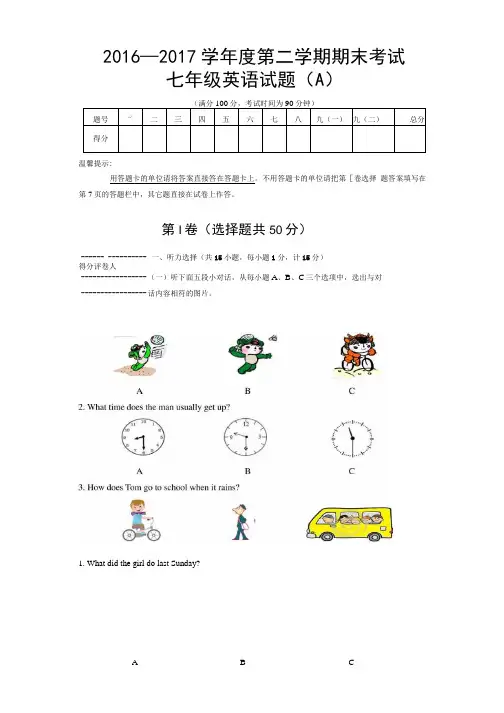
第I卷(选择题共50分)------ ---------- 一、听力选择(共15小题,每小题1分,计15分)得分评卷人----------------- (一)听下面五段小对话,从每小题A、B、C三个选项中,选出与对----------------- 话内容相符的图片。
1. What did the girl do last Sunday?A B C4.What is the girl doing?ABC5.How's the weather there in Shanghai?A B C(二)听一段对话,根据对话内容判断下面五个小题正误。
正确的选A,错误的选B。
对话听两遍。
6.The farmer showed Bob around the farm.7.Bob learned a lot about farming.8.The farmers grow strawberries form November to June.9.The farmers grow apples.10.The strawberries were very delicious.(三)听短文,选出正确的选项。
短文听两遍。
11.Who is of medium height?A. Cathy.B. Julia.C. Alice.12. What does Cathy like doing?A. Reading.B. Going to the zoo.C. Playing basketball.13.What does Julia look like?A.She has long straight hair.B.She has short curly hair.C.She has short straight hair.14.What does Julia want to be?A. A dancer.B. A teacher.C. A singer.15. How many people are there in the photo?二、单项选择(共10小题,每小题0.5分,计5分)从A 、B 、C 、D 四个选项中,选出可以填入空白处的最佳答案。
中小学题库-山东省聊城市2017英语中考试题答案及解析
山东省聊城市2017年英语中考试题一、听力理解。
听下面5个句子,从题中所给的A、B、C三个选项中选出作为恰当反应的最佳选项。
每个句子仅读一遍。
1. A.Sorry, I don’t know.B.Yes, of course. C.Yes, I need help.2. A.It's 726815. B.It’s not mine.C.It’s black.3. A.Well done! B.I hope so. C.Good idea!4. A.No, I’m not.B.Sorry, I didn’t.C.Yes, I’d love to.5. A.That’ll be great!B.You’re welcome.C.It doesn’t matter.【答案】BABCA听下面5个对话,从题中所给的A、B、C三个选项中选出作为恰当反应的最佳选项。
每个对话仅读一遍。
6. What does the woman want to buy?A.A T-shirt. B.Two T-shirts. C.Two shirts.7. What is Linda doing?A.She is counting. B.She is washing. C.She is cooking.8. Where was Lingling born?A.In a small town. B.In a small village. C.In Shandong Province.9. What is the man going to do at the weekend?A.Stay at home. B.Stay with his parents. C.Go shopping alone.10. How does the man speaker go to school?A.By bike. B.On foot. C.By bus.【答案】ACBAC听下面3段对话,从每小题所给的A、B、C三个选项中选出最佳选项。
《大学英语》2016-2017学年第二学期期末考试A卷
D. to laugh
A. It is the reason.
B. That is why
8. We have got two TV sets, but we still can not watch
C. There is why
D. It is how
第 1 页 (本套试卷共 3 页)
anything because____ work properly.
2. The word USA__________ United States of America.
3. We are__________ news of our brother, who lives away from home.
4. The children were not to___________.
A. to
B. in
Байду номын сангаас
19. --- Can I help you?
C. beyond
D. under
--- Well, I am afraid the box is ____heavy for you,
第 2 页 (本套试卷共 3 页)
but thank you all the same.
A. so
小题 2 分,共 20 分)
province still view as blame
afford look up to get by relax stand for hungry for
1. His Dad was a volunteer fireman, which was a dangerous job, so he__________ his Dad a lot.
山东省菏泽市巨野县第一中学2016-2017学年高一9月月考英语试题 含答案
高一(五十五级)九月份检测卷英语试题组题人:吴美丽陈令云陶艳梅审核人:李晓晨本试题分为Ⅰ卷和Ⅱ卷,共150分。
考试用时120分钟.注意事项:1。
考试前,先用0。
5毫米的签字笔和2B铅笔把准考证号填涂到答题纸和答题卡上。
2.选择题的作答,每小题选出答案后,用2B铅笔涂到相应的答题卡上。
3.非选择题的作答,用0。
5毫米的签字笔直接答在答题卡上的相应区域内。
写在其他地方无效.4。
考试结束后,讲答题卡和答题纸一并上交.Ⅰ卷第一部分听力(共两节,满分30分)第二部分:阅读理解(共15小题,每题2分,满分30分)阅读下列短文, 从每题所给的四个选项(A、B、C和D)中,选出最佳选项, 并在答题卡上将该项涂黑。
AAs the father of a student,I have experienced first hand what a great teacher is. My son was in the 4th grade last year, and he had a teacher called Miss Green。
I believe that when he is an adult he will surely look back on her as the best teacher he has ever had.My son has attention deficit disorder(注意力缺损症) that makes it a little more difficult for him to learn. She was able to change her teaching methods for him so that he could keep up with the rest of the class. As a result, he got straight As on many subjects。
山东省聊城市2012-2013学年高一上学期期末检测英语试题
绝密★启用前山东省聊城市2012-2013学年高一上学期“七校联考”期末检测英语试题考试时间:100分钟;C.confusing;confused D.confused;confusing11.He looks forwards every afternoon to _____ the flower-lined garden.A. visitB. paying a visitC. walk inD. walking in12.She is _______ at her boyfriend.A. disappointedB. disappointingC. disappointD. to be disappointed 13.---Don't put the waste on the ground.---Oh, I'm very sorry. I ________ the dustbin(垃圾箱) there.A. don't seeB. isn't seeingC. didn't seeD. haven't seen14.I don’t like the pattern of the trousers.____ , the color doesn’t suit me.A. HoweverB. InsteadC. BesidesD. But15.—Mary,new copies of 《Harry Potter》 are on sale now.—Great! Let’s go and buy this afternoon.A.it B.that C.any D.one二、完型填空16.It is interesting how NASA(美国航空航天管理局)chose their astronauts for landing them on the moon. They chose men 16 the age of twenty and thirty-five. There were about fifty of them, Many were 17 air pilots. 18 were scientists with two or three degrees. NASA telephoned each man they were going to choose; told him the plans and the 19 they might get in. They then asked him if he was willing to be trained as an astronaut. “How could any man 20 such an exciting job?” One of them said, “Dangerous? Of course. It’s dangerous 21 most exciting”The health and physical condition of 22 was, of course, very necessary. 23 those in very good health and physical condition were chosen.While being trained to be astronauts. They went through many 24 . They studied the star and the moon, and they also studied geology, the science of rocks. This was necessary 25 astronauts would have to look for rocks on the moon. They would try to find rocks which might help to tell the 26 of the moon. They were all 27 to fly in helicopters (直升飞机)。
2016-2017学年高一德语下学期期末考试试题
学必求其心得,业必贵于专精2016-—2017学年下学期高一年级期末考德语试卷满分150分,考试时间120分钟第一部分:听力(共20小题,每小题1.5分,总分30分)Teil 1: AlltagssituationenSie hören im folgenden 6 Minidialoge einmal。
Markieren Sie die Lösungen auf dem Antwortbogen:a, b oder c?(9P.)1. ( ) a。
Ein Referent. b. Ein Moderator。
c. Ein Professor.2. ( )a. Drei Töchter。
b. Zwei Söhne und eine Tochter。
c。
Drei Söhne。
3。
()a。
Acht Jahre. b。
Sieben Jahre。
c。
Sechs Jahre.4。
( ) a. ...Ein Fall für zwei“。
b。
...Das Piano“。
c。
(i)Ehe der Maria Braun“.5。
( ) a。
Weil er Ingenieur ist.b。
Weil er ziemlich oft ins Ausland fährt。
c. Weil er eine Dienstreise macht。
6. () a. 3 Kilo Kartoffeln,2 Kilo Erdbeeren und 1 Kilo Spinat。
b。
1 Kilo Zwiebeln, 2 Kilo Kartoffeln und 3 Kilo Erdbeeren。
c. 1 Kilo Zwiebeln, 2 Kilo Erdbeeren und 3 Kilo Kartoffeln.Teil 2:Nun hören Sie vier Texte。
山东省聊城市“四县六校”2012-2013学年高一下学期期末联考 英语试题 Word版含答案
绝密★启用前山东省聊城市“四县六校”2012-2013学年下学期高一期末联考英语试题考试时间:100分钟;1.答题前填写好自己的姓名、班级、考号等信息2.请将答案正确填写在答题卡上第I卷(选择题)一、单项选择1.--- Only one of these books is worth _______.--- _______ is no wonder that you look so upset.A. to read; ThatB. of reading; ThisC. being read; ThereD. reading; It2.Tomato, which used to be called “love-apple”, is not ____but ______.A. fruit; vegetableB. fruit; a vegetableC. a fruit; a vegetableD. a fruit; vegetables3.We were going out for a walk ________ it began to rain.A. whileB. beforeC. asD. when4.—We have booked a room for today and tomorrow.—___________, sir.A. I’m sureB. Thank youC. My pleasureD. I’ll check5.—Bob, you’re absent-minded!—Oh, I’m sorry I ______ attention to you, Miss Shute.A. haven’t paidB. wasn’t payingC. am not payingD. won’t pay6.—It’s really a __________ story!—Exactly. Almost everybody was __________.A. touching; movedB. touching; movingC. touched; movingD. touched; moved7.coughA.neighbor B.plough C.fight D.enough8.suggestionA.information B.question C.exhibition D.connection9._______ you don’t have much experience in this field, why don’t you ask Professor Wang for advice?A. UnlessB. In caseC. Even ifD. Now that10.— How is everything going?—It couldn’t be _______, for I lost my wallet this morning.A. worseB. badC. goodD. better11.The criminals were _______ with breaking into the civilians’houses.A. congestedB. chargedC. calledD. arrested12.Do you know Hawking does not like about his speech computer?A. that it is whatB. what it is thatC. it is that whatD. what is it that13.The passengers were ________in the traffic congestion which resulted from the accident ahead.A. held outB. held backC. held upD. held on14.________full use of the chance, or you will never achieve your dream of overseas study.A. Making B . To make C. Make D. To be made15.Many of them turned a deaf ear to his advice, _______ they knew it to be valuable.A. as ifB. now thatC. even thoughD. so that二、完型填空When I was young, I wanted to be a teacher if I grew up, simply because I wanted to write on the chalkboard! My teacher seemed to be the __26___ printers, curving their letters just so, and I wanted to do it 27__! Now, after “higher education”, and three__28__ career paths, I have come back to want to be a ___29____, but my reasons have changed. I was __30___ in my years of high school, to have teachers that really ___31__ me as an individual, and I want to___32___this back.A teacher’s gentleness needs to be shown when___33__ or encouraging the students. It is important to make the corrections in order for the students to learn. ___34___, this needs to be done in a ___35____ that will help to ___36____ the student to make the changes necessary, ___37___ discouraging them from learning. Being patient is also extremely important, because the class needs to know what to ____38____from the teacher. This will also help to build a better agreement with the students, and help both the teacher and students to learn more about each other.If a teacher exhibits a true love of ___39___ and helping students learn, many of the qualities___40___above will just fall into place. The teacher that had the most ___41___on me had the best fame in the school. She was strict, and she did demand a lot, but she was able to show us it was ____42___ she cared for us. She knew each of us was worth it, and she knew we each could do it. She ___43___ knowledge, firmly, patiently, respectfully, and most effectively. She gently encouraged us to make ___44___ when we needed to, and ___45___ us when we did. She was a true teacher, not just someone who taught, and this is the kind of teacher I hope to be. 16.A. funniest B. greatest C. strangest D. cleverest17.A. too B. either C. also D. hard18.A. ordinary B. familiar C. difficult D. different19.A. teacher B. doctor C. lawyer D. secretary20.A. diligent B. active C. successful D. fortunate21.A. cared about B. believed in C. longed for D. thought about22.A take B. keep C. give D. hold23.A. talking B. working C. correcting D. stressing24.A. Besides B. Moreover C. However D. Otherwise25.A. sense B. class C. means D. manner26.A. prevent B. motivate C. force D. forbid27.A. beyond B. through C. without D. towards28.A. result B. hear C. suffer D. expect29.A. teaching B. learning C. considering D. treating30.A. discussed B. referred C. mentioned D. engaged31.A. goal B. impact C. affect D. duty32.A. while B. although C. since D. because33.A. passed on B. pulled on C. kept on D. turned on34.A. decisions B. choices C. changes D. attempts35.A. blamed B. ignored C. helped D. praised三、阅读理解The Internet will open up new vistas (前景), create the global village——you can make new friends all around the world. That, at least, is what it promised us. The difficulty is that it did not take the human mind into account. The reality is that we cannot keep relationships with more than a limited number of people. No matter how hard the Internet tries to put you in communication, its best efforts will be defeated by your mind.The problem is twofold(双重的). First, there is a limit on the number of people we can hold in mind and have a meaningful relationship with. That number is about 150 and is set by the size of our brain. Second, the quality of your relationships depends on the amount of time you invest in th en. We invest a lot in a small number of people and then distribute what’s left among as many others as we can. The problem is that if we invest little time in a person, our engagement with that person will decline until eventually it dies into “someone I once knew”.This is not, of course, to say that the Internet doesn’t serve a socially valuable function. Of course it does. But the question is not that it allows you to increase the size of your social circle to include the rest of the world, but that you can keep your relationships with your existing friends going even though you have to move to the other side of the world.In one sense, that’s a good thing. But it also has a disadvantage. If you continue to invest in your old friends even though you can no longer see them, then certainly you aren’t using your time to make new friends where you now live. And I suspect that probably isn’t the best use of your time. Meaningful relationships are about being able to communicate with each other, face to face. T he Internet will slow down the rate with which relationships end, but it won’t stop that happening eventually.36.The number of friends we can keep relationships with is decided by__________.A. the InternetB. the time we haveC. the place we liveD. the mind37.The underlined word “engagement” in the second paragraph probably means “__________”.A. appointmentB. connectionC. interviewD. agreement38.The author holds the view that___________.A. the Internet helps to keep in touch with friends far awayB. the Internet determines the quality of social relationshipsC. the Internet greatly increases the size of social circlesD. the Internet is of no value in social communication39.What will the author encourage us to do?A. To keep in touch with old friends when we have moved away.B. To chat with friends often on the Internet.C. To make more new friends face to face.D. To stop using the Internet to make new friends.40.What is the author’s attitude towards the use of the Internet to strengthen relationships?A. He thinks it uselessB. He is hopeful of it.C. He approves of it.D. He doubts it.A woman named Emily renewing her driver’s license at the County Clerk’s office was asked to state her occupation. She hesitated, uncertain how to classify herself.“What I mean is,” explained the recorder, “do you have a job, or are you just a …”“Of course I have a job,” said Emily. “I’m a mother.”“We don’t list ‘mother’ as an occupation… ‘housewife’ covers it,” said the recorder. One day I found myself in the same situation. The clerk was obviously a career woman, confident and posses sed of a high sounding title. “What is your occupation?” she asked.The words simply popped out. “I’m a Research Associate in the field of Child Development and Human Relations.”The clerk paused, ballpoint pen frozen in midair.I repeated the title slowly, then I stared with wonder as my statement was written in bold, black ink on the official questionnaire.“Might I ask,” said the clerk with new interest, “Just what you do in this field?”Coolly, without any trace of panic in my voice, I heard myself r eply, “I have a continuing program of research (what mother doesn’t), in the lab and in the field (normally I would have said indoors and out). Of course, the job is one of the most demanding in the humanities (any mother care to disagree?), and I often work 14 hours a day (24 is more like it). But the job is more challenging than most careers and rewards are more of a satisfaction rather than just money.”There was an increasing note of respect in the clerk’s voice as she completed the form, stood up, and showed me out.As I drove into our driveway, buoyed up (受鼓舞) by my glamorous new career, I was greeted by my lab assistants---ages 13, 7, and 3.Upstairs I could hear our new experimental model (a 6 month old baby), in the child-development program, testing out a new vocal pattern.I felt proud! I had gone on the official records as someone more distinguished and indispensable (不可缺少的) to mankind than “just another mother.”Motherhood…What a glorious career! Especially when there’s a title on the door.41.What can we infer from the conversation between the woman and the recorder at the beginning of the passage?A. The recorder was impatient and rude.B. The woman felt ashamed to admit what her job was.C. The author was upset about the situation that mothers faced.D. Motherhood was not recognized and respected as a job by society.42.How did the female clerk feel at first when the author told her occupation?A. curiousB. indifferentC. puzzledD. interested43.Why did the woman clerk show more respect for the author?A. Because the author cared little about rewards.B. Because she thought the author did admirable work.C. Because she admired the author’s research work in the lab.D. Because the writer did something she had little knowledge of.44.What is the author’s purpose of writing the passage?A. To show how you describe your job affects your feelings toward it.B. To argue that motherhood is a worthy career and deserves respect.C. To show that the author had a greater job than Emily.D. To show that being a mother is hard and boring work.To help make the most of your experience at Auckland Zoo we suggest:Plan Your Day:Plan your day to learn more about your favorite zoo animals.Don’t forget your camera – the best way to capture your visit forever.Keep Safe at the Zoo:Children aged 12 years and under need to be accompanied (陪同) by a caregiver.To keep the safety of our animals, any throwing games are not permitted in the zoo grounds. The zoo animals are not trained. Do not enter any enclosure (围场), or put any part of your body into an enclosure.There are a number of natural waterways at the zoo, so please take care of your children at all times.General Information:Check out the weather before you come. In winter we suggest you bring a jacket and an umbrella, and in summer, be sure to bring sunscreen and a hat.Every zoo animal enjoys its own specific: well-balanced food. We hope that you enjoy some great food treats on your zoo visit, but please do not feed any of our animals. Our keepers work strictly on this.Feel free to take personal photos and make videos. However, any commercial photography or filming needs written permissions from zoo management.Not all animals are permitted in the zoo grounds. We welcome people with guide dogs, but they must contact us ahead of time about their visit. Please phone the Zoo Information Center on +64(0)9-360-3805.Smoking is not permitted in covered areas.Auckland Zoo does not allow entry to any unaccompanied children 12 years and under. If the children are found by themselves, the staff do have the right to call the police.45.When visiting Auckland Zoo, parents should tell their children that _________.A. they could play throwing gamesB. they couldstay close to the animalsC. the zoo animals have been well-trainedD. it’s dangerous to play near the waterways46.The underlin ed word “this” in the part of “General Information” refers to the fact that ____.A. zoo animals enjoy their well-balanced foodB. visitors are not allowed to feed animalsC. visitors enjoy their own food treatsD. children offer food to the zoo animals47.The main purpose of the passage is to _________.A. give people some tips on visiting Auckland ZooB. introduce Auckland Zoo animalsC. ask people to stop polluting Auckland ZooD. attract people to the zooI began working in journalism when I was eight. It was my mother’s idea. She wanted me to “make something” of myself, and decided I had better start young if I was to have any chance of keeping up with the competition.With my load of magazines I headed toward Belleville Avenue. The crowds were there. There were two gas stations on the corner of Belleville and Union. For several hours I made myself highly visible, making sure everyone could see me and the heavy black letters on the bag thatsaid THE SATURDAY EVENING POST. When it was supper time, I walked back home.“How many did you sell, my boy?” my mother asked.“None.”“Where did you go?”“The corner of Belleville and Union Avenues.”“What did you do?”“Stood on the corner waiting for somebody to buy a Saturday Evening Post.”“You just stood there?”“Didn’t sell a single one.”“My God, Russell!”Uncle Allen put in, “Well, I’ve decided to take the Post.” I handed him a copy and he paid me a nickle(五分镍币). It was the first nickle I earned.Afterwards my mother taught me how to be a salesman. I would have to ring doorbells, address adults with self-confidence, and persuade them by saying that no one, no matter how poor, could afford to be without the Saturday Evening Post in the home.One day, I told my mother I’d changed my mind. I didn’t want to make a success in the magazine business.“If you think you can change your mind like this,” she replied, “you’ll become a good-for-nothing.” She insisted that, as soon as school was over, I should start ringing doorbells, selling magazines. Whenever I said no, she would scold me.My mother and I had fought this battle almost as long as I could remember. My mother, dissatisfied with my father’s plain workman’s life, determined that I would not grow up like him and his people. But never did she expect that, forty years later, such a successful journalist as me would go back to her husband’s people for true life and love.48.Why did the boy start his job young?A.He wanted to be famous in the future B.The job was quite easy for him.C.His mother had high hopes for him. D.The competition for the job was fierce.49.From the dialogue between the boy and his mother, we learn that the mother was _______. A.excited B.interested C.ashamed D.disappointed50.What did the mother do when the boy wanted to give up?A.She forced him to continue. B.She punished him.C.She gave him some money. D.She changed her plan.51.The phrase “this battle” in the last paragraph refers to .A.the war between the boy’s parentsB.the arguing between the boy and his motherC.the quarrel between the boy and his customersD.the fight between the boy and his father52.What is the text mainly about?A.The early life of a journalist.B.The early success of a journalist.C.The happy childhood of the writer.D.The important role of the writer in his family.Children pushed in buggies which face away from their parents may suffer longterm emotional (情感的)and language problems,according to a study published on Friday.The research,believed to be the first of its kind,found that children who were not facing the person pushing them were less likely to talk,laugh and communicate with their parents.The findings were based on a study of 2,722 parents and babies and an experiment where 20 babies were wheeled in buggies for a mile,facing their parents for half the journey and facing away for the other half. Parents using facetoface buggies were twice as likely to talk to their children while the babies’ heart rates fell and they were twice as likely to fall asleep,showing that they were feeling relaxed and safe.In addition,only one baby out of the 20 studied laughed while sitting in an awayfacing buggy.“Our data(数据) suggests that for many babies today,life in a buggy is emotionally impoverished and possibly stressful. Stressed babies grow into anxious adults,” said Dr Suzanne Zeedyk,Developmental Psychologist at Scotland’s Dundee University who carried out the research. The study,which was published b y National Literacy Trust as part of its “Talk To Your Baby” campaign,found that 62 percent of all children observed travelled in awayfacing buggies. Zeedyk said it would have a negative effect on babies’ development if they spent a long time in awayfaci ng buggies,which would be bad to their ability to communicate with their parent at a time when their brain was developing rapidly.Laura Barbour of the Sutton Trust,a social mobility charity which funded the research,said buggy manufacturers(制造商) should look closely at the findings.53.Using awayfacing buggies may________.A.benefit both the babies and their parentsB.affect babies’ language ability permanentlyC.help babies communicate with their parentsD.have positive effect on babies’ development54.Which of the following is TRUE according to the passage?A.Parents may talk twice with the babies in awayfacing buggies.B.The study suggests children feel relaxed and safe in buggies.C.The samples (案例)of the study were 20 babies wheeled in buggies.D.One of the 20 babies was twice as likely to fall asleep in buggies.55.Which of the following would be the best title for the text?A.Best for Kids to Face Parents in BuggyB.Best for Kids to Communicate with ParentsC.Stressed Babies Grow into Anxious AdultsD.Buggy Manufacturers Care about the FindingThe weather is getting hotter. You are thirsty playing basketball or riding home from school.A cold drink may be just the thing. But be careful what you are drinking. Something that looks cool may not be good for your health. There are plenty of “energy drinks” on the market. Mostof them have beautiful colors and cool names. The lists on them tell you they are helpful to your health. Sounds great!But after a careful check you may find that most energy drinks have lots of caffeine(咖啡碱)in them. These drinks are especially aimed at young people, students, busy people and sports players. Makers sometimes say their drinks make you better at sports and can keep you awake. But be careful not to drink too much. Caffeine makes your heart beat fast. Because of this, the International Olympic Committee(IOC) has limited(限制) its use. Caffeine in most energy drinks is at least as strong as that in a cup of coffee or tea. Possible health dangers have something to do with energy drinks. Just one box of energy drink can make you nervous, have difficulty sleeping and can even cause heart problems. Scientists say that teenagers should be discouraged from taking drinks with a lot of caffeine in them.56.Many people like drinking energy drinks because of the following EXCEPT that ______.A. they have beautiful colors and cool namesB. they have lots of caffeineC. they can keep them awake and better at sportsD. they are said to be helpful to health57.The main reason for people not to drink too much energy drinks is that they may cause ______.A. heart problemsB. nervousnessC. sleeping difficultyD. possible health dangers58.The underlined word “discouraged” can be replaced(替换) with ______.A. encouragedB. stoppedC. helpedD. disliked59.From the passage we can know that ______.A.advertisements are important in getting people to buy energy drinksB.energy drinks are helpful to teenagers’ studyC.sports players need to drink a lot of energy drinksD.energy drinks are especially aimed at teenagers60.Which of the following can be the best title of the passage? ______A. What’s the Use of Energy Drinks?B. Who Can Drink Energy Drinks?C. What’s That in Energy Drinks?D. Why Can’t We Buy Energy Drinks?第II卷(非选择题)四、单词拼写单词拼写(每小题1分,共10分)61.It is ________(危险) for students to read the book Death Note.62.I think winter is a beautiful season,________(尤其)when it snows.63.We will________(参加)a meeting to celebrate her birthday.64.China Daily is________(广泛地)read in America.65.Brown stood at the door,________(欢迎)newcomers with a large smile.66.Everyone has the right to enjoy the________(自由)of speech.67.Many experiments have shown that just about every poor reader can ________(提高) his reading ability.68.Owning a house of their own is a________(梦想)for the young couple.69.John must________(道歉)to his boss.70.________(星期三)is often wrongly spelt.五、短文改错71.短文改错题。