
Unit 2 English around the world
English we speak at present. 当时的英语更多是以德语为基础, 而我们今天所说的英 语不是。
返回导航页
结束放映
Unit 2
English around the world
9.recognize vt.辨认出,承认;公认→ recognition n.辨认;认出
返回导航页
结束放映
Unit 2
English around the world
10.base vt.以„„为根据 n.基部;基地;基础→ basic adj.基本的;基础的→ basis n.基础;基本原则 11.gradual adj.逐渐的;逐步的→ gradually adv.逐渐地; 逐步地 tter adj.较后的;后半的;(两者中)后者的→ latest adj.最新的;最近的→ later adv.后来 adj.后期的→ lately adv.近来;最近
[记句式]
even if= even though意为 “即使;尽 管”,引导 让步状语从 句。
[会仿用]
尽管森林公园离得很 远,但是每年都会有 很多游客来此游览。 (2014•北京高考单选) Even if/though the _________________ forest park is far away ____s visit it every year.
返回导航页
结束放映
Unit 2
English around the world
8. at present 9. make use of 10. such as 11. leave for 12. standard English
现在;目前 利用;使用 例如„„;像这种的 动身去„„ 标准英语
[用得活]
4. present n. adj. v t.
礼物;目前 到场;出席 提交;赠予;展现;呈现
mand n.&vt. 命令;指令;掌握 6. request n.&vt. 请求;要求 7. straight adv. adj. 8. vocabulary n. 直接;挺直 直的;笔直的;正直的 词汇;词汇量;词表
2. At present , there is no way of predicting what the longterm effects of the explosion will be. 3.It is partly because of her sick mother that she hasn’ t taken the job abroad. 4.They were asked how much time they spent on jobs, such as cooking, washing, cleaning and shopping. 5.—I’m more than happy to take you there in my car. —You are so nice. Thank you.
返回导航页
结束放映
Unit 2
English around the world
[用得活]
用所给词的适当形式填空 1.Go straight (straight) down the road until you come to the English language school. 2.His story is written on the basis (base) of his own experience when he was studying in Harvard University. 3.The travelling experiences have enriched (rich) her understanding of each country. 4.Nearly one hundred countries recognize English as their
German than the English than ...
语为基础,而我们今天
所说的英语不是。
不如
boy was _____ more
_____. hurt
返回导航页
frightened than 说„„”。 ______________
结束放映
Unit 2
English around the world
返回导航页
结束放映
Unit 2
English around the world
Ⅱ.短语—在应用中记牢,在归纳中记多
[写得准]
1. more than 2. come up 3. be based on 4. believe it or not 5. play a part (in) 6. because of 7. the number of 超过;非常;不只是;不仅是 走近;上来;提出 以„„为基础 信不信由你 扮演一个角色;参与 因为;由于 „„的数量
official (office) language. ______
返回导航页
结束放映
Unit 2
English around the world
5.As is known to all, education is a gradual process,and people are gradually aware of its importance.(gradual) 6.The puzzled expression on her face suggested that she didn’t know how she could express her feelings properly. (express) 7.He had changed so much that you couldn’ t recognize him. As a matter of fact, illness and age changed him beyond recognition ___________.(recognize) 8.Mary speaks fluent Chinese while her brother speaks Japanese fluently .(fluent)
返回导航页
结束放映
Unit 2
English around the world
[积得多]
1.以“ial”结尾的形容词集锦 ①official ②beneficial ③commercial ④facial ⑤initial ⑥social 官方的 有益的 商业的 表面的 最初的 社会的
返回导航页
结束放映
no such person as is ________________ you describe here.
返回导航页
结束放映
Unit 2
English around the world
第一板块 核心单词归纳集释
1.base vt.以„„为根据 n.基部;基地;基础
[教材原句]
It was based more on German than the
返回导航页
结束放映
Unit 2
English around the world
13.fluent adj.流利的;流畅的→ fluently adv.流利地;流畅地 → fluency n.流利;流畅 14.frequent adj.频繁的;常见的→ frequently adv.常常; 频繁地 15.expression n.词语;表示;表达→ express vt.表达 16.enrich vt.使富裕;充实;改善→rich adj.富有的;丰富的
返回导航页
结束放映
Unit 2
English around the world
[背原句] 2.It was based more on we speak at present. 当时的英语更多是以德
[记句式] more ... “与其 说„„倒
[会仿用] 在我看来,与其说 这个男孩受到伤害 倒不如说他受到惊 吓。 In my opinion, the
Unit 2
English around the world
进入导航页
NO.1 NO.2 NO.3 NO.4
自主学习· 对知识面的辐射要宽
师生共研· 对知识线的归纳要清
课堂评价· 对知识点的掌握要实
课后训练· 对答题能力的培养要专
导航页 结束放映
Unit 2
English around the world
返回导航页
结束放映
Unit 2
English around the world
[积得多]
1.than 的相关短语聚焦 ①more than ②no more than ③not more than ④other than ⑤rather than 超过;不止;不仅仅是 仅仅;只不过 至多;不超过 除了 不愿;而不是
选用左栏短语填空 1.Although this is the first time that the plan has come up at the meeting, it has caused much concern.
返回导航页
结束放映
Unit 2
English around the world
返回导航页
航行;航海 (观光)旅行 旅行 (长途)旅行 (短途)旅行;外出 远足
结束放映
Unit 2
English around the world
4.“前缀 en+adj./n.”高频动词 ①rich→enrich ②able→enable ③large→enlarge ④sure→ensure ⑤danger→endanger ⑥force→enforce ⑦courage→encourage ⑧title→entitle 使充实 使能够 使扩大 确保;担保 使„„遭遇危险 强迫;迫使 鼓励 给„„起题目/命名; 使„„有权利/资格
【词汇讲解】英语 Unit 2 English around the world
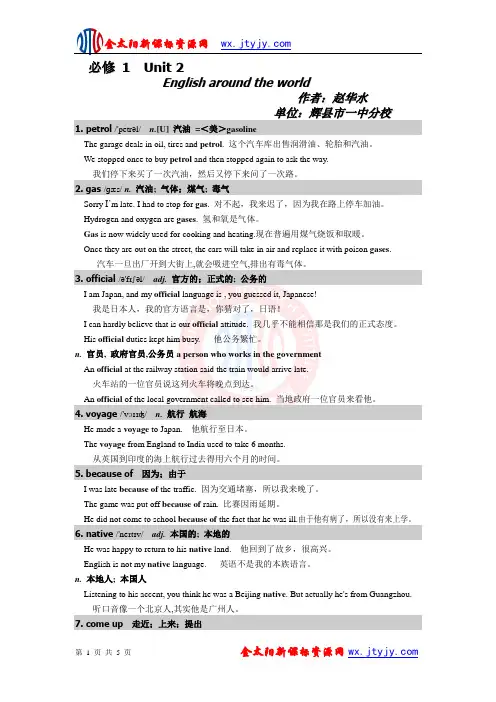
必修1U n i t2E n g l i s h a r o u n d t h e w o r l d作者:赵华水单位:辉县市一中分校1. petrol /'petrəl/ n.[U] 汽油=<美>gasolineThe garage deals in oil, tires and petrol. 这个汽车库出售润滑油、轮胎和汽油。
We stopped once to buy petrol and then stopped again to ask the way.我们停下来买了一次汽油,然后又停下来问了一次路。
2. gas /gæs/n.汽油; 气体;煤气; 毒气Sorry I’m late. I had to stop for gas. 对不起,我来迟了,因为我在路上停车加油。
Hydrogen and oxygen are gases. 氢和氧是气体。
Gas is now widely used for cooking and heating.现在普遍用煤气烧饭和取暖。
Once they are out on the street, the cars will take in air and replace it with poison gases.汽车一旦出厂开到大街上,就会吸进空气,排出有毒气体。
3. official/ə'fɪʃəl/ adj.官方的;正式的; 公务的I am Japan, and my official language is , you guessed it, Japanese!我是日本人,我的官方语言是,你猜对了,日语!I can hardly believe that is our official attitude. 我几乎不能相信那是我们的正式态度。
His official duties kept him busy. 他公务繁忙。
高中英语 Unit2 English around the world 教材导学 新人教版必修1

Unit 2 English around the world【单元导航】中国式英语欧洲人做过精细的统计,自1994年以来加入国际英语行列的词汇中,中式英语贡献了5%到20%,超过任何其他来源。
除“孔夫子(Confucious)”、“中国功夫(kung fu)”、“麻将(mahjong)”或者“豆腐(tofu)”之类绝无仅有的称谓,再挑拣几个真正有中国气质、代表华夏气派、并影响全球当代生活的“鸡蛋词”。
(一)丝绸——silk中国是养蚕大国,丝绸的故乡。
“silk”的发音,显然是汉语的音译,这个词代表了中国高超的工艺技术和贸易强势。
即便现在,丝绸仍在现代生活中充当雍容华丽、典雅高贵的象征。
(二)茶——tea这个词,又是英国人从拗口的闽南话里偷走的。
茶,和丝绸、瓷器比肩,堪称古代中国对外贸易的拳头产品。
目前,品茶代表了一种生活方式和文化品位。
18世纪的柴斯特顿勋爵在《训子家书》里写道:“尽管茶来自东方,它毕竟是绅士气味的;而可可则是个痞子、懦夫,一头粗野的猛兽。
”(三)世外桃源——Shangrila (Xanadu)这是两个近义词,都有“世外桃源”的意思。
“Shangrila”出自西藏的传说之地——香格里拉,“Xanadu”则是蒙古的元上都。
如果要表达“世外桃源”,通常采用“Xanadu”这个词。
(四)风水——Feng Shui风水,还是音译。
它凝聚了古代中国在活人住宅和死人墓地方面的集体智慧。
近年来,风水在美国红极一时,从中国人唇齿之间发出的音节,已经成为当代人急需探究的学问。
(五)走狗——running dogs中国式英语“running dogs”贴切地表达了一种见利忘义、供人驱使的“下三烂”。
最先运用这个词的是中国人,还是英国人,已无从考证;重要的是,英语世界接纳了“走狗”,并以汉语的思维抚育这个“外来词”。
接纳词汇的同时,无形中也接受了中国人的价值观。
(六)大款、巨亨——tycoon这种称呼是近些年才流行街巷的,指有钱、有势的商人或者企业家,中国传统的叫法是“大掌柜”。
教学设计15:Unit 2 English around the world
Unit 2 English around the world说课稿各位老师:大家好!我今天所说的课题是高中一年级英语上册第2单元English around the world。
我说课的内容包括五部分,包括教材分析,学生分析,教学方法,教学过程和板书设计。
一、教材分析1.教材内容分析今天我说课的内容是高一英语必修1第一单元English around the world.,本单元讨论的话题是“世界英语”介绍了英语在当今世界范围内人们生活中扮演的不同角色及其重要意义。
尤其介绍了英美语言的差异,让学生更进一步了解学好英语的必要性和其重要意义。
促使学生了解英美语言在词汇、拼写、语音等方面的区别。
使学生在认识到学好英语的重要性的同时,更加热爱自己的祖国,从而培养他们的祖国意识。
2、教学目标分析新课标提出了立体三维教学目标,本课我设计的教学目标如下:1)知识目标:熟悉本课的一些新单词,短语和句型。
语法方面掌握直接引语和间接引语的用法及其之间的转换,包括其中的请求与命令的用法。
2)能力目标:训练学生的阅读技巧(略读、寻读等),形成用英语获取信息、处理分析信息的能力。
并鼓励学生开口说英语。
3)情感态度目标:①通过学习激发学生对英语学习的浓厚兴趣;②使学生在领会语言丰富多彩性的同时更加热爱自己的祖国,从而培养他们的祖国意识。
培养他们的跨国文化意识和世界意识。
③通过对课文学习的小组讨论等形式,帮助学生养成团结、协作的品质。
3、教学重点、难点:1)教学重点:①让学生熟悉与本话题相关的一些重点单词、短语。
②提高学生的阅读能力,掌握多种阅读方法,如寻读,精读,理解等。
2)教学难点:对阅读中所获取的信息进行加工学习,形成有效的学习策略。
鼓励学生开口说英语。
二、学生分析高一年级的学生已经在初中阶段的英语学习中,已经积累了一定的词汇基础,并掌握了一些简单的学习策略和技巧,具有初步的英语听说读写能力。
但学生的英语水平参差不齐,教学既要进一步培养尖子的学习能力又要保证能力稍弱的学生能听懂,调动他们的积极性,使他们愿意学,在学习的过程中享受到乐趣。
人教版高中英语必修一 Unit2English around the world
人教版高中英语必修一Unit2English around theworld人教版高中英语必修一Unit2English around the world 的单词和词组练习一、基本词汇:n. :1) elevator 电梯2) gas气体;汽油;煤气;毒气3) apartment(美)公寓4) spelling拼写;拼法5) Singapore新加坡6) lorry(英)卡车7) lightning闪电8) cab出租车9) petrol(英)汽油10)voyage航行;航海11)vocabulary词汇;词汇量;词汇表12)identity本身;本体;身份13)Malaysia马来西亚;马来群岛14)accent口音;腔调;重音15)block街区;块;木块;石块adj. :1) latter较后的;后半的;(两者中)后者的2) African非洲的;非洲人的;非洲语言的3) southeastern东南方的4) Midwestern中西部;有中西部特征的5) eastern东部的;东方的6) northwestern西北方的n./v. :1)base以……为基础;基部;基地;基础2)mand命令;指令;掌握;命令;指挥;支配3)request请求;要求n./adj.:1)native本地人;本国人;本国的;本地的2)Danish丹麦语;丹麦的;丹麦人的;丹麦语的3)Spanish西班牙人;西班牙语;西班牙的;西班牙人的;西班牙语的adj/adv.1) straight直接;挺直;直的;笔直的;正直的二、重点词汇:1) use n&v. 用处;使用 usage n.用法;词语惯用法2) express v.表达 expression n.词语;表达;表情3) recognize v. 辨认出;承认 recognition n.认出;识别;承认4) actually adv. 实际上 actual adj.实际上的5) graadually adv. 逐渐地;逐步地 gradual adj.逐渐的;逐步的6) fulently adv. 流利地 fluency n.流利;流畅 fulent adj.流利的7) frequently adv. 常常;频繁地 frequent adj.频繁的;常见的8) office n. 办公室 official adj.官方的三、重点短语:1) because of… 由于;因为because of和 because的区别:beccause of(后接词组或单词)because (作连词,后跟句子)eg:He was late not only because of his illness but also because he missed the train.不仅因为他的病痛而且因为他误了火车他才迟到的。
Unit 2English around the world

Unit 2English around the world 课文教案设计一、课文理解主旨归纳1.Standard English is spoken ______.A. in BritainB. in the USC. in the cityD. in no place细节理解2.The British speak _____.A. excellent EnglishB. dialectsC. standard EnglishD. British English3._____ is called dialect.A. The language spoken in the midwestB. The language spoken in one areaC. Excellent EnglishD.Native language4.American English has so many dialects because _____.A. people have come from all over the worldB. the US is made up of so many statesC.Americans move from one place to anotherD. Geography plays a part in making dialects推理判断5.As many Americans move a lot, they _____.A. change their dialectB. take their dialect with themC. don’t speak their dialectD. don’t recognize each other’s dialects二、根据课文填空____ __ __ ___(信不信由你),there is no such thing ___standard English.Many people believe the English ____on TV and the redio is standard English.This is because in the early days of radio,those ____reported the news were expected to spead excellent English. _____,(然而)on TV and the radio you will hear _____(不同)in the way people speak.When people use words and _______ different from the “standard language”,it is called a _____.Geography also ___ __ ____ ____(起作用)making dialects. The USA is a large country __ ___many different dialects are spoken. Although many Americans move a lot ,they still _____ and understand ____ ____ (各自的)dialects.三、小组讨论话题:The Chinses language also has many dialects.Even in Shandong Province,there are also many dialects.In Zhucheng City …….Work in pairs and make a list of the ones you and your partner have heard.Y ou’d better give some examples.四、Read the dialogues of the task 3 on Page 13.Find the British and American words which are different but have the same meaning.1)AE______;BE______2)AE______;BE______3)AE______;BE______Can you give us more examples?五、阅读下列两篇短文,体会由于文化差异而造成的尴尬和误会。
人教高中英语 必修一 Unit-2-English-around-the-world(共51张PPT)
The seeds come up in spring. 长出来 A few new questions came up at the meeting. 被提出
come up with 意为“提出,
想出”。如:
He came up with a new suggestion.
come across v. 偶遇;无意中发现 come back v.回来;记起;恢复 原状,重新流行
用base的适当形式填空。
1. This book ________ is based on a true story.
2. Mary always ______ bases her ideas on
scientific experiments.
2) present
adj.
当前的, 现在的 (作前置定语)
vt. 赠与, 赠给予, 给, 提出
present sb. with sth.或 present sth. to sb.
把……交给, 颁发, 授予
e.g. Mother presented a gift to me just now.
On his birthday, his friends presented him
with a series of readers /presented a series
of readers to him. (送给他一套读本)
5. Then gradually between about AD 800 and 1150, English became less like German because those who ruled England spoke first Danish and later French. 【翻译】 然后,渐渐地,大约在公元 800年到1150年期间,英语不那么像德 语了,因为那时英国的统治者起初讲丹 麦语后来讲法语。
英语人教必修一Unit 2English around the world 教案
Unit 2 English around the world 教材分析第二单元的中心话题是“世界英语”,表面上从词汇使用、读音、拼写三个方面的不同,让英语学习者直观感受英式英语与美式英语的差异,而深层中则是激发高中生对于语言文化的历史起源、发展、变化及趋势等方面的学习与思考,强化英语学习的重要性和英语学习的必要性。
Warming up是一组代表英美词汇区别的对话,通过较为熟悉的一些英美常用词汇感知英语的种类,但同时不难发现,在英语的沟通过程中,哪种版本的英语形式都不会影响到用词达意的;Reading部分介绍了英语作为世界语言目前的使用状况及现代英语的发展历程。
阅读之前普及下学生目前的对于使用英语国家的地理范围感知,尤其是英语作为官方语言和重要第二外语的国家。
文章核心可以划分为三个部分:1.英语在年代和使用中的重要地位;2.举例说明英语的表达有差异,但是沟通是无障碍的;3.现在英语的历史变迁,包括几个重要性的人物、时代及相关事件;4.英语影响下的其它国家使用状况。
以时间线索带动语言发展上的探索和推动意义。
Learning about Language以一些英式英语和美式英语的通用词汇为主,另外包含一些英语的重要性及表达过程中所需的常用词汇(动词与副词),继续要求学生熟悉词性转换的运用模式和表达文章逻辑顺序的词组,例如:such as , because of , the former, the latter…;Using Language有一篇较短的文段就标准英语和方言问题发表了一些基本认知基础,让学生们继续在语言学习中追寻适合自己的学习方式,展现英语表达过程中对于语音学习的包容性,试图从更多的角度打开对于英语学习必修发音标准的不自信;Grammar还是直接引语变间接引语,并进行操练。
不同于上个单元,本单元侧重于根据直接引语的语气---要求和命令,将祈使句类型转化为间接引语,基本规则不变;Listening &Speaking &Writing 在输出部分重要探讨英语的重要性和掌握英语的学习方法上,让学生产生有逻辑顺序的表达及分类;在本单元的Learning Tip中提到找到英语学习的趣味点。
《Unit 2 English around the world》教学设计
《Unit2English around the world》教学设计
一、教学目标
1.了解英语在世界范围内的使用情况。
2.掌握不同英语变体的特点。
3.培养学生对英语学习的兴趣和跨文化意识。
二、教学重难点
1.重点:英语的全球分布和变体特点。
2.难点:理解不同英语变体之间的差异。
三、教学方法
多媒体教学法、对比分析法、讨论法。
四、教学过程
1.导入
播放不同国家的人说英语的视频片段,引出英语在世界范围内的使用话题。
2.知识讲解
(1)介绍英语在全球的分布情况。
(2)讲解不同英语变体,如英式英语、美式英语、澳式英语等的特点。
3.对比分析
(1)对比不同英语变体在发音、词汇、语法等方面的差异。
(2)通过例子让学生感受差异。
4.小组讨论
(1)讨论不同英语变体对交流的影响。
(2)分享自己对某种英语变体的喜好及原因。
5.文化拓展
(1)介绍英语国家的文化差异。
(2)培养跨文化意识。
6.课堂小结
总结英语在世界的地位和不同变体的特点。
7.作业布置
(1)收集不同英语变体的例子。
(2)写一篇短文介绍自己对英语变体的认识。
人教高中英语必修一unit-2-English-around-the-world-单词讲解
latest adj.最新的;最近的;最后的 lately(=recently) adv.最近;近来
选词填空(latter/later/late/lately/latest) ①Here are Tom and David; the _l_a_t_te_r__ is my
04 come up
come up①_上__来__,走__近_②__被__提_出____ ③__发_生__,__出__现___④__发__芽____
英译汉 (1)A foreigner came up to me and asked me the way to the railway station. 一个外国人走到我面前问我去火车站的路。 (2)The grass is just beginning to come up.
(1)vt. 以……为根据
base... on/upon 把……建立在……的基础上 be based on/upon 以……为基础/依据
(2)n.基部;基地;基础 at the base of 以……为基点;在……的底部
1.你不应该把自己的快乐建立在别人的痛苦之上。
You shouldn’t base your happiness on/upon the other’s sadness.
④The koala(考拉) is native ___to____Australia.
____考__拉__原___产__于__澳__大__利__亚__。________________________
请替换文字内容
点击添加相关标题文字,点击添加相关标题文字,点击添加相关标题 文字,点击添加相关标题文字,点击添加相关标题文字。
高中英语第一册上Unit 2 English around the world 知识要点
Unit 2 English around the world 知识要点1.majority n.大多数;大局部The majority of people seem to prefer watching games to playing games.大局部的人似乎都喜欢看比赛,而不喜欢参加比赛。
The majority were/was in favour of the plan.多数人赞成这个计划。
He was elected by a large majority/by a majority of 2 000.他以大多数〔超过对方2000票〕当选。
major adj.主要的,重要的;一流的major industries 重要产业a major problem 重大问题a major subject 主修科目The major part of the job is done by machinery.那工作的大局部由机器来完成。
n.主修科目;主修……的学生She chose physics as her major.她选择物理为主修科目。
He is an English major.他是英语系学生。
2.total adj.全部的,总计的;完全的,全然的。
total silence 完全沉默a total failure 彻底的失败者What is the total population of China?中国的人口总数是多少?n.总数;总额;全部Our expenses reached a total of £20.我们的支出总额达二十镑。
What does the total came to?总数多少?in total总计v.总数达;共计The visitors to the exhibition totaled 15 000.参观展览者总计一万五千人。
It totals up to £16.加起来有十六英镑。