
仁爱版英语七年级上册Unit3 Topic2 SectionC精品课件
1a- Read and understand. 1. Who is the boy in the photo? 2. Guess and circle his mom and dad.
Right. That’s his Who’s the young mother . woman in yellow?
Let’s study hard ! That’s the best gift for our parents. Don’t forget to say “I love you , mother / father.”
1. Recite the dialogue in 1a. 2. Finish exercise book Section C 3. Preview Section D.
1. Who are they? 2. What do they do? 3. Where do they work?
My Family Tree
grandfather (grandpa)
照 片
grandmother (grandma)
father (dad)
照 片 照 片
mother (mum)
1.The big boy has a brown toy. 2.The driver hears the bear eating a pear.
( 2 )
( 1 )
1. Family members: mother, father, parents, aunt, uncle, brother, daughter, son … 2. Useful expression: This is a photo of my family.
Father ou.
What is “family”?
Make sentences like these in pairs: grandfather Your father’s father is your __________.
grandmother Your mother’s mother is your __________. aunt Your mother’s sister is your ____. uncle Your mother’s brother is your _____. cousin Your uncle’s son/daughter is your ______.
grandparents
( father
mother )
( uncle
aunt
)
Kangkang (son)
( cousin )
2-Draw your own family tree. Then write a passage about it. The following questions may help you.
照
uncle aunt
片 照
son
daughter
片
3a- Read and complete the following words. Then read them aloud.
ow ear oy
dr tr
ow ure
dr
3b-Read aloud and match the sentences with the pictures.
grandparents, his cousin and A Photo of he. Kangkang’s Family
1b- Read 1a again and complete the passage.
family This is a photo of Kangkang's ________. The uncle young man in a green T-shirt is his _______. The young woman in yellow is his aunt _____. They have a daughter and she is in pink. She is cousin The young woman in red Kangkang’s_______. and the young man in black are his ________. parents The old man and the old woman are Kangkang’s grandparents . Kangkang has a big family. ____________
Is the young man in a green T-shirt Kangkang’s uncle?
Who are they on the sofa?
She’s Kangkang’s aunt.
Yes, he’s his uncle, his father’s brother. ’s Kangkang Is the young woman in red Kangkang’s mother?
2021年新版仁爱版七年级上册 Unit3 Topic2 Section C课件ppt
课件在线
22
father grandfather
课件在线
23
sister
mother
课件在线
24
IsWthheo’ysotuhneg myaonuningawomRainght. That’s gsihrneireytnelTlo-w? his mother .
WAWAC...hhBSTHoeaWhehritisenaesdhn'yfisotsaga’hAthtBBeahra.dueeeeyiAnnrno.odt’'ieus.sodsncsofagatBcopmdwtraeoosirolnc.eyrmt’.BnonBta.rBossnB.aw.dBengiT?noiedrhj?inarenhe'nysgidBs’d.u?.fmnraAecotlhttteeheeaearcrcdhihseoera?sr..ctDeABacher.
cousiAn aPnhdothoe.of Ka课件n在g线kang’s Family
25
grandparents ( father mother ) ( uncle aunt )
Kangkang (son) 课件在线
( cousin)
26
课件在线
27
This is a photo of Kangkang's __f_a_m_i_ly__.
学校公开课 教育教学样板
讲课人:教育者
年
班
课件在线
1
课件在线
2
What does he / she do? She/He is a (an) …
a cook
a student
【课件】Unit3Topic1SectionC课件仁爱版英语七年级上册
Language points
原文呈现: Many students in our class like English a lot, but I like it a little. 我们班许多学生非常喜欢英语,但是我只是有一点喜欢英语。
many /ˈmeni/在此是形容词,意为“许多的”,修饰可数名词的复数形式。 e. g. 例子 I have many books. 我有很多书。
very much=a lot 非常 not... at all 一点也不,根本不
A: Does Jane like Chinese? B: Yes, she likes it a lot. A: Does Sam like Chinese? B: No, he doesn't like it at all
What about you? =How about you? 那你呢?
No,he doesn’t.
Warm up
Where does she come from? She comes from Japan. Does she speak Chinese? No,she doesn’t.
1a Read and understand.
Jane, Sally and I are good friends. Guess and check(✔)the reason(s) before reading.
Warm up
Where does he come from? He comes from the USA/America.
Does he speak English? Yes,he does.
Warm up
Where is he from? He is from Canada. Does he speak Japanese?
Unit 2 Topic 3 Section C-七年级英语上册课件(仁爱版)
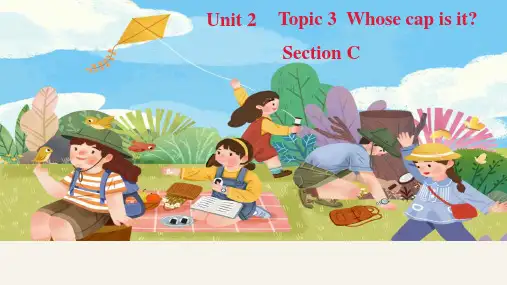
You can begin like this: I have two new classmates. They are Tom and Dick…
3
Work in groups. Mix your things together and find out the owners. You may use the following expressions.
1b Read 1a again and complete the table.
Person
Clothes Color
T-shirt Pants Shoes
Kangkang
red white blue
Kangkang’s classmate
purple
blue brown
Color the pictures.
Read, underline the children’s clothes and circle the colors.
I’m Kangkang. I have a new classmate. He is from Japan. He has black hair and black eyes. We look the same, but we are in different clothes. He is in a purple T-shirt and my T-shirt is red. His pants are blue and mine are white. My shoes are blue and his are brown. Guess! Who is he?
A: Is this/Are these ...? B: Yes. It’s/They are ... /
仁爱英语七年级上册unit3 topic2 教案

☆Teaching DesignUnit 3 Getting TogetherTopic 2 What does your mother do?Section AI. Teaching books Project English--- Unit3 Topic1 Section A.II. Teaching tools tape recorder, small blackboardIII. Teaching methodsTeaching as a whole, visual and situational method, and team cooperation.IV. Teaching aims and demands1. Learn words and sentence patterns about occupations.2. T alk about inviting and welcoming guests.3. Learn expressions about family members.V. Teaching ProceduresStep 1: Organization and review:1. Ask and answer, review Topic 1.1) Do you often speak English after class?2) Do you like English?3) Do you have a pet?4) Could you please tell me something about your pets?2. Creat a situation and lead to the new lesson.It's Kangkang's birthday today. He will invite some friends to his home. Would you like to go with me?3. T ask presentation.Step 2: Presentation:1. Check the preparation.1) My _____(父母) are both teachers.2) Tom's father is in the teachers' ______(办公室).3) I'm very g______ to see you here.4) The man is a d______ and the woman is a n______. Theyboth work(工作) in the hospital(医院).5) A f_____ works on a farm(农场).6) - _____ _____ _____, please.(请坐) - Thank you.7) - Tom is a nice k____. - Are you kidding? (你在开玩笑?)2. Listen to 1a and answer the following questions:1) Where are the kids?2) Who is talking with the kids?3. Listen to 1a again and follow. Imitating the pronunciation and intonation.4. Practice themselves. Make similar conversations in groups and act them out .5. Ask and answer. Lead to the new sentence pattern " What do/does ... do?" and the corresponding answers.What do I do? I am a teacher. What do you do?Write down the sentence pattern " What do/does ... do?" on the blackboard and explain its usage. Ask students to master it.Step 3: Consolidation and Practice1. Listen to 2a and answer the following questions:1) What does Kangkang's mother do?2) What do Michael's parents do?2. Follow the tape. Read 2a. And then fill in the blanks in 2b.3. Wok in groups. Make similar conversations and act them out.4. Look at the pictures in 3a. Try to make a conversation like the example in pairs. Some pairs have a show. Then listen to 3a and follow.5. Work in pairs. Let students use the example in 3b to practice conversations in pairs.Step 4: ProjectMake a survey. Complete the following table about the occupations of the group members' parents. Then let students pick a table and ask students of other groups to guess like this:A:They are ...'s parents. Guess! What do they do?B:Is his father a ... ? A:No, he isn't.B:What does he do? A:He is a ...Step5: Homework:1. Workbook, Section A.2. Review Section A and Preview Section B.VI. Teaching Introspection:Section BI. Teaching books Project English--- Unit3 Topic2 Section B.II. Teaching tools tape recorder, small blackboardIII. Teaching aims and demands1. Learn the sentence patterns about inquiring workplaces.2. Go on learning the expressions about occupations.IV. Teaching ProceduresStep 1: Organization and review:1. T ask presentation.2. Play a guessing game. Review the words and sentencepatterns about occupations in Sections A.Step 2: Presentation:1. Ask and answer according to the real situations. Master thenew word "work".I'm a teacher. What do you do? I work in a shool. Where do you study?2. Write down "Where do you study?" . Help them answer "Istudy in a school." and write down it, too.3. Read and master the new sentence patterns.4. Check the preparation. Match the occupations with the workplaces.A: farmer office worker student driverteacher doctor nurse cookB: hospital office school kitchen(厨房) farm bus Step 3: Consolidation and Practice1. Listen to 1a and answer the following questions:1) What does the man do?2) Where does he work?2. Listen to 1a again and follow it by imitating the pronunciation and intonation.3. Act 1a out in pairs.4. Read the example in 1b, then work in pairs to practice after the example. Choose several pairs to act it out according to the pictures.5. Listen to 3. Check the answer.6. Describe the four persons in the table using the information in 3. David works in Beijing. He is a doctor.7. Discuss in pairs and finish 2.8. Learn the word formation. Write down several pairs of words and let students find out the rules.work -- worker teach -- teacher drive -- driver ...9. Help students summarize the expressions about jobs and workplaces.10. Exercise:Lucy is a student. She studies _____ _____ _____. Her father is a doctor. He works _____ _____ ______. Her mother isa _______. She teaches in a high school. Lucy's grandfather(祖父) is a farmer. He works ____ _____ ____. What ____ Lucy's aunt ______? She is a nurse. She works with Lucy's father. Lucy has a uncle. He is an office worker. _____ does he work? He works in Beijing.Step 4: ProjectMake a survey. Let students survey the jobs and workplaces ofother students' parents. Finish the following table and make a report to the class.1. Workbook, Section B.2. Review Section B and Preview Section C.V. Teaching Introspection:Section CI. Teaching books Project English--- Unit3 Topic2 Section C. II. Teaching tools tape recorder, small blackboardIII. Teaching aims and demands1. Learn how to draw a family tree and describe it in English.2. Learn how to talk about family members.IV. Teaching ProceduresStep 1: Organization and review:1. Listen and learn to sing the chant in 3. Lead to family members.3. T ask presentation.Step 2: Presentation:1. Look at the photo in 1a and fill in the blanks in the following passage. Check the preparation.Look! This is a photo ____ Kangkang's _____. The youngman ____ a green T-shirt is his _____, his father's _______. The young woman in yellow is his ______. They have a _____. The young woman in red and the man in black are his ______.Kangkang, his ______ and his _______ are on the _____.Kangkang has a _____ family.2. According to the photo, ask and answer.1) Who is the young woman in yellow?2) Who is the little girl?3) Who are they on the sofa?4) Which one is Kangkang's mother?Step 3: Consolidation and Practice1. Listen to 1a and follow. Pay attention to the pronunciation and mark the intonation.2. Read and Check their pronunciation and intonation.3. Act 1a out in pairs.4. Finish 1b as quickly as they can. Then read it.5.Teach how to draw the family tree in English. Draw a family tree on the blackboard while talking to the students.6. Help Kangkang finish hi family tree according to the example written on the blackboard. Then make up dialogs in pairs after the example in 1c.7. Introduce Kangkang's family members to others in their groups according to the family tree.Step 4: ProjectDraw their own family trees, then write a passage to introduce their family members.Step5: Homework:1. Workbook, Section C.2. Review Section A, B and C. Preview Section D.V. Teaching Introspection:Section DI. Teaching books Project English--- Unit3 Topic2 Section D. II. Teaching tools tape recorder, small blackboardIII. Teaching aims and demands1. Learn the pronunciation rules of the consonants: /m/, /n/, / /, /l/.2. Enable students to read the short article about family, grasp the main idea, and write similar articles by themselves.3. Review how to inquire about others' occupations and workplaces, and how to respond to such inquiries.IV. Teaching ProceduresStep 1: Organization and review:1. Look at the family tree in 1c, Section C. Ask and answer to review the sentence patterns about family members, occupations and workplaces.T2. ask presentation.Step 2: Presentation:1. Listen to 2a and answer the following questions:1) How old is Peter?2) What does his mother do?3) Where does his father work?4) Is his little sister a student?5) Do his parents live with him?Step 3: Consolidation and Practice1. Practice in pairs. Finish the questions in 2b.2. Listen 2a again and follow, imitating the pronunciation and intonation.3. Mark the key words in 2a together, then retell the text according to them.4. Listen to 3 and mark True or False.5. Sum up the language points in this topic. Listen 4a and 4bafter the tape.6. Go over the consonants in the last topic. Write down somewords with the phonetic symbol /m/ on the blackboard, and write "m" with colored chalks. Let students read and conclude "m - /m/".Then teach /n/, / / and /l/ in the same way. Then Listen and read after the tape.Step 4: Project1. Give a passage about Tom's family. Let students draw a familytree for him.I have a friend, his name is Tom. He is 13 years old. He is tall.He is in a black coat and blue pants. He is a student in our school.Tom's father is 35 years old. He is strong. He is in a white T-shirt.He is an officer in Beijing. Tom's mother is beautiful. She is 35years old, too. She teaches English in our school. Their family isnot big, but they are happy.2. Finish the table in 5 according to the last passage. Then writea passage to introduce Tom's family members.Step5: Homework:1. Workbook, Section D.2. Review the whole section, prepare form the test.V. Teaching Introspection:。
Unit 2 Topic 2 Section C-七年级英语上册课件(仁爱版)
Summary
We learn:
cap coat T-shirt skirt dress shoes pants gloves
We can:
Describe one’s clothes.
Homework
基础性作业: 1.Read 1a and 2a aloud and try to repeat them. 2.Finish your text book. 拓展性作业: 3.Write a passage about My Friend.
What’s this? It’s a coat. What color is the coat? It’s purple.
What’s this? It’s a T-shirt. What color is the T-shirt? It’s red.
What’s this? It’s a dress. What color is the dress? It’s yellow.
5. will want woman white /w/
3a Write the words according to the sounds. /wait/ white /waid/ wide /leg/ leg /sʌn/ sun /blu:/ blue /glʌv/ glove
3b Read and pay attention to the rising tone and falling tone.
a white T-shirt and blue pants
3a Read the sounds and then write the words.
1. glove color
/ʌ/
2. blue shoe
仁爱版英语七年级上Unit3 Topic1 SectionCPPT课件
T: (1)Who is he/she? (2)Where does/ he/she come from? (3)Does he/she speak Chinese? (4)Can you help him/her with his/her Chinese?
S: …
16
Like this:
My pen pal is… He comes from… He lives in… He can speak …
4
Many students in our class like English a lot, but I like it a little. (1) a lot 意为“很,非常(表示程度)”,
相当于very much。 (2)如:Thanks a lot for your help. (2) a little意为“一点点”。 如:The book helps me a little with my English.
20
结束语
感谢聆听
不足之处请大家批评指导
Please Criticize And Guide The Shortcomings
讲师:XXXXXX
XX年XX月XX日
21
17
China shirt
sister fish
bird
o1r8ange
(录音2)
19
写在最后
经常不断地学习,你就什么都知道。你知道得越多,你就越有力量 Study Constantly, And You Will Know Everything. The More
You Know, The More Powerful You Will Be
Phone number:
Unit3Topic3SectionC课件2022-2023学年仁爱版英语七年级上册
4. Would you like some jiaozi? 4. e, f 5. Why not have some fish 5. e, f
and eggs? 6. What would you like to drink? 6. a
a. A glass of apple juice, please.
THANKS
①Why not/Why don’t you +V原...? 为什不……? ②How/What about+名词/动词ing …? ...怎么样? ③Would you like (to do) ... 你想要(做)...?
1. 如果你是餐馆服务员
(1) 客人来了,你说什么?
May I help you? 我能帮你吗?
b. Good idea. I like vegetables very much.
c. Rice and fish, please. d. I often have bread and
milk for breakfast. e. No, thanks. I'd like
some rice. f. Good idea.
(3) 让朋友随便吃elves to ... 请随便吃…
(一) 选一选
1. --Would you like to have dinner with me ?
--_______ .
A. Yes , please .
B. Yes, I'd love to.
What would you like to drink?
Task 1.Look at the pictures and guess the title of the passage.
仁爱英语七年级上册Unit3Topic2SectionB(共25张PPT)
her family
Kangkang.
Where do they work?
2.你妈妈的工作是什么? They work in a restaurant.
What ________Kangkang and Michael do?
—Where does he work?
What ( )3.
He’s well.
人称代词主格+be动词+职业
1. What do your parents do (do) ?
They are office workers (白领). 2. 我回来了。 I am home . 3.What does your mother do (do)? She is a teacher (老师). 4.很高兴见到你。 Glad to meet you .
Unit 3 Getting Together
Topic 2 What does your mother do?
Section B
Be what you wanna be
doctor actor lawyer or a singer
医生演员律师或歌唱家
why not president be a dreamer
does your mother
do
?
她是一个护士。She is a nurse . learn words more easily.
He drives a bus every day. ( )2.
3.你的妈妈在哪里工作? 你可以成为任何一个你想成为的人
works in hospital
doctor actor lawyer or a singer
⑷ My p_a_r_e_n_t_s___ are at home now.
仁爱版七年级英语上册Unit 3 Topic 3 Section C 课件
---No, thanks. I' d like some ___v_e_g_e_ta_b_l_e_s__(vegetable)
自学指导3
• 自学内容:课本1a中重要短语和句子 • 自学方法:先自己找出,再和同桌讨论其
用法 • 自学时间:3分钟 • 自学要求:能掌握并正确运用
自学检测3
短语汉译英
1.和某人一起吃饭 2.外出吃饭 3.想去做某事 4.喝的东西 5.16元 6.两个汉堡 7.给你
have dinner with sb eat out would like to do sth something to drink 16 yuan two hamburgers here you are
自学检测2
(视频 P75-1a)
1. The two men want to have dinner in a
restaurant.
(T )
2.The man in green doesn’t like fish or eggs. (F)
3.They want something to drink.
Why not +动词原形…? 为什么不……?
用来向对方提供建议。相当于Why don't you+动 词原形 如:Why not buy this coat?
Why not have some fish or eggs?
自学指导5
• 自学内容:课本72页4a • 自学方法:认真听,跟读,自读 • 自学时间:3分钟 • 自学要求:能认读4a中音标,并能掌握其
仁爱版英语七年级上册课件:Unit 4 Topic 2 Section C
I can’t. I'd love to, but I’m afraid I…… 3.How about=what about 用于征求对方 意见,后面出现的动词一定用—ing形 式.
4.I want to take some bread. take和 bring 都可以表示“带,拿”的意思。 他们后面都可以接名词、代词作宾语,也可 接双宾语。其区别在于:bring指从别处把某 人或某物带来、拿来。
2.Would you like to have a picnic with Mr. Cooper? Would you like to…? How about…? What about…? Why not…? 均是表示征求意见或 建议某人做某事的常用语.
Would you like ( love) to do sth. 询问对方 是否愿意做某事.
draw table
4b.Read aloud and match the sentences with the pictures. Then listen and repeat. 1.I saw the hare flying in the air. 2.The woman taught her able daughter to set the table.
Mr. Cooper is _a_n__o_ld__m_a_n__. He wants to _h_a_v_e__a_p_i_c_n_ic__ with his friends. His friends are very _n__ic_e_ and have a picnic with him. They take some h__a_m_b_u_r_g_e_r_s_,_b_a_n_a_n_a_s_ and _b_r_e_a_d_. They have a _h_a_p_p_y__picnic.