
高中译林牛津英语模块一Unit1教案
Module1 Unit1教学设计
关描述。
课时主备教案
课型Welcome & Word power
Learning objectives:
By the end of this period, students will be able to
1. enlarge their own vocabulary by knowing the exact names of all kinds of school facilities and activities;
2. improve their spoken skills by describing their favorite activities at school and showing others ways;
3. be aware of cultural differences by comparing school life in China and in Britain.
Focus of the lesson:
1. the names of school facilities
2. different expressions to ask and show ways
Predicted area of difficulties:
using locative prepositions and prepositional phrases properly
Learning aids:
1. PPT
2. blackboard
课型Reading(I)
Learning objectives:
By the end of this period, students will be able to
1. know more information about the school life in Britain;
2. learn to use two reading strategies: skimming and scanning;
3. form a reasonable attitude to different ways of education. Focus of the lesson:
1. skimming
2. scanning
Predicted area of difficulties:
When and how to use skimming and scanning?
Learning methods:
1. PPT
2. blackboard
课型Reading(II)
Learning objectives:
By the end of this period, students will be able to
1. write out the transformation and phrases of the key words correctly;
2. use the key words properly in relevant tasks;
3. use -ing form as subjects;
3. get a basic idea of attributive clause;
4. raise the awareness of learning new words or phrases in a context.
Focus of the lesson:
1. usage of the key words
2. v–ing form as subjects
Predicted area of difficulties:
1. the usage of the phrase ‘devote…to’ ‘attend’phrases about ‘look’ and so on
2. the proper usage of –ing form as subjects
Learning aids:
1. PPT
2. blackboard
Learning procedures:
课型Grammar & Usage
Learning objectives:
By the end of this period, students will be able to
1. understand the grammatical functions of attributive clauses;
2. use relative pronouns ‘that’ ‘which’ ‘who’ ‘whom’ ‘whose’;
3. enjoy the neatness and beauty of attributive clauses comparing them with simple sentences. Focus of the lesson:
the usage of relative pronouns
Predicted area of difficulties:
1. the usage of relative pronouns
Learning aids:
1. PPT
2. blackboard
课型Task
Learning objectives:
By the end of this lesson, students will be able to 1. understand the dates, time, places in a program;
2. know how to get the information by comparing;
3. report his or her decision to the whole class. write a notice. Focus of the lesson:
1. notes-taking by reading and listening
2. Writing a notice
Predicted learning difficulties:
1.the understanding of all numbers appearing as time, date or day
2. writing a notice
Learning aids:
1. PPT
2. tape and tape recorder
Learning procedures:
课型Project
Learning objectives:
By the end of this period, students will be able to
1. know what school clubs are like;
2. work out with group members how to start a school club;
3. learn the importance of teamwork.
Focus of the lesson:
1. getting to know what school clubs are like
2.how to start a club
Predicted learning difficulties:
1. the design of a school club
Learning aids:
1. multi-media courseware(PPT)
2. blackboard
Learning procedures:
11。
新教材牛津译林版高中英语必修第一册Unit1 Back to school 教学课件
3. Of equal importance are good study habits, useful skills and a positive attitude. 译文: _同__样__重__要__的__是良好的学习习惯、有用的技能和积极的态度。 4. As Lao-Tzu wisely said, “A journey of a thousand miles begins with a single step. ” 译文: _正__如__老__子__所__说__: “千里之行, 始于足下。”
Ⅱ. 必备短语: 英汉双译
1. 存在于, 在于
_li_e_i_n_
2. 能够处理
_r_is_e_t_o_
3. 起作用, 有影响
_m__a_k_e_a__d_if_f_er_e_n_c_e_
4. 充分利用, 尽情享受 _m_a_k_e__th__e_m__o_st__o_f
5. 利用 _t_a_k_e_a_d_v_a_n_t_a_g_e_o_f_
【名言名句】
1. Learning is a bitter root, but it bears sweet fruit. 学习根苦果甜。
2. I would like to live to study, and not study to live. —Bacon
我愿意为了学习而活着, 不愿意为了活着而学习。
【构词规律】
根据给出的构词规则写出下列单词
1. -ful 常用于名词之后构成形容词。
care n. → _ca_r_e_f_u_l
adj. 细心的
color n. →_c_o_lo_r_f_u_l
adj. 多彩的
2. -less 常用于名词之后构成形容词。
牛津高中英语牛津版译林版高一模块一Unit1教案
牛津英语译林版高一必修一Unit1 教案Unit 1 School lifeTeaching aims of the whole unit:1.Develop students abi’l ity of reading comprehension by reading an article about school life inthe UK and two other articles about school clubs.2.Develop students abi’lity of listening comprehension by listening to two talks about school activities.3.Develop students s’peaking ability by discussing daily school life and reporting school activities.4.Develop students writ’ing ability by writing a notice about school activities.5.Develop students inte’grated skills of using English by making a poster for a school club. 6.Enlarge students voca’bulary about school facilities.7 Help students understand what an attributive clause is and what relative words function as in attributive clauses; teach students how to use relative pronouns that, which, who, whom and whose.Period arrangement:The whole unit: 12 periodsWelcome to the unit: 1 periodReading: 2 periodsWord power: 1 periodGrammar and usage: 2 periodsTask: 2 periodsProject: 2 periodsSelf-assessment: 1 periodRevision and exercises: 1 periodPeriod 1 Welcome to the unitI. Teaching aims:1 Get students to know the different high school loves between the UK and China.2 Develop students ’English spe ak lil n s g. skiII. Teaching Procedures:Step 1. Warming upLet some students make a self-introduction.1. Introduce themselves.2. Say something about their junior high school life.3. Pair work: brain storm:When we are talking about our school life, what will we probably think of?What words or phrases will we use to describe our school life?Step 2 Presentation1. Say the following to students:It s’the beginni ng of the new term. You ’ve just finished your junior high and are about to enter a new period in your studies. I am happy to give your lessons and I hope we can be friends.I can see that some of your are eager to know what studying at senior high will be like. Will it be differ4ent from junior high? Well, there are certainly many differences between junior high and senior high, but there are also some things that are the same in every school in China.What about schools in other countries? Do you have different experiences? Are schools all overthe world the same? This is the subject of our first unit.2. Ask students to read the instruction and tell them:Here are three pictures that show some aspects of school life in the UK. Please read the instructions, look at the pictures: what's the difference between schools in China and the UK?Step 3 Discussion1 Ask students the following questions to talk about the words in the four pictures:Huge campus and low-rise buildingsWhat does h uge mean?What does low-rise mean?What about campus and school buildings in China?(Schools in China usually have a large enough campus to make sure students have enough space to study and play. But most school buildings have at least 3 storeys.)Lockers for every studentDo you know what a locker is?(There are rows of lockers by the classrooms for students to put their bookd, exercise-books and other belongings.)What do you think about locker for students?Do you think that we should have such locker in our school? Why or Why not?Fewer students in each classHow many students are there in our class?Do you know the number of students in a class in the UK?At ease with our teacherWhat can we know from this picture?What does the word ease mean? What do you think the phrase at ease mean?Were you getting on well with the teacher when you were in junior high?What relationship do you want to have with your teachers in senior high?2 Ask students to work in groups to talk about the four pictures and the differences betweenschools in the UK and China. Then ask several students to report their discussion to the whole class.aspects In the UK In ChinaHuge campus and We can see huge campus Schools in China usually have a large enoughlow-rise buildings and low-rise buildings. campus to make sure students have enough space to It is the biggest difference study and play in.from schools in China But most school buildings are taller, at least threestoreys.Lockers for every There are rows of lockers Students bring what they need for lessons to school student by the classrooms for and then take it all back home after school. Most students to put their schools in china do not have equipment in thestationary, books, classroom.exercise-books and otherbelongings.Fewer students in There are fewer studentsThere are usually more students in high school, each class in a class, no more than perhaps 40 to 50 per class. Recently some schools30 per class. are beginning to limit the number of students ineach class.At ease with our Students have a close It is similar in china. Nowadays, lots of teachers and teacher relationship with their students have established a good relationship with teachers. They feel at easeeach other. They respect each other and work toand comfortable with gain a better understanding of each other.them.4. Ask students to discuss the three questions in pairs, and them ask some of them to report their answers to the questions to the whole class.What is your dream school life like?What kind of school activities do you enjoy?What do you think of your life here in the new school?Step 4 Summary and HomeworkToday we ’ve mainly talked about the differences between the high school lives in the UK and in China. After class you should:1) Recall all the new words and expressions that we learn in this lesson.2) Find more about any other differences between the high school lives in the UK and in China, either by surf the Internet or by reading some articles in newspapers or magazines.3) Preview the following part: reading (page 2 to page 4).。
译林牛津江苏省高一英语必修模块一Unit1上教案及练习 牛津英语 教案
译林牛津某某省高一英语必修模块一Unit1上教案及练习【教学内容与教学要求】教学内容:牛津高中英语模块一Unit 1 (上)二、教学要求:1.掌握和校园生活有关的常用单词、词组与句型。
2.学会描述校园生活和学校设施。
High school is a time of discovery, learning and hard work!高中是探索、学习和辛勤劳动的时期Huge campus and low-rise building 学校面积大,没有高层建筑。
Twelve laboratories are available for different experiments.12个实验室可供不同试验使用。
Each room es with its own bothroom and Internet access.每个房间都有自己的卫生间和英特网接口。
3.学习阅读技巧:skimming&scanning。
4.语法:定语从句(一)【知识重点与学习难点】重要单词:access achieve attend assembly article available average canteen club challenging context donate display experience extra graduate gym heading locker low-rise literature poster relax二、重点词组:class teacher 班主任 at ease with 和….相处不拘束 school hours学校作息时间 earn respect from 赢得…的尊敬 sound like听起来象 for free 免费 get a general idea 了解大意 as well as 除….以外, 也 key words 关键词 word by word 逐字逐句地 find one’s way around 认识路 develop an interest in 培养对….的兴趣 surf the Internet 网上冲浪【难点讲解】 1. What is your dream school life like?你理想中的学校生活是什么样子?这里 dream 表示心目中最理想的. 如 dream team (梦之队)。
Unit1TheMassMediaReading教案高中英语牛津译林版(2020)选择性
牛津译林版(2020)选择性必修第二册Unit 1 The Mass MediaReading教材分析:本节课的主题是"The Mass Media",内容涵盖了新闻、电影、电视、广告等多方面的媒体形式,旨在帮助学生了解媒体行业的各个方面,提高他们的批判性思维能力和媒体素养。
教学目标:1. 帮助学生了解媒体行业的各种形式和运作方式。
2. 培养学生的批判性思维能力和媒体素养,能够分析和评价媒体信息。
3. 引导学生探讨媒体对社会和个人产生的影响,提高对媒体信息的辨别能力。
教学重点:1. 介绍媒体行业的各种形式和运作方式。
2. 培养学生的批判性思维能力和媒体素养。
教学难点:1. 如何帮助学生理解和掌握媒体行业的专业知识和术语。
2. 如何引导学生自主探究和思考,提高他们的媒体素养和批判性思维能力。
学情分析:1. 学生进入高二阶段,具备一定的英语基础和阅读能力。
2. 对于媒体行业的知识和术语,学生可能有一定的了解和认知。
3. 学生对于新事物和探究性学习有一定的兴趣和热情。
教学策略:1. 通过案例分析和讨论的方式,帮助学生了解媒体行业的各种形式和运作方式。
2. 通过小组合作和探究的方式,培养学生的批判性思维能力和媒体素养。
3. 通过课堂互动和提问的方式,引导学生探讨媒体对社会和个人产生的影响。
教学方法:1. 激活学生的前知:通过提问和讨论的方式,了解学生对媒体行业的认知情况。
2. 教学策略:采用案例分析、小组合作、探究学习等多种教学方法,提高学生的学习兴趣和能力。
3. 学生活动:组织学生进行小组讨论、角色扮演等活动,促进学生的参与和互动。
一、导入环节(约5分钟)1. 教学内容:引导学生了解媒体行业的背景知识,激发他们对媒体内容的兴趣。
2. 教学活动:* 使用图片和视频材料,向学生展示各种类型的媒体,如新闻报章、电视节目、社交媒体等。
* 引导学生讨论他们平时喜欢看的媒体内容,以及这些内容的特点和吸引力。
Unit1ExtendedreadingNewsthatMatters教案高中英语牛津译林版(202
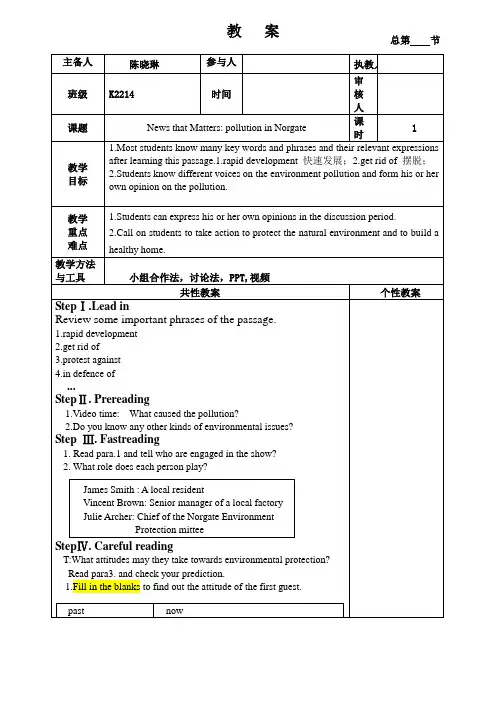
3. Role play and find out the attitude of the third guest.
Archer’s opinion:
We have to achieve a balance between environmental
StepⅦ.Summary
教案
T: Lucid waters and lush mountains are invaluable assets. 绿水青山就是金山银山
1.Review the phrases in the blanks. 2.Ask students to retell what they have learned.
Protection mittee
StepⅣ. Careful reading
T:What attitudes may they take towards environmental protection? Read para3. and check your prediction. 1.Fill in the blanks to find out the attitude of the first guest.
主备人 班级 课题
教学 目标
教案
总第 节
陈晓琳
参与人
执教人
审
K2214
时间
核
人
News that Matters: pollution in Norgate
课 时
1
1.Most students know many key words and phrases and their relevant expressions after learning this passage.1.rapid development 快速发展;2.get rid of 摆脱;
牛津译林版(2020)高中英语选择性必修第一册Unit1教案
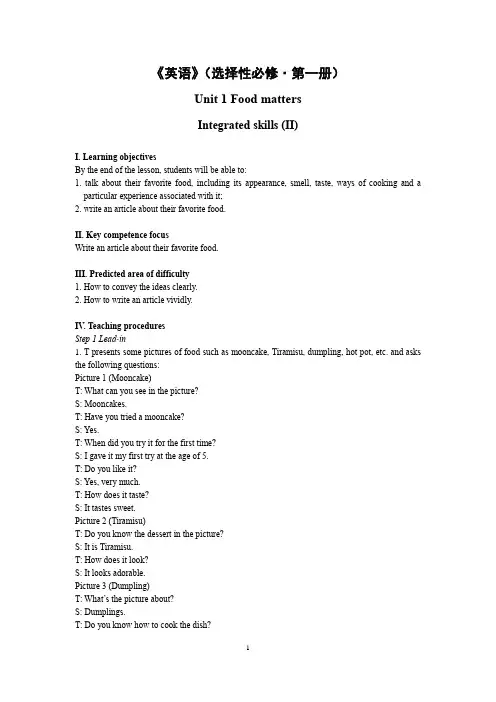
《英语》(选择性必修·第一册)Unit 1 Food mattersIntegrated skills (II)I. Learning objectivesBy the end of the lesson, students will be able to:1. talk about their favorite food, including its appearance, smell, taste, ways of cooking and a particular experience associated with it;2. write an article about their favorite food.II. Key competence focusWrite an article about their favorite food.III. Predicted area of difficulty1. How to convey the ideas clearly.2. How to write an article vividly.IV. Teaching proceduresStep 1 Lead-in1.T presents some pictures of food such as mooncake, Tiramisu, dumpling, hot pot, etc. and asks the following questions:Picture 1 (Mooncake)T: What can you see in the picture?S: Mooncakes.T: Have you tried a mooncake?S: Yes.T: When did you try it for the first time?S: I gave it my first try at the age of 5.T: Do you like it?S: Yes, very much.T: How does it taste?S: It tastes sweet.Picture 2 (Tiramisu)T: Do you know the dessert in the picture?S: It is Tiramisu.T: How does it look?S: It looks adorable.Picture 3 (Dumpling)T: What’s the picture about?S: Dumplings.T: Do you know how to cook the dish?S: It can be steamed, boiled or fried.Picture 4 (Hot pot)T: What’s it?S: It’s a hot pot.T: How do you think it feels in your mouth?S: I think it is spicy.2. T asks more questions as follows:T: What’s your favorite food? Why do you like it?(Ss may give various answers.)3. T shows a picture of salted duck and mentions her experience of tasting it for the first time.T: Salted duck is one of my personal favorites. I gave it my first try twenty years ago, together with my family members. My father went on a business trip to Nanjing and brought one back. Itlooked mouth-watering. Before my mother sliced it, brother and I couldn’t wait to have a try. The meat was juicy and salty, which really impressed all of us. How can I forget such a tasty dish?【设计意图:通过互动,引入主题,并为对话环节做铺垫。
牛津译林版英语必修一Unit1Welcometotheunit教案
牛津高中英语教学设计单元:Unit 1 School life板块:Welcome to the unitThoughts on the design:Welcome to the unit 这一板块的主要功能是激活学生与单元话题有关的已有知识,引导学生联系自己的亲身经历进行相关话题的讨论。
生动的画面为该模块的语言学习设置了生动的语言情景,能有效地引起学生对话题的兴趣,调动学生的学习积极性。
Teaching aims:1.to introduce and develop the theme of School Life;2.to get more specific information about Senior One students who have just stepped into a freshnew life;3.to enable students to get more chances of practicing listening and speaking skills;4.to guarantee effective communication among students.Teaching procedures:Step One——Oversea Conversation + Completing Timetables*Chinese student-“What you will be doing at 8 o'clock Saturday morning?*British student-“Sleeping like a log.” (*a sigh of surprise of Chinese Student)[设计说明]通过此对话凸显中西方学校生活差异,伴随而来的Timetable的比较进一步深入话题,从而引出对预设话题Dreaming of colorful school life的思考。
牛津译林版英语必修一Unit1Reading2教案
牛津高中英语教学设计单元:Unit1 School life板块:Reading (Language focus)教学设计指导思想:本课按照“点、线、面—单词、词组、句型”设计,课本主要词汇attend,drop,miss,experience通过幻灯片重点讲解, average, earn, challenging, extra, for free, used to 等以填空的形式呈现,相关短语教师口头陈述,学生举例运用。
最后学习动名词作主语并初步了解定语从句。
用所学词汇编故事。
Teaching aims:1.to learn the use of some important words and phrases;2.to get some idea about attributive clause and gerund as subject;3.to organize important words and phrases into paragraph.Step1 RevisionInterview: Suppose you have a chance to interview Wei Hua …Apart from the things you have been told, what other information would you like to know about her life and study in the UK.Ask her as many questions as possible.Step2 Language focusShowing some pictures (including attending class/school, attend a church, attend assembly, attend a wedding) to indicate “attend”.1. On the first day, all the students went to attend assembly.(1) vt.出席,参加(2) attend (on) sb. 照料某人,看护某人attend to sb.(3) attend to sth. 注意,专心干(某事)Exercises concerning “attend”.Distinguish the following four notions: “attend, join, join in, take part in”1) He _______ the army in the year of 2003.2) How many of you will ____________ the coming sports meeting?3) Who is going to ____________ the concert with me tomorrow?4) W on’t you ________ us ______ the tennis match?2. Students at that school have to study Math, English and Science, but can drop some subjects if they don’t like them. drop v. 放弃,落下,断绝(往来),减少,降低Try to tell the meaning of “drops”in the following sentences.1) It was so quiet that you could hear a pin drop.2) His voice dropped. / He dropped his voice to a whisper.3) Please drop me at the Post Office.4) It is wise of you to drop the habit of smoking. _______Drop n.滴;点; 下降;落下;下跌a drop of water 一滴水eye drops 眼药水teardrops 泪珠 a drop in the price of wheat小麦价格下跌e.g.1.The worldwide economic recession has led to ___________in people’s salary. (下降)2. I didn’t see any _________ on Liu Xiang’s face when he quit running in the Olympic GamesV ocabulary extensiondrop in / by顺便拜访drop sb. a line 写封短信drop in on sb. 造访某人drop in at a place造访某地1) The headmaster asked me to_________ him at his office. 校长让我去他办公室。
Module1Unit1复习学案(译林牛津版高一英语必修二教案教学设计)
Module1Unit1复习学案(译林牛津版高一英语必修二教案教学设计)Module 1 Unit 1 复习学案请同学们将本单元的单词背熟,并将学案及《同步练习与评价》上的短语、基础知识一一过关,然后我们来进行下面的练习。
一、单词过关1、_____________vt.出席,参加n.出席,到场,护理_______________2、_____________adj.具有挑战性的 vt.向…挑战 ________________3、_____________vt.经历,体验 n.经历,经验 ________________4、_____________vt.介绍 n. 介绍,导言 ______________5、_____________vt.培养,养成 n.发展,培养______________6、_____________vt.&vi.遗憾,抱歉;后悔,惋惜过去式和过去分词___________7、____________adj.让人恐慌 vt.使惊吓,害怕_______________8、_______________adv.立即,马上 conj.一…就…___________9、_______________n.大自然 adj.自然的,天生的 _____________10、_____________vt.获得;赚,挣得11、____________n.&vt.尊敬,敬重12、______________vt.赢得,取得;实现,成就n.成就______________13、______________n.学分;成绩;等级14、______________n.文学15、_____________adj.一般的,普通的;平均的16、、____________adj.额外的,外加的17、_____________vt.&vi.准备 n.准备__________________18、_____________vt.放弃过去式和过去分词___________19、_____________vt.思念,想念20、_____________adj.从前的,以前的反义词 ______________21、_____________n.文化 adj. 文化的 _______________22、_____________vt.捐赠;赠予 n. 捐赠物________________23、_____________vt.陈列,展览24、_____________ vt.&vi.批准,通过;赞成25、_____________集会n. 26、_____________ 甜点n.27、_____________最近adv. 28、_____________ 远足n. 29、___ 善举n. 30、 ___演说n.31、 ___ 朝代n. 32、 ___通知,告知v.二、短语过关(一)介词填空1._________free 免费2 .pay attention_____ 注意3 .inform sb _______sth 通知某人某事4. know_______ 了解5. ______the first day 在第一天6.earn respect________ 赢得尊敬7. _______lunchtime 在午饭时候8. ______the school field 在学校操场上9. ________average 平均10. according________ 根据11. be available ________ 可以用来做某事12 equip______ 装备13.____finishing one’s studies 一完成学业就14. develop an interest________ 培养兴趣15. refer ________ 指代参考提到16.relate__________ 与---相关17. _______short form 用简写形式18. be responsible _______ 对…负责19.consist _________ 由…组成e up_______ 想出21. give suggestions_________给予建议22. ______the end of the school year在学年结束时23. ______school assembly在校会上24. ________ the school entrance (to) 在学校入口处25.be late_____ my appointment ______sb约会晚点26.leave _______ 删除27. ________ this case 在这种情况下pare….______ 把……同……作比较29.show respect ______sb 尊敬某人30.sit next ______ sb 坐某人旁边31.be _____ ease ______our foreign teacher 和外教轻松相处32.be happy ______the school life = be pleased _______ the school life 对学校生活很满意33._________ other words 换句话说34.find my way _________找到出路35.sign _________ 签名36.give/make a speech _______ 作关于…的演讲37.word _______word 逐词地38. _________the year终年39.move to different classrooms ______ different classes去不同的教室上不同的课40.a bit challenging ________sb 对某人来说有点挑战性41.a library _______over 18,000 books 有18,000多藏书的图书馆42. _________ campus 在校园里43.read aloud = read sth _________ loud高声读出44.be confident _________sth 对…有信心45.base …_________…/ be based _______ … 以…为基础(二)动词填空1.自我介绍__________oneself to2.上网 ___________the internet3.参加集会___________assembly4.获得高分___________high grades5.作出决定___________a decision6.经营一个饭店 ________a restaurant7.创办一个书店 _________a bookstore8备课_________one’s lesson9.赞成这个想法 ________ofthe idea10.听彼此谈论诗歌 listen to each other ________about poems11.让大家围绕一棵古树坐着________ everyone around an old tree12.讨论你的日常校园生活 ________ your daily school life13.比较信息 __________ information13. 写一个通知 __________a notice14. 设计海报 __________ a poster15. 体验不同的生活方式 ___________ different ways of life16. 给你家人发电子邮件 __________your family17. 一直往前走 __________ straight on18. 住的离家很远 __________ far away from home19. 放弃某些科目 __________ some subjects20. 了解……的中心意思 __________ a general idea about / of sth.21. 用其他东西与某物搭配 __________sth. with sth. else22. 把某物捐献给某人 _________sth. to sb.23. 参考 _________to24. 删除 _________out25. 从……毕业 _________ from26. 有了做某事的兴趣 _________an interest in _______sth.27. 一完成学业(就……) upon _______ his studies28. 把……同……作比较________….with…29. 把某事通知某人 ________sb. of sth30. 每天花一个小时的时间在图书馆读英语书______an hour each day________ English books in the library31. 在树下放松 _________under a tree(三)重要短语及知识拓展(读读、背背)1.do sth out of the respect of our teacher 出于对老师的尊敬而做某事2.show respect for __________________3. achieve success/one’s goal ______________4.for freeo ______________5.drop out 中途退出6. miss doing sth 错过做..miss being punished by the teacher 逃过老师惩罚miss the chance to go abroad for further education 错过出国深造的机会miss talking with my mother 想念和妈妈的谈话7.run a company/school/hospital经营/管理________8.have much experience in ___________9.introduce sb to…(be introduced to)10.the former…the latter前者…后者11.have a gift for..在某一方面有天赋12.donate sth to sb/sp ______________13.give (sb) a speech ______________14.on display 在展出15.be pleased with 对…满意16.approve of… 批准…17.go outing ______________18.in nature ______________19.not a bit = not at all 一点儿也不 not a little = much 非常 a little bit 一点….20.set sb a good example 为某人树立好榜样take sth for example = take sth as an example 拿……来举例21. in a word 简而言之keep one’s word 守信break one’s word 违背诺言in one’s own words 用自己的话have words with sb 和某人吵架have a word with sb = have a few words with sb 与某人交谈22.would like to do sth = feel like doing sth 想要做某事would like to have done 本来想做的但没做23.meet/ one’s needs/demands/requirements = satisfy the needs/demands…. 满足需要24. compare sth with 把…和…相比较 compare sth to把…和…相比较,把…比作…make comparisons 作比较in comparison with 与…相比25.regret doing= regret having done 后悔做了某事/regret to do 抱歉要…26. inform sb of sth→be informed of sth; inform sb that +从句inform sb of the meeting 提醒他开会be informed of sth. 对…..了解well-informed消息灵通的27.under discussion 在讨论中/under construction 在建设中/under consideration 在考虑中28. be disappointed at the result 对结果失望to my disappointment 失望的是much to one’s disappointment =to my great disappointment29. at ease: 安逸,自在 with ease=easily uneasy: 心神不安的, 不自在的30 .be used to do sth:被用来做… be/get used to sth / doing sth:习惯于做…used to do sth: (过去)常常做… There used to be…(以前有…)31.pay attention to doing sth (to为介词) look forward to doing sth32. prepare lessons/supper(备课/烧饭)prepare for the coming examprepare sb for sthbe (well/poorly) prepared for sth: 为…作好了准备make preparations for sth=prepare for sthin preparation for…为...准备33.develop an interest in; develop a good habit (培养/养成)34. require sb to do sth→be required to do sth ___________________require that…(should) do sth _______________________require sth of sb _________________________We did all that was required of us.35.act in a play/film; act the part of Zhou Enlai ; act as:作为/充当36.give sb some advice(不可数)on…_____________ask (sb) for advice ______________take/follow one’s advicemake some suggestions(可数) ______________37.be present at a meeting/a party出席/参加the people present:在场的人三、重点知识点、句型整合(再次强调)1. do用来加强语气“的确/确实”, 有时态变化,其后接动词原形。
英语ⅰ译林牛津版unit1第一课时教案
英语ⅰ译林牛津版unit1第一课时教案Teachinggoals1.TargetlanguageImportantwordsandexpressions:low-rise,locker,atease2.AbilitygoalsEnablethestudentstocomparejuniorschoollifewithhighschoo llife.3.LearningabilitygoalsHelpthestudentslearnhowtocomparejuniorschoollifewithhig hschoollife.Teachingimportant&difficultpointsLearntocomparejuniorschoollifewithhighschoollife. TeachingmethodsDiscussion.TeachingaidsAcomputerandaprojector.TeachingproceduresStepⅠFreeTalkMakeaself-introductionandtalkaboutjuniorschoollifewitht hestudents.T:Hello,everyone.WelcometotheseniorhighEnglishclass.I'm ××.IhavebeenhereteachingEnglishsinceIgraduatedfrom××Universitymorethan10yearsago.Therefore,I'vemadealotoffriend s.NowI'mverygladtolearnEnglishtogetherwithyouthisyearandI'm surewe'llsoonbecomefriends,too.Nowyou'vejustfinishedyourjun iorschoollifeandareabouttoenteranewperiodinyourstudies.Doyo ufeelnervous?SI:Notatall.I'vemadesomepreparationsbeforeIcamehere.S2:Alittle.ThenewschoolisquitedifferentfromtheoneIwasin .S3:Yes,Idofeelnervous.Everythinghereisnewandstrangetome .S4:No.Idon'tfeelnervous.BecauseI'msureIcandomyschoolwor kbetterhere.T:Highschooltimeisveryimportantandoftenconsideredasgold entimeinourlife.However,someofyoumayfeeluncomfortablewhenfi rstcamehere.Whatdoyouthinkyoucandotoovercomethesedifficulti es?S5:Ithinkwecantrytorelaxourselvesbymakingasmanyfriendsa spossibleanddoingmoreactivities.S6:Therearereallysomedifferencesbetweenthelifeinjuniora ndhighschools.Weshouldadjustourselvestothenewenvironmentass oonaspossible.Ifwehavedifficulties,wecanaskforhelpfromclass matesandteachers.T:Well,whatarethedifferencesdoyouthinkbetweenthelifeinj uniorandhighschoolsare?Haveyoufoundsome?S7.YesFirsttherearemorestudentsherefromdifferentplaces. Inmyjuniorschool,studentswereallfromthesametown,andtherewer eonly30studentsinmyoldclass.T:Well,canyoutellussomethingaboutyourselfandyourschool?S7:I'mfromXMiddleSchoolMynameisS7.Thereisonlyathree-sto reybuildinginmyjuniorschool.Therewereabout500studentsthere. Andthestudents'dormitoryisnotbigenoughtoholdallthestudents. Asmyhomeisnotfarawayfromtheschool,Ihadtogobackhomeeveryday.T:Nowyouneedn'tgobackhomeeveryday.Butwouldyoumissyoupar ents?S7:Ofcourse.ButI'lltrytoovercomemyfeelings.T:Good.Anyotherdifferences?S8:Yes.We'llhavemoresubjectsinhighschoolandthickbooks.M aybetheyaremoredifficulttolearn.T:Don'tworry.Bothjuniorandhighschoolstudyareforagoodfou ndationofallsubjects.Aslongasyouworkhard,I'msureyoucanbebet ter.S9:Ifoundtherearemoreandhigherbuildingshere.Andmorebeau tifultoo.Inourschool,thereisonlyoneoldfive-storeybuilding.T:Whichschooldoyoucomefrom?Canyoutellussomethingaboutyourschoollifethere?S9:Icamefrom×middleschool.Itisasmallbutbeautifulschoolwithmountainsallar ound.Welivedattheschooldorms.Weusedtoclimbthemountainattheb ackoftheschoolafterclassandwereadandplayedthere.Weusedtopla ybasketballintheafternoonbuthadtogotoclassroomsforone-hours elf-study.T:Soundsinteresting.Anyway,anewschoolandnewstudentbodyi sagreatopportunitytolearnaboutpeople,placesandcultures.Iwis heveryoneherecanmakemanyfriendsandgetgreatsuccessinyourscho olworkintheseyears.StepⅡWelcometotheunitLookatthepicturesandtalkaboutdifferenthighschoollives.T:Well,boysandgirls,whenwespeakofschoollife,whichEnglis hwordscanyouthinkof?pleaselookatsomepicturesfirst.Ss:(joys;sorrows;dreams;discoveries;failures;tears;succ esses;challenges;excitement)T:We'vestudiedEnglishforthreeormoreyears.WhatistheUKsch oollifelike?HowdifferentisitfromthatinChina?Pleaselookatthe followingpictures.TheyshowsomepartsofhighschoolintheUK.What canyouseeinthepictures?Whatarethedifferencesbetweenschoolsi nChinaandintheUK.?T:Asweallknow,therearedifferencesbetweenschoollivesinju niorandhighschools.Sotheremustbedifferencesindifferentcultu res.Someofusmustbeeagertoknowwhattheschoollifeinothercountr iesarelike.Forexample,we'vestudiedEnglishforthreeormoreyear s,whatistheUKschoollifelike?HowdifferentisitfrominChina?You know,therearemanyfamousschoolsanduniversitiesintheUK.Today, we'llpickupthissubject.NowreadtheinstructionsinWelcometothe unitonpage1andfocusonthepicturesindividually.Askthestudents totalkaboutthepictures.T:Whatcanyouseeinthepictures?Whatarethedifferencesbetwe enschoolsinChinaandintheUK.S1:InPictureI-2,wecanseeverylow-risehousesandhugecampus .TheyareverydifferentfromthoseinChina.InChina,weusuallyhave largebuildingsandcampustomakesurestudentshaveenoughspacetos tudyinandplayin.S2:InPicture3-4,wecanseelockersforeachstudentoutsidethe classroom.InChina,weoftenhavesomelockersineverybedroom.S3:InPicture5-6,wecanseealargerclassroomwithfewerstuden tsinit.Thestudentssitintwolinesandfacetoface.Thestudentsare puttinguptheirhandseagerlytoanswertheteacher'squestions.InC hina,wealwayshaveafullclassroomwithstudentssittinginseveral linesfacingtheblackboardAndinmostcases,studentsarenotsoeagertoanswertheteachers'questions,especiallyhighmiddleschoolst udents.S4:InPicture7-8,twostudentsarediscussingsomethingwithth eirteacher.TheylookquiteateaseWiththeirteacherandlikefriend s.ItissimilarinChina,Nowadays,lotsofteachersandstudentshave establishedagoodrelationshipwitheachother.Theyrespecteachot herandtrytogainabetterunderstandingofeachother.T:Therearecertainlymanydifferencesbetweentheschoollives inChinaandintheUK,asweallcanseeclearlyfromthepictures.Doyou knowofanyotherdifferences?S5:Certainly.IheardthestudentsintheUKcanchoosewhatevers ubjecttheylike.S6:AndtheyarescoredA,B,C,DandEforeverysubjecttheychoose insteadof100points,150points,etc,suchasinChinaorotherAsianc ountries.T:Also,studentsintheUKhavedifferentschoolactivities.For example,theyorganizeschoolclubs,designpostersordovolunteerw ork.InChina,wealsohavemanyschoolactivities.Whatkindofschool activitiesdoyouenjoy?S7:Ienjoyplayingbasketballafterschool.S8:Ipreferdrawing.S9:Ilikeplayingchess.T:Withoutvarietiesofschoolactivities,schoollifewouldbeb oring.Mostofyoumusthavedrawnapictureofwhathighschoollifewou ldbelikeinyourmindbeforeyoucamehere.Nowwho'dliketoshareyour dreamschoollifewithus?S10:Mydreamschoollifeislikethis:therearemanyfriendlyand knowledgeableteachers;classmatesgetalongwellwitheachother;w estudy,play,singanddancetogether;wehaveparties,etc.Allinall ,I'mhappywitheverythingandeveryonehere.S11:Mydreamschoollifewouldbelikethis:Instudy,Iwillworkh ardertomakegreatprogressineverysubject;Iwilltrytodomorespor tstomakemestronger;Iwillbeabletolearntoplaycomputergames,et c....T:Justaswhatthefourpicturesshow,differencesdoexistbetwe enhighschoolsinourcountryandintheUK.Thereareofcourse,manyma sonsforsuchphenomena.Whatdoyouthinkthereasonsare?S1:Ithinkit'smainlybecausewebelongtodifferentcultures.B othChinaandtheUKhavealonghistoryofcivilizationamongwhichdif ferentschoolsystemsdeveloped.Itisnowonderwehavedifferentsch oollives.S2:Iquiteagreewithyou.Chinahasdifferentculturalandeduca tionalbackgroundfromthatoftheUK,sotherewillbedifferences.S$:ChinaandtheUKhavedifferent,traditionsineducationands choolsystems.Ibelieveeachhasadvantagesanddisadvantages.StepⅢHomeworkT:Studentsindifferentcountrieslearndifferentlyandhavedi fferentschoollifeexperiences.Idohopeyou'llhaveagreatexperie ncehere.Afterclass,1.Trytomakeacarefulplanforyourhighschoolstudy.2.PreviewtheReading.。